Redeeming the Heart of Israel, Part 1

So when they had come together, they asked him, “Lord, will you at this time restore the kingdom to Israel?” He said to them, “It is not for you to know times or seasons that the Father has fixed by his own authority. But you will receive power when the Holy Spirit has come upon you, and you will be my witnesses in Jerusalem and in all Judea and Samaria, and to the end of the earth.”

Acts 1:6-8 (ESV)

At present, however, I am going to Jerusalem bringing aid to the saints. For Macedonia and Achaia have been pleased to make some contribution for the poor among the saints at Jerusalem. For they were pleased to do it, and indeed they owe it to them. For if the Gentiles have come to share in their spiritual blessings, they ought also to be of service to them in material blessings. When therefore I have completed this and have delivered to them what has been collected, I will leave for Spain by way of you. I know that when I come to you I will come in the fullness of the blessing of Christ.

Romans 15:25-29 (ESV)

It is believed by the sages that if all of Israel would observe a single Shabbat properly, the Messiah would immediately come, since obeying the Shabbat is equivalent to obeying the entire Torah. We could extend this idea to say that if all Jews were to perfectly observe all of the Torah mitzvot, the redemption of Israel would be at hand. Interestingly enough, the two portions of scripture I quoted above directly apply to this concept. Let me explain.

There is just so much I could say about the First Fruits of Zion Shavuot conference I attended a few days ago. In fact, over the next several days, I will blog almost exclusively on my different experiences at Beth Immanuel, however one particular presentation stands out. When I heard it on the evening of the last full day of the conference, I knew it would be the keystone to everything I took away from my trip and the centerpiece to everything I intend to write.

I’ll just tell you in advance that this is going to be challenging. Some people don’t like being challenged.

Boaz Michael, Founder and President of First Fruits of Zion (FFOZ) gave a presentation about, among other things, the redemption of Israel. But it’s not the sort of redemption that you are probably imagining. According to dictionary.reference.com, redemption, in a theological sense, can mean:

  1. deliverance from sin; salvation.
  2. atonement for guilt.

This falls in line with the traditional Christian understanding of the term “redemption” and often equates to “when I die, I’m going to heaven.” Being “saved” or “redeemed” is typically the single most important part of what happens to a Christian. Nothing else matters until you “confess Christ” and are “saved.” After that, you can live a life consistent with the teachings of Jesus knowing your eternal future in Heaven is secure.

But Jews think about meriting a place in the world to come quite a bit differently. The chief difference is that Jews aren’t really obsessed about being “saved” and “going to heaven.” While meriting a place in the world to come is certainly important, Religious Jews are far more concerned with obeying God in the here and now, and some even look for opportunities to perform a mitzvah that cannot often be accomplished. There is even a saying that the reward for a mitzvah is a mitzvah. This is actually a concept Christians should recognize:

For to everyone who has will more be given, and he will have an abundance. –Matthew 25:29 (ESV)
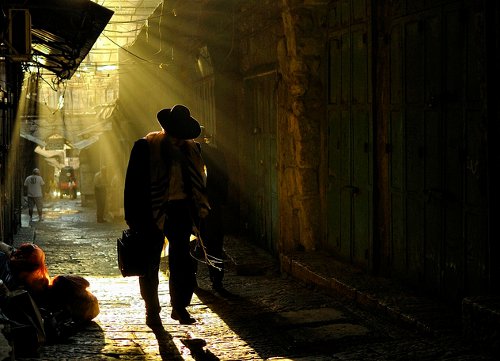
Jewish in JerusalemThis is the point of the “parable of the talents” as told by the Master. As in the wisdom from the Pirkei Avot (Ethics of Our Fathers), “the reward of a mitzvah is a mitzvah and the ‘reward’ of a sin is a sin,” we are “rewarded” for what we do, whether it is for the good or the bad. That reward can come either in this world or the next, according to Jewish thinking, but it’s directly tied to the sort of life a Jew lives right now. Jews have been commanded to obey all of the 613 commandments in the Torah but as you might imagine, being just as human as Christians or anyone else, they don’t do a perfect job. Unfortunately, God was very specific about the consequences to the Jewish people if, as a nation, they did not obey the commandments of Sinai.

The second Temple – when the Jews were involved in Torah, mitzvahs and acts of kindness – why was it destroyed? Because the Jews were guilty of harboring baseless hatred towards each other!”

-Rabbi Naftali Silberberg
-as quoted from askmoses.com

Most Christians believe that Herod’s Temple was destroyed in 70 CE and the Jews subsequently exiled from Israel because they did not accept Jesus as the Messiah. As you’ve just seen, this isn’t how Jews understand the cause for their exile and in fact, during the days of the Second Temple and when Jesus walked among his people, proper Jewish religious observance was rather high; much more so than in the days of the destruction of the First Temple.

However, the sin of baseless hatred of one Jew for another was very severe. Jesus especially pleaded with his people to repent of this sin.

“If your brother sins against you, go and tell him his fault, between you and him alone. If he listens to you, you have gained your brother. But if he does not listen, take one or two others along with you, that every charge may be established by the evidence of two or three witnesses. If he refuses to listen to them, tell it to the church. And if he refuses to listen even to the church, let him be to you as a Gentile and a tax collector. –Matthew 18:15-17 (ESV)

As recorded in Matthew 18:21-35, the Master illustrates how serious this sin is in the “parable of the unforgiving servant.” But sadly, tragically, Israel didn’t listen, resulting in dire consequences.

“O Jerusalem, Jerusalem, the city that kills the prophets and stones those who are sent to it! How often would I have gathered your children together as a hen gathers her brood under her wings, and you were not willing! See, your house is left to you desolate. For I tell you, you will not see me again, until you say, ‘Blessed is he who comes in the name of the Lord.’” –Matthew 23:37-39 (ESV)

Simchat TorahIt’s not as if every single Jew in Israel was guilty of this sin, but Israel is judged by God as a nation, not a collection of individuals. If the nation is in sin, every Jew suffers whether they commmitted the offense or not. To this day, the Jewish people are in exile, not because they failed to recognize Jesus as the Messiah, but because they refused to listen and obey his teaching to turn away from the sin of baseless hatred toward their brothers and to instead seek peace.

This has nothing to do with whether or not Jews merit a place in the world to come. God didn’t take away Jewish “salvation” as a result of this sin, He took away the posession of the Land of Israel from the Nation of Israel, and scattered them across the face of the earth. Redemption, for Israel, isn’t being saved so they can go to Heaven, it’s the restoration of the Jews to their Land and the ascension of Israel above all the peoples of the earth.

It shall come to pass in the latter days
that the mountain of the house of the Lord
shall be established as the highest of the mountains,
and it shall be lifted up above the hills;
and peoples shall flow to it,
and many nations shall come, and say:
“Come, let us go up to the mountain of the Lord,
to the house of the God of Jacob,
that he may teach us his ways
and that we may walk in his paths.”
For out of Zion shall go forth the law,
and the word of the Lord from Jerusalem –Micah 4:1-2 (ESV)

Connect that back to Acts 1:6-8 and you’ll see that Israel, as a nation, awaits final redemption so it can be restored to the place at the head of the nations as God has always intended.

But what does that have to do with you and me? Even if we accept that this is true for the Jewish people, what sort of role would Christians have in Israel’s redemption?

I’ll give you the answer to that in Part 2.

Disconnect Reconnect Disconnect

Normally, I start out a “meditation” with some sort of meaningful or inspirational quote, usually from Chabad.org, but I’ve got other things on my mind. Most of you know that I recently attended the First Fruits of Zion 2012 Shavuot Conference, hosted by Beth Immanuel Sabbath Fellowship in Hudson, Wisconsin. After five wonderful, exhausting days, I’m back home in Idaho. I’m really tired, even after sleeping all night, but I need to start writing about all this.

Blogging is inherently lonely. I know it might not seem that way, since in theory, I’m talking to anyone who has Internet access, but the reality of blogging is that I’m sitting at a computer keyboard alone and writing to myself. Ultimately, when I post this online, it’s available to anyone and everyone, but from my point of view, it’s like being a man who is stranded on a small, desert island, writing a note, putting it in a bottle, and then throwing it into the ocean. The tide takes it out and I’ll probably never see it again or know what happens to it. Will the cork work loose and pop out, letting water in and sinking my bottle? Will just enough water get in and ruin the message so that even if someone finds the bottle, they’ll never be able to read the note inside? Or will the bottle just float and float, carried here and there by nameless, unknown currents, bobbing around the seas, lost to time and man forever and ever?

Who knows, but that’s how I feel. Even if someone responds to a blog post, they are far away and faceless, an identity I can communicate with but never really know. An almost anonymous cardboard cut out, but never a living, breathing flesh-and-blood human being.

Until now.

There’s a long story about everything that happened up to the point when I entered Beth Immanuel for the first time last Thursday afternoon, but I won’t tell that tale right now. Jeremiah, my ride from the motel to the conference on the first day, dropped me off and then was called away. I walked into the congregation building (which is a very beautiful and richly textured synagogue) and didn’t get two steps inside before someone said (I can’t remember the exact wording), “You’re Jim Pyles. I love your blog.” (Hi, Michele)

Needless to say, I was stunned.

I really didn’t expect to get any attention relative to this blog. I figured that I’d meet one or two people I know through Facebook but otherwise I’d be pretty much anonymous. That never happened.

Please don’t think I’m saying this to blow my own horn, but probably fifteen people or so came up to me during the conference, recognizing me on sight, and saying something complementary about my blog. Daniel Lancaster publicly introduced all of the staff of FFOZ the first evening of the conference, asking each person to stand up when their name was called. I didn’t think much of it until he called my name.

What?

It probably didn’t help that I agreed be a presenter at Tikkun Leil Shavuos Saturday night (Sunday morning at about 2, actually).

Why am I telling you all this? It’s what happens when someone finds the bottle, reads the message, and comes to rescue you with a boat. It’s what happens when you get on the boat and you realize that a lot of people read the message and because of that, they feel like they know you and they want to get to know you better. It’s when you feel disconnected and alone on a desert island and then the island fills up with people who all know your name and story and all of them want you to know them, too. They tell you their stories and somehow your story and their stories interact, weave, and blend into each other to create a different, larger story about people who come from radically different places and yet all have something in common. To use a “star trek-ism”, it’s infinite diversity coming together to form an infinite combination.

Disconnection becomes connection.

And then it’s over.

Anyone who’s been to a conference like this knows that you are put through a whirlwind of events, worship services, presentations, meals, discussions, and fellowship. Suddenly, you’re back in your motel room asleep and then the next thing you know, it’s another morning and you’re praying shacharit with the congregation again. What seems like a days long stream of activities compresses into a few minutes, and once they blur by, you’re on a plane in the middle of the night, fighting the urge to try to sleep in an extremely uncomfortable seat while wedged between two people, flying back home.

I actually started to feel this loneliness the evening of the first full day of the conference. Some “vision” of the end presented itself to me during one of the presentations and I felt compelled to write notes for this particular blog post. I can’t find the notes but I still feel the separation and disconnection. I suppose that’s to be expected. After one of these events when you make or re-make so many connections so quickly, you almost always feel a sense of profound loss when it’s over. I remember thinking at one point that I could happily settle down into the community at Beth Immanuel and spend the rest of my life in worship there.

Of course, that will never happen for more reasons than I have time to recount in this missive.

Since I didn’t have a car, Jeremiah Detwiler picked me up from the airport (thanks for all your help, Jeremiah), and during the first night, I met a fellow named Dave who was staying at the same motel, so he agreed to ferry me back and forth (thanks, Dave). Dave and I met in the motel lobby on Friday morning after breakfast and drove back to Beth Immanuel. We got there a little early and sat in the sanctuary. After a few minutes, I heard the faint sound of Hebrew prayers and followed it into the library (the library by the way, is to die for). In a small room above the library, a group of men had gathered together for shacharit before the public ceremonies began.

I remember standing directly under the room and being filled with…something, an emotion, just listening to the prayers, and I found myself floating on the surface of the rhythm of the words, letting myself be carried off to sea. I’m terrible at languages and on my best day in life, I’ll never be able to learn Hebrew, but for some reason I can’t explain, Hebrew prayer just calls to me. However, it would have been too embarrassing to actually try to participate in the prayers with them, and since I’m not Jewish, I’ve promised myself I won’t put on a tallit again for that, and more reasons than I have time to recount here. But I couldn’t help myself when I followed the sound of the prayers from the sanctuary to the library and then I just stood in awe and wonder and longing, and I listened.

The prayers ended and I quickly returned to my seat in the sanctuary, but those precious moments when I was listening to the men praying are one of the highlights of my entire experience at the conference. I really do miss the prayers and while they resonate in some mysterious way with my soul, they also remind me that I can only be who I am and that there is a world I will always orbit but never truly arrive upon. My bird has no legs, so I must forever be suspended alone in flight.

And so I’m disconnected again, but it’s even worse than that.

It’s not simply that I’m restored to my previous state. If that’s all it was, I would eventually return to my “normal life” and that would be the end of it. After all, there’s always next year and I can attend the 2013 conference if I want to.

But it’s not just that.

I brought something back with me from the conference. Yes, I brought books back, and materials back, and memories back, but that’s not what changed things for me, not really. I also brought back questions about purpose, identity, and mission. I’m wondering about goals, and process, and destination. In the days ahead, I’m going to write about what I brought back, some of which is vast in scope and some that touches on just a few tiny details.

In many ways, blogging is futile. While I know now that I’ve touched a lot of people just by writing, I also realize that in a much grander scope, it doesn’t really matter. I can only touch people who choose to read this blog and even then, only those people who choose to be touched. And as a said before, there are severe limitations to the (dis)connections I can make in a virtual universe when, after all, both God and man exist and talk in the real one.

It’s like something really strange happened to the man rescued from the desert island and to all the people who welcomed him on their boat. Instead of going away from the island and letting himself go back to their land with them, the man ate with those people, and talked with those people, and shared experiences with those people for four or five days, and at the end of that time, he got off the boat and went back to the island. The people turned their boat around and went back where they came from. And again, they are isolated from him and he is isolated from them. From disconnection to connection to disconnection.

But he carried away their notes with him and he’s reading them. And he can’t just send out messages in a bottle anymore. And he doesn’t know what to do instead. So he reads. And he thinks. And he prays. And he waits.

And he still writes messages and sends them off upon the currents of the sea every morning as the sun rises because he doesn’t know what else to do.

Maybe one day, God will reach onto the surface of the deep and find one of those messages and read it.

And maybe one day, God will be the one to come to the island and talk to the man.

And then, He’ll tell the man how to leave the island without a boat, even if he has to walk.

And he’ll go to a place where he’ll find someone new to talk to.

I want to thank Dave, and Jeremiah, and Michele, and Karen, and Jim, and Mel, and Jacob, and Jacob, and Michael, and Bill, and Cliff, and lots and lots and lots of other people for talking to me and spending time with me and sharing your lives with me. If I didn’t mention your name, it’s because my memory leaks and sometimes certain details go away. It’s nothing personal, my brain is just getting older.

I also want to thank the leaders and congregation at Beth Immanuel Sabbath Fellowship for hosting the conference and for allowing me to participate in your community. I also want to thank everyone at First Fruits of Zion for creating and producing an absolutely amazing conference that not only informed but illuminated human beings. I now have a lot of new mysteries to experience and anguish over (but in a good way). I want to thank Aaron who I’ve never met before and Daniel who I have, as well as Toby, even though he thought I was a different person at first, and Shayna who kept the entire event under control. I want to thank Nick and Jordan who I never met before and who are two of the most amazing young people it has ever been my privilege to encounter, and Jacob who is an amazing young person who I have (virtually) encountered before.

Most of all, I want to thank Boaz Michael who I have met before but who I never got to know so well as I did over the past five days or so. It’s fairly common to encounter Boaz’s thoughts but I am blessed to have experienced his heart, and his passion, and his desire to please God and to serve not only the Jewish community, but the body of all believers in the Jewish Messiah, no matter who they are or where they may be found.

I’m sitting in a chair in front of a computer on a desert island on a Tuesday afternoon as I write this. I have no idea what’s going to happen next as I listen to the waves softly washing up to the sandy shore and hear the wind rustle the palm fronds above my head. But as I experience the loss of connection and settle back into my solitary niche, I proceed hopefully.

To Serve My Creator

“Everything was created to serve me,” states the Talmud, “and I was created to serve my Creator.”

-Talmud, Kiddushin 82a.

“I was created to serve my Creator.” With these words, the Talmud sums up the purpose of life. But there is also another version of this talmudic passage, which reads. “I was not created, but to serve my Creator.” A similar “double negative” is employed by our mishnah: “All that G-d created in His world, He did not create but for His glory.”

The difference is significant. The statement, “I was created to serve my Creator,” recognizes man as an existence in his own right (“I was created”), though one whose ultimate raison d’etre is defined by a reality greater than himself. The second version, however, attributes no legitimacy whatsoever to man as an entity distinct from his role: “I was not created, but to serve my Creator”–therein, and only therein, lies the fact of his being.

One of Torah’s basic rule is: “These and these are both the words of the Living G-d.” When the Torah mentions two opinions or interpretations it is because both are valid and relevant. Differing versions and manners of articulation of the same statement also complement one another, each providing another perspective to the concept they express.

The same applies to two descriptions of man’s identity and purpose: both are integral to our lives. There is an aspect to our mission in life that involves the total abnegation of self. But our service of the Creator also includes an element that allows for–indeed demands–the retaining of an individual identity, an “I” which serves as opposed to an egoless service.

from an Ethics of Our Fathers commentary
Sivan 2, 5772 * May 23, 2012
Chabad.org

Recently, I’ve been exploring the identity of “faithful man” based on Rabbi Joseph Soloveitchik’s book The Lonely Man of Faith. You may have read some of my musings in “meditations” like Burning the Plow and Behar-Behukotai: Seeking Crowns. But in all of the explorations of the purpose of man I’ve read that were written by people of faith, I continue to collide with one important fact: each of us as individuals is important to God.

On the one hand, I guess that doesn’t come as much of a shock, since we assume it all the time, particularly when we pray. But on the other hand, the significance of a single human soul seems so unimaginably small when compared to the infinite being of the eternal Creator. Even David remarked on it in this famous passage from one of his psalms:

O Lord, what is man that you regard him,
or the son of man that you think of him?
Man is like a breath;
his days are like a passing shadow. –Psalm 144:3-4 (ESV)

Interestingly enough, Shakespeare “answered” David’s query.

What a piece of work is a man, how noble in reason, how infinite in faculties, in form and moving how express and admirable, in action how like an angel, in apprehension how like a god!

-Hamlet Act 2, scene 2

But what Shakespeare quipped in irony, we might say with conviction. I’ve been tempted more than once to imagine that God created the Universe for the sake of humanity but not necessarily for individual people. Then, I’ve imagined that only certain people have been worthy of Creation and the rest of us just got a “free ride,” but is that selling God and His intentions short?

There’s no way to know for sure, except when we read David’s psalm, but then, was David only talking about himself, or was he describing even the most humble of God’s creations? All men, great and small alike, are equal in that our “days are like a passing shadow” and each of us is “like a breath.” No one is immune from loneliness, loss, sickness, pain, and finally, death. We take comfort in the hope of the life in the world to come, but we live here and now and frankly, even people of faith can feel scared and small. In fact, we may be uniquely suited to feel scared and small because we are, in some tiny sense, aware of the vastness of God. Secular man in his self-appointed position of supremacy over the earth, knows only himself as the largest and most dominant of beings and only in vague impressions may get glimpses of something bigger…but then that might only be “the environment” or whatever is out there in “the universe.”

All Israel has a share in the World to Come, as is stated: “And your people are all righteous; they shall inherit the land forever. They are the shoot of My planting, the work of My hands, in which I take pride.” -Sanhedrin, 11:1

“G-d makes the spiritual physical; the Jew makes the physical spiritual” -Rabbi Israel Baal Shem Tov

The Jew of faith, can take comfort in these words but what about the rest of us? What about the non-Jewish disciples of the Jewish Messiah? What about Christians? Actually, Christians tend to be a little arrogant in their…in our salvation. We believe only those who are exactly like us have “saved” and will “go to Heaven” but we deny Sanhedrin 11:1 (which is understandable for most Christians) as well as Paul’s own words:

And in this way all Israel will be saved, as it is written, “The Deliverer will come from Zion, he will banish ungodliness from Jacob”; –Romans 11:26 (ESV)

Somewhere between the crushing humility of insignificance in God’s incredible universe and the Babel-like pedestal some Christians put themselves on, is the reality of who we are as individual disciples of Christ, and what all that means. However, it’s not just individual Christians and Jews who are significant and important in the vision of God but, if we believe that “God so loved the world” (John 3:16), then God loves everyone. We were, after all, created in His image, each of us, as individuals, as single, tiny, frail, and frightened human beings. He loves us and cares for us, whether we acknowledge His existence or not.

And He loves us so much, all humanity, each and every person, that He made it possible for us all to be aware of Him, to know Him (to the best of our ability and comprehension), and to love Him.

And you were dead in the trespasses and sins in which you once walked, following the course of this world, following the prince of the power of the air, the spirit that is now at work in the sons of disobedience – among whom we all once lived in the passions of our flesh, carrying out the desires of the body and the mind, and were by nature children of wrath, like the rest of mankind. But God, being rich in mercy, because of the great love with which he loved us, even when we were dead in our trespasses, made us alive together with Christ— by grace you have been saved – and raised us up with him and seated us with him in the heavenly places in Christ Jesus, so that in the coming ages he might show the immeasurable riches of his grace in kindness toward us in Christ Jesus. For by grace you have been saved through faith. And this is not your own doing; it is the gift of God, not a result of works, so that no one may boast. For we are his workmanship, created in Christ Jesus for good works, which God prepared beforehand, that we should walk in them. –Ephesians 2:1-10 (ESV)

We were once “strangers to the covenants of promise, having no hope and without God in the world.” (Ephesians 2:12 ESV) but no longer. Not because we are just part of humanity but because each and every one of us as an individual person was crafted by God’s own hand. He made us lovingly, He cherished us, He caused us to be born, He’s helping us grow.

and I was created to serve my Creator…

Addendum: As most of you know, I recently attended the First Fruits of Zion (FFOZ) 2012 Shavuot Conference hosted by Beth Immanuel Shabbath Fellowship in Hudson, WI. It was fabulous but it will take quite a number of “meditations” to describe all of my experiences, including the wonderful people I met and the very interesting ideas, concepts, and teachings to which I was exposed. For those of you who attended with me and everyone else who want to know how things went, please be patient. I’ll be writing about all this shortly.

Shavuot: An Oasis in the Desert

Torah at SinaiOur retelling of the Exodus on Passover ends when we close the Haggadah text. But when did the story really end?

You might think that the story ended when the Jewish people left Egypt on the 15th day of the Jewish month of Nissan, 1313 BCE. On that day the Jews were freed from the land where they had been enslaved. But it was not so easy to leave slavery behind…

-Rochel Chein
“When Does the Passover Story End?”
Chabad.org

It may seem strange to talk about Passover in a blog post about Shavuot, but there’s a connection. The most obvious link between Passover and Shavuot is the Counting of the Omer which begins after the first full day of Passover and ends, 49 days later, on Shavuot. While this may not seem to mean a lot to most Christians, I’ve previously lamented about why Christians don’t count the Omer. It seems like the giving of the Torah at Sinai and the giving of the Spirit in Jerusalem are parallel events or on some mystical and cosmic level, even the same event. It seems it would make good sense for both Jews and Christians to be doing a countdown and for very similar reasons.

But is arriving at Shavuot and receiving the Torah the final end of Passover for the Jews? Rochel Chein’s commentary continues.

Now the Jews had the Torah, but they were still homeless and unable to fulfill many of its laws. G‑d used four expressions of redemption to promise Moses that He would redeem the Jews from Egypt. (We commemorate them by drinking four cups of wine at the Passover Seder.) But the four expressions were followed by a fifth promise (Exodus 6:8), “And I will bring you to the land…”

Similarly, G-d told Moses that, “I have descended to rescue them from the hand[s] of the Egyptians and to bring them up from that land to a good and spacious land, to a land flowing with milk and honey” (Exodus 3:8).

Surely it’s safe to say that the Exodus narrative ends when the Jews enter the Promised Land after 40 years in the desert?

I’ve previously written how each year we have numerous times of renewal if we observe the festivals on the Jewish calendar, when we can not only remember the great acts of God for the sake of Israel, but live them as if they were happening for the first time, becoming new souls again as the Torah and the Spirit fill our emptiness. But here we see that this never ending cycle is not just a series of annual events. Perhaps what we are experiencing is eternal.

But the first few centuries after the Jewish people entered Israel were tumultuous, and it was only when King Solomon ruled that there was true peace, and “Each man sat under his vine and his fig tree.”

Support for the idea that the Exodus concluded with the building of Solomon’s Temple can be found in the famous “Dayeinu” song in the Passover Hagaddah reader. The song reviews all the miracles that G‑d did for the Jews after they were saved from Egypt, concluding with the building of the Holy Temple.

But Solomon’s reign ended, and it was followed by eras of civil strife, the destruction of the first and second Holy Temples, and the dispersal of the Jewish nation in exile. We end the Seder with the prayer, “Next year in Jerusalem,” that we may speedily merit the final redemption and the building of the third Temple.

In a sense, saying “next year in Jerusalem” is a cry to God to send the Messiah. In a sense, each year we live on earth, even with the Torah and the Spirit to comfort and guide us, we are still wandering in the desert. Passover has never really ended. We are all still walking away from Egypt and toward the final redemption of the world one step at a time, one day at a time, one year at a time.

Shavuot is one of those steps that we take each year but as we see, it’s not the final step, nor is it the “end of Passover.” We have the Torah and we have the Spirit, but we are still here and it is still now and the Messiah has not yet returned. The world is unredeemed and there is a longing for God to restore the garden that was lost. When will God return the Messiah to us?

According to Mrs. Chein, Mitzrayim, the Hebrew name for Egypt, is similar to the word meitzarim, which means “boundaries” or “limitations.” We exist in a limited world and we are bound by a broken Creation and our flesh and blood frailty. Shavuot isn’t the end of the Passover or the Exodus wanderings, it’s just a milestone along the way. Yet it is a precious and wonderful milestone because it, and the Shabbat, are foretastes of the final Shabbat, the full redemption, the world to come.

It’s an oasis in the desert where we may rest for a time. At the conclusion of the festival, we rise up, and move on, following our pillar of fire by night and the cloud by day.

Bamidbar and Shavuot: Souls in the Desert

“Numbers” may be the name by which the fourth of the Five Books of Moses is commonly called, but in the Hebrew original it is known as Bamidbar, or “In the Wilderness.” It is interesting to note that this parsha is always read immediately before the festival of Shavuot, “the season of the giving of the Torah.” What is the connection?

The Sages teach that it is not enough for G-d to give us the Torah, we have to be ready to receive the Torah. What makes us worthy recipients of this most precious and infinite gift from G-d? This is where the “wilderness” idea comes in. A wilderness is a no-man’s land. It is ownerless and barren. Just as a desert is empty and desolate, so does a student of Torah need to know that he is but an “empty vessel.” Humility is a vital prerequisite if we are to successfully absorb divine wisdom.

-Rabbi Yossy Goldman
“Wisdom from the Wilderness”
Commentary on Torah Portion Bamidbar (Numbers)
Chabad.org

When the day of Pentecost (that is, Shavuot) arrived, they were all together in one place. And suddenly there came from heaven a sound like a mighty rushing wind, and it filled the entire house where they were sitting. And divided tongues as of fire appeared to them and rested on each one of them. And they were all filled with the Holy Spirit and began to speak in other tongues as the Spirit gave them utterance.

Now there were dwelling in Jerusalem Jews, devout men from every nation under heaven. And at this sound the multitude came together, and they were bewildered, because each one was hearing them speak in his own language. And they were amazed and astonished, saying, “Are not all these who are speaking Galileans? And how is it that we hear, each of us in his own native language?”

Acts 2:1-8 (ESV)

I’m not sure what I’m supposed to write about. On my “morning meditation” for Fridays, I usually create a commentary on the weekly Torah Portion, which this week is the beginning of Numbers. However, we are also on the cusp of Shavuot and the two cannot be neatly divided and separated. In my quote from Rabbi Goldman, he even asks about the connection between the two. Fortunately, he also gives us an answer.

However, for those of us who are disciples of the Jewish Messiah and devoted to Jesus Christ, there is an added dimension to offering the Torah to the wilderness within all our souls. There is the giving of the Spirit and God. This isn’t to say that Jews do not have access to the Spirit of God. Far from it. But in accepting the Messiah into our hearts and recognizing that it is Jesus who is Lord of life and firstborn from the dead, we enter into a covenant that not only preserves us in the present world, but one that will endure beyond the next and into all eternity, even as Heaven and Earth pass away (Matthew 5:18).

But we are still here and we exist in what we call “now,” which is approaching Shabbat and a day later, Shavuot. We look to the past, to Mount Sinai and the Torah and to that room in Jerusalem and the Apostles being filled with the Spirit, and we rejoice. But it’s not all about the past.

Unlike Passover or Sukkos, or even the minor Rabbinic holiday of Purim, Shavuos comes with no special observances, no unique Mitzvos to be performed on that day. The “only” thing that sets Shavuos apart is that it is the day when G-d gave the Torah, His most precious gift, to the Jewish people.

Each year, we don’t merely revisit or even relive that experience. Kabbalistic sources teach that the unique spiritual powers of each holiday return to this world every year on that same day. On Shavuos, we have a special power to take our portion in Torah, each and every year.

Every year, many of us skip out on this unique opportunity. We deny ourselves the closeness to G-d which is within our grasp. And there is a fascinating Medrash concerning the giving of the Torah, which hints that this isn’t an entirely new phenomenon.

-Rabbi Yaakov Menken
“Shavuos”
Torah.org

Rabbi Menken doesn’t say this explicitly, but the reason we study Torah, observe the festivals, and remember the holy acts in the lives of the Apostles is to not just relive them today, but to experience them as new, fresh, living events that are happening to us for the very first time. Many Christians speak of a need for renewal in the church and yet Judaism has built into its calendar multiple times of renewing each and every year. Jews and Christians are at such a time now. Before our awareness of God, we existed as a wilderness, empty and barren in our soul. This is especially tragic for Jews since they are members of the Covenant and a chosen people, even if they acknowledge God not at all. We who are Gentiles, if we are without God, we are as Paul described us; far off and without hope (Ephesians 2:12).

The Jews were joined with God at the foot of Sinai in the desert, where the Torah was given to them. We who were once far off were offered the opportunity to also draw close to God at the foot of the cross and in that room in Jerusalem, when we were washed by blood and filled with Spirit. We were made alive and spiritually aware of God through Christ.

Rabbi Goldman concludes his commentary on Numbers and Shavuot by saying:

May we receive the Torah with joy and earnestness so that this important festival will be both memorable and meaningful.

Paul says in Ephesians 12:22 (ESV):

And in him you too are being built together to become a dwelling in which God lives by his Spirit.

Open your minds, your hearts, and your spirits to God. Today we become new again.

A Happy Shavuos and Good Shabbos.

(Shavuot begins Saturday evening right when Shabbat ends, so my next “morning meditation” will be posted online Monday morning. Blessings).

Looking Through a Dark Window

The Alter Rebbe explained in the previous chapter that the light of the Shechinah, an illumination utterly transcending the realm of the world, must have a “garment” which enables it to radiate there. The “garment” of the Shechinah is Torah.

…As explained earlier, for this reason the Torah is able to act as a “garment” that does not become nullified in the light of the Shechinah which garbs itself in it — since its source is higher than the Shechinah. However, in order for Torah to act as a concealing “garment” it must descend lower than the level of the Shechinah, thereby enabling the light of the Shechinah to be received by created beings.

However, as Torah descended into the Ten Commandments engraved on the Tablets, it did not do so in a manner that would make it similar to other physical things. Rather, as will soon be explained, it remained on a level which is higher than the previously mentioned upper Worlds.

Today’s Tanya Lesson (Listen online)
Likutei Amarim, beginning of Chapter 53
By Rabbi Schneur Zalman of Liadi (1745-1812), founder of Chabad Chassidism
Elucidated by Rabbi Yosef Wineberg
Translated from Yiddish by Rabbi Levy Wineberg and Rabbi Sholom B. Wineberg
Edited by Uri Kaploun
Chabad.org

OK, so you’re not into Kabbalah or other mystic experiences and the Tanya as a source of information is completely lost to you. Hang in there, you can still learn something from today’s “meditation.” What is Rabbi Zalman saying? Here’s another point of view.

Torah is the interface between the Infinite and creation. On the outside, it speaks the language of humankind. On the inside, its depth is without end.

Grasp either end and you have nothing. Grasp both and you have G-d Himself.

-Rabbi Tzvi Freeman
“Interface”
Based on letters and talks of the Rebbe
Rabbi M. M. Schneerson
Chabad.org

I hope my quote from Rabbi Freeman’s interpretation of the Rebbe helped you because it did a lot for me. It’s saying what I’ve said before and what I’ve believed for quite some time. It’s saying that everything we use to try to connect to God is an interface and not a direct connection. Let me explain.

If you’re reading this, you’re using some sort of a computer. It could be a PC, laptop, tablet, smartphone, whatever. Most people relate to their computer they way they relate to their car. They don’t really know how it works, they just turn it on and expect it to work. But when you turn your computer on and use it, your aren’t really directly interacting with the computer hardware or software. You are using a graphical user interface (GUI) to execute commands that are passed on to the computer via the operating system. It’s more complicated than that, and you are actually working through several layers of abstraction every time you read an email, surf the web, create a document, or whatever other activities you perform to get things done on your device.

In the end, you get your work completed, but you haven’t really “touched” the raw “guts” of the computer. You’ve used an interface to work with the computer it make what you want to do happen on your terms. Using an interface means you don’t have to learn how to speak the computer’s “language.”

On various Christian blogs I sometimes see statements such as “let’s go directly to the Word rather than relying on human understanding” and “let the Holy Spirit interpret Scripture and not the knowledge of men.”

Huh?

How are you going to do that? Folks who say such things act as if they have direct and unfiltered access to the original, raw meaning and context of the Bible, as if they were standing right there while Matthew, John, Paul, and scores of others were putting pen to paper, listening to these men explain (in plain, 21st century English no less) what they were thinking and what they really meant as they created their books and letters.

We know we don’t have that kind of insight available to us. We realize that the Bible was written over a period of thousands of years by dozens of writers using variations of languages most of us don’t understand. We realize that the Bible was written within a foreign and ancient national, cultural, and ethnic context that is completely alien to us. And yet we behave as if all of that doesn’t matter.

I know what you’re thinking. You’re thinking something like this:

…these things God has revealed to us through the Spirit. For the Spirit searches everything, even the depths of God. For who knows a person’s thoughts except the spirit of that person, which is in him? So also no one comprehends the thoughts of God except the Spirit of God. Now we have received not the spirit of the world, but the Spirit who is from God, that we might understand the things freely given us by God. And we impart this in words not taught by human wisdom but taught by the Spirit, interpreting spiritual truths to those who are spiritual. –1 Corinthians 2:11-13 (ESV)

You’re thinking that the Holy Spirit, which you possess if you have accepted Jesus Christ as Lord and Savior over your life, will automatically interpret what the Bible is saying to you as you are reading it.

Well, maybe you’re not thinking exactly those thoughts, but that’s as close as I can come to understanding what we Christians expect to happen when we read the Bible and attempt to comprehend its content. We seem to believe that whatever we come up with by way of an interpretation must be from the Holy Spirit just by virtue of the fact that we’re Christians.

But what if the Holy Spirit doesn’t act like an automatic pilot and just routinely guide us to the correct conclusions every time we pick up a Bible and read a few verses? What if other stuff gets in the way?

Beloved, do not believe every spirit, but test the spirits to see whether they are from God, for many false prophets have gone out into the world. By this you know the Spirit of God: every spirit that confesses that Jesus Christ has come in the flesh is from God, and every spirit that does not confess Jesus is not from God. –1 John 4:1-3 (ESV)

Seems simple enough until you try to do it. If you come up with a particular interpretation of the Bible and you believe you arrived at your understanding through the Spirit, do you just call out, “Hey Spirit! Do you confess that Jesus has come in the flesh is from God?” The Spirit would have to say “yes” or “no” before you could determine the validity of your Bible interpretation. Does that happen to you very often?

How about this?

The brothers immediately sent Paul and Silas away by night to Berea, and when they arrived they went into the Jewish synagogue. Now these Jews were more noble than those in Thessalonica; they received the word with all eagerness, examining the Scriptures daily to see if these things were so. –Acts 17:10-11 (ESV)

Do not quench the Spirit. Do not despise prophecies, but test everything; hold fast what is good. –1 Thessalonians 5:19-21 (ESV)

Paul advocates for asking lots of questions. Don’t take anything at face value. Test even the spirits. Lots of false prophets are selling their wares out there, especially on the Internet.

But it also says to “not quench the Spirit” which I suppose means not to toss the baby out with the bathwater. Don’t be so skeptical that you close the door to spiritual learning and interpretation. Just don’t believe everything your hear or feel, either.

The Bible doesn’t put it into so many words, but I believe that one of the big factors inhibiting our understanding of the Word of God is our own emotional and intellectual wants, needs, and desires. Once we’ve made up our mind about something the Bible says, we believe that is that. The Spirit has spoken. This is how it is. But is what we believe about our interpretation the way it is as defined by God’s Spirit, or just the way we want things to be because it “feels right” to us?

I don’t have an absolute answer for you, but this is one of the great challenges and mysteries about understanding God and our purpose in life using supernatural means. We have to constantly pay attention to what we believe and why we believe it and not take anything for granted.

For now we see in a mirror dimly, but then face to face. Now I know in part; then I shall know fully, even as I have been fully known. –1 Corinthians 13:12 (ESV)

Even at his best, Paul says that we can only see “in a mirror dimly” but only later “face to face” the things of God. Once we become too sure about our own theology and our own doctrine and stop asking the tough questions we can’t always find answers to, we start having a problem. We start worshiping our own self-assured “image of God” as we’ve created Him in our hearts and minds, and not the unknowable, unfathomable, insurmountable, infinite, unique One God. We have to “grab” both ends of the Bible, so to speak; the spiritual end and the material end. We have to rely on the Spirit and we have to use our understanding and education. Even then, we aren’t absolutely sure of what we’re doing.

“It is the dull man who is always sure, and the sure man who is always dull.”

-H.L. Mencken, American journalist and essayist

The Bible, sermons, lessons, even prayer, are only interfaces; the “garments” God must put on to allow us to even dimly view His existence, as through a mirror darkly. Keep searching the darkness. Look for the light.

Notice! By the time you read this, I’ll have left home and be traveling to the First Fruits of Zion (FFOZ) 2012 Shavuot Conference in Hudson, WI. Part of what that means is I’ll have limited access to the Internet. I’ll still be posting “meditations” every morning except for Shabbat and Shavuot (Sunday) but I won’t be able to respond to comments and emails, at least not very effectively. I also probably won’t be able to post links to my meditations on Facebook, Google+ and twitter like I usually do. Please feel free to comment but realize I may be slow in getting back to you, which includes approving first-time comments. God be willing, I’ll be back home very late on Monday night. Thanks for your patience.