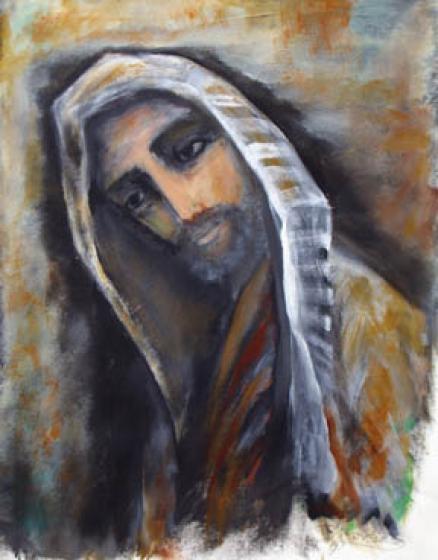
The Long Flight Home

There are two places to find the divine presence in all Her glory.

One: In the most holy of chambers, beyond the place of light and heavenly incense. There She is found by the most perfect of beings at the most sublime apexes of time.

The other: Beyond catacombs and convoluted mazes deep within the earth’s bowels. There She is found by those whose faces are charred with the ashes of failure, their hands bloody from scraping through dirt and stone, their garments torn from falling again and again and their hearts ripped by bitter tears.

There, in that subterranean darkness, they are blinded by the light of the hidden things of G-d, until that Presence will shine for all of us, forever.

So it is for the human spirit, and so it was in Solomon’s temple. There are two places for the Holy Ark: One in the chamber of the Holy of Holies; and one deep beneath that chamber, for us to find now.

-Rabbi Tzvi Freeman
“The Lost Ark”
Based on letters and talks of the Rebbe
Rabbi M. M. Schneerson
Chabad.org

We should expect holiness in the most holy of places, in the midst of the Heavenly Temple of God. But how can we expect to find holiness in the darkest and most dismal abyss under the earth or in the darkest heart of man? Of course, if holiness is present there, then the darkness can no longer be dark.

Or can it?

In Judaism and particularly through the philosophy of the Chabad, each of us contains a spark of the divine; of heaven come down to earth, which gives us our own unique identity and purpose. This spark is forever seeking its heavenly source, which is probably why, often against our human will, we find ourselves inexorably searching for God, so that our spark may return to Him.

I’ve recently been exploring the humanity of Jesus and have encountered some occasional resistance to my considering the “flesh” along with the spirit, but if God is One and we are, in some sense, part of God, even as Jesus was and is, then can we always separate the physical and the ethereal? Rabbi Freeman comments:

Yes, G-d is one. But, to share an analogy from the Maharal of Prague, from a simple point an infinite number of lines may be drawn through infinite dimensions.

So, too, with that divine spark within: On the one hand it is the same simple point within each one of us. Yet how that point expresses itself within you—another facet of the diamond, another ray of the light—that is unique. Both aspects, the point and its expression, are equally divine.

There’s no way to resolve this in some sort of mechanical sense or by use of a formula or diagram. This relationship within our human existence that connects to God exists, otherwise I would hardly be so obsessed with discussing it, yet I have no ability to explain the connection. The light is there in my inner darkness and it’s doing something, but I don’t know what it is, because I can’t clearly see it.

As I review my recent “meditations,” I find I’ve been writing about this a lot in one way or another. I have written of our human limits in exploring knowledge of God and how, though we are holy, can desecrate not only God, but ourselves.

Recently, I discovered that my original purpose and goal in creating this specific blog was completely in vain, and now I turn to God not knowing what to expect, and wondering if I should expect anything at all. I’ve even gone so far as to ask, in a completely Christian venue, if it’s possible for someone like me to find a church in which I, with all of my theological idiosyncrasies, could ever be at home (so far, it hasn’t worked out very well).

For many years, I called myself “Messianic,” but found that many Jews in the Messianic Jewish movement, to which I had once thought myself attached, objected to a non-Jew identifying himself as such. The Jews in Messianic Judaism saw me as a Christian, and my Jewish wife and children see me as Christian, in spite of my atypical beliefs. When I created this blog, I was determined to honor how they see me and to distance myself from anything that might cause them discomfort, and I agreed to call myself a Christian. I also felt that, if I wanted to reach a wider audience, which is part of the goal of this blog, I should attempt to reconnect with the larger body of Gentiles who call upon the name of Jesus.

So I’m a Christian.

But I wonder now if any of that matters. No, I’m not going back to calling myself “Messianic” or any variation on that theme. If indeed, it is a designation that is uniquely Jewish, I am content to leave it in that place and for those people who were called to the Creator and chosen at Sinai. But in leaving that behind, (if it was ever truly mine in the first place) I find, like fictional author George Webber (in Thomas Wolfe’s novel), you can’t go home again. I have no choice but to proceed forward into the dark unknown and seek a future to which I am blind.

And yet, if I dare the conceit of believing that the divine spark exists in me too, then the light must be there illuminating my darkness, though I can see nary a glimmer. If the spark exists, then does it conclude within me as Rabbi Freeman describes?

These two facets of the divine spark are expressed in every mitzvah: On the one hand, the act of the mitzvah is the same for each person–corresponding to the simple, essence-point of the soul. But the mental focus and passion you invest into the mitzvah, that is uniquely yours, expressing the unique mission of your soul.

Spiritual or “fleshly” (the latter being considered with disdain by many disciples of Christ) seem to be interchangeable in Jewish thought, like matter and energy in the realm of physics. In Judaism, you connect to the holy by performing “worldly” charity. I suppose it’s not as noble as prayer, laying tefillin (though this is a physical act), or singing the ancient Hebrew prayers, but it is something that is as accessible to me as to any of you reading this, or to any person who really can see only their holy light and nothing of their darkness.

Part of this blog, and my previous writing attempt, was to reinvent myself to be more consistent with how my understanding in God was being reinvented. Now I find that there is no rest for the “legless bird” and I must still continue to soar and search and continue to reinvent and reconfigure who I am and who I am in Him.

But to reverse causality, I’m going to ask the question that Rabbi Freeman already (supposedly) answered:

If the core of my being is a “spark of G-d,” then where is the me in me?

Is there a “me” in my or, as Rabbi Freeman also has said, there is only a “me” in the doing of mitzvot?

What is divine wisdom?
Divine wisdom is the inner delight of the Infinite, condensed and crystallized until fit for human consumption.

What is a mitzvah?
A mitzvah is divine wisdom condensed and crystallized until it can be performed as a physical action.

That is why in the study of Torah there is infinite delight.
That is why in the act of a mitzvah there is unlimited joy.

—Maamar Arbaah Rashei Shanim Heim, 5731

Somewhere in each of us, there is a spark of holiness. Somewhere in the holiness, is a lost human being, struggling in the glare and the abyss, trying to find his way, his face, and his name.

Somewhere in the sky, there is a bird, like the dove of Noah, soaring over an endless sea searching for a place to land and rest. Does the bird search in vain, as do I?

Love and Divorce, Part 1

Today’s daf discusses a case of one who is forbidden to divorce his wife.

Sh’lom bayis is a very complex area which requires much finesse and understanding. One must be very deft with a couple facing challenges in their marriage. Teaching each spouse to understand the other’s point of view and how to explain his or her own perspective without making judgments is essential when trying to establish good sh’lom bayis.

Although the Sichos HaRan, zt”l, writes that, in general, one should not divorce his wife unless compelled to by the halachah, there are certainly exceptions to this rule. Some people—even those with experience working with couples—believe that every rift in a marriage can be healed. According to that view, if a couple did not make their marriage work it must have been that one or both were unwilling to work hard enough to build their relationship. Although this is true in the vast majority of cases, there are times when the best option does seem to be divorce.

A certain ben Torah worked with a husband and wife who had many areas of conflict, and tried his best to heal their relationship. When his efforts turned out to be of no avail, he brought them to the Chofetz Chaim, zt”l, for assistance. After they had explained all of their many issues, the Chofetz Chaim suggested that they get a divorce. The astounded ben Torah could not contain himself. “How could it be that you won’t even try to make peace between them?”

The Chofetz Chaim explained. “If you are correct that in every situation divorce is avoidable, why did God give the parshah of voluntary divorce in the Torah? Clearly the Torah provided the halachos of gittin because sometimes the only way to bring peace to this couple is to allow them to divorce and go their separate ways!”

Daf Yomi Digest
Stories Off the Daf
“The Parshah of Gittin”
Temurah 5-1

The subject of divorce can be pretty touchy in the community of Christ. On the one hand, it is generally believed that there is no valid reason for divorce except for adultery. On the other hand, the available statistics seem to indicate that the rate of divorce in the church is no different than in the secular world, with about 50% of all marriages breaking up resulting in shattered hearts and devastated families. But before proceeding, let’s review the scripture you are all probably thinking about right now.

And Pharisees came up to him and tested him by asking, “Is it lawful to divorce one’s wife for any cause?” He answered, “Have you not read that he who created them from the beginning made them male and female, and said, ‘Therefore a man shall leave his father and his mother and hold fast to his wife, and the two shall become one flesh’? So they are no longer two but one flesh. What therefore God has joined together, let not man separate.” They said to him, “Why then did Moses command one to give a certificate of divorce and to send her away?” He said to them, “Because of your hardness of heart Moses allowed you to divorce your wives, but from the beginning it was not so. And I say to you: whoever divorces his wife, except for sexual immorality, and marries another, commits adultery.” –Matthew 19:3-9 (ESV)

This teaching of the Master is sometimes used to give Jews a hard time regarding divorce, but as we see from the daf, the desire to make peace among a feuding husband and wife is extremely strong in Judaism. In fact, our example showed us how the ben Torah working with the couple in dispute was shocked when the Chofetz Chaim actually recommended that the couple divorce as the only way to bring peace between them. Also, as I mentioned before, since the divorce rate in the church mirrors the secular divorce rate, we don’t have a lot of room to criticize Judaism, either in ancient or modern times, for allowing divorces.

But what’s wrong? As Christians, on our wedding day, we take a vow before God to love, honor, and cherish our spouse under all circumstances. It’s virtually the only vow the church maintains formally in the 21st century, especially given the Master’s teaching about not taking vows in Matthew 5:36-37. Why do we divorce so much?

I suppose I should say at this point that I am not literally including myself in “we” since my wife and I have been married for almost 30 years. My parents have been married for almost 60 years. I can’t speak for my parents, but I do know my own marriage hasn’t been without without it’s “rocks in the road” and I claim no special abilities on my part that resulted in my wife and I remaining united. I think marriage is always difficult at times and perhaps many “happily married” couples have considered divorce at one point or another. Troubles in the marriage are to be expected. It’s how you react that makes the difference.

But I’m not here to lecture and I’m certainly not here to hold myself up as some sort of example (if I tried that, my wife could easily chime in and lay out all of the details regarding my many faults). I’m here to talk about the humanity of marriage and divorce. Sometimes break ups are necessary…they just shouldn’t be so common.

Wives, submit to your own husbands, as to the Lord. For the husband is the head of the wife even as Christ is the head of the church, his body, and is himself its Savior. Now as the church submits to Christ, so also wives should submit in everything to their husbands. –Ephesians 5:22-24 (ESV)

I’m sure you’ve heard examples of how certain “primitive” Christian (so called) men have used this passage to justify making their wives jump through all sorts of hoops because God told her to “submit”. I’m no Bible expert and I don’t read the New Testament in Greek, but I’m still going to say, “Oh brother” to these fellows. Remember that the Bible also says this.

Husbands, love your wives, as Christ loved the church and gave himself up for her, that he might sanctify her, having cleansed her by the washing of water with the word, so that he might present the church to himself in splendor, without spot or wrinkle or any such thing, that she might be holy and without blemish. In the same way husbands should love their wives as their own bodies. He who loves his wife loves himself. For no one ever hated his own flesh, but nourishes and cherishes it, just as Christ does the church, because we are members of his body. –Ephesians 5:25-30(ESV)

Husbands, if you are supposed to be loving your wife like Christ loves the church, consider for a minute just what the love of Jesus Christ means. The number one way we know that Jesus loves us is because he voluntarily surrendered his life for the sake of our eternal relationship with God. Not only that, but it was completely unfair in that he did not deserve to die at all. Add to that the fact that it was a long, lingering, painful, and shameful death. If you Christian husbands love your wives in the same way, I suppose you should be putting up with a lot from her, even the stuff you don’t deserve. Remember, Christ died for us while we were still his “enemies” (Romans 5:8). He didn’t wait until we turned to him in love in order to die. If he had, we’d have no chance at redemption or salvation at all.

I could go on and on, but I want you guys to savor the example Christ gave to us as husbands (I’ve never been a wife, so I’m not going to try and speak from that perspective). The next time you get angry at your wife, feel annoyed because she makes some unreasonable request, or otherwise contemplate how much easier your existence would be if she weren’t around, think about Jesus and what he did for us. Imagine how much we sin, even after we have accepted Christ as Lord and Savior. Don’t you think he should have the right to be annoyed with us for our “unfaithfulness?” Yet he hasn’t abandoned us, though he probably should in some cases. Where do we get off abandoning our wives either physically or emotionally when the going gets tough?

So is it ever acceptable to get a divorce? I’ll express my opinions on that next time in Love and Divorce, Part 2.

“Education is the ability to listen to almost anything without losing your temper or your self-confidence.”

-Robert Frost, American poet

The Messiah’s Father

It’s striking, then, that the Gospels explain that Jesus was not from David’s house, nor a male descendent of any but God, as he was born of a virgin. I’ve already explained it is anathema to Judaism for the divine to be in any way mortal or otherwise individuated as a human man. But if we set this stricture aside and take the Gospels at face value, already it seems they have contradicted the prophecies.

Some Christians have explained that Mary was from the bloodline of King David, but the Gospels of Matthew and Luke both specifically trace Jesus’ genealogy to David through Joseph. Not only that, even if Mary was descended from David, Jewish law traces genealogy paternally. Jesus still would not qualify as the messiah, at leat by the standard set by the prophecies he was supposed to fulfill.

-Rabbi Shmuley Boteach
“Chapter 30: A Davidic Messiah?” (pg 173)
Kosher Jesus

I’ve already written my review of Rabbi Boteach’s book, but questions remain. This one is a doozy, at least for me. I’m sure some New Testament scholar can easily brush away the Rabbi’s objections to the lineage of Jesus, but I have no way of evaluating his words except at face value. My understanding of the genealogies of Jesus provided in the Gospels of Matthew and Luke, is that they establish that Jesus is a male heir of the throne of David, but Rabbi Boteach says the opposite. He states in his book that both of these genealogies actually prove that Jesus could not be a proper descendant of David and thus, he could not possibly fulfill the Messianic prophesies. It means that Jesus could not possibly be the Messiah; the Christ, as we have been taught in the Christian church.

That’s pretty disturbing, but as I said, I’m sure New Testament scholars can resolve this apparently iron-clad supposition that Rabbi Boteach offers…can’t they?

Before answering, let’s have a look at the offending passages, including Rabbi Boteach’s remarks about each one.

Boteach states (pg 174): Matters are further complicated by the fact that the genealogies in Matthew and Luke contradict one another. They even disagree regarding which branch of David’s descendants Jesus came from. Matthew says he was from Solomon’s line…

Throughout his book, Boteach quoted from the NIV Bible when referencing any New Testament text, but I’ll be using the ESV translation:

The book of the genealogy of Jesus Christ, the son of David, the son of Abraham.

Abraham was the father of Isaac, and Isaac the father of Jacob, and Jacob the father of Judah and his brothers, and Judah the father of Perez and Zerah by Tamar, and Perez the father of Hezron, and Hezron the father of Ram, and Ram the father of Amminadab, and Amminadab the father of Nahshon, and Nahshon the father of Salmon, and Salmon the father of Boaz by Rahab, and Boaz the father of Obed by Ruth, and Obed the father of Jesse, and Jesse the father of David the king.

And David was the father of Solomon by the wife of Uriah… –Matthew 1:1-6

Rabbi Boteach emphasized (as I did above) the fact that Jesus is, according to Matthew, descended from David through Solomon. Here’s more of the Rabbis’ comments:

Matthew concludes his genealogy by linking David and Solomon with Jesus: “And Jacob the father of Joseph, the husband of Mary, and Mary was the mother of Jesus who is called the Messiah.” (pg 174)

Now Boteach turns to Luke’s genealogy of Jesus:

Luke differs, claiming that Jesus was of Nathan’s line (pg 174):

Jesus, when he began his ministry, was about thirty years of age, being the son (as was supposed) of Joseph, the son of Heli, the son of Matthat, the son of Levi, the son of Melchi, the son of Jannai, the son of Joseph, the son of Mattathias, the son of Amos, the son of Nahum, the son of Esli, the son of Naggai, the son of Maath, the son of Mattathias, the son of Semein, the son of Josech, the son of Joda, the son of Joanan, the son of Rhesa, the son of Zerubbabel, the son of Shealtiel, the son of Neri, the son of Melchi, the son of Addi, the son of Cosam, the son of Elmadam, the son of Er, the son of Joshua, the son of Eliezer, the son of Jorim, the son of Matthat, the son of Levi, the son of Simeon, the son of Judah, the son of Joseph, the son of Jonam, the son of Eliakim, the son of Melea, the son of Menna, the son of Mattatha, the son of Nathan, the son of David… –Luke 3:23-31

I’ve added Boteach’s emphasis again, which he uses as proof that neither genealogy could be used to establish Jesus as the Messiah. He cites 1 Chronicles 22:9-10 to immediately dismiss Luke’s genealogy of Jesus, since it clearly states that the Messiah will be descended from David through Solomon (though for some odd reason, Boteach continues to use the NIV translation rather than the JPS or Stone Edition of the Tanakh). Luke clearly has Jesus being descended from David through Nathan, rather than Solomon, as is required according to Boteach, so that, as they say, is that.

Yet Boteach says that Matthew’s genealogy also disproves the “Messiahship” of Jesus because of verse 17:

So all the generations from Abraham to David were fourteen generations, and from David to the deportation to Babylon fourteen generations, and from the deportation to Babylon to the Christ fourteen generations.

To make this neat numerological passage fit so that there are “fourteen generations” between these three epic events, Boteach says that Matthew had to remove any mention of four kings that should be in the line between Solomon and Jesus, given how Matthew has structured his list: Ahaziah, Joash, Amaziah, and Jehoiakim. Once these four kings are added back into the genealogy, there’s a big problem.

Boteach continues (pg 176):

Elsewhere in the Bible it is made clear that Jeconiah is the son of Jehoiakim, as in Jeremiah here it is written, “…when he carried Jehoiachin son of Jehoiakim king of Judah into exile from Jerusalem to Babylon.” (Jeremiah 27:20 NIV) Sickened by the idolatrous and blasphemous misbehavior of Jeconiah, God curses him and all of his descendents. God specifically vows that “none of his offspring will prosper, none will sit on the throne of David or rule anymore in Judah.” (Jeremiah 22:30 NIV)

If Jesus was indeed descended from Jeconiah, he is included in the curse and forbidden from being the King Messiah as described in the Hebrew Bible. Both New Testament genealogies therefore disqualify Jesus from being the messiah: Luke because the messiah must come from Solomon, and Matthew because he must not come from Jeconiah.

This may be a common argument used by Jewish anti-missionaries and for all I know, these genealogical problems may have long since been laid to rest by Christian respondents, but I don’t know that for a fact. There’s a lot that I don’t know, which I suppose is what Rabbi Boteach is counting on in his Christian audience. On the other hand, for all I know, he may have just delivered a devastating blow to Christian claims of Jesus being the Messiah based on Matthew’s and Luke’s lists. If Boteach has, in fact, effectively proven that Jesus cannot be the Messiah as the church states, then he has unraveled the very fabric of Christian faith in Jesus as the Moshiach. Being the Messiah is inexorably tied to Jesus being the Son of the Most High God, Savior of the world, and the one upon whom all our hopes are laid. If Jesus is not the Messiah; the Christ, then he isn’t anything else the church counts on for the salvation of our souls.

Since I can’t answer Boteach’s challenge, perhaps you can. How can we look at the genealogies listed by both Matthew and Luke and say that they really do prove Jesus is the Messiah? The comments box is now open and ready.

To Desecrate What is Holy

Chasam Sofer also writes that it is obvious that one does not violate the prohibition against saying God’s Name in vain unless he pronounces the Name but writing God’s Name does not violate a prohibition. He adds that if one examines our Gemara carefully he will realize that the prohibition against cursing someone with the Name of God and the prohibition against taking a false oath with the Name of God are subsets of the prohibition of saying God’s Name in vain.

Daf Yomi Digest
Halacha Highlight
“Writing God’s Name in vain”
Temurah 4

What is the purpose?

The One Above desires to dwell in things below.

Meaning that a breath of G-dly life descends below and dresses itself in a body and human person, and this body and person negate and conceal the light of this G-dly soul…yet nevertheless, the soul purifies and elevates the body, the person and even her share of the world.

And what is the reason behind this purpose?

There is none.

It transcends reason; it is the place from which all reason is born.

And so it is unbounded and all-consuming. For it is a desire of the Essence.

-Rabbi Tzvi Freeman
“Entrance”
—from the Rebbe’s discussions of his father-in-law’s last discourse.
Chabad.org

The concepts of holiness and respect for God vary between Christian and Jewish thought. When I used to attend a church, I heard God referred to in the most casual and intimate manner, as if God were nothing more than a super-amplified grandfather. People, admittedly in need of comfort, described themselves as if they were sitting on God’s lap and cuddling up with Him. Even as a brand new Christian all those years ago, I found myself uncomfortable with the image.

Now I know why.

I’m sure some of you reading my quote from the daf on Temurah 4 probably think the Jewish people overdo this “respect” thing a little, and yet, if we could have stood at the foot of Mt. Sinai on that day when the thunder of His voice shook the ground, and if we could have seen the fire and the smoke, and trembled at the sound of the great shofar, would we still think of God as a “cuddly grandfather?”

I’m not saying we should not take comfort in God, but only that we should remember that He is not a man, not even a great man, and we cannot treat Him as such.

The comfort we can take is that, as Rabbi Freeman cites of the Rebbe’s discourse, the “One Above desires to dwell in things below.” From this, we who are Christians see God’s desire to dwell in things below” ultimately expressed here:

The word was made flesh and dwelled in our midst. We have beheld his glory, like the glory of a father’s only son, great in kindness and truth. –John 1:14 (DHE Gospels)

This is our greatest comfort, that in some mysterious and mystic way, an aspect of the One, has been able to dwell among men, as the Divine Presence dwelled within the Mishkan and among the Children of Israel. A tent is not God cannot contain God anymore than the body of a man is God can contain the infinite Essence, and yet in some inexplicable fashion, “we have beheld his glory.”

We also learn why the Jewish people revere the Torah, not merely as a scroll or a holy icon, but as the One, who again has dwelled “in things below.”

When God began to create heaven and earth – the earth being unformed and void, with darkness over the surface of the deep and a wind from God sweeping over the water –Genesis 1:1-2 (JPS Tanakh)

In the beginning was the word, and the word was with God, and the word was God. –John 1:1 (DHE Gospels)

But God’s holiness is not limited, and just as Judaism believes that each Jew is a receptacle for the Divine Presence and just as Christianity embraces the fact that all believers have received the Holy Spirit within us, so we understand together, the words of the Rebbe “that a breath of G-dly life descends below and dresses itself in a body and human person.”

That means each one of us is holy and sacred. This lesson is understood, in some manner, even among secular people, and even in the realm of fiction, where perhaps it’s easier for a worldly and progressive humanity to express such spiritual thoughts.

Lakanta: What do you think is sacred to us here?
Wesley Crusher: Maybe the necklace you’re wearing? The designs on the walls?
Lakanta: Everything is sacred to us – the buildings, the food, the sky, the dirt beneath your feet – and you. Whether you believe in your spirit or not, we believe in it. You are a sacred person here, Wesley.
Wesley Crusher: I think that’s the first time anyone’s used that particular word to describe me.
Lakanta: You must treat yourself with respect. To do otherwise is to desecrate something that is holy.
Wesley Crusher: Is that what you think I’ve been doing?
Lakanta: Only you can decide that.
Wesley Crusher: I guess I haven’t had a lot of respect for myself lately.

-from the Star Trek: The Next Generation episode
Journey’s End

Not only do I think it has become common among the people of faith to treat God all too casually and without respect, I think we also have gotten into the habit of treating each other and ourselves in the same way. And as we see from this important lesson from a rather unusual source, if we don’t treat each other and ourselves with respect, just as we don’t treat God with respect, how much more so do we desecrate something and someone that is holy?

Expectant

Rabbi Yisrael Reisman describes on a tape entitled “Great Expectations” his recollections of an incident that occurred when he was yet a young Yeshiva student. He had positioned himself in his dorm room so his bed would be adjacent to the sink for some strategic purpose. The sink, he soon discovered, had a constant drip which he promptly reported to the powers that be. Understanding that it was just a matter of a washer or some such nickel or dime item he assumed it would be taken care of pronto. The next few nights he lay awake tossing and turning to the dripping faucet becoming more upset, frustrated and resentful.

Finally after a couple of days, the janitor arrived. It was a loose washer. The whole thing took a few moments and cost next to nothing. The dripping was finally was over. That very evening there was huge rain storm and as he lay there in bed ready for a good night’s sleep he became aware of the dripping from the roof to the window sill below- the same constant drip- drip and it didn’t bother him a bit.

He wondered why one drip sound stirred him so and the other had zero effect. He concluded that the dripping sound was not what was actually annoying him. The proof is that the water from the rain didn’t wrinkle his psyche at all. What bothered him about the sink? The answer is that he assumed somebody would do something about it, it would be done right away, that his request would be fulfilled and honored swiftly etc. And it wasn’t…it wasn’t true!

I once heard from Rabbi Yitzchok Kirzner ztl two words that he called “the secret to happiness”. Admittedly, at the time I felt it sounded rather negative. Over many years, though, I have grown in appreciation for the wisdom of his insight. I share it often with my children and myself too. It’s a hard pill, “Expect Nothing!”

-Rabbi Label Lam
“Expect Nothing!”
Parashas Mishpatim
Torah.org

It is true that expectations can lead to unhappiness, especially if those expectations are unrealistic or simply mistaken. A few days ago, I commented on my own expectations in a blog post called Nothing’s Perfect. Over the past year or two, I set a series of actions into motion based, in part, on what I felt was the right thing to do and what I expected should happen as a result of those actions. What I did was rather dramatic in the sense that, after many years at one congregation, serving on the board of elders and doing some writing and teaching, I gave my resignation, not only from my formal leadership position, but from membership within the congregation.

This horrified just about everyone, including my wife (her response kind of surprised me), since I was generally well-regarded in the congregation and many in the community of faith felt that difficult things would happen to me if I had no fellowship among the body of believers.

Needless to say, I felt I had compelling reasons to make such a decision and still believe my reasoning was sound. I also had expectations about what was to happen next, maybe not in the immediate sense, but over a period of weeks and months.

Guess what?

My expectations did not pan out. Like young Yisrael Reisman enduring the dripping faucet, I had an expectation about what was supposed to happen after a while. He expected someone to come fairly quickly and to fix the leak. I expected a certain response from my spouse and from God. Both of us didn’t get what we wanted in the way or the time frame that we expected.

But Rabbi Lam’s story (actually, Rabbi Reisman’s) story missed something. Here’s a clue.

Understanding that it was just a matter of a washer or some such nickel or dime item he assumed it would be taken care of pronto.

Rabbi Reisman, as a young Yeshiva student, knew the problem with the faucet could probably be fixed by replacing a cheap washer. All he needed to do, if he was tired of waiting, was to purchase this inexpensive item and repair the faucet himself. Maybe he was concerned that he shouldn’t perform this task it was supposed to be done by the janitor, but it was within his abilities (apparently) to fix the drip if he really wanted to do so.

What about me?

Fulfilling my expectation isn’t that simple, but it isn’t that difficult either, at least in principle. It depends on how I choose to look at my situation. If I feel that I have the ability to fix my own “dripping faucet,” I can choose to seek fellowship within a community of faith. It would be a matter of generating the effort to seek one out (which might involve visiting a fair number of Christian communities) and begin attending. This isn’t without its problems, as I’ve already stated in another of my “meditations,” Why I Don’t Go to Church. Nevertheless, it’s not like I am without options.

On the other hand, I could choose to look at my situation as Rabbi Reisman did when the rain started falling and dripping noises came from the window sill of his room. I can decide that there is nothing to be done. The rain is the rain and it makes all sorts of sounds, some of which are quite soothing. I could simply follow Rabbi Reisman’s example, allow the situation to be what it is, and do nothing. Here though, Rabbi Reisman did not explain the whole story. It won’t rain forever. True, we never really know how long a rain storm will last, (barring a report from the weatherman) but we know it will end at some point. We also know that God knows when the rain will end.

When Rabbi Kirzner advises “expect nothing,” it is true that if you expect nothing, you will be disappointed by nothing that happens or doesn’t happen. On the other hand, it’s difficult for most people to plan out even a trip to the grocery store without some small set of expectations. If such is true for a small task like shopping, how much more so should we have expectations when we plan out our walk on a lifelong path of faith?

It is unreasonable expectations and inflexible expectations that often get us in trouble one way or another. We expect a raise so we can afford to go on vacation, and we don’t get it. We expect our spouse to cook dinner one night and she decides to go out to see a friend instead. The result of these inflexible expectations is usually feeling resentment toward the person who disappointed us. Rabbi Reisman felt resentful toward the janitor for taking so long to fix his faucet. There are people who are very resentful of God for also not meeting expectations.

But it’s not like we can’t expect to depend on God. If we could not rely on God for our daily food, our shelter, our livelihood, and our comfort in distress, we would truly feel lost in a chaotic and random world. Fortunately, such is not the case.

He is my God, my living Redeemer,
Rock of my pain in time of distress.
He is my banner, a refuge for me,
the portion in my cup on the day I call.
Into His hand I shall entrust my spirit
when I go to sleep — and I shall awaken!
With my spirit shall my body remain.
HASHEM is with me, I shall not fear.

-from Adon Olam

Adon Olam or “Master of the Universe” is a blessing sung in synagogues all over the world on every Shabbat. It is also the last blessing recited during the bedtime Shema by a Jew right before he retires. It is an expectation that when he goes to sleep and in some small sense, enters the realm of “death,” that he will awaken the next morning, with his spirit returned to him by God. It is true that some people go to sleep and do not awaken and ultimately, as mortal beings, that awaits us all. However, we rely on God and depend on Him to preserve us and to protect us. This is why, upon awakening, a Jew recites Modeh Ani.

I gratefully thank You,
living and existing King,
for returning my soul to me with compassion;
abundant is Your faithfulness.

While I have no idea what will actually happen after I go to sleep or what each day will bring when I first wake up, I expect that God will be there during my sleeping and waking. Near the end of his life, David composed a final Psalm in which he expects that the work he has left unfinished as King will be continued by his son Solomon. It could also be read as a prophesy of the Messiah’s coming and how he will finish the work of tikkun olam; repairing our broken world.

My his name endure forever, may his name connote mastery as long as the sun endures; and all the nations will bless themselves by him; they will praise him. Blessed is Hashem, God, the God of Israel, Who alone does wondrous things. Blessed is His glorious Name forever; and may all the earth be filled with His glory. Amen and Amen.

Psalm 72:17-19 (Stone Edition Tanakh)

I don’t know what is going to happen, today, tomorrow, or next week, but I do know that whatever happens, God will be present in my life. If I were to expect nothing, I would have no reason to be disappointed, but I would also have nothing to hope for, and without hope, what is life? The future is a great mystery to human beings but it is not an entirely dark unknown. I know that God is there, my rock and my redeemer and regardless of the direction my path of faith takes, around each bend, at the bottom of each ravine, and at the top of each height, I expect God.

Kosher Jesus, A Book Review

In my neighborhood, we did not even mention his name. We said “Yoshke,” a Hebrew play on his name, or some children learned to say “cheese and crust” in place of “Jesus Christ.” In a synagogue sermon, rabbis might refer to Jesus – exceedingly rarely – by saying “the founder of Christianity.”

Fundamentally, we understood Jesus as a foreign deity, a man worshipped by people. The Torah instructs us never to mention the names of other gods, as no other god exists except God. We also understood Jesus to be as anti-Jewish as his followers. Was he not the Jew who had rebelled against his people? Was he not the one who instructed his followers to hate the Jews as he did, instigating countless cruelties against those with whom God had established an everlasting covenant? Was he not also the man who had abrogated the Law and said that the Torah is now mostly abolished?

So begins Rabbi Shmuley Boteach’s narrative in the Preface to his latest (and perhaps most controversial) book Kosher Jesus. Rabbi Boteach paints for us, a typical picture of how an Orthodox Jewish boy growing up in an Orthodox Jewish neighborhood understands the Christian Jesus.

The picture isn’t very flattering to Christians.

You might be wondering why Rabbi Boteach would choose to write a book about Jesus. After all, most Jewish people are, at best, neutral about the existence of the itinerant Jewish rabbi who wandered the through the countryside and towns of Roman occupied Judea in the First Century of the Common Era. Why would an Orthodox Jewish rabbi draw attention to Jesus in anyway? If you’ve been reading the media stories about the sort of attention this book has been receiving, you already know it’s been less than complimentary, both from Christian sources and the Orthodox Jewish community. This book seems to please no one.

So why did Rabbi Boteach write it?

Kosher Jesus sets the stage for Jews and Christians to bridge their differences and come together for the first time through the personality of Jesus himself – the hero, martyr, and teacher that they both share.

This paragraph, taken from the cover flap of the book, provides an “in a nutshell” summary of Boteach’s reasons for creating this much-talked-about work, and it provides us with his goal: to create a connection between Judaism and Christianity across the back of the Jewish Jesus.

Was he successful in achieving his goal?

Not as far as I can tell today, at least on the surface. Of course, it may take months, or even years, to determine the larger impact on the Jewish and Christians communities. One immediate effect we can see is that just about every one with a vested interest in the “reputation” of Jesus is talking about this book. A number of Orthodox Rabbis have outright forbidden their communities to even read the Boteach book (and nothing makes a book more irresistible than when it has been censored) and I can only imagine what (if anything) Christian Pastors are telling their flocks about “Kosher Jesus” from the pulpit.

If Rabbi Boteach had the goal of drawing attention to his book and himself, he has certainly succeeded. He has been known as “the media Rabbi” and has attracted criticism more than once in the past for his statements and associations (particularly with the late Michael Jackson). If his goal was to start a great deal of dialog (polite and otherwise) around the subject of his book, the Jewish Jesus Christ, he has succeeded in this as well, at least in the short term. But is he going to be able to inspire Jewish and Christian audiences to find something in common by “sharing” Jesus?

As I’ve been reading this book, I’ve shared a few of my own insights in various blog posts. I focused on how the Christian community might see the book in my prior write up, Kosher Jesus: The Undivine Savior. In order to emphasize the “Jewishness” of Jesus and make him even somewhat attractive to other Jews, Boteach had to completely deconstruct traditional Christian theology about the “Lord and Savior,” transforming him from the Son of God and prophesied Messiah, to a man born of two Jewish parents, a carpenter turned Rabbi, who fancied himself a would-be Messiah (in Judaism, the Messiah is not expected to be supernatural and particularly not expected to be divine), and ultimately, a man who died as a noble but failed political dissident.

Not exactly the typical Christian view of Jesus.

Scholars who have reviewed this book (and I’m no scholar) have criticized Boteach for his heavy usage of material created by Hyam Maccoby regarding Jesus. In fact, Maccoby’s own views on Jesus have been characterized: Maccoby’s thesis as “perverse misreading” and concluded “Thus I must conclude that Maccoby’s book is not good history, not even history at all.” (Steven T. Katz The Holocaust in Historical Context: The holocaust and mass death before the modern age 1994 “Maccoby’s last work has been devastatingly reviewed, and quite properly so, by John Gager, “Maccoby’s The Mythmaker,” JQR 79.2-3 [October–January 1989], 248-250; to which Maccoby replied, “Paul and Circumcision: A Rejoinder,” JQR). So to use the vernacular, Boteach may have “shot himself in the foot” when he decided to base his depiction of Jesus almost completely on Maccoby’s work.

Since I can’t speak from a Jewish point of view, I must wonder from a Christian perspective, how Rabbi Boteach expects to unite Jews and Christians around their “commonality” in a Jesus Christ who is so unlike the Jesus most Christians find in church? Also, in answering the Christian question, “Why the Jews Cannot Accept Jesus” (Part IV of the book), Boteach creates a Jesus who absolutely must be rejected by Judaism as Messiah, and he describes any person or group who worships a man as if he is a god as idolatrous. Christianity’s insistence on a “three-in-one” God adds polytheism to the mix, and both idolatry and polytheism are anathema to the staunchly monotheistic Jewish people. Rabbi Boteach depicts a church that has to be hopelessly confused to believe Jesus is God, yet Boteach also says this:

I say this not to offend Christian believers, nor to dissuade adherents from living a Christian life. (pg 149)

But if, by definition, Christians are deluded by a terrible misunderstanding of the New Testament text, heavily biased editing of the original teachings of Jesus, and the traitorous actions of the Apostle Paul, to believe that a young Jewish rabbi and revolutionary is actually God incarnate, how can Rabbi Boteach not dissuade believers “from living a Christian life?” He’s just spent the first two-thirds of his book explaining why Christianity has everything completely wrong about who Jesus was, what he saw as his purpose in life, and especially the fact that he has no power to forgive sins and save souls. If anything, Boteach seems to have pounded home the final wedge that will forever separate Christians and Jews.

God is the one great truth. Judaism, Christianity, and Islam are paths that bring us to Him. One finds God through personal discovery usually directed by the faith in which one is reared, practiced by one’s ancestors. The merit of any religion is established not by a test of its theological claims but by the goodness of its followers. Therefore, any religion that leads to a good and Godly life has authenticity and truth, even if we cannot embrace all of its theological claims. (pp 149-50)

That probably seems like an insane statement to most Christians. We are taught that no one comes to the Father except through Jesus (John 14:6), so either you’re in or out. We are taught that the only way to God is to “Believe in the Lord Jesus, and you will be saved.” (Acts 16:31). There are no other options, according to traditional Christianity. There is only one doorway to salvation and it’s not through anything we can do. Our only participation in our own salvation is belief and faith in Jesus Christ.

But in Judaism, it isn’t what you believe, it’s what you do that matters. If, in the name of your religion, you feed the hungry, visit the sick, build an orphanage for homeless and abandoned children, or act as a peacemaker between a feuding husband and wife, then that is how you will be judged. You could be a Jew or a Christian or a Muslim and it’s all the same. That seems to be what Rabbi Boteach is saying, and that is the basis on which he expects his readers to build the bridge between Judaism and Christianity, using the Jesus we see in his book.

In real life, it doesn’t work out that way. Judaism, unlike Christianity, doesn’t believe there is a single path to God, but it does believe there are specific paths. If you’re a Jew, your path is the Torah, living a life of righteous acts, prayer, and ritual worship. If you are any other people group or religion, your path is in obedience to the Seven Noahide Laws. If you are compliant to these seven basic requirements, (these laws are deceptively simple, since they can be subdivided into almost a hundred “sub-laws”) you merit a place in the world to come and are considered by the Jews as a righteous Gentile.

But by definition, a typical Christian cannot be considered a righteous Gentile because, in believing Jesus is God, the believer violates the prohibition against Idolatry. There have been exceptions, such as those Christians who, during the Holocaust, made great efforts to protect the Jews from the Nazis and who rescued Jewish people from being sent to the death camps, but those exceptions are few and far between. It is also true that the Talmud has much to say about Jews maintaining good relations with everyone, including idol worshipers, for the ways of peace:

“They said of Rabbi Yochanan ben Zakai that no man ever greeted him first, even idol worshippers in the market” [i.e., Rabbi Yochanan ben Zakai was the first to greet every person, even idol worshippers] (Berachot 17). At the same location the sage Abaye advocated soft speech and words of peace to everyone, especially including idol worshippers.

“[it is proper to] support the idol worshippers during the sabbatical year… and to inquire after their welfare [commentators: even on the days of the holidays of their idols, even if they do not keep the seven Noahide commandments] because of the ways of peace.” (Shevi’it 4,3)

The rabbis taught: ‘We support poor Gentiles with the poor people of Israel, and we visit sick Gentiles as well as the sick of Israel and we bury the dead of the Gentiles as well as the dead of Israel, because of the ways of peace.” (Gitin 61a)

Nevertheless, the Tanya, an early work of Hasidic philosophy used heavily in Kabbalah, has less complementary things to say about all non-Jews:

The souls of the nations of the world, however, emanate from the other, unclean kelipot which contain no good whatever, as is written in Etz Chayim, Portal 49, ch. 3, that all the good that the nations do, is done out of selfish motives. So the Gemara comments on the verse, “The kindness of the nations is sin” — that all the charity and kindness done by the nations of the world is only for their self-glorification…

as quoted from
“Lessons in Tanya”
Chabad.org

I know I’m throwing a huge monkey wrench into the machine, but it’s important to define the barriers to Rabbi Boteach’s stated goals, both from the Christian and Jewish perspectives. All I’m saying is that nearly 2,000 years of strife between Christians and Jews will not be repaired for the sake of a single book which depicts the historical Jesus in a manner that most Christians and Jews will not be able to accept.

So what’s good about this book? More than you might think, given everything I’ve just written. Actually, I think Christians can benefit from quite a few things Boteach has to say about Jesus, not in terms of historical accuracy, but in introducing the believer to the Jewish Jesus. There is no doubt that Jesus was (and is) a Jewish man and rabbi who taught lessons that were completely consistent with the Law of Moses, who did not break the Shabbat or any of the other mitzvot as Christianity imagines, and who did not expect even the tiniest portions of the Torah to be extinguished until Heaven and Earth themselves were extinguished (Matthew 5:18).

Christian supersessionism is responsible for the legacy of crimes against the Jewish people which the church suffers from even today. It is also the source of a terrible misconception about who Christ was and is, both in relation to the descendents of Jacob and to the non-Jewish disciples of Jesus. If we can absorb some sort of understanding of the Jewish identity of Jesus into the theology and doctrine of the modern church, perhaps we can be instrumental in building a better bridge between us and the Jewish people. We might also (and this is probably an unintended effect by Rabbi Boteach, but it fits so well) find a way, as Christians, to understand those Jews who have faith in Jesus as the Jewish Messiah and who also continue to live a completely Jewish ethnic, cultural, and religious life.

Rabbi Shmuley Boteach’s book Kosher Jesus is both deeply flawed and irresistibly compelling. For many, it will be “the book you love to hate” but it is also a window, albeit a shaded and distorted one, into the Jewish perspective on the Jewish Jesus. If you are a Christian who cannot tolerate any portrait of your Savior besides the one you encounter in the pew of your church on Sunday morning, then this book will seem horrifying. However, if you are a little adventurous and want to seek out the portions of wheat this book offers among the chaff, then Kosher Jesus may be worth your while. I don’t agree with a great deal that Rabbi Boteach had to say about Jesus, but I also learned a few things. I don’t regret reading his book.