Who Am I Now?

At the event I took the opportunity to ask Rabbi Boteach a question having to do with historical context. I challenged him over his claim that Christians seeing the Jewish Jesus would lead to a more human understanding of Jesus, which in turn would lead to a more tolerant Christianity. My problem with such a claim is that we have ample historical precedent from the history of Jewish-Christian relations that an emphasis on the humanity of Jesus does not necessarily lead to greater tolerance of Jews. On the contrary, it can lead to anti-Semitism by focusing attention on the cause of Jesus’ suffering. This was the case during the high Middle-Ages. Christians “discovered” the humanity of Jesus. This led to a plethora of artwork showing Mary with baby Jesus actually drawn with baby features and gave us the Christmas creche we have today. This also led to an emphasis on Jesus’ physical suffering on the cross. The divine Jesus could never possibly feel pain; only the human Jesus could suffer. Rabbi Boteach response was that the Jews were not responsible for the death of Jesus, the Roman were. This is in fact a major point of his book. While this answers the question whether Christian readers will take Rabbi Boteach’s arguments to anti-Semitic conclusions, it does not answer the question I was asking of why we should be willing to draw a straight line between a human Jesus and a tolerant Christianity when historically this has not necessarily been the case.

“Kosher Jesus’ Lack of Historical Context”
Book review of Rabbi Shmuley Boteach’s Kosher Jesus
from Izgad

This isn’t a review of Boteach’s book Kosher Jesus from a Christian point of view, but reading it did make me start to think about the “Christian point of view” and whether or not I actually have one. I don’t. I realized in reading this blog post that I haven’t the faintest idea how “traditional Christians” see the world, at least from an actual “lived” experience, even though I call myself a Christian.

So why do I call myself a “Christian?”

Frankly, for lack of any other way to describe myself as a person of faith. My wife, who is Jewish, considers me a Christian. Everyone who I know who is Jewish considers me a Christian. Ironically, many of the Christians I know call me a “Messianic Jew.” I find this last part rather surprising (and uncomfortable) since, not being Jewish, I can’t be any sort of “Jew,” Messianic or otherwise. According to many Messianic Jews I know, I can’t be “Messianic” either, since being “Messianic” is considered a Jewish designation. Technically, as far as it’s been explained to me, the Gentiles cannot have a “Messiah” as such. We can have a Savior, or Lord, or Prince of Peace, but the Messiah came for “the lost sheep of Israel.”

I call myself a “Christian” to try and avoid any confusion about who I am. I am not a Jew so calling me a “Messianic Jew” is completely inappropriate. Calling myself a Christian announces that I am a Gentile who believes in Jesus Christ, just as millions and millions of Gentiles have been Christian across the vast expanse of history. Since I”m also vehemently non-supersessionist, I am also at odds with some and perhaps many other Christians, which is one of the reasons why I don’t go to church.
Even though some Jewish people consider me “Judaically-oriented” or having a heart and mind for Judaism, it has occurred to me lately (and again, referring back to the Izgad review of Kosher Jesus), that I might not fit all that well into a Jewish setting, either. It’s one thing to read and study Jewish commentary and studious texts and another thing entirely to be part of a community. It occurs to me that when my wife says the Rabbis at the local Reform and Chabad synagogues “tolerate” the presence of Christians in their midst (as long as they don’t try and proselytize the Jews at shul), that “tolerate” may be in the sense of tolerating a splinter under your fingernail or the discomfort caused by a repetative motion injury. You can handle it being around, but it’s not exactly enjoyable…and it would be a relief when the thing you are “tolerating” is finally gone.

That’s my projection, of course, but I think it’s reasonable. In reading Jacob Fronczak’s blog post Why I Go to Church, part of what he is saying is that he must “tolerate” some aspects of church communal life. It’s not perfect and it’s not going to be. That would be true for me as well if I were to attend a church (though I suppose they’d have to learn to “tolerate” me if I ever chose to actually open my mouth and say what I was thinking). To emphasize my “differentness” from how “regular” Christians think, I have to say I’ve received my first criticism on my recent article Origins of Supersessionism in the Church. My critic, a Christian, and a person I have no reason to believe is anything but honest, sincere, and well-grounded in the faith, states that many of the historical wounds between Messianic Judaism and the church are well on their way to healing at this point in our relationship, but the tone and attitude of my article, has resulted in ripping open some of the scars and pouring salt into the reopened injuries. I don’t seem to be doing “Christian” very well.

So if I’m a Christian, it’s because the label is the closest and most accurate approximation that represents my faith, but I’m a Christian who would not easily fit into either a church or synagogue setting. I’m nearly nine months into my current “experiment,” the primary goal of which was to join with my wife and, as a married couple, worship together within a Jewish context. It hasn’t worked out well thus far. With just a little more than three months left before I decide to continue toward my goal or to pull the plug for good on my hopes, it has become increasingly unlikely that I will achieve anything I started out aiming for.

I don’t actually have to confront the “where do I go from here” question until the end of May or perhaps early June (and keep in mind these time frames are completely arbitrary and self-assigned), but it’s not too early to start thinking about the question. If I had to frame an answer today, I would have to say that there are no options for community that meet my requirements. Facing that would mean facing the consequence of having no tangible faith community for the long term and possibly for the rest of my life.

I don’t fit in. Even if I did find a community where I personally fit in, chances are very high that my wife wouldn’t, and one of the primary requirements for achieving my goal is to worship with my wife. If someone were to offer me a practical option for community that fit me personally “hand in glove,” it would still be lacking if it didn’t fit my spouse as well.

So, who am I? I’m a Christian who doesn’t think very much like a Christian but to be honest, I don’t think very much like a Jew either. I’m the fish in the game Marco Polo who is always “out of water”. If I can’t say that I’m a “freak of nature” I have to say that I’m probably a “freak of faith.” I’m not trying to sound pathetic, but this blog is centered on my “experiment” so it represents, among other things, a chronicle of my progress or lack thereof.

Oh, interesting thing about the reviews of the Boteach book. I’ve found numerous Jewish and Messianic Jewish book reviews, but I have yet to find even one single review written by a Christian. If Rabbi Boteach had hoped to reach not only the Jewish community, but the church with his book, he doesn’t seem to have achieved his goal either, at least up until now.

At the Table of Abraham, Isaac, and Jacob

On today’s amud we find that seeming to prefer one sefer Torah over the other is like besmirching the other sefer Torah.

Honoring the sefer Torah is a great mitzvah. Some people even purchase a special silver crown for the Torah to show honor and respect for it. In one shul they had several sifrei Torah but only one crown. Usually this was sufficient, since on most weekdays and Shabbosim only one sefer is removed from the aron hakodesh. But on days when more than one sefer was removed, they would put the crown on only one of the seforim—what choice did they have?

One talmid chacham pointed out that this may be a lack of honor to the second sefer. “The Chazon Ish told Rav Simchah Kaplan, the rav of Tzfas, that he should not allow them to make a special monument in the cemetery there for a certain tzaddik since this besmirches the many other great tzaddikim interred there. Presumably the same is true in our situation and we must either purchase another crown or refrain from putting the crown on either sefer?”

They agreed to ask Rav Chaim Kanievsky, shlit”a, and he ruled in his usual brief and to-the-point manner: “They can put the crown on whichever Torah they want.”

When this question and answer reached the author of Doleh Umashkeh, shlit”a, he explained why there is no proof from the Chazon Ish’s ruling regarding a memorial in the cemetery in Tzfas. “A special monument is a permanent way of distinguishing one tzaddik over the others, while a crown on a Torah is only worn for a short time.”

Mishna Berura Yomi Digest
Stories to Share
“The Torah’s Honor”
Siman 144, Seif 4

You may be wondering what this has to do with anything, but when I read this commentary, I couldn’t help but think of the conversation that’s been going on in another one of my “meditations” for the past week about debating fulfillment theology. Let me explain.

One of the issues regarding how we consider the “specialness” of the Jewish disciples of Jesus (or Jews in general) relative to the Gentile disciples is the concern that Gentiles will become “second-class citizens” of the Kingdom if Jews are viewed as having a different covenant relationship with God. My proposition has been that the Messianic or Davidic covenant which was initiated by the birth, death, resurrection, and ascension of Jesus Christ, did not overwrite or eliminate either the Abrahamic or Mosaic covenants that came before it, but rather, the Messianic covenant ratified the previous two covenants even as the Mosaic ratified but did not eliminate the Abrahamic covenant.

The first two covenants apply only to the Children of Israel but the third applies to Israel and to the nations. I know this is pretty confusing, and it’s probably easier for most Christians to do away with the complex nature of treaty and covenant relationships as they were understood in the ancient near east, by simply doing away with all but the most recent covenant, but that wouldn’t be accurate, fair, or Biblically honest. Yet, like the crown we see that can only be applied to a single Torah scroll, it seems as if only one scroll receives the highest honors with the other scrolls being subordinate. Just as with the concerns expressed in the commentary above, the Gentile disciples of Jesus (i.e. Christians) do not think it’s fair for the Jews to be crowned with a higher honor than the Gentiles and thus, one of the motivations for supersessionism is born. Instead of the Jews being ascendant over the Christians, the Christians become ascendant over the Jews. Using another Daf commentary, he’s a metaphor of how Christians see the Jews and the Torah.

Shulchan Aruch rules that a rented property that is used for a Beis HaKnesses does not have the sanctity of a Beis HaKnesses. The reason, explains Levush, is that although for the duration of the lease the property will be used for a Beis HaKnesses it is still considered only temporary since today or tomorrow the owner will take back the property. Only when a building was constructed in the first place to be a Beis HaKnesses or if it was purchased to be used as a Beis HaKnesses does it attain the sanctity of a Beis HaKnesses. Teshuvas Ravaz suggests that Shulchan Aruch is basing his ruling on our Gemara which states that a tenant cannot sanctify the rented property since it is not his. The rationale, suggests Teshuvas Ravaz, is that we do not find precedent that property could become sanctified for a limited period of time and then have the sanctity dissipate into nothing upon the end of the lease. As such one could assert that just as a tenant cannot sanctify the property that he is renting to the Beis HaMikdash, so too, he cannot sanctify rental property as a Beis HaKnesses for a limited period of time and then have that sanctity dissipate upon the end of the lease.

Beiur Halacha cites earlier authorities who maintain that Shulchan Aruch’s ruling is limited to the circumstances of Mahari ben Chaviv whose words are the source for Shulchan Aruch’s ruling. In the time of Mahari ben Chaviv the government did not allow property to be rented out to serve as a Beis HaKnesses. For that reason the rental of a property for a Beis HaKnesses was by nature very temporary since at any time the owner could contact the renters and inform them that they had to leave the premises. As such a property rented to be a Beis HaKnesses did not attain the sanctity of a Beis HaKnesses. In our times when it is acceptable for property to be used as a Beis HaKnesses and the owner cannot terminate the lease early a Beis HaKnesses that rents space does attain the sanctity of a Beis HaKnesses with all the halachos that go together with that.

Daf Yomi Digest
Halacha Highlight
“The sanctity of a Beis HaKnesess on leased property”
Arachin 21

The Mosaic covenant, the Torah which details its conditions, and the people who have been subject to that covenant, are all considered temporary or “placeholders” until the arrival of the Messiah. According to supersessionist thought, the Jewish people have no intrinsic value in and of themselves, to God or to the world. The Jews, the Torah, and the Mosaic covenant only existed to point to the Messiah and perhaps just to “fill up space” until Jesus was born.

Once the Messiah arrived and “completed” the work of the Law, the temporary covenant expired, according to supersessionism, and the Messianic covenant permanently replaced the Mosaic covenant, the conditions of the Torah for the Children of Israel, and the descendents of Israel, the Jewish people, forever. Any “sanctity” that the Jews possessed, like a Beis HaKnesses that is rented property, is considered temporary and perishable. In contrast, the Messianic covenant and the Gentile Christians (and any Jews who might choose to surrender their Jewish identity and succumb to becoming a Gentile by converting) rise to become the permanent inheritors of all the covenant promises God made and that were contained in the Abrahamic covenant, with the conditions of the Mosaic covenant (with minor exceptions) being swept away as inferior and even repulsive (which is probably where many Christians over the past 2,000 years got the idea that the Jews themselves were inferior and repulsive).

But is this really so? The two commentaries above do not have direct applications to the answer and I’m using them only as imperfect metaphors, but I think they’re very good imperfect metaphors. Let’s consider the “temporary” nature of Jesus Christ.

And the Word became flesh and dwelt among us… –John 1:14 (ESV)

And the Word became flesh, and did tabernacle among us… –John 1:14 (Young’s Literal Translation)

Most common English translations of John 1:14 say that the Word “dwelt among us” or “made his dwelling among us” or “lived among us”. Young’s translation implies that the “living among us” was temporary, because a tabernacle or a “tent” is not considered a permanent home (although it can be used over an extended period of time, even decades, as we see in the example of the wanderings of the Children of Israel in the wilderness). The Weymouth New Testament translates the same words as “and lived for a time in our midst”, which also emphasizes that Jesus was among us only temporarily.

Jesus, the Word, lived among human beings but only temporarily. Did that make him any less sanctified before God? Perhaps we shouldn’t be so quick to discard things we consider temporary. They could have a much longer “shelf life” than we might imagine.

“I will make with them a covenant of peace and banish wild beasts from the land, so that they may dwell securely in the wilderness and sleep in the woods. And I will make them and the places all around my hill a blessing, and I will send down the showers in their season; they shall be showers of blessing. And the trees of the field shall yield their fruit, and the earth shall yield its increase, and they shall be secure in their land. And they shall know that I am the LORD, when I break the bars of their yoke, and deliver them from the hand of those who enslaved them. They shall no more be a prey to the nations, nor shall the beasts of the land devour them. They shall dwell securely, and none shall make them afraid. And I will provide for them renowned plantations so that they shall no more be consumed with hunger in the land, and no longer suffer the reproach of the nations. And they shall know that I am the LORD their God with them, and that they, the house of Israel, are my people, declares the Lord GOD. And you are my sheep, human sheep of my pasture, and I am your God, declares the Lord GOD.” –Ezekiel 34:25-31 (ESV)

“For behold, in those days and at that time, when I restore the fortunes of Judah and Jerusalem, I will gather all the nations and bring them down to the Valley of Jehoshaphat. And I will enter into judgment with them there, on behalf of my people and my heritage Israel, because they have scattered them among the nations and have divided up my land, and have cast lots for my people, and have traded a boy for a prostitute, and have sold a girl for wine and have drunk it. –Joel 3:1-3 (ESV)

Lest you be wise in your own sight, I do not want you to be unaware of this mystery, brothers: a partial hardening has come upon Israel, until the fullness of the Gentiles has come in. And in this way all Israel will be saved, as it is written,

“The Deliverer will come from Zion,
he will banish ungodliness from Jacob”;
“and this will be my covenant with them
when I take away their sins.” –Romans 11:25-27 (ESV)

Unless God was leaving out some important details, He never seemed to indicate that the Children of Israel would be a people before Him only up to a certain time, and then He’d toss them aside like a bowl of hummus that had been left out in the sun too long. In fact, it seems as if He plans to judge all of the nations that have treated His people Israel poorly, so perhaps the rest of us should be a little cautious when we casually claim that we have replaced “the apple of His eye.” For those Christians who are reading this who are still convinced that Jews and Judaism are “dead” in the eyes of God and as seen through the lens of the Davidic covenant, remember that God can resurrect human beings and even a nation of “dry bones” (Ezekiel 37:1-14). Israel is not “cut off.” Israel has hope. God will place flesh upon all of Israel and Israel will be restored. In fact, God is restoring Israel right now, before our very eyes.

We have a picture, based on John 1 of the Messiah temporarily dwelling among his people Israel and then leaving again. We have a picture of the Jewish people, based on Romans 11 temporarily being “hardened” against the Messiah. We also have this.

And I heard the number of the sealed, 144,000, sealed from every tribe of the sons of Israel… After this I looked, and behold, a great multitude that no one could number, from every nation, from all tribes and peoples and languages, standing before the throne and before the Lamb, clothed in white robes, with palm branches in their hands, and crying out with a loud voice, “Salvation belongs to our God who sits on the throne, and to the Lamb!” –Revelation 7:4,9-10 (ESV)

Then the angel showed me the river of the water of life, bright as crystal, flowing from the throne of God and of the Lamb through the middle of the street of the city; also, on either side of the river, the tree of life with its twelve kinds of fruit, yielding its fruit each month. The leaves of the tree were for the healing of the nations. No longer will there be anything accursed, but the throne of God and of the Lamb will be in it, and his servants will worship him. They will see his face, and his name will be on their foreheads. And night will be no more. They will need no light of lamp or sun, for the Lord God will be their light, and they will reign forever and ever. –Revelation 22:1-5 (ESV)

Here we see that the “temporary” Lamb is now permanent and the “temporary” tribes of Israel are now permanent, and we also see that “a great multitude…from every nation, from all tribes and peoples and languages” will be “standing before the throne and before the Lamb.” Jesus is permanent though he was once temporarily on the Earth. The tribes of Israel are permanent though they temporarily were hardened to the Messiah for the sake of the Gentiles. The Gentiles are there with the tribes of Israel and with the Lamb, not as second-class citizens, but co-citizens with Israel in the Kingdom, and the Lamb is the Lamb for us all.

One God, One Lamb, One throne, One Kingdom. One shepherd over two folds in one pen.

I am the good shepherd. I know my own and my own know me, just as the Father knows me and I know the Father; and I lay down my life for the sheep. And I have other sheep that are not of this fold. I must bring them also, and they will listen to my voice. So there will be one flock, one shepherd. –John 10:14-16

I don’t know how it all works or how it will all work out, but I trust that it will all work out between God and His people Israel, and we Gentile Christians, His people who were placed in His hand by Jesus. And in the end, we will all be seated together at the feast of Abraham, Isaac, and Jacob (Matthew 8:11) and we will all be at peace and none will make us afraid (Micah 4:4) “for the mouth of the LORD of hosts has spoken.”

Is It Better to Rule?

This week’s reading describes the miracle of the Mahn (Manna), the miraculous bread which G-d gave to our ancestors to eat in the desert. The people said they were hungry, they complained, and they were given an open miracle in return — along with instructions. They were told to gather only what they needed for the day, except on the sixth day, when they were told to gather a double portion for the Sabbath. So almost everybody did exactly what they were told to do. But the Torah tells us that “they didn’t listen to Moses, and men left it over until morning, and it became wormy” [Ex. 16:25]. Who didn’t listen? The Medrash tells us: Dasan and Aviram.

You just have to ask, who were these guys? In modern language, what was their problem?

We first meet Dasan and Aviram much earlier. Moses goes out and sees an Egyptian beating a Jew, and in order to protect his brother from death, he kills the Egyptian. The next day, he finds Dasan and Aviram fighting with each other, and he says to the attacker, why are you hitting your friend?

He answers back, “who made you ruler and judge over us? Are you saying you’re going to kill me like you killed the Egyptian?” The Medrash says that what Moses found so frightening about this exchange is that there were wicked people, informers among the Jews.

-Rabbi Yaakov Menken
Director, Project Genesis – Torah.org
Challenging Authority “for its own sake”
Commentary on Torah Portion Beshalach
ProjectGenesis.org

Some people just aren’t satisfied with what they’ve got. That seems to be the premise of the midrash for Dasan and Aviram, according to Rabbi Menken. I have a tendency to give the newly freed slaves of the Egyptians a break because after centuries of servitude to a corrupt and idolatrous kingdom, they are suddenly thrust into a world they could hardly have imagined and after all, learning to wait for God’s provision isn’t something they really understood. But Dasan and Aviram are a different case. Midrash states that they questioned authority, not because they didn’t understand and desired to comprehend the will of God, but just because they could.

But they weren’t simply informers, they were troublemakers at every opportunity. They finally met their end during the rebellion of Korach, which they joined. Korach was jealous of Moses and Aharon for the honor they received. But if Korach had become the leader instead, Dasan and Aviram would still have been simply members of the tribe of Reuven. What did they stand to gain from getting involved in the argument?

They were obviously sincere to a certain degree, because they merited to be part of the Exodus. But they could not get over their desire to challenge authority, apparently simply for its own sake. Even on something so trivial as gathering extra Mahn, they couldn’t resist seeing if they could find a flaw in the orders Moses gave them. And that was the same trait that eventually led to their deaths in Korach’s rebellion.

But that’s not really relevant to us today, is it? I mean after all, we don’t find people today, apparently well-meaning in some way, but acting out, against authority, just “because,” do we? Or perhaps it is more common than ever.

Rabbi Menken’s last paragraph obviously communicates more than a little irony, and he points to last time we see such rebellion against authority from these two Reubenites, just because they were jealous and had a desire to rebel.

Now Korah, son of Izhar son of Kohath son of Levi, betook himself, along with Dathan and Abiram sons of Eliab, and On son of Peleth — descendants of Reuben — to rise up against Moses, together with two hundred and fifty Israelites, chieftains of the community, chosen in the assembly, men of repute. They combined against Moses and Aaron and said to them, “You have gone too far! For all the community are holy, all of them, and the Lord is in their midst. Why then do you raise yourselves above the Lord’s congregation?” –Numbers 16:1-3 (JPS Tanakh)

The two same malcontents who insisted on disobeying Moses in regards to the manna are also backing up Korah in his opposition against Moses and Aaron. They are nothing if not persistent, but as the subsequent verses in this chapter and Rabbi Menken’s commentary tells us, they finally came to a bad end.

Unfortunately, as Rabbi Menken suggests, discontent within the community of faith isn’t exactly a rare occurrence. In fact, it seems to happen all the time. Jewish blogger Shmarya Rosenberg even suggests (incorrectly) that Jesus broke from the traditional sects of Judaism in the late Second Temple period, and formed his own branch because he too was rebelling against religious authority which, in that place and time, had become corrupt and laden with many superfluous, man-made rulings.

A student of one of Hillel’s students attacked these rabbis’ extremism: “You blind guides!” he said, “You strain out a gnat and swallow a camel!”

That student, fed up with the growing halakhic extremism that dominated Israel from the last few years of Hillel’s life until the Destruction, did what many other disgruntled Jews did with regard to the rabbis or to the Temple cult – they walked away and formed their own version of Judaism or joined one of the many sects that began at that time.

His sect, known in history as the Jerusalem Church, grew. An offshoot from it – one the student’s brother, who was then the sect’s leader, opposed – is Christianity.

This is a completely distorted view of Jesus and the early formation of Christianity, but it does illustrate that when the Messiah walked among his people as a man, there were many branches of Judaism in existence which often zealously disagreed with each other on many basic tenants of Jewish belief and practice.

Progressing only slightly forward into history, we are keenly aware that the Gentile disciples of the Jewish Messiah would eventually turn against their Jewish mentors and by the second and third centuries of the Common Era, would create a religion that was completely distinct from and excised of any traces of its Jewish origins. This could be viewed as a historical extension of a “Dasan and Aviram” type of rebellion against the Jewish authority which was established by God through the Messiah.

Why do we have people like this among us? As Rabbi Menken previously pointed out, it wasn’t as if Dasan and Aviram were completely evil and beyond redemption. After all, they merited leaving the “enthrallment” of Egypt along with the rest of the Israelites, so they couldn’t be “that bad,” could they? This example may tell us that the “rebels” in the community of faith today aren’t necessarily “all that bad” but then again they aren’t necessarily all that good, and can still be really annoying nudniks. Maybe they’re just people who will never be satisfied with anything that even slightly disagrees with their own personal desires.

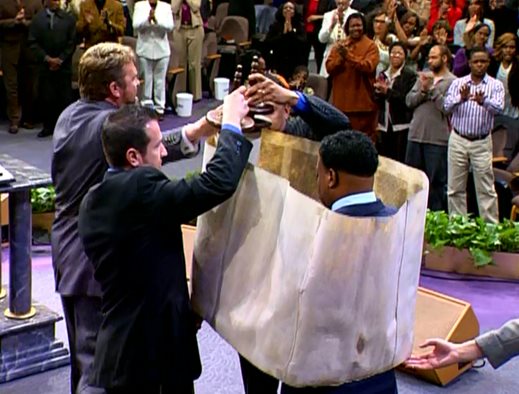
In the past couple of days, the Messianic blogosphere has been alive with passionate discourse about one such “extremist nudnik.” In an opinion piece at the Huff Post called Eddie Long Is Not a King, Rev. Wil Gafney, Ph.D, an Associate Professor of Biblical Hebrew and Jewish and Christian Scripture, posts a commentary on the extremely controversial YouTube video of “troubled pastor” Eddie Long, of the New Birth Missionary Baptist Church in Atlanta GA, being “apparently crowned king with the ritual use of a Jewish Torah scroll.” The real “nudnik” of this sad and sorry tale though, is a fellow named Ralph Messer, as Rev. Gafney states:

The unidentified man who, (in the YouTube video to which I had access he is identified subsequently as Ralph Messer), represents himself as a Jew. He may well be some sort of Messianic Jew, a person who claims Jewish heritage and recognizes Jesus as the Son of God, but who is not part of one of the major Jewish movements: Orthodox, Reform, Conservative, Reconstructionist, Reform, Renewal. He does not, however, represent recognizable Jewish thought or practice in his (mis-) representations of the Torah and other Jewish sancta — or for that matter, New Testament and Christian biblical interpretation and theology.

I won’t present any more details about this story since I would end up just duplicating what’s been thoroughly covered in much more worthy blogs, such as the one maintained by Dr. Rabbi Michael Schiffman, however, I would like to suggest that one of the motivations for such bizarre and unBiblical behavior on the part of men like Long and Messer is the same motivation Dasan and Aviram had in rebelling against the authority of Moses, Aaron, and ultimately God. This desire lead them, like Nadab and Abihu, to offer, “unauthorized fire” or in this case, to misuse a holy sefer Torah for unholy purposes.

Some people just have a problem with legitimate authority and having such a problem, do what Korah did and rebel by attempting to recreate that authority within themselves. This is at the heart of the theological arguments that have supported supersessionism in the ancient and modern church. I can’t truly say that the Christian church stands in total opposition and rebellion against the authority of God, since it is abundantly obvious that God has been using His Christian church to perform His will for centuries. I can say that the seeds that were planted 2,000 years ago which resulted in the weed that opposed the Jerusalem Council and denied the Jewish foundations of the church, were born of rebellion, but it was perhaps a “necessary” rebellion (Romans 11) so that the Gentiles could find a place within their Messianic covenant relationship to God.

That doesn’t make it any less painful or harmful and I believe the time for that “rebellion” is coming to a close.

People like Long and Messer seem to be establishing themselves as “authorities” simply because they can draw a following and they can magnify themselves by creating the illusion that they are “anointed” by God. But what do the people who follow these “rebels” want? Perhaps they are looking for whatever the rest of us are searching for, too.

Where was the knowledgeable one who wove his spell to bring his familiarity with the Atman out of the sleep into the state of being awake, into the life, into every step of the way, into word and deed? Siddhartha knew many venerable Brahmans, chiefly his father, the pure one, the scholar, the most venerable one. His father was to be admired, quiet and noble were his manners, pure his life, wise his words, delicate and noble thoughts lived behind its brow – but even he, who knew so much, did he live in blissfulness, did he have peace, was he not also just a searching man, a thirsty man? Did he not, again and again, have to drink from holy sources, as a thirsty man, from the offerings, from the books, from the disputes of the Brahmans? Why did he, the irreproachable one, have to wash off sins every day, strive for a cleansing every day, over and over every day?

from the novel Siddhartha (1951 U.S. publication)
by Hermann Hesse

This may seem like an odd source to quote within a Christian (and tangentially Jewish) context, but take one giant step backward from your religion and consider what human beings are looking for in general. What does the praying Christian have in common with the Jewish man davening in a minyan or a Muslim kneeling on his prayer mat? What do they have in common with the Buddhist, the Wiccan, and the New Age mystic? Aren’t we all, in our many and diverse ways, seeking God, in whatever way we may conceive of Him (or “Her”)?

I’m not saying that each and every one of these religious paths is equal in its validity or potential to arrive at the true “destination” of God, but the need to strive for that destination is the same in each of us. Some of our paths are legitimate and worthy, and many, many other paths lead to dead ends, darkness, and many ghastly conclusions in the spiritual travels of such seekers.

There are paths that lead people who desire a sincere and simple relationship with God to people like Ralph Messer, more’s the pity. Messer took the true message found in our Bibles and twisted it into a horrible distortion of God, misusing and desecrating the holy Torah of the Jewish people in order to glorify a misguided and selfish man. There is a legitimate path that allows man to understand God through the revelation of Torah, but Messer chose not to take it, perhaps because he would have to become a humble student and not an exalted “teacher.”

Milton, in his classic Paradise Lost, allows the “character” Satan to utter the famous line, “It is better to rule in hell than to serve in Heaven.” That seems to sum up anyone who would usurp the authority of God and the Bible (and Torah) for their own purposes rather than submit to the legitimate authorities God has established and to humbly serve under them. Jesus taught the exact opposite (John 13:1-17)  of Milton’s “adversary” when he washed the feet of his disciples and explained that “a servant is not greater than his master, nor is a messenger greater than the one who sent him” (v. 16). It is terrible to forget the words of the Master and to seek to rule over yourself and others, thinking you are better than those who came before you.

It is better to serve in Heaven than to rule in hell. Seek out those who are truly appointed by God and repudiate those who aren’t, so that the others who seek God just as you do, will be saved. Do not take such actions out of the desire to glorify yourself or whatever group or religion you serve but to glorify God only, lest you become like Dasan and Aviram and surrender to the temptation to serve only yourself. Should you feel that temptation within you, as if being who God made you to be isn’t good enough to satisfy you or Him, consider the parable of the Stonecutter by R’ Abraham Twerski MD. Perhaps it will add some perspective and even a hint of wisdom.

Beshalach: Waiting for the Bread of Heaven

The purpose of the manna was to uplift those who ate it and heighten their spiritual consciousness. As a result of this spiritual boost, the Jews were able to “follow My teaching”—to receive the Torah, as it is indeed stated in the Midrash: (Mechilta ad loc) “The Torah could only have been given to those who had partaken of the manna.” (Sefer HaMa’amarim Melukat, vol. 1, pp. 238-239.)

-From the Kehot Chumash
Chassidic Insights for Parshah Beshalach
Chapter 16
Based on the works of the Lubavitcher Rebbe
Rabbi Menachem Mendel Schneerson, of righteous memory
Chabad.org

And he humbled you and let you hunger and fed you with manna, which you did not know, nor did your fathers know, that he might make you know that man does not live by bread alone, but man lives by every word that comes from the mouth of the LORD. Deuteronomy 8:3 (ESV)

And the tempter came and said to him, “If you are the Son of God, command these stones to become loaves of bread.” But he answered, “It is written,
“‘Man shall not live by bread alone,
but by every word that comes from the mouth of God.’”
Matthew 4:3-4 (ESV)

It may be strange to think of us today as waiting for our bread from Heaven, but I think that’s exactly what we do at times. Think about what it meant to the Children of Israel in the wilderness to wait on God for their bread. Although they had vast herds of livestock with them, they still have no reliable source of “daily bread,” especially enough to feed millions of people, morning, noon, and night. In this, they were completely reliant on God for their food and drink and without Him, they could do nothing.

As slaves, the Israelites depended on the Egyptians for their food and drink (and housing and everything else), and even though life was hard and often brutal, they were used to it, as a convict becomes used to a long term in prison. There was a routine. There were expectations that were fulfilled day in and day out. Breakfast would come tomorrow from the Egyptians because it came yesterday, and the day before, and last year, and in the days of their fathers and grandfathers.

But they weren’t used to waiting on God. They were together as a people, but they felt alone. They were free, but they were in a strange and unpredictable environment. The Egyptians were men and the Israelites understood how men could provide bread, but God is not a man and who can possibly understand manna?

So they were afraid, and they doubted, and they complained, and they tested God. This was a mistake, but it was a completely understandable one. But did God understand?

“You shall not put the LORD your God to the test, as you tested him at Massah. –Deuteronomy 6:16 (ESV)

Jesus said to him, “Again it is written, ‘You shall not put the Lord your God to the test.’” –Matthew 4:7 (ESV)

It certainly doesn’t sound that way, but then again, how could God possibly misunderstand His creations? How can He possibly misunderstand us, when we too are waiting for our “bread from Heaven” and we feel alone, and afraid, and uncertain?

It’s even more confusing when God sets up a schedule and then creates an exception:

Interestingly, Moses does not tell the Jews that the manna will not be in the field, but only that they will not find it there. And indeed, the manna was esoterically present on the Sabbath as well. The Sabbath is the source of all blessings, including those of material sustenance. In this sense, the manna of the other six days descended as a result of the “spiritual manna” that was produced on the Sabbath. (Zohar 2:63b, 88a.)

The physical manna gathered during the week “materialized” out of this spiritual manna. It therefore had to be acquired through physical effort: it had to be gathered, cooked, and so on. In contrast, the Sabbath manna was not manifested physically and therefore could not be “accessed” by any physical means.

Similarly, our physical livelihood is spiritually “produced” by our observance of the Sabbath. During the ensuing week, we have to gather the material blessings of the Sabbath by engaging in our weekday work. But on the Sabbath itself, we must refrain even from thinking about our livelihood. (Likutei Sichot, vol. 16, pp. 181-182.)

-Chassidic Insights commentary continued

This is certainly a very mystic interpretation, but it teaches us something beyond the literal telling of the tale of manna in the desert. Whether we believe we provide for ourselves through the work of our hands and our minds, in reality, everything we think belongs to us was produced by and belongs to God. Beyond that, it shows us that in some manner or fashion, the Shabbat rest results in producing what we need from God and ourselves for the other six days of the week. That’s why we give thanks to Him for everything.

But what about when we ask and we don’t receive, at least right away? But what about when we ask and we don’t receive, at least in the manner we expected to receive? But what about when we ask for a fish and God gives us (seemingly) a snake instead?

“Ask, and it will be given to you; seek, and you will find; knock, and it will be opened to you. For everyone who asks receives, and the one who seeks finds, and to the one who knocks it will be opened. For which one of you, if his son asks him for bread, will give him a stone? Or if he asks for a fish, will give him a serpent? If you then, who are evil, know how to give good gifts to your children, how much more will your Father who is in heaven give good things to those who ask him! –Matthew 7:7-11 (ESV)

There’s a difference between what we need and what we want. God knows what we need, even as He knew what the Israelites in the desert needed. They didn’t ask for manna, but God knew they needed it. At first, they didn’t even know what to do with the manna, but God told Moses and Moses told the people. Eventually, the people got sick and tired of eating manna every single day, but God knew they still needed it on a regular basis and the gift that God gave continued to be His gift, regardless of whether or not it was received with gratitude.

We know that our purpose in a life created by God is not to be served but to serve. Jesus illustrated this very clearly here:

When he had washed their feet and put on his outer garments and resumed his place, he said to them, “Do you understand what I have done to you? You call me Teacher and Lord, and you are right, for so I am. If I then, your Lord and Teacher, have washed your feet, you also ought to wash one another’s feet. For I have given you an example, that you also should do just as I have done to you. Truly, truly, I say to you, a servant is not greater than his master, nor is a messenger greater than the one who sent him. If you know these things, blessed are you if you do them. –John 13:12-17

And yet, we are weak, and we need so much, and we depend on God, or we try to. There are times when we must act in order to receive from God, but there are other times when we are utterly helpless, and we can do nothing but wait.

And waiting on God to deliver His bread from Heaven is very hard. Even when it arrives, we may not recognize it for what it is, since His blessings may not come in a form we will understand. Even when we realize He has delivered His blessings, because they are not as we wanted them to be, we may be ungrateful, or hurt, or even feel betrayed that God didn’t give us what we wanted, when we wanted it, in exactly the way, shape, and form we asked for. But as difficult as it is for us, we must strive to trust God and not to question our Sovereign.

But Moses said to the people, “Have no fear! Stand by, and witness the deliverance which the Lord will work for you today; for the Egyptians whom you see today you will never see again. The Lord will battle for you; you hold your peace!” –Exodus 14:13-14 (JPS Tanakh)

“Be still, and know that I am God.
I will be exalted among the nations,
I will be exalted in the earth!” –Psalm 46:10 (ESV)

We can trust in God, if only we will wait.

You open your hand; you satisfy the desire of every living thing. –Psalm 145:16 (ESV)

His hand is opening. He’s about to help you. Wait.

Good Shabbos.

The Alleyways to Eden

The objective of all man’s toil in this world is to reach higher than his own mind, higher than mind at all. Not to a place where the mind is ignored, but rather, to its essence, to the inner sense of beauty and wonder that guides it.

“A river went out from Eden to water the garden.” The garden is Mind, where all worlds begin. Eden is a place of delight beyond the garden, far beyond. Yet its river nurtures all that grows there. Adam is placed in the garden to discover the Eden flowing within.

-Rabbi Tzvi Freeman
“The River From Eden”
Based on letters and talks of the Rebbe
Rabbi M. M. Schneerson
Chabad.org

And the Lord God said, “Now that the man has become like one of us, knowing good and bad, what if he should stretch out his hand and take also from the tree of life and eat, and live forever!” So the Lord God banished him from the garden of Eden, to till the soil from which he was taken. He drove the man out, and stationed east of the garden of Eden the cherubim and the fiery ever-turning sword, to guard the way to the tree of life. Genesis 3:22-24 (JPS Tanakh)

Ever since the expulsion from Eden, man has been trying to get back to paradise and to God. We haven’t been doing a very good job along the journey and we’ve taken many detours. The idea of “paradise” means many different things to many different people. I think there’s something inside of us that “remembers” the freedom we had to explore and to master our world, and we mistakenly try to recapture that freedom along a lot of poorly chosen routes. Some of those back alleys and rough streets lead to drugs, sex, booze, money, and other activities we somehow think will give us what we once had and then lost. The irony is that we try to recover paradise by the very acts that caused us to lose Eden and to lose our intimacy with God in the first place. We try to find God by making service to self as paradise and sin as our “god.” Notice the shape the world is in. We haven’t been doing a very good job along the journey.

But with a lot of wrong decisions, we’ve also made a few right choices, or at least choices that point us in the right direction. Sometimes we do so only by stumbling along, half perceiving the light along the path that God has provided to show us the way. Most of the time, even when we see the light, we don’t really know what to do with it and how to follow where it leads. And yet, God said the answer is there.

I do not turn aside from your teachings,
for you have taught me.
How sweet are your words to my taste,
sweeter than honey to my mouth!
Through your precepts I get understanding;
therefore I hate every false way.
Your word is a lamp to my feet
and a light to my path. –Psalm 119:102-105

The way back to Eden is along the path that God has illuminated for us with the power of His Word. His Word is what we have in the Bible but He also caused His Word to “become flesh and live among us” (John 1:14) in a manner we cannot fully understand. God has provided many different ways we can become aware of Him and to come to know Him. As we become aware of God, we join with Him and put our “thumbprint” on His plan for us, in our own humanly imperfect way, declaring that we are involved with Him and with the ways of Heaven. Those of us who love God and who seek Eden have many and varied methods of revealing ourselves to the world. In walking along our different paths, we somethings encounter each other. When we do, we don’t always recognize that we are connected or if we do, we don’t always agree with how someone else is walking their own path.

Ever hear of Women of the Wall? I hadn’t either until just a few days ago. In their own words, they are…

a group of Jewish women from around the world who strive to achieve the right, as women, to wear prayer shawls, pray and read from the Torah collectively and out loud at the Western Wall (Kotel) in Jerusalem, Israel. The Western Wall is Judaism’s most sacred holy site and the principal symbol of Jewish people-hood and sovereignty and Women of the Wall works to make it a holy site where women can pray freely.

They started as seventy Jewish women who gathered at the Kotel on December 1, 1988 to pray aloud with each other, which is the first time in history this has ever happened. Later, they gathered again to read from a sefer Torah at the Kotel.

However, it’s illegal for women to pray together at the Kotel in such a manner, and Anat Hoffman, the leader of Women of the Wall, was even arrested in July 2010, according to a Haaretz.com news story.

Anat Hoffman, the women’s prayer group leader, was arrested and taken in for questioning after she was caught holding a Torah scroll in violation of a High Court ruling prohibiting women from reading the Torah at the Western Wall.

While the desire of Jewish women to pray at the Kotel wearing talitot and tefillin runs counter to the Orthodox authorities, is it really wrong for them to do so? From the point of view of the Orthodox, it may be, but in this case, I must question whether or not the intent of these women really runs counter to the desires of God. They are walking their own path, created by their awareness of God, and the path is defined by their devotion to God as Jewish women. This isn’t the first time I’ve been critical of something regarding Jewish practice, such as in the treatment of converts wishing to make aliyah to Israel or some of the barriers synagogues place in front of Jews who wish to worship on the High Holy Days.

I want to honor the right of Judaism to define itself in terms of God as well as in terms of culture, custom, and lifestyle, but I am also aware that halacha doesn’t necessarily reflect the will of God with perfect clarity (and sometimes that can be an understatement). Paul said that we see “in a mirror dimly” but someday, it will be face to face (1 Corinthians 13). Whether you think it’s right or wrong for women to pray at the Kotel, they are seeking what we are all seeking; a way to walk along the path that leads back to a “paradise lost” and to return to the “lover of our souls.” According to the vision of John, one day we will arrive at our goal.

Then the angel showed me the river of the water of life, bright as crystal, flowing from the throne of God and of the Lamb through the middle of the street of the city; also, on either side of the river, the tree of life with its twelve kinds of fruit, yielding its fruit each month. The leaves of the tree were for the healing of the nations. No longer will there be anything accursed, but the throne of God and of the Lamb will be in it, and his servants will worship him. They will see his face, and his name will be on their foreheads. And night will be no more. They will need no light of lamp or sun, for the Lord God will be their light, and they will reign forever and ever. –Revelation 22:1-5 (ESV)

Until that day, we search the free mountain trails and rough back alleys of our lives and our world for that one slender thread of light amid the darkness that guides us to an illumination beyond human expression. Day by day, we follow the thread, that lamp for our feet, and we walk the steps, which are different for each and every one of us, enduring hardships and being misunderstood. We will continue to travel until that one day when we will look up into his face, and he will wipe away our tears, and “death shall be no more, neither shall there be mourning, nor crying, nor pain anymore, for the former things have passed away” (Revelation 21:4 ESV).

Amen and amen.

Uncomfortably Serving God

No person can know his own inner motives.

He may be kind because kindness brings him pleasure.

He may be wise because wisdom is music to his soul.

He may become a martyr burned in fire because his nature is to defy, his nature is to be fire.

When can you know that your motives are sincere? Only when it is not within your nature to do this thing.

And how do you know that it is not within your nature? Only when you travel two opposite paths at once.

-Rabbi Tzvi Freeman
“Real Motives”
Based on letters and talks of the Rebbe
Rabbi M. M. Schneerson
Chabad.org

This is exactly how I can tell God is working in my life; by how uncomfortable He makes me. I’ve always found it very interesting that some Christians “confirm” the wishes of the Holy Spirit in their decision making process by how much “peace” they feel after praying about a decision. Their peaceful emotional state somehow tells them that they’ve made a decision (regardless of the situation) that is in accordance to the will of God. And yet we see from Rabbi Freeman’s statement above, that people can feel “at peace” with various decisions or actions, not because their motives are pure and perhaps not even because what they are doing lines up with God’s wishes, but just because those decisions and actions are “natural” for that person.

You could argue, probably successfully, that God created us with natures that allow us to serve Him within the activities associated with our natures, but that seems somehow limiting, especially when the needs of the world are so great and so varied.

Here’s an example.

I hate going to hospitals. They kind of creep me out (I think I’ve mentioned this somewhere before). So it’s not easy for me to go to a hospital and visit a sick person. And yet, it’s a commandment of Jesus that we visit the sick. It’s far easier for me to obey the commandment to feed the hungry, because I have no emotional resistance to donating a bunch of canned goods to my local food bank. But would I volunteer to work the kitchen at my local homeless shelter once a week? Gee, I dunno.

And that’s my point. Not that we have to make ourselves serve God only in ways that trigger our discomfort, but we also need to keep in mind that those uncomfortable opportunities God plops directly in our paths to help people, are the very ones we need to do if we want to be called disciples of Jesus (as opposed to “believers” whose only fruit is to “believe”). That makes serving God a lot less approachable for many of us. I’ve heard Christians praying to Jesus to help them be more like him and wondered what would happen if God really gave them the opportunity to do so. I’m sure some people would rise to the occasion, but how many others, when it actually happened to them, would say something like, “Hey wait! This isn’t what I had in mind!”

Sure. We all want to serve God. We just want to serve Him our way and to be really cool and comfortable while doing so.

Uh-huh. Let me know how that works out for you.

Here’s another perspective:

Teshuvas B’tzeil Hachochmah suggests that our Gemara is a proof to Gaon Chida’s position. The Mishnah teaches that one who made an erech vow while wealthy and before fulfilling his vow lost his wealth remains obligated to fulfill his vow as someone who is wealthy and he is not appraised by the kohen as one who vowed when poor whose obligation is discounted in accordance with his means. Tosafos Yom Tov asserts that they will take from the person what he has towards his vow and the remaining amount will remain a debt that he will fulfill when he acquires the necessary funds. The question is how they could collect from him only part of his obligation if it may turn out that he will never have the necessary funds to pay off this debt. If that were to happen he will have never fulfilled his pledge and there was no reason to have taken funds from him in the first place. It must be that even partial fulfillment is considered fulfillment of the mitzvah and that is why they will collect from him what they can even though they may never collect the remainder.

Daf Yomi Digest
Halacha Highlight
“Fulfilling only part of a mitzvah”
Arachin 17

OK, all that might be difficult to understand, so let me boil it down a bit. If you decided to serve God out of your strengths, such as having a lot of money, and something should happen unexpectedly to make that service a lot more difficult, are you still obligated to fulfill your commitment to God? After all, you said you’d do it and presumably, you made a commitment. Are you absolved of your commitment because you misunderstood how God wanted you to satisfy the requirements of the task or because you realized that you didn’t have enough money in your bank account to cover costs?

The Rabbinic sages debate the matter and conclude that you only have to do the best you can. If you promised to donate $1,000 to the food bank but you only have $500, then you pay the $500 and it’s as if you paid the full amount. If you promised to pray for the sick each morning without fail for the next week, but you woke up late for work two days out of seven and had to rush off without praying, then praying for the sick for only five days fulfills your promise.

Gee, you can see why Jesus said this.

“Again you have heard that it was said to those of old, ‘You shall not swear falsely, but shall perform to the Lord what you have sworn.’ But I say to you, Do not take an oath at all, either by heaven, for it is the throne of God, or by the earth, for it is his footstool, or by Jerusalem, for it is the city of the great King. And do not take an oath by your head, for you cannot make one hair white or black. Let what you say be simply ‘Yes’ or ‘No’; anything more than this comes from evil. –Matthew 5:33-37 (ESV)

Of course, that doesn’t cover those unanticipated “requests” from God to serve Him that you never saw coming across the horizon. What about those areas when you want to serve God as a “prayer warrior” for an hour each day just after lunch, but instead, on your commute into work, He wants you to help a mother trying to get her sick baby to the doctor’s office by changing her flat tire? The answer is you do the best you can, and if you can’t change a flat tire, you use your cell to call your brother-in-law who works for a tow truck company to drive over and help out.

You do the best you can, which doesn’t have to be perfect. You do the best you can, even though you are really uncomfortable doing it. You do the best you can, even though sometimes God asks you to do things that make you want to crawl out of your skin.

At least you know that when you’ve served God under those conditions, it wasn’t because you were serving yourself.