
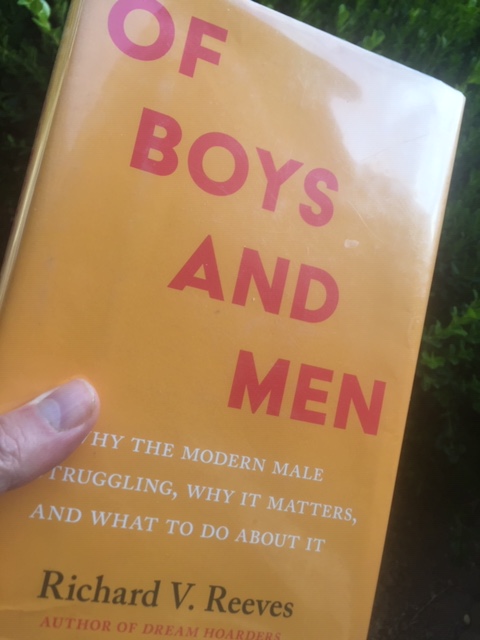
 I just finished reading Of Boys and Men: Why the Modern Male Is Struggling, Why It Matters, and What to Do about It (2022) by Richard Reeves. I was inspired by what I had learned when writing my Defining Men series on this blog. I thought I might gain some further insights.
I was wrong.
I don’t doubt that author Richard Reeves is sincere in everything he’s written and that he actually is deeply concerned about the future of boys and men in our world. I just think he’s looking at the topic through a rather narrow lens.
I know when you read a book that has an extensive bibliography, it’s hard to impossible to say that the author was biased or misinformed. On the other hand, it really depends on which sources you mine and how you interpret them.
Reeves did state that both Progressives and Conservatives have, to one degree or another, not fully understood the issues involved in how males have become lost and without identity and purpose:
Progressives resist the idea that fathers have a distinct role to play, afraid that this will somehow undermine mothers or belittle same-sex couples. So they recoil from any proposal that might smack of “father’s rights.” Conservatives meanwhile lament an epidemic of fatherlessness but simply want to restore traditional marriage, with clear and separate roles for men and women.
However, Reeves is not impartial. He sprinkles these little moments of supposed political/social objectivity as a light seasoning, and then goes right back to his central message, which, for a book on boys and men, isn’t what you’d expect.
The central and overarching message of this book is that the road to overcoming systemic gender inequality is still long and before us. We not only cannot give an inch in the progress made, but must continue to surge forward seeking ever greater gains for girls and women.
But what about boys and men?
Reeves correctly states that educationally, boys and young men are lagging behind girls and women. Except for the very highest area areas in business (CEO and such), women tend to dominate. If women are earning less, it isn’t so much that they aren’t being paid the same as men for the same work, it’s that they have two stumbling blocks: marriage and children.
He actually quoted Gloria Steinem, a decades old quote at that, stating that marriage has always been a trap to suppress women, and implying that nothing has changed.
Back to wages, women will tend to take lower-paying jobs with more women “clustered” around those forms of employment, in part, to be available to take care of their children. Also, even higher-paid women will work fewer hours and no overtime for the same reason.
He admits women are doing a lot better than in 1970, but still have more territory to cover.
To counter the deficits boys face educationally, he suggests “redshirting” boys across the board. That means girls will enter kindergarten at age five the way the system is now. Boys, on the other hand, because of their cognitive developmental issues, would be universally held back a year, not entering elementary school until age six.

Try telling a generation of boys that they can’t keep up with girls. They’ll interpret it as “boys are stupid” or “boys aren’t as good.” Given some of the school teachers I’ve encountered over the years, that message could be reinforced by the very “educators” who are supposed to be teaching them.
I have twin sons but they’re not identical. In fact, they’ve always been very distinct. One son excelled academically and the other suffered from multiple learning disabilities. The kindergarden teacher at our local school who evaluated them both outrageously asked my wife if they were even brothers. She suggested entering one in kindergarden that year and holding the other one back for the next year.
As an aside, Reeves faced a similar issue with his middle son and did hold him back about four months, wishing in retrospect that he had done so for a whole year.
My son with learning disabilities (he’s in his mid-30s now, married with three children) caught up with his age mates in reading ability by middle school. He may have had his struggles but he wasn’t stupid. He was pretty freaked at age five by the idea that he wouldn’t go into school with his brother.
My wife and I decided to have him admitted that year and then, in cooperation with the school, worked with him, including having additional private testing done (school systems are all about crowd control, not so much about the needs of the individual, IEPs not withstanding), tutoring, and providing a lot of support at home. It was a struggle for everyone, but I’m convinced that “redshirting” him as Reeves most certainly would have done would have destroyed him.
So no, the author doesn’t know everything.
He does recognize that Dad’s are vitally important in the lives of their sons (he completely ignored how Dad’s influence their daughters positively…imagine that. Oh, he also ignored the roles played by other men in the family such as Uncles and Grandpas, so he really missed the boat in terms of extended family support). He suggested that Mom’s have more caretaking responsibilities of younger kids and Dads have a greater role in a boy’s teen years.
That part actually sounds about right. I do want to emphasize that Dads, Uncles, and Grandpas can be a positive influence in a child’s life at any stage. My eight and three year old granddaughters are very attached to my wife and I and we each fulfill specific needs in their lives. In my case, a girl (as well as a boy) can never have too many positive male influences.
The author both suggests that girls continue to be promoted in STEM studies, while boys and men be redirected toward HEAL (Health, Education, Administration, and Literacy). He emphasized recasting a career in nursing as more “manly” so more men would be attracted to that path. He also said that more men need to enter education, even becoming kindergarten teachers (I immediately thought of the 1990 film Kindergarten Cop).
Those aren’t bad ideas. I’ve already come across a bunch of men in the roles of nurses, social workers, counselors (I worked in the last two fields), psychologists, and so on. The idea is that the “brute labor” jobs men have traditionally held (construction, warehousing) are very likely to be automated fairly soon, leaving men unemployed with few other prospects.
I did look into the future and imagined trends where entertainment, news, and social media were all used to influence generations of young men to channel their career goals into HEAL, while generations of young women were guided into STEM (Reeves wants 30% of each population in those respective careers). Eventually fewer men would go into the very high-paying senior management and CEO tracks leaving them open for women (Reeves never said this, but it’s easy to see).
That may sound a little paranoid and plenty of people would say, “What’s wrong with that?” Nothing, I suppose, except you are using social, corporate, and governmental resources to deliberately elevate women while at the same time, reducing men’s options. That isn’t equality or equity, it’s role reversal. Again, I suppose some people would say, “What’s wrong with that?”
I noticed Reeves only briefly touched on men’s loneliness and isolation. As I discovered previously, men more often develop friendships with other men based on an activity such as playing basketball, fishing, hunting, camping, and so on. These are activities the author completely ignored and I can only guess that’s because he doesn’t engage in any of them (although I’ve been wrong before).
As a progressive, he probably supported the dismantling of the Boy Scouts of America as a boy-centric organization. After all, any boy-only club is seen as exclusive, misogynistic, and sexist. Girls are still allowed their own unique spaces (relative to trans girls and women of course) but boys are not.
While Reeves supports men having a unique identity and role, especially as Dads, in truth, he really draws the line at men engaging in more traditional male roles and activities. He doesn’t breathe a word about how boys learn to be men, not just from their Dads, but from other male role models.
My Dad used to take my brother and me hunting and target shooting as well a fishing. Just the guys. The whole family went camping. A career in the military isn’t exclusively male, but men and women don’t cohabitate in the service as far as I know (my Dad was a firefighter in the Air Force for forty years and one of my sons served in the Marine Corps). A military tradition can add a lot of discipline to a young man’s life, even if he’s had few other examples.
Reeves did make some references to his three sons and his partner/wife, but they were pretty superficial. That’s fine. He doesn’t owe the reader any insights into his personal life. He’s also a researcher and an academic, which is how he approached all of this. It shows.
At the end of the day, being a son or Dad or Uncle or Grandpa isn’t done in an ivory tower, it’s lived on the ground and sometimes in the dirt and mud. It’s messy and not an exact science. As I said, he had some good ideas (not busting a divorced father’s buns with insanely high child support payments for instance) but he really didn’t think things through. It seemed as if he was filtering the topic through his own experiences (and biases) as a Dad and perhaps a little as a son.
But the rest of us aren’t him. Also, the rest of us, being married, don’t see marriage as this hideous and torturous pit for the upwardly mobile woman. I’ve seen divorced families raise kids and I’ve seen them raised in intact families. The latter has the greater advantage (yes, divorced, blended families can do a great job too, but there are more challenges).
We don’t live in a perfect world. It will never be a perfect world until the Messiah comes or the second coming (depending on your theological viewpoint). The author likely believes that just human beings will make that perfection, as defined by his political/social beliefs. Good luck.
Reeves very, very briefly mentioned faith institutions, but he didn’t seem to value them or consider a church, synagogue, or other religious community as a resource, more’s the pity.
I was considering reading this book next, but it has the same bias problem, just in the opposite direction. All I’d be doing is sampling another “flavor of the month” with little substance.
I wonder if I’ll ever find a source that honestly and objectively deals with the “puzzle” of boys and men. Maybe there is no way to separate us from what politicians, social influences, and academicians think, believe, and sell to the public.
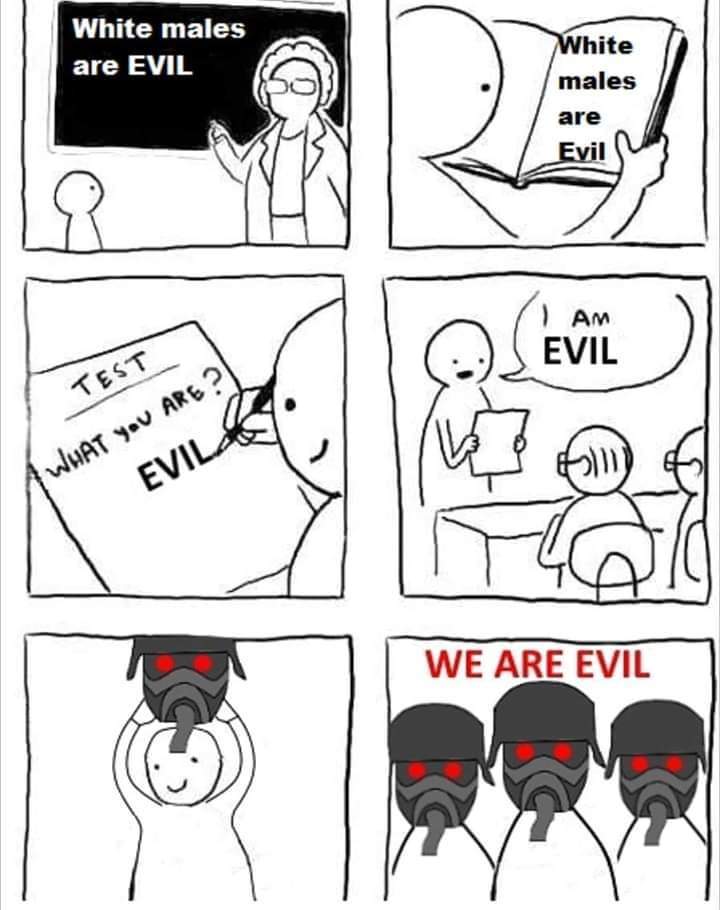
Such a shame, because I’m left with the same unyielding knot I started out with. Men and boys are the problem, especially white men and boys. We have to be “solved.” Based on some of Reeves’ sources such as Ta-Nehisi Coates and Ibram X. Kendi (see my article The antiracist God), we must either be radically changed (which is pretty much what Reeves is saying as well) or eliminated as a societal influence (or just eliminated).
I gave this book three stars on Amazon and goodreads and only rated it that high because it was very readable (I did skip over a couple of chapters once I figured out where the author was heading). I’m sure Reeves is a very nice person and a great Dad, but he missed this one by a country mile. Now his book goes back to the public library.
Oh, as a refresher, here’s the conclusion to my Defining Men series as well as the Afterword.
Addendum: 9/26/2023 – After I finished writing and publishing this article, I went to Reeves’ twitter account. I don’t know whether to be excited or worried. I don’t want at least some of the suggestions he made in his book to become actual government policy or worse, law.
 Morning Meditations
If you can stand mythology as a way of communicating, you might try Iron John: Robert Bly. I’m mainly mentioning it to you because he recommended a different book I read but can’t find when I look for it (I think written by a woman) somewhere at the back of the book; about actually raising boys.