
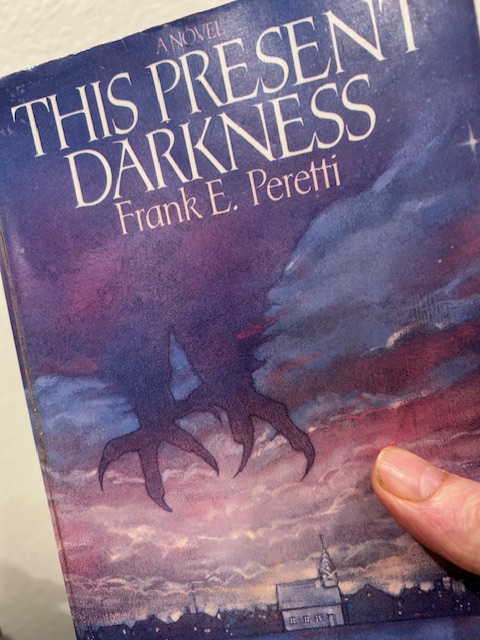
I finished reading Frank E. Peretti’s 1986 novel This Present Darkness last night. It isn’t something I’d normally read, but someone mentioned the author on my other blog and I thought I’d try it out.
This isn’t a review. For that, you can visit my substack. However, in reading the book as well as some of the commentaries about it, I started wondering at the relative value of Christian supernatural fiction and thrillers.
The book continues to receive rave reviews and the author has been likened to as “a sanctified Stephen King” or alternately “the Stephen King of Christian fiction.”
The book is the first of a series of such novels and according to commentaries written by Jay R. Howard and Glenn W. Shuck, Peretti’s writing is considered to reflect what is considered the New Christian Right.
My understanding is that Peretti’s books are widely read by members of the Evangelical, Charismatic, and Pentecostal churches, enthusiastically consumed by both the clergy and laity alike.
The worrisome part is that some of these folks are taking fiction and using it as, at least potentially, guides on matters of prayer, spiritual warfare, and even exorcizing demons.
The book portrays prayer as directly impacting how effective angels are in battling demons who are attempting to damage or ruin your life. The more you pray and the more people who pray, the more powerful the angels are. However, a lack of prayer desperately weakens said-angels, leaving demonic forces much stronger.
Did I mention this is a work of fiction?
The book also framed New Age and Eastern Religions as inherently evil and gateways into demonic influences. Guided meditation, for example, could be used by an unscrupulous therapist or psychologist to lead a client or patient to believe that a demon is really a spiritual comforter and adviser.
Academic abstracts such as Masculinity, Political Action, and Spiritual Warfare in the Fictional Ministry of Frank E. Peretti (2020) has said Perreti’s work:
has led the way for later Christian fiction such as the Left Behind series, which authors Tim LaHaye and Jerry B. Jenkins have acknowledged.
A number of critics have mentioned the theme of child abuse and sexual assault as problematic. In the novel, the teenage daughter of the local newspaper owner has accused him of sexually abusing her as a child which he denies. The “memory” of the abuse had been planted within her during hypnosis and meditation, which as you may recall in the real world, was a key element in the infamous McMartin Preschool Trial of 1983.
The book also attributes demonic possession as the cause for victims making such allegations against innocent men. That casts the victims, along with their preschool teachers, therapists, and social workers advocate for abused children, as the villains.

Within the context of the story, demonic possession does account for such false accusations, but if readers took the book too seriously (or the author took himself too seriously), could potentially lead to terrible mistakes by real-world Christian caretakers including pastors and Christian counselors.
Actually, it’s worse than that because in the novel, the police, psychologists, and other helpers are also demon influenced or possessed, so none of them can be trusted.
If you accept that this novel is wholly fictional and spiritual warfare isn’t really expressed like this in our world, then you can enjoy it and come away totally fine. After all, who thinks any of Stephen King’s novels represent the actual world we live in.
Remember, Peretti’s books don’t represent our world or Christians spiritually with anymore accuracy.
As I mentioned above, for the full review, visit my substack.
 Morning Meditations