
 When G-d sends the souls forth into the world, they include a male and female joined together…When they descend to the world…they are separated from each other. Sometimes one soul precedes the other in descending and entering a body of a human being. When their time to be married arrives, G-d, Who knows these souls, joins them as they were before [they descended to this world]…When they are joined together, they become one body and one soul. –Zohar 1:91b
Some Pharisees came to him to test him. They asked, “Is it lawful for a man to divorce his wife for any and every reason?” “Haven’t you read,” he replied, “that at the beginning the Creator ‘made them male and female,’ and said, ‘For this reason a man will leave his father and mother and be united to his wife, and the two will become one flesh’? So they are no longer two, but one flesh. Therefore what God has joined together, let no one separate.” –Matthew 19:4-6
This is a continuation of my commentary on the JLI course Toward the Meaning of Life. See The Prophet and the Shade Plant for the previous commentary and links to earlier lessons.
As Christians, we are generally taught that we have no pre-existence prior to conception and birth. Somehow, our individual souls are all part of that process and we exist in isolation within the womb, physically and spiritually. We do not realize the joining of two souls as one until marriage so that we become “one flesh” (Genesis 2:24), but Kabbalah suggests another interpretation. We also see this viewpoint in the Chasidic writings as related by Rabbi Tzvi Freeman’s rendition of the Rebbe’s teaching on man and woman:
It is a mistake to consider man and woman two separate beings. They are no more than two halves of a single form, two converse hemispheres that fit tightly together to make a perfect whole. They are heaven and earth encapsulated in flesh and blood.
It is only that on its way to enter this world, this sphere was shattered apart. What was once the infinity of a perfect globe became two finite surfaces. What was once a duet of sublime harmony became two bizarre solos of unfinished motions, of unresolved discord.
So much so, that each one hears in itself only half a melody, and so too it hears in the other. Each sees the other and says, “That is broken.” Feigning wholeness, the two halves wander aimlessly in space alone.
Until each fragment allows itself to surrender, to admit that it too is broken. Only then can it search for the warmth it is missing. For the depth of its own self that was ripped away. For the harmony that will make sense of its song.
And in perfect union, two finite beings find in one another infinite beauty.
While there is a beauty in this interpretation; a poetic and romantic image that calls to anyone who has found their “soulmate” in their spouse or who is ernestly seeking their bashert, couldn’t all this just be considered some non-Biblical fantasy? After all, Adam, a man, was created first and then Eve was created from his rib. This is how we understand it in Christianity. They are two separate beings who were joined together by God spiritually. The only “unity” they shared originally is that Eve was made out of one of Adam’s body parts.
But is that how it really was? Genesis 2:18 says, “And the Lord God said, it is not good for the man (ha-adam) to be alone; I will make a fitting helper for him.” Let’s have closer look at some of the Hebrew words and concepts. Rabbi Pinchas Stolper in his article, “The Man-Woman Dynamic of Ha-Adam: A Jewish Paradigm of Marriage provides some important insights into Genesis that we miss when we read the English text:
Who is ha-adam? It is neither man (ish) nor the first man (adam). To identify ha-adam, we turn to Genesis 1:27. “And God created ha-adam in His image, in the image of God He created him (oto); make and female, He created them (otam).” The first part of the verse clearly indicates that ha-adam is a single being. The second half indicates that this single being, at the conclusion of the creation process, becomes “otam (them),” two individuals.
The key to decoding this mystery is to be found in Rashi, the Biblical commentator par excellence, who generally anchors the Biblical text in its plain meaning. Rashi explains: “They were created shenai partzufim [of two faces, androgynous] in the original creation; and only later did God divide them.” In other words, ha-adam, the first human being is a unique creation; both male and female simultaneously (see Ketuvot 8a).
This is an amazing revelation of the first human beings and has startling implications on what it is to be created in the “image of God” (since God is without gender) and on Paul’s teaching, “neither male nor female” (Galatians 3:28), but can we accept the interpretation of a 12th century Jewish sage over the actual Biblical text? If ha-adam was not the actual first “man” in Creation, where did the separate entities of Adam and Eve come from? Rabbi Stolper provides an answer:
Later, the Torah records that “the Lord God put ha-adam into a tardema (deep sleep) and took one of his tzela’ot.” Rashi indicates that “tzela’otav” does not mean “one of his ribs” but, “one of his sides,” as it is taught, “the side of the Tabernacle.” This follows the meaning of the Talmud “that they were created with two faces.” Ha-adam was originally a unified individual with two “sides,” two faces, two aspects, two sexes, subsequently divided into two.
A footnote on this commentary states:
Rabbi Samson Raphael Hirsch, notes (Genesis 2:21) that “tzela does not occur elsewhere in the Tanakh (OT) as a ‘rib’, but always as a ‘side,’ which is also why tzalua means to be inclined towards one side, to limp.”
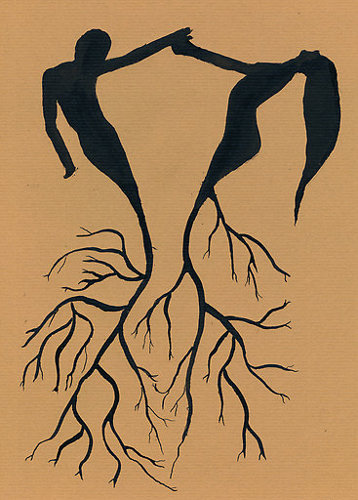 Based on the actual Hebrew of the Genesis creation story, the common interpretation of Eve being “Adam’s rib” doesn’t hold an ounce of water. Man and woman were originally united as a single, unified entity that God deliberately separated into different and equal parts designed to perform different functions in the created world. However, like any single thing that is put into two parts, neither one is complete until they are joined back together. In fact, the Hebrew for “cling to” that we find in Genesis 2:24 is the Hebrew word “vedavak” which carries the sense that a man must “leave his father and his mother, and shall glue himself to his wife: and they shall be one flesh.”
But why didn’t God just let ha-adam stay as a single entity? I’m sure most married couples, who have had their fair share of marital disagreements must be asking the same question. You’d think that having an “unsplit” ha-adam would have avoided thousands of years of stormy marital discord and the proverbial “battle of the sexes”.
Interestingly enough, in Genesis 2:18, when God says, “It is not good (lo tov) for man to be alone (levado)”, the implication of the Hebrew is that “it is not yet good”. The ultimate “good” could not be achieved unless their were two of them. Animals were already created “male and female” without going through the “splitting” process described for ha-adam and thus only human beings are able to be joined together as a spiritual “one”. No other living beings in creation are capable of this level of total unity of essense, and it requires that the two must specifically be “male” and “female”, man and woman.
But that doesn’t answer the question.
Rabbi Stolper’s article quotes Rabbi Shlomo Wolbe and Rabbi Yeruchem Lovivitz on the matter and the answer in part states:
“It is clearly demonstrated to you that the Lord alone, levado, is God; there is none beside Him.” God is on the level of levado (citing Deut. 4:35).
Only God is One, a unique and radical unity (Deuteronomy 6:4) and there is no other “oneness” like God. In the Garden, part of the serpent’s temptation of Eve was that “when you eat of it, your eyes will be opened, and you will be like God…” (Genesis 3:5). This was the only sin possible for Adam and Eve to commit in Eden; to attempt to be like God. We are meant to be much more than the other creatures of Creation, but we were created to be “a little lower than the angels” (Psalm 8:5; Hebrews 2:7). Only God is One, levado; alone. Humans are unique in creation but we are still meant to be two, man and woman, and to become “one flesh”.
There’s an obvious problem with the Chasidic interpretation of God always joining the “split souls” of man and woman together again in marriage when you consider Jewish/Gentile intermarried couples such as me and my wife. When asked “Can a Jewish woman’s berheret (soul-mate) be a non-Jew”, Rabbi Shraga Simmons
replies in part:
The Talmud says that 40 days before the formation of a fetus, it is decreed in heaven which boy will marry which girl. Since God has forbidden a Jew from marrying a non- Jew (Deut. 7:3), it is obvious that the beshert is a Jew. There is of course the possibility that one’s beshert will be a convert, though this again would only apply to someone who converted in accordance with God’s laws.
Yet here we are, man and woman, married to each other, presumably by God’s decree and (though Rabbi Simmons wouldn’t consider this a factor) commanded by Jesus that “what God has joined together, let no one separate.”
I don’t know how it works or how it’s supposed to work. I only know that things are what they are and that God is here with us, helping us to try to do our best, just the way He made us, to repair our little bit of the broken world and prepare for the coming of the Moshiach. Our two halves don’t always make an agreeable whole and like any married person, I sometimes wonder why. The only answer I can find is in how Rabbi Freeman interprets the Rebbe on the topic of getting along:
When we can’t get along with someone, we like to blame it on that person’s faults: stupidity, incompetence, outrageous actions, aggression or some other evil.
The real reason is none of these. It is that the world is broken, and we are the shattered fragments.
And all that stops us from coming back together is that we each imagine ourselves to be whole.
We are shattered fragments trying to become whole again. We contain Divine sparks within us that are constantly striving to break free and return to the One Source of all things. We are prisoners, imaging ourselves as individuals sitting isolated in a jail cell of our own making, but we’re sitting on the keys.
The next part of this series, and a continuation of the discussion about marriage, is in the “morning meditation” Who Are We to God?.
 Morning Meditations