Tag Archives: Christians

Torah Study for Christians

This is “Torah 101” for everyone. Torah Club Volume One: Unrolling the Scroll offers Christians a Messianic Jewish study from Genesis to Deuteronomy with easy-to-read, devotional-styled commentary on the weekly, synagogue Torah readings.

Peppered with insights from ancient rabbis and anecdotes from modern Christian life, Volume One demonstrates the value of Torah for Christian living today. Includes connections to the New Testament and writings of early Christians. This volume introduces students to both the Hebrew Roots of Christianity and the world of Messianic Judaism.

from the promotional material for
“Unrolling the Scroll”
Torah Club, Volume 1
ffoz.org

I know I’ve talked a great deal lately about returning the Torah to the Jews, so I suppose it seems odd that I’m now suggesting that we Christians actually study the Torah. Why the inconsistency?

Actually, no inconsistency exists. I never said that Torah, or how Jews understand the first five books of the Bible, was of no value to Christians, and in fact, I think that studying Torah is of tremendous value. You should be able to tell this by the fact that I cite mostly Jewish sources in my “morning meditations” and apply them within a Christian context.

One of my first introductions to the Torah within a “Messianic” context was the First Fruits of Zion (FFOZ) Torah Club, but that was ten years ago. The Torah Club of today has been updated to be more relevant and eye-opening for Christian Bible study groups, and I must admit, having been absent from studying these materials for quite some time now, I’ve been curious about how they’ve evolved.

But what is the “Torah Club?” Sounds like meetings that adventurous Jewish boys would hold in a tree house or a book club for Jewish Bible readers. The second suggestion (both were tongue-in-cheek) isn’t far off.

To understand what the Torah Club is, you have to understand something about how Jews study the Torah in an annual cycle:

The Torah is an ancient scroll containing the books of Genesis, Exodus, Leviticus, Numbers and Deuteronomy—the first five books of the Bible.

The Torah is the foundation of faith in Yeshua. All of the concepts associated with the Gospel—such as God, holiness, righteousness, sin, sacrifice, repentance, faith, forgiveness, covenant, grace and the kingdom of heaven on earth—are introduced in the Torah. Basic sacraments and rituals like baptism, communion, prayer and blessing all come from the Torah. Faith in Jesus is meaningful because of the Torah. Without the Torah, the Gospel has no foundation on which to stand.

The Torah Club follows the weekly Torah readings that are read in Jewish and Messianic synagogues every Sabbath. “For Moses from ancient generations has in every city those who preach him, since he is read in the synagogues every Sabbath” (Acts 15:21). In the synagogue, the Torah begins with Genesis 1:1 in the fall, usually around October. Each week several chapters are read aloud to the congregation in Hebrew—a total of fifty-four Torah portions. Each reading is called a parashah, which means “portion.” The names of the weekly portions are derived from a significant Hebrew word in the first sentence of that week’s reading. A year after beginning the first portion, the congregation finishes Deuteronomy and begins Genesis again.

In addition to readings from the five books of Moses, the Torah Cycle includes a weekly reading from the prophets. At First Fruits of Zion, we have created an accompanying reading cycle for the Gospels and Acts as well.

The full introduction to the Torah Club can be found at ffoz.org, but I think you get the basic idea. The Torah Club is a set of materials that can be used by a study group to follow each week’s Torah reading and gain insights about that section of the Torah from the Messianic/Christian perspective.

Why should you, as a Christian, care about a Law that supposedly was nailed to the cross and died with Jesus?

Because it wasn’t. In fact, Jesus himself said that, “until heaven and earth pass away, not an iota, not a dot, will pass from the Law until all is accomplished” (Matthew 5:18 ESV). As I look around, the earth is still here and I’ll take it for granted that heaven continues to exist. That would mean I suppose, that not everything is yet accomplished. But does that mean the Law or the Torah is fully applicable to the Christian as it is to the Jew?

As I’ve mentioned previously, I don’t believe so, but that doesn’t mean it doesn’t matter at all. As you’ve already read, you can’t really understand what Jesus was teaching in the Gospels unless you understand his “source material.” Virtually everything he taught and everything we try to understand today as Christians comes from Christ’s understanding of the Torah: a first century Jewish understanding. If you’ve always believed the Torah is dead and totally irrelevant to the teachings of Jesus, discovering this isn’t true is your first lesson in Torah.

If you know nothing about Torah and its relevance in the life of a Christian, and you’re looking for a way to “discover” Torah in a small Bible study group, starting with Unrolling the Scroll is your best bet. If you’ve just clicked that link though, you’ve discovered, that there are six volumes of the Torah Club, each one with a different emphasis.

  1. Unrolling the Scroll: Getting started with the ancient Torah
  2. Shadows of the Messiah: Lifting the veil and revealing Messiah in the Torah
  3. Voice of the Prophets: Studying the words of the prophets and the end times
  4. Chronicles of the Messiah: Studying the life and teachings of Jesus
  5. Depths of the Torah: Understanding the difficult laws of the Torah
  6. Chronicles of the Apostles: Learning the epic story of the apostles and the early Christians

You can click the link I provided above and then explore each of the “volumes” tabs to learn more. You can also read over 200 pages of Torah Club sample materials to get a firm handle on what to expect from this method of Torah study for Christians.

I know, I sound like an infomercial, but I have a reason for writing this “extra meditation” today. Like anyone else who isn’t a professional Bible scholar with multiple university degrees and tons of letters after my name, I could use some help in deciphering my understanding of God, the Torah, Jesus, and everything else. From where I am today in how I understand the Bible, if I had to choose one of the six volumes, I’d probably go for Volume 6: Chronicles of the Apostles:

Chronicles of the Apostles takes students on a year-long study of the book of Acts with Messianic commentary and Jewish insights into the Epistles.

Follow the lives and adventures of the apostles beyond the book of Acts and into the lost chapter of church history. Study Jewish sources, Church fathers, and Christian history to reveal the untold story of the disciples into the second century.

This all new Torah Club Volume Six (2011–12) goes beyond the book Acts and opens the lost chapter of Messianic Jewish and Christian history.

In a Bible study that reads like an epic novel, Chronicles of the Apostles harmonizes Josephus, rabbinic lore, and apostolic legends to tell the story of the martyrdom of Peter, the work of Thomas, the flight to Pella, the fall of Jerusalem, John’s exile on Patmos, the Roman persecutions, Shavuotthe second generation of disciples, the transitions from Sabbath to Sunday and from apostolic Judaism to Christianity. Rewind your religion and discover the truth about our Jewish roots.

Actually, I’ve ordered this volume for myself (though it hasn’t arrived yet) since, if you’ve been reading my blog over the last several weeks, you know that I’m investigating how the covenants God made with Israel allow Christians to have a covenant relationship with God through Jesus Christ. I’m hoping “Chronicles of the Apostles” will illuminate my path.

Naturally, as I go through each week of study, I’ll write about it (I write about everything) and let you know what I’ve learned. If you want to learn more about the Torah and how its many differing viewpoints are applied to a Christian life and understanding of our Messiah, I can’t think of a better set of resources with which to start.

Blessings.

Praying As One on Sunday

T.G.

Dear Friends,

There will be a world-wide simultaneous event on Sunday, September 23 (11:00 AM New York time), for all Jews to say the following prayer for G-d to send Mashiach (the true Messiah) – see http://www.facebook.com/AllJewsAsOne.

“Master of the Universe, we, the children of Israel, ask You for Mashiach to redeem us, now and with mercy, from exile and all suffering, to reveal Your Name in the world and to bring peace.”

Rabbi Moshe Weiner of Jerusalem (author of Sheva Mitzvot HaShem and The Divine Code) has approved a separate version for ALL GENTILES world-wide, to say as one at that same designated time:

“Master of the Universe, we, the children of Noah, ask You for Mashiach, now and with mercy, to end all suffering, to reveal Your Name in the world and to bring peace.”

We are looking forward to your participation!

Best regards,

-Dr. Michael Schulman
Director
Ask Noah International

I received this as an email this morning and felt I should pass it along, not only to my Jewish readers but to everyone else. Most Christians don’t typically identify themselves as Noahides based on their (our) understanding of a Christian’s covenant relationship with God through Jesus Christ, but I would certainly encourage everyone reading this message to find the time to pray one of the above prayers (Christians will probably want to adapt the “Noahide” prayer) so that we all can be united in speaking to God at one time, with one voice, and one purpose; the purpose of bringing the Messiah.

The time of prayer is based on Israel time (winter time DST) and will begin there at 5 p.m. That will be 5 p.m. Paris time, 11 a.m. New York time, 9 a.m. Boise time (for my local readers), 8 a.m. Los Angeles time, and 1 a.m. (September 24th) Sydney time.

May we, the people of God, all of us, from our many backgrounds, faith traditions, and all peoples of every nation, tongue, and heritage, gather together from around the world and turn our hearts and our voices to God, begging Him to end the exile of the Jewish people and all of humanity’s suffering by bringing Messiah, Son of David, back to us.

May he come soon and in our day.

Hope and Love

Canon White is not only concerned about the physical safety of the scrolls; he is also dedicated to what’s written on them.

“The thing that I really respect about how Jews live is that God is in everything. If you’re really Orthodox, God is not removed from anything. From the bathroom to the bracha [blessing] you make afterwards, you bless Him and you thank Him. Every time you say ‘Baruch ata Hashem,’ you are showing that you believe that He is the King of the Universe!”

He pauses. “Do I sound frum?”

Yes, he does. Canon White learned the lingo as the first non-Jewish student at the Karlin yeshiva in Jerusalem. A rabbi there permitted him to get a taste of Jewish learning.

He has grown from a student of Judaism into a teacher of it. He offers a weekly course about Judaism to Christians in Baghdad.

“The Iraqi Christians who come to my class are shocked,” says Canon White.

“They say that nobody has ever told them about Judaism before. It’s hard for them to accept that they’ve been told lies.

None of the young Iraqis have heard about the Holocaust. They don’t know how Christians have persecuted Jews.”

-by Ari Werth
“Struggle for the Scrolls”
Aish.com

Every once in a while, I’ll hear about an extraordinary person, an extraordinary Christian who really does love the Jewish people and Israel. In my circle of friends and acquaintances, I hear a lot about Christians loving Jews, but I don’t think the lot of us can hold a candle to the Vicar of Baghdad.

Andrew White is an Anglican priest risking his life helping Christians in Iraq. Even more dangerous, however, is what he volunteers to do – protecting the last few Iraqi Jews.

“I help Jews because the very heart of my own education, of my faith, is a love for Judaism,” says Canon White. “I don’t see how I can be a Christian without knowing my Jewish roots, and without loving them.”

Given the opportunity, I wonder how many of us would take the risks that White is taking to protect Iraqi Christians and Jews and to try to rescue the single largest collection of Torah scrolls in existence; 365 deteriorating Torah scrolls hidden away in a secret sub-basement in the Iraq Museum in Baghdad.

I said just the other day that no Christian would ever be admitted into a Yeshiva, but obviously I was wrong. As you read in the quote above, White is the first non-Jewish student ever admitted into the Karlin yeshiva in Jerusalem. His “reward” perhaps for truly dedicating his heart and his spirit to understanding the Jewish people and their closeness to God.

Ignorance, as Canon White calls it, prompted him to write a book about the Jewish roots of Christianity. He shared the newly finished manuscript . It describes several fundamental concepts and practices of Torah observance.

“There is nothing more inspiring than ‘Shema Yisrael,’” he writes in the upcoming book. “I say it every morning and every night. I taught my little boys to say ‘Shema’ before they go to sleep.” He’s planning on translating the book into Arabic. “The Muslims need to know that our faiths come out of Judaism and that therefore the Jews are our brothers, not our enemies. We need to learn from and love our older brother.”

Most believers live in a world where we’ve been taught that the Jews have been marginalized and that Christianity has ascended over them. I know the church is changing, but change is slow. Sometimes change can get sidetracked and Jewish practice and tradition isn’t dismissed, but rather taken over by non-Jewish “Christians” and reinvented as a new type of Christian faith. But there’s a difference between practicing Christianity with a thin Jewish veneer and what White is doing. When he teaches his children to say the Shema, (Deut. 11:19) he isn’t doing so in a way that diminishes the Jewish people but rather, in a manner that honors them. Canon White is one of the few Christians who really “gets it” as far as comprehending what it actually means to honor his faith and recognize Judaism as its root.

Christianity isn’t evil, in spite of what you may have heard in certain corners of the blogosphere. God is opening our eyes and turning our hearts. Men like Canon White are living proof of this (my final article in my supersessionism series for Messiah Journal, which will be published this coming winter, will show how White is hardly alone).

There’s another way to look at Christianity within the current context as well.

On the one hand, it is very difficult for Jews to accept that something is built on the spot of the Holy Temple.

On the other hand, we can thank God for the kindness He has shown – since I imagine He could have allowed a much less flattering structure built on it – like a parking lot, or a sanctuary to an idol. In this case, the Muslims believe in one God and treat the Temple Mount with sanctity.

In fact, Maimonides explains that other monotheistic religions have flourished in order to help spread essential Jewish ideals, to better prepare the world for the coming of the Messiah.

from “Ask the Rabbi”
“Temple Mount”
Aish.com

A strange attitude for a Rabbi to take regarding Islam (or Christianity) but then, it’s just as strange for an Anglican priest to teach Arab Muslims and Christians that Jews aren’t the enemy. Jesus himself said that “salvation is from the Jews” (John 4:22) and from a Jewish point of view, salvation is about both national Israel and the individual human being. And it’s about hope.

Each day we hope for Your salvation. -Shemoneh Esrei

The Talmud states that one of the questions that will be posed to each person on his or her day of judgment is, “Did you look forward to salvation?” While the question refers to anticipating the ultimate Redemption, it can also refer to the salvation of the individual.

Positive attitudes beget positive results, and negative attitudes beget negative results. Books have been written about people who have recovered from hopeless illnesses because, contrary to medical opinion, they did not give up hope. On the contrary, they maintained a positive attitude. While this phenomenon may be controversial (for many people are skeptical that cheerful outlooks can cure), people certainly can and have killed themselves by depression. With a negative attitude, a person suffering from an illness may even abandon those practices that can give strength and prolong life, such as the treatment itself.

I have seen a poster that displays birds in flight. Its caption comments, “They fly because they think they can.” We could do much if we did not despair of our capacity to do it.

Looking forward to Divine salvation is one such positive attitude. The Talmud states that even when the blade of an enemy’s sword is at our throat, we have no right to abandon hope of help.

No one can ever take hope from us, but we can surrender it voluntarily. How foolish to do so.

Today I shall…

try to always maintain a positive attitude and to hope for Divine salvation.

-Rabbi Abraham J Twerski
“Growing Each Day, Elul 11”
Aish.com

Never abandon hope, even when “the blade of an enemy’s sword is at our throat.” Men like Canon White give me hope in Christianity and the church. He shows me that Christians and Jews can co-exist, work, live, and worship God side-by-side in unity. We don’t have to do away with the Jews so that Christians can thrive. We don’t have to “reinvent the wheel” by creating new “Christian” religions or denominations or sects that discard the church and the Jewish people while taking over Jewish worship practices.

In the modern world, it’s difficult for me to have heroes. So many of them are revealed to be flawed and damaged human beings. I don’t know who Andrew White is behind the article I just read, but today, he became one of my heroes; one of the few. If I needed a model for how to be a Christian in relation to the Jewish people, I wouldn’t have to look any further than men like Canon White.

I hope you read all of the Ari Werth’s article Struggle for the Scrolls. If you haven’t, please do so now. Read it all. Scroll all the way to the bottom. There, you’ll find a section in yellow with information and links that instruct us on how to “save the scrolls” that are being held in Iraq. Read the article. Spread the word. So much of Jewish history has been lost to oppressors. If even some of the scrolls are still undamaged, we can return them to their rightful owners, the Jewish people.

To achieve wonders takes a heart both humble and fearless.

Yes, two opposites. But also from two opposite directions:

The mind awakens the heart to its nothingness, and by this, the soul G‑d gave you is bared in all its brazen power.

-Rabbi Tzvi Freeman
“Fierce and Humble”
Based on letters and talks of the Rebbe
Rabbi M. M. Schneerson
Chabad.org

If you love Israel, and I know many of you reading my words do, then you can do something with that love. You can give hope.

Redeeming the Heart of Israel, Part 1

So when they had come together, they asked him, “Lord, will you at this time restore the kingdom to Israel?” He said to them, “It is not for you to know times or seasons that the Father has fixed by his own authority. But you will receive power when the Holy Spirit has come upon you, and you will be my witnesses in Jerusalem and in all Judea and Samaria, and to the end of the earth.”

Acts 1:6-8 (ESV)

At present, however, I am going to Jerusalem bringing aid to the saints. For Macedonia and Achaia have been pleased to make some contribution for the poor among the saints at Jerusalem. For they were pleased to do it, and indeed they owe it to them. For if the Gentiles have come to share in their spiritual blessings, they ought also to be of service to them in material blessings. When therefore I have completed this and have delivered to them what has been collected, I will leave for Spain by way of you. I know that when I come to you I will come in the fullness of the blessing of Christ.

Romans 15:25-29 (ESV)

It is believed by the sages that if all of Israel would observe a single Shabbat properly, the Messiah would immediately come, since obeying the Shabbat is equivalent to obeying the entire Torah. We could extend this idea to say that if all Jews were to perfectly observe all of the Torah mitzvot, the redemption of Israel would be at hand. Interestingly enough, the two portions of scripture I quoted above directly apply to this concept. Let me explain.

There is just so much I could say about the First Fruits of Zion Shavuot conference I attended a few days ago. In fact, over the next several days, I will blog almost exclusively on my different experiences at Beth Immanuel, however one particular presentation stands out. When I heard it on the evening of the last full day of the conference, I knew it would be the keystone to everything I took away from my trip and the centerpiece to everything I intend to write.

I’ll just tell you in advance that this is going to be challenging. Some people don’t like being challenged.

Boaz Michael, Founder and President of First Fruits of Zion (FFOZ) gave a presentation about, among other things, the redemption of Israel. But it’s not the sort of redemption that you are probably imagining. According to dictionary.reference.com, redemption, in a theological sense, can mean:

  1. deliverance from sin; salvation.
  2. atonement for guilt.

This falls in line with the traditional Christian understanding of the term “redemption” and often equates to “when I die, I’m going to heaven.” Being “saved” or “redeemed” is typically the single most important part of what happens to a Christian. Nothing else matters until you “confess Christ” and are “saved.” After that, you can live a life consistent with the teachings of Jesus knowing your eternal future in Heaven is secure.

But Jews think about meriting a place in the world to come quite a bit differently. The chief difference is that Jews aren’t really obsessed about being “saved” and “going to heaven.” While meriting a place in the world to come is certainly important, Religious Jews are far more concerned with obeying God in the here and now, and some even look for opportunities to perform a mitzvah that cannot often be accomplished. There is even a saying that the reward for a mitzvah is a mitzvah. This is actually a concept Christians should recognize:

For to everyone who has will more be given, and he will have an abundance. –Matthew 25:29 (ESV)

Jewish in JerusalemThis is the point of the “parable of the talents” as told by the Master. As in the wisdom from the Pirkei Avot (Ethics of Our Fathers), “the reward of a mitzvah is a mitzvah and the ‘reward’ of a sin is a sin,” we are “rewarded” for what we do, whether it is for the good or the bad. That reward can come either in this world or the next, according to Jewish thinking, but it’s directly tied to the sort of life a Jew lives right now. Jews have been commanded to obey all of the 613 commandments in the Torah but as you might imagine, being just as human as Christians or anyone else, they don’t do a perfect job. Unfortunately, God was very specific about the consequences to the Jewish people if, as a nation, they did not obey the commandments of Sinai.

The second Temple – when the Jews were involved in Torah, mitzvahs and acts of kindness – why was it destroyed? Because the Jews were guilty of harboring baseless hatred towards each other!”

-Rabbi Naftali Silberberg
-as quoted from askmoses.com

Most Christians believe that Herod’s Temple was destroyed in 70 CE and the Jews subsequently exiled from Israel because they did not accept Jesus as the Messiah. As you’ve just seen, this isn’t how Jews understand the cause for their exile and in fact, during the days of the Second Temple and when Jesus walked among his people, proper Jewish religious observance was rather high; much more so than in the days of the destruction of the First Temple.

However, the sin of baseless hatred of one Jew for another was very severe. Jesus especially pleaded with his people to repent of this sin.

“If your brother sins against you, go and tell him his fault, between you and him alone. If he listens to you, you have gained your brother. But if he does not listen, take one or two others along with you, that every charge may be established by the evidence of two or three witnesses. If he refuses to listen to them, tell it to the church. And if he refuses to listen even to the church, let him be to you as a Gentile and a tax collector. –Matthew 18:15-17 (ESV)

As recorded in Matthew 18:21-35, the Master illustrates how serious this sin is in the “parable of the unforgiving servant.” But sadly, tragically, Israel didn’t listen, resulting in dire consequences.

“O Jerusalem, Jerusalem, the city that kills the prophets and stones those who are sent to it! How often would I have gathered your children together as a hen gathers her brood under her wings, and you were not willing! See, your house is left to you desolate. For I tell you, you will not see me again, until you say, ‘Blessed is he who comes in the name of the Lord.’” –Matthew 23:37-39 (ESV)

Simchat TorahIt’s not as if every single Jew in Israel was guilty of this sin, but Israel is judged by God as a nation, not a collection of individuals. If the nation is in sin, every Jew suffers whether they commmitted the offense or not. To this day, the Jewish people are in exile, not because they failed to recognize Jesus as the Messiah, but because they refused to listen and obey his teaching to turn away from the sin of baseless hatred toward their brothers and to instead seek peace.

This has nothing to do with whether or not Jews merit a place in the world to come. God didn’t take away Jewish “salvation” as a result of this sin, He took away the posession of the Land of Israel from the Nation of Israel, and scattered them across the face of the earth. Redemption, for Israel, isn’t being saved so they can go to Heaven, it’s the restoration of the Jews to their Land and the ascension of Israel above all the peoples of the earth.

It shall come to pass in the latter days
that the mountain of the house of the Lord
shall be established as the highest of the mountains,
and it shall be lifted up above the hills;
and peoples shall flow to it,
and many nations shall come, and say:
“Come, let us go up to the mountain of the Lord,
to the house of the God of Jacob,
that he may teach us his ways
and that we may walk in his paths.”
For out of Zion shall go forth the law,
and the word of the Lord from Jerusalem –Micah 4:1-2 (ESV)

Connect that back to Acts 1:6-8 and you’ll see that Israel, as a nation, awaits final redemption so it can be restored to the place at the head of the nations as God has always intended.

But what does that have to do with you and me? Even if we accept that this is true for the Jewish people, what sort of role would Christians have in Israel’s redemption?

I’ll give you the answer to that in Part 2.

The Sign on the Bus

“You shall stand up before the gray head and honor the face of an old man, and you shall fear your God: I am the LORD.”

Leviticus 19:32 (ESV)

The Torah (Shulchan Aruch, Yoreh Deah 244:1) tells us to rise before old people aged seventy or older, even if they are not Torah-scholars, out of respect “for the trials and tribulations they have undergone” ( Talmud Kiddushin 33a)

-quoted from sichosinenglish.org

On the bus you will find a sign saying, “Mipnei Sevah Takum” … The sign on the bus confronts the bus rider with the command, “Stand up for the elderly!”

-by Lawrence Grossman
“Jewish Ethics, from Ancient Bible to Modern Bus”
Jewish Ideas Daily

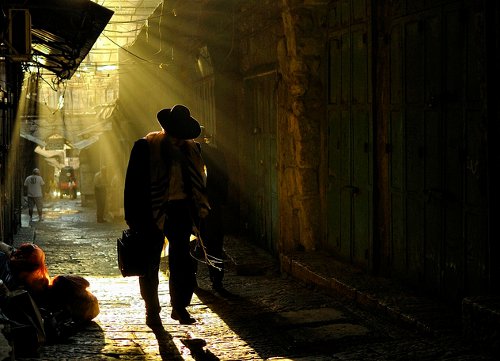
My wife read to me from one of the email newsletters she gets periodically, probably from Chabad, about the signs you see on Israeli buses to “stand for the elderly.” The signs are used to indicate certain seats that are set aside for older people or anyone else who would have trouble with mobility or standing for long periods of time. The irony, as pointed out in Grossman’s article, is the “collision” between the holy and the secular. Even though the majority of Israel’s Jewish population isn’t religious, the Torah and the intent of God cannot be so easily removed from being Jewish.

In quoting Leviticus 19:32, my wife made the same sort of remark as Grossman did in his news story. Then she said an interesting thing. She said that, for a Jew, it is impossible to separate loving and obeying God with being good to other human beings. She quoted from a teaching of the Baal Shem Tov (which I don’t have immediately available to me) to support this point.

I agreed with her and remarked that I often say the same thing, however I declined to mention that my source is from a different teacher:

“Teacher, which is the great commandment in the Law?” And he said to him, “You shall love the Lord your God with all your heart and with all your soul and with all your mind. This is the great and first commandment. And a second is like it: You shall love your neighbor as yourself. On these two commandments depend all the Law and the Prophets.” –Matthew 22:36-40 (ESV)

As far as I can tell, Jesus is saying the same thing: Loving God means loving human beings. You can’t separate the two. If you say you love God and you hate people, something is wrong with your love for God.

But it’s not easy to love other people, at least not all other people. After all, who gets along with everyone all of the time? I don’t. And yet Paul added some commentary (midrash on Torah, perhaps) that speaks to this very issue.

Repay no one evil for evil, but give thought to do what is honorable in the sight of all. If possible, so far as it depends on you, live peaceably with all. –Romans 12:17-18 (ESV)

Oh snap! Really?

Going to verses 20 and 21, Paul adds, “…if your enemy is hungry, feed him; if he is thirsty, give him something to drink; for by so doing you will heap burning coals on his head.” Do not be overcome by evil, but overcome evil with good. It almost sounds like Paul is connecting his message to the Romans back to what the Master said in Matthew 25:31-46. If so, then giving food and drink to our “enemies” and not just our friends, is the same as feeding a hungry and thirsty Jesus. Does that mean we will be rewarded for serving our enemies as if we were serving Christ?

That’s a startling thought.

So doing good to others, even if you don’t want to, and even if they’re your “enemy” (in this context, it means a person you don’t like, not someone who is trying to kill you in war) is a very Christian value. And yet we see it is also very Jewish.

But more importantly, it just isn’t Christians being good to Christians and Jews being good to Jews:

“They said of Rabbi Yochanan ben Zakai that no man ever greeted him first, even idol worshippers in the market” [i.e., Rabbi Yochanan ben Zakai was the first to greet every person, even idol worshippers] (Berachot 17). At the same location the sage Abaye advocated soft speech and words of peace to everyone, especially including idol worshippers.

“[it is proper to] support the idol worshippers during the sabbatical year… and to inquire after their welfare [commentators: even on the days of the holidays of their idols, even if they do not keep the seven Noahide commandments] because of the ways of peace.” (Shevi’it 4,3)

The rabbis taught: ‘We support poor Gentiles with the poor people of Israel, and we visit sick Gentiles as well as the sick of Israel and we bury the dead of the Gentiles as well as the dead of Israel, because of the ways of peace.” (Gitin 61a)

I “borrowed” those quotes from an older blog post of mine called What the Talmud Says About Gentiles, Revisited as a reminder of who is the root and who is the branch.

Lately, I’ve been writing about why loving isn’t easy and why we should love even a person who leaves the faith and becomes an atheist. Quite the opposite of what you’d expect, religious people have the toughest time loving each other and especially loving people who are different in their religious orientation than they are. In spite of the supposed similarities between Christians and Jews (Judaism being the foundation of Christianity), we have a very hard time being civil with each other on certain occasions.

The conversation going on right now at Gene Shlomovich’s blog Daily Minyan is one minor example. Actually, the transactions are pretty civil for the most part, especially when I recall the verbal “blood bathes” I’ve witnessed in the past. However, even between Gentiles and Jews who are all disciples of the Jewish Messiah, we have a long way to go.

And yet God tells us that if we love Him, we must love other people, even if we don’t always like them. The next time you are tempted to think of yourself as especially holy and righteous, recall the last time when you had thoughts and feelings of disrespect and hostility for your fellow human being.

Maybe we can rescue some feelings of humility from this experience.

Hadassah and the King

The Queen Esther daughter of Abihail wrote, along with Mordechai the Jew, with full authority to ratify this second letter of Purim. Dispatches were sent to all the Jews, to the hundred and twenty-seven provinces of the kingdom of Ahashuerus – [with] words of peace and truth – to establish these days of Purim on their [proper] dates just as Mordechai the Jew and Queen Esther had enjoined them, and as they had confirmed upon themselves and their posterity the matter of the fasts and their lamentations. Esther’s ordinance confirmed these regulations for Purim; and it was recorded in the book.Esther 9:29-32

I love a happy ending, don’t you? With Purim only a few days away, Jews all over the world are getting ready to celebrate one of the most joyous occasions on their annual calendar. As with many Jewish celebrations, there will be plenty of good and sweet things to eat, lots of laughter and happiness and, on this particular occasion, practical jokes, dressing up in costumes, and generally acting silly. What better way to announce to the world your happiness at not being exterminated as a people?

However, there’s another aspect to Purim that isn’t generally mentioned, although it should be obvious to anyone familiar with the story of Queen Esther, or rather Hadassah, and King Ahashuerus. This wonderful victory was accomplished because they were an intermarried couple, a Jew married to a Gentile.

In today’s world there are still plenty of Hamans. Iran is threatening Israel with nuclear attack and Islamic Jihad sends suicide bombers. Skinheads still tattoo themselves with swastikas and synagogues around the world are defaced. Jews are still killed because they are Jews.

Perhaps we now have a glimmer of hope coming from an unlikely place. Intermarriages, which until now have been so troubling, now offer us opportunities and new realities.

Perhaps in all the intermarriages that are happening today, we are acquiring allies for the Jewish people. Perhaps we now have hundreds of thousands of non-Jews who are also committed to the survival of the Jewish people, its customs and teachings, and to raising Jewish children. Perhaps we have fellow travelers who appreciate the richness of our heritage and will step forward to help us combat the hatred that exists. Perhaps we will find it safer to live as Jews.

-Rabbi Geela Rayzel Raphael
“Purim and Intermarriage”
Originally published March 14, 2006 and reprinted February 27, 2012
InterfaithFamily.com

In Judaism, intermarriages are usually thought to contribute to the destruction of the Jewish people, largely through secularization and assimilation, if not downright conversion of the Jewish partner to Christianity. The non-Jewish partner, if not seen as “the enemy” when accompanying his or her Jewish spouse to the synagogue, is often considered with suspicion or maybe just a little anxiety, particularly if the non-Jew is actively Christian. Today, many Evangelical Christian congregations have completely embraced the right of Israel to exist and are strongly attempting to influence American politics in supporting Israel, but that doesn’t mean intermarriage would be welcomed by most Jews because of this.

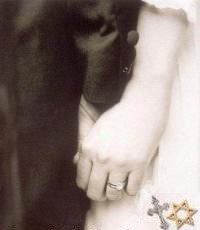
intermarriageHowever, as Rabbi Raphael pointed out, the Gentile member of an intermarriage can also be seen as an especially close ally because he or she is married to a Jew. To the Gentile spouse, the Jew is no longer an “other” or “outsider.” Jews are family. Up until a few days ago, as an intermarried husband, I hadn’t really considered celebrating Purim in any way except as a remembrance of the victory of the Jews over a moral enemy and against total annihilation. But now there’s something new to commemorate as well. Purim, for me, has become the time of year when it’s OK to celebrate the victories that can be attained through Jewish/Gentile intermarriage, even if this aspect of Purim is never mentioned in the synagogue.

Perhaps the rabbis are afraid that such an admission would amount to implied acquiescence with those who choose to intermarry today — as if an ancient historical precedent affects the decisions individuals make about love, life, and Jewish continuity in today’s secular society.

The Purim story is timeless. That is its strength.

But this timelessness is not a result of a lachrymose approach to Jewish history, in which we see enemies rise up against us time and again, regardless of where we live.

Rather, it is Esther’s relationship to Ahashuerus that catapults the story through the portals of Jewish history.

Esther and Mordechai were heroes, but so was Ahashuerus. The Purim story shows that in the face of Jewish destruction — whether it comes from the outside, as in ancient Persia, or from inside the American Jewish community — intermarriage has the potential to help us rather than destroy us, if we are willing to bring the intermarried into our Jewish family and invite them to cast their lot with our own.

-Rabbi Kerry M. Olitzky
“Purim – story of intermarriage gone right?
Jewish Outreach Institute

This isn’t to say that intermarriage has gained any greater approval in Jewish society lately or that there aren’t about a million trap doors that intermarried/interfaith families can’t fall through, but I’d also like to encourage Jews and Judaism to stop thinking of intermarriage as a road that automatically leads to disaster for the Jewish people. I’d also like to encourage Christians and the church to stop seeing intermarriage as a means of converting the Jewish spouse and children to Christianity and eliminating their Jewish identity, which can be a danger as great as any represented by Haman, may his name be blotted out. Purim is the victory of the successful joining of a Jewish wife and a Gentile husband against the forces that would eliminate all Jews from the face of the earth, a destruction I believe God would never allow.

Hadassah called herself “Esther,” hiding her Jewish heritage for a time, but when it was important, she revealed herself to her husband, the King, risking everything to save all Jews everywhere. By the time of our happy ending, Hadassah didn’t have to stop being a Jew because her husband wasn’t, and her uncle Mordechai the Jew, was elevated to the position of viceroy to King Ahashuerus. For that time in that place, Jews and Gentiles lived together in peace.

May there be peace in all the intermarried families and peace between all of God’s children, Jews and Gentiles. And may the Messiah come soon and in our days.

Purim Sameach.