
 The Jews recognized that God no longer spoke to them in the same way as in the past. The prophets who persisted in seeing heavenly visions and hearing heavenly voices saw and heard in a manner very different from those of earlier times. As a consequence (cause?) of the cessation or permutation of prophecy, the Jews began to seek the word of the Lord not from people but from texts. The sacred traditions of the past were compiled and redacted, and the Torah was created. The words of the great prophets of the past were similarly compiled and redacted. This process, whose ultimate result was the formation of the Bible, raised two important questions. First, which books were to be considered canonical? Second, how were the canonical books to be interpreted, and who was authorized to interpret them?
-Shaye J.D. Cohen
Chapter 5: Sectarian and Normative, pg 126
From the Maccabees to the Mishnah, 2nd Ed
It is one of the oldest puzzles in the world. Investigators have been wrestling with it practically since the Bible was completed. As it happens, it did not start as an investigation into the authorship of the Bible. It simply began with individuals raising questions about problems that they observed in the biblical text itself. It proceeded like a detective story spread across centuries, with investigators uncovering clues to the Bible’s origin one by one.
It began with questions about the first five books of the Bible: Genesis, Exodus, Leviticus, Numbers, and Deuteronomy. These books are known as the Pentateuch (from Greek, meaning “five scrolls”) or the Torah (from Hebrew, meaning “instruction”). They are also known as the Five Books of Moses. Moses is the major figure through most of these books, and early Jewish and Christian tradition held that Moses himself wrote them, though nowhere in the Five Books of Moses themselves does the text say that he was the author. But the tradition that one person, Moses, alone, wrote these books presented problems.
-Richard Elliott Friedman
Introduction: Who Wrote the Bible? pp 15, 16-17
Who Wrote the Bible?
Yes, this is a continuation of yesterday’s morning meditation. I was prompted by the mention of Friedman’s book on Derek Leman’s blog post to check and see if my local public library had a copy available. It did and so I checked it out over my lunch hour (I work about a ten minute walk from the Boise Public Library’s main branch).
Depending on your thoughts and feelings about the origins of the Bible we have today, this could be dangerous stuff. In fact, questioning the traditions we have about the Bible has historically been very dangerous stuff.
At the first stage, investigators still accepted the tradition that Moses wrote the Five Books, but they suggested that a few lines were added here or there. In the eleventh century, Isaac ibn Yashush, a Jewish court physician of a ruler in Muslim Spain, pointed out that a list of Edomite kings that appears in Genesis 36 named kings who lived long after Moses was dead. Ibn Yashush suggested that the list was written by someone who lived after Moses. The response to his conclusion was that he was called “Isaac the blunderer.”
-Friedman, pp 18-19
But that’s not the half of it.
He (Bonfils) still thought that the passages in question were written by “one of the later prophets.” He was only concluding that they were not written by Moses. Still, three and a half centuries later, his work was reprinted with the references to this subject deleted.
Van Maes suggested that a later editor inserted phrases or changed the name of a place to its more current name so that readers would understand it better. Van Maes’ book was placed on the Catholic Index of Prohibited Books.
De la Peyrere’s book was banned and burned. He was arrested and informed that in order to be released he would have to become Catholic and recant his views to the Pope. He did.
Spinoza had been excommunicated from Judaism. Now his work was condemned by Catholics and Protestants as well. His book was placed on the Catholic Index, within six years thirty-seven edits were issued against it, and an attempt was made on his life.
Simon was attacked by other Catholic clergy and expelled from his order. His books were placed on the Index. Forty refutations of his work were written by Protestants. Of the thirteen hundred copies printed of his book, all but six were burned.
-Friedman, pp 18-21
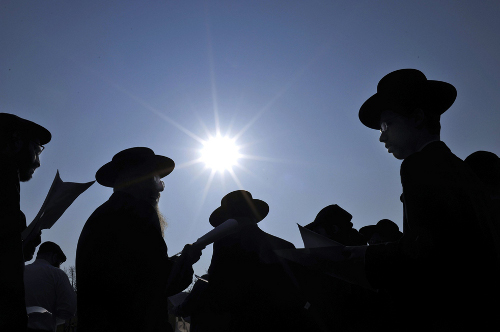 At least up to the 17th century, it was worth your life to suggest that Moses didn’t literally write every single word that appears in the first five books of the Bible. Jewish, Catholic, and Protestant tradition vehemently defended this viewpoint and if you were a scholar who studied such matters, it was better to keep any opinions that deviated from tradition strictly to yourself.
But what about now? Are we as a body of believers more tolerant of serious, scholarly study of the Bible?
The answer is probably yes and no. I don’t believe that anyone in the modern era has ever been put in prison or (gulp) executed for having non-traditional beliefs about the Bible, but you rarely hear controvertial views on scripture spoken of in a Sunday morning sermon. For that matter, how much controversy about the Bible makes its way into the Rabbi’s discussion of the Torah portion on Shabbat?
In addition to the written scriptures we have an “Oral Torah,” a tradition explaining what the above scriptures mean and how to interpret them and apply the Laws. Orthodox Jews believe G-d taught the Oral Torah to Moses, and he taught it to others, down to the present day. This tradition was maintained only in oral form until about the 2nd century C.E., when the oral law was compiled and written down in a document called the Mishnah.
-from “Torah: Oral Torah, the Talmud”
Judaism 101
Within these four methods of understanding Torah, there exist countless possible avenues of understanding. For example: There are many different ways to understand the Torah according to Peshat. That’s why there are many Torah commentators who concentrate on Peshat — Rashi, Ibn Ezra, Rashbam and many more – and they will very often (it seems, more often than not…) disagree on the literal meaning of a verse. In fact, according to Kabbalastic teachings there are 600,000 ways to understand Peshat, 600,000 ways to understand Remez, 600,000 ways to understand Drush, and 600,000 ways to understand Sod!
Any insight in Torah is acceptable as long as it (makes sense and) does not contradict any of our fundamental beliefs.
-Rabbi Naftali Silberberg
“How is the Torah Interpreted?”
Chabad.org
My wife tells me that in Judaism, one does not interpret Torah outside of tradition, so at least from an Orthodox point of view (her perspective was likely learned from the local Chabad Rabbi), it would be unacceptable practice to consider interpreting Torah from any viewpoint other than established Jewish halachah.
But what about Christianity?
The Bible is God’s Word. But some of the interpretations derived from it are not. There are many cults and Christian groups that use the Bible, claiming their interpretations are correct. Too often, however, the interpretations not only differ dramatically but are clearly contradictory. This does not mean that the Bible is a confusing document. Rather, the problem lies in those who interpret and the methods they use.
We need, as best as can be had, the guidance of the Holy Spirit in interpreting God’s Word.
Because we are sinners, we are incapable of interpreting God’s word perfectly all of the time. The body, mind, will, and emotions are affected by sin and make 100% interpretive accuracy impossible. This does not mean that accurate understanding of God’s Word is impossible. But it does mean that we need to approach His word with care, humility, and reason. Additionally, we need, as best as can be had, the guidance of the Holy Spirit in interpreting God’s Word. After all, the Bible is inspired by God and is addressed to His people. The Holy Spirit helps us to understand what God’s word means and how to apply it.
On the human level, to lessen the errors that come in our interpretations, we need to look at some basic biblical interpretive methods. I’ll list some of the principles in the form of questions and then apply them one at a time to a passage of Scripture.
-Matt Slick
“How to Interpret the Bible”
Christian Apologetics and Research Ministry
You can click on the link I provided to read Mr. Slick’s ten principles for interpreting the Bible and everything else he has to say. I selected this resource basically because it was at the top of the Google search results for the “how do christians interpret the bible” search string. However, Mr. Slick and the carm.org web site don’t address the role of tradition in interpreting the Bible (except unintentionally by mentioning more than once that in Christian tradition, the Holy Spirit is required and considered always available to interpret the Bible).
How the Bible is translated from its ancient languages to English, for example, is driven by theology and tradition. Consider how Christian and Jewish translators address the text of the “Old Testament” let alone how they interpret its meaning. Sure, for the most part, reading a Christian Old Testament and a Jewish Tanakh will produce a similar experience, but it won’t be identical. Also consider, for example, how the text of Isaiah 56 is interpreted between Christians and Jews. Christianity largely believes that the Messiah, that is, the Christ, is being described, while its traditional in Judaism to say that Israel itself is the “suffering servant.”
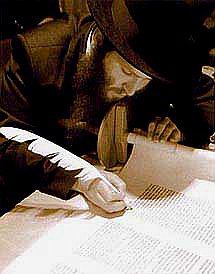 Not only is the origin of the Bible understood by various traditions, but what the text is supposed to mean is also interpreted in that manner, at least for the most part. I don’t doubt that there are certain individuals who are willing to take a wider look and a less dogmatic approach to the Bible, and certainly there are numerous scholars who will broach the subject of the authorship of the Bible, but how many of us, the “rank and file” of the church (or synagogue) are willing to take such a risk?
I say “risk” because if we aren’t able to detach our traditions from our faith, at least temporarily, in the study of the Bible, then we are likely to find ourselves approaching the edge of a very steep precipice and risk falling into the abyss of crisis. For some people, faith hangs in the balance.
But so does enlightenment. Frankly, if your faith can’t stand being shaken up a time or two, it probably isn’t very strong. Also, no one grows spiritually by playing it safe. Sure, it’s comfortable, and nice, and warm, and cozy inside the cocoon of tradition and pre-programmed belief systems, but who we are as disciples of the Master requires a modicum of courage at a minimum. Paul commended the Bereans (Acts 17:11) for examining the scriptures daily in order to verify what Paul was teaching. Can we do any less when addressing the scriptures themselves, including their sometimes mysterious authors?
Some people who do this, exit faith completely, unable to reconcile their relationship with God with the dissonance about the Bible. Some people abandon critical examination of the Bible and retreat into their former comfort zone, manufacturing some explanation about why such an examination is in error if not heretical. But some people actually grow.
I’m finding that Cohen’s and Friedman’s books seem to work well when read in parallel. However, it is important (to me, anyway) to stay grounded in the world of faith and not to stray too far into the area of objectification of the Bible. I still “just plain read” the Bible every day and more recently, I go to church every week. Every other week, I meet with a friend who has been a Christian for forty years. All this acts as an anchor on the shore as I also choose to explore deep (well, deep for me) waters.
In his book (Chapter 5), Cohen writes:
Judaism is a relativistic construct of human beings, and no variety of Judaism is any more correct or authentic than any other. This is the perspective of the historian.
Judaism is a body of absolute truths revealed by God and/or sanctioned by tradition, and those interpretations of Judaism that are more nearly approximate these absolute truths are truer and more authentic than those that do not. This is the perspective of the believer.
Following those definitions, of himself, Cohen writes:
In this book, I write as a historian.
I can see how the above definitions can be applied to how we view Christianity as well as Judaism, so it is possible to look at the Bible and its origins from either the historian’s or the believer’s point of view. I’m a believer but it is my opinion that my life as a believer can be enhanced by also looking at the Bible as a historian (with the aid or real historians and scholars such as Cohen and Friedman). It’s an adventure and as such, it presents a set of challenges and dangers.
If that doesn’t scare you off, I invite you to participate in the adventure along with me as I continue to read and comment upon Cohen and Friedman and their revelations about the Bible, tradition, history, and faith. May we all learn together and may we all draw closer to the One who is the Author of our lives and the Lover of our souls.
 Morning Meditations