
 Israeli Prime Minister Benjamin Netanyahu told President Barack Obama he’s willing to make some compromises to achieve peace in his nation, but that returning to Israel’s 1967 borders is not an option.
Netanyahu met with Obama in Washington, D.C., Friday, on the heels of the president’s public call to return Israel to the borders the state held before the 1967 Six Day War, as a concession for peace with the Palestinians.
CBN News Story
“Netanyahu Tells Obama 1967 Borders ‘Indefensible’
by Jennifer Wishon
My companion attacks his friends;
he violates his covenant.
His talk is smooth as butter,
yet war is in his heart;
his words are more soothing than oil,
yet they are drawn swords. –Psalm 55:20-21
On Tisha B’Av, five national calamities occurred:
- During the time of Moses, Jews in the desert accepted the slanderous report of the 10 Spies, and the decree was issued forbidding them from entering the Land of Israel. (1312 BCE)
- The First Temple was destroyed by the Babylonians, led by Nebuchadnezzar. 100,000 Jews were slaughtered and millions more exiled. (586 BCE)
- The Second Temple was destroyed by the Romans, led by Titus. Some two million Jews died, and another one million were exiled. (70 CE)
- The Bar Kochba revolt was crushed by Roman Emperor Hadrian. The city of Betar — the Jews’ last stand against the Romans — was captured and liquidated. Over 100,000 Jews were slaughtered. (135 CE)
- The Temple area and its surroundings were plowed under by the Roman general Turnus Rufus. Jerusalem was rebuilt as a pagan city — renamed Aelia Capitolina — and access was forbidden to Jews.
-Rabbi Shraga Simmons
“Overview and laws of the Jewish national day of mourning”
Aish.com
I sometimes wonder what keeps the Jewish people going. I know, the “politically correct” answer is “God”, but think about it. You are Israel. You are surrounded by nations who have wanted to completely destroy you since the day you arrived in the modern world. Within your ancient and historic borders is a people group who demands that you give up more and more of your land and if you don’t, they’ll keep on killing your citizens. Even your biggest “ally”, the United States, for decades has continued to demand that you “give up land for peace”, even when you’ve already shown (think Gaza) that doing so only results in more terrorism; the opposite of peace.
Not only does the world hate Israel, the world hates Jews. Anti-Semitism is on the rise in Sweden, Anti-Semitism is on the rise in Canada, Anti-Semitism is on the rise all over the world.
If you’re a Jew, you’re not really safe anywhere. Sooner or later, someone is going to turn on you.
Why go on?
You can sort of see why assimilation has always been a forbidden but attractive alternative for Jews in the diaspora. Tisha b’Av is a reminder of just how much the world hates the Jews and how many times throughout history, everyone else has tried to kill the Jews; to wipe them out of existence.
Why go on? Why not either give in and let the world have their way, or assimilate and quietly disappear into the pages of history, as so many other ancient people groups have done (ever hear of a Canaanite, a Hittite, or an Edomite anymore)?
Why go on?
In the times of the First Temple lived very lofty souls. It was their thirst for spiritual ecstasy that led them to worship foreign gods.
Thousands of years later, the holy Ari taught, in the 500 years of forced conversions from the Crusades until the Spanish Expulsion, these souls returned so they could be repaired.
Many of the martyrs of that time were men of reason—and for a philosopher to give his life for the sanctity of G–d’s name is a very great test. Many did, and so they were healed.
When the Ari came, however, he revealed the secret wisdom and repaired the world so that all souls were healed and no repairs were left to be made. It follows that all the suffering of the Jewish people since the Ari are neither punishment nor repair. If so, what are they?
We do not know.
One thing we do know: That we do not know.
-Rabbi Tzvi Freeman
Based on letters and talks of the Rebbe, Rabbi M. M. Schneerson
“Beyond Punishment and Repair”
Chabad.org
Were you hoping for something more uplifting? So was I.
I’m not Jewish, so I lack any real understanding to be able to answer the question. The  only thing I know is that the Jews have endured and they continue to endure. Is it God’s will that the Jews should continue to exist and that they should also continue to suffer?
“I know, I know. We are Your chosen people. But, once in a while, can’t You choose someone else?” -Teyve from the film Fiddler on the Roof (1971)
There are times when individuals get so discouraged they want to give up. Some quit their jobs, some get divorced, some simply withdraw into themselves and we call that depression, and some do the ultimate “quitting” by committing suicide. In these cases, the people involved feel trapped and alone and hopeless. Whether it’s true or not, they feel like everyone is against them and that there’s no where to turn. They feel out of control of their environment and their lives and they want to make the pain stop.
They’re willing to do anything to make the pain stop because life doesn’t make any sense.
I know you’re reading this a day later, but I’m writing this on Tisha b’Av. I know that hope is supposed to be mixed in with mourning and loss, but mourning and loss are a vital and inescapable element on the 9th of Av. The hunger of fasting is a reminder of how empty the world is of justice and mercy:
“Blessed are the poor in spirit,
for theirs is the kingdom of heaven.
Blessed are those who mourn,
for they will be comforted.
Blessed are the meek,
for they will inherit the earth.
Blessed are those who hunger and thirst for righteousness,
for they will be filled.” –Matthew 5:3-6
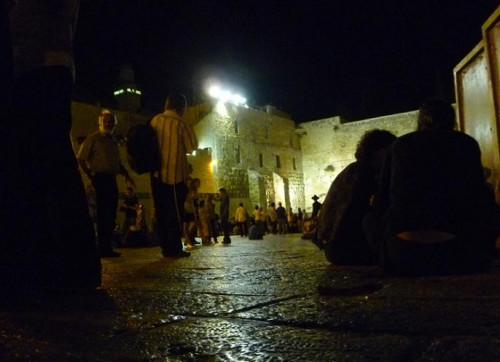 The Master might as well have been talking about Tisha b’Av…or about life.
Maybe the only answer is the one provided by the Rebbe as interpreted by Rabbi Freeman at Chabad.org:
We are imprisoned because we have exiled our G-d.
As long as we search for G-d by abandoning the world He has made, we can never truly find Him.
As long as we believe there is a place to escape, we cannot be liberated.
The ultimate liberation will be when we open our eyes
to see that everything is here, now.
If the Jews are in exile, if the Jews suffer and mourn, God suffers and mourns with them. They aren’t alone. Even in torment, they are never alone. However, based on the words of Jesus quoted above, does that also apply to the rest of us? In mourning, where is our promised comforter? In sorrow, where is our peace?
Remember my affliction and my wandering, the wormwood and bitterness.
Surely my soul remembers
And is bowed down within me.
Therefore I have hope.
The LORD’S lovingkindnesses indeed never cease,
For His compassions never fail.
They are new every morning;
Great is Your faithfulness.
“The LORD is my portion,” says my soul,
“Therefore I have hope in Him.”
The LORD is good to those who wait for Him,
To the person who seeks Him.
It is good that he waits silently
For the salvation of the LORD. –Lamentations 3:19-26 (NASB)
As it is said, every descent is for the sake of an ascent, and so we have this Kabbalistic interpretation of Tisha b’Av from Rabbi Yitzchak Ginsburgh:
The Seer of Lublin passed away, at the age of 70, on the 9th of Av 5575 (1815), a day of national mourning, but also, according to the sages, the birthday of the Mashiach. Long before his passing he hinted to his followers that he would pass away on the 9th of Av.
The passing of the Seer of Lublin joins together with the “passing” of the Divine Presence from the Holy Temple in Jerusalem on the 9th of Av (the day of the destruction of the Temple – only its physical body “died” but its soul ascended to heaven) to arouse God to bring the Mashiach (who will permeate reality with Divine revelation, bringing redemption, peace and goodness to all) – now!
 Morning Meditations