
 The following paper is based on a faculty workshop given by the writer on October 25, 1971, in a faculty meeting at Faith Baptist Bible College. Frequent questions by students in the area of the sovereignty of God have prompted the writer to put his notes into a more permanent form. Although recognizing the differences that exist among evangelicals, the author believes that the position stated herein approximates most closely the Biblical and historical Baptistic view. This paper must not be construed a the official position of the school. However, it is sent forth with the prayer that it might generate more light than heat and be found profitable by the ever inquiring students…
-Manfred E. Kober, Th.D.
“Divine Election or Human Effort?”
Pastor Randy gave me a copy of this paper during our Wednesday night talk last week and I’m just now getting into it. I’ve read the first two chapters (17 pages) and can’t restrain my response any longer. I’ll write more as I progress through the 50+ pages of Dr. Kober’s paper and hopefully I too will generate “more light than heat.”
Before proceeding, a few things. First of all, I told Pastor Randy that I tend to think of myself as a “generic Christian with a Jewish twist” rather than align with a particular denomination, Baptist or otherwise. I also believe it’s quite possible to be a perfectly well-functioning Christian without declaring to be an Arminianist or a Calvinist. After all, these are systems constructed by theologians and honed by other theologians over the course of many centuries. Sure, they’re both based on scripture, but they are derived from scripture; interpreted from scripture. That doesn’t mean that either system is presupposed by scripture, let alone God. I could wad up both Arminianism and Calvinism in all their variations like so much waste paper and toss them into the trash can, then move on to other matters. My existence as a disciple of the Jewish Messiah does not hinge on making such a decision. Theologians, teachers, and preachers in a formal Christian sense must come up on one side or another but as a plain old “vanilla” Christian, I don’t.
Now on with the show.
The primary task for a theologian is to interpret God’s Word for man. But interpretation is both an art and a science. This means that any exposition of the Bible is guided by specific rules and checks which guard against personal whims and prejudices of the interpreter. The application of these rules demands the greatest care in judgment that the godly and dedicated interpreter can bring to bear upon the text. In that sense interpretation is an art.
-Kober
“Chapter 1: The Duty of the Theologian,” pg 1
I can grasp the science of Biblical translation and interpretation but we must admit that it is the “art” that makes things elusive and ambiguous on occasion. If theology was an “exact science,” we wouldn’t have so many different ideas about what the Bible means. Or would we? After all, even a hard science such as astronomy contains many varying points of view on phenomena we can observe through the electromagnetic spectrum, and sometimes what we see can surprise us and challenge our long-held positions.
Kober has already somewhat contradicted himself (I’m sure he doesn’t see it quite that way and I am stretching my interpretation of “contradicted” a bit) by saying in the introduction that he’s presenting his material from the “historical Baptistic view” and in Chapter 1, he says that the science of Biblical interpretation follows rules and checks “which guard against personal whims and prejudices.” Maybe those rules and checks guard against the interpreter’s personal bias, but what about the bias built into the “historical Baptist view?”
Which aspect of salvation does God the Holy Spirit accent? Is it God’s sovereignty in salvation or the effort of man?
-Kober, pg 2
I’m crying “foul” here. Kober makes it sound like the question at hand is “Does God save or do people save themselves?” Not being a Calvinist, I can still agree that God and only God saves, but the question is, do human beings have any ownership of the process at all. It is God’s “effort” that saves, all a human being has to do is to effectively surrender to God. Is surrender an “effort?” Why do we have to be so “either-or?”
This is something of a side note, but I couldn’t resist finding the following statement somewhat ironic.
Frequently, one encounters a strangely resigned attitude on the part of believers toward certain areas of God’s truth, especially that of election, such as “Oh, well, we will know it all by and by!” This is true of course. But the point is that God has revealed more about His majestic plan of redemption than Christians sometimes realize.
-Kober, pp 2-3
 Given the multitude of blog posts I’ve just written giving my own interpretation of how Messianic Judaism understands God’s revelation of His “majestic plan of redemption,” I wonder what Dr. Kober would say to the suggestion that he, like the Christians he references, may be unconscious of certain viewpoints on the redemption and salvation of Israel as well as the people of the nations called by God’s Name as presented from outside his own framework?
But back to the main focus on this “meditation.”
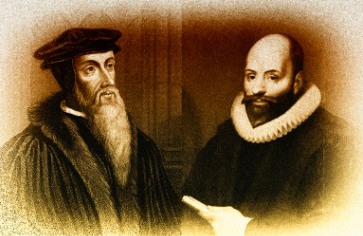
There are two basic ways of approaching the doctrine of salvation. One way is to stress the importance of man and his free will to choose for or against christ; this school of interpretation is called Arminianism, named after James Arminus. The other way of approaching salvation is to stress the importance of God and His sovereign will in bringing men to Himself through Christ; this school of Interpretation is called Calvinism, named for John Calvin. It is unfortunate that one must call himself an Arminian or Calvinist but for theological purposes every Christian is either one or the other.
-Kober
“Chapter 2: The Decrees of God,” pg 4
Is it better to be feared or respected? — I say, is it too much to ask for both?
-Tony Stark (Robert Downey Jr)
Iron Man (2008)
When you come to a fork in the road, take it.
That’s kind of my resolution to the problem in a nutshell, and it’s way too early to tip my hand, but I’m doing it anyway. I know people reading this blog post will probably classify me as an Arminian because I’m not a huge fan of God running roughshod over humanity, approving this one for salvation and tossing that one into the fires of the damned for all eternity without so much as a by your leave.
On page 4 of the paper, Kober quotes J.I. Packer saying:
The difference between them is not primarily one of emphasis but one of content. Once proclaims a God who saves; the other speaks of a God who enables man to save himself.
Again, I cry foul because Packer, like Kober, is looking at the picture as an “either-or” equation. Either God is supremely sovereign and saves who He wills and condemns who He wills, all outside the awareness let alone the consent of the people involved (you are saved or “unsaved” before you are ever conceived and born and draw your first breath of life according to a Calvinist) or God has handed some sort of authority over to the human who then does the job of saving himself. It’s not that concrete a choice.
I suppose I’ll be busted because I can’t point to a part of the Bible that says “it can be both” but is that entirely true? I’m going to try to find out and then show you some examples but let me introduce something first.
Jacob was left alone; and a man wrestled with him until daybreak. When the man saw that he did not prevail against Jacob, he struck him on the hip socket; and Jacob’s hip was put out of joint as he wrestled with him. Then he said, “Let me go, for the day is breaking.” But Jacob said, “I will not let you go, unless you bless me.” So he said to him, “What is your name?” And he said, “Jacob.” Then the man said, “You shall no longer be called Jacob, but Israel, for you have striven with God and with humans, and have prevailed.” Then Jacob asked him, “Please tell me your name.” But he said, “Why is it that you ask my name?” And there he blessed him. So Jacob called the place Peniel, saying, “For I have seen God face to face, and yet my life is preserved.”
–Genesis 32:24-30 (NRSV)
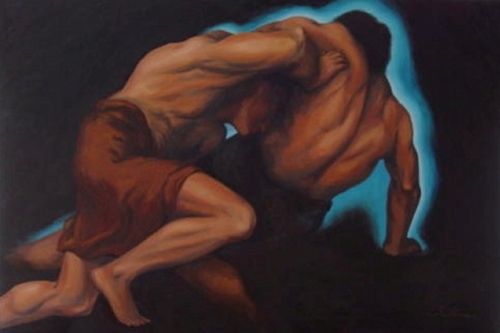 The name “Israel” can be interpreted a number of ways, but one common meaning is one who struggles with God and prevails (wins). If Jacob struggled with a personified God or an angel of God, logic tells us that a flesh and blood mortal cannot hold his own let alone defeat a supernatural being, particularly if that being is literally the Creator of the Universe or some incarnation of Him.
In some areas of Judaism, it is thought that Jacob’s struggle with God is a picture of how the Jewish people struggle with the difficulties of understanding God’s perfection in an imperfect world. I’ve sat in a local synagogue and listened to the Rabbi disagree with another person’s understanding of God’s sovereignty and say something like “I’m willing to struggle with God on this one.” (not an exact quote)
What if the difficulties we have with the doctrine of salvation are built into the text of the Bible and built into our lives as believers so we can “struggle with God” over them and our relationship with Him? I’m not saying it has to be that way, but it seems like Christians always want definite “either-or” answers to all of the difficult sayings in the Bible, while many religious Jews are willing to live in a state of uncertainty on certain matters, “wrestling with God” over them.
Six million Jews were slaughtered in Hitler’s Holocaust. Many of the Jewish survivors lost their faith and turned their backs on God, and from a human point of view, this is understandable. But many other Jewish survivors found a stronger faith in God as they moved forward with their lives, ultimately raising children and grandchildren with that same abiding faith. How were they able to “wrestle with God” over a seemingly enormous injustice committed or at least allowed by God against His treasured, splendorous people?
Because Arminius was not the systematic theologian that John Calvin was, he did not clearly define his thinking on salvation. As a result, the followers of Arminius distorted his system with views Arminius simply did not hold.
-Kober, pg 5
While this can be taken as a statement of fact regarding the relative backgrounds of Arminius and Calvin, it also reveals (again) the writer’s bias. He is predisposed to select Calvinism over Arminianism, so you could say the paper I’m reading is hardly a balanced and objective examination of the two viewpoints. Nevertheless, I choose to believe that Kober is an honest person who is just trying to “clear the air” about this debate. It doesn’t mean I have to accept the either-or premise of his argument, though.
As I’ve already mentioned, I have a problem with “either-or” and believe that, on some level, the answer can be “both.” While most people may not think of it this way, by “forcing” a decision about God’s thoughts and actions, even based on scripture, we assume that we can know God’s process and intentions to an absolute or at least reasonably knowable and concrete degree, then drag it down from Heaven, so to speak, and into the realm of human understanding at ground level.
It’s almost arrogant to say that the “mechanism” of salvation cannot be mysterious on any level and that we can wholly know all of the little nuts and bolts about how God “does it.” Actually, even the author must admit that we are rather “slippery” on just how many screws God used to put salvation together, and what type of battery he powers the thing with (I’m speaking metaphorically, of course). I’ll get to that tomorrow.
On page six, in describing the “five points of Arminianism,” Kober says, “The faith which God foresaw and…” This wouldn’t be the last time Kober would say or intimate that from the point of creation or before (if “before,” “during,” and “after” have any meaning to God), God looked into the future and saw what was going to happen, like some cheap fortune-teller wielding a crystal ball and some Tarot cards.
 I wrote a response to this idea in relation to Calvinism about a month ago and suggested that God exists outside of time and thus is not subject to its passing as we are. Unlike human beings, God isn’t “trapped” in a little pocket of linear time being carried forward one day at a time whether He wants to be or not. I can’t prove this, but it makes sense (to me anyway) for God to “experience” all of “timespace” as a single instantaneous event, as if everything from the creation of the earth, to Moses parting the Reed sea, to the giving of the Torah at Sinai, to David seeing Bathsheba bathing on a rooftop, to the first birth cries of Mary (Miriam) as Jesus is about to leave her womb, to Jesus breathing his last on the cross, to the first crusade, to the first inquisition, to the first ship to sail to the new world, to the first footstep of man on the moon, as if all those events, and everything else, were happening simultaneously.
God doesn’t “foresee” anything. He just knows because all of Creation from alpha to omega is before Him always. It’s only from our point of view that, when God chooses to touch a specific moment within Creation, we human beings experience God within the context of linear timespace.
Which may be part of the “solution” to the “either-or” problem of God’s Sovereignty vs. Man’s free will. Remember, as Kober writes his paper, he’s the observer. His readers are the observers. We are all the observers of God and it’s our point of view we depend upon. We experience choice and free will because that’s what it looks like from down here. We’re powerless to glean even a hint of God’s perspective and who knows what all this looks like as He sits enthroned in the Heavenly Court?
I have no problem with God being ultimately sovereign and at the same time with humanity experiencing a sense of “partnership” with God in the affairs of the world and in the workings of our lives.
This blog post took on a life of its own and I had to split it into two parts. I continue my discussion of Chapter 2 of Dr. Kober’s article in tomorrow’s morning meditation.
114 days.




 Morning Meditations