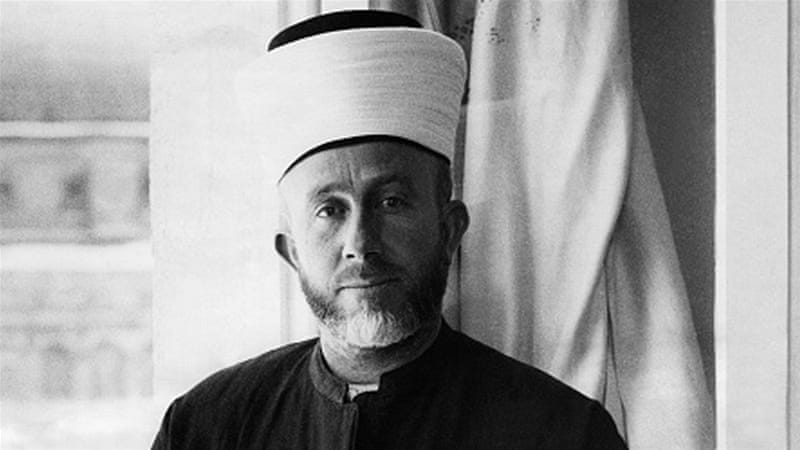
Mohammed Amin al-Husseini, Mufti of Jerusalem, 1937 [Getty]There is no place in Palestine for two races. The Jews left Palestine 2,000 years ago. Let them go to other parts of the world where there are wide vacant places.” –Amin al-Husseini, 1936
And that, in a nutshell, is why there will never be a two-state solution, not because Jewish Israel hasn’t been bending over backwards trying to agree to one, but because the Arab leadership will never accept it. They never have from the start.
By the way, just because I stuck in that link from ForeignPolicy.com doesn’t necessarily mean I agree with their opinion. It was just handy.
I’ve decided this will be the fourth and last installment in my “Israel is Jewish” series. Here are the other three:
Of course, what started it all was the wee piece Israel is NOT an Apartheid State or an “Occupier” : A Beginning. I’m getting sick and tired of bullies who manufacture “war crimes” and “human rights crimes” against Israel in the service of exterminating the Jewish citizens of the Jewish state.
So let’s talk about “the occupation.” In order for the Jews to “occupy” Arab “Palestine,” there had to be an Arab Palestinian people in the first place. Were there ever such a people?
Before that, going to the quote from Amin al-Husseini, did the Jews completely abandon “Palestine” for a full 2,000 years?
As it turns out, there has always been a Jewish presence in the Land, regardless of who the conqueror was at the time. Sometimes the population was larger than others. Sometimes Jews were allowed to return to their Land in great numbers. There was even a time when the Jewish population started planning the construction of a third Temple. Other times, they were driven out so that only a few thousand remained. But they remained.
Both in David Brog’s book Reclaiming Israel’s History: Roots, Rights, and the Struggle for Peace and at BesaCenter.org, we see that between the destruction of the Second Temple in 70 C.E. and the forming of the modern state of Israel in 1948, Jews have always lived in their ancestral land, so no, they didn’t abandon Israel for 2,000 years. They were just the victims of an endless sea of occupiers.
So what about the Arabs? Were they the ones in charge? Depends on who you ask. The site ancient.eu covers some of it, but not in enough detail, at least not during the time frame I’m examining.
After the Romans, there were the Byzantines. Then starting in the Middle Ages you had the Rashidun, Umayyad and Abbasid periods, the Fatimid period, the Crusader period, the Ayyubid and Mamluk periods, and then there was the Ottoman period.
That ended only with British rule. During that time, while the Jews always clung to their Land as their ancient inheritance, from an Arab perspective, it was simply a part of southern Syria and they, the Arabs, were whoever the conquerors were. For instance, from the 15th century onward, they were Ottomans, not Palestinian Arabs. If anything, they would have more identified as Syrians.
So at no time did “Palestinian Arabs” come on the radar until the 20th century, and it wasn’t seriously considered and then claimed until after the Six-Day War in 1967, nearly 20 years after the formation of modern Israel.
Even in the early 20th century, before World War Two, the Zionists who had planned a Jewish return to “Palestine” were determined to displace no Arabs at all, and sought only to live in unclaimed land, mainly the Negev which was an unpopulated desert.
As I said before, if the Arabs had accepted the British partition plan in 1948, they would have had a “Palestinian homeland” and there would have been exactly zero Palestinian refugees. However, instead, they decided to wage a “Civil War” against their Jewish neighbors the day the State of Israel was born, and after the British mandate ended, many other Arab nations came across the border for the purpose of making sure a Jewish state would never exist.
Up until the late 1960s, the concept of a Pan-Arabism was one of the primary forces behind opposing the continuance of Israel. While the concept of an “Arab Palestine” didn’t exist as such, the Arab nations believed that the entire Middle East should be one, single Arab domain. No room for other people groups, particularly Jews.
Only after 1967, when the Pan-Arab dream was abandoned, did the Arabs in and near Israel consider themselves “Palestinian.”
So you see, it’s pretty hard to say that the Jews displaced Palestinian Arabs when such an entity did not exist. Also, even after the 1948 war, there were still Arabs in abundance who hadn’t left and they were welcomed in Israel.
The history is long and complex, but the Jews have always been willing to share. The Arabs, or at least their leadership, were absolutely opposed.
In his book, Brog coins the phrase, the “Five Nos.” There were the five primary occasions where Palestinian Arabs were offered deals that included their own sovereign land, each offer being sweeter than the last. Each and every time, they said “No.”
Camera.org says the Palestinians said “No” only three times:
The original UN Resolution 181, the Partition Resolution, passed in November 1947, called for the creation of a Jewish state and an Arab state in the land which at that point was controlled by the British-run Palestine Mandate. We know about that one. The Arabs decided to kill the Jews instead.
In the summer of 2000 US President Bill Clinton hosted intense peace talks at Camp David between Palestinian leader Yasir Arafat and Israeli leader Ehud Barak, culminating in a comprehensive peace plan known as the Clinton Parameters, which was similar to the later Olmert Plan, though not quite as extensive. Despite the vast concessions the plan required of Israel, Prime Minister Barak accepted President Clinton’s proposal, while Arafat refused, returned home, and launched a new terror campaign against Israeli civilians (the Second Intifada).
In 2008, after extensive talks, then Israeli Prime Minister Ehud Olmert met with Palestinian President Mahmoud Abbas and presented a comprehensive peace plan. Olmert’s plan would have annexed the major Israeli settlements to Israel and in return given equivalent Israeli territory to the Palestinians, and would have divided Jerusalem. This was the single most generous offer Israel could possibly make and Abbas still said “No.”
Brog is counting the 1937 partition plan based on the Peel Commission’s recommendation that less than 20% of Palestine be set aside for the Jews. In spite of the inequity of the offer, the Jews jumped at the chance. Not so the Arabs.
He also adds the aftermath of the 1967 Six-Day War. In spite of the security concerns, Israel returned the Sinai to Egypt and the Golan to Syria. Israelis were divided on whether to return the West Bank to Jordan or to empower the Palestinian inhabitants to govern themselves.
Brog states:
These dreams of peace were quickly dashed. In late August 1967, the Arab League met in Khartoum, Sudan, and adopted a hard anti-Israel line. Among the resolutions these Arab states approved was one specifying that there would be “no peace with Israel, no recognition of Israel, no negotiations with it.” The West Bank Arabs who had been negotiating with Israel decided to fall in line and their talks ended.
It seems that as far as establishing an Arab Palestinian “homeland,” the Arabs are their own worse enemies, at least as long as they are determined to be the enemy of the Jews.
It’s interesting to note that at the 2000 Ehud Barak, Bill Clinton, Camp David peace summit, time after time Yasser Arafat continued to say “No” to each offer, without proposing a counter-offer or giving any details about why he was refusing. Brog records:
Arafat didn’t accept Barak’s offer. Nor did he make a counteroffer. He simply let the clock run out. At the close of the summit, President Clinton “blew up” at Arafat, shouting at the Palestinian leader that he had “been here fourteen days and said no to everything.”
Based on both ancient and modern claims, the Jews do have a right to their historic lands, and even though they have tried again and again to broker a peace with the Arab population, offering them exceedingly generous deals. They have said “No,” just “no.” After Arafat, Abbas followed suit, saying “no” with no counter-offers and no explanations.
However, this series is going to end differently than I expected. I just learned that Israel and United Arab Emirates strike historic peace accord. I want to be excited. I want to say “at last.” But everything I know about the history of Palestine going back two thousand years, or even just going back a century, tells me it’s not going to be that easy. After all of the conflict and enmity between Arabs and Jews in the Middle East and the absolute Arab refusal to accept a Jewish homeland within their midst, how is it ever going to be that easy?
It’s not. To quote the FT.com article:
But the move has infuriated the Palestinians. The Palestinian leadership rejected the “surprising” announcement by the US, Israel and UAE, calling it “an assault on the Palestinian people and an abandonment of the rights of the Palestinians and the holy sites”.
See? Told you.
So, when various civil rights groups in the U.S. vandalize synagogues and Jewish businesses, painting “Free Palestine” on those structures, and perhaps feeling justified in attacking American Jews as if they are somehow responsible for the so-called “occupation,” they are most likely operating in ignorance of the facts. If they choose to ally themselves with Arab terrorists groups such as Hamas, then maybe they understand things all too well, more’s the pity.
I know none of this will convince those who have already been convinced by decades of anti-Israel propaganda, and centuries if not millennia of hatred against the Jewish people. Anti-semitism seems to be the only form of bigotry that’s acceptable when all other forms are not.
The ancient Israelites were slaves in Egypt approximately 3,500 years ago and they were reportedly enslaved for 430 years. They have suffered unspeakable losses for those thousands of years, so you’d think anyone else who feels the need to rise up against the inequities of their background would study that history and find kinship, rather than ignoring that history and condemning the Jews and their right to exist as a nation.
Addendum 8-19-2020: You see, this is exactly why the Palestinians will never consent to a two-state solution. Their leaders say any cooperation with Israel is treason, probably punishable by death. The Palestinians’ own leadership is their worst enemy, not Israel.
“Criticizing Israel is not anti-Semitic, and saying so is vile. But singling out Israel for opprobrium and international sanction out of proportion to any other party in the Middle East is anti-Semitic, and not saying so is dishonest.” –Thomas L. Friedman, 2002
I was going to make Part Three of this series address the idea of the “occupation,” but then I started reading David Brog‘s excellent book Reclaiming Israel’s History: Roots, Rights, and the Struggle for Peace. I’ve only gotten through the Preface and Introduction, but already there are so many important details to share.
To back up a step, I created this series, which includes Is There a Palestine and Israel is Not Apartheid, in response to certain actions committed during the recent protests/riots here in the U.S. Namely that synagogues and Jewish businesses have been vandalized with the phrase “Free Palestine” being prominently included in the “message.”
As the quote above suggests, you can criticize Israel as a nation and not be anti-Semitic or anti-Jewish, but the relentless and narrowly focused allegations against the Jewish state and their “crimes” against the Palestinian people, including refugees, ignores the reality that there are many more displaced people groups all over the world. We rarely or never hear of them, and according to what I’ve read so far, the Palestinian Arabs and their experiences are hardly unique historically and in the current world.
Brog tells some of the history of “Jewish Arab” nationalist Albert Memmi. As a marginalized Jew in Arab Tunisia, his efforts helped free Tunisia from French rule, but then the Arabs turned around and exiled him from his homeland because he was Jewish.
As early as 1969, Memmi was calling for a Palestinian homeland, but the irony of that cry is one had existed twenty years prior. On November 29, 1947, according to the author:
…the United Nations voted to partition Palestine into two states – one Jewish and one Arab.
In a 2011 Op-Ed piece for the New York Times, PLO President Mahmoud Abbas wrote a passionate plea to the United Nations to create a Palestinian state that for decades Israel had denied them. But such a state did exist as a legally recognized entity, just as much as “Jewish Palestine” did.
In his essay, Abbas said that the Jews started the 1948 war in order to oust the Arabs from their land. That’s a lie (politely, we’re supposed to say it’s the “Palestinian narrative”)
Brog writes:
The 1948 War began as a civil war, with Palestine’s Arabs attacking Palestine’s Jews in an effort to prevent the creation of a Jewish state.
It wasn’t about Jews taking away and occupying Arab land. The conflict, the real conflict is and always has been preventing, and now, destroying every bit of the Jewish state in the Middle East. It’s about eradicating Israel from the face of the Earth.
In 1969, in the aftermath of 1967’s “Six Day War,” Albert Memmi called for a Palestinian state to be created alongside Jewish Israel, and considering himself both Arab and Jewish, he was sincere. However, as Brog says:
From the start, Palestinian leaders linked their national liberation to the destruction of Israel. The Palestinians did not seek a state alongside the Jewish state; they demanded a state that would replace the Jewish state. In doing so, they were setting the stage for endless conflict.
But let’s go back to 1947-48 for a minute. You might be saying to yourself that by carving Palestine up in two (it’s actually more complicated than that), wasn’t it the United Nations who stole Arab land?
We could argue about the historic right of the Jews to the Land as I did in Part One and Brog does say that has to be considered in light of the lack of a Jewish presence in Palestine for so long, but remember, lands, borders, and people groups had been shifted around for centuries.
Brog covered some historical ground about World Wars One and Two, and how in their aftermath, whole populations were moved hundreds of miles away from lands they’d occupied for nearly a thousand years. Then there were the massive reshifting of national boundaries as well as the creation of brand new countries. So whether you agree or not that the Jewish state should have been created by the U.N., it was hardly a rare or unique event.
When the British Mandate for Palestine was officially ended on May 15, 1948, the civil war between Jewish and Arab Palestinians “went international,” with Egypt, Syria, Transjordan, and Iraq all attacking the tiny, newborn Jewish state.
Now, here’s the kicker:
The Arab states did not invade Israel to help the Palestinian refugees (as Abbas’s essay erroneously claimed). It was the Arab invasion that produced the Palestinian refugees. Had the Arabs accepted the UN Partition Plan and agreed to the creation of the Jewish state, there would have been a Palestinian state back in 1948. And had the Arabs accepted the partition of Palestine, there would not have been so much as one Palestinian refugee.
There’s a lot more to this history of course, and I certainly encourage you to get a copy of Brog’s book (I found one at my local public library) to discover the rest.
Now let’s return to the title of this write up. “The Creation of the Palestinian Refugee”. They weren’t oppressed and didn’t exist as refugees until the surrounding Arab nations attacked Israel and attempted to destroy them. It was the consequences of that war which created these refugees.
There’s a reason they still exist. Most refugee populations dwindle as time passes. Although there are hundreds of different people groups who have been displaced and have refugee status, the Palestinians are unique in a single detail.
After the 1948 Arab-Israeli War, the United Nations established a new organization dedicated exclusively to the Palestinian refugees: the United Nations Relief and Works Agency (UNRWA). UNRWA defines a “Palestine refugee” as anyone who was displaced by the 1948 War plus the “descendants of Palestine refugee males, including legally adopted children.” In other words, Palestinian refugees pass their refugee status to their children in perpetuity.
It’s even worse than that because any Palestinian refugee who obtains citizenship in another county is still considered a refugee…forever. Brog continues:
For example, there are approximately two million Palestinian refugees currently living in Jordan. They are all counted as refugees even though over ninety percent of these individuals are full Jordanian citizens.
The only refugee population on Earth that grows in size over time and continues to exist generation after generation, at least based on what I’ve read so far, are Palestinian refugees.
According to Israel’s Central Bureau of Statistics, the Arab population in 2019 was estimated at 1,890,000, representing 20.95% of the country’s population. The majority of these identify themselves as Arab or Palestinian by nationality and Israeli by citizenship.
Further:
Arab citizens of Israel, or Arab Israelis, are Israeli citizens who are Arab. Many Arab citizens of Israel self-identify as Palestinian and commonly self-designate themselves as Palestinian citizens of Israel or Israeli Palestinians.
Muslim: 82%
Christian: 9%
Druze: 9%
So, Palestinian refugees can live in Gaza or the West Bank, they can become full citizens of Israel (and we saw in Part Two that Arab Israeli citizens enjoy the same rights as Jewish citizens), and as we’ve seen, an additional nearly two million are citizens of neighboring Jordan.
Brog says according to the UNRWA website, when the agency began operating in 1950, there were about some 750,000 Palestinian refugees. As of the publication of his book a few years ago, that number had exploded to 5 million refugees eligible for services. He concludes this point with:
If Palestinian refugees were defined the same way as all other refugees, the number of Palestinian refugees in 2014 would be closer to 30,000.
There’s a very strategic reason for the continued existence and population growth of the “Palestinian refugee” and it seems to be to continually outrage people in many other nations on how Israel has oppressed its refugee population for decades. The goal, although the “outraged” are probably not aware of this for the most part, is to reduce and eventually eliminate the Jewish nation of Israel.
So, when (probably) well meaning U.S. protesters torch synagogues and physically assault elderly Jews men on the street, all in the name of “Freeing Palestine,” I think they are simply another expression of folks who have bought a fantasy and ignored the facts. To be fair, we all practice bias confirmation, and you would say I’m doing that right now.
On the other hand, anyone with a library card and who can read can educate themselves.
David Brog is scrupulous to point out that Israel is not a perfect nation and that Jews have committed injustices against Arabs. That said, the injustices much of the world believes Israel is guilty of aren’t factual.
I’m not writing this series to come up with some “magic” answer. People a lot smarter than I am have been approaching that for a long time. I do want to remind people, or maybe inform people for the first time, that what you see in the news and what’s actually happening are sometimes, maybe often, two different things.
Just because someone paints “Free Palestine” on the side of a Jewish deli, or breaks the windows, or assaults the proprietor, doesn’t mean they’re being just. In fact, quite the opposite. They’ve just been fooled.
"When you awake in the morning, learn something to inspire you and mediate upon it, then plunge forward full of light with which to illuminate the darkness." -Rabbi Tzvi Freeman


 Morning Meditations