Tag Archives: Christian

Cherishing Her Yiddisher Neshamah

Tonica Marlow stood looking down into the main hall of the synagogue. She couldn’t take her eyes off the rabbi or the Torah scroll he held in his hand as he faced the congregation. What am I doing here? she kept asking herself. So many times she had promised herself never to come here again, and yet here she was again, dressed in a brown wool habit, her hair covered with a brown scarf.

“Shema Yisroel Ado-nai Elo-heinu Ado-nai Echad,” the rabbi’s voice rang across the synagogue, and the congregants repeated after him. Tonica, too, found herself mouthing the words, though she knew not what they meant. She didn’t understand why her feet kept carrying her back here; but the more she came, the more she longed to hear those precious words again.

Her mother had been born a Jew, that much she knew. But then she’d converted, abandoning her Jewish faith at age 25 and marrying a gentile. Tonica, the youngest of five children, had been raised as a non-Jew. Nonetheless, the question cried out from her very soul: Who am I? It gave her no rest, the question; it tormented her, robbed her of her peace of mind.

Tonica watched as the rabbi lovingly replaced the Torah scroll into a wooden sculptured cabinet and drew the dark blue curtain over it. Then she hurried back to the theological college where she was studying to become a minister.

But she’d tarried too long; she was late for her responsibilities. The principal summoned her to his office. “Where were you?” he demanded.

“Why, I just popped into the synagogue for a few minutes,” she said.

“What?” the principal yelled. “I’m telling you, child, you are a gentile. I forbid you to go there.”

-Mirish Kiszner
“I’m Telling You, Child, You Are a Gentile
A spiritual journey: from Tonica Marlow to Tova Mordechai”
Chabad.org

I got an email announcing a beta version of the new Chabad.org website, so naturally, I clicked on the link. That’s where I found Tova’s story. I started reading it because of the provocative title (“I’m telling you child, you are a gentile”) and continued reading because it reminded me of my wife’s journey…with some differences.

Of course, my wife wasn’t studying for the ministry when she became connected to her Judaism but at the time, we were going to a church. She didn’t go to Israel for years afterwards and never lived with an Orthodox family, but the same “connectedness” was there, the same absolute “need” to be a part of the Jewish community was there for my wife as it was for Tova.

Maybe if she had started that journey at 25 instead of 45, things would have been different.

But she didn’t and they aren’t and here we are.

Tova’s story, at least as it’s rendered in this article, is very light on the details regarding her husband. If she was a Christian and studying for the ministry and she had married a Gentile, chances are that he was (and is?) a Christian, too.

I wonder what happened to him? What happened to their five children? They all live in Israel now. But who are they?

Of course, I could just buy Tova’s book, To Play with Fire, which is the chronicle of her journey from Christianity and return to Judaism. As I write these words, I realize that I probably will.

But what will it tell me about my life?

Probably not as much as I hope.
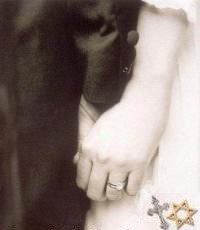
intermarriageI suppose this is a continuation my previous “meditation,” Opting Out of Yiddishkeit. It contains the same themes: identity, Judaism, intermarriage, interfaith, connectedness, and “just what the heck does God want from me, anyway?”

I was talking to my son this morning after our workout at the gym. He was asking how my Thursday afternoon “coffee meeting” went. I had taken him to one such meeting a few weeks ago with interesting results. Since the men I meet with are all believers, I think my Jewish wife thought I was trying to turn our Jewish son (though he’s not observant in the slightest right now) into a Christian.

That would not sit well with her.

I told him that his mother would be very happy if he’d start going to synagogue again, and asked how his wife would take it, since she (his wife, not mine) is seriously considering returning to church. He tells me that it would be fine with her, but then I brought up my grandson. At only age three, how confusing would it be to have his parents going in different directions?

But that brings me back to my own family and my own situation and the answers just aren’t getting any clearer. Some people would say that Messianic Judaism is the answer as the nexus of Christianity and Judaism, but it doesn’t really work that way. Why?

Sid (played by John Leguizamo): Then why are you trying so hard to convince her she’s a mammoth?
Manfred (played by Ray Romano): Because that’s what she is! I don’t care if she thinks she’s a possum. You can’t be two things.

-from Ice Age 2: The Meltdown (2006)

You can’t be two things. I don’t mean that you can’t be Jewish and have a deep, abiding, and real faith in Yeshua HaMashiach (Jesus the Christ). I mean that your identity, your culture, the very fabric of who you are, right down to the DNA level is either Gentile or Jewish. Just like Tova discovered; just like my wife discovered, you’re either one or the other. You can’t be both.

Most “Messianic Jewish” congregations aren’t all that Jewish, at least as far as I know. There are very few that have a completely Jewish synagogue identity and practice. Many, probably most, employ some aspects of a Jewish synagogue service, but largely, their identity as individuals and as a group are Gentiles who come from a strong, traditional, Christian background.

There’s nothing wrong with that, but then using the term “Jewish” becomes a misnomer. They may be a group who acknowledges the Jewishness of Jesus as the Messiah, who loves Israel, who honors the Shabbat and believes that the Torah continues to be alive and strong and incredibly present in the lives of the Jewish people today, but they aren’t Jewish.

Beth Immanuel Shabbat Fellowship is probably the Messianic congregation I’ve attended that has come closest to achieving a true Jewish synagogue identity, but I suspect that the majority of the members and the staff are still non-Jewish. Again, there’s nothing wrong with that, but what if you’re Jewish and you not only want, but you absolutely need to worship with Jews, be around Jews, and belong to a Jewish community?

I suppose like Tova, you stop being Christian and move from being Tonica Marlow to being Tova Mordechai. Or you move from being Lin to being Yaffa (my wife’s given and Hebrew names). Or, like my friend Gene, you maintain your Messianic faith, but you regularly worship with an Orthodox Jewish community.

None of this is at all easy.

I check the statistics for this blog and frankly, personal explorations such as this one just don’t capture a lot of reader interest. I don’t know why, since the stats only provide raw numbers without the attendant human motivation.

However, one of the “meditations” I wrote seems to be getting some attention recently: Fearfully in the Hands of God. Near the end of the blog post, I wrote this:

I know this sounds dismal and depressing, especially on the day when the vast majority of the Christian world is celebrating the birth of the King of Kings, but lest we imagine that God is obligated to grant us a perfect, stress free existence, the counterpoint is that we are but dust and ashes; we are grass that is growing today, and tomorrow, is withered and thrown into the fire. In the end, we can try to live healthy lives, lives of faith, devotion, charity, and study; we try take care of ourselves and others, but still, no one knows the hour of his own death.

In those moments of hideous uncertainty or in that final ”moment of truth”, we can only summon whatever trust in God we may possess and cry out to Him for His infinite mercy. If he should turn the hand of sickness and death away, we rejoice, and if not, we are with Him.

When a Christian cries out to God, we just cry out. But a Jew does something different.

Tova relates that some years ago her mother was lying on the operating table before undergoing life-threatening surgery. From the depths of her mother’s soul, a desperate cry shot forth, “Shema Yisroel Ado-nai Elo-heinu Ado-nai Echad.”

The Shema is the first prayer taught to children and it is the prayer at is on the lips of any Jew who is afraid they’re about to die. In some way we non-Jews don’t understand, it is a special conduit between a Jew and God.

Most Christians are baffled why Jews don’t convert to Christianity. Those Jews who come to faith in Jesus but express that faith within a Jewish Messianic context are thought by non-Messianic Jews to have converted to Christianity. Christians generally don’t think so and either publicly or privately, wish those “Messianic Jews” would stop “denying the power of Christ’s death on the cross” (as Pastor Tim Keller might say), and actually come to a “true faith” in Jesus Christ; that is, convert to Christianity.

But as you, my readers, already know…it’s not that simple.

And it’s not right. It’s not right to finish the job that the Holocaust started. It’s not right to cooperate with terrorists who are hurting and murdering Jews to his very day. It’s not right to try to reduce the Jewish population of the world to zero.

Most Christians and even most atheists would say that it’s a sin and a crime to commit genocide, to try to eradicate an entire race, population, or nation. “Ethnic cleansing” is considered barbaric and monstrous by every one except the barbaric monsters who are committing those acts…except when it happens to Jews. Then the world, including most of the Christian world, just doesn’t give a damn.

That’s why I have to support my Jewish wife being Jewish. That’s why I have to support my son returning to davening with a siddur and praying the Shema (though he’s not very close to this point at the moment). And that’s why Christian Tonica became Jewish Tova and currently “lives in Tzfas (Safed), Israel, with her husband and five children.”

I’m sure each interfaith marriage is different. I don’t doubt that each one has its challenges and even its heartaches. I do know that I have my own journey to travel, both as an individual of faith and as a Christian husband married to a Jewish wife. I know that journey is not as simple as converting to Judaism or simply abandoning Christianity for atheism, just for the ways of peace.

I keep asking the question, where do I go from here? I keep answering the question, I don’t know. Except I do know, albeit in an extremely limited sense. I keep going forward, day by day, moment by moment. Yesterday afternoon, I had coffee with a friend and then I went home. I made hamburgers and talked to my wife about her day. My daughter came home and we talked with her for a bit. Then I read for a while and went to bed.

Life is normal. Being married to the girl with the Jewish soul is not really fraught it anguish and troubles all of the time, at least not on the surface. Somewhere beneath the surface of the blue crystal waves, God waits and He’s doing stuff I can’t see. So I walk or I sail or I swim as best I can in the direction I think God wants me to go.

And maybe God has a few surprises left for me on this path I’ve chosen (or did He choose it for me?). I hope they are surprises I can take.

There is an easy path to fulfill the Torah as it is meant to be fulfilled. Not by forcing yourself, nor by convincing yourself, but by achieving awareness:

A constant awareness that all you see and hear, the wind against your face, the pulse of your own heart, the stars in the heavens and the earth beneath your feet, all things of this cosmos and beyond . . .

. . . all are but the outer garments of an inner consciousness, a projection of His will and thoughts. Nothing more than His words to us, within which He is concealed.

And the Master of that consciousness speaks to you and asks you to join Him in the mystic union of deed and study.

In such a state of mind, could you possibly choose otherwise?

-Rabbi Tzvi Freeman
“Natural Response”
Based on letters and talks of the Rebbe
Rabbi M. M. Schneerson
Chabad.org

It’s probably too much to ask that they be surprises that make me happy.

The Unmixing Bowl

Many MKs opened their mailboxes on Monday morning and were appalled to find a New Testament inside, sent to them by a messianic organization.

The Bible Society in Israel, a messianic Judaism institution for research, publication and dissemination of holy books, sent a “Book of Testaments,” which combines the Tanach and New Testament in one, leather-bound volume, published with references in Hebrew for the first time.

While the sect incorporates elements of religious Jewish practice, it holds that Jesus is the Messiah.

MK Tzipi Hotovely (Likud) sent a letter of complaint to Knesset Speaker Reuven Rivlin, writing that “it cannot be that missionary materials can be distributed in the Knesset.”

“Texts that were used to persecute and harass [Jews] cannot be distributed through the front door of the State of Israel,” Hotovely fumed.

Christian Allies Caucus chairman MK David Rotem (Yisrael Beytenu) said the mailing is “not missionary work, but an act of foolishness.”

Shas MK Nissim Ze’ev did not receive a package, but said the society had crossed the line between free speech and proselytizing.

-Lahav Harkov
“Missionaries in the Knesset?”
07/16/2012
The Jerusalem Post

Sending a bunch of “Christian Bibles” to all the Jewish members of the Knesset was, depending on the reaction you expected, predictably a bad idea. At best (as you read in the quote from the article), it would be seen as “foolishness.” At worst, it would be taken as Christians proselytizing Jews, which is deeply offensive. Think of how many Jews were tortured and even murdered by the church in the past thousand years in attempts to force Jews to convert to Christianity. So, do you think sticking a Christian Bible under the noses of a group of Jews is a good idea?

Anything that even hints of Christian “missionary work” among the Jews is going to trigger a hostile response. Even my attempt at discussing this issue on Facebook drew several passionate responses. After all, Judaism and Christianity are completely incompatible religions and lifestyles.

Or are they?

I’ve started reading Daniel Boyarin’s The Jewish Gospels, which has drawn its own “passionate responses” in the Amazon reviews section for the book. The fact that Boyarin is a Jewish educator and the Taubman Professor of Talmudic Culture and rhetoric at the University of California, Berkeley hasn’t helped calm the obvious emotional commentary this topic inspires from both Christians and Jews. After all, what Jew, let alone a noted and respected Talmudic scholar, would approach the Christian New Testament with anything but disdain?

I’m barely past the Introduction of the book, but while it is a short work at 224 pages, so far, it is extremely dense with content.

If there is one thing that Christians know about their religion, it is that it is not Judaism. If there is one thing that Jews know about their religion, it is that it is not Christianity. If there is one thing that both groups know about this double not, it is that Christians believe in the Trinity and the incarnation of Christ (the Greek word for Messiah) and that Jews don’t, that Jews keep kosher and Christian don’t.

If only things were this simple.

…The question was not “Is a divine Messiah coming?” but only “Is this carpenter from Nazareth the One we are expecting?” Not surprisingly, some Jews said yes and some said no. Today, we call the first group Christians and the second group Jews, but it was not like that then, not at all.

-Daniel Boyarin
from the Introduction of his book
The Jewish Gospels

Boyarin is suggesting the unthinkable to both Jewish and Christian readers. He’s suggesting that at one point, what we now call Christianity was a form of Judaism, and it was accepted among the different forms or sects of Judaism that existed in the late Second Temple period in Roman occupied “Palestine.” Rabbi Shmuley Boteach tried to reintegrate Christianity into its original Jewish framework in his recent book Kosher Jesus, but it wasn’t well received, either by Jewish audiences (and particularly the Chabad) or by Christians. In my opinion, not having even started Chapter 1 in Boyarin’s book yet, I think he does a much better job than Rabbi Boteach. Although Boyarin is hardly accepting of Jesus as the Messiah, he seems to be able to communicate that a non-trivial number of first century Jews could see that the son of a carpenter from Nazareth might possibly be the Moshiach. Many groups of Jews were divided on this issue in those days, but that’s not particularly unusual according to Boyarin.

Some believed that in order to be a kosher Jew you had to believe in a single divine figure and any other belief was simply idol worship. Others believed that God had a divine deputy or emissary or even a son, exalted above all the angels, who functioned as an intermediary between God and the world in creation, revelation, and redemption. Many Jews believed that redemption was going to be effected by a human being, an actual hidden scion of the house of David–an Anastasia–who at a certain point would take up the scepter and the sword, defeat Israel’s enemies, and return her to her former glory. Others believed that the redemption was going to be effected by that same second divine figure mentioned above and not a human being at all. And still others believed that these two were one and the same, that the Messiah of David would be the divine Redeemer. As I said, a complicated affair.

I would love to see Boyarin’s research from exclusively Jewish sources that supports his understanding of these different factions of Jews, some of whom held beliefs that so mirrored a Christian’s vision of Jesus as divine and as God’s son. You don’t typically hear that sort of viewpoint from Jewish scholars and sages, particularly in modern times.

In other parts of the book’s introduction, Boyarin indicates that he sees the final crystallization of Christ occurring in the church in the late 4th century, specifically at the Council of Nicaea, where the last few nails were driven into the coffin of “Jewish Christianity.” Prior to this, Boyarin believes there were groups of Jews who continued to honor Jesus as the Messiah and the sent one of the God of Jacob; that faith in Jesus was not inconsistent with being a halakhic Jew. In fact, quoting a letter of St. Jerome (347-420 CE) written to St. Augustine of Hippo, Boyarin thinks there where a few small “Christian Jewish” sects that survived into the early 5th century.

In our own day there exists a sect among the Jews throughout all the synagogues of the East, which is called the sect of the Minei, and is even now condemned by the Pharisees. The adherents to this sect are known commonly as Nazarenes; they believe in Christ the Son of God, born of the Virgin Mary; and they say that He who suffered under Pontius Pilate and rose again, is the same as the one in whom we believe. But while they desire to be both Jews and Christians, they are neither one nor the other.

Boyarin points out that sadly, Jerome was unable to reconcile Christianity and Judaism, even at this early stage in the history of the church, and yet these “minim” (sectarians) and “Notzrim” (Nazarenes) were Jewish people who lived halachically Jewish lives, keeping kosher, observing the Shabbat, and performing the other mitzvot according to the Torah of Moses…and lifting up this carpenter from Nazareth as the Messiah, who came once and will come again.

Anyone familiar with Christianity’s history and how it is intertwined (rather tragically) with the history of post-Second Temple Judaism, knows something of how the schism between Gentile Christians and diaspora Jews was formed, widened, and eventually ruptured across the pages of the Bible and the Talmud in a bloody, awful mess.

My wife and daughter (sometimes with the “help” of my three-year old grandson Landon) are avid bakers. They have their specialized tools and devices to assist them in their craft, much as an expert carpenter has his coveted power tools. A great deal is made of the mixing bowl and the various mechanisms and peripheral elements that stir delicious substances together, this way and that, in order to produce the correct result that is fit for baking (but first, fit for sampling, at least if it’s cookie dough, by the small “helper” in the kitchen…and occasionally by grandpa).

History has provided for us the converse; an “unmixing bowl” of something that was once an acceptable and perhaps even integral ingredient in the “dough” of ancient Judaism. The portions of that “dough” which eventually became Christianity are now as popular among the descendants of Jacob as a bowl of flour on the kitchen table of a Jewish home during Passover week.

And so, when a “Christian Bible” was sent to each of the Jewish MKs in Jerusalem a few days ago, all the wheels fell off the cart, so to speak, and the stories and letters telling the tales of the man who many Jews once believed was the Messiah is now treated as an object of scorn and insult.

And ultimately trashed.

But there are a few, very few Jews who are re-examining the mixing bowl to see if there is anything left over at the bottom or clinging to the rim, that may serve as a reminder of the “Maggid of Natzaret;” the one who may have been much more than a small town carpenter turned itinerant teacher, or a failed revolutionary who came to a bad end. What if the story of Jesus Christ is really a Jewish story? Could such a thing be possible? Can a modern Jewish Talmudic scholar breach the separating wall between Christianity and Judaism and find this man, or more than a man, waiting in the shadows?

That’s what I’m going to find out as I continue to read Boyarin’s book.

For in discovering the Jewish story of the Jewish Jesus, we may all find out who we really are as people created in His image. And by finding our own face in the mirror, we can find his face, and we can take ownership of the reality of the Lord, Savior, and Messiah, who was sent not just for Israel, but for the entire world.

You need to take ownership of those things important in life—the charity you give, the kind deeds you do, the Torah you learn and teach.

You can’t just say, “This is G‑d’s business, He has to take care of it.” It has to hurt when it doesn’t work out; you have to dance with joy when it does.

That is why G‑d created the “I”—so that we would do these things as owners, not just as workers.

-Rabbi Tzvi Freeman
“My Thing”
Based on letters and talks of the Rebbe
Rabbi M. M. Schneerson
Chabad.org

Where Will The King Lead Me?

In this week’s reading, G-d explains to Moshe how his successors will be chosen. Hashem Himself will choose the leader, “who will go out in front of them, and who will come in before them, and they will go out and come in, and the congregation of G-d will not be like sheep without a shepherd.”

If you ask most people what they think is the ideal form of government, they will probably choose democracy. When compared to communism, dictatorships, monarchies and oligarchies, we see their point. But is it really such a great choice? In the United States, tens of millions of dollars will be wasted this year to convince millions of people, most of them woefully ignorant of the candidates, issues, and policy choices, to pull one lever versus another — based entirely upon advertisements which willfully distort the opponent’s record and glorify the candidate’s own, and “news” reports whose partiality is obvious. If that is insufficient to give you second thoughts, one word: Egypt. That’s the country that just selected the Muslim Brotherhood, a “suspected” supporter of terrorism according to the US, to lead it. Gaza similarly elected Hamas, a murderous gang unquestionably in the same category. And for that matter, Hitler ysv”z was elected democratically as well.

-Rabbi Yaakov Menken
“Sign of a True Leader”
Commentary on Torah Portion Pinchas
ProjectGenesis.org

In spite of the quote above, this “morning meditation” isn’t particularly about politics. In fact, it’s related to a question I asked just yesterday about just how “Jewish” the Jewish King will be upon his return?

In the U.S., we’re not that fond of kings. In fact, our nation started when we rejected a King and “taxation without representation” in favor of a Republic (technically, our nation didn’t begin as a Democracy). While some kings can be benign leaders and have the best interests of the citizens at heart, most royalty, when they wield real power (as opposed to say, the Monarchy in the U.K.), have a tendency to become despots and to virtually enslave the populace of the Kingdom.

That’s why it’s so interesting that we tend to be eager to rely on human leaders, since invariably and even under the best of circumstances, most  of them will fail us (but, of course, what choice do we have?).

Rabbi Menken’s commentary on Pinchas illustrates this very well and provides a compelling metaphor.

Interestingly enough, the Mishnah [Sotah 9:15] says that one of the signs of the “footsteps of the Messiah” is that “the face of the generation will be like the face of a dog.” There are many explanations as to what this means, but one of them is that the leadership will lead in the manner that a dog leads its owner. The dog bounds ahead, but is limited, leashed by the owner. When they come to a street corner, the dog may choose to go in one direction, only to find the owner choosing a different one. Moments later, where is the dog? Out in front of its owner once again, “leading” in the new direction. That’s what democracy looks like!

The Avnei Azel explains that in order to be a true leader one must lead, rather than being driven by polls. The Jewish Nation must be a meritocracy, with a leader capable of uplifting the people, rather than being dragged down by them. He must “go before them” and lead the congregation, rather than looking over his shoulder to see which way people want to go, and then fulfilling their desires. Look how much abuse Moshe had to put up with because he wouldn’t do whatever the congregation wanted! And that’s what made him, although he was “the most humble of men,” also an unparalleled leader.

The one thing Rabbi Menken didn’t mention was that, in the ancient past, Israel was the only fully functioning Theocracy that ever existed on Earth; a nation whose only King was God. But when Israel demanded a human King so that they could be like all the other nations, Saul was anointed first and then David. Both were human and, for all their greatness, both were flawed.

Now it’s the inheritor of David’s throne we of the nations are all waiting for, not just Israel, for he is the only just King, the one from God, the Messiah. He is the King who not only leads and who we will all follow, but the only King who leads with fairness, justice, and mercy, not favoring some party’s or organization’s political or social imperatives, but the just rule and law of the One who made us, the Author of existence, the lover of our souls, and the Creator of all life and light.

That Author even signed His creation.

When He had finished His world, complete and whole, each thing in its place, the earth below and the heavens beyond,

…it was then that the Artist signed His holy name, with a stillness within the busy movement, a vacuum in time, so that the Infinite Light could kiss the finite world and enter within. And He called it Shabbat.

In each thing there is a Shabbat, an opening that allows life to enter, a desire to receive from Beyond. In each being there is a sense of wonder, of knowing that there is something greater. Of knowing something it will never truly know. And with that perception it receives life, as it opens itself for the Infinite to enter.

-Rabbi Tzvi Freeman
“The Autograph”
Based on letters and talks of the Rebbe
Rabbi M. M. Schneerson
Chabad.org

Here’s where I struggle in following the Jewish King. The Shabbat is supposed to be only for the Jews, and yet observing the Shabbat is also an acknowledgement that God is Creator, and a foretaste of the Messianic Age. Both the acknowledgement and the foretaste affect not only the Jews, but all mankind. Should not all humanity recognize that God created the Universe? So how can the Shabbat be only for the Jews? What of the Gentiles who also cling to Messiah?

It’s another mystery. In Messianic days, will the Jews truly rest while the non-Jews continue to labor and suffer in order to maintain absolute distinctiveness between Israel and the nations? That hardly sounds like God’s justice and mercy, but what do I know?

Blessed is the man who does this,
and the son of man who holds it fast,
who keeps the Sabbath, not profaning it,
and keeps his hand from doing any evil.”

Let not the foreigner who has joined himself to the Lord say,
“The Lord will surely separate me from his people”;
and let not the eunuch say,
“Behold, I am a dry tree.”
For thus says the Lord:
“To the eunuchs who keep my Sabbaths,
who choose the things that please me
and hold fast my covenant,
I will give in my house and within my walls
a monument and a name
better than sons and daughters;
I will give them an everlasting name
that shall not be cut off.

“And the foreigners who join themselves to the Lord,
to minister to him, to love the name of the Lord,
and to be his servants,
everyone who keeps the Sabbath and does not profane it,
and holds fast my covenant—
these I will bring to my holy mountain,
and make them joyful in my house of prayer;
their burnt offerings and their sacrifices
will be accepted on my altar;
for my house shall be called a house of prayer
for all peoples.”
The Lord God,
who gathers the outcasts of Israel, declares,
“I will gather yet others to him
besides those already gathered.” –Isaiah 56:2-8 (ESV)

But if I’m not to keep the Shabbat (and don’t worry, I haven’t been), even in future days, I must be less than a foreigner and a eunuch. If so, what does the King want with me and why does he say that I am to pick up my cross and follow him? Follow him where? (Luke 9:23) If the Messianic covenant and the writings of the Apostles mean anything, I suppose I’ll find out someday.

The Tenth Man

“Our world is a banquet,” proclaims the Talmud. “Grab and eat, grab and drink.”

Those who arrived during the early hours of the banquet, went about the business of feasting and dinning in a most professional and methodical manner. First, they sampled the appetizers just enough, mind you, to properly whet their appetites. Then, they proceeded up the ladder of courses and wines, carefully negotiating their way to gastronomic satisfaction par excellence.

But what of the group who arrived a few scant minutes before midnight, the hour when the tables were cleared, the chairs stacked and the doors bolted shut? For them to attempt to follow the course outlined by the intricate rules of dinner etiquette would only guarantee that the doors would will slam on their empty stomachs. “Just grab!” we tell them. Grab meat, salads, soup, wine and fish never mind the order and proportion. It’s a race against the clock: Grab and eat, grab and drink….

In earlier generations, there was a well-defined “Standard Operating Procedure” for those who consulted the Torah’s spiritual menu for the banquet of life. No one, for example, would have ventured to sample the esoteric wine of creation’s secrets before filling his belly with the “meat and potatoes” of Talmud and halacha. No one would have been so presumptuous as to believe that he could refine his nature and character before he had perfected his behavior and made his every act, word and thought to utterly conform to Torah’s directives.

All this, however, was a luxury of generations bygone. Today, we are rapidly approaching the climax of history, the day when Moshiach will herald a new era of goodness and perfection, yet will also bring down the curtain on the struggles and attainments that stem of our currently imperfect state. So grab! Grab another mitzvah, master another, yet deeper, facet of Torah. Never mind the “Standard Operating Procedure” – strive for the ultimate, now.

Commentary on Ethics of Our Fathers
Tammuz 21, 5772 * July 11, 2012
Chabad.org

He said also to the man who had invited him, “When you give a dinner or a banquet, do not invite your friends or your brothers or your relatives or rich neighbors, lest they also invite you in return and you be repaid. But when you give a feast, invite the poor, the crippled, the lame, the blind, and you will be blessed, because they cannot repay you. For you will be repaid at the resurrection of the just.”

When one of those who reclined at table with him heard these things, he said to him, “Blessed is everyone who will eat bread in the kingdom of God!” But he said to him, “A man once gave a great banquet and invited many. And at the time for the banquet he sent his servant to say to those who had been invited, ‘Come, for everything is now ready.’ But they all alike began to make excuses. The first said to him, ‘I have bought a field, and I must go out and see it. Please have me excused.’ And another said, ‘I have bought five yoke of oxen, and I go to examine them. Please have me excused.’ And another said, ‘I have married a wife, and therefore I cannot come.’ So the servant came and reported these things to his master. Then the master of the house became angry and said to his servant, ‘Go out quickly to the streets and lanes of the city, and bring in the poor and crippled and blind and lame.’ And the servant said, ‘Sir, what you commanded has been done, and still there is room.’ And the master said to the servant, ‘Go out to the highways and hedges and compel people to come in, that my house may be filled. For I tell you, none of those men who were invited shall taste my banquet.’”

Luke 14:12-24 (ESV)

At our local Reform/Conservative synagogue in years gone by, they had an annual event called Feast of Torah which, as you can see if you click the link, is a multi-day affair combining food, social gathering, art, and study.

I’m rather taken by the picture of sitting at God’s table; at His banquet, feeding off of His teachings, joining with the other hungry students, consuming the Word, and drinking in wisdom. Of course, that’s all rather poetic and, as I’ve said before, the reality of a life of faith is that it can be rather punishing and even diminishing.

The Talmud refers to the world as our banquet, but Jesus teaches that such is the Kingdom of God. While I would hardly ever be invited to a Talmud study, according to the Master, the Banquet of the King is available to everyone. Don’t think you’re too good for it just because some of the guests are poor, crippled, blind and lame. Remember, the wealthy and powerful; the princes and kings have also been invited. It’s just a matter of who is willing to come and feast and who will decline and end up being locked out.

Inclusion, as it’s used on progressive social and political circles, refers to the concept that all people and groups, especially those who have been marginalized or abused in the past by the larger society, should be mainstreamed with the greater populace so that everyone carries equal value and dignity within the cultural context. That has been applied to all people of color, the LGBT community, and anyone else who has experienced discrimination by the primarily rich, white, male “ruling class” of the western world.

Now let’s take one really giant step backward and try to see the big, big picture.

From this point of view, we are looking at the panorama of the “Grand Canyon” of all eternity and we see that God is the ultimate inclusionist. As least according to this teaching in the Christian Bible, God invites and welcomes absolutely everyone who is willing to come to Him. In fact, He probably welcomes those folks who even the staunchest political leftists would hesitate to invite to their table. Politics and social standing are irrelevant. Wealth or lack thereof is irrelevant. Age, sex, color, nationality, and everything else is irrelevant at this level. All that is required to enter the banquet hall is a willingness to be sensitive and to respond to the voice of God.

While this is something we all should aspire to, most of the world-wide human population currently disdains God and ridicules His people as they represent archaic reminders of a simple, primitive past, and who inappropriately try to apply ancient Jewish tribal customs (in the case of religious Jews and Christians) to the Information Age.

And yet, it should be for us like it is for the recent bar mitzvah, who now finds that nine Jewish men are waiting for him to arrive so they can have a minyan and begin to daven.

Today’s daf continues discussing the halachos of determining when a child attains majority. The Otzar HaYir’ah, zt”l, points out that we see the greatness of being a Jewish man from his ability to combine with nine others and form a minyan. “Imagine nine outstanding tzaddikim who join together to daven. These tzaddikim may be the greatest the world has ever known, yet without a tenth man they may not do anything more than any other nine Jews. They may not recite kaddish or kedushah. Nor can they conduct the repetition of the amidah or read publicly from the Torah. But if the simplest Jew who has emunah joins their group, he makes a minyan. Now they can do all the aforementioned and give God special pleasure— all thanks to that simple Jew!” It is fairly common to find a minyan composed of exactly ten people. It is also all too common to have exactly nine and wait a while for a tenth man.

Daf Yomi Digest
Stories Off the Daf
“Taking His Word for It”
Niddah 52

I can only imagine what it must be like, to be a boy of barely thirteen, inexperienced and insecure, being the indispensible man who must arrive before nine august tzaddikim can recite kaddish. Christianity has no such rite of passage that allows the new initiate to be included with such elevated company and to be valued as an integral part of the minyan and ultimately, the community.

Imagine if all God’s children were given such an opportunity.

In Yisroel Cotlar’s article Honor a Holocaust Victim by Tattooing Her Number?, he responds to the question about a Jewish teenager wanting to tattoo her grandmother’s concentration camp number on her arm to honor her. Cotlar states that this may seem a sort of appropriate memorial to some, but also reminds us that inclusiveness can be a memorial, too.

This story…demonstrates that children need to get the message that Judaism is alive and well, and that it is a life of joy (not only a life of oy). Museums and memorials are incredibly important, but children should also be taught to be excited about the future of Judaism; they should feel a sense of purpose and pride as Jews.

A few years after the Holocaust, an influential Jewish leader made a request of the Rebbe, Rabbi Menachem Mendel Schneerson, of righteous memory: “We need your help and cooperation to perpetuate the memory of the millions tragically killed in the Holocaust. We decided it would be most fitting for each family to set aside one empty chair at their Passover festive Seder meal. The chair will commemorate the millions who sadly cannot attend. Rabbi, would you encourage your followers to join in this campaign?”

The Rebbe responded (paraphrased), “Your idea is a nice one, but with all due respect, instead of leaving the chair empty, let us fill that chair with an extra guest. Invite a Jew who would otherwise not participate in a Seder. This would be a true living legacy and a victory for the Jewish nation.”

While in a certain sense, I will always be alone in this life, the fact that I am also invited to the “recline at table with Abraham, Isaac, and Jacob in the kingdom of heaven” (Matthew 8:11 ESV) means that it won’t be so forever.

Gene Shlomovich just posted the blog article How many people will be present on the Judgment Day as a reminder that there will be an incredibly vast multitude who will one day stand before the Throne of God.

“After this I looked, and behold, a great multitude that no one could number, from every nation, from all tribes and peoples and languages, standing before the throne and before the Lamb, clothed in white robes, with palm branches in their hands…” –Revelation 7:9 (ESV)

A life of faith can be very isolating. Most of the “cool kids” don’t want to have anything to do with you. Sometimes that’s even true within the confines of the church. But according to the teachings of the Master, a day will come when not only will each of us will be invited into the banquet, we will be valued as who we are when we get there. We won’t simply lost in the crowd.

And we won’t be alone anymore.

“Behold, the dwelling place of God is with man. He will dwell with them, and they will be his people, and God himself will be with them as their God. He will wipe away every tear from their eyes, and death shall be no more, neither shall there be mourning, nor crying, nor pain anymore, for the former things have passed away.” –Revelation 21:3-4 (ESV)

But until then…

Pinchas: Is It Too Much To Ask For Both?

The Torah portion of Pinchas begins with G-d saying to Moshe: (Bamidbar 25:11-12.) “Pinchas… has turned My wrath away from the Jewish people by displaying anger among them on My behalf.”

Pinchas’ conduct involved self-sacrifice, for his deed aroused the wrath of the tribe of Shimon, whose members sought to kill him. (See Sifri and Tanchuma, end of Parshas Balak; Sanhedrin 82b.)

After the Torah concludes the tale of Pinchas, it speaks about the division of Eretz Yisrael and the appointment of Yehoshua to lead the Jewish people into the Promised Land. The portion concludes with a section on offerings, a number of which could be brought only when the Jews were in Eretz Yisrael. (See Menachos 45b; Zevachim 111a.)

Since all the above is part of the portion titled Pinchas, it follows that the entrance to Eretz Yisrael and all related matters are somehow connected to the spiritual service of Pinchas.

What is the connection?

Our Rabbis tell us (Nedarim 22b. See also Shmos Rabbah, beginning of ch. 32.) that, were it not for the iniquities of the Jews, their first entry into Eretz Yisrael would have triggered the Redemption. Although this did not actually take place, in some respects the first entry resembled the future Redemption.

This similarity helps us understand the relationship between Pinchas and the entry into Eretz Yisrael, for our Sages state: (Targum Yonasan, Va’eira 6:18; Zohar, Vol. II, p. 190a; Pirkei d’Rebbe Eliezer, ch. 47; Yalkut Shimoni, beginning of Pinchas.) “Pinchas is Eliyahu,” and Eliyahu is the one who will bring the tidings of Redemption.

-Rabbi Sholom B. Wineberg
“Pinchas”
The Chassidic Dimension
Commentary on Torah Portion Pinchas
Based on the teachings of the Lubavitcher Rebbe
Rabbi Menachem M. Schneerson
Chabad.org

You can click the link I provided above to read the full “Chassidic Dimension” commentary (and remember, this is midrash, not concrete fact, so I make no claim as to how or if it can be applied to a specific understanding of the Biblical text), but what Rabbi Wineberg wrote reminded me of something else I recently read.

“If both Judaism and Christianity are correct in their definitions of redemption, then Jesus must do both what Judaism is expecting the Messiah to do, and what Christians expect him to do. This means that Jesus will do more than come back and save those who believe in him from sin and death. He will also re-gather his people Israel from exile and restore them to their land in a state of blessing and peace (Isaiah 35, 48:12-22, 52:1-12; Jeremiah 31).”

-Boaz Michael

I suspect that Boaz is sending out some “teasers” from First Fruits of Zion’s next project and if so, then it’s something I’ve been looking forward to since my last face-to-face conversation with him.

Both Rabbi Wineberg and Boaz talk about Israel’s redemption, but what does that mean? What is redemption within the Jewish religious context? We have a pretty good idea from Boaz’s statement above, but here’s a little bit more.

The mashiach will bring about the political and spiritual redemption of the Jewish people by bringing us back to Israel and restoring Jerusalem (Isaiah 11:11-12; Jeremiah 23:8; 30:3; Hosea 3:4-5). He will establish a government in Israel that will be the center of all world government, both for Jews and gentiles (Isaiah 2:2-4; 11:10; 42:1). He will rebuild the Temple and re-establish its worship (Jeremiah 33:18). He will restore the religious court system of Israel and establish Jewish law as the law of the land (Jeremiah 33:15).

Judaism 101

Wikipedia has a more condensed explanation:

In Judaism, (Hebrew ge’ulah), redemption refers to God redeeming the people of Israel from their various exiles. This includes the final redemption from the present exile. In Hasidic philosophy parallels are drawn between the redemption from exile and the personal redemption achieved when a person refines his character traits.

I’ll assume that most of my audience has a basic working knowledge of what Christians mean when they refer to redemption, but once again, I’ll invoke Wikipedia in order to offer a brief definition:

In Christian theology redemption is an element of salvation that broadly means the deliverance from sin. Leon Morris says that “Paul uses the concept of redemption primarily to speak of the saving significance of the death of Christ.” The English word redemption means ‘repurchase’ or ‘buy back’, and in the Old Testament referred to the ransom of slaves (Exodus 21:8). In the New Testament the redemption word group is used to refer both to deliverance from sin and freedom from captivity. Theologically, redemption is a metaphor for what is achieved through the Atonement. Therefore there is a metaphorical sense in which the death of Jesus pays the price of a ransom, releasing Christians from bondage to sin and death. Most evangelical theologians and Protestant denominations, however, reject the idea of Origen who held that redemption means that in the atonement God paid Satan with the death of Jesus.

Rabbi Wineberg is obviously addressing the Jewish and specifically the Chassidic viewpoint, while Boaz is saying that the Messiah will bring about both “redemptions” since they both are presupposed by the Biblical text. But how does this work or indeed, does it work at all?

One person commented critically about this on Facebook:

Sounds like Messianic theology to me please both groups so that every ome [sic] get to go! Makings all that Israel went though worth NOTHING. But this will please the people so tell them what makes them happy.

This isn’t the first time Boaz and FFOZ have been accused of playing both sides against the middle, but is that what they’re doing here? It would be impossible to tell based on a single quote, so let’s try another one from Boaz.

“I have to confess, I don’t really get it. If you believe in Jesus, you believe he is the King. The Lord. The Boss. Your Boss. There is no other option. It’s an integral part of his identity. The fact that some people have lost sight of that fact is evidence, to me, of how far we have come from a really Biblical idea of who Jesus is. We have forgotten that there is no such thing as a Jesus who is not our King, a Jesus we don’t have to obey.”

That one is also bound to draw some fire since the Messianic movement in all of its flavors has been rather “Torah-centric,” often at the expense of the Jewish Messiah. A lot of Christians who have been dissatisfied with the church have abandoned it in favor of the Torah and probably without meaning to, have fused the Torah and Jesus (Yeshua) into a single unit, as if they were interchangeable components; cosmic spark plugs, so to speak. Torah equals Messiah and Messiah equals Torah and pretty soon we forget that the Messiah was and is the living example of what a Torah lifestyle looks like (at least in the late second Temple period) and that he also has a life of his own, and a very critical life at that.

I actually started talking about this topic right after I returned home from the FFOZ 2012 Shavuot Conference. Blog posts “Redeeming the Heart of Israel,” Part 1 and Part 2 discuss the interactivity between Christianity and Judaism in bringing about national Jewish redemption.

Initially, I was very keen on this concept, since the mission of the church as presented in this paradigm, is to bring about Israel’s redemption by encouraging Jewish Torah observance, and this is something that is very dear to me on a personal level. But then, as I thought about it, I wondered where we could look in the Bible to support this viewpoint. Christianity is (and in this case, rightly so) a tad suspicious of Jewish religious pronouncements that seem to be disconnected from the Bible or which have a source largely based on Rabbinic midrash. If you can’t point to where in the Bible we can find Israel’s redemption linked to Torah obedience and to personal salvation all as the work of the Messiah, how real can it be? Can we successfully bridge Jewish and Christian conceptualizations of redemption so that we can envision all of this as what the Jewish King will accomplish upon his return?

I find this to be a compelling direction to investigate, but I suspect FFOZ has its work cut out for it, not just in performing the necessary scholarly research and constructing a book that is accessible to a mass audience made up of a broad spectrum of Jewish and Christian theologies, but in convincing that audience that the powers of the Messiah are indeed sufficiently vast as to encompass such a redemption.

I just finished a conversation on Facebook unrelated to this one, where the fellow and I were discussing the difficulties involved in truly seeing a situation from another person’s paradigm. We all almost exclusively tend to see the world from our own limited perspective. If you’re an evangelical Christian for example, your worldview is colored by that lived experience. The same is true if you are an Orthodox Jew, a Sunni Muslim, a Catholic priest, a liberal, progressive Democrat, or just about anybody else.

Although we like to believe so, Messianic Judaism doesn’t successfully meld Judaism and Christianity. Both are extremely different perspectives as we understand them currently and also historically. So saying something like, “If both Judaism and Christianity are correct in their definitions of redemption, then Jesus must do both what Judaism is expecting the Messiah to do, and what Christians expect him to do,” seems as if you are talking out of both sides of your mouth. Maybe both things can be true, but how can you see and understand the Messiah from the perspectives of both Christian and Jewish redemptive imperatives simultaneously?

It isn’t easy.

Rabbi Wineberg states:

The novel aspect of the future Redemption lies in the fact that at that time, G-dliness will be fully revealed. (Tanya ch. 37.) Nowadays, G-dliness is clothed in the material world, and manifest only in a contracted manner. In times to come, however, a greater level of Divine illumination will be found within this world — a level not subject to contraction or limitation.

On the Facebook thread discussing this topic, Pastor Bill Beyer replied:

Theology is not about making people happy. It’s about finding the truth. To say that Yeshua can only do one OR the other is limiting the power of the Messiah. Truth be told, scripture says he’s going to do even more than these two things.

The only limiting factor imposed on the Messiah is us. We place constraints on his power and what he will accomplish based on our viewpoints, doctrines, dogmas, and desires. Christians have been told that redemption means only personal redemption for believers. Jews have been told that redemption means only the national redemption of Israel and the ingathering of the exiles. To quote Tony Stark (played by Robert Downey, Jr.) from the first Iron Man (2008) film, “I say, is it too much to ask for both?”

I suspect the answer is right around the corner.

Good Shabbos.

Opting Out of Yiddishkeit?

On today’s daf we find halachos that apply to converts.

Converting is a huge sacrifice, which God values greatly—and so should we. But as is well known there is a halachah that a non-Jew who converted as a minor can recant his decision upon reaching majority. In that case, he reverts to being a non-Jew. How sad that he lost out on such a special distinction due to some passing whim!

There was a case where a family converted together; mother, father and children. When one son heard that he was allowed to opt out of Yiddishkeit, he honestly said that he wanted to let go of his conversion. “If I am obligated to be a Jew that is one thing, since God wants me to fulfill the mitzvos. But if I am able to be a non-Jew, why should I take on the obligation to do all the mitzvos? How can I know that I will fulfill them as I should? Isn’t it better for me to go the easier but more sure way?”

But when he expressed this wish, the dayan he spoke to wasn’t sure what to do. “I am not sure whether when an entire family converts one who was a minor at the time can opt out. This is a machlokes Rishonim and I am not certain how we rule.”

When this question reached the Chasam Sofer, zt”l, he ruled decisively. “We hold like the Rishonim who rule that a convert whose entire family converted with him cannot opt out of his Jewishness.”

Daf Yomi Digest
Stories Off the Daf
“The Convert’s Choice”
Niddah 49

I’ve been thinking a lot about religious observance recently. Actually, I’ve been thinking about it for a long time and wondering if I’d ever get up the nerve to actually blog about it.

So here goes.

It’s fairly common knowledge within the Messianic Jewish and Hebrew Roots communities that the status of non-Jews and their possible obligation to Jewish religious observance is a matter of some concern. Mark Kinzer’s book Postmissionary Messianic Judaism: Redefining Christian Engagement with the Jewish People is something of a blueprint of one end of the spectrum of Messianic Judaism that advocates for parallel but wholly separate conduits of Jews occupying Messianic Judaism and Gentiles occupying traditional Christianity. In theory, both groups relate to One God and to Jesus (Yeshua) as the Jewish Messiah, but their recommended approaches to religious practice are totally different, and the two groups rarely if ever, interact.

On the other side of the spectrum is the One Law group which states that there are no distinctions or differences between Jews and non-Jews in the Messianic movement. Except for a matter of DNA, Jews are no different from Gentiles in their obligation to the 613 commandments that define the modern understanding of the Torah. This brings up the uncomfortable reality that all Christians everywhere have the same obligation to the Torah, whether they realize it or not. The One Law position must come to the conclusion (though I’ve never heard them state it as such) that the vast majority of the Christian church is continually in sin because they don’t refrain from eating trief and work and play on Saturday.

The educational ministry First Fruits of Zion (FFOZ) has proposed a sort of “middle ground” in this arena with the idea of something called “divine invitation.” FFOZ has produced a number of books and other, similar materials presenting information from Jewish literary sources suggesting that historically, Gentiles were not always completely forbidden from certain Jewish observances. I won’t attempt to list the details here since they are too numerous, but the basic idea is that, while non-Jews are not obligated to fulfill the Torah mitzvot in the manner of Jews, they are, in many cases, permitted to do so.

This would no doubt fly in the face of more traditional Jewish viewpoints and certainly Orthodox Judaism would be in almost complete disagreement. Nevertheless, within the Messianic context, you will find many non-Jewish people voluntarily taking on board some of the Torah mitzvot as they feel led to do so, but with the understanding that refraining from any of the mitzvot does not constitute a sin on the part of a non-Jewish Christian.

Divine invitation is an opportunity for non-Jews in the movement who have become accustomed to keeping certain of the mitzvot to continue to do so without necessarily crossing the distinction barrier between Gentile and Jew and thus preserving Jewish distinction in Messianic Judaism.

But there’s a flip side to the coin. Divine invitation allows non-Jews in the movement or at least associated with the movement to not observe the mitzvot…at all…ever.

It’s been well over a month since I attended FFOZ’s Shavuot conference at Beth Immanuel Sabbath Fellowship in Hudson, Wisconsin. For several days, I was allowed to worship in what seemed to be the ideal Messianic Jewish religious environment. The Gentiles still outnumbered the Jews by quite a bit, but the model for worship was definitely that of the synagogue, though great accommodations were made for non-Hebrew speakers and readers.

There were a lot of non-Jews worshiping in the Jewish manner, though in that environment, they were not obligated to do so. We non-Jews were not obligated to eat the fine kosher food that was provided. We were not obligated to daven shacharit. We were not obligated to don tzitzit. And yet most of the non-Jewish worshipers did so and no one seemed to mind.

But what if we didn’t? I mean, if we’re not obligated and let’s say, we don’t feel led, so what if we didn’t worship in even a remotely Jewish manner? I suppose nothing bad would happen. But is there an expectation that even if we don’t have to keep the mitzvot, that we should, particularly if we are choosing to worship with Jews who are worshiping God as Jews in a (Messianic) Jewish synagogue?

It would be an interesting experiment in that environment to have a non-Jew observe absolutely none of the mitzvot, just to see what it would be like to decline a “divine invitation.” I suppose it would be like going to your high school senior prom and then continually refusing invitations to dance. What would be the point?

The point I suppose, is that the “prom” is where you feel you belong, where your friends and maybe your family are, and yet you feel you aren’t called to dance their dance because you believe you don’t really belong to that group of dancers.

OK, it’s a crummy metaphor, but you get the idea.

Of course, most of the time, I don’t worship with anybody. In fact, I don’t worship in a community at all. This avoids the whole problem of how I should worship, identity confusion, and the whole shooting match, but there’s a problem. I live with Jewish people. Do I do what they do?

Well, sort of.

Here’s the scary part.

The Jewish people I live with aren’t particularly observant.

There, I said it.

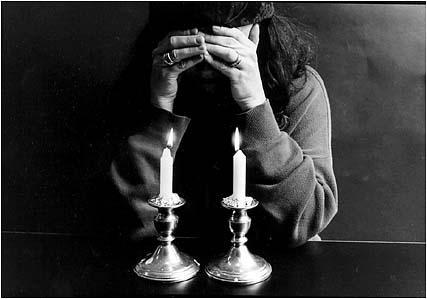
It’s true. At this point, my wife and daughter don’t even light the candles on Erev Shabbat. For a long time, I was the only one doing it, but it seemed absurd that I continue since I’m the only non-Jew in the house and a male and I’m the one lighting the candles. I kept asking my wife on Friday as sundown approached, “Do you want to light the Shabbos candles?” Her response was always something like, “You can if you want to.”

Like I said, it got kind of absurd. No one seemed to care if I lit the candles or not. So I stopped.

My wife hasn’t gone so far as to serve up pork chops for dinner and in fact, she’s rather studious about making sure we all continue to eat “kosher style” (see Leviticus 11), but our kitchen isn’t kosher and, strictly speaking, my wife doesn’t understand why I don’t choose to eat trief, since the kosher obligation doesn’t apply to me.

We also (gasp) work on the Shabbat. This part really bothers me, but there’s not a lot I can do about it. My daughter’s and my wife’s employers require that they work highly variable hours including the weekends, and they often work late Friday nights and on Saturday. The missus has made no bones about saying she would like me to keep my writing and editing schedules up on the weekends, though I’m able to refrain from household chores on Shabbos for the most part, deferring them to Sunday. I can’t remember the last time she went to shul, except perhaps to cook for some special occasions.

Yes, I do know that my Jewish family members are obligated to the Torah, though none of them are observant at the moment.

I suppose that makes me a bad husband and father for not compelling them to do so.

But I can’t really compel them to do anything. I have tried being supportive, but my children are all of adult age and my wife is of course, my wife, so she takes responsibility for her Jewishness and again, it seems rather absurd for a non-Jew and particularly a Christian to be telling her the business of being Jewish.

So having tried that and seeing that it didn’t work out so well, I stopped.

(I suppose at this point I should add that my wife subscribes to and reads the same (more or less) Chabad.org newsletters and tutorials that I do, which means her “morning meditations” are substantially similar to my own. I should also say that she anticipates leaving her current “slave job” at some point in the reasonably near but not clearly defined future, so what she does with her “free” Sabbaths after that is up in the air…but I can hope.)

The whole “divine invitation” and Christian identity thing means that I am not obligated to a Jewish lifestyle. I’m sure most Jews out there are relieved to hear that I’m not living like a Jew. But depending on your view of Jewishness and Jewish obligations to God, some of you may be distressed that my Jewish family members are not observant. Heck, there are members of the local Reform shul who are more observant than my family.

I can imagine that many Jews would blame me for all of this. After all, my wife and I are intermarried. Intermarriage is usually seen as the gateway for a Jew to leave Judaism and assimilate into Gentile secular culture or even into Christianity. While I can assure you that my wife has no attraction to Christianity on any level and I don’t believe she has become secularized, she doesn’t display a strong religious Jewish lifestyle.

More’s the pity.

(I’ll add here that my wife does keep up on events at the local synagogues and does have definite opinions about people at the Reform shul with a “questionable” Jewish background positioning themselves to lead services and teach [and that would never happen at the Chabad]. She’s “OK” with non-Jews and even Christians attending synagogue as long as they don’t talk about their faith, but she draws the line at “Messianics” or those who were formerly associated with the movement assuming any formal synagogue role.)

I have been trying to encourage my son David to return to the synagogue. His wife has recently rekindled her interest in attending church but I don’t think David would go with her on a regular basis. His basic internal template for religion is still Jewish and he remembers fondly some of his “debates” with the local Reform Rabbi. Actually, just last Sunday, my wife said she’d love it is David would visit the Chabad here in town, so she has her hopes as well.

The “religious identity” of my family continues to be in flux. I’m not even sure how much more my wife can tolerate my Christianity, so where I’ll end up in the months and years ahead is uncertain. I’d like my Jewish family to return to Judaism as an observant lifestyle. I hope they don’t see me as a barrier. I’m really anything but. In fact, in a recent conversation about conversion with my wife, (hence the quote at the beginning of this “meditation”) she said it would be ridiculous for a Gentile to try to convert to Judaism in Boise, (although a good friend of hers converted within the past year) since the convert wouldn’t have a strong Jewish community in which to live. So I don’t think my wife wants me to be “Torah observant” in any way, shape, or form. But what about her?

It would seem that for the sake of peace in the home, I must decline my “invitation,” and as a Christian, I would not only make a poor model of Jewish observance for my Jewish family, but I would actually be an annoyance if I tried. Thus, I cannot encourage them by my example since my example would be completely unwelcome.

I suppose if I were a Jewish husband and father, it might be different, but that’s not an option. Maybe the fears of Judaism are authentic fears and intermarriage is the path to slow death for the Jewish people. Even though it is not my intent, I certainly seem to be killing the Judaism in my home.

Across the long span of history, an untold number of Jews have suffered and died to preserve who they are as Jews. Given that realization, I wish I understood what was going on in my own home. But then, in this particular case, I don’t have a say. I only have to wait and pray that God, who has never abandoned His people Israel before, won’t abandon those who live in my household now.

My wife and children are Jewish. I want and even need them to live like Jews. May the God of mercy grant this for them and for the sake of Israel.