Tag Archives: Jesus

Questions That Would Cross a Rabbi’s Eyes

Hashem, your God, shall you follow and Him shall you fear; His commandments shall you observe and to His voice shall you hearken; Him shall you serve and to Him shall you cleave.

Deuteronomy 13:5 (Stone Edition Chumash)

Yeshua said to him, I am the way and the truth and the life. No one will come to the Father except through me.

John 14:6 (DHE Gospels)

The most important men in town will come to fawn on me
They will ask me to advise them,
Like a Solomon the Wise
“If you please, Reb Tevye?”
“Pardon me, Reb Tevye?”
Posing problems that would cross a rabbi’s eyes

from the song, “If I Were a Rich Man”
by Sheldon Hamick and Jerry Bock
Fiddler on the Roof (1971)

I ponder this mystery off and on but it’s a profound one, at least to me. The church often asks the question, “Were the Israelites saved?” Opinions vary. A very literalist interpretation of John 14:6 says, “no,” since Jesus wasn’t there at Sinai. But then I’ve heard that the salvation of Jesus spans across all time forward and back, so that anyone who has faith in God is saved by Jesus.

OK, wait. Isn’t that putting the cart before the horse?

And he trusted in Hashem, and He reckoned it to him as righteousness. –Genesis 15:6 (Stone Edition Chumash)

Abraham trusted in God and God alone and it was counted to him (by God) as righteousness. A Christian would say that Abraham’s faith in God saved him, just as our faith in Jesus saves us. See what I mean about “posing problems that would cross a rabbi’s eyes?” Are we talking about two paths of salvation, one through God and another through Jesus?

I don’t think that’s a sustainable viewpoint given the overarching message of the Bible to love and trust God and God only. On the other hand, if we invoke the deity of Jesus, then I suppose the problem is solved. If you have faith in Jesus then you have faith in God and vice versa. End of story.

Or is it?

For it is impossible for the blood of bulls and goats to take away sins. –Hebrews 10:4 (ESV)

So what exactly were the ancient Israelites doing, then? Why did God command them to perform animal sacrifices if they didn’t do any good?

Why do I need your numerous sacrifices? says Hashem. I am sated with elevation-offerings of rams and the fat of fatlings; the blood of bulls, sheep and goats I do not desire…Bring your worthless meal-offerings no longer, it is incense of abomination to Me. –Isaiah 1:11,13 (Stone Edition Tanakh)

Obviously that didn’t work. I mean, God doesn’t seem to want the sacrifices that He previously said He wanted. Seems kind of fickle of God, doesn’t it.

Except it’s impossible for God to be fickle or inconsistent. So what’s the answer?

What does God want and who does He want us to have faith and trust in? If no one comes to the Father except through the Son, why didn’t He teach the ancient Israelites to worship the future Jesus instead of the God of Heaven? Why didn’t God teach Abraham to have trust in Jesus instead of Him, thus counting trust in Jesus as righteousness? Why did God bother teaching the ancient Israelites the sacrificial system in the first place?

Maybe I’m being too literal. Maybe I’m not being “mystic” enough. But it does seem like a head scratcher.

I keep thinking I’m on the cusp of an answer but somehow it always eludes me. I keep thinking that the key is “faith and trust in God.” Of course the blood of bulls and goats doesn’t save. It never did. What saved was that the ancient Israelites trusted in God and agreed to do everything He told them to.

Moses came and summoned the elders of the people, and put before them all these words that Hashem had commanded him. The entire people responded together and said, “Everything that Hashem has spoken we shall do!” –Exodus 19:7-8 (Stone Edition Chumash)

Faith and trust, and then obedience. It’s not so much that what we do has the power to save, it’s that what we do is a reflection of our faith and trust. If God tells us to sacrifice animals at such-and-thus a place in such-and-thus a manner, the sacrifices aren’t as important as our obedience to Him. If we perform the same sort of sacrifice in the same place and in the same manner as before, but not because of faith and trust, the sacrifices are meaningless. It’s always about faith and trust. So that takes care of the salvation of the ancient Israelites and Abraham before them.

But how to we deal with Jesus and “no one comes to the Father except through me?” It would seem as if all one has to do is have faith and trust in God the Father to be saved. What does Jesus have to do with it?

OK, I know I said before that Jesus does matter. After all, neither we people among the nations nor our distant ancestors stood at Sinai with the Israelites (mixed multitude notwithstanding), and so we do not possess the ancient covenant relationship with God. It is completely understandable that we Gentiles cannot “come to the Father except through the Son.” But what about the Jews?

I’m not so sure I can answer that one. To say that they are “saved” through Sinai means that there is two salvational paths, one for the Jews (Moses) and one for the Gentiles (Jesus). To say that only Jesus saves deconstructs the Sinai covenant and renders Judaism invalid post-Jesus. To say that only Moses saves means we have to throw out the New Testament, and salvation for the Gentiles only comes from conversion to Judaism or obedience to the Noahide Laws.

Traditional Christians would say that salvation through Jesus replaced the Law of Moses and they solve the question that way. Traditional Jews would say that the New Testament is invalid and Gentiles must either convert to Judaism or become Noahides and they solve the question that way. There is a group who tries to split the difference and says that everyone must comply to the terms of both the Mosaic and Davidic covenants and essentially behave both like Jews and like Christians, but as you’ve seen on this and other blogs in the Messianic blogosphere, that becomes hopelessly confusing relative to retaining any sense of Jewish vs. non-Jewish identity.

So what is the answer? I don’t know. I know that’s rather disappointing, but I’ve said numerous times before that I’m not a Bible scholar or historian. I’m a reasonably intelligent human being (depending on the day of the week, how much sleep I’ve had, and whether or not my wife is upset with some dumb thing I did), but the niggling little details of how to interpret the scriptures and the nuances of theology, doctrine, dogma, and so on escapes me.

But does that mean it’s forbidden for “ordinary Christians” to ask questions and pose problems about our faith? Gee, I hope not.

So am I stuck? No. By faith, I worship the One God of Israel. I know that my salvation hinges upon the truth of the Jewish Messiah. He is the vine and I am the branch. I will follow him in search of my answers and believe that ultimately, all truth of God is in him and through him. How it all works behind the scenes, I don’t know. Maybe someone out there does. I know I’m asking for another “punishing” debate and people will question my convictions, my intelligence, and maybe even my sanity.

But I can’t stop asking questions just because people are going to give me a hard time about them.

In the end, there’s God. In the beginning, too.

A prayer of Moses, the man of God. O Lord, You have been our dwelling place throughout all generations. Before the mountains were born, and You brought forth the earth and the inhabited world, and from everlasting to everlasting, You are God. You bring man to the crushing point, and You say, “Return, O sons of men.” For a thousand years are in Your eyes like yesterday, which passed, and a watch in the night. You carry them away as a flood; they are like a sleep; in the morning, like grass it passes away. In the morning, it blossoms and passes away; in the evening, it is cut off and withers. For we perish from Your wrath, and from Your anger we are dismayed. You have placed our iniquities before You, [the sins of] our youth before the light of Your countenance. For all our days have passed away in Your anger; we have consumed our years as a murmur. The days of our years because of them are seventy years, and if with increase, eighty years; but their pride is toil and pain, for it passes quickly and we fly away. Who knows the might of Your wrath, and according to Your fear is Your anger. So teach the number of our days, so that we shall acquire a heart of wisdom. Return, O Lord, how long? And repent about Your servants. Satiate us in the morning with Your loving-kindness, and let us sing praises and rejoice with all our days. Cause us to rejoice according to the days that You afflicted us, the years that we saw evil. May Your works appear to Your servants, and Your beauty to their sons. And may the pleasantness of the Lord our God be upon us, and the work of our hands establish for us, and the work of our hands establish it. –Psalm 90

Just a small note: this is my 500th meditation if anyone is intereseted.

Shoftim: Walk with Simplicity

Be wholesome (‘tamim’) with G-d

Deuteronomy 18:13

To be ‘tamim’ with G-d means: Walk with Him with simplicity and without guile. Do not seek to manipulate the future; rather, accept whatever He brings upon you wholeheartedly. Then, He will be with you and you will reap the rewards of His apportionment.

-Rashi’s commentary
as quoted from Chabad.org

Instead of complaining about someone’s behavior toward you, it is more constructive to work on your own behavior toward him.

Ignore another person’s grouchiness and anger, and speak cheerfully and with compassion. If you find this difficult, pretend that you are an actor on stage. Adopting this attitude can keep people from much needless quarreling and suffering. Do it consistently and you will see major improvements in their behavior toward you.

Be flexible. People differ greatly on what they evaluate as “positive,” and it is necessary to understand the unique needs of each person you’re dealing with. If one approach is unsuccessful, try other approaches. But keep trying.

-Rabbi Zelig Pliskin
Daily Lift #555
“Put On Your Best Act”
Aish.com

You may be wondering what all of the above has to do with this week’s Torah Portion Shoftim (Deuteronomy 16:18 – 21:9). We can see that Rashi has focused on a very small part of the reading and derived a very specific principle.

It’s also a principle that is very hard to live up to. As people of faith, we are tempted to “manipulate the future” all the time by asking, praying, and pleading to God for everything that we want and all that is important to us. That’s not a bad thing, but human beings can be very self-indulgent. We tend to want what we want when we want it and are rather disappointed with God when He doesn’t deliver the “goods” on time and in the way that we ordered them.

The same is true of our relationships with other people. As Rabbi Pliskin points out, when there is an “issue” between us and someone else, we almost invariably blame the other person for the problem. Most of the time, it never occurs to us to look in the mirror and see if the person staring back at us has anything to do with it…or everything to do with it.

If only we could stop ourselves and the events flowing around us and take a really good look at who we are and what’s going on. But then, isn’t that what the month of Elul is all about? OK, I understand that the practice of deep self-examination and taking a “spiritual inventory” during Elul is commonly associated with observant Jews as they approach Rosh Hashanah and Yom Kippur, but I’ve also said that it wouldn’t hurt for a few Christians to take up the practice as well. Perhaps we would all discover that the source of whatever pains and sorrows and hurts we experience isn’t located outside of us at all.

When we are in pain, are frustrated, or angry, we blame God or we blame other people, or we blame the cruelty of the “generic” universe. Everything’s so complicated. There are too many rules. There’s no clear-cut guideline to tell us how to live our lives and be satisfied with what we’ve got.

Or is there?

He has told you, O man, what is good; and what does the Lord require of you but to do justice, and to love kindness, and to walk humbly with your God. –Micah 6:8 (ESV)

A new commandment I give to you, that you love one another: just as I have loved you, you also are to love one another. –John 13:34 (ESV)

Ben Zoma would say…Who is rich? One who is satisfied with his lot. -from Pirkei Avot 4:1

HumbleGod is very clear in His intent. Jesus makes his meaning plain. At the core of what God wants and what He knows will satisfy us is not controversies and criticisms, not possessions or acquisitions, but rather to walk simply and humbly with our God and to do good to our fellow human beings. If your life is complicated and messy, it’s most likely not because of anyone else. Even if you’ve had a difficult life, if your family was abusive, if your school teachers were critical, if your church leaders were harsh, at some point as you become an adult, you must begin to cast off your chains or learn to be their victim forever.

Ironically, in order to remove the weight of our restraints and apply the principle of making our lives less of a burden, we have to do something we don’t always want to do. We have to work and work hard to take greater personal responsibility for who we are in our lives and in our faith:

If one wishes to add on more restrictions than the law requires, one may do so for oneself, but not [make such demands] of others. -Shulchan Aruch

Some people employ a double standard. One set of rules applies to themselves, and another to everyone else. The Shulchan Aruch, the standard authoritative compilation of Jewish law, accepts this policy – but on one condition: the more restrictive set of rules must apply to oneself, and the more lenient apply to other people.

Guidelines exist for many things, such as the percentage of income that one should give for tzedakah. Many tzaddikim, righteous people, retained only the barest minimum of their income for themselves, just enough to provide for their families, and gave everything else to the poor. However, they would never expect anyone else to follow their example, and some even forbade it.

Our minds are ingenious in concocting self-serving rationalizations. Sometimes we may have excellent reasons not to give more liberally to tzedakah, even if it is within the required amount. We may project into the future, worry about our economic security, and conclude that we should put more money away for a rainy day. Yet we often criticize people who we feel do not give enough to tzedakah.

We should be aware of such rationalizations and remember that the more demanding rules should apply to ourselves. If we are going to rationalize, let us rationalize in a way that gives the benefit of doubt to others.

Today I shall…

remember to be more demanding of myself than I am of others.

-Rabbi Abraham J. Twerski
“Growing Each Day, Elul 5”
Aish.com

There is no greater challenge than to seek God. But instead of looking to Heaven, or to your house of worship, or to the holy men, look within. See if you can discover the footsteps of your Master as you peer into your heart. If you can’t, perhaps it’s time to start a new journey and follow where Jesus is leading you.

Good Shabbos.

Does Jesus Matter?

Why Native American religions, when scholars acknowledge that Native American tribes do not traditionally distinguish between religion and the rest of life?

-William T. Cavanaugh
Chapter 1: The Anatomy of the Myth”
The Myth of Religious Violence: Secular Ideology and the Roots of Modern Conflict

But what does it say? “The word is near you, in your mouth and in your heart” (that is, the word of faith that we proclaim); because, if you confess with your mouth that Jesus is Lord and believe in your heart that God raised him from the dead, you will be saved.

Romans 10:8-9 (ESV)

Disclaimer: This is a long “meditation.” I’m sorry. I couldn’t make my point and keep it under 2600 words. Just letting you know.

I’ve been reading Cavanaugh’s The Myth of Religious Violence, albeit somewhat slowly, but I came to a complete stop when I read the quote from his book I placed at the top of this blog post. Cavanaugh is trying to refute those people who believe that religion is inherently more violent and prone to causing wars than secular systems of finance or government. One of his main criticisms against this viewpoint is the lack of definition for what is a “religion” which, on the surface may seem easily defined, but in the world of scholarly analysis, is pretty difficult to pin down.

But look at what he says about Native American religions. “Native American tribes do not traditionally distinguish between religion and the rest of life.” But shouldn’t it be that way for all other religions as well?

If you’re a Christian, you may be nodding your head and agreeing that your faith is your life, but I think for a great many of us, we tend to compartmentalize what we do into “religious” and “secular” activities. When you go to church, it’s “religious.” When you pay your taxes or take out the garbage, it’s “secular.” A lot of Christians say that their faith “isn’t a religion, it’s a relationship.” If that’s so, then are there times in your day-to-day life when your relationship with Jesus doesn’t exist or doesn’t matter? If you are married, are there times when your marriage or your spouse doesn’t matter or doesn’t factor into your decision-making, particularly when those decisions don’t have a direct connection to your being married?

Who we are in Christ should permeate every single part of our lives, everything we do, every thought we have. It was Paul who wrote (see 2 Corinthians 10:5) that we must “take every thought captive to obey Christ.” If our Christianity is supposed to function down to the level of our very thoughts, shouldn’t it be ingrained into everything else we are as well?

I’ve been participating in a number of online discussions, including one at Gene Shlomovich’s blog Daily Minyan, regarding the relevance of the Mosaic covenant between God and the Israelites as applied to non-Jewish Christians today. The principle question is, do Christians become obligated to the Law of Moses when we first confess faith in Christ?

I know the vast majority of Christians (and probably Jews) will immediately answer, “No.” But then, most Christians believe that the Law or Torah of Moses was wholly replaced by the grace of Jesus Christ when our Master died on the cross. I disagree with this “replacement theology” (and those of you who’ve been reading my blog for long know this quite well) and believe that the Jewish people continue to be bound to the covenant they made with God at Sinai.

But Christian brothers and sisters, you and I weren’t at Sinai. Our covenant connection to God isn’t dependant on that event, even though there were non-Israelites, the so-called “mixed multitude” of people groups, who also stood at the mountain and agreed to obey God in all things.

However, there are some folks out there who believe that the non-Israelites at Sinai sets a precedent that not only allows, but actually requires all Christians to be fully compliant (or as much as we can be living outside Israel, and without a Temple, Priesthood, and Sanhedrin) to the 613 commandments that the Jews must perform as a condition of their covenant with God through Moses.

But that raises one big, giant red flag for me. If all any Gentile ever had to do to have a covenant relationship with God was to perform the mitzvot as a Jew would, then why do we need Jesus in order to enter into relationship with God and be saved?

This issue is actually more complicated than I’m making it here, but the details would result in an impossibly long blog post. Also, I’m not historian, linguist, or Bible scholar, so I lack the educational “chops” to fully explore all of the niggling little details this topic brings up. On the other hand, any “ordinary person” should be able to discuss their faith in a reasonably intelligent manner without having to possess multiple advanced degrees. If we can’t, then we must relegate ourselves to the status of “sheep” and be at the mercy of anyone who comes up with a theology based on some understanding of what certain Hebrew and Greek words might mean in English.

(I have to say here that I am not denigrating scholarship and education. Far from it. I possess one graduate and two undergraduate university degrees, so I value education and learning very highly. However, it is important to search out and study the findings of legitimate scholars in religious studies. You won’t always find them involved in online religious debates in the blogosphere.)

Let’s get down to it. If Torah obedience is the primary key to entering into covenant relationship with God, then why don’t we all just convert to Judaism? More to the point, why did God bother to send Jesus Christ to be born, live, teach, suffer, die, be resurrected, and ascend to Heaven? That’s a lot of trouble and certainly it wasn’t any fun for Jesus. All God had to do was send a prophet to go to the Gentiles (someone like Paul perhaps) and say, “Convert to Judaism and you will be saved.”

But that’s not what Paul said. And that’s not what Jesus said. I don’t believe Jesus, Paul, Peter, or anyone else said that the Jews must give up Judaism and become Christians, since even Jesus, Paul, and Peter remained Jews, sacrificed at the Temple, and kept kosher throughout their entire lives. I do believe though, that something had to be done for the rest of the people in the world who were worshiping mute idols of stone, wood, and metal.

But if the Gentile pagans didn’t convert to Judaism, what did they become when they abandoned polytheism and began to exclusively worship the God of Israel through faith in the Jewish Messiah?

For a whole year they met with the church and taught a great many people. And in Antioch the disciples were first called Christians. –Acts 11:26 (ESV)

The term “Christians” could more or less be thought of as “Messianics” as well, or people who are disciples of the Jewish Messiah. But it doesn’t translate into “Jews” and it doesn’t translate into “Israelites” or any other such thing. What the believers in Jesus as the Jewish Messiah were called was directly connected to his Messianic identity and what we can think of as the “Messianic” covenant; the covenant that makes it specifically possible for non-Jews/non-Israelites to come into relationship with God “without surrendering their ethnic, racial, or national identity as Gentiles.”

If we were expected to surrender our “Gentileness” and covert to Judaism or in some manner or fashion, become obligated to the full mitzvot of Torah, even while retaining our Gentile identity, why would Paul say this?

Look: I, Paul, say to you that if you accept circumcision, Christ will be of no advantage to you. I testify again to every man who accepts circumcision that he is obligated to keep the whole law. –Galatians 5:2-3 (ESV)

He said something even more dramatic on the same subject:

I do not nullify the grace of God, for if righteousness were through the law, then Christ died for no purpose. –Galatians 2:21 (ESV)

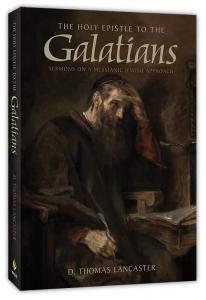
Galatians by D.T. LancasterGranted, Paul’s letter to the Galatians is amazingly difficult to understand (see D. Thomas Lancaster’s book The Holy Epistle to the Galatians for an excellent analysis of this letter) but it’s hard to get around the idea that Paul was severely “discouraging” the non-Jewish members of the churches in Galatia from converting to Judaism (being circumcised) because doing so would place them under the full weight of the Torah mitzvot. Also, if the Gentiles thought they had to convert to Judaism and take on board the entire Torah as an obligation in order to be justified, it would make Christ’s bloody, humiliating, agonizing death on the cross completely meaningless.

So I just don’t see how Jesus is requiring every non-Jewish person who comes to him as a disciple to be obligated to the Torah of Moses.

Having said all that, is the Torah such a bad thing? No, absolutely not. Paul knew that even Jews were justified by faith and not by works of the law. (Galatians 2:15-16)

Is the law then contrary to the promises of God? Certainly not! For if a law had been given that could give life, then righteousness would indeed be by the law. –Galatians 3:21

Paul didn’t abolish the law and neither did Jesus (Matthew 5:17). In fact, Jesus said that “until heaven and earth pass away, not an iota, not a dot, will pass from the Law until all is accomplished.” (v. 18) As far as I can tell, Heaven and Earth are still with us and not everything the Messiah was supposed to accomplish has happened yet. So the law continues to exist.

I can confidently say Jewish people remain obligated to the mitzvot, both in Second Temple times and today. This, in my opinion, includes the Jews who have come to faith in Jesus as the Jewish Messiah. Jesus never got rid of the Mosaic covenant or replaced it with a newer covenant. I do believe the newer “Messianic” or “Davidic” covenant ratifies the older ones for the Jews so the Messianic promises are realized for them in Christ.

What about the Torah for the rest of us? Modern (non-Messianic) Jews believe that the rest of the people of the earth are obligated to what is called the Seven Laws of Noah and that the covenant of God made with Noah (see Genesis 9) puts all of us in relation with God as long as we obey our Noahide obligations.

But that doesn’t take anything we know from the Gospels or Epistles into account. The Messiah’s mission was not just to restore Israel nationally and spiritually, but to bring the rest of the world into relationship with God. That isn’t dependant on Noah or on Moses but only on Christ.

I’ve heard it said that the Messianic covenant with the Gentiles “travels back in time” as it were, so that the non-Jews at Sinai were brought into relationship with God through Christ and then obligated to the Torah mitzvot as a consequence, but to employ Occam’s razor, when two hypotheses are in competition, the one that makes the fewest assumptions is more likely to be true. The “time traveling” covenant hypothesis creates a lot of hoops to jump through just to support a theory.

Moses didn’t tell the Israelites that they had to obey God in all things and believe in the coming Messiah in order for God to be their God. This is what happened right before God gave the Torah at Sinai:

So Moses came and called the elders of the people and set before them all these words that the Lord had commanded him. All the people answered together and said, “All that the Lord has spoken we will do.” And Moses reported the words of the people to the Lord. –Exodus 19:7-8 (ESV)

Because of faith in God, the Israelites unreservedly agreed to obey everything God told them to do, including everything He hadn’t told them yet. Their agreement is the Mosaic covenant and the Torah mitzvot are the conditions applied to each party subject to that agreement (the Israelites and God). Belief in the future Messiah isn’t specifically mentioned so at that point in time (I know, mysticism could probably “explain” this but I’m trying to stick to the mechanics of the text), Israelites and the Gentile “mixed multitude,”  because of their faith, agreed to obey God and in order to fulfill their agreement, they obeyed all the conditions of the Torah.

But the mixed multitude who became “alien sojourners” among native-born Israelites have disappeared from history. We can argue back and forth that their lives in relation with God did somehow involve the Messiah and absolutely required mitzvot obedience that was identical to the Israelites, but what of the Gentiles who wanted to attach themselves to Israel during and after the earthly ministry of Jesus. Were there “sojourners” in those days or were they “God-fearers” like Cornelius the Roman Centurion? (see Acts 10) What was their status and was Torah obedience required?

While I think we can make a pretty good argument that even Jewish believers in Christ retain their obligation to God relative to Sinai, that seems to be unique to the descendents of Jacob. I do believe that the very first Gentile Christians probably worshipped God in a way that looked much more “Jewish” than we do today, but that’s just a guess. We only have “hints” of Gentile observance that looks Jewish in scripture, (see the aforementioned Cornelius in Acts 10 for example) but no “smoking gun” pointing to Paul teaching Gentiles to say the Shema, wear tzitzit, or lay tefillin. We never actually see an illustration of the Gentile Christians behaving exactly like the Jewish believers in all of the mitzvot.

the-joy-of-torahI don’t see any harm in Christians performing many or even most of the mitzvot. After all. The commandments have a great deal to do with feeding the hungry, treating even the neighbor you don’t like with respect and dignity, and loving God. In fact, if you actually read all 613 commandments, for those that we can actually perform outside of Israel, and without a Temple in Jerusalem, a Priesthood, a “Biblical” court system, I can’t find much that would violate a Christian’s faith.

I think it is mandatory to feed the hungry, to find shelter for the homeless, to comfort the widow, to make sure the orphan is taken care of. If you’re a Christian and you aren’t seeking social justice and performing acts of mercy and kindness, then there’s something wrong with your faith and your lifestyle. Recently, I’ve encouraged Christians to seek God and repent of sins during the month of Elul. I think it’s perfectly fine for Christians to participate in the High Holidays, light candles on Chanukah, eat the Passover meal with their Jewish brothers, count the Omer, celebrate Shavuot/Pentecost, and build a Sukkah.

Certainly Jesus did all these things in accordance to the halachah that was normative for the Jews of the late Second Temple period. Perhaps (though there’s no way to know for sure) even Cornelius the Roman built a sukkah. It don’t think it’s an outrageous idea.

I do think, believe, and endorse with all my heart, mind, and spirit, that Jesus, or Yeshua as he’s called in Hebrew, absolutely, positively must be the center of our faith and covenant connection with God. Without Christ and the specifics of the Davidic covenant that allows us to be in relation to God and to call Jesus Lord and King, we among the nations are lost. We have nothing. Neither Jew nor Gentile has ever been justified by obedience to Torah commandments. As Paul said, we’re justified by faith.

Jesus does matter. He matters to anyone who wants a relationship with God.

Make Christ your everything. He is not irrelevant. He is indispensible. He is the key. He is the vine and we are his branches.

Past, Future, or Present?

The world of Moshiach is a world free of hate, jealousy and suffering, a world suffused with wisdom, a world in harmony with itself and its Creator. And what model of leadership does the Torah envision for this perfect world? Moshiach, the world leader who will herald and preside over this climatic era, is described as both teacher and king, a paragon of spiritual and material leadership in one.

So the example of Moses represents the Torah’s concept of the perfect leader. For Moses embodied the ultimate criterion for leadership: an utter self-effacement and a complete absence of self-interest. As the Torah attests: “And the man, Moses, was the most humble man on the face of the earth.” In such a man, absolute authority only ensures the optimum integration and harmony between all areas of communal life. For it is not power that corrupts, but the ego of the powerful. Only in lesser generations, whose leaders’ selflessness is not on the level exemplified by Moses, is it necessary for authority to be fragmented and shared.

But the halving of life into “spiritual” and “material” spheres, its compartmentalization into “moral” and “political” domains, is an artificial one. Life, in its entirety, is a single endeavor: the development of the perfect world that G-d envisioned at creation and outlined in the Torah. The many “areas” of life are but the many facets to its singular essence.

Ethics of Our Fathers
Commentary on Chapter 6
“Torah and State”
Elul 4, 5772 * August 22, 2012
Chabad.org

I’m going to talk a lot more about the “compartmentalization” of the secular and spiritual in our lives in tomorrow’s “morning meditation,” but in reviewing this commentary, I thought we could take a moment to look at a Jewish perspective about life now vs. life in the Messianic Age. I don’t think it’s all that different from how Christians see life now as opposed to how things are going to be when Jesus returns.

Religious Jews tend to draw a much closer comparison between Moses and the Messiah than we Christians do, probably because much of the church has been taught that the Law is done away with, thus Moses becomes superseded by Jesus. In some sense, it’s almost like modern religious Jews see Moses the way we Christians see Jesus. He is the model and the “king” they look up to. He set the standard for Jewish leadership and the Messiah will be a “perfected” version of Moses.

OK, I’m oversimplifying all this, but I think it’s important for us to consider Jesus as the Jewish Messiah King. When Jesus returns (and I’ve said this before), he will look, talk, walk, eat, pray, worship, and be a Jewish man, the Messiah, the King of Israel. He will definitely be “too Jewish” for many Christians and I think it would help if we got used to the idea that he won’t be the “Jesus” we see in the movies before he actually arrives.

One of the reasons I like Jewish commentaries on the Messiah is because it compels me to conceptualize Jesus as Jewish and not as the sort of “gentilized” person that we’ve turned him into as the centuries have passed. This is also why I sometimes encourage Christians to at least try on some Jewish practices for size. Turning our thoughts and hearts toward God during the month of Elul for example, isn’t such a bad idea. It encourages us to conform our lives more toward holiness and God at a time of year when we probably aren’t thinking that hard about our lives of faith (Christians don’t have religious events in or around August typically).

Why not consider and practice self-purification and making who we are just a little bit better than we were yesterday? Maybe we can even do something to make the world a little bit of a better place. Maybe God put us here to actually accomplish something special; something that is uniquely our purpose.

Whoever has faith in individual Divine Providence knows that “Man’s steps are established by G-d,” (Psalm 37:23) that this particular soul must purify and improve something specific in a particular place. For centuries, or even since the world’s creation, that which needs purification or improvement waits for this soul to come and purify or improve it. The soul too, has been waiting – ever since it came into being – for its time to descend, so that it can discharge the tasks of purification and improvement assigned to it.

“Today’s Day”
Shabbat, Elul 4, 5703
Compiled by the Lubavitcher Rebbe
Translated by Yitschak Meir Kagan
Chabad.org

Tomorrow, I’m going to ask some important questions on my “morning meditation.” I’m going to ask if Jesus still matters in our lives. I’m going to ask why he’s so important to us and to the world. I think at least some of us are beginning to lose track of the vital nature of the Messiah. It’s not just what he’ll do when he returns and ascends his throne on Earth. It’s what he’s already done for each and every person who calls themselves “Christian” or “Messianic.” It’s what he’s done for us that could never have been done without him.

If you are separating the secular and the spiritual in your life, you may be shutting Jesus out of times and areas of your existence where he needs to be and where you need him to be. Does Jesus matter? Is he important in every part of your life?

I’ll try to answer those questions tomorrow. Stay tuned.

Learning to Live

I have been testing the waters, trying to get involved in Judaism. But I feel like I’m swimming in a vast ocean of unfamiliar concepts: Hebrew texts, legal nuances, culture, etc. I’m not sure any of this is for me!

The Aish Rabbi Replies:

There is a misconception that many people have about Judaism, what I call “the all or nothing” syndrome. With 613 mitzvot in the Torah, things can seem a bit overwhelming. People take a look at traditional Judaism with all these different commandments and say to themselves, there’s no way that I can be successful at living that type of lifestyle, so what’s the point of looking into it or getting involved? Where to start? What to focus on? How to make sense of it all?!

That’s not the Jewish way!

Imagine you bump into an old friend and he tells you how miserable he is. You ask him, what’s the matter? He says, I’m in the precious metals industry. My company just found a vein of gold in Brazil that’s going to be worth hundreds of millions of dollars.

You say, that’s fantastic. Your financial problems are solved. What’s the problem?

He says, you just don’t get it. Do you realize that this is just one vein of gold? It represents such a tiny fraction of all of the unmined gold in the world. What do I really have, compared with what’s out there?

You say, are you nuts? Who the heck cares about what you haven’t found yet? What you’ve got now is a gold mine!

That’s the Jewish approach. Any aspect that you learn about, or can incorporate into your life, is a gold mine. What does it matter what aspect of Judaism you’re not ready to take on? In Judaism, every mitzvah is of infinite value. Every mitzvah is more than any gold mine. Don’t worry about what you can’t do. Even if you never take on another mitzvah, you’ve still struck eternal gold.

The best advice: Relax.

“Judaism: All Or Nothing?”
from Ask the Rabbi
Aish.com

Performing mitzvot or “Torah commandments” as such isn’t really the focus of most Christians. And on top of that, what the Rabbi seems to be saying in the above-quoted passage appears to contradict this:

If you really fulfill the royal law according to the Scripture, “You shall love your neighbor as yourself,” you are doing well. But if you show partiality, you are committing sin and are convicted by the law as transgressors. For whoever keeps the whole law but fails in one point has become accountable for all of it. For he who said, “Do not commit adultery,” also said, “Do not murder.” If you do not commit adultery but do murder, you have become a transgressor of the law. –James 2:8-11 (ESV)

According to the traditional interpretation of this passage, to violate one commandment in the law is to violate them all. But since we are all human, sooner or later, we are all going to make a mistake. How could anyone obey all of the laws all of the time?

Christianity’s answer is to replace behavioral obedience to the law with the grace of Jesus Christ and thus, any of our mistakes are forgiven, as long as we repent, turn away from wrongdoing, and return to God.

Of course, if you keep reading James 2, you discover verses 14-17 in which he says that faith without works is dead, so it’s not a matter of doing away with the behaviors that are associated with a life of holiness.

So what is it? If we commit to the law but cannot keep all of it are we perpetually doomed to failure or are we commanded to perpetually try?

The Rabbi isn’t responding to a Christian’s question, though. There are scores of Jewish people who haven’t lived religious lives but who desire to come closer to God, especially in the month of Elul. But as the questioner admits, the number of mitzvot to learn is dizzying and the details associated with proper observance is beyond intimidating. How could anyone not only learn all of the commandments, but additionally, how modern halachah defines proper observance?

The Rabbi has a simple and surprising answer:

The misconception that Judaism is all-or-nothing includes the false idea that a person is either “observant,” or “non-observant.” But that’s not true. In fact, here’s a secret:

Nobody is observing all the mitzvot.

That’s because certain mitzvot only women usually do – like lighting Shabbat candles or going to the mikveh. Other mitzvot only men can fulfill – like Brit Milah. Others only apply to first-born children, such as the “fast of the first-born” on the day before Passover. And only a Kohen can fulfill the mitzvah of reciting the Priestly Blessing.

Actually, it’s not that surprising but then again, I don’t think it adequately answers the original question.

I have an answer of my own. Here’s a story.

Many years ago, I was at my local Reform shul. One of the Jewish members was telling his own story about observance. He had been an atheist for most of his life. He was also an educator and took annual trips to Israel for scholarly purposes. It was on one of those trips that he told a Rabbi that he wanted to live as a religious Jew. Just one problem. It was the same problem the questioner above has. There’s just so much to learn.

Here’s the Rabbi’s answer.

Pick just one mitzvot. It doesn’t matter which one. Let’s say it’s lighting the Shabbos candles. Get a siddur and learn the blessing. Every Erev Shabbat, say the blessing and light the candles. Do nothing else. Keep doing that on every Shabbat until you have learned the mitzvot well and are very comfortable performing it. Once you have achieved that level of competence, pick another mitzvot. It doesn’t matter which one. Learn to perform it until you are comfortable and competent at it. Continue adding mitzvot in this manner. It will take time, but as the months and years past, you will progressively learn to perform a great number of the mitzvot.

I reconstructed all that from memory, so I’m sure it’s not “word-for-word” accurate. But you get the idea.

But what does that have to do with James and with Christians. We don’t obey the mitzvot of Moses. We weren’t called to do so. After all, when Jesus gave his Jewish disciples the “great commission” to make disciples of the people of the nations, here’s what he said:

And Jesus came and said to them, “All authority in heaven and on earth has been given to me. Go therefore and make disciples of all nations, baptizing them in the name of the Father and of the Son and of the Holy Spirit, teaching them to observe all that I have commanded you. And behold, I am with you always, to the end of the age.” –Matthew 28:18-20 (ESV)

Path of TorahNotice what Jesus didn’t say. He didn’t say to teach the disciples from the nations “to observe all that Moses has commanded you.” If Jesus wanted to have the Gentile disciples observe the Torah in an identical manner and for an identical purpose as the Jewish disciples, his message would have been different. It would have been much easier for him to tell the Jewish disciples to convert all Gentiles everywhere into Jews.

Galatians is Paul’s great cautionary tale against Gentile disciples converting to Judaism as a means to be justified before God. He said it would make the bloody, sacrificial death of the Master a waste of time and effort if they did so (see Galatians 2:21).

Paul went on in chapter 3 of his letter to explain that it is by faith and not merely the mechanical observance to the law that we Gentiles received the Spirit. In fact, everyone, Jew and Gentile, received the Spirit by faith, not by the law.

At Sinai, the Israelites agreed to do all that God would tell them to do (at the point when they agreed, the specifics of the Torah had not yet been given). They accepted God’s rule by faith and subsequently, God, through Moses, gave the Israelites the Torah. By faith, we accept Jesus Christ as Lord and Savior and through him, we can come to God in a covenant relationship. But since we Gentiles among the body of believers were not at Sinai as were our Jewish brothers, what do we receive from God?

The Jews have the Spirit, just as we have, but they also have the Torah. Do we have the Torah?

Yes and no.

Naturally, this is just my opinion, but the “Torah” we have isn’t all that dissimilar from that of the Jews (and I know some Jewish and Christian readers may balk at this part). But consider the following.

And one of the scribes came up and heard them disputing with one another, and seeing that he answered them well, asked him, “Which commandment is the most important of all?” Jesus answered, “The most important is, ‘Hear, O Israel: The Lord our God, the Lord is one. And you shall love the Lord your God with all your heart and with all your soul and with all your mind and with all your strength.’ The second is this: ‘You shall love your neighbor as yourself.’ There is no other commandment greater than these.” And the scribe said to him, “You are right, Teacher. You have truly said that he is one, and there is no other besides him. And to love him with all the heart and with all the understanding and with all the strength, and to love one’s neighbor as oneself, is much more than all whole burnt offerings and sacrifices.” And when Jesus saw that he answered wisely, he said to him, “You are not far from the kingdom of God.” And after that no one dared to ask him any more questions. –Mark 12:28-34 (ESV)

I know I tend to revisit this particular scripture with an almost annoying frequency, but it is one of the core teachings of our Master. He emphasizes that we are to love God and love other human beings above all other considerations. The process by which we do so may vary from person to person, but Matthew 25:31-46 gives us a pretty good idea of what Jesus is looking for in how we follow him.

Within myself, I have long since resolved the meaning of what Jesus intended for the disciples of the nations to learn. That’s a personal resolution, and I don’t expect anyone else to particularly agree with my conclusions. On the other hand, we have just a ton of examples of obedience to God as chronicled in the Bible. If you were a new Christian, what would you tackle first? Feeding a hungry person? Going to church every Sunday morning? Praying every night? There’s a lot to consider.

On the other hand, maybe even for we Christians, it’s just as simple as picking one thing, practicing it over and over, and getting good at it. It doesn’t matter what it is. Let’s say it’s praying to God every night before going to bed. Once you’re good at that, you can pick something else. Let’s say it’s donating to a charity. How about collecting canned goods in your home and every month, taking your collection down to the local food bank. Seems simple enough.

There are so many people out there who seem to think that serving God and obeying the mitzvot is this long, complicated, list of actions and behaviors. Maybe it is for them. I know it seems that way when we look at observant Jews. But no one obeys God perfectly or completely. No one performs literally every act of obedience that they can. I’m not suggesting that we should be lazy or to neglect doing what God wants us to do, but we can also give ourselves some time to adjust our lives and learn to be better people, better servants, and better adopted sons and daughters of the Most High God.

For Jews, the month of Elul is a time to prepare for the High Holidays and particularly for the day of judgment. It’s a time of deep spiritual introspection, repentance, and study. Jews renew old friendships, repair broken relationships, and perform many acts of kindness and charity. Maybe it’s a good month for the rest of us, the Gentile disciples of the Jewish Messiah King, to reconsider our own lives, to see where we have gotten things right and where we’ve fallen down face first in the mud.

If your life of faith has become cumbersome, complicated, and even overwhelming, maybe it’s time to step back and see what’s really important to do, and what you could set aside. Just decide what God thinks is important, maybe volunteering to visit sick people in the hospital, for example. Then arrange to do that (or something like that). Keep performing that mitzvot regularly. Learn to get good at it. Love God. Serve His purposes. Help other people.

If you do that, the rest will probably take care of itself.

Learn to live.

Does the Messiah Wait for Us?

As much as a Jew may wrestle to separate himself from his G‑d and his people, the undercurrent of indignation remains endemic to his Jewish psyche, a gnawing conviction that the world is not the way it should be. The Jew aches with expectation, and blatantly demands that the world act according to the beauty it inherently contains.

Yes, there is a way the world is supposed to be. Inherently beautiful, it feigns ugliness; fathomless in wisdom, it acts stupid; like the creation of a master craftsmen brutally dismantled, its parts scattered across a dirt floor; as a philharmonic orchestra tuning up, fragmented into a nightmare of chaos and discord, holding its audience in tortured anticipation.

But we are not the audience; we are the musicians. The instruments are in our hands, such devices to unite humankind as we have never held before; tools to obsolesce ignorance, hunger and need, to plunge the depths of our universe’s wisdom, to know its oneness, the oneness of its Creator.

Do we await a human messiah?

-Rabbi Tzvi Freeman
“Do the Jewish People Still Expect a Messiah?”
from the “Chassidic Thought” series
Chabad.org

It’s no secret that Christians and Jews have radically different perceptions of the Messiah. For a Jew, the Messiah is a King, fully human, someone born of human (Jewish) parents, a latter-day Moses. For Christians, the Messiah is the Son of God, supernatural, both man and God. Ultimately Divine.

It doesn’t sound like we’re talking about the same guy, does it?

Actually, a recent book written by noted Talmud scholar Daniel Boyarin, describes how it is possible for the Jesus of the New Testament to have been perceived by his Jewish contemporaries as both Messiah King and Son of God, though from Boyarin’s point of view, their understanding of his identity was fatally flawed (some have said the same thing about Boyarin’s “The Jewish Gospels”).

If it were just a matter of the difference between how the church and the synagogue viewed the identity the Messiah, I suppose the distinctions would be clear and the conclusion would be that Christians and Jews will never agree on who the Messiah is or his role in the redemption of both Israel and the world.

But then there are Jews who accept Jesus as the Jewish Messiah King, but with an “appearance,” if you will, that is distinctly more “Jewish” than most Christians would feel comfortable with. It is in “Messianic Judaism” that we see the intersection between the New Testament Jesus and the Jewish Moshiach. It’s not easy making these two guys live together. Heck. It’s not easy even getting them to sit down together in the same room for ten minutes at a time.

Why is that?

A lot of how we understand Jesus/Messiah has been crafted post-Second Temple period and probably the picture we have today has been painted a lot more recently than that. I’m neither a Bible scholar nor a historian, so I can’t comment on any of those details, but it occurs to me (and I’m sure it has occurred to many others) that the Jesus who walked and talked with Peter, Matthew, and John looked, sounded, and acted quite a bit differently than most people in the church would imagine. He also didn’t really fit the mold of how the Messiah is conceived of among Jewish people today (hence the dissonance). He certainly didn’t (at that time) fulfill all of the Messianic prophecies that should have resulted in him restoring self-rule to Israel rather than letting the Romans virtually level Jerusalem some forty years after his death and resurrection.

So where do we go to get a picture of the “objective Jesus;” the person of Jesus as he really was when he walked among his people, as he taught by the lakes, and as he related parables in the Temple courts?

I’m tempted to say, “the Gospels,” but obviously it’s not that easy, otherwise we’d all have the same, identical image of Jesus and it would be the image John, Peter and the others had of him, too.

This is hardly the first time I’ve written on such a topic. Consider In Search of the Jewish Voice of Jesus, A Christian Seeking Messiah ben David, and The Sacrifice at Golgotha as just a few examples of my previous missives.

So where do we find Jesus the Jew?

That’s a tough one. He isn’t as clearly defined as we’d like to believe, especially in terms of his expectations for his Jewish and Gentile disciples. Did he expect us to all conform to a “One Torah” model, or were there distinctions between groups relative to the mitzvot? There’s no consensus. The debate rages on.

I suppose commentaries like this don’t really help…or do they?

The Nesivos, in the introduction to his Sefer Nachalas Yaakov, asks how we can say in Birchos HaTorah that Hashem chose us from all the nations, when we know that God went to each nation and offered them the Torah? It was only after the other nations refused the offer did God approach Klal Yisroel to offer us the Torah, and even then it was given to us only because of our declaration, ‫ .נעשה ונשמע‬Why, then, in the brocha do we say that God chose us?

The Nesivos answers by pointing out that there are three differences between the mitzvos given to Klal Yisroel and the seven mitzvos given to the other nations. The first difference is that we fulfill a mitzvah when we study the Torah as opposed to the other nations who do not fulfill a mitzvah when they study the seven Noahide laws. Secondly, we were given the inner dimensions of the Torah and the non-Jews were not. Lastly, we were given the authority to decide halachah according to our understanding, and that becomes binding halachah even in shamayim. Non-Jews do not have that authority even for the mitzvos they keep.

The three Birchos HaTorah correspond to these three features. The first brochah, “‫”אשר קדשנו…לעסוק בדברי תורה‬ emphasizes that we were given the Torah to study. The second brochah refers to the inner dimensions of Torah which can not be understood by man without a spirit from Above. The last brochah, “‫”אשר בחר בנו‬ highlights the fact that only Klal Yisroel was given the Torah to decide issues according to our understanding and even had the other nations agreed to accept the Torah they would not have been granted that authority. It is with this idea in mind that we say, “God chose us from all the nations.”

Commentary on Berachos 11b

I asked my friend Gene the following question on his blog:

Obviously, this viewpoint doesn’t take the validity of Jewish and Gentile faith in Jesus (Yeshua) as Messiah into account. I have two questions that are related to the “three differences.” First, if we believe that Jews, according to midrash, fulfill a mitzvah when they study Torah, is this not true when Christians (non-Jews who are disciples of the Jewish Messiah King) study the Bible (New Testament and/or full Bible)? Second, if Jews were given the authority to decide halachah as it applies to them, do not Christians have the same sort of autonomy in deciding whatever “halachah” applies to us based on our understanding of the teachings of Jesus?

You can go to his blog to read the entire transaction between us, but basically he said, “That’s a tough one.” Remember though, that our belief in Jesus as the one, true Messiah and the authority he was given by the Father makes all the difference in the world.

But how was all this supposed to work originally and what does it mean to us now? My best guess is, in the days of Paul, the non-Jewish disciples had a much closer image and conceptualization of the Jewish Messiah as transmitted to them by the Apostle to the Gentiles. Their “observance” of the mitzvot may have more closely approximated what was halachah for the normative Judaism of the day because new disciples tend to imitate their mentors and teachers. They just don’t know any better way of learning than to do what their shepherds and guides are doing.

But all that was lost in the ensuing split between Christianity and Judaism and our mission today is one of rediscovery. Publications such as the DHE Gospels and particularly Tsvi Sadan’s landmark The Concealed Light peer into the shadows of antiquity and illuminate the man who both Jewish and Gentile disciples called “Master” and “King”.

But if we can’t even agree among the Jewish and non-Jewish body of believers who Jesus was and is and what he expects us all to do, how can we unite as brothers and sisters in the faith and do the will of our Master? If it were just a matter of bearing good fruit and choosing to love, there wouldn’t be much of a problem.

But wait! Why does it have to be a problem?

What have we forgotten about what Jesus taught? What were his most important lessons? How to tie tzitzit and lay tefillin? The proper order of service in the synagogue?

No.

His most important Torah mitzvot were these:

But when the Pharisees heard that he had silenced the Sadducees, they gathered together. And one of them, a lawyer, asked him a question to test him. “Teacher, which is the great commandment in the Law?” And he said to him, “You shall love the Lord your God with all your heart and with all your soul and with all your mind. This is the great and first commandment. And a second is like it: You shall love your neighbor as yourself. On these two commandments depend all the Law and the Prophets.” –Matthew 22:34-40 (ESV)

A new commandment I give to you, that you love one another: just as I have loved you, you also are to love one another. –John 13:34 (ESV)

Why do I continually repeat these specific teachings of the Master? Because these are the Torah commandments of the Messiah we consistently fail to obey.

I know, it’s shocking. We can spend all day every day at our computer keyboards ripping apart the minutiae of specific Bible verses down to the level of Greek and Hebrew translations and citing the experts and authorities who we believe support our various theories, but how many of us actually step away from our PCs and Macs long enough to donate even a single can of soup to our local foodbank or to mow the lawn of the aged couple who live across the street?

Who is the true Jewish Jesus and what does he want of us? He wants us to stop blogging long enough to actually do good and to show love to the least of his little ones. We know that Christians and Jews are waiting for the Messiah. But is he also waiting for us?