
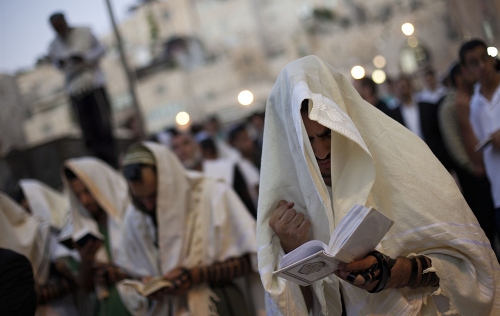
 The rabbinic approach to prayer, rather than pointing to the collectivization of Jewish religious consciousness, encourages individuals within the community to discover the personal dimension of Judaic spirituality within the communal life of the halakhah. In prayer and the Shema, the rabbis sought to allow the personal to be present in the framework of halakhic practice by joining individual initiative to structure, discipline, and order. They insisted that habit not triumph in the life of prayer, and they constantly admonished the community that prayer must not be a gesture that one repeats unthinkingly. They insist that one must not pray today just because one prayed yesterday. Personal supplication must be brought within the fixed framework of the petitional benedictions of the Amidah. One must even strive to bring novel elements into daily petitional prayer.
-Rabbi David Hartman
A Living Covenant: The Innovative Spirit in Traditional Judaism
Chapter 7: “Individual and Community Prayer”
Actually, there are days when I’d do almost anything if I could just flip my brain, heart, and soul into automatic pilot and be able to belong to the “collectivization of…religious consciousness” and turn what some religious Jews refer to as tefillat nedavah (voluntary prayer) into “structure, discipline, and order.” Sometimes my relationship with God, or at least the thoughts and feelings associated with that relationship, is too chaotic and scrambled to be of much use to either me or Him.
But as Rabbi Hartman describes it, there is a greater responsibility and intention (kavvanah) in Jewish prayer than most Christians tend to understand. There are exceptions, such as Pastor Jacob Fronczak’s love of liturgy, but I think you have to be wired a certain way as a non-Jew in order to love liturgical prayer. For me though, on those days (or weeks) when it is just too much for me to summon up the necessary energy and passion to take aim at God through my “prayer antenna” so what I want to say to God will reach Him, a structured set of benedictions would do quite nicely.
I don’t know where we learn to pray. I guess it’s different for everyone. For Rabbi Hartman, it came from listening to his mother pray during the synagogue service when he was a child.
I could hear her asking God to ensure that her adult sons would find good brides and that her husband would be able to support his family with dignity. Her prayers gave expression to her personal yearnings as a wife and mother. Her language was in no way inhibited or stunted. As I listened to her prayers, I did not sense that she felt unworthy to approach God with “petty” personal needs. She would have been astonished if someone had told her that the significance of prayer is to manifest an Akedah consciousness and asked how she dared feel so relaxed and easy before God. My mother, a deeply traditional Jew, prayed in the manner of generations of Jewish mothers. She continued a tradition that she received from her own family.
I’m compelled to think of the prayer of Hannah when reading about how Rabbi Hartman heard his mother’s prayers:
As she continued praying before the Lord, Eli observed her mouth. Hannah was speaking in her heart; only her lips moved, and her voice was not heard. Therefore Eli took her to be a drunken woman. And Eli said to her, “How long will you go on being drunk? Put your wine away from you.” But Hannah answered, “No, my lord, I am a woman troubled in spirit. I have drunk neither wine nor strong drink, but I have been pouring out my soul before the Lord. Do not regard your servant as a worthless woman, for all along I have been speaking out of my great anxiety and vexation.” Then Eli answered, “Go in peace, and the God of Israel grant your petition that you have made to him.” And she said, “Let your servant find favor in your eyes.” Then the woman went her way and ate, and her face was no longer sad. –1 Samuel 1:12-18 (ESV)
 It’s funny. In the moments when I was typing the previous quote from Rabbi Hartman’s book, I also couldn’t help but think of my wife. As a child, she would never have heard her mother pray as a Jew because her mother had long since abandoned any vestige of cultural, let alone religious Judaism. I can only feel compassion for my wife as I picture her first entering into the Jewish community in middle age, determined to reclaim what God intended for her from the first breath she took after birth, but could never live out until decades later.
The only prayer I can remember from my childhood is the one that begins, Now I lay me down to sleep, I pray the Lord my soul to keep…” While I don’t doubt that it’s comfortable for most Christians to keep formalized and liturgical prayer down to a bare minimum, I think they rob themselves and their children of something special when they dismiss it altogether. There’s a fabric of tradition, history, community, and belonging in those prayers. I’ve never been part of a purely Christian congregation that has employed a traditional prayer structure (although it could be argued that the small, “One Law” group with whom I once “fellowshipped” and continue to remember with affection, were more Christian than anything else), but in relation to Jewish prayer, the attraction for me to be part of that dynamic is substantial.
But more often than not, I find that serious time in prayer eludes me. I don’t know if it’s because I previously declared I would forego worship practices that even appear to be Jewish (with some rare and recent exceptions) or it it’s something more endemic to my soul, but lately, God seems to be rather “standoffish,” or perhaps it’s me. I used to think that a “crisis of faith” would be singular and rather brief since, by definition, a crisis is a dramatic event or set of events that occur very quickly and result in non-trivial change, but now I’m not so sure. I’m beginning to believe, maybe just in my case, that this “crisis of faith” is an evolutionary process that is leading me to some newer (and hopefully higher) realization of who I am in God.
In commenting on Maimonides, Hartman states:
I believe, however, that Maimonides’ understanding of prayer as avodah she-be-lev is an invitation to individuals to discover their own personal and individual mode of worship within a system in which common practice and community are so heavily emphasized.
She-be-lev or service of the heart is the individual operating of personal worship and devotion to God within the larger community of Judaism. It’s the unique part of space and time where a man davening during morning prayers with a minyan can still be an individual Jew with an individual heart and soul given up like an incense offering to God.
 Traditional Jewish prayer is like a container holding a liquid. The container defines the shape of the liquid but not its characteristics, substance, and behavior. The liquid can freeze, boil, or steam within the container and still be held and kept “safe.” Without the container though, all it can do is spill into a puddle on the counter top and dribble onto the floor, becoming fodder for the mop and destined for the drain and sewer.
When I try to pray or even think about how to get back to, let alone closer to God, I’m poured all over the ground. It would be nice if I could consider myself Paul’s proverbial “drink offering” (Philippians 2:17; 2 Timothy 4:6), but I know in fact, that I’m just making a mess.
But we have this treasure in jars of clay, to show that the surpassing power belongs to God and not to us. We are afflicted in every way, but not crushed; perplexed, but not driven to despair; persecuted, but not forsaken; struck down, but not destroyed; always carrying in the body the death of Jesus, so that the life of Jesus may also be manifested in our bodies. –2 Corinthians 4:7-10 (ESV)
Does anyone out there have a sponge to soak me up with and a handy jar to squeeze me into?


 Morning Meditations