Tag Archives: Torah

The Pious Fraud

In a reply to a yechidus query in the winter of 5635 (1874-75), my grandfather said to my father: The yetzer hara, (the evil impulse), is called “animal soul,” not because it is necessarily a brute animal. At times it may be a fox, the most cunning of beasts, and great wisdom is needed to perceive its machinations. At other times it may clothe itself in the garb of an earnest, straightforward, humble tzadik, possessing fine traits of character.

The animal soul manifests itself in each person according to his individual character. One person may suddenly experience a powerful longing to study Chassidus or to meditate deeply on some chassidic concept. The truth is, however, that this is nothing more than the yetzer hara’s counsel and the animal soul’s machinations to prevent him from engaging in the avoda of davening or a similar activity.

Take this as a general principle and remember it always: Any matter that is effective towards or actually leads to active avoda, and is confronted with opposition of any sort, even the most noble, that opposition is the scheming of the animal soul. My father concluded: Until then I had not known that there can be a “pious” animal soul, let alone a “chassidic” animal soul.

“Today’s Day”
Shabbat * Sivan 23, 5703
Compiled and arranged by the Lubavitcher Rebbe
Rabbi Menachem Mendel Schneerson, of righteous memory, in 5703 (1943)
from the talks and letters of the sixth Chabad Rebbe
Rabbi Yosef Yitzchak Schneersohn, of righteous memory
Translated by Yitschak Meir Kagan

The nature of good vs. evil and the nature of the human soul is somewhat more complicated in Judaism than it is in Christianity. I’m not going to spend any time trying to delve into these explanations, since there are people much more knowledgable and wiser than I am who have already made those distinctions. I do want to talk about how as human beings, we tend to fool ourselves, though. I know a lot about that.

It’s interesting to consider that even a very righteous person who desires to study Chassidus (If you’re Christian, think of it as studying the Bible, though that is a woefully inadequate comparison) could actually be caving into his “evil impulse.” I mean, what’s wrong with studying the Bible, folks? Or, what’s wrong with praying, or going to your local house of worship?

According to the commentary, even the desire to do something praiseworthy may be masking something else we’re trying to avoid, including our own awareness that we’re not being forthright in our motivations.

Really?

Think about this.

I want to read and study the Bible or some online commentary on the Torah. Being who I am, I’ll probably start writing a blog about it just because it’s in my nature to turn Bible study into blogs. But the floor needs to be vacuumed. Or my daughter needs a ride to work. Or my grandson is visiting and wants me to play with him. Or something is bothering my wife and she wants to talk with me about it. Or…

Well, you get the idea.

There’s nothing wrong with studying. There’s nothing wrong with blogging about Biblical or faith-based topics…unless they get in the way of “the weightier matters of the Torah,” which almost always involves actually doing some sort of good deed for another human being.

Imagine an extreme case where a person studied the Torah to the exclusion of all other considerations, including earning a living and supporting his family.

For even when we were with you, we would give you this command: If anyone is not willing to work, let him not eat. –2 Thessalonians 3:10 (ESV)

But if anyone does not provide for his relatives, and especially for members of his household, he has denied the faith and is worse than an unbeliever. –1 Timothy 5:8 (ESV)

But most of us aren’t that extreme. We do however, know how to appear pious and holy to the outside world and still have defective motives though.

“Woe to you, scribes and Pharisees, hypocrites! For you are like whitewashed tombs, which outwardly appear beautiful, but within are full of dead people’s bones and all uncleanness. So you also outwardly appear righteous to others, but within you are full of hypocrisy and lawlessness. –Matthew 23:27-28 (ESV)

Jesus was addressing people who knew they were being hypocrites and they didn’t mind behaving that way. What about those of us who truly believe we’re doing the right thing, but are really serving our own interests? We may really tell ourselves that studying Torah is more important than getting a job or getting a better job so we can support our families. We may tell ourselves that studying the Bible is more important than doing the vacuuming, washing the dishes, making dinner for the kids, or helping our neighbor with her yard work. I suppose, on a certain level, we can make a convincing case for it, too. After all, what’s wrong with studying the Word of God? What’s wrong with being immersed in the Bible? What’s wrong with being consumed and even obsessed with a life of faith?

What? But doesn’t a life of faith involve actually doing something about it? Doesn’t mowing your neighbor’s yard override praying, at least sometimes? Should we always ignore people for the sake of something we consider a higher ideal?

It’s probably not clear-cut in every single situation, but often we are so clever, we convince ourselves to do what we want to do, something that is indeed praiseworthy, so we can get out of doing something we don’t want to do that is equally praiseworthy.

The ego of man is cannibalistic in essence. At worst, it destroys everyone and everything in its path in order to attain its selfish goals. At best, as in the case of a civilized, refined and tolerant individual, it acknowledges its status as one among many, avows its support of the “human rights” of its fellows and concedes the legitimacy of pursuits other than its own. But even the most liberal-minded of men cannot escape the trappings of the ego: he will always see his fellow through the prism of self. His (seemingly) objective mind will point out that he shares the planet with billions of others, that there exist countless perspectives and callings in addition to his own. Deep down, however, the self will remain the gravitational center of reality, its ultimate point of reference. He will see others as necessary, perhaps crucial, but always secondary cogs to the kingpin of self.

Commentary on Ethics of Our Fathers
“The Contemporary Cannibal”
Sivan 23, 5772 * June 13, 2012
Chabad.org

This is part of a direct commentary on the following:

Rabbi Chaninah, deputy to the kohanim, would say: Pray for the integrity of the sovereignty, for were it not for the fear of its authority a man would swallow his neighbor alive. Rabbi Chaninah son of Tradyon would say: … Two who sit and exchange words of Torah, the Divine Presence rests amongst them…

-Ethics of the Fathers, 3:2

On the surface, it doesn’t seem as if there’s a connection between our need for a sovereign in order to curb man’s aggressive nature and studying words of Torah, but with just a little thought, the link becomes apparent.

So anyone who views the universe as an ownerless, arbitrary existence will never transcend the moral and intellectual cannibalism of the ego. For without a supreme authority that creates, defines and gives direction to all of creation, the self and its perceptions are the sole judge of right and wrong; inevitably, one’s vision of others will be tinted with the color of self.

It is only through the fear of G-d, only through the acceptance of the sovereignty of the King Of All Kings, that man can grow beyond the prejudice and anarchy of the ego. It is only by sensing an Absolute Truth before which all are equally insignificant, but which grants significance to the countless individual roles that fulfill the Divine purpose in creation, that an individual can genuinely see his fellow as his equal.

And because the naturally self-centered consciousness of man is, by definition, incapable of truly seeing beyond itself, this truth it is not something that one can understand and feel with the contemporary tools of his mind and heart. One must therefore “pray for the integrity of the sovereignty” in his life. One must concede that the transcendence of self is beyond his humanly natural capabilities, and humbly request that he be granted a higher, ego-free vision of his fellow.

It is only by acknowledging the absolute sovereign of the universe and submitting to His will that we can stop, look at what we’re doing, and realize what is really important in our lives and in the lives of those around us. Studying the Bible is important. Praying is important. Playing with your three-year old grandson is more important. God’s Bible is always there and is vital in helping us understand the importance of our roles, but once a moment in a child’s life has passed, you never get it back again.

You need to decide what you are. If you believe yourself to be angel, be prepared for some disappointment. If you think of yourself as a beast, you may well become depressed.

Best to know you are human. Stay away from situations you can’t handle, and face up to the mess when you fall down. That’s even higher than the angels.

-Rabbi Tzvi Freeman
“Identity”
Based on letters and talks of the Rebbe
Rabbi M. M. Schneerson
Chabad.org


Behaalotecha: The Presence of Light and Compassion

lightThe Lord spoke to Moses, saying: Speak to Aaron and say to him, “When you mount the lamps, let the seven lamps give light at the front of the lampstand.” Aaron did so; he mounted the lamps at the front of the lampstand, as the Lord had commanded Moses.

Numbers 8:1-3 (JPS Tanakh)

The Almighty is not in need of our light. On the contrary, we are in need of His. For this reason the Torah guides us in the proper way of taking full spiritual advantage of the light of the Menorah: The lamps must radiate toward themselves, meaning that the light they give should not only illuminate others, but it must come back and shine on the Menorah itself.

This returning light is at once a fact and a commandment. It applies especially in our day and age when the Temple and the Menorah are no longer standing, and when we must fill the void of the reflecting light that the Menorah once provided.

When the light we radiate around us by leading Torah lives returns to us, enhancing our spirituality and improving our behavior to one another, we will have fulfilled both the fact and the commandment of “When you light the lamps opposite the front of the candlestick the seven lamps shall give light.”

-from “Light That Returns”
A commentary on Torah Portion Behaalotecha
VirtualJerusalem.com

“You are the light of the world. A city set on a hill cannot be hidden. Nor do people light a lamp and put it under a basket, but on a stand, and it gives light to all in the house. In the same way, let your light shine before others, so that they may see your good works and give glory to your Father who is in heaven.”

Matthew 5:14-16 (ESV)

I suppose this week’s commentary on the Torah Portion is only loosely based on the Parashah, but I must admit that I need a little extra “light” in my world. With that in mind, I’m “tweaking” my “meditation” to favor “light.”

The Virtual Jerusalem commentary compares the commandment of lighting the Menorah in the Tabernacle to the “light” of spirituality, goodness, Torah study, and scholarship. To a Christian, praying, singing hymns, and preaching the Word might all seem like more worthwhile activities than studying the Bible, but for some Jews, studying Torah is directly associated with obeying its commands to do good and to show kindness to others. When you take in the light of the Torah, it shines in the world around you as well.

That very well could be related to what the Master was thinking when he said the words we have recorded in Matthew 5:14-16. We shine our light because we have received that light from our Master and teacher. It extends out into the world but it also is reflected back toward us as those we have touched in a meaningful way received our light (which comes from our Master) and it returns to us as a blessing.

Yes, we need blessings and renewal because even among the body of believers, it can be a trying world. If you’ve been reading the comments made on my blog over the past week or so, you know that tempers became heated, nerves became frayed, and some among the body of Christ seemingly forgot that our Master taught us a new commandment to love one another (John 13:34). Of course, there is the concept of “tough love” or “I’m only telling the truth,” but the Bible is replete with teachings about how to approach a brother privately to solve a dispute (Matthew 18:15-18).

Of course, Jesus goes on to say:

Again I say to you, if two of you agree on earth about anything they ask, it will be done for them by my Father in heaven. For where two or three are gathered in my name, there am I among them.” –Matthew 18:19-20 (ESV)

Naturally, the two have to actually agree on something, which seems easier said and done, and perhaps that “two or three..gathered in my name” means gathering face-to-face and not virtually in the blogosphere.

Yes, the “magic” of brotherhood I experienced at the Shavuot conference I recently attended has dissipated and once again, I encounter the actuality of “religious conversations,” where one can be accused of various misdeeds when the only “crime” that occurred was saying to the other person, “I don’t agree with you.” Failing to unreservedly honor another’s sacred cow can be a terrible thing (and I know a little something about pursuing sacred cows).

Tsvi Sadan calls the Messiah the concealed light, in part because the light of the Jewish King has been temporarily concealed from his Jewish brethern for the sake of the nations (see Romans 11). Rabbi Tzvi Freeman, in presenting the wisdom of the Lubavitcher Rebbe, of righteous memory, says:

It all began with an infinite light that filled all and left no room for a world to be. Then that light was withheld so the world might be created in the resulting void.

Then the world was created, with the purpose of returning to that original state of light — yet to remain a world.

All the world’s problems stem from light being withheld.

Our job then, is to correct this. Wherever we find light, we must rip away its casings, exposing it to all, letting it shine forth to the darkest ends of the earth.

Especially the light you yourself hold.

The Light was concealed. But its Source was not. The Source of Light is everywhere.

For those of you with little tolerance for Chassidic mysticism, I prefer to think of these writings as metaphorical. If indeed we shine some of the “concealed light” of our Master, the Messiah, Jesus Christ, as he taught us, we must not let the light be concealed. We must “rip away its casings” and expose that light to others. But what light are we talking about and what happens when it shines?

“Blessed are the poor in spirit, for theirs is the kingdom of heaven.

“Blessed are those who mourn, for they shall be comforted.

“Blessed are the meek, for they shall inherit the earth.

“Blessed are those who hunger and thirst for righteousness, for they shall be satisfied.

“Blessed are the merciful, for they shall receive mercy.

“Blessed are the pure in heart, for they shall see God.

“Blessed are the peacemakers, for they shall be called sons of God.

“Blessed are those who are persecuted for righteousness’ sake, for theirs is the kingdom of heaven.

“Blessed are you when others revile you and persecute you and utter all kinds of evil against you falsely on my account. Rejoice and be glad, for your reward is great in heaven, for so they persecuted the prophets who were before you. –Matthew 5:3-12 (ESV)

I suppose I could have quoted from any number of the Master’s teachings, but this one seemed particularly appropriate. Who is blessed? The poor in spirit, mourners, the meek, people who are passionate for righteousness, the merciful, the pure of heart, peacemakers, those persecuted for the sake of righteousness, the reviled, those falsely accused on account of the Master.

If you toss the Beatitudes into a big bowl, take a large wooden spoon and stir vigorously, you can come out with the idea that if you are persecuted, reviled, falsely accused, or just plain “bad mouthed,” you should still respond with meekness, act mercifully, be peacemakers, and mourn for the souls of those who need to personalize conflict in the name of Christ. What an odd way to react to a verbal slap in the face, but then the Master also said something about turning the other cheek (though probably not literal in meaning).

Sorry, I just needed to ponder those thoughts and to consider that even the world of religious discourse (some would say especially the world of religious discourse) is no less filled with landmines and tripwires than any secular conversation.

He could have placed streetlamps along all the pathways of wisdom, but then there would be no journey.

Who would discover the secret passages, the hidden treasures, if all of us took the king’s highway?

Toward the light Rabbi Freeman uses light and darkness to describe the presence or absence of wisdom and knowledge of God, but I choose to see this as a metaphor illustrating peace, mercy, and righteousness, or their absense. A movie I’ve seen a few times starring Harrison Ford as (of all people) the President of the United States, contains one of my favorite lines of dialog:

Peace isn’t merely the absence of conflict, but the presence of justice.

In my case, I’d settle for only the occasional absence of conflict (since, after all, this is the Internet and human beings are involved), the presence of compassion, and the soft glow of a bit of kindness, like candlelight, holding the darkness at bay.

Good Shabbos.

Naso: Bridegroom of the Sabbath

The Torah portion of Naso discusses the law of Sotah: (Bamidbar 5:11-31) When a husband warns his wife not to be alone with a certain man and she disobeys him, then even if she did not sin with that man, the very fact that she was alone with him causes her to become a sotah — a woman “straying from the path of modesty.” (Rashi, ibid., verse 12.)

The relationship between husband and wife in this world is analogous to the relationship between the A-lmighty and the Jewish people, who are deemed “husband and wife.” (See Likkutei Sichos , Vol. III, p. 984.) Thus all the laws of sotah apply to the relationship between G-d and the Jews.

The “warning” that G-d issues to the Jewish people is the command: “You shall have no other gods before Me.” (Shmos 20:3.) This is similar to the warning: “do not conceal yourself with a certain man.”

The Chassidic Dimension
Commentary on Torah Portion Naso
Based on Likkutei Sichos, Vol. IV, pp. 1032-1034
and the teachings of the Lubavitcher Rebbe
Rabbi Menachem M. Schneerson
Chabad.org

The Bible is replete with marriage metaphors, usually contrasting God and Israel as husband and wife. We also have a great deal of similar imagery in the Apostolic Scriptures depicting Jesus as husband and the church as his bride.

Wives, submit to your own husbands, as to the Lord. For the husband is the head of the wife even as Christ is the head of the church, his body, and is himself its Savior. Now as the church submits to Christ, so also wives should submit in everything to their husbands.

Husbands, love your wives, as Christ loved the church and gave himself up for her, that he might sanctify her, having cleansed her by the washing of water with the word, so that he might present the church to himself in splendor, without spot or wrinkle or any such thing, that she might be holy and without blemish. –Ephesians 5:22-27 (ESV)

Many Christian women take great comfort in these metaphors but more than a few men struggle with the role of “bride” relative to the Messiah. But let’s not be incredibly literal, since the Bible writers are using metaphors to describe a level of close intimacy between the Messiah and his disciples that can only be likened with the closeness and love experienced by two people who are intertwined by devotion. But Israel and the church aren’t the only “bride” metaphors we know of.

The chorus of the classic Sabbath hymn Lekhah Dodi states in part:

Let’s go, my beloved, to meet the bride,
and let us welcome the presence of Shabbat.

But in this instance, if the Shabbat is the bride, who is the bridegroom? The traditional Jewish tradition casts God in that role, but we also have this:

Or have you not read in the Law how on the Sabbath the priests in the temple profane the Sabbath and are guiltless? I tell you, something greater than the temple is here. And if you had known what this means, ‘I desire mercy, and not sacrifice,’ you would not have condemned the guiltless. For the Son of Man is lord of the Sabbath.” –Matthew 12:5-8 (ESV)

The oldest text we have for this passage is in Greek, but if we try to “retrofit” these verses back into the Hebrew thoughts of the Jewish writer of Matthew, when he says “the Son of Man is lord of the Sabbath,” what word did he use for “lord?”

“Adon” seems to be fitting under the circumstances, but a week ago, I heard a different interpretation by a young Jewish scholar (yes, I’m “borrowing” this from you, Nick) who offered a sort of midrash on this topic.

The word Baal is derived from the common Hebrew verb (ba’al), own, rule, possess. The verb is even used to indicate the husband’s relationship to his wife (Deuteronomy 24:1) and is applied to the relationship between God and man, “For your husband (ba’al) is your Maker…” (Isaiah 54:5).

-quoted from the
abarim-publications.com website

ShabbatBaal can mean both “lord” and “husband” but by deliberately applying the latter meaning, we can discover something about the relationship between Messiah and the Shabbat as well as something about the Messiah and us.

When we read the passage as “‘lord’ of the Shabbat”, we think of someone in charge or in command or with authority. These are very powerful images, but they don’t fit very well with how a loving groom should be approaching his bride. However, if we say, “‘husband’ of the Shabbat,” we completely change the meaning. Suddenly, we have an intimate, warm, caring interaction between the Messiah and the Shabbat.

Some Jewish sages state that the Shabbat is actually a small taste of the life in the world to come; Paradise, if you will. Creating the picture of a husband, the Messiah, welcoming his beloved bride, the Shabbat, into his arms, we can see something of the peace we will experience when he finally returns and fixes our broken world and our broken hearts.

He will wipe away every tear from their eyes, and death shall be no more, neither shall there be mourning, nor crying, nor pain anymore. –Revelation 21:4 (ESV)

This also fits very well back into what we saw in Ephesians 5 in comparing Jesus and the church with a husband and wife.

I know I’m being more than a little poetic here, but I take a certain amount of comfort in applying the lessons of both this week’s Torah Portion and the Shabbat to my walk of faith, and realize that Shabbat is not only a way for God to comfort us in the midst of our weekly trials, but His promise that He will always love us and, through the Messiah, grant us eternal peace.

Why should we stray after others to be alone with them when we can be the bride of the Moshiach and receive boundless intimacy with our bridegroom.

Good Shabbos.


Bamidbar and Shavuot: Souls in the Desert

“Numbers” may be the name by which the fourth of the Five Books of Moses is commonly called, but in the Hebrew original it is known as Bamidbar, or “In the Wilderness.” It is interesting to note that this parsha is always read immediately before the festival of Shavuot, “the season of the giving of the Torah.” What is the connection?

The Sages teach that it is not enough for G-d to give us the Torah, we have to be ready to receive the Torah. What makes us worthy recipients of this most precious and infinite gift from G-d? This is where the “wilderness” idea comes in. A wilderness is a no-man’s land. It is ownerless and barren. Just as a desert is empty and desolate, so does a student of Torah need to know that he is but an “empty vessel.” Humility is a vital prerequisite if we are to successfully absorb divine wisdom.

-Rabbi Yossy Goldman
“Wisdom from the Wilderness”
Commentary on Torah Portion Bamidbar (Numbers)
Chabad.org

When the day of Pentecost (that is, Shavuot) arrived, they were all together in one place. And suddenly there came from heaven a sound like a mighty rushing wind, and it filled the entire house where they were sitting. And divided tongues as of fire appeared to them and rested on each one of them. And they were all filled with the Holy Spirit and began to speak in other tongues as the Spirit gave them utterance.

Now there were dwelling in Jerusalem Jews, devout men from every nation under heaven. And at this sound the multitude came together, and they were bewildered, because each one was hearing them speak in his own language. And they were amazed and astonished, saying, “Are not all these who are speaking Galileans? And how is it that we hear, each of us in his own native language?”

Acts 2:1-8 (ESV)

I’m not sure what I’m supposed to write about. On my “morning meditation” for Fridays, I usually create a commentary on the weekly Torah Portion, which this week is the beginning of Numbers. However, we are also on the cusp of Shavuot and the two cannot be neatly divided and separated. In my quote from Rabbi Goldman, he even asks about the connection between the two. Fortunately, he also gives us an answer.

However, for those of us who are disciples of the Jewish Messiah and devoted to Jesus Christ, there is an added dimension to offering the Torah to the wilderness within all our souls. There is the giving of the Spirit and God. This isn’t to say that Jews do not have access to the Spirit of God. Far from it. But in accepting the Messiah into our hearts and recognizing that it is Jesus who is Lord of life and firstborn from the dead, we enter into a covenant that not only preserves us in the present world, but one that will endure beyond the next and into all eternity, even as Heaven and Earth pass away (Matthew 5:18).

But we are still here and we exist in what we call “now,” which is approaching Shabbat and a day later, Shavuot. We look to the past, to Mount Sinai and the Torah and to that room in Jerusalem and the Apostles being filled with the Spirit, and we rejoice. But it’s not all about the past.

Unlike Passover or Sukkos, or even the minor Rabbinic holiday of Purim, Shavuos comes with no special observances, no unique Mitzvos to be performed on that day. The “only” thing that sets Shavuos apart is that it is the day when G-d gave the Torah, His most precious gift, to the Jewish people.

Each year, we don’t merely revisit or even relive that experience. Kabbalistic sources teach that the unique spiritual powers of each holiday return to this world every year on that same day. On Shavuos, we have a special power to take our portion in Torah, each and every year.

Every year, many of us skip out on this unique opportunity. We deny ourselves the closeness to G-d which is within our grasp. And there is a fascinating Medrash concerning the giving of the Torah, which hints that this isn’t an entirely new phenomenon.

-Rabbi Yaakov Menken
“Shavuos”
Torah.org

Rabbi Menken doesn’t say this explicitly, but the reason we study Torah, observe the festivals, and remember the holy acts in the lives of the Apostles is to not just relive them today, but to experience them as new, fresh, living events that are happening to us for the very first time. Many Christians speak of a need for renewal in the church and yet Judaism has built into its calendar multiple times of renewing each and every year. Jews and Christians are at such a time now. Before our awareness of God, we existed as a wilderness, empty and barren in our soul. This is especially tragic for Jews since they are members of the Covenant and a chosen people, even if they acknowledge God not at all. We who are Gentiles, if we are without God, we are as Paul described us; far off and without hope (Ephesians 2:12).

The Jews were joined with God at the foot of Sinai in the desert, where the Torah was given to them. We who were once far off were offered the opportunity to also draw close to God at the foot of the cross and in that room in Jerusalem, when we were washed by blood and filled with Spirit. We were made alive and spiritually aware of God through Christ.

Rabbi Goldman concludes his commentary on Numbers and Shavuot by saying:

May we receive the Torah with joy and earnestness so that this important festival will be both memorable and meaningful.

Paul says in Ephesians 12:22 (ESV):

And in him you too are being built together to become a dwelling in which God lives by his Spirit.

Open your minds, your hearts, and your spirits to God. Today we become new again.

A Happy Shavuos and Good Shabbos.

(Shavuot begins Saturday evening right when Shabbat ends, so my next “morning meditation” will be posted online Monday morning. Blessings).

Looking Through a Dark Window

The Alter Rebbe explained in the previous chapter that the light of the Shechinah, an illumination utterly transcending the realm of the world, must have a “garment” which enables it to radiate there. The “garment” of the Shechinah is Torah.

…As explained earlier, for this reason the Torah is able to act as a “garment” that does not become nullified in the light of the Shechinah which garbs itself in it — since its source is higher than the Shechinah. However, in order for Torah to act as a concealing “garment” it must descend lower than the level of the Shechinah, thereby enabling the light of the Shechinah to be received by created beings.

However, as Torah descended into the Ten Commandments engraved on the Tablets, it did not do so in a manner that would make it similar to other physical things. Rather, as will soon be explained, it remained on a level which is higher than the previously mentioned upper Worlds.

Today’s Tanya Lesson (Listen online)
Likutei Amarim, beginning of Chapter 53
By Rabbi Schneur Zalman of Liadi (1745-1812), founder of Chabad Chassidism
Elucidated by Rabbi Yosef Wineberg
Translated from Yiddish by Rabbi Levy Wineberg and Rabbi Sholom B. Wineberg
Edited by Uri Kaploun
Chabad.org

OK, so you’re not into Kabbalah or other mystic experiences and the Tanya as a source of information is completely lost to you. Hang in there, you can still learn something from today’s “meditation.” What is Rabbi Zalman saying? Here’s another point of view.

Torah is the interface between the Infinite and creation. On the outside, it speaks the language of humankind. On the inside, its depth is without end.

Grasp either end and you have nothing. Grasp both and you have G-d Himself.

-Rabbi Tzvi Freeman
“Interface”
Based on letters and talks of the Rebbe
Rabbi M. M. Schneerson
Chabad.org

I hope my quote from Rabbi Freeman’s interpretation of the Rebbe helped you because it did a lot for me. It’s saying what I’ve said before and what I’ve believed for quite some time. It’s saying that everything we use to try to connect to God is an interface and not a direct connection. Let me explain.

If you’re reading this, you’re using some sort of a computer. It could be a PC, laptop, tablet, smartphone, whatever. Most people relate to their computer they way they relate to their car. They don’t really know how it works, they just turn it on and expect it to work. But when you turn your computer on and use it, your aren’t really directly interacting with the computer hardware or software. You are using a graphical user interface (GUI) to execute commands that are passed on to the computer via the operating system. It’s more complicated than that, and you are actually working through several layers of abstraction every time you read an email, surf the web, create a document, or whatever other activities you perform to get things done on your device.

In the end, you get your work completed, but you haven’t really “touched” the raw “guts” of the computer. You’ve used an interface to work with the computer it make what you want to do happen on your terms. Using an interface means you don’t have to learn how to speak the computer’s “language.”

On various Christian blogs I sometimes see statements such as “let’s go directly to the Word rather than relying on human understanding” and “let the Holy Spirit interpret Scripture and not the knowledge of men.”

Huh?

How are you going to do that? Folks who say such things act as if they have direct and unfiltered access to the original, raw meaning and context of the Bible, as if they were standing right there while Matthew, John, Paul, and scores of others were putting pen to paper, listening to these men explain (in plain, 21st century English no less) what they were thinking and what they really meant as they created their books and letters.

We know we don’t have that kind of insight available to us. We realize that the Bible was written over a period of thousands of years by dozens of writers using variations of languages most of us don’t understand. We realize that the Bible was written within a foreign and ancient national, cultural, and ethnic context that is completely alien to us. And yet we behave as if all of that doesn’t matter.

I know what you’re thinking. You’re thinking something like this:

…these things God has revealed to us through the Spirit. For the Spirit searches everything, even the depths of God. For who knows a person’s thoughts except the spirit of that person, which is in him? So also no one comprehends the thoughts of God except the Spirit of God. Now we have received not the spirit of the world, but the Spirit who is from God, that we might understand the things freely given us by God. And we impart this in words not taught by human wisdom but taught by the Spirit, interpreting spiritual truths to those who are spiritual. –1 Corinthians 2:11-13 (ESV)

You’re thinking that the Holy Spirit, which you possess if you have accepted Jesus Christ as Lord and Savior over your life, will automatically interpret what the Bible is saying to you as you are reading it.

Well, maybe you’re not thinking exactly those thoughts, but that’s as close as I can come to understanding what we Christians expect to happen when we read the Bible and attempt to comprehend its content. We seem to believe that whatever we come up with by way of an interpretation must be from the Holy Spirit just by virtue of the fact that we’re Christians.

But what if the Holy Spirit doesn’t act like an automatic pilot and just routinely guide us to the correct conclusions every time we pick up a Bible and read a few verses? What if other stuff gets in the way?

Beloved, do not believe every spirit, but test the spirits to see whether they are from God, for many false prophets have gone out into the world. By this you know the Spirit of God: every spirit that confesses that Jesus Christ has come in the flesh is from God, and every spirit that does not confess Jesus is not from God. –1 John 4:1-3 (ESV)

Seems simple enough until you try to do it. If you come up with a particular interpretation of the Bible and you believe you arrived at your understanding through the Spirit, do you just call out, “Hey Spirit! Do you confess that Jesus has come in the flesh is from God?” The Spirit would have to say “yes” or “no” before you could determine the validity of your Bible interpretation. Does that happen to you very often?

How about this?

The brothers immediately sent Paul and Silas away by night to Berea, and when they arrived they went into the Jewish synagogue. Now these Jews were more noble than those in Thessalonica; they received the word with all eagerness, examining the Scriptures daily to see if these things were so. –Acts 17:10-11 (ESV)

Do not quench the Spirit. Do not despise prophecies, but test everything; hold fast what is good. –1 Thessalonians 5:19-21 (ESV)

Paul advocates for asking lots of questions. Don’t take anything at face value. Test even the spirits. Lots of false prophets are selling their wares out there, especially on the Internet.

But it also says to “not quench the Spirit” which I suppose means not to toss the baby out with the bathwater. Don’t be so skeptical that you close the door to spiritual learning and interpretation. Just don’t believe everything your hear or feel, either.

The Bible doesn’t put it into so many words, but I believe that one of the big factors inhibiting our understanding of the Word of God is our own emotional and intellectual wants, needs, and desires. Once we’ve made up our mind about something the Bible says, we believe that is that. The Spirit has spoken. This is how it is. But is what we believe about our interpretation the way it is as defined by God’s Spirit, or just the way we want things to be because it “feels right” to us?

I don’t have an absolute answer for you, but this is one of the great challenges and mysteries about understanding God and our purpose in life using supernatural means. We have to constantly pay attention to what we believe and why we believe it and not take anything for granted.

For now we see in a mirror dimly, but then face to face. Now I know in part; then I shall know fully, even as I have been fully known. –1 Corinthians 13:12 (ESV)

Even at his best, Paul says that we can only see “in a mirror dimly” but only later “face to face” the things of God. Once we become too sure about our own theology and our own doctrine and stop asking the tough questions we can’t always find answers to, we start having a problem. We start worshiping our own self-assured “image of God” as we’ve created Him in our hearts and minds, and not the unknowable, unfathomable, insurmountable, infinite, unique One God. We have to “grab” both ends of the Bible, so to speak; the spiritual end and the material end. We have to rely on the Spirit and we have to use our understanding and education. Even then, we aren’t absolutely sure of what we’re doing.

“It is the dull man who is always sure, and the sure man who is always dull.”

-H.L. Mencken, American journalist and essayist

The Bible, sermons, lessons, even prayer, are only interfaces; the “garments” God must put on to allow us to even dimly view His existence, as through a mirror darkly. Keep searching the darkness. Look for the light.

Notice! By the time you read this, I’ll have left home and be traveling to the First Fruits of Zion (FFOZ) 2012 Shavuot Conference in Hudson, WI. Part of what that means is I’ll have limited access to the Internet. I’ll still be posting “meditations” every morning except for Shabbat and Shavuot (Sunday) but I won’t be able to respond to comments and emails, at least not very effectively. I also probably won’t be able to post links to my meditations on Facebook, Google+ and twitter like I usually do. Please feel free to comment but realize I may be slow in getting back to you, which includes approving first-time comments. God be willing, I’ll be back home very late on Monday night. Thanks for your patience.

Our Teacher Moshe the Shepherd

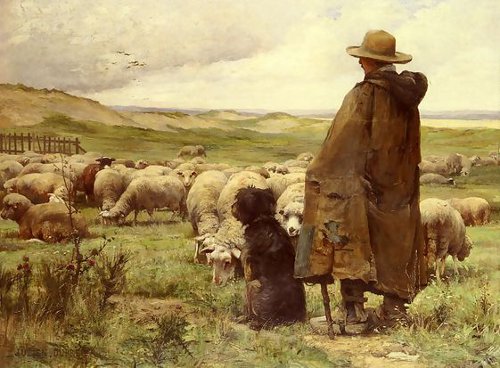
The Baal Shem Tov was once shown from heaven that a certain simple man called Moshe the Shepherd served G‑d, blessed be He, better than he did. He longed to meet this shepherd, so he ordered his horses harnessed to his coach, and traveled, with a few of his disciples, to the place where he was told the shepherd lived.

They stopped in a field at the foot of a hill, and saw, on the hillside above them, a shepherd who was blowing his horn to call his flock. After the sheep gathered to him, he led them to a nearby trough to water them. While they were drinking, he looked up to heaven and began to call out loudly, “Master of the world, You are so great! You created heaven and earth, and everything else! I’m a simple man; I’m ignorant and unlearned, and I don’t know how to serve You or praise You. I was orphaned as a child and raised among gentiles, so I never learned any Torah. But I can blow on my shepherd’s horn like a shofar, with all my strength, and call out, ‘The L-rd is G‑d!’” After blowing with all his might on the horn, he collapsed to the ground, without an ounce of energy, and lay there motionless until his strength returned.

Then he got up and said, “Master of the world, I’m just a simple shepherd; I don’t know any Torah, and I don’t know how to pray. What can I do for You? The only thing I know is to sing shepherds’ songs!” He then began to sing loudly and fervently with all his strength until, again, he fell to the earth, exhausted, without an ounce of energy.

-Yitzchak Buxbaum
“The Shepherd”
from his book, Light and Fire of the Baal Shem Tov
quoted from Chabad.org

You shall love the Lord your God with all your heart and with all your soul and with all your might.Deuteronomy 6:5 (ESV)

Buxbaum goes on to describe the shepherd’s further efforts to love and please God, some which may sound almost ludicrous, such as standing on his head and waving his feet wildly in the air, but we can learn a lesson from this shepherd and this tale of the Baal Shem Tov.

In all likelihood, no such shepherd ever existed and God never showed the Baal Shem Tov how to find him, but that’s not the point. The point is to learn something about us and about God and about how we’re supposed to connect our lives to Him. That’s what Chassidic tales are all about.

In our tale, the shepherd, who God tells the Baal Shem Tov worships Him better than the venerated Chassidic sage, is a Jew who was raised among Gentiles and who has absolutely no grasp of Torah, Talmud, or even the most basic understanding of halachah. He has no formal education in any of the mitzvot and although the shepherd knows he is to honor, worship, and give glory to God, he doesn’t know the first thing about how a Jew is supposed accomplish this.

Interesting, isn’t it.

This isn’t to say that we shouldn’t study and learn and strive to comprehend what God expects of us, but the information seems to be secondary to the desire, the will, and the intent of the person in worship. Moshe the Shepherd knew nothing but in a sense, he knew everything. He knew to take care of his sheep just as shepherds such as Moshe the Prophet, David the King, and our “good shepherd” Jesus the Rabbi knew how to take care of their sheep, even to the point of laying down their lives.

Moshe the Shepherd called to his sheep by blowing his horn which he compared to a shofar, and since the sheep responded by going to him, it shows he had certainly earned their trust. He gathered his sheep and watered them, and while watering them, cried out to God, blew his horn for Him, sang shepherd’s songs for Him, acknowledged God’s might and glory in the loudest voice he could muster, and he did all this with such zeal and energy that he collapsed, exhausted upon the ground.

And after seeing Moshe the Shepherd do this over and over again to the point of total collapse, we reach the dramatic conclusion of our tale:

What more can I do to serve You?” After pausing to reflect, he said, “Yesterday, the nobleman who owns the flock made a feast for his servants, and when it ended, he gave each of us a silver coin. I’m giving that coin to You as a gift, O G‑d, because You created everything and You feed all Your creatures, including me, Moshe the little shepherd!” Saying this, he threw the coin upward.

At that moment, the Baal Shem Tov saw a hand reach out from heaven to receive the coin. He said to his disciples, “This shepherd has taught me how to fulfill the verse: ‘You shall love the L‑rd your G‑d with all your heart, with all your soul and with all your might.’”

What does God want from you? The answer is amazingly simple:

He has told you, O man, what is good; and what does the LORD require of you but to do justice, and to love kindness, and to walk humbly with your God? –Micah 6:8 (ESV)

Without studying the Bible, Moshe the Shepherd knew what pleased God and he worshiped and pleased God with all his strength. How much more should we who study the Bible know and then do what pleases God. But do we try to please Him with all our might as did Moshe the Shepherd?

Torah is not about getting to the truth. When you are immersed in Torah, even while pondering the question, even while struggling to make sense of it all, you are at truth already.

Torah is about being truth.

-Rabbi Tzvi Freeman
“The Process”
Based on letters and talks of the Rebbe
Rabbi M. M. Schneerson
Chabad.org