
 In each one glows a spark of Moses. He is our teacher. A teacher’s job is to open a small window for the inner knowledge to pour down into the conscious mind.
How do you awaken Moses? By waking yourself.
How do you awaken yourself? By finding someone in whom Moses is awake.
Only the awakened can waken others.
Rabbi Tzvi Freeman
“Moses Inside”
Chabad.org
In Judaism, none like Moses has ever appeared upon the earth again; a man who spoke to God “face-to-face”. In Christianity, only one person has appeared who is greater than Moses:
When Jesus came to the region of Caesarea Philippi, he asked his disciples, “Who do people say the Son of Man is?”
They replied, “Some say John the Baptist; others say Elijah; and still others, Jeremiah or one of the prophets.”
“But what about you?” he asked. “Who do you say I am?”
Simon Peter answered, “You are the Messiah, the Son of the living God.” –Matthew 16:13-16
If we extend Rabbi Freeman’s statement into the life of a Christian, what can we say? Perhaps the clue is in a commentary from this week’s Torah Portion Balak:
The Torah portion Balak relates how Balak, king of Moav, hired the prophet Bilam to curse the Jewish people. G-d, however, frustrated the king’s scheme and caused Bilam to utter praises and blessings of the Jewish people.
Among Bilam’s words of praise and blessing, we find the following: “I see him [Israel] from the peak of flintrocks, and gaze upon him from the heights; it is a nation dwelling alone, entirely dissimilar to other nations.”
In explaining the words: “I see him [Israel] from the peak of flintrocks,” Rashi comments: “I gaze upon their beginnings and their roots, and see them braced and as strong as these flintrocks and rocky heights, on account of their Patriarchs and Matriarchs.” Bilam’s statement was thus allegorical.
The true power of a Jew lies not in his physical might but in his spiritual prowess, particularly his power of mesirus nefesh , a submission to the Divine that is so profound that he is willing to lay down his life if necessary for the realization of G-d’s will. The soul that possesses the power of mesirus nefesh is referred to as “the peak of flintrocks.” This power emanates from a Jew’s mighty, firm and immutable faith in G-d, a faith so powerful that a Jew will offer his very life in order not to renounce G-d.
The Alter Rebbe thus explains that the power to act with mesirus nefesh is a byproduct of G-d’s shining within every Jewish soul, for mesirus nefesh flies in the face of nature; a living creature doesn’t do things that cause its own negation.
-Based on the teachings of the Lubavitcher Rebbe, Rabbi Menachem M. Schneerson for Torah Portion Balak
“A View from Above”
Chabad.org
This fits very well with what Rabbi Freeman wrote earlier and illustrates that strength comes from the presence of the Divine within each individual and within the community as a whole. We see something similar in the writings of Paul:
I know what it is to be in need, and I know what it is to have plenty. I have learned the secret of being content in any and every situation, whether well fed or hungry, whether living in plenty or in want. I can do all this through him who gives me strength. –Philippians 4:12-13
Among his many blessings upon the Children of Israel, Balaam prophesied the coming of the Messiah (Numbers 24:17-19). This is a hope that both the Jewish people and Christianity looks to, though each with a different understanding:
In writing about Moshiach (Messiah), the Rambam states in his Code of Law, Yad HaChazakah : “Whoever does not believe in him or does not await his coming, denies not only [the statements of] the other prophets, but also [those of] the Torah and of Moshe, our teacher, for the Torah attests to his coming, stating: ‘And the L-rd your G-d will bring back your captivity and have compassion upon you.’
-Based on the teachings of the Lubavitcher Rebbe, Rabbi Menachem M. Schneerson for Torah Portion Balak
“The Prophecies of Bilam”
Chabad.org
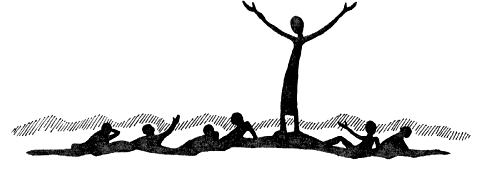 We see that failing to have faith in the coming of the Messiah is failing to have faith in all the Prophets that came before him and indeed, the entire record of the actions of God among mankind. The twelfth of Rambam’s Thirteen Principles of Faith states this message clearly, and we are to make our trust and hope a centerpiece in our life of faith:
I believe with complete faith in the coming of the Messiah. And even though he may delay, nevertheless, every day I anticipate that he will come.
It is in that hope that Jews and Christians sustain themselves, regardless of hardship and the struggles of our lives. In addition to what we’ve read so far, Christians look to the following:
As it is written:
“For your sake we face death all day long;
we are considered as sheep to be slaughtered.”No, in all these things we are more than conquerors through him who loved us. For I am convinced that neither death nor life, neither angels nor demons, neither the present nor the future, nor any powers, neither height nor depth, nor anything else in all creation, will be able to separate us from the love of God that is in Christ Jesus our Lord. –Romans 8:36-39 (quoting Psalm 44:22)
Three times I pleaded with the Lord to take it away from me. But he said to me, “My grace is sufficient for you, for my power is made perfect in weakness.” Therefore I will boast all the more gladly about my weaknesses, so that Christ’s power may rest on me. That is why, for Christ’s sake, I delight in weaknesses, in insults, in hardships, in persecutions, in difficulties. For when I am weak, then I am strong. –2 Corinthians 12:8-10
To awaken the Messiah within us, we must find someone in whom the Messiah is awake. If the Messiah is awake in you, awaken him in others. Make his power perfect.
Arise, shine, for your light has come,
and the glory of the LORD rises upon you. –Isaiah 60:1
Good Shabbos.
 Morning Meditations
I just came across this post while TagSurfing. I too write the occational post about God and Jesus over on my blog mostly about economics and theology. Check it out and thanks for being part of this important conversation.
Thanks, Lauren. I’ll have a look. Please feel free to post a comment that’s more relevant to the content of today’s “meditation”.
You asked a question about tzitzits here. http://www.messianicjudaism.me/yinon/2011/06/17/keeping-the-faith/ Namely why only Jews are allowed to wear them in Messianic congregations.
I posted a comment that I doubt will be published, and this is it:
–beginning of comment
They’re supposed to be blue, and the one in the picture hanging off the dude’s jeans is white. Oh, I forgot, the rabbis have the authority to change the words of the Almighty. If Adonai wants blue, they say to Him, “no you should want white, O King of the Universe,” and he just says “Ok,” right? Interestingly, the commandment to wear blue fringes on your garment is more fulfilled by wearing the jeans than by the white tzitzits! Just ruffle the lining of the jeans a bit to give ‘em a fringed look, and you’re covered; with the right color to boot!
–end of comment
In other words, in my estimation, every time you (Gentile as you may be) wear jeans, you are fulfilling the command to wear blue tzitzits (blue fringes) on your garment, more than any Jews of modern times, since they have changed the color to white! Only the Kairites still wear the blue tzitzits, because they reject rabbinic tradition and claim to follow the peshat, or plain meaning, of the text. Of course, as a result, they are hated by rabbinic Jews and considered a heresy, and it is pretended that they do not exist. They are like Uncle Toms or something, to be considered “not Jewish enough” to be real Jews because they would rather follow the Torah itself and wear blue fringes like it says then listen to the rabbis and change the color to white.
Its also silly that most tallits actually have blue in them…but not in the fringes. They claim that only the blue dye from a particular rare shellfish can be used….yet they put blue in the tallit, just always in the wrong place. It is very telling. The rabbis just wanted to feel the power of God and change God’s commandments for the sake of some high or rush.
They’re supposed to be blue, and the one in the picture hanging off the dude’s jeans is white. Oh, I forgot, the rabbis have the authority to change the words of the Almighty. If Adonai wants blue, they say to Him, “no you should want white, O King of the Universe,” and he just says “Ok,” right? Interestingly, the commandment to wear blue fringes on your garment is more fulfilled by wearing the jeans than by the white tzitzits!
Whoa!
First of all, welcome to my blog, Rey.
Secondly, your comment doesn’t have a lot to do with my actual blog post, but I’m OK with it.
Now to the topic at hand. Only one thread is supposed to be blue. However, it can’t just be any blue from any source. I believe there’s a specific snail that must be used to produce the exact type of blue (you won’t find this in the Bible, it’s part of the Oral Law passed from Hashem to Moses at Sinai and later recorded in the Talmud..I don’t have the specific reference handy).
As with many other things, the exact snail and the process were lost so it became impossible for tzitzit to be made with the exact shade of blue. Rather than taking the risk of improperly using the wrong process, it was determined to forego dying the one thread blue at all..because it was impossible to properly do so..just as Jews can no longer offer korban because the Holy Temple does not exist in Jerusalem.
The interesting thing is that the process was rediscovered (I don’t know the details) about ten years ago, so you can purchase tzitzit with the proper blue thread again. I don’t know how well received this is, especially in Orthodox circles, but I think a significant number of Jewish men still wear tallitot with all white tzitzit, “just in case” (Gene would probably be a better person to ask about all this).
I really don’t think there’s any reason to become upset about this matter. You just have to dig into the rationale behind the Rabbinic rulings and try to see things from that point of view (I doubt I’m all that successful, but I feel honor-bound to make the attempt, rather than judging them out of hand from a Gentile’s perspective).
Oh, and technically speaking, wearing a tallit isn’t part of the commandment, which is why you can find them in a variety of colors. The special blue coloring only applies to that one thread on the tzitzit.
Does that help clear up the issue?