Vayishlah: The Running Shliach

That same night he arose, and taking his two wives, his two maidservants, and his eleven children, he crossed the ford of the Jabbok. After taking them across the stream, he sent across all his possessions. Jacob was left alone. And a man wrestled with him until the break of dawn. When he saw that he had not prevailed against him, he wrenched Jacob’s hip at its socket, so that the socket of his hip was strained as he wrestled with him. Then he said, “Let me go, for dawn is breaking.” But he answered, “I will not let you go, unless you bless me.” Said the other, “What is your name?” He replied, “Jacob.” Said he, “Your name shall no longer be Jacob, but Israel, for you have striven with beings divine and human, and have prevailed.” Jacob asked, “Pray tell me your name.” But he said, “You must not ask my name!” And he took leave of him there. So Jacob named the place Peniel, meaning, “I have seen a divine being face to face, yet my life has been preserved.” The sun rose upon him as he passed Penuel, limping on his hip.Genesis 32:23-32 (JPS Tanakh)

As he prepared to face Esau, Jacob experienced a strange mystical encounter with God. He had sent his family, his servants and his possessions across a river ahead of him. He was about to follow when he was suddenly attacked by an assailant. Jacob wrestled the man through the night. The attacker turned out to be none other than the angel of the LORD.

“A Life-Changing Encounter”
First Fruits of Zion (FFOZ) commentary on
Torah Portion Vayishlah

I know. Everybody teaches and writes on Jacob wrestling with the angel. It gets a little cliche’ after awhile. Who was the angel? Was it Jesus? Was it God? Was it Jacob’s “evil inclination?” Was it the angel embodying the spirit of Esau? All of the above, some of the above, none of the above? Who knows?

And what does it have to do with us?

The FFOZ commentary goes on to say that the name change of Jacob to Israel, as a result of the patriarch’s encounter with the Divine, altered the course of his life, changing his nature from “trickery and deceit” to one who is “authorized to receive the blessing.” The commentary concludes with this:

A genuine encounter with God is life-changing. It is a sort of wrestling match. The apostles teach us that, through faith in Yeshua, we are born again as new creations. In Messiah we have a whole new identity. Paul speaks of our old identity as the “old self.” He declares that, for the believer, the “old self was crucified with [Messiah], in order that our body of sin might be done away with, so that we would no longer be slaves to sin” (Romans 6:6). “Therefore if anyone is in Messiah, he is a new creature; the old things passed away; behold, new things have come” (2 Corinthians 5:17).

The commentary assumes, like Abraham before him (Genesis 17:5), that Jacob’s name was changed immediately and permanently and that “Israel” would never be referred to as “Jacob” again.

So Israel set out with all that was his, and he came to Beer-sheba, where he offered sacrifices to the God of his father Isaac. God called to Israel in a vision by night: “Jacob! Jacob!” He answered, “Here.” And He said, “I am God, the God of your father. Fear not to go down to Egypt, for I will make you there into a great nation. I Myself will go down with you to Egypt, and I Myself will also bring you back; and Joseph’s hand shall close your eyes.”

So Jacob set out from Beer-sheba. The sons of Israel put their father Jacob and their children and their wives in the wagons that Pharaoh had sent to transport him; and they took along their livestock and the wealth that they had amassed in the land of Canaan. Thus Jacob and all his offspring with him came to Egypt: he brought with him to Egypt his sons and grandsons, his daughters and granddaughters — all his offspring.

These are the names of the Israelites, Jacob and his descendants, who came to Egypt. –Genesis 46:1-8

As you can see here, the names “Jacob” and “Israel” seem to be used interchangeably. Unlike Abraham who was never called “Abram” again after his name was changed, Jacob seemed to exist as both “Jacob” and “Israel” depending on the situation or the role he was playing. Someone once told me that the patriarch was called “Jacob” when he was being referred to as an ordinary person and “Israel” when he was fulfilling his prophetic and “national” role. I have no idea if this is correct or not, but it seems to fit what we read in the Torah.

But what does this have to do with us and encountering God as if we were meeting a stranger along our path? How are we changed by that meeting and what is the nature of the change?

From a personal point of view, I feel the “aftermath” of my personal encounter with God (coming to faith) is more like Jacob’s than Abraham’s. I feel like my “name change” isn’t quite permanent, and that I toggle back and forth between one nature and the other. I know you probably think that’s a terrible thing to say. After all, who can deny that once we come to faith in Jesus, that we are changed to a “new man” (2 Corinthians 5:17) and that we’ve left our old sin nature completely behind us. Of course, my struggle could be an indication that I’m “double-minded” (James 1:8) which is certainly not a good thing.

But do we abruptly change? Really?

Poof! All at once, you came to faith and transformed into a completely new human being that has absolutely no resemblance to the person you were ten seconds before? Really?

It didn’t happen that way for me. Not by a long shot.

After I came to faith and even after I was baptized in the Boise River, I didn’t suddenly feel like an emotional and spiritual stranger to my “former self”. In fact, I was disappointed to discover that I felt and thought in exactly the same way as I did the day before. What a let down. I was expecting this mystical transformative experience, but it didn’t happen that way.

In fact, over many, many years, my life has gone through various twists and turns, some of which were extremely unpleasant, and looking back, I can see that my way of looking at things and reacting to my surroundings and to people has very gradually begun to change. In fact, the process is still going on today, although at a pace that would make a glacier’s movement seem like the electric speed of “Lightning McQueen” in the Pixar film Cars (2006).

There are times when I experience my life as truly different than it was before I came to faith. Sadly, there are times when I still feel like that flawed and limited human being I was before I even considered the idea that there is a God. In fact, I don’t ever think I’ve felt “perfect” in anything (Matthew 5:48).

What happened?

I don’t think “perfection” is something we achieve and then rest on our laurels but rather, I think a life of faith and unity in God is a goal was always strive for. Some days are better than others. Some days can be just lousy. Occasionally, we are magnificent, but I think for most of us (especially me), those days are rare.

There are times when I just want to know it all and to be it all but it’s sort of like my goals at the gym. No matter how much I psych myself up for a workout, when I actually hit the machines, I can only lift so much weight so many times, and then I run out of gas. Sometimes I exceed my expectations, sometimes I fail miserably, and most of the time, I break even. Kind of disappointing to shoot for the stars and to land in the mud.

Tear off a piece of your bread before you eat. You cannot fit it all into your mouth.

Do the same with wisdom. For Truth does not begin with Mind.

-Rabbi Tzvi Freeman
“Wisdom and Bread”
Based on letters and talks of the Rebbe
Rabbi M. M. Schneerson
Chabad.org

Do you not know that those who run in a race all run, but only one receives the prize? Run in such a way that you may win. –1 Corinthians 9:24
I’ve always been such a terrible runner. I don’t know if that means I’m not really “in Christ” and thus I never transformed into that mystical, magical “new creature,” or if this is what most believers experience (or would admit to if it is their experience) most of the time. From where I sit in the mud, having fallen down in my race in the rain for the ten-thousandth time, a life of faith is lived one day at a time and the bread is eaten one chunk at a time. In the end, God will make the judgment about whether or not I’m good enough for what comes next. All I can do is drag my sweaty, out-of-shape body out of the mud hole one more time, and try to force my dead, lead-heavy legs to run for one more mile. As I rise to run the race again, I strain to see if the sages understand this puzzle.

As we apply ourselves to our mission, we also internalize it. Not only do we effect changes in the world, we ourselves change. Just as an agent must be identified with his principal, we must give ourselves over to G-d’s will and identify with it.

There are tzaddikim, righteous men, whose commitment to G-dliness dominates their personality; every aspect of their being is permeated with G-dliness. Their thoughts and even their will and their pleasure reflect G-d’s.

This, however, is a rung which most people cannot attain. But the second level in which each person remains an independent entity although his deeds are not his own is within the reach of more individuals. For the mitzvos we perform are not human acts; they are G-dly, so a person who performs them selflessly expresses their inner G-dly power.

There are individuals at an even lower level; they are not concerned with the G-dly nature of the mitzvos they perform. Nevertheless, they perform mitzvos for even “the sinners of Israel are filled with mitzvos as a pomegranate is filled with seeds” and the consequences of the deeds they perform represent an expression of G-d’s will. Thus they also contribute toward the transformation of the world.

Regardless of the differences between individuals, all mankind possesses a fundamental commonalty: we are all G-d’s agents, charged with various dimensions of a shared mission. The setting in which each individual functions, the task he is given, and the intent with which he performs it may differ, but the goal is the same.

This is the message of Parshas Vayishlach : that every one of us is a shliach, an agent of G-d.

-Rabbi Eli Touger
Commentary on Torah Portion Vayishlach
“Changing Ourselves as We Change the World”
Adapted from
Likkutei Sichos, Vol. IX, pgs. 323-324;
Sefer HaSichos 5748, p. 138ff;
Sichos Simchas Torah, 5748
Chabad.org

We are each an agent of God. We are sent. We run. We fall. We get up and run again.

Addendum: Rabbi Joshua posts a more conventional interpretation of this Torah reading at Yinon Blog.

Good Shabbos.

Kabbalah Christmas

Hessed is the emotion of giving and sharing. When we reach out to a person in need, we are drawing on our Hessed flow. It is the basic cosmic flow with which creation is imbued. Indeed, we can say that the Sefira of Hessed is at the heart of humanity’s desire to make a meaning contribution to the world.

-Rabbi Laibl Wolf
“Hessed: Unlocking the Flow of Love” (pg. 120)
Practical Kabbalah: A Guide to Jewish Wisdom for Everyday Life

Does a kosher Christmas tree really exist? Well, not exactly but a new trend is taking place across the globe of topping off Christmas trees with a Magen David (“star of David”). As oxymoronic as that sounds, thousands have been sold in the US, Canada, the UK, Austria, Ireland, Australia and Mexico.

Not surprisingly, the holiday season can be a difficult time for interfaith families made up of Jews and Christians. The excessive commercial marketing of Christmas often makes Jews feel left out. Enter Morri Chowaki. He is a Jewish man who is married to a woman whose mother is Jewish and father is Greek Orthodox.

-Tobi Janicki
“A Kosher Christmas Tree?”
First Fruits of Zion blog.

No, I haven’t lost my mind (at least I don’t think I have). I know there’s no such thing as a “Kabbalah Christmas,” but I thought it would be a great title for this morning’s meditation, hopefully the title will attract a little attention and maybe even inspire a few folks to stick around and read today’s missive (please feel free to comment, too).

I never thought I’d write about Christmas. My family hasn’t celebrated this holiday in a religious or even a secular manner for well over a decade. But in reading about Hessed and Gevurah (more on that in a minute) in Rabbi Wolf’s book and then reading Toby’s write-up about Christmas at the FFOZ blog, inspiration took hold of me. After all, when we think of Hessed (sometimes spelled, “Chesed”), we think of acts of kindness and charity, which are certainly consistent with the highest ideals of Christmas. But there’s an important flip side.

Strength takes on many forms. Some of us are physically strong, or our strength may lie in our willpower. We may be strong-minded, or we may allow our feelings to flow strongly. Perhaps we have strong convictions. Our faith may be unshakable. The Kabbalah tells us that each of these forms of strength is connected by a common flow – the flow of Gevurah. (pg 132)

Our natural tendency is to be Hessed oriented, but sometimes it is necessary to be highly focused, single-minded, and self-contained to achieve a specific goal. At such times, the balance must weigh heavily in favor of Gevurah rather than Hessed. (pg 135)

Rabbi Wolf speaks of Hessed and Gevurah as being in balance for a spiritually healthy person, with each of these natures coming to the forefront as the circumstances require. Hessed allows us to give to others in need without being overly concerned with our own desires while Gevurah keeps us from giving our rent money to charity. Each, as an apparent opposite of the other, has its place, but neither one should exist without the other. If they are out of balance, we could ignore the needs of our family to give to the poor or horde our very last dollar without considering the starving widow and orphan in the slightest. There are blessings involved in meeting our personal and family responsibilities and in acts of loving kindness to the stranger. Life is a study of duality and balance.

Toby’s article speaks in part about intermarried couples and how Jewish and Christian spouses might try to “manage” Christmas between them. In my household, that isn’t one of our “dualities”, but for many couples it certainly is. Even for someone like me there is a sort of “dual-mindedness” about this time of year. My family and I originally gave up Christmas because of its “pagan” origins. I’ve long since left that particular “boogey man” behind, but I left Christmas behind, too. I don’t find the Messiah and Savior “living” anywhere near December 25th and I see him much more clearly through the “lens” of Sukkot and Pesach (Passover). Yet I self-identify as a Christian, which drives other Christians nuts.

Christian blogger Antwuan Malone asked me:

So, you mentioned “the thought of facing the requirement of celebrating Christmas within church context”. What do you mean?

I’m curious why you don’t celebrate Christmas in any form.

You can click the link I provided above to read my answer, but the wording of his question tells me that even when Christians struggle with managing Christmas in their lives, they still can’t understand why another Christian would choose not to celebrate Christmas in any way at all.

I suppose it’s because I have no emotional ties to Christmas. Although I enjoyed Christmas for the loot I raked in as a child, I don’t recall any warm, fond memories of Christmas time that overcome me with nostalgic bliss. As an adult, I wasn’t a traditional Christian long enough to form any meaningful emotional and spiritual connections before I turned onto the Messianic path. Now that I’m a Christian again (sounds strange, I know), I have nothing to “fall back on” in terms of a nostalgia for Christmas. It just doesn’t “feel” like the birth of Christ or any other high point on my religious calendar. I suppose, put in “Kabbalah” terms, my Hessed is coming up rather dry and my Gevurah is restricting my response.

It’s my Gevurah that also looks at the power surge of emotions and expectations of Christians at this time of year and wonders why I must feel joyful and cheerful and happy. Even the secular world thinks of Christmas as “the most wonderful time of the year.” If I have anything “against” Christmas at all anymore, it’s that expectation that I should feel something and that I must be channeling Ebenezer Scrooge if I don’t.

I’d be a lot more comfortable enjoying my freedom from holiday stress and shopping anxiety if there wasn’t this latent desire in the world around me to drag me into a set of emotions I just can’t relate to.

Usually around this time of year, I’ll hear of some news story where a person loads up the parking meters downtown with quarters so no one will get a parking ticket, or someone will take $500.00 and pay for gas for customers at their local gas station while the money lasts (both of these stories are true, by the way). I can’t complain about Christmas spirit like this except to say I wish Christians would behave with such Hessed the year round.

I’m looking forward to having a few days off toward the end of this month, eating Chinese food (a tradition in my house on December 25th), warming myself in front of the fireplace, sipping a glass of wine, and reading a good book (on Kabbalah, perhaps). The few strings of Christmas that are still tenuously attached to my life will tug at me and I’ll notice the slight pull, but I’ll continue to balance the wants and needs of this time of year in the secular and Christian world, against the feeling of lightness I’ve come to enjoy at not being a enthralled to the heavy demands of the yuletide season.

For many, December 25th is the day when the King of King and the Lord of Lords was born, and that peace on Earth and good will towards others can be celebrated in anticipation of the return of Christ and the peace he will bring. I can’t deny that specialness to those who feel it nor would I ever attempt to speak against the kindness others express toward their fellows during this holiday. I only ask that you don’t expect me to feel what you might be feeling. I do not disdain Christmas for being pagan nor enrapture myself with Carols and Nativity scenes. I look forward only to a quiet sort of peace which is not Christmas for me, but rather the ability to let Christmas pass by me like a momentary breeze on its way to January.

Addendum: For more on this topic, go to Christmas Trees and Panic Attacks and The New Testament is Not in Heaven.

Wisdom’s Mystery

The author of the Likutei Yehudah, zt”l, recounted an inspiring Torah he heard from his grandfather, the illustrious Chidushei Harim, zt”l, “Every person has something special which finds favor in God’s eyes. In the merit of this singular aspect we are afforded life and vitality from the Source of all life. But what we naturally believe gives God pleasure is often not the correct attribute. With our limited understanding, how can we possibly know what is truly important on high?

Daf Yomi Digest
Stories Off the Daf
“The Importance of Appreciation”
Bechoros 21

The mind that demands all things enter its realm will contain nothing. The mind that allows for knowledge beyond mind will contain everything.

Every theory has a premise, every explanation an assumption. Every wise person prefaces his pursuit of wisdom by acknowledging, “This I will not be able to explain. This will remain in wonder.”

-Rabbi Tzvi Freeman
“Conquest Through Surrender”
Based on letters and talks of the Rebbe
Rabbi M. M. Schneerson
Chabad.org

We strive to know God for in knowing God, we also know ourselves. To look into the mirror and to see our reflection as God sees us is beautiful and startling. A word of caution though: it is also dismaying, because as accomplished and learned as we may believe we are, in fact, we are “but dust and ashes.” (Genesis 18:27). We know nothing. Realizing this puts us one step closer to the truth about ourselves and about us in God but there is another truth that we find in both the Daf for Bechoros 21 and in Rabbi Freeman’s teaching. We find that we do not even know what truth is important and what knowledge to pursue. What we consider vital in our lives may, from a Heavenly perspective, be trivial, ridiculous, or even completely forbidden for us.

The Chofetz Chaim, zt”l, found his son, Reb Leib, zt”l, learning Moreh Nevuchim a number of times, and on each occasion he reprimanded him. When the Chofetz Chaim eventually took the sefer away, Reb Leib protested. “But I don’t understand what the problem is! Don’t chazal tell us that Avraham Avinu came to belief in God through philosophical speculation?”

The Chofetz Chaim replied, “You cannot use Avraham Avinu as proof since he lived in a generation of idolaters and had to find his own way to true emunah. Rambam wrote his book for those already influenced by the non-Jewish philosophers. This is the reason for the name of the work, the Moreh Nevuchim—it is a guide for those who are already confused!”

Daf Yomi Digest
Stories Off the Daf
“One Type Finds its Match”
Bechoros 22

Here we discover that some sources of learned wisdom do not apply to everyone who wishes to gain knowledge of God. The experiences of Abraham for example, aren’t always appropriate for all other people because the circumstances are different. As Derek Leman points out on his blog:

The Torah contains a mixed set of laws dealing with different spheres of life. Some Torah laws were not perfect, they were accommodations to the broken world in which God called Israel…

Torah is interpreted in Judaism differently for the needs of each generation and even within a single generation, it is interpreted differently depending on the Jewish individual, their class, their responsibilities, and even where in the world they live. When applied outside of the Jewish context, Torah wisdom is substantially more difficult to comprehend and sometimes impossible to apply.

There is knowledge and then there is wisdom. Studying will provide knowledge and knowledge, in and of itself, isn’t always “good” or “bad”, but sometimes it is “relevant” and “irrelevant”. Wisdom tells us how or if that knowledge can be applied to us. The “path of wonder the Torah takes to come into our world” is not a path that Christians can readily follow and even if somehow we can, it’s not a path we are always called to walk. As Rabbi Freeman points out, “Every wise person prefaces his pursuit of wisdom by acknowledging, ‘This I will not be able to explain. This will remain in wonder.'” Since I seem to exist in a dual world, my “wisdom” is challenged daily in my attempt to know what is knowledge I can achieve and apply to my life, and what will always remain shrouded in mystery behind the veil of wonder. Whatever God does grant that I understand, arrives through that part of me that is open to Him.

Bet is the second letter of the Hebrew alphabet. It’s literal meaning in Hebrew is “house.” It is the feminine aspect, as compared to aleph, which is male. Bet is the first letter of the first word in the Torah – Bereshit. (In the beginning…) Notice the shape, which is like a house. Meditate on its meaning. Imagine the world is a house.

Hebrew FireNotice that one side is open to G-d, and the remaining three are closed. In the same way, knowledge of the beginning is closed to us – it is unknowable. Bet is the second letter, corresponding to the second day of creation, when G-d divided the waters into two realms. Think about the two realms of consciousness – higher and lower.

-Rabbi Laibl Wolf
“Meditation on the Letter Bet” (pg 97)
Practical Kabbalah: A Guide to Jewish Wisdom for Everyday Life

As human beings, we are encompassed by our mortal lives with only limited access to the infinite. Depending on who we are within the human realm and who we perceive ourselves to be, we limit ourselves even more. God provided a window in our otherwise closed and locked house through which we can see Him. Whatever He wants us to see is waiting for us when we are ready to look outside. The rest is in the mystery of the Ein Sof.

The Empty Room

The author of the Likutei Yehudah, zt”l, recounted an inspiring Torah he heard from his grandfather, the illustrious Chidushei Harim, zt”l, “Every person has something special which finds favor in God’s eyes. In the merit of this singular aspect we are afforded life and vitality from the Source of all life. But what we naturally believe gives God pleasure is often not the correct attribute. With our limited understanding, how can we possibly know what is truly important on high?

“Tzaddikim expand on their positive attributes by working to give God pleasure in their every endeavor. In this manner they are compared to fertile ground which harbors growth. But the actions of the wicked are compared to barren land. Since they only obey their base nature, their actions do not bear positive fruit. Like desolate land, the deeds of the wicked are inconsequential on high.

“This is the meaning of the Midrash on the verse, ‘Whoever offers a todah offering honors Me.’ …This teaches that one who brings a todah sacrifice honors God both in this world and the next.

“The special aspect of a todah offering is that one must bring forty breads along with it, unlike other sacrifices. Ten of the breads brought are chametz, which alludes to the negative aspects of a person. Nevertheless, the majority of these breads are matzah. The forty breads correspond to the forty days of formation of the human fetus. This teaches that feeling and expressing appreciation to God—for both the good and the bad—is the main way to rectify every Jew.”

Daf Yomi Digest
Stories Off the Daf
“The Importance of Appreciation”
Bechoros 21

When I read this “story off the Daf”, I immediately thought of Jesus and his parable of the sower (see Mark 4:1-20) when contrasting “they are compared to fertile ground which harbors growth” to “like seed sown on good soil, hear the word, accept it, and produce a crop”, but I wonder if the similarity is only superficial? Chidushei Harim is describing relative impact of the deeds of the righteous and the wicked in the Heavenly realm, while Jesus is specifically discussing how different people receive the Word and respond in both the short and long run. I suppose you can say there’s a relationship, but if it even exists, it’s extremely tenuous. Also, the Daf is specifically directed to Jewish people, while the teachings of Jesus can be applied to both Jewish and Gentile disciples (even though at the time he was delivering his parable, Jesus was speaking to an exclusively Jewish audience).

Yesterday’s “meditation” was called Living Out Loud which is (I hope) an encouragement to persevere in the faith against the pressures of a secular world that seems to want us to completely disappear. Today’s “mediation” is the “anti” of yesterday’s.

Let me explain.

It occurs to me that part of what allows us as people of faith to carry on and to stand firmly on the foundation of our principles against the adversity of the world around us is that we are not alone. We always have a safe haven to return to for support and encouragement, be it our church, our synagogue, or some group of like-minded folks who hold the same religious values as we do. It’s a lot harder to face the world around us and express who we are and what we believe if we have to always do it alone. Even with a supportive community, it’s still possible to feel isolated most of the time.

I’m over six months into my “experiment” and I find myself in a rather odd developmental circumstance. I realized that as I was driving to the gym on Sunday morning, I was eying the parking lot of a church I pass along the way and wondering what it would be like to turn in and spend Sunday morning worshiping. I was really surprised at this. Part of the reason I left my previous congregation was to make myself available, should my wife decide to invite me to share her faith life. Carrying the mantle “Messianic” isn’t exactly compatible with entering a traditional Jewish synagogue. But, if I were to even occasionally worship at a church, how damaging would that be to my goal of sharing a faith life with my family?

I have to admit, my wife hasn’t been to shul or participated in any classes or activities at our local synagogues in quite some time. She’s been pretty busy with other pursuits and probably won’t have space in her schedule until after the (Christian/secular) holidays. Still, after six months, I’m beginning to wonder if my goal to share a life of faith with her is even remotely realistic. I don’t think it was a mistake to leave my former congregation because, as supportive and warm as that environment was, it also limited me in terms or other, more personal options. Still, perhaps my journey will lead me in a direction that will never again include a sense of community. How much “spiritual horsepower” do I have in me and how long will it take for my supply to run empty?

I can do all things through Him who strengthens me. –Philippians 4:13

Yeah, I’ve heard that before, but I’m not Paul, not by a long shot. Sure, he faced extraordinary hardships and trials with little or no help and managed to endure to the end of his days, but how many of us could do the same? I know I couldn’t. I have a tough enough time with the challenges operating within the confines of my very ordinary life and frankly, I can feel myself running down. I keep thinking about where I could go to recharge my batteries. No options present themselves as viable. I doubt my wife would object if I chose to visit a church, but there are just tons of problems involved in even a semi-formal re-entry into Christianity, not the least of which would be the upcoming Christmas holidays. Also, getting back to my original issue, one of the goals of my experiment was to be able to worship with my wife. Going to any faith community is hollow if I have to go alone. Going to a church or other house of worship by myself means admitting that I’ll never share a faith life with my wife. Is that what’s going to happen?

I keep turning the options over and over in my mind but nothing new comes up. No fresh path presents itself. The soil is shallow, the land is desolate, there are thorns growing everywhere. I am maintaining my faith, but almost everywhere I go (virtually), it is thrown back in my face. The world has no desire to hear truth. It only wants to hear the socially and politically correct “doctrine” of the “church of secular humanism”, and the message that human beings continually evolve on their own, to become more progressively perfect.

Today’s Daf says that each “person has something special which finds favor in God’s eyes”, but I find myself wondering what that is for me. I am beginning to see why some religious hermits find the idea of living in a cave or in some other isolated area appealing.

But being in isolation doesn’t serve God.

God never said that a life of faith would be comfortable or even safe. I’m not being persecuted, and my life and safety isn’t at risk, but I am a “stranger in a strange land”, sometimes even in my own home. I’m certainly an oddball everywhere else I go, including in all of my online “personas”. Yesterday, I talked about living a life of faith “out loud” and today I’m wondering if in my own case, it is even worth it? Maybe I should spend more time in quiet and solitary study and prayer and less time shooting off my big mouth on the Internet and in real life.

But when you experience that which you do not yet understand, there is surprise and there is wonder. For that moment, you are swept away and lifted out of your little world. You taste firsthand that, yes, there is truly a reality that exists beyond my own mind and heart.

This is the path of wonder the Torah takes to come into our world. It is a path that takes an open mind, one ready for truths beyond itself. As the people declared at Sinai, “We will do, and then we will understand.”

-Rabbi Tzvi Freeman
“Experience First”
Based on letters and talks of the Rebbe
Rabbi M. M. Schneerson
Chabad.org

“We will do, and then we will understand” sounds like a call to continue a life of faith without having to know the “why” of it. But when Rabbi Freeman says, “This is the path of wonder the Torah takes to come into our world”, he isn’t saying anything that can be applied to a Gentile who, by definition, has no part in the Torah. In confronting my Jewish studies and trying to express who I am and what I believe, I find myself in a room with four blank walls but no door, alone in muffled silence, crying out in a voice that is speaking in vain.

The Ba’al Shem Tov once told his disciples a story about a beautiful bird that flew into the king’s garden and perched on the high branch of a tree. Every day the bird sang its song, and the melody so captivated the king that he vowed to capture it and bring it inside the castle to sing for him alone. The king drew his servants together and instructed them to create a human ladder via which he would reach the treetop. They did as he ordered, and all went well, until he reached out to snatch the bird. At that moment, the man at the bottom became tired and moved away. The human ladder collapsed.

What does this story tell us? On one level it is a parable that might point to the folly of trying to capture for one man’s personal pleasure the bounty that was meant for us all to enjoy. But we are told that the Ba’al Shem Tov had a deeper lesson in mind. He wanted us to understand that G-d’s love can descend to earth only when we support each other – the strong helping the weak and the weak aspiring to strength. When even one person gives in to weakness – to greed or cruelty – the entire structure collapses. Thus the universe is dependent upon each of our efforts.

-Rabbi Laibl Wolf
“The Ten Sefirot” (pp 51-2)
Practical Kabbalah: A Guide to Jewish Wisdom for Everyday Life

I’m writing this on Monday for the “meditation” on Tuesday, so maybe I’ll wake up tomorrow morning feeling differently. Maybe not. On the other hand, I’d hate to think that by walking away from hope, I’ll cause someone else to fall. Or is that arrogant presumption on my part?

Living Out Loud

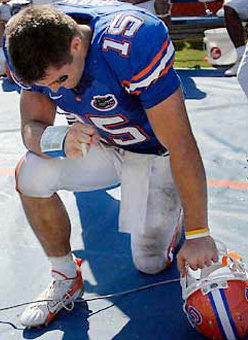
Tim Tebow is an anomaly – in more ways than one. Although he plays quarterback for the Denver Broncos, he seems to run as much as he passes. (For those of you not familiar with the National Football League, a quarterback traditionally throws the ball much more than he runs with it.) And when he does throw, he has an unorthodox throwing motion. As a result, many sports analysts dislike him as an NFL quarterback. But the criticism doesn’t end there. You see, Tebow is also a religious Christian whose values influence his conduct both on and off the field. As a result, many people dislike him as a person.

“The Tebow Effect”
Lev Echad blog

We all have our animal inside. The point is not simply to muzzle that animal, but to harness its power. To determine what sort of an animal this is and what can be done with it.

A sheep, for example, is easily domesticated and doesn’t care to hurt anyone, while an ox may kick and gore. But did you ever see a sheep plow a field?

-Rabbi Tzvi Freeman
“Your Beast”
Based on letters and talks of the Rebbe
Rabbi M. M. Schneerson
Chabad.org

If you’re a religious person, do you ever feel a little picked on by the world around you? Do you ever feel that you are sometimes misjudged by secular society or even by your atheist friends and family members? Do you ever get a little angry and want to snap back at them when they call you “ignorant” or “unscientific” or “superstitious” or even a “bigot?” If you do, then I suppose that makes you human. It also speaks to Rabbi Freeman’s commentary on “Your Beast”. Christians are sometimes taught to “turn the other cheek” (Matthew 5:39) when confronted unfairly, and many times we do. Sometimes we don’t and there are even times when some of us are really unfair.

When Stella Harville brought her black boyfriend to her family’s all-white church in rural Kentucky, she thought nothing of it. She and Ticha Chikuni worshiped there whenever they were in town, and he even sang before the congregation during one service.

Then, in August, a member of Gulnare Free Will Baptist Church in Pike County told Harville’s father that Chikuni couldn’t sing there anymore. And last Sunday, in a moment that seems from another time, church members voted 9 to 6 to bar mixed-race couples from joining the congregation.

“Rural Kentucky church revisits ban on interracial couples”
Los Angeles Times

Examples like this are fairly rare, but they do exist and unfortunately, once they make national and even international headlines, this is what the secular world sees as Christianity. Could this be why so many people who cheer on quarterback Tim Tebow of the Denver Broncos want him to keep quiet about his Christianity, at least in public?

Whether or not Ebersole endorses that view or merely observes it, he definitely touches on a common perception of public religion. Believe whatever you want and worship whoever you want with your family in private. But when you step into the public arena, you can’t say much more than “God bless you” and “God bless America” without stirring controversy. This idea, that religion belongs only in the home, underlies the principle of public reason that I discussed in my last post.

-David Fryman
“Tebowing as a Political Metaphor”
Jewneric.com

If you believe in free speech rights, rights to peaceful assembly, and rights to worship in the religion of your choice, then even if you are an American atheist, you must support the right of Tim Tebow or anyone else to hold whatever beliefs they wish, whether you agree with them or not. However, as Fryman just pointed out, most people want us to be quiet about it. I’m sure it would be “safer” for us to do so, to gather in our churches and our synagogues and to keep to ourselves. I don’t mean “safer” in the sense that we would be physically threatened if we chose to pray in public, such as before eating a meal at our local restaurant, but safer in the sense that we wouldn’t have to hear how “bad” we are (perhaps because of our stance on some hot political and social topic such as abortion, same-sex marriage, or “creationism”). We also wouldn’t have to take as much fallout over news reports of those little religious anomalies like the aforementioned interracial banning Kentucky church.

It’s interesting because, in response to the media backlash on the Kentucky church’s controversial vote, that church may be changing its tune. In this case, I applaud them for rethinking their blatantly racist position, but it does bring up a disturbing thought. Racism and banning interracial couples in a house of worship cannot be reasonably supported from how I understand the Bible, but what about those times when we, as people of faith, do take a stand based firmly on our faith, that does contradict societal political correctness? Should we just keep our mouths shut and stay “safe” or open our mouths and be dismissed as hateful bigots? Or should we change our minds in order to better fit in with what the secular world wants out of us: compliance with established social norms?

If it’s a matter of faith and principle, I believe we should stand our ground. Otherwise, our faith becomes a sham and our identity as disciples of the Master becomes a paper-thin mask hiding the fact that we are no different from people who claim no faith in God (and there are churches already doing this). Fryman’s final comments on his blog tell us why we must not hide who we are and, God forbid, cave in to media and social pressure.

Tim Tebow is Christian. Sounds obvious, I know, but his critics (of his religiosity, not his quarterbacking) don’t seem to understand. I know he’s Christian, but does he have to be so damn religious every time he opens his mouth?! Yes, he does. Because that’s what religion is: a way of life. Football is his life, so of course his football is Christian. If politics were his life, his politics would be Christian too.

There are times when it is best for us to be as meek as sheep but sometimes we are faced with a task such as “plowing a field”. Sheep can’t do the heavy lifting but an ox can. Both of those natures are part of us for a reason. The trick is knowing which trait to display and under what circumstances. Some expressions of our faith are best demonstrated in private prayer or in our houses of worship. But our faith, if authentic, is not just a weekly plug-in we connect to on Saturday or Sunday. It is who we are more than any other aspect of our being. Like the gay community is so fond of saying of themselves, we should “live out loud” our lives of faith.

The Rabbinization of Abraham

When Abraham heeded G-d’s order he was already fully proficient in what was to become known as Kabbalah. He had even authored a major Kabbalistic text – Sefer HaYetzira (the Book of Creative Formation). He was an acclaimed astrologer and conversant in the magic of the East. In his youth, Abraham had turned his back on the negative forces of tum’ah (spiritual blemish) and adopted the pathway of spiritual monotheism.

-from Practical Kabbalah: A Guide to Jewish Wisdom for Everyday Life (pp 19-20)
by Rabbi Laibl Wolf

You shall not practice divination or soothsaying.Leviticus 19:26 (JPS Tanakh)

The word “se’onenu” in the verse cited above (Lev 19:26) can be a derivation of the root onah (time season) or of the root ayin (eye). Consequently, two different prohibitions are based on this verse. One, quoted by Rashi on the verse, is the prohibition against “calculating times and hours.” It is forbidden to employ astrological (Rambam Hilchos Avodas Kochavim 11:8) calculations in order to determine when to engage in or refrain from a certain activity.

-Rabbi Doniel Neustadt
“Selected Halachos relating to Parshas Kedoshim”
Torah.org

I don’t always understand what I’m reading in the Jewish teachings, or at least I don’t always understand it well enough to agree with what is being taught. For instance, Rabbi Wolf plainly states in his book that Abraham was “an acclaimed astrologer” and yet Rabbi Neustadt, referencing Rashi and the Rambam, interprets Leviticus 19:26 as prohibiting the use of astrology. Furthermore, practicing various types of sorcery and magic is forbidden in Torah as described here:

Let no one be found among you who consigns his son or daughter to the fire, or who is an augur, a soothsayer, a diviner, a sorcerer, one who casts spells, or one who consults ghosts or familiar spirits, or one who inquires of the dead. For anyone who does such things is abhorrent to the Lord, and it is because of these abhorrent things that the Lord your God is dispossessing them before you. You must be wholehearted with the Lord your God. Those nations that you are about to dispossess do indeed resort to soothsayers and augurs; to you, however, the Lord your God has not assigned the like. –Deuteronomy 18:10-14 (JPS Tanakh)

So where would Rabbi Wolf get the idea that Abraham was an accomplished astrologer and “conversant in the magic of the East?”

There are two ways to look at this. The first is that Kabbalah suggests many things that we can’t derive from the plain meaning of the Torah text. While proponents of Kabbalah believe that it has its origins as an oral tradition that predated Jesus and indeed, may have been practiced in some manner by Abraham and even by Noah and Adam, other Jewish scholars attribute the rise of Kabbalah to a much later time, with the writing of the Zohar (presumably by Moses de Lyon, although this is not firmly established) in the 13th century CE. Given the historical “uncertainty” about Kabbalistic teachings, not everything we read about figures such as Abraham in Kabbalah can be taken as completely factual.

The second is that Abraham lived in an age far earlier than Moses and the giving of the Torah at Sinai and he can’t be expected to have understood all of the prohibitions it contained (and thus, may have possibly practiced magic and astrology in his earlier days, although this is pure conjecture). Nevertheless, there is also a tradition in Judaism that says Abraham was certainly aware of everything in the Torah, even though it had yet to be written down.

The Talmud states that Abraham, Isaac, and Jacob all studied in the academies of Shem and Eber. The Talmud further proclaims that the Patriarchs kept the entire Torah before it was given. How was this possible? The Kabbalists explain that they kept the Torah in its spiritual form, for it was only subsequently through Moses that the Torah instruction became manifest in the physical observance of Mitzvot.

-Rabbi Nissan Dovid Dubov
“The Key to Kabbalah”
Chabad.org

But since this information takes us back to Kabbalah, we may tend to disregard it as a source of historical fact and relegate it to the status of almost legend.

But there are many observant Jews who consider everything I’ve just said about Abraham’s history as outlined in Kabbalah as absolutely true.

As a Christian who doesn’t have the benefit of a classical Jewish education, let alone a working knowledge of Kabbalah, how am I to interpret all this, as Rabbinic fiction or even fantasy? That seems a little harsh, but many of the statements about Abraham studying Torah in the House of Shem and practicing the magic of the East stretch credibility beyond the breaking point. Is it that I am just so ignorant of Jewish tradition and the Hebraic mindset that I am unable to grasp the deeper and hidden (Sod) meaning in Torah, or is there something else going on?

The process is evident even on the basis of a casual reading of Midrash Genesis Rabbah. The rabbinic ideal of “Talmud Torah” as the driving force in Jewish religious behavior is projected as a constant factor in the lives of the patriarchs: The children of the patriarchs study in the batei midrash of Shem and ‘Ever’ (e.g. Genesis Rabbah 63:10); Jacob strives to establish “a house of Talmud where he might teach Torah” in Egypt (Genesis Rabbah 95:3); Abraham was well versed in the prohibition of carrying on Shabbat without an ‘eruv’ (specifically an ‘eruv hazerot’ Bereshit Rabbah 49:2)…

-Isaiah Gafni
“Rabbinic Historiography and Representations of the Past” (pg 305)
The Cambridge Companion to the Talmud and Rabbinic Literature
Edited by Charlotte E. Fonrobert and Martin S. Jaffee

In his essay, Gafni speaks of the Talmud’s “Rabbinization of the past”.

If, indeed, we can assume that the contemporary rabbinic Judaism espoused by certain talmudic sages held up favorably when compared with earlier expressions of the faith, issues of past and present no longer suggest a one-directional regression from the glories of the past. With this in mind, we might better understand a well-documented phenomenon in rabbinic midrash, namely, the “rabbinization of the past.” (pg 304)

One way to establish and support an acceptance of Talmudic interpretation and judgment relative to Torah for post-Second Temple Judaism is to project the values and even the “reality” of Talmud (and later, Kabbalah) not only forward in time but backward. Peering at the Patriarchs through this lens, we can indeed “see” Abraham, Isaac, and Jacob studying Torah and Talmud in the study house of Shem when by historical knowledge and a plain reading of the Torah, such events seem very unlikely to have actually taken place.

However, the Rabbis may have had other motivations besides cementing the validity of Talmud for the Jewish people as Gafni points out.

But while the practical observation of the Law by pre-Sinaitic figures predates the rabbis, the more thorough rabbinization of the past by endowing it with a more focused stress on uniquely post-Destruction religious and social categories was clearly the work of talmudic sages, emerging primarily in amoraic (and not tannaitic) literature. The rabbis may have been motivated, at least in part, by a wish to avoid a type of supersession imagery embraced by the Church. However, in fact they were, to a certain degree, doing precisely what the Fathers had done, namely, applying to the patriarchs a more spiritualized behavior in manifesting their Jewish identity. (pg 308)

I find it more than a little ironic that the “rabbinization” of the ancient men and women of the Torah, which Christianity criticizes with great zeal, was possibly motivated in part, by the Jewish need to defend itself against early Christian supersessionism.

Viewed through the eyes of Gafni’s study, we can read many of the Talmudic and Kabbalistic “histories” of the patriarchs and matriarchs as, not exactly fiction, but a “rabbinization” process designed in the early centuries of the Common Era, to preserve the Jewish people as a people, which was a requirement in the face of the exile from the Land of Israel and hostile persecution by the official Church of the Roman Empire.

So we can hardly blame the Rabbis (well, I can’t anyway) when we read something like this.

But the children struggled in her womb, and she said, “If so, why do I exist?” She went to inquire of the Lord. –Genesis 25:22 (JPS Tanakh)

When she passed the academy of Shem and Ever, Jacob struggled to leave the womb, and when she passed a temple of idol worship, Esav fought to leave. – Rashi

It seems unlikely that a “Torah academy of Shem and Ever” really existed and even if somehow it did, that Jacob would struggle to escape his mother’s womb in order to study Torah (as an unborn child) there whenever she was near that place.

Strangely enough though, we have a sort of parallel in Christianity.

Miryam arose in those days and went quickly to the mountains, to a town of Yehudah. She entered the house of Zecharyah and blessed Elisheva. When Elisheva heard Miryam’s brachah, the child danced inside of her and Elisheva was filled with the Holy Spirit. –Luke 1:39-41 (DHE Gospels)

If the unborn John could dance in his mother’s womb at the sound of the blessing of Miryam (Mary) who was pregnant with Messiah and Savior, is this scripture a sort of “Christian rabbinization” of the Gospels or is it something more? If it is more, then what are we to make of the “rabbinization of the patriarchs?”

If we were prophets or people of vision, we would see what is important and what is not, what will bear fruits and what will remain barren.

But we are simple people in an age of confusion. Our lives are filled with uncertainties—anything could happen, we have no way of telling.

We cannot decide which mitzvah is important and which will bear fruit. Neither are we expected to make our decisions that way.

All that’s expected of us is to simply grab whatever G‑d sends our way, and do our very best at it. What will come of it? What is its purpose?

Only He needs to know.

-Rabbi Tzvi Freeman
“Un-Prophets”
Based on letters and talks of the Rebbe
Rabbi M. M. Schneerson
Chabad.org

The teachings of the Jewish masters are difficult for me to comprehend at times but then again, for the same reasons, so are the teachings of the Jewish writers of the Gospels.