
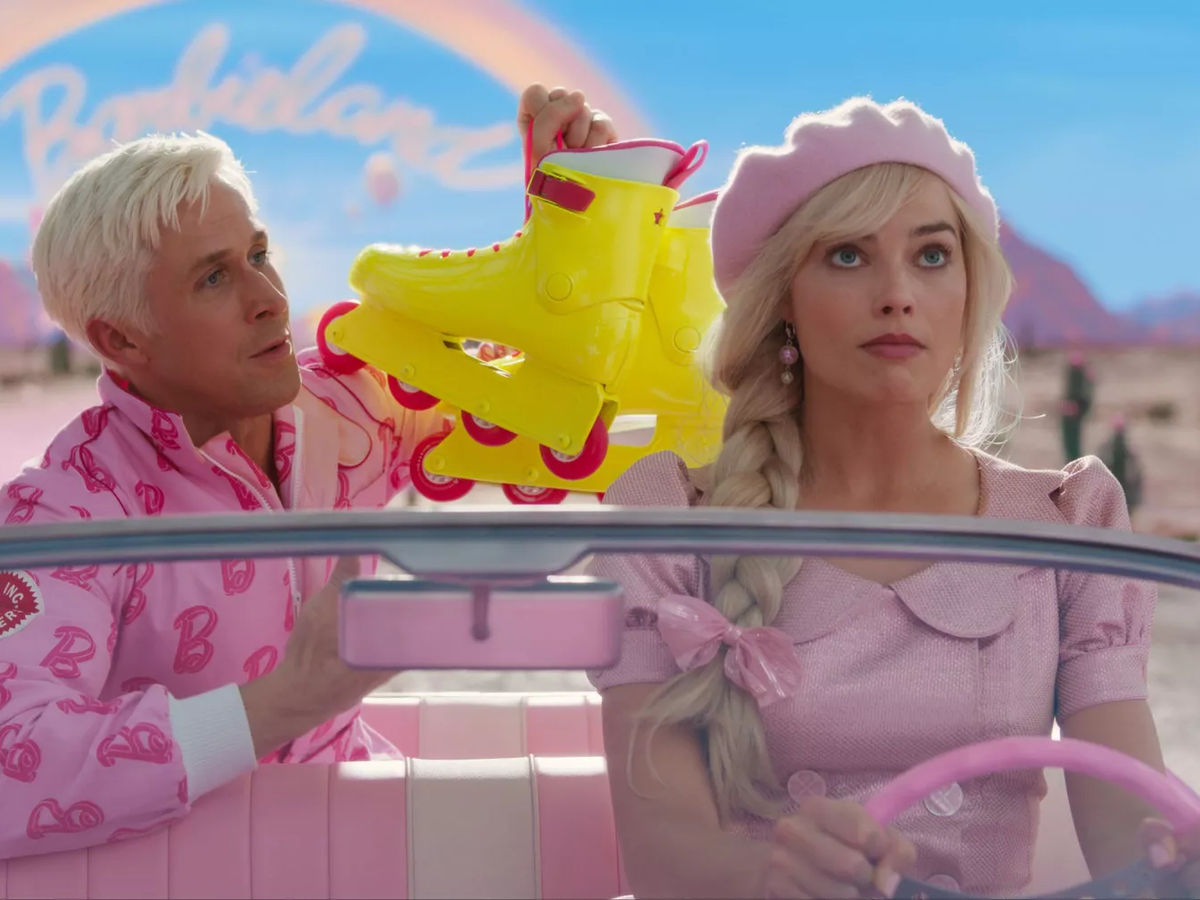
By now I’m sure you have all heard of, if not seen (perhaps multiple times) the Barbie (2023) movie starring (and produced by) Margot Robbie and Ryan Gosling. Depending on who you talk to, it’s either “the most subversive blockbuster of the 21st century” (Rolling Stone magazine) or “Just a doll movie” (Whoopi Goldberg).
According to Chloe Laws in her Glamor magazine article Barbie is an extremely ‘pro-men’ film – and yes, men are still mad about it, alternately titled “Barbie isn’t Anti-Men (I Wish It Were):”
Women are often accused of being ‘overly’ sensitive. We’re told we need to stop taking things so seriously. May I direct your attention to the men getting unreasonably upset at Greta Gerwig’s film Barbie?
Depending on whose review you read/watch, it is either a fabulous movie (having recently beaten The Dark Knight as Warner Bros. biggest ever domestic box office blockbuster) or really awful (Conservative pundit Ben Shapiro spends 42 minutes tearing it to shreds on YouTube).
I’ve never seen the movie, and unless my eight-year-old granddaughter begs me to view it with her, I have no motivation to go. After all, I’m nearly seventy and a guy. Why would I want to see it?
Greta Gerwig thought she was making a Barbie movie. But certain men saw an entirely different film, some accusing it of sexism and others heralding it as a pro-patriarchy awakening.
Or to quote Gerwig, “My hope for the movie is that it’s an invitation for everybody to be part of the party and let go of the things that aren’t necessarily serving us as either women or men. I hope that in all of that passion, if they see it or engage with it, it can give them some of the relief that it gave other people.” -from the Newsweek article How Men Are Watching ‘Barbie’ Wrong
Why am I bringing up this film and why should you even care?
Because it has become the latest lightning rod for feminism, toxic masculinity, and what all that is supposed to mean to people. There’s also the application of how we see the relationships between and the identities of men and women in the Bible, but I won’t be covering that until later.
The Glamour article says:
One of the film’s major plot lines follows Ryan Gosling’s Ken on a journey of self-discovery, where he becomes seduced by the real world’s patriarchy without realising it will harm him too. In the musical number ‘Just Ken’, he has a moment of growth, where he cuts himself loose from this enforced masculinity. In so many words, Barbie talks to him about finding his own identity; one separate from her and the patriarchy. One where he is ‘Just Ken’.
It’s true that Ken has no identity except in relation to Barbie. Assuming a Barbie doll could become self-aware in a human fashion and that Ken can too, then Barbie is the queen of her universe, and Ken, all the Kens, are just window dressing.
In fact, it is my understanding (having never actually seen it) that by the film’s conclusion, Ken is “released” by Barbie to discover his own identity, but he literally has no place to go. Without Barbie, there is no Ken, thus he becomes nothing (or was that the point?).
Yes, this is a movie primarily (exclusively) for girls and women, one that “takes down” the patriarchy and launches Barbie on a journey of self-realization that transcends her “dollness.” Why care about Ken or, for that matter, why are men concerned about what amounts to a well-marketed “chick flick?”
According to Elaine Roth who wrote the SheKnows article Why Our Sons Need to See the Barbie Movie
Both Barbie and Ken are new to “the real world”, they’re both obviously outsiders, but it’s only Barbie who senses that need to be hyper-vigilant. Women around the world will relate to that feeling; men likely less. It’s hugely valuable for our sons to see the contrast in that moment — and then talk to them about it.
However, the author admits…
I arrived at the theater early and watched the audience stream in. Suburban women in pink shirts with matching Barbie-head Cricut designs. Little girls decked out in tiaras and boas. Trios of teenage girls and gray-haired ladies. What I didn’t see: any boys. From where I sat in the theater, I counted three men, including my friend’s husband, who, along with my friend, graciously allowed me to tag along with them on their night out. But no young boys.
The basic emphasis on why boys and men should see “Barbie” is A) to educate them on the struggles that girls and women go through in a world dominated by the patriarchy and white supremacy and B) to show that modern feminism is actually a liberator of men from the patriarchy and white supremacy.
The Newsweek article continues:
“The film views gender as a tool to understand who you are. Seeing male role models and empowered male figures makes [Ken] want better for himself. But the film recognizes that worshipping and enforcing those standards can be harmful, because they’re unrealistic to live up to. The Barbies have their own unrealistic standards of beauty that ostracize people in the community like Weird Barbie,” @expert_oscar continued in the thread. “Just like with the Kens, what empowers Barbies (seeing themselves as powerful and perfect) causes problems in their world. The film clearly argues that any gender holding a disproportionate amount of power is an issue. It has no double-standard about masculinity or femininity.”
Anyone who disagrees with this viewpoint:
“People who say the film is man-hating are deliberately misinterpreting the movie so they can cry woke or just don’t know how to properly interpret it.”
One simply needs to interpret the movie in the “correct” manner to come to the same conclusions as it’s supporters.
The Glamour article agreed, stating:
If anything, I thought Barbie was a hit-us-over-the-head positive about men and masculinity. It was thoughtful and conscious about how boys and men watching it would feel, and wanted to give them a similarly powerful message to Barbie’s; a measure that was kind but not required.
To anyone still moaning that Barbie is ‘anti-men’, I say this in the nicest way possible: grow up.
However, it concedes:
Films and TV shows are constantly made – like literally on a weekly basis –which don’t pass the Bechdel test. Some are outright misogynistic, like The Idol, and still get standing ovations at prestigious ceremonies.
So even if “Barbie” did have an anti-men message, we kind of deserve it.
Still, this is only one movie. Yes, it’s making money hand-over-fist and it the highest cinematic money-maker ever directed by a woman. But it’s not real life (I’ll get to that later, too). Why care? Movies come and go.

ABC News spoke with feminists across the generations to define modern feminism.
Because if it is the latest attempt to preach acceptance of post-modern feminism to men who otherwise wouldn’t give it a second thought, we should probably know what we’re being asked to accept.
The ABC News article The feminist movement has changed drastically. Here’s what the movement looks like today defines feminism as:
Feminism is the belief in the equality of people of all genders, a set of values aimed at dismantling gender inequality and the structures that uphold it.
These inequalities could be pay inequality, gender-based health care inaccessibility, rigid social expectations, or gender-based violence which still impact people everywhere to this day, feminists say.
In recent decades, the movement has begun to proactively include and uplift the voices of people who have typically been left out of past mainstream feminist movements. This includes women of color, as well as gender diverse people.
Attempting to answer the question, “How much further does feminism have to go?”
In recent years, though, the U.S. has faced a wave of laws restricting reproductive health care, transgender health care, certain curriculum in education, laws restricting voting rights, and more.
That certainly seems a lot different than the feminism I first became aware of in the early to mid-1970s.
I originally imagined I’d be able to cram everything I have to say into a single article, but there’s just too much. “Barbie” only scratches the surface, or more accurately, it’s just the springboard for trying to understand and define boys and men in the modern world. Feminism has certain ideas about what boys and men should be in their idealized sense. Should feminism be the last word in that definition?
Add to that the fact that the real world, at least as I live it, doesn’t map very well, if at all, to anything feminism imagines reality to be.
On top of all that, since this is a blog written by and for believers, does any of this modify who men and women are from a Biblical perspective?
I know that last question will be violently kicked back out by all feminists everywhere, since the Bible, Judaism, Christianity, and Islam are all considered hyper-patriarchal structures that have historically oppressed women and minorities and is a tool of white supremacy (never mind that not all Christians, Jews, and Muslims are male, white, or live in western countries).
I’ll continue this in Part Two, but right now, I have no idea how many parts this tale of mine will require.
Who are men in the world today? That must be hard to say for folks who can’t define what a woman is.
 Morning Meditations
The Ken doll looks stupid, as does the Barbie doll, and offers a bunch of stiff accessories. That’s why Ken is stupid-looking in the movie, on brand. These things were designed for little girls to buy a lot of plastic (or have it bought for them). I may run across the movie for free someday and watch it out of curiosity; or not. Meanwhile, sort of a non-topic to me… except as it might provide some fun to people. I think there are enough (other) topics about which to be worried.