All posts by James Pyles

James Pyles is a published Science Fiction, Fantasy, and Horror author as well as the Technical Writer for a large, diversified business in the Northwest. He currently has over 30 short stories published in various anthologies and periodicals and has just sold his first novella. He won the 2021 Helicon Short Story Award for his science fiction tale "The Three Billion Year Love" which appears in the Tuscany Bay Press Planetary Anthology "Mars."

Locking Up Meditation

There are three forms of hitbon’nut (contemplation, meditation):

  1. Study-meditation: After mastering the concept thoroughly, one meditates on its profundity, until the intellectual element shines forth for him.
  2. Meditation before davening: This is directed toward sensing the vitality of the concept learned, in contrast to sensing the intellectual element emphasized in study-meditation.
  3. Meditation in davening: To sense the “G-dly element” in the concept learned.

These three are rungs on the ladder of sensitivity. It is only by G-d’s kindness towards us that we may occasionally sense G-dhood spontaneously, without any avoda at all. This comes about by virtue of the quality of Ultimate Essential G-dhood within the soul. For avoda by one’s own efforts, however, these three forms of meditation are essential.

“Today’s Day”
Friday, Tamuz 20, 5703
Torah lessons: Chumash: Pinchas, Shishi with Rashi.
Tehillim: 97-103.
Tanya: Precisely so (p. 357) …or articulation. (p. 357).
Compiled by the Lubavitcher Rebbe; Translated by Yitschak Meir Kagan
Chabad.org

Don’t be discouraged. It’s often the last key in the bunch that opens the lock.

-Author unknown

I always consider meditation to be a quiet, contemplative state. As such, I never enter into it. I know that seems completely contrary to the basic premise of this blog, but I find it very difficult to quiet my mind. About the closest I come to a conscious, meditative state is the four minutes I’m cooling down after an aerobic workout on the elliptical machine. I can close my eyes and imagine my breath going in and out as a frosty, illuminated vapor in the darkness. All I’m trying to achieve though, is to slow my heart rate down as much as I can so that when I get off the machine, it’s not still pounding away at 150+ beats per minute.

I’m not contemplating God.

Even when I do contemplate God, it’s in a sea of static and chaos. It’s difficult or impossible to enter into a space where it’s just Him and me. Frankly, I don’t know if I even want to enter into that space. God is big and scary and I’m not even sure how guys like Abraham and Moses could stand being in His presence for even one split second. The God that created the Universe and everything in it isn’t some comfortable cosmic teddy bear that you can just walk up to and then sit in His lap.

Most days, I have a really good idea what I want to blog about, but not today. I pretty much burned off all my passion in yesterday’s meditation. Today, I’m emotionally drained. Wiped out. I know it probably doesn’t look this way from the outside, but some of these mediations take a lot of energy to write.

I just saw a photo of me (thankfully, I’m way in the background) in some promotional material for where I work. Everyone else looks fresh and young and happy. I look really old and fat and worn out. While I’ve got all this dynamic energy that sparks up in most of my “morning mediations,” today I feel like that picture (believe me, you don’t want to see it). I have this horrible feeling that’s how I look all the time.

I’m kind of reminded of the character Happy Hogan who first appeared in the comic book Tales of Suspense #45 (September 1963) with Iron Man. Marvel comics has “handsomed him up” quite a bit since those days, but back then, he was created for comic relief (along with Tony Stark’s then “mousy” secretary Pepper Potts). Happy rescued Tony from a race car crash and as a reward, Tony gave the out-of-work boxer a job as his chauffeur and personal assistant. Happy was always looking completely glum and “hang-dog”. Tony commented on it early in their relationship and asked if he was depressed. Happy’s response was something like, “Nah, I look like this all the time.”

I think I look like this all the time. OK, so I’ve never been a really attractive person, but I think this is more than age and carrying around a bunch of extra tonnage. I think I get tired of fighting God or fighting life or are they both the same thing? Problem is, that sort of fight is unavoidable. You only stop fighting when you die. Until then, it seems like it’s one battle after another, hammering away at something or being hammered at by something.

I try to imagine what it would be like to not fight. To relax. To set aside responsibility and duty, not just for a few minutes, or an hour, or when I’m asleep, but to really relax. Don’t say “vacation” because vacations are anything but relaxing. In fact, they’re harder work than going to work. Besides, even the most relaxing vacation in the world has to end sometime.

Paul spoke of “the peace of God, which surpasses all understanding” (Philippians 4:7) but I haven’t found it yet. I suspect I never will.

My “morning meditations” are really more like “morning encounters” or “morning contemplations” or even “morning conflicts”. I sleep. Wake up. Drink coffee. Go to the gym with my son. Eat breakfast. Take a shower. Go to work. Somewhere in the rest of the day, the next morning’s meditation gets written depending on my available time and what I’m thinking about. I eat dinner. Go to sleep. And the cycle starts all over again.

If someone has this lovey-dovey, floating on clouds, easy-peasy relationship with God and faith that keeps them in a semi-divine state as they slowly sail through each day, I’d like to know about it. I’m probably not a good candidate for such a state, even if it exists, but sometimes, as fluffy as it all sounds, I think I’d like a piece of it.

We are representatives of Above. And as such, live two lives at once:

We are free-thinking, independent beings.

And we are no more than messengers of Above.

It is a play of opposites in a single being. An impossibility realized in true-life drama. Just the sort of thing in which the Impossible One Above delights.

-Rabbi Tzvi Freeman
“Representatives”
Based on letters and talks of the Rebbe
Rabbi M. M. Schneerson
Chabad.org

Rabbi Freeman presents an idealized view of the thoughts and expressions of the Rebbe and thus of the Chabad, but I know there’s a reality behind Crown Heights in Brooklyn that isn’t anywhere near as pretty. That’s not to say anything against the Chabad as such, but to acknowledge that humans are humans and we can make a mess of things on the inside, even if the outside looks good.

My insides and my outsides seem to look the same, that is rather threadbare and lumpy. All the religious and motivational stuff on the web often seems empty to me because all of that “feel good” material seems so phony and unrealistic. Life is a struggle. You fight hard every day. You can only hope that food and sleep will rejuvenate you enough to face another day just like the one that came before. Somewhere in there, God is present, but who knows exactly where or when or if He’ll make Himself known or intervene in any meaningful way?

Between the “free-thinking, independent being” and the “messenger of Above,” there’s an ordinary (or sometimes I feel, sub-standard) human being who is just trying to stay alive and make sense the events of each passing moment. Making sense of life and contemplating the nature of God doesn’t happen as much as you’d think.

I get tired. Sometimes I don’t know why I’m doing all this. I’ve also just been reminded again of how many Jews see Christians so…gee whiz.

Time for another cup of coffee and then back to work…

..and to try to find that last key that will open the lock to…who knows what?

Opting Out of Yiddishkeit?

On today’s daf we find halachos that apply to converts.

Converting is a huge sacrifice, which God values greatly—and so should we. But as is well known there is a halachah that a non-Jew who converted as a minor can recant his decision upon reaching majority. In that case, he reverts to being a non-Jew. How sad that he lost out on such a special distinction due to some passing whim!

There was a case where a family converted together; mother, father and children. When one son heard that he was allowed to opt out of Yiddishkeit, he honestly said that he wanted to let go of his conversion. “If I am obligated to be a Jew that is one thing, since God wants me to fulfill the mitzvos. But if I am able to be a non-Jew, why should I take on the obligation to do all the mitzvos? How can I know that I will fulfill them as I should? Isn’t it better for me to go the easier but more sure way?”

But when he expressed this wish, the dayan he spoke to wasn’t sure what to do. “I am not sure whether when an entire family converts one who was a minor at the time can opt out. This is a machlokes Rishonim and I am not certain how we rule.”

When this question reached the Chasam Sofer, zt”l, he ruled decisively. “We hold like the Rishonim who rule that a convert whose entire family converted with him cannot opt out of his Jewishness.”

Daf Yomi Digest
Stories Off the Daf
“The Convert’s Choice”
Niddah 49

I’ve been thinking a lot about religious observance recently. Actually, I’ve been thinking about it for a long time and wondering if I’d ever get up the nerve to actually blog about it.

So here goes.

It’s fairly common knowledge within the Messianic Jewish and Hebrew Roots communities that the status of non-Jews and their possible obligation to Jewish religious observance is a matter of some concern. Mark Kinzer’s book Postmissionary Messianic Judaism: Redefining Christian Engagement with the Jewish People is something of a blueprint of one end of the spectrum of Messianic Judaism that advocates for parallel but wholly separate conduits of Jews occupying Messianic Judaism and Gentiles occupying traditional Christianity. In theory, both groups relate to One God and to Jesus (Yeshua) as the Jewish Messiah, but their recommended approaches to religious practice are totally different, and the two groups rarely if ever, interact.

On the other side of the spectrum is the One Law group which states that there are no distinctions or differences between Jews and non-Jews in the Messianic movement. Except for a matter of DNA, Jews are no different from Gentiles in their obligation to the 613 commandments that define the modern understanding of the Torah. This brings up the uncomfortable reality that all Christians everywhere have the same obligation to the Torah, whether they realize it or not. The One Law position must come to the conclusion (though I’ve never heard them state it as such) that the vast majority of the Christian church is continually in sin because they don’t refrain from eating trief and work and play on Saturday.

The educational ministry First Fruits of Zion (FFOZ) has proposed a sort of “middle ground” in this arena with the idea of something called “divine invitation.” FFOZ has produced a number of books and other, similar materials presenting information from Jewish literary sources suggesting that historically, Gentiles were not always completely forbidden from certain Jewish observances. I won’t attempt to list the details here since they are too numerous, but the basic idea is that, while non-Jews are not obligated to fulfill the Torah mitzvot in the manner of Jews, they are, in many cases, permitted to do so.

This would no doubt fly in the face of more traditional Jewish viewpoints and certainly Orthodox Judaism would be in almost complete disagreement. Nevertheless, within the Messianic context, you will find many non-Jewish people voluntarily taking on board some of the Torah mitzvot as they feel led to do so, but with the understanding that refraining from any of the mitzvot does not constitute a sin on the part of a non-Jewish Christian.

Divine invitation is an opportunity for non-Jews in the movement who have become accustomed to keeping certain of the mitzvot to continue to do so without necessarily crossing the distinction barrier between Gentile and Jew and thus preserving Jewish distinction in Messianic Judaism.

But there’s a flip side to the coin. Divine invitation allows non-Jews in the movement or at least associated with the movement to not observe the mitzvot…at all…ever.

It’s been well over a month since I attended FFOZ’s Shavuot conference at Beth Immanuel Sabbath Fellowship in Hudson, Wisconsin. For several days, I was allowed to worship in what seemed to be the ideal Messianic Jewish religious environment. The Gentiles still outnumbered the Jews by quite a bit, but the model for worship was definitely that of the synagogue, though great accommodations were made for non-Hebrew speakers and readers.

There were a lot of non-Jews worshiping in the Jewish manner, though in that environment, they were not obligated to do so. We non-Jews were not obligated to eat the fine kosher food that was provided. We were not obligated to daven shacharit. We were not obligated to don tzitzit. And yet most of the non-Jewish worshipers did so and no one seemed to mind.

But what if we didn’t? I mean, if we’re not obligated and let’s say, we don’t feel led, so what if we didn’t worship in even a remotely Jewish manner? I suppose nothing bad would happen. But is there an expectation that even if we don’t have to keep the mitzvot, that we should, particularly if we are choosing to worship with Jews who are worshiping God as Jews in a (Messianic) Jewish synagogue?

It would be an interesting experiment in that environment to have a non-Jew observe absolutely none of the mitzvot, just to see what it would be like to decline a “divine invitation.” I suppose it would be like going to your high school senior prom and then continually refusing invitations to dance. What would be the point?

The point I suppose, is that the “prom” is where you feel you belong, where your friends and maybe your family are, and yet you feel you aren’t called to dance their dance because you believe you don’t really belong to that group of dancers.

OK, it’s a crummy metaphor, but you get the idea.

Of course, most of the time, I don’t worship with anybody. In fact, I don’t worship in a community at all. This avoids the whole problem of how I should worship, identity confusion, and the whole shooting match, but there’s a problem. I live with Jewish people. Do I do what they do?

Well, sort of.

Here’s the scary part.

The Jewish people I live with aren’t particularly observant.

There, I said it.

It’s true. At this point, my wife and daughter don’t even light the candles on Erev Shabbat. For a long time, I was the only one doing it, but it seemed absurd that I continue since I’m the only non-Jew in the house and a male and I’m the one lighting the candles. I kept asking my wife on Friday as sundown approached, “Do you want to light the Shabbos candles?” Her response was always something like, “You can if you want to.”

Like I said, it got kind of absurd. No one seemed to care if I lit the candles or not. So I stopped.

My wife hasn’t gone so far as to serve up pork chops for dinner and in fact, she’s rather studious about making sure we all continue to eat “kosher style” (see Leviticus 11), but our kitchen isn’t kosher and, strictly speaking, my wife doesn’t understand why I don’t choose to eat trief, since the kosher obligation doesn’t apply to me.

We also (gasp) work on the Shabbat. This part really bothers me, but there’s not a lot I can do about it. My daughter’s and my wife’s employers require that they work highly variable hours including the weekends, and they often work late Friday nights and on Saturday. The missus has made no bones about saying she would like me to keep my writing and editing schedules up on the weekends, though I’m able to refrain from household chores on Shabbos for the most part, deferring them to Sunday. I can’t remember the last time she went to shul, except perhaps to cook for some special occasions.

Yes, I do know that my Jewish family members are obligated to the Torah, though none of them are observant at the moment.

I suppose that makes me a bad husband and father for not compelling them to do so.

But I can’t really compel them to do anything. I have tried being supportive, but my children are all of adult age and my wife is of course, my wife, so she takes responsibility for her Jewishness and again, it seems rather absurd for a non-Jew and particularly a Christian to be telling her the business of being Jewish.

So having tried that and seeing that it didn’t work out so well, I stopped.

(I suppose at this point I should add that my wife subscribes to and reads the same (more or less) Chabad.org newsletters and tutorials that I do, which means her “morning meditations” are substantially similar to my own. I should also say that she anticipates leaving her current “slave job” at some point in the reasonably near but not clearly defined future, so what she does with her “free” Sabbaths after that is up in the air…but I can hope.)

The whole “divine invitation” and Christian identity thing means that I am not obligated to a Jewish lifestyle. I’m sure most Jews out there are relieved to hear that I’m not living like a Jew. But depending on your view of Jewishness and Jewish obligations to God, some of you may be distressed that my Jewish family members are not observant. Heck, there are members of the local Reform shul who are more observant than my family.

I can imagine that many Jews would blame me for all of this. After all, my wife and I are intermarried. Intermarriage is usually seen as the gateway for a Jew to leave Judaism and assimilate into Gentile secular culture or even into Christianity. While I can assure you that my wife has no attraction to Christianity on any level and I don’t believe she has become secularized, she doesn’t display a strong religious Jewish lifestyle.

More’s the pity.

(I’ll add here that my wife does keep up on events at the local synagogues and does have definite opinions about people at the Reform shul with a “questionable” Jewish background positioning themselves to lead services and teach [and that would never happen at the Chabad]. She’s “OK” with non-Jews and even Christians attending synagogue as long as they don’t talk about their faith, but she draws the line at “Messianics” or those who were formerly associated with the movement assuming any formal synagogue role.)

I have been trying to encourage my son David to return to the synagogue. His wife has recently rekindled her interest in attending church but I don’t think David would go with her on a regular basis. His basic internal template for religion is still Jewish and he remembers fondly some of his “debates” with the local Reform Rabbi. Actually, just last Sunday, my wife said she’d love it is David would visit the Chabad here in town, so she has her hopes as well.

The “religious identity” of my family continues to be in flux. I’m not even sure how much more my wife can tolerate my Christianity, so where I’ll end up in the months and years ahead is uncertain. I’d like my Jewish family to return to Judaism as an observant lifestyle. I hope they don’t see me as a barrier. I’m really anything but. In fact, in a recent conversation about conversion with my wife, (hence the quote at the beginning of this “meditation”) she said it would be ridiculous for a Gentile to try to convert to Judaism in Boise, (although a good friend of hers converted within the past year) since the convert wouldn’t have a strong Jewish community in which to live. So I don’t think my wife wants me to be “Torah observant” in any way, shape, or form. But what about her?

It would seem that for the sake of peace in the home, I must decline my “invitation,” and as a Christian, I would not only make a poor model of Jewish observance for my Jewish family, but I would actually be an annoyance if I tried. Thus, I cannot encourage them by my example since my example would be completely unwelcome.

I suppose if I were a Jewish husband and father, it might be different, but that’s not an option. Maybe the fears of Judaism are authentic fears and intermarriage is the path to slow death for the Jewish people. Even though it is not my intent, I certainly seem to be killing the Judaism in my home.

Across the long span of history, an untold number of Jews have suffered and died to preserve who they are as Jews. Given that realization, I wish I understood what was going on in my own home. But then, in this particular case, I don’t have a say. I only have to wait and pray that God, who has never abandoned His people Israel before, won’t abandon those who live in my household now.

My wife and children are Jewish. I want and even need them to live like Jews. May the God of mercy grant this for them and for the sake of Israel.

And Don’t Forget To Dance

Imagine there’s no heaven
It’s easy if you try
No hell below us
Above us only sky

-John Lennon
Imagine (1971)

And I heard a loud voice from the throne saying, “Behold, the dwelling place of God is with man. He will dwell with them, and they will be his people, and God himself will be with them as their God.”

“He will wipe away every tear from their eyes, and death shall be no more, neither shall there be mourning, nor crying, nor pain anymore, for the former things have passed away.”

Revelation 21:3-4 (ESV)

I hate to keep picking on Joe and Heidi, but their continual battle with cancer is a continual inspiration to me. More than that, it’s their courage, faith, and humor in the face of living a nearly impossible life that is the real inspiration. It puts to shame most of us who complain about our rather modest discomforts.

The first thing I thought of when I saw the photo of Joe and Heidi dancing, and knowing something about the hardships they face was, “this is what it must be like to watch people dancing in Heaven.” Then I thought about the “no more tears” portion from John’s Revelation. Then I thought about writing.

And here I am.

But what if, as John Lennon suggested, that there is no Heaven. What if we face insurmountable hardships, heartbreak, tragedy, and sorrow with no hope and no end except a black and empty death? How would that change us? What would it make human behavior like?

Or is this why the world is in the shape it’s in today? Because the majority of the world, as Lennon suggested, believes there is no Heaven…no accountability…no God?

I know I’m going to experience some serious “blowback” about that comment from secular humanists and atheists who see themselves as the greater moral force in the world and I can’t say they’re not. It doesn’t take a belief in God in order to do good. However, I think it takes such a belief to give it all a greater meaning beyond our temporal context. But some atheists cast themselves in the superior role because they don’t do good just to satisfy some abstract and alien being sitting in judgment on a throne. They do so because…um, why? Because it’s the right thing to do? But how do they know? How does anyone know?

Where do we get the idea that something is good and some other thing isn’t? What is “good” and what is “evil?” How do you know? If you’re an atheist, there is no moral structure attached to your belief since not believing in God isn’t value laden. It simply means you don’t believe a supernatural being created the universe and is involved in our lives.

What if there is no Heaven for Joe and Heidi? What would it mean in terms of the overwhelming fight they’ve been waging against cancer? Have they been praying to empty air? Has the courage they’ve gotten from faith been in vain?

Based on Lennon’s lyrics, he seemed to believe that if we deconstructed all human (and supernatural) infrastructures, organizations, groupings, and distinctions, the world of human beings would be a better place. Maybe it would be, I don’t know. It won’t happen because human beings absolutely need to identify, label, and organize their environment in order to make any sort of sense of it. All people groups use two basic names. One for themselves and the other for everyone else. Those names mean something to them and to us. Of course, they might not mean the same things.

When I say I’m a Christian, I mean a particular thing. Other people hear that label and perhaps comprehend it in a different way than I do. Some people hear that label and comprehend it in the most negative possible light. In their world, they have one name for themselves, which means they’re “good”, but the name “Christian” or “Jew” means something that bad, wrong, immoral, or evil (and where did the concepts of good and evil come from, anyway?)

But from inside my point of view and from inside my faith, I don’t perceive my faith to be evil. I know I am not a perfect person and I have made mistakes. I’ll make mistakes again. I don’t brag about it or enjoy it, but that’s part of what it is to be a flawed human being living in an broken world. And after all, human beings broke it.

I’m accountable not just to other human beings (my wife, my family, my employer, the government), but I’m accountable to a force that is larger than human institutions and an intelligence that comprehends the infinite mysteries of the universe. For me, there is a greater sense of morality and ethics that exists and One who is the origin of what it is to be good or to be evil.

What shall we say, then? Is the law sinful? Certainly not! Nevertheless, I would not have known what sin was had it not been for the law. For I would not have known what coveting really was if the law had not said, “You shall not covet.” –Romans 7:7 (ESV)

Sometimes it helps to have an external standard to help us define our role in life. For those of us who have faith, God is that standard. For those without faith, I suppose our government, or the news media, or a social organization will have to do. I can’t tell anyone else how to live their lives, but it would be wonderful if others would stop insisting they have the right to tell me to abandon my faith. But that’s the way of the world. If faith isn’t strong enough to withstand the winds of criticism from society, it will never stand up against the brutal storms of some disaster like cancer.

So Joe and Heidi showed me what it’s like to dance in Heaven this morning. As I looked at their photo, all of the sorrow and grief and hostility of the world surrounding me momentarily faded away. Imagine there is no Heaven if you want. But grasping hold of my faith not only gives me peace about the future, but the strength to carry on in the harsh and uncertain present and to try to do a little good in the world I live in every day. I pray, whoever you are reading this, that you can find the same.

In your worldly business, just do what needs to be done and trust in G-d to fill in the rest.

In your spiritual business, however, you’ll have to take the whole thing on your own shoulders. Don’t rely on G-d to heal the sick, help the poor, educate the ignorant and teach you Torah.

He’s relying on you.

-Rabbi Tzvi Freeman
“Make it Your Business”
Based on letters and talks of the Rebbe
Rabbi M. M. Schneerson
Chabad.org

And don’t forget to dance.

Where Is Your Heart?

A guest who had traveled from afar once visited the saintly Chofetz Chaim, Rabbi Yisrael Meir Kagan zt”l, and was taken aback by the Rabbi’s simple living conditions. The home was lacking the most basic furnishings! When he relayed his surprise, the Chofetz Chaim asked him, “And where is your furniture? Why didn’t you bring it?” The guest replied with the obvious, “I’m just passing through here. I live quite a distance from here, and there I have many furnishings to decorate my home.” “I’m following the same practice,” responded the Chofetz Chaim. “In this world I’m just passing through. My real home is in the next world, and with the eternal treasures produced from my service of the Al-mighty I am furnishing that future home.”

-Rabbi Mordechai Dixler
“Those People Are In Tents!”
Commentary on Torah Portion Balak
ProjectGenesis.org

“Do not lay up for yourselves treasures on earth, where moth and rust destroy and where thieves break in and steal, but lay up for yourselves treasures in heaven, where neither moth nor rust destroys and where thieves do not break in and steal. For where your treasure is, there your heart will be also.

Matthew 6:19-21 (ESV)

I know. This is pretty elementary. Most relatively new Christians are taught that what we have in the here and now is transitory while our true home and treasure lies with God.

Rabbi Dixler uses this principle in his commentary on last week’s Torah Portion, but adds that it’s not just living here temporarily that’s important, but our attitude about it.

Bilaam was hired to curse the Jewish nation, but was denied the ability to do so. In fact, he eventually formulated a number of blessings and praises, including “How goodly are your tents, Jacob, your dwelling places, Israel!” (Numbers 24:5) The Jews were indeed dwelling in tents at the time, but the message was that they not only dwelt in tents, but their attitude was in tents. All the wealth and possessions they had, whatever “stuff” they collected, was understood for what it was — temporary, like a tent. What they really valued and focused on was their everlasting spiritual acquisitions in their service of the Al-mighty. (Sefer Taam V’Daas)

Of course, this is midrash and not necessarily absolute fact as far as the Children of Israel are concerned, but it is also long-established Jewish tradition and this tradition teaches a lesson.

But maybe not the lesson you are thinking about.

Let the faith of God be in you. For amen, I say to you, anyone who says to this mountain, “Be lifted up and moved into the middle of the sea,” and does not doubt in his heart, but rather believes that what he says will be done, so it will be for him as he has said. Therefore I say to you, all that you ask in your prayer, believe that you have received it, and it will be so for you. And when you stand to pray, pardon everyone for what is in your heart against them, so that your Father who is in heaven will also forgive your transgressions. But as for you, if you do not pardon, neither will your Father who is in heaven forgive your transgressions.

Mark 11:22-26 (DHE Gospels)

This verse is used to fuel the “name it and claim it” theology, which seems to be a subset of the prosperity theology; a gross distortion of the intent of Jesus when he’s describing faith. Faith isn’t about greed and it isn’t about “magic tricks.” We see by the words of the Master in the latter portion of the quote, it’s about mercy, grace, and compassion.

It’s also about conditional forgiveness.

Huh?

I thought God’s forgiveness through the sacrifice of Jesus and the grace of Christ our Lord was unconditional. I thought we couldn’t merit salvation or buy our way into Heaven. I thought it was a free gift. All I have to do is believe.

Sure. Except that’s not exactly what Jesus said, is it?

There seems to be a bit of craziness involved in some of the beliefs of the church (or at least some churches). If our treasures are stored in Heaven rather than on earth, and we are told everything here is temporary, then why are we so concerned with praying for “stuff” so we can get “stuff?” I don’t get it.

What’s more, we seem to see that while material “stuff” isn’t supposed to be such a big deal, people are. In fact, people are such a big deal to God that Jesus tells us we are only forgiven to the degree that we forgive others.

I’m sure I’ve written about this before, but it needs to be repeated from time to time.

According to midrash, the Israelites lived in tents realizing that their true hope was with God and not their physical possessions. When Jesus tells us to “love your neighbor as yourself” in Matthew 5:43 and Mark 12:31, he’s quoting what God said to the Israelites in Leviticus 19:18, so the lessons of Jesus are not disconnected from the understanding and faith of the ancient Israelites.

If you claim to have faith, what is your faith in? How far does that faith go? Is it dependent on what God gives you, or could your faith endure living in a tent as a homeless person or a homeless family? Does your love of other people only extend to how much stuff God gives you (so you have tangible proof of God’s love) or could you love your neighbor, even if you were destitute?

We tend to feel more forgiving when we believe God has forgiven us, but turn the equation completely around. Forgive others first. Grant people mercy, compassion, grace, and hope. Value human beings more than the crap you collect in your living room and your garage.

Then turn to God and ask Him to forgive you.

God so loved the world that He gave His only Son. How does God show love today? By giving us stuff? No. By how much you give your love to others because you love Him.

If you want to receive love and forgiveness, give them away first.

If That’s Not Love

An elderly woman and her little grandson, whose face was sprinkled with bright freckles, spent the day at the zoo. Lots of children were waiting in line to get their cheeks painted by a resident artist who was decorating them with tiger paws..

“You’ve got so many freckles, there’s no place to paint!” a girl in the line said to the little boy. Embarrassed, the little guy dropped his head. His grandmother knelt down next to him. “I love your freckles. When I was a little girl I always wanted freckles,” she said, while tracing her finger across the child’s cheek. “Freckles are beautiful!” The boy looked up, “Really?” “Of course,” said the grandmother. “Why just name me one thing that’s more beautiful than freckles.” The little boy thought for a moment, peered intensely into his grandmother’s face, and softly whispered…

“Wrinkles!”

-Rabbi Label Lam
“Wrinkles!”
Commentary on Torah Portion Balak
Torah.org

Elsewhere in Rabbi Lam’s commentary, he discusses the power of words. When we speak we have the power to heal or to harm, to educate or mislead, to raise one person to the highest achievements possible in his nation, and reduce another to abject defeat and despair. Even as I write this, two men are using the power of words to try to convince our nation which one of them should be our President and the leader of the free world for the next four years. Words have great power.

The writings of James, the brother of the Master, also tell us just how powerful words can be.

So also the tongue is a small member, yet it boasts of great things. How great a forest is set ablaze by such a small fire! And the tongue is a fire, a world of unrighteousness. The tongue is set among our members, staining the whole body, setting on fire the entire course of life, and set on fire by hell. For every kind of beast and bird, of reptile and sea creature, can be tamed and has been tamed by mankind, but no human being can tame the tongue. It is a restless evil, full of deadly poison. With it we bless our Lord and Father, and with it we curse people who are made in the likeness of God. From the same mouth come blessing and cursing. –James 3:5-10 (ESV)

Rabbi Lam tells us that the “entire world was created by G-d with words! We say every day in our liturgy, “Blessed is He Who spoke and the world came to be!” So it is said elsewhere:

In the beginning was the Word, and the Word was with God, and the Word was God. He was in the beginning with God. All things were made through him, and without him was not any thing made that was made. In him was life, and the life was the light of men. The light shines in the darkness, and the darkness has not overcome it.

And the Word became flesh and dwelt among us, and we have seen his glory, glory as of the only Son from the Father, full of grace and truth. –John 1:1-5, 14 (ESV)

We human beings wield a terrible power; we have the ability to speak. With that ability, we can create or destroy, much in the same manner that God creates or destroys with words. One misspoken word and we can destroy a child’s dreams or break a lover’s heart. We can crush a grandmother’s love or reduce a young girl’s spirit to ashes.

Not that we’d mean to, but mistakes happen. One slip of the tongue is all it takes. This is how we are not like God. We can make mistakes and He can’t…

…or can He?

We know that G‑d is the most perfect Being, and that everything exists solely because of Him. Furthermore, He knows everything through His knowledge of Himself, so of course He does not make mistakes.

At the same time, our rabbis shake it up and tell us that there are things which G‑d “regrets” having created, such as the evil inclination.

One way to reconcile these viewpoints is to understand that of course G‑d knew what He was doing when He created these negative things, but He knew that they were necessary in order for humanity to attain the greater good He had in mind. So, while He created these things, He does not “like” them, and we are supposed to view them as temporary.

-Rabbi Shmary Brownstein
“Does G-d Ever Make Mistakes?”
Chabad.org

We have a tendency to anthropomorphize God, to make Him seem human. We do this in order to relate to Him better because how can you imagine an infinite, unimaginable being?

You can’t.

So you make Him seem a little more like you in order to talk to Him. I think that’s why some Christians pray directly to Jesus instead of God the Father (even though Jesus said to direct prayers only to God). Because Jesus lived as a human being and walked among his people. He’s easier to relate to, to talk to, to express ourselves in words to.

And he’s supposed to understand mistakes.

For we do not have a high priest who is unable to sympathize with our weaknesses, but one who in every respect has been tempted as we are, yet without sin. –Hebrews 4:15 (ESV)

Well, yes he was tempted, but no he didn’t sin. So he never made a mistake. And God never makes a mistakes, though He has His “regrets.”

We have our regrets, too. We make mistakes. Lots of them. We hurt people. We use words carelessly. Then we don’t like to admit mistakes because we’re embarrassed. And we hurt people again. We’re irresponsible. We don’t say we’re sorry. We don’t apologize. We don’t ask for forgiveness. We don’t say, “I forgive you.”

God doesn’t make mistakes but we do. Jesus didn’t make mistakes but we do, all of the time.

So why are we here? It’s not like we’re going to get any better. Well, maybe we’ll get somewhat better, but perfection is beyond our capacity. The church tells us that if we just confess our sins to Jesus and ask for forgiveness, we are covered in Christ’s blood, so we appear as pure as the driven snow to God.

But that does nothing to get rid of remorse.

The progressive humanist society around us says that if we become atheists and surrender our archaic belief in God, then we’ll have nothing to feel guilty about. But does that mean surrendering accountability and a conscience? Isn’t that just replacing one system of laws and judgments for another, but with human fallibility being the final arbiter of right and wrong?

I suppose one of the reasons my faith is sustainable is that my pursuit of a Holy God gives me an ideal to shoot for that isn’t based on humanity’s foibles, errors, and selfishness. All men fail. All men make mistakes. There is no “Messiah” apart from God.

God gave us the ability to use words and shows us how to be perfectly creative with them, whereas mankind mixes up creativity and destruction. It’s the destruction where I find despair. But even in our imperfection, God finds hope.

We are the finishing tools for His handiwork.

He applies His breath, our souls, to the harsh earth , softening it to absorb the rains of blessing from heaven; to the coarse surfaces of human life to polish them, so they can receive light from above and shine.

That friction that wears us down, those sparks that fly—it is all a byproduct of His handiwork.

And if you should ask, how could it be that a mundane world presents resistance to the infinitely powerful breath of G‑d?

In truth, it cannot. But He condenses that breath into a soul, He tightly focuses her power, until the harshness of this world can seem real to her, and then she will struggle, and in that struggle she will make the world shine.

-Rabbi Tzvi Freeman
“Friction”
Based on letters and talks of the Rebbe
Rabbi M. M. Schneerson
Chabad.org

And struggle we do. An imperfect vessel vainly attempting to contain and utilize the power of a perfect soul. And yet we fail to use even a simple set of words such as “I love you” correctly.

King Solomon had acknowledged that “Life and death are in the hands of the tongue!” The famous British poet Rudyard Kipling expressed it this way, “Words are the most intoxicating drug known to man!” Isn’t it so!? Lives rise and fall on a single word! People get courage to carry on or so discouraged to end it all, based on the slight turn of a phrase. It makes a world of difference if the message says, “I love you!” or “I hate you!”

-Rabbi Lam

Even when you know inside that someone loves you, a single word spoken in anger or disdain can be ultimately annihilating. The apology comes too late. The memory of a thousand, thousand prior failures springs unbidden from the abyss. A lifetime of verbal slaps is re-experienced in a moment.

If we are to make mistakes, then we need to make a lot fewer of them. For every word of anger, we need to speak ten of love and compassion. It’s not as hard as we imagine. All we have to do is this.

His grandmother knelt down next to him. “I love your freckles. When I was a little girl I always wanted freckles,” she said, while tracing her finger across the child’s cheek. “Freckles are beautiful!” The boy looked up, “Really?” “Of course,” said the grandmother. “Why just name me one thing that’s more beautiful than freckles.” The little boy thought for a moment, peered intensely into his grandmother’s face, and softly whispered…

“Wrinkles!”

If that’s not love…

Try to speak words of love before it’s too late.

Balak: The Good, The Bad, and The Gay

In some years, Parshas Balak is read together with Parshas Chukas. For it is the selfless commitment implied by the name Chukas which makes possible the transformation of evil into good. When a person fans the spark of G-dliness in his soul and expresses it through unbounded devotion to the Torah, he influences his environment, negating undesirable influences and transforming them into good.

And as this pattern spreads throughout the world, we draw closer to the fulfillment of the prophecies mentioned in this week’s Torah reading: (Numbers 24:17, cited by Rashi, Rambam, and others as a reference to Mashiach.) “A star shall emerge from Yaakov, and a staff shall arise in Israel, crushing all of Moab’s princes, and dominating all of Seth’s descendants.”

-Rabbi Eli Touger
“Remembering What Should Be Forgotten”
In the Garden of the Torah series
Commentary on Torah Portion Balak
Chabad.org

Just to let you know, I’m probably going to break every rule that was ever made about writing a commentary on a Torah Portion. In fact, it will probably seem like I’m stretching credibility beyond all reasonable limits. So if you want to take exception for the content of today’s “morning meditation,” you’ll have to look elsewhere. Oh, and today’s “meditation” is really long. Sorry. Just worked out like that. Remember, you have been warned.

In reading Rabbi Touger’s statements which I quoted above, I was captured by phrase, “negating undesirable influences and transforming them into good.” On the surface, they sound a lot like something many Christians would be familiar with.

What Satan intended for evil, God intended for good.

This isn’t in the Bible exactly, and it’s actually adapted from something Joseph said to his brothers (the ones who tried to kill him) after Joseph revealed his true identity to them (along with the fact that he was still alive).

As for you, you meant evil against me, but God meant it for good, to bring it about that many people should be kept alive, as they are today. –Genesis 50:20 (ESV)

You can probably point to events in your life when something happened that looked like it was going to be trouble or something actually caused trouble, but it eventually worked out to be some sort of advantage or had a good outcome.

But that’s not what I’m talking about. I just wanted to get that particularly viewpoint out of the way.

The evil “wizard” Balaam was hired by Balak, a King, to use his abilities to curse the Children of Israel. If you have even a tenuous familiarity with this week’s Torah Portion, you know about this. You should also know that God told Balaam that he was forbidden to perform the curses and, as it turns out, every time Balaam tried to curse the Israelites at Balak’s behest, he uttered blessings instead.

What was intended to be evil actually turned out to be a good thing.

However, we could spin this idea in another direction. We could say that something that was once considered evil (or undesirable, or unacceptable, or intolerable) has turned out to be good.

Such as being gay and even gay sex.

I separate the two because being gay isn’t really an issue in the Bible since God doesn’t forbid a person from being attracted to the same-sex. He simply forbids the Israelite men from having sex with other men.

You shall not lie with a male as with a woman; it is an abomination. –Leviticus 18:22 (ESV)

In virtually the same breath, God also forbids an Israelite man from having sex with a woman during her menstrual period, having sex with his neighbor’s wife, and having sex with an animal. Most of these “thou shalt nots” make sense to Christians and they are all part of the list of unlawful sexual relations we find in Leviticus 18 (which a friend of mine calls, “the icky chapter” of Leviticus).

Progressive liberal thought has, for decades, supported the right of people to behave freely in accordance with their sexual orientation, be that straight, gay, bi, or transsexual, but in recent months, it’s almost become “popular” to be gay or to be straight and to support gay causes. We see this in everything from President Obama’s public statements supporting gay marriage to how gay relationships are being depicted in comic books.

Politics and children’s entertainment make strange bedfellows.

But it brings up the question that if mainstream politics, entertainment, social discourse, and even comic books are progressing beyond mere tolerance of the LGBT community into active support and promotion of what is being called “marriage equality,” then what impact will this have on the world of religion?
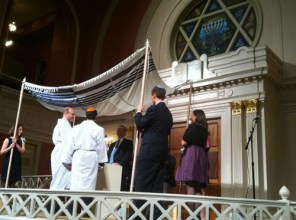
Greenberg-weddingAfter all, atheists and progressives have traditionally portrayed religious people in general and Christians in particular as being backward, superstitious, intolerant, and even bigoted. With the continued dynamic shift in attitudes toward supporting LGBT in the larger culture, what increased social pressure will be applied to people of faith who have long been considered (and in most cases, rightly so) anti-gay? Has acceptance or rejection of LGBT and specifically marriage equality become the litmus test of the progressive left as applied to religion?

It would seem so. But contrary to how Christianity has been painted with the same, broad brush by the media, how the church (I use that term in the most generic sense) responds to homosexuality including homosexual acts, is split along political lines (and Jesus is once again being dragged into the political arena, whether he wants to be or not).

It’s in these contentious times that I do what culturally-concerned Christians should do — turn to Will Ferrell for insight. And insight he brings us…

Yes, it’s the legendary “dear Lord Baby Jesus” scene (from the 2006 film Talladega Nights), where Ricky Bobby prays to the Jesus he likes best, which of course triggers an intensely thought-provoking discussion:

Kyle Naughton, Jr: “I like to picture Jesus in a tuxedo t-shirt because it says, like, I wanna be formal, but I’m here to party too. I like to party, so I like my Jesus to party.”

Walker (or is it Texas Ranger?): “I like to picture Jesus as a ninja, fighting off evil samurai.”

The whole scene is basically a three minute summary of much of what passes for contemporary Christian theology. We invent the Jesus we like best, name that version the God we serve (or partner with), and then find the church (or friend group) that aligns with our vision and — voila! — we’ve got our faith. To be clear, our version of Jesus typically corresponds with some of his attributes, but the picture is always so woefully incomplete.

Gay Rights Jesus is about sex, love, acceptance, and — above all — no judgment (except of course, you can judge someone else’s alleged intolerance). Gay Rights Jesus isn’t bound by your antiquated notions of sexual morality anymore than he’s bound by antiquated dietary rules that maybe involve shellfish . . . or something.

-from “Homosexuality, Morality, and Talladega Nights Theology”
Patheos.com

Irreverent though the quote may be, it tells a certain amount of truth about how we treat religion, adapting it (and Jesus) to fit the moral, ethical, and popular agendas of our society and ourselves.

But it prompts the nasty question of whether or not “commandments” can be adapted, or were intended to be adapted based on the needs of each generation? A blatant example from Judaism are things like cars and microwave ovens that didn’t exist when the Torah was given at Sinai, and they still didn’t exist during the time of Jesus or the later Talmudic period. Once they were invented, someone asked a Rabbi if they could be used on Shabbat, and Rabbinic authority had to consider the Torah and the relevant halakah and render a decision. The commandments regarding Shabbat had to be adapted to fit the needs of the current generation.

But homosexuality wasn’t “invented” recently since the Bible records the prohibition of an Israelite man having sex with another man back in the Torah.

If I were to stop with Judaism, I suppose I could say that the prohibition should remain intact unless some significant evidence is brought forth stating that the Leviticus 18 portion of the Torah was only intended for the ancient Israelites but not modern generations of Jews (but then you have to start asking questions about all of the other forbidden sexual relationships listed in Leviticus 18).

But how many of the Torah prohibitions regarding sex trickle down to Christianity?

In response, it is not enough to point out that Jesus never said anything explicitly about homosexuality or homosexuals. Since he was Jewish, silence cannot easily be filled with a viewpoint that was not common in Judaism in the first century – however much one might go on to insist that Jesus’ views did not always mirror what most people thought.

Jesus taught us to allow love for neighbor and concern for human beings to trump other concerns – even if it leads to healing on the Sabbath or eating sacred bread. Even if it means to breaking other laws, laws which according to the Bible were laid down by God himself.

Dr. James F. McGrath, June 29, 2012
“The Well-Thought-Out Christian Rationale Behind Christian Acceptance of Gays and Lesbians”
Patheos.com

ShabbatDr. McGrath makes the classic Christian assumption that Jesus broke (and therefore invalidated) the commandments regarding the Sabbath (which is highly debatable) and thus, Jesus could have and probably did break other commandments in Judaism including, in this case, those prohibiting homosexual behavior among the Jews.

If we follow Dr. McGrath’s line of thinking and assume it is all correct (and since he’s the Clarence L. Goodwin Chair in New Testament Language and Literature at Butler University in Indianapolis, he’s got a lot of “cred” behind him), then we might make a “quick and dirty” conclusion that Jesus not only didn’t have a thing against homosexual behavior among the Jews (and by extension, the later Christians), but he was all for it (Keep in mind that Rabbi David Hartman says, “The Sabbath, therefore, does not force us to choose between a theocentric focus on the world and the dignity and significance of human existence,” so healing on the Shabbat does not particularly constitute breaking the Shabbat).

Actually, I’m not sure I can take Dr. McGrath’s commentary that far (since he doesn’t), but he does say this:

Ancient Israel’s marriage laws reflected those of the time, and the workings of the marriage institution as an element of patriarchal society allowing men to treat women as property so as to ensure that their other property passed to their legitimate heirs. Times have changed, marriage has changed, and none of the conservative Christians I know who are married are involved in anything that mirrors “Biblical marriage” in all its features.

And so of course our thinking about marriage reflects the wider perspective of our time and place. Thinking about marriage among the people of God always has. And as with so many issues, such as women’s equality and slavery, we sometimes advocating the setting aside of practices that can be justified by careful exegesis of certain Biblical passages, on the basis of more fundamental Biblical principles. We pick and choose from both the Bible and our culture based on overarching principles and convictions about the centrality of love, the importance of justice, concern for the poor, and so on.

I’m fully willing to admit that there are a lot of things in Paul’s letters that I can accept as situational and that were intended to apply only to the specific group Paul was addressing in a certain place at a certain time. But how far can we “relativize” the Bible and the teachings of Jesus before we become guilty of the following?

Woe to those who call evil good
and good evil,
who put darkness for light
and light for darkness,
who put bitter for sweet
and sweet for bitter!
Woe to those who are wise in their own eyes,
and shrewd in their own sight! –Isaiah 5:20-21 (ESV)

How about this one?

For the time is coming when people will not endure sound teaching, but having itching ears they will accumulate for themselves teachers to suit their own passions, and will turn away from listening to the truth and wander off into myths. –2 Timothy 4:3-4 (ESV)

Even if I were to take a conservative Christian approach regarding homosexuality and homosexual acts, I’d have to admit that the commandments can only apply to religious Jews and to Christians. You have to be a member of the covenant before you come under the commandments (OK, Christians believe in a final judgment of all humanity by God, but that’s up to Him, not us). A conservative Christian is able to apply the Bible commandment prohibiting homosexual acts to someone performing such acts as a practicing Christian. However, he couldn’t do so regarding two men who are atheists, gay, and having sex anymore than he could against a man and woman who are atheists, living together as an unmarried couple and having sex (you don’t see a lot of Christian groups protesting against the latter these days).

As far as I can tell, the church has every right to police itself (and given the abuses in the church that occasionally come to light in the public media, perhaps they should) but they cannot apply their (our) own commandments and prohibitions onto the larger culture and attempt (and this is an extreme example) to legislate the Bible into local, state, or national law (even though significant portions of our laws are based on the Bible).

I know that’s what some Christians don’t want to hear.

Getting back to earlier portions of this blog post, are liberal Christians guilty of choosing “baby Jesus” or “Ninja Jesus” or “Gay Rights Jesus” over the closest approximation of “real Jesus” we can gather from the actual New Testament texts to satisfy modern cultural imperatives, or are, as Dr. McGrath suggests, we allowed to adapt the teachings of Jesus to be more appropriate with the needs of the current generations and even to override certain commandments for the sake of loving our neighbor unconditionally and without reservation under all circumstances, no matter what?

There’s no denying that there is an enormously complex set of variables in operation here. For many Christians, just policing their own backyard relative to homosexuality isn’t enough and they want to make the larger culture more “comfortable” for them/us. However, for the past 2,000 years, Jews have constantly lived as a subset of a larger culture that absolutely wasn’t comfortable to them and that existed in complete opposition to all of the commandments held more dear in religious Judaism.

And they managed to get by.

Why does Christianity expect anything different to happen to them?

Last November, I blogged on similar issues in a missive called At the Intersection of Intolerance and Humanity. I don’t believe that the church as the right to commit wholesale condemnation of all LGBT people everywhere as people because of the moral and religious commitments we’ve made as Christians. Perhaps we have the right to do so in our own churches, but this becomes problematic if your church accepts heterosexual couples living together as “OK” but not gay couples living together.

Whether you approve or disapprove of homosexual behavior based on your personal feelings and/or your understanding of the Bible doesn’t mean you have the right to disregard someone as a human being. Jesus expected us to, among other things, visit people in prison, meaning he wanted us to extend compassion to people who are convicted of crimes (and probably guilty of sins) and to treat them with respect. Why is being gay so much worse than being a bank robber, or someone who beat his wife, or even a murderer?

I’m not a big fan of having the larger, popular culture shove their values and ideals down my throat just because there are more of them than there are of me and they have the support of MSNBC and CNN. On the other hand, they do force the body of faith to confront moral issues that we’d just as soon avoid or even condemn, without actually examining what the Bible seems to be telling us, and especially without examining our own thoughts and feelings.

In this week’s Torah portion, Balak offered Balaam a small fortune if Balaam would consent to curse the Children of Israel, and given the fact that the evil Balaam could even speak with God, we have every reason to believe such a curse would have worked to the detriment of the Israelites. But what Balak intended for evil, God chose to make good. Are we to go so far as to say that what God considered evil in Leviticus, He chose to make good in the 21st century?

I don’t know if I can go that far. The popular media outlets are choosing to depict the LGBT community as “especially good” these days. We believers aren’t supposed to decide which people we love and which we hate. (Matthew 5:46). Although we are held to a higher moral standard (atheists and progressives would debate this) than the world around us, that isn’t a mandate to circle our wagons and to restrict love only to our own groups. If God so loved the world, the entire world, and everyone in it (John 3:16) while we were all still enemies of Christ (Romans 5:10), who are we to do any less?

Don’t turn good into evil and evil into good, but do good in order to overcome evil (Romans 12:21). I think rewriting the Bible to fit a modern moral agenda is going too far. But instead of overcoming what we believe is evil by force, we can do what Paul suggested in Romans 12:20 whilst quoting Proverbs 25:21-22

“If your enemy is hungry, feed him;
if he is thirsty, give him something to drink.
In doing this, you will heap burning coals on his head.”

Doing good doesn’t mean surrendering to evil. It means surrendering to God.

Good Shabbos.

Addendum: For more on loving your enemies, you might want to consider New Testament Scholar Larry Hurtado’s recent (and short) essay, Hermeneutics of ‘Agape’. Also, Dr. Stuart Dauermann presents a somewhat related blog post (not incredibly related but when you read it, you’ll see why I’m including it here) called Re-masculinizing the Church and Synagogue – Toward Addressing the Problem. Food for thought.