All posts by James Pyles

James Pyles is a published Science Fiction, Fantasy, and Horror author as well as the Technical Writer for a large, diversified business in the Northwest. He currently has over 30 short stories published in various anthologies and periodicals and has just sold his first novella. He won the 2021 Helicon Short Story Award for his science fiction tale "The Three Billion Year Love" which appears in the Tuscany Bay Press Planetary Anthology "Mars."

Bitachon and Hishtadlus for the Rest of Us

How does one balance these two seemingly contradictory ideas? It all depends on the person’s spiritual level. The closer a person is to perfection in his belief in Hashem, the more he is expected to rely on Hashem, and his level of hishtadlus (effort) must drop accordingly. Until a person reaches that level he may — and must — work, to achieve whatever he needs to function and sustain himself and his family. As his belief and trust in Hashem grow — and he must work on this mitzvah constantly, to reach ever higher levels of bitachon (trust) — he must adjust his level of hishtadlus and rely more on Hashem.

-from Torah Thought for the Day, p.56
Commentary for Parashas Mikeitz for Sunday
A Daily Dose of Torah

As I mentioned yesterday, for a person to trust God for his every need and be content in every circumstance as was the Apostle Paul (Philippians 4:10-13), that person would already have to be operating at a very high level spiritually. For the rest of us…well, we worry sometimes.

But I don’t entirely agree with the Rabbinic statement I quoted above. It seems that it could be abused by some people who state that they have achieved so high a spiritual level that they don’t (or shouldn’t) have to work to support themselves and their families at all, and instead, should be allowed to study Torah uninterrupted almost every waking moment. We can see such an example in the Ultra-Orthodox Jewish population of Israel who refuse mandatory military service and many who choose not to work and have the Israeli government providing them with support.

I suppose any principle can be taken too far. The Bible is replete with examples of very holy men who were close to God and who nevertheless also labored to support themselves.

workI do agree with the principle of hishtadus, which is that we are to work to support ourselves and not to rely on God’s miracles for our “daily bread,” so to speak. But I don’t think that necessarily changes as we learn to believe and trust in God to greater degrees over our lifetimes. Sure, God could cause us to win the lottery by a miracle, but don’t count on it.

As I’ve also previously mentioned, we know that at the end of last week’s Torah portion, we saw that Joseph is in prison. After giving the Chamberlain of the Cupbearers a favorable interpretation of his dream, Joseph asked that the Chamberlain put in a good word for him to Pharaoh, King of Egypt (Genesis 40:14-15). But according to midrash, this was a mistake (although what mistake Joseph actually made is debated by the Rabbis) and as a result, Joseph spent two more years in prison.

The plain text of the scripture doesn’t seem to indicate this and it seems more likely that once the Chamberlain of the Cupbearers had regained his freedom, he simply didn’t bother himself with the request of one insignificant Hebrew slave.

But we do see in this example the delicate balance between trust in God and the necessity of our own efforts. Technically, there was nothing wrong with Joseph asking for help and indeed, God may have arranged this very situation. After all, we find that two years later, the Chamberlain does remember Joseph, but only because Pharaoh has a dream that no one can interpret (Genesis 41:1-13). If the Chamberlain had spoken to Pharaoh two years previously, Pharaoh could either have denied the request or in granting it, possibly make Joseph unavailable when he was needed to interpret Pharaoh’s most important dream.

Sometimes bitachon or trust in God isn’t a matter of asking or not asking a person’s help in a tough situation. Sometimes and perhaps quite often, it’s a matter of asking and then waiting.

The true description of bitachon is the belief that there is no coincidence in this world, and that everything that transpires occurs with Hashem’s approval and instruction.

When a person finds himself in a situation which appears dangerous according to the natural way of the world, and he is powerless to help himself, he must overcome his fear by realizing that the One Who controls everything in this world can cause a positive outcome just as easily as a negative one. This is called bitachon.

-from A Mussar Thought for the Day, p.60
Commentary for Parashas Mikeitz for Sunday
A Daily Dose of Torah

Sometimes we know that saying something will make a situation worse. We can tell ourselves to, “Just keep silent.” If we feel tempted to speak negatively about someone, we can strengthen our resolve not to say it by telling ourselves, “Just keep silent.”

The more difficult it is to keep silent, the greater the resulting spiritual elevation. When you tell yourself, “Just keep silent,” your silence isn’t just a passive state of being. Rather, it is an act of remaining silent.

In Tehillim (Psalms 34), King David tells us: “Who is the person who wants life and loves days that he may see good? Guard your tongue from evil and your lips from speaking deceit.” Remaining silent instead of speaking against others enhances and lengthens life.

(from Rabbi Zelig Pliskin’s book: “Conversations With Yourself”, p.145) [Artscroll.com])

-from Just Keep Silent
Daily Lift #194
Aish.com

SilenceThat last quote is more directed at a person who wants to say something to another person, usually something insulting, but who choses for the sake of Heaven to refrain, but I think it fits in our current discussion as well. Sometimes we can only say and do so much, and when we reach the limit of our ability to positively affect our situation, then all we can do is rely on God’s mercy.

The issue though is that even a complete trust in God is no guarantee that the outcome will always be good. True bitachon enables a person to realize that good or bad, everything comes from the hand of God.

And that is a very difficult middah, yet there is hope, at least according to the Sages:

Chazon Ish states that just as there are levels in other middos, such as mercy, humility, etc., there are many levels of bitachon. As long as one possesses even a small trace of bitachon, he is not excluded from the group of believers, and will merit ultimate redemption.

-from A Mussar Thought for the Day, p.60

Sacrificing Serenity for Spirituality

And Yaakov sat…

Braishis (Genesis) 37:1

Rashi cites the Sages who say that Yaakov wanted to live in peace and serenity. But this was not to be, and the troubles of his son Yosef began. The Almighty said, “Is it not sufficient for the righteous that they receive their reward in the world to come? Why do they need to live in serenity in this world?”

The question arises: why is it wrong to want to live in serenity? Yaakov desired serenity not so that he could devote his time to personal pleasures, but rather to be able to engage in spiritual pursuits.

-Rabbi Zelig Pliskin
“Keep your focus on growth, not serenity,” p.102
Commentary on Torah Portion Vayeishev
Growth Through Torah

When I’m stressed, when things aren’t working out right, when relationships are strained, more than anything, I want peace and serenity. I want to relax. I sometimes want everyone just to get along, and at other times, I just want to be alone to follow both personal and spiritual pursuits without interruption and distraction.

So midrash aside, I can very much empathize with Jacob’s desire for peace and serenity.

But I think Rashi, as interpreted by Rabbi Pliskin, has a point. We weren’t put here by God to seek peace and serenity, we were put here to serve Him. Serving God is rarely very peaceful. Just look at lives such as Abraham’s, Jacob’s, Joseph’s, Moshe’s, David’s, Jeremiah’s, and of course, our Master Yeshua’s (Jesus’) life. Also consider the apostles, particularly Paul. Was their service in spreading the good news of the Moshiach to the Jews and to the nations particularly peaceful? Most of the time, it was ultimately fatal in a violent and premature sense.

May God not wish me to serve him in such a manner for I know my faith and trust pale in comparison to even the least of the Biblical tzaddikim (righteous ones or “saints”).

But R. Pliskin said “growth, not serenity,” which I take to mean that rather than seeking peace, we should be seeking to experience our lives as the platform upon which we strive to grow spiritually, to grow closer to God.

This, said Rav Yeruchem, is an attitude we should all internalize. Every occurrence in this world can make you a better person. When you have this awareness your attitude towards everything that happens to you in life will be very positive. Before, during, and after every incident that occurs reflect on your behavior and reactions. Ask yourself, “What type of person am I after this happened? How did I do on this test? Did I pass it in an elevated manner?” (Daas Torah: Barishis, pp.222-3)

-ibid

The Jewish PaulThis means that regardless of our circumstances, good or bad, we should approach the experience in the same manner, as a test or a “training session” designed to assist us in becoming more spiritually elevated. Of course, to be in a position to look at everything from ecstasy to agony in this way probably requires that we be in a fairly elevated state already. I don’t think I’m there yet, but maybe being aware that it’s possible will give me something to shoot for.

But I rejoiced in the Lord greatly, that now at last you have revived your concern for me; indeed, you were concerned before, but you lacked opportunity. Not that I speak from want, for I have learned to be content in whatever circumstances I am. I know how to get along with humble means, and I also know how to live in prosperity; in any and every circumstance I have learned the secret of being filled and going hungry, both of having abundance and suffering need. I can do all things through Him who strengthens me.

Philippians 4:10-13 (NASB)

If the ancient and modern Rabbinic sages can apply this principle to Jacob, I think it’s reasonable to apply it to Paul as well. This gives it a more universal usage which means it comes right back to my front door, so to speak. The goal of trust and faith in God and living a holy life then, is not to find peace in our circumstances, but regardless of what is happening to us, to find peace in God as Paul did.

“And Yosef was brought down to Egypt.”

Braishis (Genesis) 39:1

Anyone viewing the scene of Yosef being brought down to Egypt as a slave would have considered it a major tragedy. His brothers sold him into slavery and he was being taken far away from his father and his homeland. But the reality was that this was the first step towards his being appointed the second in command of Egypt. He would eventually be in charge of the national economy of Egypt and would be the mastermind behind the complex program to prepare for the years of famine during the years of plenty.

-Rav Pliskin
“Realize that you can never tell how events will actually turn out in the end,” p.110

Being limited, temporal beings, our major focus is what is happening to us right now or what has just recently occurred. If it’s something unpleasant, then we tend to believe that it is also undesirable. Joseph probably felt that way when he was being sold into Potipher’s household and certainly would have that experience upon being sent to prison.

If only you would think of me with yourself when he benefits you, and you will do me a kindness, if you please, and mention me to Pharaoh, then you would get me out of this building. For indeed I was kidnapped from the land of the Hebrews, and even here I have done nothing for them to have put me in the pit.

Genesis 40:14-15 (Stone Edition Chumash)

After two years in prison, Joseph’s words give us no indication that he was viewing his continued incarceration as anything but a miscarriage of justice, and an unfair and unpleasant circumstance. He had not “learned to be content in whatever circumstances” he found himself in. With great respect to the Rabbis, I don’t think midrash sufficiently describes Joseph’s personality or spirituality. While he did indeed have great faith and trust in God, he really wanted to get out of prison and he was willing to ask for help from a potentially influential person, a bit of quid pro quo, as it were.

Joseph in prisonPerhaps Joseph realized what God had done in retrospect, but it doesn’t seem that he realized it when he was still locked up. Nevertheless, we shouldn’t lose sight of the fact that Joseph acted with utmost integrity and morality, both as a slave and as a prisoner. If he had given up hope and surrendered to despair, engaging in the baser behaviors of a prison inmate, then he certainly would not have been in position to take the next step in God’s plan.

The take away from this is that regardless of circumstances, even if you (or I) can’t possibly see how they can be beneficial at the time they’re happening, we must continue to behave (or start behaving) in a moral and upright manner for who knows how you can affect what happens next by what you decide to do now? And if you (or I) fail in this, there’s still time to repent, but that time is not limitless:

He took up a parable and said: A certain man had a fig tree planted in his vineyard. He came to seek fruit from it, but he did not find any. He said to the vinedresser, “Look, for three years I have come to seek fruit in the fig tree, but I have not found any. Cut it down; why should it waste the ground?” He answered and said to him, “My master, leave it alone for another year, until I have dug around it and given it some manure. Perhaps it will produce fruit. If it does not produce, then cut it down the following year.”

Luke 13:6-9 (Delitzsch Hebrew Gospels)

Keep Practicing Repentance

I was thinking about the Parable of the Prodigal Son (Luke 15:11-32) while driving in to work this morning (Friday) and in relation to the stream of repentance, atonement, and forgiveness related blog posts I’ve been writing lately. The parable is only twenty-two verses long, just a couple of paragraphs, but if it were a true to life experience, the events being described could have taken months or even years.

A selfish son demanded of his father his inheritance, which one usually doesn’t receive until the father dies. This was a rather cold-blooded thing to ask for, but his father relented. This son, the younger of two brothers, did what most young people would do with a lot of money they didn’t have to earn by working. He blew it all on what the NASB translation calls “loose living” and ended up impoverished, that is, flat broke. All that money, presumably a sizable sum, and it’s all gone.

So he went and hired himself out to one of the citizens of that country, and he sent him into his fields to feed swine. And he would have gladly filled his stomach with the pods that the swine were eating, and no one was giving anything to him. But when he came to his senses, he said, ‘How many of my father’s hired men have more than enough bread, but I am dying here with hunger! I will get up and go to my father, and will say to him, “Father, I have sinned against heaven, and in your sight; I am no longer worthy to be called your son; make me as one of your hired men.”’

Luke 15:15-19

Like I said, it could have taken this young person months or even years to reach this dead-end in his life. What was he doing in the meantime? Apparently enjoying himself. Until the money ran out, he probably didn’t give a second thought to the cruel way he had treated his father and how he had deserted his family in pursuit of his own pleasure and enjoyment.

Once he ended up broke, we don’t really have a sense of how long he was working as a hired laborer, but if he wasn’t eating even as well as the pigs he fed, it probably wasn’t too long. Assuming he was just really hungry and not literally starving, it would have still been weeks or months before he hit that hard wall and finally overcame his pride, self-indulgence, and then shame and fear at the thought of turning back to his father.

Shame and fear?

Sure.

Look at what he did. He pretty much demanded his father (virtually) die so this kid could have whatever he would have inherited of his father’s estate upon Dad’s death. I doubt the guy was ever planning to see or speak to his father again, so after throwing the supreme insult in his Dad’s face, what was it like to even imagine being confronted by his father again? By rights, Dad should have told him to get lost and slammed the door in his face, leaving this boy homeless, abandoned, and alone. What a tremendous risk it would be, emotionally and physically, for him to walk back home and to ask to be treated, not as a son, but as a hired hand.

However, as we see in the parable, the kid had gotten to the point where he had nothing to lose. He was starving anyway. The pigs got fed but no one was giving him any food. Why not take the chance? Who knows? Maybe his father would have pity on him and at least give him a job in the fields or tending the sheep.

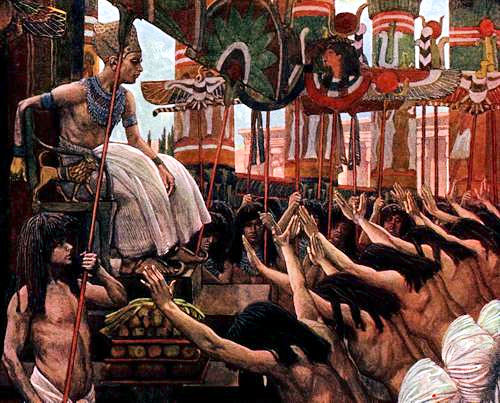
Joseph of EgyptI was also thinking about the story of Joseph. It’s not until Parasha Va-yiggash (Genesis 44:18-47:27) when Jacob and his family descend into Egypt and Joseph is reunited with his father. Of course, ever since being sold into slavery in Egypt, Joseph’s behavior was exemplary, first as a slave in Potiphar’s household, and then as a prisoner in the King’s prison. His wrongdoing (in spite of how the Rabbinic sages seem to explain it away) ended when his brothers threw him into a pit with the intention of killing him. Teenage arrogance was tempered by trial and suffering which ultimately turned his talents toward saving the world from famine.

But I wonder if there’s a secondary lesson in all this? Both Jacob and Joseph suffered from their long separation. Jacob thought Joseph dead for long decades, while his brothers suffered the guilt and shame of knowing they had contributed to their favored sibling’s disappearance, and then lied about it to their father. They too suffered and Joseph in testing them, delivered stern consequences upon them until they admitted their wrongdoing.

Can Joseph, certainly a Messiah-like figure, be compared to the prodigal son? Was there a lesson he had to learn before he merited reunification with his family? It seems more likely that the brothers were the prodigals and it was what they needed to learn before being reunited with Joseph and being given the relative comforts the land of Goshen had to offer.

But consider:

He had sent Judah ahead of him to Joseph, to point the way before him to Goshen. So when they came to the region of Goshen, Joseph ordered his chariot and went to Goshen to meet his father Israel; he presented himself to him and, embracing him around the neck, he wept on his neck a good while. Then Israel said to Joseph, “Now I can die, having seen for myself that you are still alive.”

Genesis 46:28-30 (JPS Tanakh)

So he got up and came to his father. But while he was still a long way off, his father saw him and felt compassion for him, and ran and embraced him and kissed him. And the son said to him, ‘Father, I have sinned against heaven and in your sight; I am no longer worthy to be called your son.’ But the father said to his slaves, ‘Quickly bring out the best robe and put it on him, and put a ring on his hand and sandals on his feet; and bring the fattened calf, kill it, and let us eat and celebrate; for this son of mine was dead and has come to life again; he was lost and has been found.’ And they began to celebrate.

Luke 15:20-24 (NASB)

Admittedly, except for the tearful reunion between father and son, there isn’t much of a comparison. Joseph is a Prince in Egypt, the most powerful man on Earth, except for Pharaoh King of Egypt, and Pharaoh denies Joseph nothing. Jacob and his family are saved from famine by going down to Egypt and accepting Pharaoh’s generosity (admittedly for the sake of Joseph who had saved Egypt). Conversely, it is the returning prodigal son who is saved by his father’s generosity, mercy, and joy.
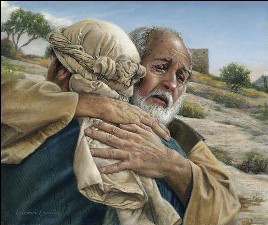
Wayward SonBut in all the years Joseph had been in Egypt, not once did he send a message to his grieving father that he was alive and well, even if he couldn’t tell him the exact circumstances for his long absence. Certainly a man of Joseph’s means could have sent a secret messenger into Canaan to let Jacob know he was alive. In this, he was like Jacob himself who, upon returning to Canaan with his family after serving Laban for twenty years and then escaping association with Esau, never let Isaac and Rebecca, who were both still alive at the time, know that he had returned. In fact, the only mention of Jacob and Isaac being together again was when Jacob and Esau buried their father upon his death (Genesis 35:28-29).

At least the prodigal son didn’t wait that long. He returned to his father while Dad was still alive. For all Joseph knew, his father could have already died, which is why he urged his brothers, when they still didn’t know who Joseph was, to tell him about Jacob and Benjamin (Genesis 45:3 for example).

There are many things that we should do, but we procrastinate. We delay taking action. Doing nothing is often much easier then taking action. What can you say to get yourself moving? You can say, “Just do it.”

Sometimes we really have a good reason or reasons for hesitating. Deep down we may feel that it’s better for us not to take the action we’re postponing. But we aren’t yet clear about the entire matter. If you have an intuitive feeling that it might be unwise to take action, then wait. Think it over some more. Consult others.

But when you know that you or others will benefit if you take action and you don’t have a valid reason for procrastinating, tell yourself, “Just do it.”

(from Rabbi Zelig Pliskin’s book: “Conversations With Yourself”, p.141) [Artscroll.com])

-Rabbi Zelig Pliskin
from Daily Lift #192 “Just Do It
Aish.com

Hillel says, “If I am not for myself, who will be for me? But if I am only for myself, who am I? If not now, when?”

-Ethics of the Fathers, 1:14

How long did it take for Joseph to call his father, brothers, and family to come and join him in the safety of Egypt during a world-wide famine? How long did it take for the prodigal son to hit rock bottom and in humiliation, return to his father?

Years. Decades.

How long will it take you and how long will it take me to finally return to our Father? What holds us back, the comfort and pleasure of the still wealthy prodigal? The power and control of Joseph, Prince of Egypt? Or the humiliation, shame, and fear of the dead broke prodigal son?

guiltyA single, impulsive act of disobedience is one thing and we can quickly apply correction and immediately repent and return. A lifetime of separation and self-indulgence isn’t swept aside so easily, and it can take time to reach the final conclusion that we have nothing left to lose and everything to gain if we turn around and go back where we came from. Even Joseph, who had every material comfort in the world, was still missing something without his family, for as a Hebrew, he was still utterly alone without his community, without his family, a servant of God amid a nation of pagans. That too is a habit difficult to break. Not that Joseph worshiped idols, but what about his wife and children? Maybe they didn’t either, but what about his in-laws? What about Pharaoh?

It took a long time before both of these men finally came to the point where they had to return to their families and become part of their community again.

Consider three things, and you will not approach sin. Know whence you came, whereto you are going, and before Whom you are destined to give an accounting.

-Ethics of the Fathers, 3:1

If we all considered these three statements with the proper gravity, we would be far less likely to sin and then keep on sinning (or sin, repent, sin, repent, sin…). But having reached a point to where you and I desire to return, these three things are dauntingly inhibiting, like staring up the summit of some great mountain that we realize we need to climb.

And being daunted and inhibited, we hesitate. Why now? Why not in a little bit? But then Hillel’s words come back to haunt us: “If not now, when?”

My rabbi once told me that even when I don’t feel like praying, I should still make an effort. Even if I feel completely disconnected from the action that I’m doing. Why? Because there will come a day when I will feel like praying, and if I haven’t been keeping my muscles in shape, I won’t be able to connect to my Creator through the vehicle of prayer. It will be so foreign to me that it will impede my attempt to connect.

By going through the motions, even in times of spiritual famine, I am keeping the lines of communication clear. I’m weeding my spiritual garden, even though I may not be harvesting any vegetables at the time.

-Rivki Silver
“Just Do It”
Aish.com

praying at masadaThe practice of Judaism really is a matter of practice. Judaism isn’t so much a matter of believing as doing. As Ms. Silver tells us in her brief article, a relationship with God is something you perform, saying the blessings and doing the mitzvot, even when you don’t feel like it, and sometimes you don’t practice at all or at least not as much as needed.

Judaism is very much a religion of practice, of doing. In the morning, I wake up and thank God for creating me and giving me another day. Then I ritually wash my hands. If I’m really on it, I’ll say my morning blessings after that (though sometimes they get said a little later).

When you do something every day, it becomes routine. And then something which is really quite sublime can become rote. And then the emotional component of spirituality which is, for many people, a big draw, can become separated from the physical component of spirituality. And then you can wake up one morning and realize that you’re just going through the motions.

I know. I’ve been there. I AM there in some areas of my practice.

Time to give up? Not so fast.

As the previous quote from Ms. Silver states, even “going through the motions” serves as a sort of “place holder” until we are ready to stop being “spiritual zombies”. Speaking of which:

This doesn’t mean that it’s okay to stay a spiritual zombie. While the reality of my morning blessings may be that I don’t have the best concentration while saying them, that doesn’t exempt me from trying to improve their quality.

We’re not perfect, and that’s okay. When Jascha Heifetz first picked up a violin, he wasn’t perfect either. It took years of practice and determination to become great.

And that’s something I find encouraging when I’m not feeling particularly “spiritual,” when doing a mitzvah might even feel like one more thing to check off my to-do list. I know that by continuing to practice, I am continually improving, much like a musician who is working on a piece of music.

Have you ever considered that true repentance takes time and practice as well? I’ve always imagined repentance to occur in an instant. Just repent of your sins to God, change your behavior, and it’s all done.

Well, no. I think that’s why so many people trying to break a long pattern of sinful behavior have such a difficult time. If you expect repentance, atonement, and forgiveness in an instant and it doesn’t actually happen in an instant, it’s demoralizing. Imagine thinking you’ve repented only to give in to the temptation to return to sin. It’s a horrible thing. What if it means repentance doesn’t work? You’re trapped.

Time to give up? Not so fast.

The “just do it” slogan made famous by Nike, doesn’t always mean do it once, do it right, and do it permanently. I’m not excusing the revolving door method of sin, repentance, sin, and so on. I’m saying that what has taken years to build up won’t always get torn down in a single day. Ever watch an old building being demolished? Sure, it doesn’t take as long to knock it down as it took to construct it, but it still takes time. Further, it takes planning, the right equipment, and the right execution. So too repentance.

father and sonThe journey from the pig farm in a foreign country to home must have taken some time, even after the prodigal son made his decision. So too with us. Maybe his trip was uneventful or maybe there were barriers along the way that Jesus (Yeshua) didn’t include in his parable. They probably weren’t relevant to the point the Master was making, but maybe they’re relevant to us.

Repentance takes practice, like a Jewish person trying to overcome being “stuck” on a particular mitzvah. But it’s like a young child learning how to walk. The would-be toddler never gives up and decides to keep crawling for the rest of his or her life. They keep at it. They’re driven to learn to walk and eventually they do. The child’s parents don’t give up on the little one for standing and falling and standing and falling and taking a step and falling. As long as the child keeps trying, there’s nothing to be concerned about and most parents are pretty patient with the whole process.

How much more so is our Heavenly Father patient with us…

…as long as we keep trying and practicing and we don’t give up.

Choosing Your Prison

It is worthwhile to elaborate a bit on this important concept of free will, which the Rambam calls “an important principle and a pillar of all Torah and mitzvos.”

He states: “Do not let the thought cross your mind, that which the foolish ones among the nations and even ignorant Jews claim, that Hashem predetermined and decreed upon every person what he will be — a righteous person or a wicked one. It is not so — for every single person can be either a tzaddik like Moshe Rabbeinu, or a wicked man like Yeravam. There is no one pulling him in either direction. It is each person’s own choice to pick the way of life he will follow.”

-from “A Mussar Thought for the Day,” p.14
Commentary for Monday on Parashas Vayeishev
A Daily Dose of Torah

So much for Calvinism. We can’t claim that God preselected us to be good or to be evil. We get to choose who we are and we get to make different choices over time. That’s miserable and encouraging all at once. It’s miserable because we human beings all by ourselves are prone to willfulness, weakness, and error. But it’s also hopeful in that we can strive to overcome our faults and to be better tomorrow than we were yesterday.

One of the recurring themes in the various incarnations of “Star Trek” is that mankind continually works to improve itself, with the presupposition that humans have the moral framework and ability to do so independently. However, both Judaism and Christianity maintain that we are unable to elevate ourselves spiritually to any degree at all without relying on God. This does not negate free will, since we must choose to either obey or disobey God in the different and varied areas of our lives.

No temptation has overtaken you but such as is common to man; and God is faithful, who will not allow you to be tempted beyond what you are able, but with the temptation will provide the way of escape also, so that you will be able to endure it.

1 Corinthians 10:13 (NASB)

Maybe that’s the answer to this sometimes frustrating statement of Paul’s. It may seem like temptation is irresistible, but the circumstances tempting us are the same for a lot of people, even if we’re only aware of our own individual experience. We can either rely on ourselves and fail or rely on God and have the hope of success, and God is faithful.

It’s when we assume that we’re helpless victims, either of God’s “Divine Plan” to choose only some for salvation and to let the rest burn, or of our own “sin nature” or “evil inclination” that the following happens:

So when you are assembled and I am with you in spirit, and the power of our Lord Jesus is present, hand this man over to Satan for the destruction of the flesh, so that his spirit may be saved on the day of the Lord.

1 Corinthians 5:4-5

Joseph the SlaveNot that God necessarily gives up on us, but He certainly can give us enough rope to hang ourselves with, if we so choose. Then, when swinging in the breeze, if we’re still alive, we can call out to Him.

But even resisting temptation is no guarantee of an easy or good life.

One day he went into the house to attend to his duties, and none of the household servants was inside. She caught him by his cloak and said, “Come to bed with me!” But he left his cloak in her hand and ran out of the house.

When she saw that he had left his cloak in her hand and had run out of the house, she called her household servants. “Look,” she said to them, “this Hebrew has been brought to us to make sport of us! He came in here to sleep with me, but I screamed. When he heard me scream for help, he left his cloak beside me and ran out of the house.”

She kept his cloak beside her until his master came home. Then she told him this story: “That Hebrew slave you brought us came to me to make sport of me. But as soon as I screamed for help, he left his cloak beside me and ran out of the house.”

When his master heard the story his wife told him, saying, “This is how your slave treated me,” he burned with anger. Joseph’s master took him and put him in prison, the place where the king’s prisoners were confined.

Genesis 39:11-20

Joseph resisted the repeated temptation to have an illicit affair with his master’s wife. He was blameless and still ended up in prison. How much more so do we, who are not blameless, risk “prison” of one form or another, even after we cry out to God and begin to learn to resist our own temptations and to strive to be better servants of Hashem.

The worst prison is when G-d locks you up. He doesn’t need guards or cells or stone walls. He simply decides that, at this point in life, although you have talent, you will not find a way to express it. Although you have wisdom, there is nobody who will listen. Although you have a soul, there is nowhere for it to shine.

And you scream, “Is this why you sent a soul into this world? For such futility?”

That is when He gets the tastiest essence of your juice squeezed out from you.

(Likutei Sichot vol. 23, pp. 163–165; Shlach 5732:1; 5th night of Chanukah 5720:4.)

-Rabbi Tzvi Freeman
“The Invisible Prison”
Chabad.org

If God puts us in “prison,” isn’t it what we deserve? Why should we complain (although we invariably do)? In sin, we are slaves but slaves who have deliberately put ourselves in the hand of our master. In choosing to not sin, we are deciding to be slaves of a different Master, one who loves our soul, one who desires the best for us. As Rabbi Freeman suggests, the prison God incarcerates us in is designed not to confine and demoralize us, but to drive us to be the very best we can be.

PrisonWe can either choose the evil prison where we trap ourselves and reap only what we deserve, or allow God to “imprison” us and have the hope of being led to a better life.

And David said to Gad, “I am exceedingly distressed. Let us fall into Hashem’s hand, for His mercies are abundant, but let me not fall into human hands.”

II Samuel 24:14

This verse is the opening line of the Tachanun prayer. Dovid HaMelach had sinned by taking a census of the Jews in a manner contrary to that prescribed by the Torah. Hashem, through the agency of the prophet Gad, gave Dovid HaMelech a choice of three calamities, one of which he and his people would have to suffer in atonement for his sin: seven years of hunger, three months of defeat in battle, or a deadly three-day plague. Dovid chose the last, because that one would be inflicted directly by God, Whose mercy is ever present even when His wrath is aroused. His choice proved to be the correct one, for God mercifully halted the plague after a duration of only half a day.

-from “A Closer Look at the Siddur,” pp.15-16
Commentary for Monday on Parashas Vayeishev
A Daily Dose of Torah

Joseph’s incarceration is recorded in this week’s Torah Portion but not its resolution. Joseph was made a slave and then a prisoner in order to accomplish God’s plan, not just for Joseph or even just for Egypt, but for the entire world. No doubt you already know how the story of Joseph continues, how he was released from prison to interpret a dream of Pharaoh’s, and as a result, how Joseph was made a ruler in Egypt second only to Pharaoh. From prisoner to prince in one stroke.

Very few of us will have such an experience, yet it would be enough if God were to judge us and not human beings. God is incapable of treating us with malice and His rulings are truly impartial and fair, though they can be harsh.

When you look at that imperfect and sinful wreck in the mirror each morning, are you not much harder on yourself than God would be? Doesn’t God look at us with pity and compassion when most people, even those closest to us, react out of hurt and anger?

A basic Torah principle is that when correcting someone, we need to do so with a sense of love and compassion. When you speak in a blaming manner, the message you give is not a loving one.

If there is a specific person you tend to speak to in a blaming manner, be resolved to speak to more pleasantly.

(For a series of probing questions on this topic, see Rabbi Pliskin’s “Gateway to Self Knowledge,” pp.135-7)

-Rabbi Zelig Pliskin
Daily Lift #189: “Replace Blame with Compassion”
Aish.com

Would that other people or even we ourselves were as merciful and compassionate as God when we fail and seek to make amends.

compassionBut coming back to the matter of free will, our actions and the consequences rest on our shoulders. No one else is to blame, though we can hope and pray for mercy. In the end, people are not always merciful, but even when we do not deserve it, God is compassionate.

The Tzemach Tzedek writes: The love expressed in “Beside You I wish for nothing,” (Psalm 73:25) means that one should desire nothing other than G-d, not even “Heaven” or “earth” i.e. Higher Gan Eden and Lower Gan Eden, for these were created with a mere yud…. The love is to be directed to Him alone, to His very Being and Essence. This was actually expressed by my master and teacher (the Alter Rebbe) when he was in a state of d’veikut and he exclaimed as follows:

I want nothing at all! I don’t want Your gan eden, I don’t want Your olam haba… I want nothing but You alone.

from “Today’s Day”
Wednesday, Kislev 18, 5704
Compiled by the Lubavitcher Rebbe; Translated by Yitschak Meir Kagan
Chabad.org

Whatever prison you find yourself in, seek God alone. Everything else will take care of itself.

Choose Hope Today

At each moment of every day, you choose your thoughts, words, and actions. You even choose your feelings by choosing your thoughts, words, and actions. So say, “Just choose wisely now.”

The more frequently you choose wisely, the more this choice will become second nature. You probably know what happens to a person who keeps making wise choices of thoughts, feelings, words, and actions. They live their life much more wisely.

“But what if I don’t always recognize the wisest choice?” Just saying, “Just choose wisely now,” won’t guarantee that you will always choose the wisest choices. But it will still be much better than saying, “Choose the stupidest choice!”

(from Rabbi Zelig Pliskin’s book: “Conversations With Yourself”, p.139) [Artscroll.com])

-Rabbi Zelig Pliskin
Daily Lift #185: Just Choose Wisely Now
Aish.com

As I’ve mentioned before, the path of repentance, forgiveness, and redemption is not a straight line where one walks along each day making steady progress. I’ve used metaphors to describe this process such as birds and ladders but it can also be a lot like one step forward and two steps back, or maybe like running on a string of spaghetti all curled and twisted in a bowl…in the dark. Sometimes you can’t even make heads or tails of where you are or how you’re doing. You just know you’re running (and sometimes, running scared).

But every step you take whether straight and narrow or to the left or right requires a choice, even if it doesn’t seem that way. As Rabbi Pliskin writes in the above quoted set of paragraphs, you may have made bad choices in the past but you can make a wise choice now. That doesn’t erase the past, but nothing can do that. You can’t change what has happened but you can change the future by acting in the present.

But it’s not easy. It is said (supposedly by Samuel L.Clemens [Mark Twain]) that “the best predictor of future behavior is past behavior.” This is true up to a point but it doesn’t acknowledge the possibility of change. It’s easy to tell yourself that your future will be what your past has been. But if that’s the case, is there hope?

“In whatever way a person chooses, therein is he led” (Makkos 10b).

We tend to disown those thoughts, feelings, and actions that we dislike. Something we saw, read, or heard upset us, we like to think, and caused us to think, feel, or act in a certain way. We forget that we have considerable say in what we choose to see or hear.

Psychiatry and psychology have contributed to this abdication of responsibility. Their emphasis on the impact of early-life events on our emotions has been taken to mean that these factors determine our psyche, and that we are but helpless victims of our past.

We forget that if someone puts trash on our doorstep, we do not have to take it in; even if it was put into the house and filled it with an odor, we have the option to throw it out and clean up. Similarly, even if early-life experiences have an impact, the effects are not cast in stone; we can take steps to overcome them.

A man once complained to his rabbi that alien thoughts were interfering with his prayer and meditation. The rabbi shrugged his shoulders. “I don’t know why you refer to them as alien,” he said. “They are your own.”

If we stop disowning feelings and actions, we may be able to do something about them.

Today I shall…

…try to avoid exposing myself to those influences that are likely to stimulate feelings and behavior that I think are wrong.

-Rabbi Abraham J. Twersky
Growing Each Day for Kislev 13
Aish.com

I guess that means the first step in the journey is to own up to the thoughts, feelings, and actions that resulted in our current situation and need for repentance. We can’t very well take out the trash if we don’t admit that we created it in the first place. Well, I guess we could, but we’d always by “mystified” by the fact that no matter how often we take out “someone else’s” garbage, more shows up in our trash can.

Rabbi Zelig Pliskin
Rabbi Zelig Pliskin

So connecting what Rabbi Twersky said to the statement made by Rabbi Pliskin, we need to make different choices, first by admitting that our prior choices are our own, and then changing the choices we make now, eliminating “those influences that are likely to stimulate feelings and behavior that” we think are wrong.

And if not now, then when? (Ethics of the Fathers 1:14).

Hillel’s famous statement is a bit enigmatic. The simple answer is, “Later.” Why can’t we take care of whatever it is some other time? Granted that procrastination is not a virtue, why does Hillel imply that if not now, then it will never be?

The Rabbi of Gur explained that if I do something later, it may indeed get done, but I will have missed the current “now.” The present “now” has but a momentary existence, and whether used or not, it will never return. Later will be a different “now.”

King Solomon dedicates seven famous verses of Ecclesiastes to his principle that everything has its specific time. His point comes across clearly: I can put off doing a good deed for someone until tomorrow, but will that deed, done exactly as I would have done it today, carry the same impact?

The wisdom that I learn at this moment belongs to this moment. The good deed that I do at this moment belongs to this moment. Of course I can do them later, but they will belong to the later moments. What I can do that belongs to this moment is only that which I do now.

Today I shall…

…try to value each moment. I must realize that my mission is not only to get something done, but to get things done in their proper time, and the proper time may be now.

-Rabbi Abraham J. Twersky
Growing Each Day for Kislev 14
Aish.com

You’ve probably heard the saying, “There’s no time like the present,” attributed to Georgia Byng and that seems to be what both of these esteemed Ravs are telling us. Once you’ve recognized that you are the one making decisions in your life, that they are bad decisions, and that they are causing harm, the next step is to determine what good decisions are and start making them right now.

Jeff stood before the Wall, and made up an atheist’s prayer. He looked at the stones and said:

“God, I don’t believe in You. As far as I know, You don’t exist. But I do feel something. So if I’m making a mistake, I want You to know, God, I have no quarrel against You. It’s just that I don’t know that You exist. But God, just in case You’re really there and I’m making a mistake, get me an introduction.”

Jeff finished his prayer, and one of the yeshiva students who happened to be at the Wall, saw Jeff and thought, “Perhaps he’d be interested in learning some Torah.”

He tapped Jeff on the shoulder, startling him so much that he jumped three feet in the air. Jeff whirled around and shouted,

“What in the blankety-blank-dash-bang do you want?!”

“I’m sorry. I just want to know if you’d like to learn about God.”

That question hit Jeff like a 2-by-4 right between the eyes. He had just finished asking God for an introduction, and immediately someone was offering to introduce him to God.

“Prayer of an Atheist”
from the Ask the Rabbi column
Aish.com

I encourage you to click the link above to get the full context of the article, but I included this quote to illustrate just how powerful prayer, even one uttered by an atheist, can be to remediate a person’s life.

The young Jewish fellow in question studied Torah in Jerusalem for the next six weeks following his encounter at the Kotel, continued his studies and coming to faith after returning to his home in the United States, and eventually married a devout Jewish woman.

But up until he prayed that one prayer at the Kotel, his life was heading in a very different direction.

Of course Jeff’s decision to pray at that moment wasn’t random:

Jeff had been in Norway, visiting his Norwegian fiancée. And he decided it was now or never: either he is going to come to Israel or he’ll never make it.

So he headed for Jerusalem and the Western Wall. He figured he would stop by the Wall to see some old stones. Yet upon his arrival he was amazed. He felt something heavy. He was moved.

Jeff stood before the Wall, and made up an atheist’s prayer. He looked at the stones and said…

white-pigeon-kotelSomething about being a Jew in Jerusalem and at the Kotel got through to Jeff. More accurately put, God got through to Jeff using the holiness of Jerusalem as a catalyst.

God uses all manner of events and circumstances to motivate human beings, Jews and everyone else. Although I’ve been quoting from Jewish sources throughout this blog post, the advice is just as applicable to the rest of us. If the Jewish people are supposed to be a light to the nations, then this is one way they are accomplishing their mission.

Jesus (Yeshua) said that he was the light of the world (John 8:12), which I take to mean that he is the living embodiment of Israel’s mission to the nations, the best personal example of Israel shining a light on the path allowing the people of the nations to find God. But he also said to his disciples that they were the light of the world (Matthew 5:14-16) indicating that they were to assume his mission and continue to shine the light for the rest of us to follow. Eventually, we Gentiles become that light as well, but only once we have achieved a level of spiritual achievement and discipline to live a life worthy of that light.

It all comes down to the choices we make. It also means that even if we make bad choices, they don’t have to determine the course of the rest of our lives. We have free will. We can make different choices. We can choose differently now, today, this morning.

I always like the “I’ll be back” line because it is a great philosophy for life. Life isn’t all successes, it is also defeats. But you can always be back. No matter what, just like the Terminator. You’re not a loser when you fall. You’re only a loser if you don’t get up. Winners get up and come back.

Arnold Schwarzenegger

Get this straight: The secret behind success is knowing how to fail. Failures are people who fail once. Successes are people who fail thousands of times—and pick themselves back up each time. Like little kids learning to walk. Like Babe Ruth, who held the world record for home runs—and also held the record for strike-outs.

Rabbi Tzvi Freeman

For more on this topic, please read On Choosing God.

The Enemy Within Us

The truth is that the yetzer hara also uses both of these tactics, but it is more successful when it approaches as a friend. Chovos HaLevavos (Yichud HaMaaseh Ch. 5) describes at length the dangerous power the yetzer hara possesses: “A person must realize that his biggest enemy in this world is his yetzer hara, which is well-connected to his character and is mixed into his personality. It is a partner in all of a person’s spiritual and physical aspirations. It gives advice on all of one’s movements, the revealed ones and the concealed ones, and lies in ambush to persuade one to sin at all times. Even while sleeping, one is not safe: the yetzer hara is always wide awake, seeking to harm. A person may forget about it, but it never forgets. It masquerades as a friend and a close confidant; indeed, with its shrewdness it tries to be considered a most loyal and trusted friend. The yetzer hara is so convincing that a person might think that it is running to fulfill his every wish. But in truth, it is shooting dangerous, deadly arrows, to uproot the person from the World to Come.”

Mussar Thought for the Day
for Monday’s Commentary on Parashas Vayishlach, p.191
A Daily Dose of Torah

“If you do well, will not your countenance be lifted up? And if you do not do well, sin is crouching at the door; and its desire is for you, but you must master it.”

Genesis 4:7 (NASB)

According to a midrash on the Torah portion for this coming Shabbat, when Jacob is contemplating his upcoming encounter with Esau after many years, he fears two things: being killed by Esau and being befriended by Esau. Rabbinic commentary likens this to how the yetzer hara (evil inclination) operates inside of a human being. Our most basic nature or what a Christian might call our “sin nature” seeks to disobey God and lead us into ruin and exile from the World to Come, the ultimate physical and spiritual harm. In that, it’s easy to see the temptation to sin and resistance to repent as our enemy and something we must actively battle.

But the flip side of the coin is the deceptiveness of our own human natures, and this I think (and the commentary quoted above agrees) is the greater danger. People have a tremendous capacity for self-delusion and often choose to see and hear only what fits into their own dynamic or world view, regardless of the objective facts. We define good and evil by our own human standards and justify any harm we might be doing to ourselves and others in any number of creative ways. This is the yetzer hara as our friend, leading us down the peaceful and attractive path to destruction.

Other commentaries on this Torah portion say these are the twin dangers of the nations toward the Jewish people. History is replete with terrible acts done by non-Jews upon Jews including inquisitions, pogroms, torture, and murder. But the other danger, and this seems strange at first glance, is for the nations (that is, Gentiles) to extend friendship toward the Jews. Why is this a problem? Because it often leads Jewish people away from Torah, away from performing the mitzvot, and away from God. It waters down Jewish distinctiveness and we have a clear record of how Jews have assimilated into secular culture or even converted to other religions including Christianity (this is complicated when you add Messianic Judaism to the mix, but that’s a conversation for another time).

I haven’t come to talk about Jewish distinctiveness, but of a more personal danger:

In working with alcoholics and addicts, I have come to realize that the most absolute slavery does not come from enslavement by another person, but from enslavement by one’s own drives. No slavemaster has ever dominated anyone the way alcohol, heroin, and cocaine dominate the addict, who must lie, steal, and even kill to obey the demands of the addiction.

Such domination is not unique to addiction. We may not realize that passion of any kind may totally control us and ruthlessly terrorize us. We may rationalize and justify behavior that we would otherwise have considered as totally alien to us, but when our passion demands it, we are helpless to resist.

-Rabbi Abraham J. Twersky
“Growing Each Day” for Kislev 11
Aish.com

Infinite darknessLittle by little, we are guided away from the light with small, even tiny deviations off our original course and by the time we realize it, we are as Rabbi Twersky describes: slaves. When we finally realize the yetzer hara is not our friend, we are totally engulfed by this nature.

But in speaking of the yetzer hara as it if were something separate from the whole person, I’m denying the truth that our nature is who we are or at least part of who we are. That’s why it is so difficult to detach our temptations and our giving in to them, that is, our sin, from the rest of our identity and being.

So when we have fallen and fallen far, what are we to do?

This concept helps us better understand the true power of prayer. We know that, on the one hand, the Gemara says: “one cannot rely on a miracle,” and must do whatever we can to protect himself naturally. On the other hand, the Gemara (Berachos 10a) tells us that even when a sharp sword is placed upon the neck of a person, he should not give up hope, but rather he should pray for mercy from Hashem. How do we reconcile these mixed messages?

A Closer Look at the Siddur
for Monday’s Commentary on Parashas Vayishlach, p.193
A Daily Dose of Torah

I mentioned this Gemara in a previous blog post and it is a critical one, for as I also mentioned, repentance, particularly if we look at it as a set of stages or steps, is hardly linear. We may start out on the path to repentance with high hopes and set a straight course, only to find ourselves being pulled back into the darkness as if we were tethered to it by a large rubber band. We get so far only to snap back into our old habits and patterns.

Many people think they are free, yet they are really pawns in the hands of their drives. Like the addict, they are not at all in control, and do not have the fundamental feature of humanity: freedom.

-R. Twersky, ibid

This first step is to realize that the yetzer hara is not a friend and that we are not free. However, we must realize that we are exercising free will in our behavior, which is confusing when you consider yourself a slave. Does a slave stay with the slave master voluntarily? In our case, the answer is often “yes”.

Our only defense is to become masters over our desires rather than their slaves. We must direct our minds to rule over the passions of our hearts.

R. Twersky offers this as the answer to our slavery, but he’s only got so much room to write and article, and he can’t say everything that may need to be said.

For that matter, all the reading and writing in the world wouldn’t say enough or do enough because once a person recognizes they are a slave, they can only become the master through effort.

But one of those efforts is prayer.

sword on neckAbove, it was suggested that we shouldn’t depend on miracles to get us out of these messes but on the other hand, we should pray to God to help us out of our troubles. Is this a contradiction? The Rabbinic sages don’t think so, and resolve the apparent conflict by stating the power of prayer was built into the nature of Creation when God made the universe. No, that’s not in the Bible, but what it may mean is that when God made a perfect universe and human disobedience broke it, something in the essential nature of our world included a way to fix the world and to fix ourselves by invoking our relationship with God.

While God’s nature is incompatible with sin and human despair, it’s not like God can’t see or hear us when we are in the darkest corners of our own souls.

If at first you don’t succeed,: Try, try, try again.

-attributed to William Edward Hickson (1803-1870)

Just as the yetzer hara can attack us in two ways, we can be defeated in two ways. The first is to simply give up, to say to ourselves that we are weak and worthless and there is no hope. The enemy has won. The second is to never realize that we’re fighting an enemy at all and to believe that nothing is our fault. The yetzer hara is our friend and he/she would never lie to us. If we have problems in life or with other people, someone else is responsible, not us.

Either way is no good, but at least in the first situation, we realize there is an enemy and there is a sharp sword resting on our neck poised to execute us. Then we know to pray and to hope in God. In the second situation, we may never realize our danger and may fail fatally unless we are shocked out of apathy and delusion by the consequences of our folly and by a loving God. But at that point, the fight is just beginning.