Where Do We Find God?

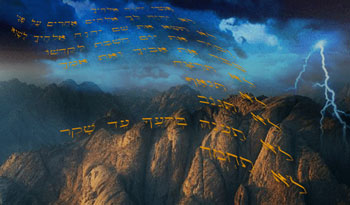
Torah at SinaiWhere is the Torah?

-Shabbos 89a

It seems incredulous that Satan was unaware that Moshe had received the Torah and had taken it down to earth. Tosafos answers that at that moment, Hashem caused the Satan to become confused and confounded in order to avoid the risk of having Satan interfere with the giving of the Torah.

Maharsha notes that the Gemara had earlier reported that when Moshe came to the heavens, all the celestial angels presented Moshe with various gifts, and among those who gave Moshe a tribute was Satan himself. (This interpretation is based upon the fact that Satan and the Angel of Death are one and the same. It was the Angel of Death that divulged the secret of the incense to Moshe, and that it had the power to interrupt a raging plague.) Satan, we see, clearly was aware of the events surrounding Moshe’s mission and that his coming to the heavens was specifically in order to receive the Torah and to bring it back for the Jewish people. Why, then, asks Maharsha, was Satan surprised when Moshe took the Torah back to earth?

Daf Yomi Digest
Gemara Gem
“To where did the Torah go?”
Commentary on Shabbos 89a

This is midrash and as such, it’s not a good idea to try to take it literally, but perhaps there is something we can learn here. If we indeed have an Adversary who seeks to divert us from a life of holiness and an awareness of God and if this Adversary has the ability to succeed in his task, then how is a life of holiness possible at all?

Maharsha responds that…

Satan realized that the Torah was going to be given to Moshe. However, due to its extreme holiness and spiritual nature, Satan was certain that this was valid only as long as Moshe remained in the heavens. It did not seem possible that the Torah had any purpose in being taken to earth, to be shared with men who are made up of physical elements. When Moshe took the Torah to the Jews, Satan was shocked, and he asked, “What happened to the Torah? How could it be fitting for man to have?”

The truth is, though, that the purpose of Torah is indeed for man to have.

There are certain voices in Judaism who believe the Torah is far more than a document; a scroll with words that communicate information. They see the Torah as having a life of its own, it is wisdom and it is also part of God and thus it is the embodiment of God. Interestingly enough, Christianity’s perception of “the Word” is not far from this.

In the beginning was the word, and the word was with God, and the word was God. He was in the beginning with God. Everything was made to exist through him, and nothing that was made to exist was made to exist except by him.

–John 1:1-3 (DHE Gospels)

But of course, there’s more.

The word was made flesh and dwelled in our midst. We have beheld his glory, like the glory of a father’s only son, great in kindness and truth.

–John 1:14 (DHE Gospels)

The Bible exists between two “bookends,” between two instances wherein we see God dwelling among His people. In Genesis, we see that He walked in the Garden with man and in Revelation, we see God once more among those who love Him. And in between, the Torah was brought to earth by an emissary of God and given to men, both as the Torah from Sinai and the Word made flesh in Israel.

While midrash may ponder how the Adversary could allow the Torah to be brought down from Heaven to become accessible to man, the Bible tells us that he challenged such an action in the days of the second temple.

Then the spirit carried Yeshua into the wilderness so that the satan could test him.

–Matthew 4:1 (DHE Gospels .. see Matthew 4:1-11 for more)

everlastingBut testing isn’t the same thing as stopping or preventing or defeating. As the midrash says…

The goal of the Torah is that it be studied and applied by man, in order for him to incorporate it into his unique blend of being made up of both physical and spiritual aspects.

And as told to us by John…

And from his fullness we all have received kindness upon kindness. For the Torah was given by Mosheh and the kindness and truth came through Yeshua the Mashiach. No one has ever seen God; the only son who is in the Father’s lap has made him known.

–John 1:16-18 (DHE Gospels)

God has always desired to dwell among His special creation; among humanity. He has done so before, however briefly, and He will do so again in eternity. He has sent His messengers and His emissaries to us to give us gifts of Himself, the Torah of Moses and the Mashiach, the Christ. The means to know God and to be with God are within our grasp. As the sages say, the Torah is not in Heaven. As the Apostles of the Messiah say, the Spirit of God is with us in our hearts.

Blessings to you and all who are yours, and blessed be God who so loved the whole world that he gave us His only son.

Amen.

Day Zero

divide-by-zeroThat fall, Pastor S. from a church in another county came to our church to share in a morning service how they felt led to the mission field and were going to go to another country. S. shared his testimony followed by his wife L. L’s testimony paralleled my life closely, baptized at an early age, regular in church and youth activities but still felt empty. However in her early 20s she realized that she had not admitted that she personally was a sinner and that Christ’s death was for her. At that moment, God opened my eyes and I realized why I had been feeling guilty as my own pastor was preaching. I know the facts about Christ, his birth, life and death but had never applied them personally to myself. I had never admitted I personally was a sinner destined to hell without the shed blood of Jesus and had not believed in the reason for his death on the cross. My sin.

-Testimony found in last Sunday’s church bulletin.

There’s more to the writer’s testimony but I decided to quote just the portion specific to this blog post and of course, I took out any information that might identify the parties involved. This is Day Zero, the last few hours of the last day. At midnight tonight, time runs out in my countdown.

Yesterday, I went to church. It was interesting.

I walked in the side door and immediately ran into Pastor Randy. He smiled and greeted me. In a very friendly way, he asked where I’d been the last couple of weeks (he wouldn’t be the only one). He also surprised me. The day I met him and we had our rather lengthy chat in his office, I had volunteered to do some work for the church that is within my skill set. He hadn’t brought it up again, but yesterday, he said he talked with the deacons and they’d like me to proceed. He’ll email me later this week to set up a meeting and tell me what he has in mind. I’ll keep the nature of the work to myself for now, but in the moment that Pastor brought it up, I knew I was committed to the church. Actually, I knew that before I walked in the door that morning.

I also saw Charlie, who teaches my Sunday school class. He said he’d been thinking about me and wondering where I was. I saw Dick and Virgil and a number of other people whose names I still can’t remember (I’m getting better at it, though). People were friendly, but the friendliness was a different quality. I can’t explain it in so many words, but I felt more welcome somehow. As my wife says, maybe what’s different was my attitude.

Church was still church. There was a brief DVD presentation made by missionaries in the Congo. They baptized 18 people in the first month they were there. They make bricks for their worship structure out of clay that has to be dried in the sun. After the first Sunday service, a storm blew the thatch roof off of the structure and they had a “church work day” to put it back up. Services are spoken in French and then translated into one of the indigenous languages. It’s a different world, and yet, we’re all human beings on a journey to encounter God in our lives.

Pastor spoke on Acts 8:9-25. I’d recently covered the same material in D. Thomas Lancaster’s Torah Club Vol. 6, Chronicles of the Apostles, and Pastor Randy’s treatment of Philip’s encounter with Simon in Samaria seemed very different from Torah Club. The immediate impression I got was that the church was trying a little too hard to apply a modern Christian sense of evangelism to people and events that are 2000 years distant. Ancient Judaism likely didn’t concern itself with how converting someone of Simon Magus’s statue would be a big accomplishment.

But he said something else that made more sense.

Even Simon himself believed, and after being baptized he continued with Philip. And seeing signs and great miracles performed, he was amazed…Then they laid their hands on them and they received the Holy Spirit. Now when Simon saw that the Spirit was given through the laying on of the apostles’ hands, he offered them money, saying, “Give me this power also, so that anyone on whom I lay my hands may receive the Holy Spirit.” But Peter said to him, “May your silver perish with you, because you thought you could obtain the gift of God with money! You have neither part nor lot in this matter, for your heart is not right before God.

–Acts 8:14, 17-21 (ESV)

simon-the-magicianWhen Simon first hears the Good News from Philip, it seems like he too comes to faith in the Jewish Messiah King and is willing to reconcile his life to the will of the God of Israel. In other words, it seems like he has converted to Christianity. But his subsequent response to seeing the giving of the Holy Spirit indicates that he completely misunderstands what he is observing and what his faith in God is supposed to really mean. Pastor Randy says there is a faith that doesn’t save. And he said more than that.

He ran off a litany of verses from the New Testament, all “convicting Christians of their sin.” Verses such as 2 Cor. 13:5, Gal. 5:19-21, Eph 5:5-6, 1 Jn 3:6-10. Here’s another one.

For this very reason, make every effort to supplement your faith with virtue, and virtue with knowledge, and knowledge with self-control, and self-control with steadfastness, and steadfastness with godliness, and godliness with brotherly affection, and brotherly affection with love. For if these qualities are yours and are increasing, they keep you from being ineffective or unfruitful in the knowledge of our Lord Jesus Christ. For whoever lacks these qualities is so nearsighted that he is blind, having forgotten that he was cleansed from his former sins. Therefore, brothers, be all the more diligent to confirm your calling and election, for if you practice these qualities you will never fall. For in this way there will be richly provided for you an entrance into the eternal kingdom of our Lord and Savior Jesus Christ.

–2 Peter 1:5-11 (ESV)

One of the objections I hear about “going to church” from believers who are not church-goers is that the church gives a whitewashed, “feel good” message, that doesn’t communicate the reality of the Bible, sin, and salvation. That may be true in other churches but it wasn’t in the one I attended last Sunday. It was anything but “whitewashed, feel-good.” The quote I opened this “meditation” with is part of that message. The message is that just because you believe, you may not have a terrifically realistic grip on the consequences of your belief. If you call yourself a Christian or a believer, but still can violate the Word of God with no feelings of guilt, anguish, or remorse, what you have may not even be what is called “faith.” Believing isn’t enough.

You believe that God is one; you do well. Even the demons believe—and shudder!

–James 2:19 (ESV)

“Not everyone who says to me, ‘Lord, Lord,’ will enter the kingdom of heaven, but the one who does the will of my Father who is in heaven. On that day many will say to me, ‘Lord, Lord, did we not prophesy in your name, and cast out demons in your name, and do many mighty works in your name?’ And then will I declare to them, ‘I never knew you; depart from me, you workers of lawlessness.’

–Matthew 7:21-23 (ESV)

Think about the author of the text I quoted from at the top of this blog post. If he hadn’t experienced God’s message about his life, at the end of all things, he might have been one who the Master declared that “I never knew you…depart from me!” How horrible that a person might live that long and believe they are truly in the service of God through Jesus Christ only to be told to their face that they have been woefully mistaken about what faith means. Even performing great signs and wonders isn’t meaningful. Simon in Samaria was a magician who was called “great,” and yet his magic meant nothing to God.

hourglassIn the days of the Torah the great magician Balaam was commissioned by Balak, a King, to curse the Children of Israel. Balaam spoke with God and an angel of the Lord appeared to Balaam, but he was no servant of the God of Israel (see Torah Portion Balak). Yes, what you do matters (James 2:14-24), but behavior, purpose, and intent all go hand in hand. Everyone has times of doubt when we wonder if God will ever come near, including me, but there comes a time that we can’t simply wait on God to tell us what we need to know, we must pursue God with all of our strength, our will, and our resources. If He is our goal, then we have only one avenue to reach it; Jesus Christ and a true and saving faith in the promises of the Messiah.

There’s much more to do once faith is affirmed or reaffirmed, but sometimes you need to touch home plate to make sure your foundation is solid. It’s like I went to church and God asked me, “Do you know what you’re doing here?” “Do you know what you want?” “Are you sure you want this?” The answer is either “yes” or “no.”

My time is up. The clock is running to zero. Before the last hours, minutes, and seconds ticked down and the hourglass emptied, I said, “yes.”

If Water Can Wear Down A Stone

prayer-hitbodedutSet aside time each day to meditate and pray alone in a room or some meadow and express your innermost thoughts and feelings and personal prayers to God. Use every kind of appeal and argument. Use words that will endear you to God and win His favor. Plead with God to draw you closer and let you truly serve Him. This is Hitbodedut.

You should hold these conversations in whatever language you speak best. Our set prayers are said in Hebrew, but if this is not one’s native language, it is difficult to use it to give expression to all one’s innermost thoughts and feelings and the heart is less drawn after the words. It is easier to pour out your heart and say everything you need in your own language.

You should tell God everything you feel, be it contrition and longing to repent over the past or requests and supplications to come truly close to God from now on, each person according to his level.

Be very careful to get into the habit of spending time every day on your personal prayers and meditation. Fix a regular time for this and then be happy for the rest of the day!

-Rebbe Nachman of Breslov
Translated by Rabbi Avraham Greenbaum
azamra.org

Sunday before last, I was having my bi-monthly coffee encounter with my friend. We spoke of many things, including matters both painful and necessary to me, but one of the topics we briefly touched upon was hitbodeut. I should say that neither of us could remember the name, but this is what we were describing when discussing an encounter with God. To briefly quote from Wikipedia:

Hitbodedut refers to an unstructured, spontaneous and individualized form of prayer and meditation taught by Rebbe Nachman of Breslov. Through hitbodedut one may establish a close, personal relationship with God and gain a clearer understanding of one’s personal motives and aspirations. However, Rebbe Nachman states that the ultimate goal is to free oneself of all negative traits that obstruct the spiritually-transforming non-dual realization of the “Imperative Existent,” which is the Divinity inherent in all being.

Mystic aspects aside, why am I bothering to write about this? Those of you reading my blog who are aware of hitbodedut, probably know far more about the practice than I do, and those of you who don’t can simply reduce the concept down to a way to be alone and talk to God. What’s the big deal?

First off, I have been aware of hitbodedut off and on for a few years but mentally, I always manage to lose track of both the term and the practice. This is a sort of “bookmark” in my memory so if I lose my place again, I can just search my blog and find it. Beyond a reminder, there is also what we know about how Jesus prayed:

At about morning light he left and went to a desolate place.

–Luke 4:42 (DHE Gospels)

But he departed to the wilderness areas and prayed.

–Luke 5:16 (DHE Gospels)

As he was praying alone, his disciples were gathered to him.

–Luke 9:18 (DHE Gospels)

Although we can’t draw a direct connection between these examples of Jesus praying from Luke and Rebbe Nachman of Breslov, we can say that both of them seemed to practice a similar manner of prayer, withdrawing to wilderness areas or other places to be alone in order to pray. Even in his most desperate hour, Jesus continued to seek his Father alone.

Afterward, Yeshua came with them to a courtyard that was called Gat Shamnei. He said to the disciples, “You remain here until I have gone over there and prayed.” He took Petros and the two sons of Zavdai with him, and he began to become distressed and disheartened. He said to them, “My soul is bitterly troubled to the point of death. Stay here and keep watch with me.” Then he went a little bit away from them, fell on his face and prayed, saying “My Father, if it is possible to be so, let this cup pass from me, yet not according to my will, but according to your will.”

–Matthew 26:36-39 (DHE Gospels)

I’ve often wondered if Jesus wanted to be alone, why he also took his closest companions with him. Maybe he wanted them to keep watch in case anyone might come who would disturb his prayers. Maybe he wanted them to pray for him in his hour of terror and hardship, before the betrayer came. What is he trying to say to us? Is it better to be alone with God than to pray in assembly?

But as for you, when you pray, go into your room, close your door behind you, and pray to your Father who is in secret, and your Father who sees the secret things will {openly} be generous to you.

–Matthew 6:6 (DHE Gospels)

Being alone with God can be a lonely or terrifying experience. It can be lonely if all you experience is the emptiness of your own words. It can be terrifying if God answers you.

Really? How can I say that? Sure, we all have experienced times in prayer when it seems as if God isn’t listening, as if He has taken a two-week vacation to some distant place, leaving us to fend for ourselves, but why would God answering prayer be terrifying?

Because it’s God. He’s not a “cosmic teddy bear” who allows us to hop on His comfortable lap as if He was Santa Claus. We are trying to be seriously alone with the creator of the entire universe, who can and has laid waste to the surface of the Earth. Do we…do I know what I’m asking for?

And how can Nachman of Breslov say, “and then be happy for the rest of the day?”

Hitbodedut is of the greatest value. It is the way to come closer to God, because it includes everything else. No matter what you lack in your service of God, even if you feel totally remote from His service, tell God everything and ask Him for all that you need.

If at times you find yourself unable to speak to God or even open your mouth, the very fact that you are there before Him wanting and yearning to speak is itself very good. You can even turn your very inability to speak into a prayer. Tell God that you feel so far away that you cannot even speak to Him! Ask Him to have mercy on you and open your mouth to tell Him what you need.

Many great and famous Tzaddikim have said that all their achievements came only through Hitbodedut. Anyone with understanding can recognize the supreme value of this practice, which ascends to the most sublime heights. This advice applies to everyone equally, from the very least to the very greatest. Everyone is capable of practicing it and can attain great levels. Happy are all who persist in it.

It is also good to turn Torah teachings into prayers. When you study or hear a teaching of a true Tzaddik, make a prayer out of it. Ask God when you too will be able to fulfill this teaching. Tell Him how far from it you are and beg Him to help you attain everything contained in the lesson.

A person of understanding who wants the truth will be led by God in the path of truth, and he will learn how to practice Hitbodedut and offer words of grace and sound arguments to persuade God to bring him to true service.

Hitbodedut rises to a very high place. This applies especially to turning Torah teachings into prayers, which creates the greatest delight above.

Hitbodedut is the highest level: it is greater than everything.

When God helps with Hitbodedut, it is like a person talking to his friend.
prayers_in_the_darkI get the sense that the “talking to his friend” part is more familiar to some Christians than to many religious Jews. I could be wrong of course, but when I pray from a siddur, the words communicate a more formal relationship with God, a greater awe, the powerful majesty, as we stand before the King of all Glory. Not exactly like schmoozing with a good buddy.

But then again, that’s not exactly right, either. God is closer, more intimate than a friend. As the Master says, He is our Father, our “Abba.”

It is very good to pour out your heart to God like a child pleading with his father.

Doesn’t God call us His children? “You are children to the Lord your God” (Deuteronomy 14:1) . Therefore it is good to express your thoughts and feelings and all your troubles to God, like a child nagging and complaining to his father.

Even if you think you have done so much wrong that you are no longer one of God’s children, remember that God still calls you His child. As the Rabbis taught: “For better or worse, you are always called His children” ( Kiddushin 36a) .

Even if you think God has rejected you and told you that you are no longer His child, you must still say: “Let Him do His will – but I must do my part and continue acting as His child.”

How good it is when you can arouse your heart and plead with God until tears stream from your eyes and you stand like a little child crying before his Father.

Confusing thoughts may enter your mind, but if you stand firm, God will send you another thought to encourage you. You may think you are no longer one of God’s children. But if you do your part, God will eventually send you thoughts of encouragement.

Jesus encouraged his disciples to pray to their Father who is in Heaven. These were his Jewish disciples but by extension (and since we have no other model from the time of Jesus), we may apply the teachings of the Master about prayer to we non-Jewish disciples as well. What choice do we have?

I know Nachman of Breslev is addressing Jews in his teachings, but he does say, “From the smallest to the greatest, it is impossible to be a truly good person without Hitbodedut,” implying that one’s station in life or relative level of spirituality is beside the point. No matter who you are, unless you pray Hitbodedut, that is, pray totally from the heart, you are missing something.

Can we small, finite creatures be intimate with an infinite and Holy God?

Christianity seems to think so and sometimes I think some folks are a little too intimate. I’ve never been one of those who thinks that I can simply sit down at my kitchen table and share a casual cup of coffee with Jesus. He’s a King, not my next door neighbor. Not even his own disciples treated him so commonly.

But I’ve got to “reboot” my journey by starting somewhere. I’ve got to attempt to rise to a higher level. Even if I get it wrong, it’s better to stub my toe while walking the path than to stand frozen in one spot out of appearing foolish or a fear of failure.

During your Hitbodedut, it is good to say: “Today I am starting to attach myself to You!”

Make a new start each time, because everything that comes later is always in accordance with the beginning.

No matter what happens, it is always good to make a new start each time and say, “Today I am beginning…” If things were already good, now they will be even better! And if they were not good before, then you certainly need to start anew.

You’re probably familiar with the phrase, “today is the first day of the rest of your life,” generally attributed to Charles (“Chuck”) Dederich, and that seems to be part of what the Rebbe is saying too. Each day is a new beginning. Every moment is a fresh opportunity. The Master said, the spirit desires but the flesh is weak” (Matthew 26:41). We want to draw nearer to God, but there are so many things we let get in the way. After a while, we start to feel as if there are too many barriers and we stop trying.

But while we live there are always opportunities. Pushing the walls aside is as easy as finding some place to be alone and then starting to talk to God. Our first words can always be, “Today I am starting to attach myself to You!” Even if nothing seems to “happen” first, be patient.

Even if many days and years pass and it seems as if you have accomplished nothing with your prayers and conversations with God, don’t give up! Every single word makes an impression.

“Water wears away stone” (Job 14: 19 ) . It may seem that water dripping on hard stone could not make any impression, yet when water drips on stone continuously for many years, it can literally wear a hole in the stone. We actually see this.

Even if your heart is like stone and it seems that your words of prayer are making no impression at all, still, as the days and years pass, your heart of stone will also be softened. For: “Water wears away stone”.

rabbi-akiva-stone-waterThere is a story told about the great Rabbi Akiva that applies to us and particularly (I hope) to me.

Rabbi Akiva was a shepherd, a laborer, an am ha’aretz – religious in observance, but ignorant of Torah knowledge. At age 40, he didn’t even know how to read the aleph-beis.

One day, while sitting by a brook, Akiva noticed a steady trickle of water hitting a rock. It was only a drip, but it was constant – drop after drop after drop. Akiva observed something incredible: A hole had been carved out by that steady drip of water. He wondered how that could be. He concluded: If something as soft as water can carve a hole in solid rock, how much more so can words of Torah – which is hard as iron – make an indelible impression on my heart.

That marked a turning point in Rabbi Akiva’s life. He committed himself to Torah study, and went on to become the greatest sage of his generation, with 24,000 students learning under him at one time.

-from “Like Water on Rock”
Aish.com

It is said of Rabbi Akiva: If water can wear down a stone, then every Jew can and will study Torah…If water can wear down a stone, the Jewish people can overcome Rome…If water can wear down stone, then the Temple can be rebuilt…

If water can wear down a stone, then I can encounter God in prayer.

And so can you.

A Line as the Unending Horizon

horizon-at-nightWe live as exiles. We’re called to be pilgrims.

As he sent Adam and Eve into exile, God promised redemption and offered protection. But toil, pain, relational struggle, sin and death went with them as well, marking them and their descendants as refugees from Eden. Consider the ways in which your everyday life is not at all like the perfect paradise of that Garden. Take a few moments to list the markers of your existence as an exile by naming the broken things in your world, the brokenness in you.

The sorrow or anger that you may have felt as you named those broken things? The sinking recognition that things aren’t the way they’re supposed to be?

Those are marks of the exile experience, but they also contain a clue, a compass of sorts. Deep in our DNA, beyond rational thought or extravagant imagination, is a longing for home. Adam and Eve had it or it wouldn’t have taken sword and cherubim to protect Eden. We have it, too. This longing contains our invitation into the new identity and life direction God longs to give to his beloved exiles. This longing is designed to transform us into pilgrims.

Which word resonates with your life experience more: exile or pilgrim? Why do you say so?

-Michelle Van Loon
“Pilgrim’s Road Trip #1”
MichelleVanLoon.com

Since becoming aware of the reality of God, my existence has been one of searching, traveling on a journey, walking along a path, striving toward a destination…God doesn’t promise that we’ll always be well or even safe, just that regardless of what happens to us, he will be with us, as he was with Jacob when Jacob and his family descended into Egypt. Sometimes we’re slaves. And we wait until God lifts us up again. Even if he doesn’t, blessed be the name of the Lord. I’m still walking as a pilgrim on the trail.

–my (edited) response

I’ve admitted before feeling abandoned by God, an exile in the desert, but I suppose in reality, I was the one pushing God away and not the opposite. Frankly, encountering God is scary and there have been long periods of time when I thought I’d rather not hear from Him. Ultimately though, once a person has become aware of God’s presence, avoiding such encounters is impossible. God has ways to get our…my attention and He calls us…me out of exile and into relationship.

O God before Whom my forefathers Abraham and Isaac walked – God Who shepherds me from my inception until this day…

–Genesis 48:15 (Stone Edition Chumash)

Although Jacob suffered greatly over his lifetime, and before Pharaoh, King of Egypt, Jacob said of his life that “few and bad have been the days of the years of my life,” (Genesis 47:9) yet he calls God his “shepherd” who has guided the steps of Jacob “from my inception until this day.”

We Christians have a shepherd, the same shepherd actually, though we access God through the “good shepherd” who once walked among men and who will walk among us again.

I am the good shepherd, and I know what is mine, and I am known to those who are mine, just as the Father knows me and I know the Father and I give my life for the flock. I have other flocks that are not from this sheepfold, and I must lead them as well. They will hear my voice, and there will be one herd and one shepherd.

–John 10:14-16 (DHE Gospels)

While Jesus admittedly came for the “lost sheep of Israel,” (Matthew 15:24), the “good shepherd” verses are widely believed to express his desire to also bring in the people from the nations, that is non-Jews, into his “flock,” though this wouldn’t begin to occur until some years after his death, resurrection, and ascension. While Israel has many covenants with God that establish their relationship with Him, it is only through Israel’s first-born son, the Moshiach, the “Notzri,” Jesus that we who are from outside Israel have been brought near to Israel and to God.

I don’t mean to imply that there are two roads to salvation, one for the Jewish pilgrim and one for the Gentile, and in fact, as he was dying, Jacob explained everything to his sons about the centrality of Messiah, and because of the Torah, we hear his voice, too.

The scepter shall not depart from Judah nor a scholar from among his descendants until Shiloh arrives and his will be an assemblage of nations.

–Genesis 49:10 (Stone Edition Chumash)

Perhaps a slightly different translation will be more illuminating.

The scepter shall not depart from Judah, nor the lawgiver from his descendants, until the Moshiach comes . . .

king-davidThese words are widely believed in Judaism to be the primary source indicating that the Messiah will come to restore justice and that even the nations will pay homage to him with gifts. As the midrash states:

…the word Shiloh is a composite of the words “a gift to him” (in Hebrew), a reference to the King Messiah, to whom all nations will bring gifts. This verse is the primary Torah source for the belief that the Messiah will come, and the rabbis always referred to it in the Middle Ages…

…the sense of the verse is that once Messiah begins to reign, Judah’s blessing of kingship will become fully realized and go to an even higher plateau (Sh’lah). At that time, all the nations will assemble to acknowledge his greatness and pay homage to him.

This is quite similar to how Christians believe that Jesus will return and establish his Sovereign rule over all the earth. Remarkable how none of this paints a portrait of the faithful in exile but rather a people who are following a King.

They led the boat to the land, and they left everything and followed him.

–Luke 5:11 (DHE Gospels)

Our existence is one of searching, traveling on a journey, walking along a path, striving toward a destination. Although most of us don’t literally leave everything behind, home, family, job, to follow him, when we commit our lives to pursuing holiness by walking in the footsteps our Master left in the dust, who we are and how we live are never the same again. Our every sin is illuminated by a stark, white light, our imperfections are covered in dripping scarlet, we are always aware of our faults and our shortcomings, and maybe it is out of that awareness we sometimes feel exiled from God’s presence, for how can the pure and the impure co-exist?

But through repentance, we are offered a way out of the darkness, through teshuvah we are once more made clean. God offers us a path that we may journey from the mundane to the magnificent. Each day we have the opportunity to travel with a companion. He is only far off when we push him away, and he draws near the instant we call with sincerity.

…but there is a friend who sticks closer than a brother.

–Proverbs 18:24 (ESV)

…the LORD is near to all who call upon Him; to all who call upon Him with sincerity.

–Psalm 145:18 (from the siddur; weekday morning and afternoon prayers)

Although many times when we desire God the most, we don’t get a sense of His presence. But putting the limitations of our perceptions aside, God is as near to us or as far from us as we want Him to be. If what we want most in our lives is God, He is there. If we have other more pressing priorities, God will stand aside. If we are in exile, it is one of our own making. God has already made the path for us to be with Him. All we have to do is decide to walk on it.

Early in the Morning – Late in Life

Running out of timeMoshe ascended early in the morning and descended early in the morning.

-Shabbos 86a

Rabbi Menachem Bentzion Sacks used to expound upon this theme. The climb to God, the spiritual drive to perfection, must begin early in one’s life. In reference to Moshe’s receiving the second tablets (34:2), the Torah similarly emphasizes: “Be ready in the morning, and go up in the morning to Mount Sinai, and be placed there before Me at the top of the mountain.” Within these words is contained a message for all generations. Namely, one must prepare in the “early morning” of one’s life and begin an ascent in order to stand before Hashem when one reaches the peak of one’s maturity.

Our sages have praised those who partake of a hearty morning meal. We are told (Bava Kama 92b): “I will remove illness from amongst you.” (Shemos 23:25). This refers to the removal of eighty-three maladies associated with the disease called “marah”. Also among the benefits gained by eating a morning meal is that one is granted the ability to study Torah and to teach.

Finally, “Sixty men may pursue one who has early meals in the morning, but they will not overtake him.” All of these advantages can be applied as well to one who partakes of spiritual food. “Torah is compared to water, as in Yeshayahu 55:1.” – Bava Kama 17. The more a young person is nourished early in the morning by studying in the dawn of his life, the stronger and more solid are the fibers of his spiritual foundation. By means of this reinforced and vitalized internal charge, our youth can merit to study Torah, to teach Torah, and to have the knowledge of Torah permeate their beings. Shlomo HaMelech has written (Mishlei 22:6): “Educate a child in the way he should go, and when he is old he will not depart from it.” This system serves to immunize children from illnesses of the soul which otherwise infect them with ‫ .מרה‬Only when our youth are equipped with Torah ideals can they withstand the difficult and corrupting challenges which the world will present to them later.

Daf Yomi Digest
Gemara Gem
“Early in the Morning – Early in Life”
Commentary on Shabbos 86a

Fortunate are we that our youth has not caused us embarrassment in later life.

-Succah 53a

Many people gain wisdom in their later years. When they look back on their youth, they regret having squandered so much time. Some people’s “golden years” are unfortunately marred with regret over the time they lost.

Young people can learn from their elders. People who reflect on the past during their last days often say, “My greatest regret is that I did not spend more time with my family.” Has anyone ever said, “My greatest regret is that I did not spend more time at the office”?

While experience teaches most efficiently, some things are simply too costly to be learned by experience, because the opportunity to apply these lessons may never arise. Our learning too late that we have spent time foolishly is a prime example.

Ask your father and he will tell you; your elders and they will say it to you (Deuteronomy 32:7). In his last words, Moses gives us this most important teaching: “Why learn the hard way when you can benefit from the experience of others who have been there?” We should regularly ask: “How pleased will I be in the future about what I am doing now?”

Today I shall…

try to examine my actions with the consideration of how I will look back at them in the future.

-Rabbi Abraham J. Twerski
“Growing Each Day, Tevet 15”
Aish.com

None of the above is at all comforting to those of us who came to faith later in life. Worse, since my initial coming to faith was not within a Jewish context and there were a lot of “mixed messages” between Christianity and Judaism traveling in my household when my children were young, I was unable to communicate a distinct Jewish “intent” for my children who now, as young adults, operate only marginally within the Jewish lifestyle and not at all within one of religious observance and faith.

interfaithMore’s the pity and certainly as the Father, it is my fault.

Not that my children blame me, I suppose, but given the dangers we hear about intermarriage and assimilation as delivered by the Jewish community and by Jewish history, I feel the weight of responsibility rests upon my shoulders.

Patrick Stewart (in the role of Captain Jean-Luc Picard on Star Trek: The Next Generation) once delivered the line…

Remembrance and regrets, they, too, are a part of friendship…And understanding that has brought you a step closer to understanding humanity.

Being human and given my particular background, I may understand humanity, but I am no less vulnerable to human foibles and failures as the next man. I suppose, from the Jewish point of view, at least if I use the above quoted commentaries as my guide, I’ve arrived at the party far too late and wearing the wrong suit for the occasion. Only the Master suggests that it may be otherwise.

“For the kingdom of heaven is like a master of a house who went out early in the morning to hire laborers for his vineyard. After agreeing with the laborers for a denarius a day, he sent them into his vineyard. And going out about the third hour he saw others standing idle in the marketplace, and to them he said, ‘You go into the vineyard too, and whatever is right I will give you.’ So they went. Going out again about the sixth hour and the ninth hour, he did the same. And about the eleventh hour he went out and found others standing. And he said to them, ‘Why do you stand here idle all day?’ They said to him, ‘Because no one has hired us.’ He said to them, ‘You go into the vineyard too.’ And when evening came, the owner of the vineyard said to his foreman, ‘Call the laborers and pay them their wages, beginning with the last, up to the first.’ And when those hired about the eleventh hour came, each of them received a denarius. Now when those hired first came, they thought they would receive more, but each of them also received a denarius. And on receiving it they grumbled at the master of the house, saying, ‘These last worked only one hour, and you have made them equal to us who have borne the burden of the day and the scorching heat.’ But he replied to one of them, ‘Friend, I am doing you no wrong. Did you not agree with me for a denarius? Take what belongs to you and go. I choose to give to this last worker as I give to you. Am I not allowed to do what I choose with what belongs to me? Or do you begrudge my generosity?’ So the last will be first, and the first last.”

–Matthew 20:1-16 (ESV)

That helps me but it doesn’t help my family, particularly my children who, as young adults, are now responsible for making their own decisions without any sort of “parental influence” from me, at least the unwanted kind.

But if I didn’t arrive early enough, perhaps it’s still not too late.

Hearken and hear Israel, (Devarim 27:9) this is the time marked for the redemption by Mashiach. The sufferings befalling us are the birth-pangs of Mashiach. Israel will be redeemed only through teshuva. (Jerusalem Talmud, Taanit I:1) Have no faith in the false prophets who assure you of glories and salvation after the War. Remember the word of G-d, “Cursed is the man who puts his trust in man, who places his reliance for help in mortals, and turns his heart from G-d” (Yirmiyahu 17:5). Return Israel unto the Eternal your G-d; (Hoshei’a 14:2) prepare yourself and your family to go forth and receive Mashiach, whose coming is imminent.

“Today’s Day”
Wednesday, Tevet 15, 5703
Compiled by the Lubavitcher Rebbe
Translated by Yitschak Meir Kagan
Chabad.org

early_morning_skyI wish I could prepare my family to go forth and receive Mashiach, but the best I’m able to do at the moment is attempt to prepare myself. On the other hand, my wife recently confided in me that she feels I blog more about my feelings of going back to church than I ever discuss with her. I was rather shocked at hearing this, since I had no idea she had any interest in my church activities at all. Maybe what I do to prepare myself to go forth and receive Mashiach is more noticeable than I thought.

On the one hand, God and faith seem to be happening too late to do much good in my life and in the lives of those I love the most. On the other hand, Rabbi Tzvi Freeman had this to say about the Rebbe’s lessons, which may also apply to me.

There is a recurring theme in the volumes of stories told of the Rebbe: The tale of the man who was in the right place at the right time.

There are the stories of someone embarking on a trip to some distant place, and the Rebbe gave him a book to take along, or asked him to do a certain thing there, or to meet a certain person. Or the Rebbe simply asked someone to go to a place, with little direction of what to do there.

And then, in these stories, it always works out that just at the right time the right person turns up in the right place and all the story unfolds. It’s all a matter of making connections: Every soul has certain sparks of light scattered throughout the world that relate to it in particular. The Rebbe sees the soul and senses, like a geiger counter, the sparks that await this soul. All that was needed is to bring the two within a reasonable proximity and the rest takes care of itself.

The stories are meant as a teaching as well. The Rebbe was revealing to us the wonder of our own lives, that there is purpose latent in whatever you are doing.

To extend the metaphor and express it as a question, is God still writing my story with purpose and intent in what I am doing today? Is it still possible for my life to draw others to God?

“A wise man changes his mind, a fool never”

-Spanish Proverb

Vayechi: Being Strong Until the End

Lion of JudahThe scepter shall not depart from Judah, nor the lawgiver from his descendants, until the Moshiach comes . . .

–Genesis 49:10

Every soul possesses a spark of the soul of Moshiach

—Rabbi Israel Baal Shem Tov

After the passing of Rabbi DovBer of Mezeritch in 1772, Rabbi Menachem Mendel of Horodok led a group of chassidim to settle in the Holy Land.

One day, a somewhat deluded individual climbed the Mount of Olives in Jerusalem and sounded a shofar. Soon the rumor spread that Moshiach had arrived, setting off a great commotion in the street. Rabbi Mendel went to his window and sniffed the air. “No,” he said, “unfortunately, the redeemer has not yet arrived. On that day, ‘the world shall be filled with the knowledge of G‑d as the waters cover the sea,’ and ‘all flesh will perceive’ (Isaiah 11:9 and 40:5) the reality of the Creator. I do not sense the divine truth that will permeate the world in the era of Moshiach.”

Said the renowned mashpia, Rabbi Grunem Estherman: “Why did Rabbi Mendel need to go to the window to sniff for the presence of Moshiach? Because the all-pervading truth of G‑d was already a tangible reality within the walls of Rabbi Mendel’s room.”

-Rabbi Yanki Tauber
“Moshiach in the Air”
Chabad.org

I know this commentary seems rather fanciful and not particularly realistic (can you smell Moshiach in the air?), but as I read it, I was reminded of how in certain corners of Christianity, the topic of the end times and the second coming are very prominent, almost to the point of obsession. It’s as if we haven’t read the Gospels in our own Bibles.

Then if anyone says to you, ‘Look, here is the Christ!’ or ‘There he is!’ do not believe it. For false christs and false prophets will arise and perform great signs and wonders, so as to lead astray, if possible, even the elect. See, I have told you beforehand. So, if they say to you, ‘Look, he is in the wilderness,’ do not go out. If they say, ‘Look, he is in the inner rooms,’ do not believe it. For as the lightning comes from the east and shines as far as the west, so will be the coming of the Son of Man. Wherever the corpse is, there the vultures will gather.

–Matthew 24:23-28 (ESV)

Why are we so worried about the coming Messiah? He gave us great advice about what worry is all about.

But if God so clothes the grass of the field, which today is alive and tomorrow is thrown into the oven, will he not much more clothe you, O you of little faith? Therefore do not be anxious, saying, ‘What shall we eat?’ or ‘What shall we drink?’ or ‘What shall we wear?’ For the Gentiles seek after all these things, and your heavenly Father knows that you need them all. But seek first the kingdom of God and his righteousness, and all these things will be added to you.

“Therefore do not be anxious about tomorrow, for tomorrow will be anxious for itself. Sufficient for the day is its own trouble.

–Matthew 6:30-34 (ESV)

But as I said before, it’s very difficult for us to change our thinking and to rise up out of the darkness as a light. It is very difficult to let the world be the world, to just do our best, and to have faith and trust that everything will work out according to God.

And will not God give justice to his elect, who cry to him day and night? Will he delay long over them? I tell you, he will give justice to them speedily. Nevertheless, when the Son of Man comes, will he find faith on earth?”

–Luke 18:7-8 (ESV)

Who is Moshiach?Is waiting and rumor a test of faith? It’s been nearly 2,000 years since the ascension and we’ve been waiting ever since. Jews cry out “Moshiach now” but Moshiach has yet to come. Rabbi Mendel said that the world will be filled with the knowledge of God before the Messiah’s coming (return) but that’s just one of many different thoughts about what must happen beforehand. We can’t be that sure of our facts. In many ways, the Bible is a mystery containing clues we struggle all our lives to interpret.

This Shabbos is called Shabbos Chazak, “the Shabbos of reinforcement,” because of the custom of declaring, Chazak, Chazak, Vinischazaik (“Be strong, be strong, and may you be strengthened”) at the conclusion of the Torah reading, in acknowledgment of the completion of the Book of Genesis.

The awareness nurtured by the reading of Vayechi generates strength. When a Jew knows he has been granted a heritage of life expressed through a connection with the Torah, and that there will come a time when this connection will blossom, he will acquire the inner strength to confront the challenges presented by his environment.

By heightening the expression of this potential in our people as a whole, we hasten the coming of its fruition in the Era of the Redemption. May this take place in the immediate future.

-Rabbi Eliyahu Touger
“True Life”
Adapted from
Likkutei Sichos, Vol. X, p. 160ff; Vol. XV, p. 422ff;
Sichos Shabbos Parshas Vayechi, 5751
Commentary on Torah Portion Vayechi
Chabad.org

So Joseph and his father’s household remained in Egypt. Joseph lived one hundred and ten years. Joseph lived to see children of the third generation of Ephraim; the children of Machir son of Manasseh were likewise born upon Joseph’s knees. At length, Joseph said to his brothers, “I am about to die. God will surely take notice of you and bring you up from this land to the land that He promised on oath to Abraham, to Isaac, and to Jacob.” So Joseph made the sons of Israel swear, saying, “When God has taken notice of you, you shall carry up my bones from here.”

Joseph died at the age of one hundred and ten years; and he was embalmed and placed in a coffin in Egypt.

–Genesis 50:22-26 (JPS Tanakh)

chanukah-josephs-tombThe final verses of this Torah Portion and the book of Genesis find Jacob and Joseph dead and Jacob’s descendants continuing to live in Egypt. This sets the stage for the birth of Moses and the centuries of slavery of the Jewish people under a “new king who arose over Egypt and who did not know Joseph.” If Jacob understood prophesy, he must have known what was going to come after his death, just as Joseph did. True, he was reassured by God that He would go down into Egypt with Jacob and his family, and that God would bring Jacob’s descendants back out of Egypt (Genesis 46:4), and yet what a bitter thing to go to your grave knowing your children and your children’s children will suffer.

As Rabbi Touger states, at the end of this Torah portion, it is customary to declare “Chazak, Chazak, Vinischazaik (“Be strong, be strong, and may you be strengthened”).”

Where ever you are in your life and whatever your experiences are, however you anticipate your future, whether it be long or brief, you…we…all of us must be strong.

But that can be so very hard. Seek first the kingdom of God and His righteousness.

God be merciful, and may Moshiach come soon and in our days. Amen.

Good Shabbos.

"When you awake in the morning, learn something to inspire you and mediate upon it, then plunge forward full of light with which to illuminate the darkness." -Rabbi Tzvi Freeman