Pointing Light to Miracles

Without miracles, we might come to believe that the laws of physics define reality. Once we witness the inexplicable, we see that there is a higher reality. And then we look back at physics and say, “This too is a miracle.” The miracle of a small flask of oil burning for eight days was this sort of miracle.

Then there are those small miracles that occur every day. Those acts of synchronicity we call ‘coincidence’ because, in them, G-d prefers to remain anonymous. But when we open our eyes and hearts, we see there is truly no place void of this wondrous, unlimited G-d. These were the sort of miracles the Maccabees saw in their battles against the mighty Greek army.

-Rabbi Tzvi Freeman
“Chanukah Miracles”
Based on letters and talks of the Rebbe
Rabbi M. M. Schneerson
Chabad.org

God is not a scientific problem, and scientific methods are not capable of solving it. The reason why scientific methods are often thought to be capable of solving it is the success of their application in positive sciences. The fallacy involved in this analogy is that of treating God as if He were a phenomenon within the order of nature. The truth, however, is that the problem of God is not only related to phenomena within nature but to nature itself; not only to concepts within thinking but to thinking itself. It is a problem that refers to what surpasses nature, so what lies beyond all things and all concepts. (page 102)

The object of science is to explain the processes of nature. (page 104)

-Abraham Joshua Heschel
God in Search of Man: A Philosophy of Judaism
As quoted in Searching by Ineffable Light

Chanukah, or any time when we see or hear of God’s miracles, forces us to try and understand the nature and character of God’s activity in the world we experience. 21st century western thought is almost wholly focused on the observable, the measurable, the quantifiable. We are dazzled by the possibility of discovering the Higgs Boson particle and what it would mean about our understanding of the universe. We are hopeful that our latest probe to Mars will show us definitive proof that the red planet once harbored life. We are astounded that we might actually be able to detect other Earth-like planets in the galaxy.

We are so amazed with our own seeming “miracles” that there is hardly room left in our world for the miracles of God.

For me, the short definition of a miracle is an event that we can observe in our universe that defies the working laws of said-universe. It is an event that has its origins outside our four-dimensional realm but that intrudes in that realm to make itself known to us. In fact, the point of a miracle is to make God known to us.

Jesus performed many “signs and wonders”, not to dazzle the crowds like some traveling magician, but to show that he was from God. Miracles also sometimes result in directly helping others, such as curing illnesses and healing injuries (see Matthew 11:1-6 as an example). Miracles are one of the ways that God makes Himself known to us. But while they seemed plentiful in the Bible, they are all too rare (and too well “explained” by scientific means, supposedly) in the present age. Even those miracles of the past are subject to significant “armchair quarterbacking” these days, as far as what natural phenomena “could” have caused such supposed miracles. The modern world wants no part in the supernatural, probably because it takes away from the wonder of man (and no wonder so many people give Tim Tebow a hard time for making his faith public on national television in front of millions of sports fans).

Rabbi Abraham Joshua Heschel, who I quoted above, doesn’t believe that science has the right tools to examine the miracles of God let alone God Himself. This sounds like a cop out to secular people who want independent validation of the existence of God before believing. But while demanding evidence of the reality of the Divine, these secular folks are confident such validation will not be forthcoming, thus “proving” that they’re right.

But miracles aren’t about proof, they’re about faith.

Then some of the Pharisees and teachers of the law said to him, “Teacher, we want to see a sign from you.” He answered, “A wicked and adulterous generation asks for a sign! But none will be given it except the sign of the prophet Jonah. For as Jonah was three days and three nights in the belly of a huge fish, so the Son of Man will be three days and three nights in the heart of the earth. –Matthew 12:38-40

I mentioned in yesterday’s meditation that part of the purpose of lighting the menorah during Chanukah is to declare the miracles of God. This is an act of faith as well as tradition, since we were not there to witness the miracle. Given the cynicism most people bear for the wonders of God, it’s also a miracle that anyone comes to faith, since to do so goes against the majority of rational human beings and the “idol” of popular opinion.

Faith is a miracle. Publicly demonstrating faith is a miracle, too. It just doesn’t seem “supernatural”.

I periodically get notices from AskNoah.org which is an organization dedicated to the support of Gentile Noahides. I just got an email pointing me to an article about the proper way for a Noahide to light the menorah. Lest you think it’s unusual for Jews to encourage non-Jews to celebrate Chanukah, the advice comes with caveats.

If you are a Noahide who is observant of the 7 Noahide Commandments, you may be interested in lighting Hanukkah candles. If so, you can buy or make a menorah lamp for yourself (very easy), or you can usually obtain one from your local Chabad Center. If your intention is to publicize the Divine miracles of Hanukkah, and thereby educate and remind your family and others about the greatness of G-d, the candle lighting may be done in the correct manner according to the Jewish custom – but without saying the Jewish blessings when lighting the candles. (For non-Jews, those would be false statements said in G-d’s Name, G-d forbid, because they testify that the person lighting the candles is commanded to “kindle the lights of Hanukkah”, and that G-d did those miracles for “our fathers”.) There are alternative readings and Psalms that a Noahide can say when lighting Hanukkah candles, and we have posted some suggestions below.

Thus, it is proper for a non-Jew to light the Chanukah menorah if “your intention is to publicize the Divine miracles of Hanukkah, and thereby educate and remind your family and others about the greatness of G-d” but only if you do so “without saying the Jewish blessings when lighting the candles”. This may sound restrictive, especially to those Gentiles who consider themselves “Messianic” and “grafted in” to the root of Israel, but while there are Christian applications to Chanukah, we must not lose sight of the primarily Jewish applications.

I was reminded of this when reading various commentaries on Siman 672 that I receive from Mishna Berura Yomi. The laws and halachah relative to the Birkat Kohenim (Priestly Blessing) recited during a synagogue service are delineated in these particular commentaries. One of the obvious pieces of information presented is that this blessing should only be recited by a Kohen. Yet, I’ve heard this blessing (in English) recited by Pastors (non-Jews) at the end of church services, and I’ve heard this blessing said by Gentiles in “Messianic” worship. I’m embarrassed to admit that I’ve delivered this blessing myself many times in my previous congregation (since I’m not Jewish let alone a Kohen).

Miracles, faith, and worship are funny things. They all open certain doors but not the doors we think might be open. Lighting a menorah doesn’t make a Gentile person Jewish or the direct recipient of miracles or messages meant by God for Jews. Chanukah candle lighting also doesn’t open up the world of Jewish worship to Christians in the same way that this door is available to Jewish people. We must be cautious to make sure we are walking the right path.

On the other hand, there is a level where God’s presence and miracles are available to everyone. A Noahide, and I believe a Christian, may light the menorah if the purpose is to announce God’s miracles and their faith in God, particularly if their faith is not based on miracles. The blessing of the Birkat Kohenim in Hebrew is beautiful to hear and a tremendous reminder of God’s providence to the Children of Israel, even if you are not a Jew. Asher at the Lev Echad blog reminds us that even though we are all unique individuals and belong to unique and distinct people groups, we all have a common foundation.

This Mishnaic excerpt provides the quintessential response to anyone who claims that certain types of people are superior or inferior to others. Since all people descend from the same person, we are all related. There is no moral justification for dividing people based upon race or prominence or wealth. All of creation can be traced back to one God, and all of humanity can be traced back to one person. The very word for people in Hebrew is bnei adam (lit. children of Adam) – a subtle reminder that we all descend from one man, the first human ever created by God.

Perhaps God’s greatest miracle is the human race after all, not because we are so terrific and so accomplished (though He gave us the ability to perform terrific acts of accomplishment), but because we can learn to love each other, to recognize that unique as we are, we were created in a common image (Genesis 1:26), and out of that image, we can learn to love Him who has loved us first.

“Therefore was a single man created, to teach us that whoever takes a single life it is as though he destroyed an entire world, and whoever saves a single life it is as though he saved an entire world. It is also meant to foster peace between people, because no one can boast to his neighbor: ‘My ancestor was greater than your ancestor.'” –Mishnah, Sanhedrin 4:5

Though the intent of this Mishnaic quote, which I borrowed from Asher’s blog, is to reference Adam, the first man, in my personal faith, I choose to interpret it as illuminating another man who Christians call the “light of the world;” a man who has shown us that we can also be a light pointing to miracles.

Addendum: This doesn’t have anything to do with today’s “meditation”, but I happened across an interesting looking web resource called Halachipedia. It’s where “Halachah meets Wiki”. Enjoy.

Impossible Light

Shulchan Aruch rules that one should not kindle the Chanukah lights before shekiah; rather one should kindle the lights at the end of shekiah. Mishnah Berurah explains that when Shulchan Aruch refers to the end of shekiah he refers to tzeis hakochavim – the emergence of stars. That is the time that people are in the streets and thus the miracle will be publicized.

He then notes that according to many Rishonim the intent of the Gemara is that one should kindle the lights at the beginning of the second shekiah which is about a quarter of an hour before tzeis hakochavim. Poskim write that if one kindles the lights within half an hour of sunset (shekiah according to Gaonim) and they remain lit until half an hour after tzeis hakochavim one fulfills both opinions.

Mishna Berura Yomi Digest
Halacha Highlight
“Lighting after plag hamincha”
Siman 672 Seif 1

That the spark of G-d within us will ponder G-d, what is the surprise?

But when the animal lifts its eyes to the heavens, when the dark side of Man lets in a little light, that is truly wondrous. How can darkness know light? How can earth know heaven?

Only with the power of He who is beyond both darkness and light, heaven and earth.

-Rabbi Tzvi Freeman
“Dark Knowing Light”
Based on letters and talks of the Rebbe
Rabbi M. M. Schneerson
Chabad.org

Yesterday’s “morning meditation” Shine was an attempt to reach some sort of thematic connection between the miracle of the light of Chanukah and Jesus Christ, the light of the world. I also brought up the rather important point that we disciples of the Master are considered by him as “lights to the world” as well.

“You are the light of the world. A town built on a hill cannot be hidden. Neither do people light a lamp and put it under a bowl. Instead they put it on its stand, and it gives light to everyone in the house. In the same way, let your light shine before others, that they may see your good deeds and glorify your Father in heaven. –Matthew 5:14-16

While it would be more convenient for us if Jesus could stay as that light or if we could let Israel carry the burden (Isaiah 49:6), the master specifically expanded the mandate to include all of his disciples among the nations. We, like the ancient Israelites lifting their eyes to Heaven that they might live (Numbers 21:4-9), are the darkness lifting our eyes to the light and seeking life. Now let’s “marry” this idea back to the quote from the “Halacha Highlight” for Siman 672 Seif 1 and accept the responsibility to “lift” the miracle of the Savior of the world with our light, just as the Jewish people announce the miracle of Chanukah by lighting the menorah.

In my commentary for Torah Portion Vayeishev, I addressed how it would be so much easier to shine that light if we didn’t have to deal with the problems and pitfalls of day to day life. However, God has determined that the value of the light we shine is especially great when it illuminates a life that struggles in the same fashion as our neighbors. I think that was His point when He caused the “Word to become an ordinary human being and to live among us” (John 1:14). My humble opinion is that Jesus did not come as King but as pauper the first time around, so that he could show us we don’t have to be freed of an ordinary life in order to serve Heaven.

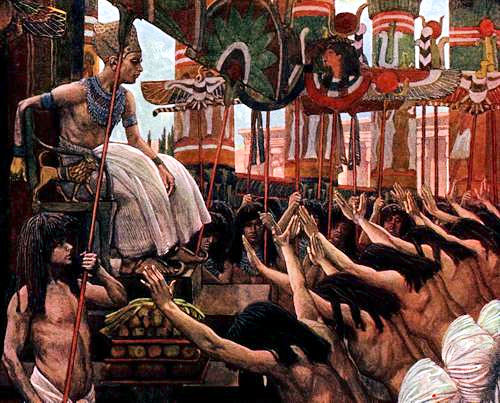
Going back to the life of Joseph, before he became “king”, he was also a slave and then a prison inmate. In both of these situations (which were far more difficult than the average “ordinary” life of a person in America), he served God so well that, relative to his position, he was exalted to the highest status a slave and prisoner could attain. Before Moses could lead an entire nation and speak to God as one speaks to a friend, he had to live as a prince and then a shepherd. Before Jesus comes as King and Lord, he first had to come as carpenter and itinerant teacher among his people Israel, living a life not substantially different than any other Jew and associating primarily with what today we would call “the working class”.

I’m saying all this to show that the typical “wear and tear” we take on every day doesn’t absolve us from our responsibilities to God and to other people. Sure, we’re busy people, but we can hardly tell God, when he calls us, that we are too preoccupied with our work to respond to Him. And even if we are, we still have to do something about it.

When this question reached Rav Yosef Shalom Eliyashiv, shlit”a, he ruled decisively and also gave sound advice. “A doctor who treats patients when the time to light the menorah arrives should first finish his shift, and then go home and light. In the case of a doctor who works a long shift in the hospital which encompasses the entire time that it is possible for him to light the menorah… Since he cannot go home in the middle because he is busy working the entire time, he is absolved from the mitzvah. This falls under the category of one who is involved in a mitzvah who is discharged from other mitzvos during this time.

Rav Eliyashiv added an essential point. “This is only true regarding one who lives alone. If the doctor has family he should instruct them to light when the time comes and he is discharged even if he comes home while it is still possible to light. And even if he lives alone he is obligated to designate a messenger to light for him when the time comes.”

Mishna Berura Yomi Digest
Stories to Share
“Occupied with a Mitzvah”
Siman 672 Seif 1

I’m stretching my metaphor pretty thin here, but bear with me. The Rav rules that a doctor who is treating patients at the time when the Chanukah menorah is to be lit is absolved of the mitzvah because of his important responsibilities, but only to the degree that he does not have to perform the mitzvah personally. The important part of this ruling states, “even if he lives alone he is obligated to designate a messenger to light for him when the time comes.” Putting that back into the topic I’m presenting, even if we feel we are “too busy” to perform the will of God as we understand it, do we also have the responsibility to make sure God’s will is done “by proxy?” The Rav first says if the doctor is married, he can have his wife perform the mitzvah, but then he says the doctor is still obligated, even if he lives alone. If we are alone, perhaps we still have a duty to make sure that whatever we believe God requires of us at any point in time is still be performed.

Of course, we have examples of people who literally dropped everything when Jesus called and followed him.

As Jesus was walking beside the Sea of Galilee, he saw two brothers, Simon called Peter and his brother Andrew. They were casting a net into the lake, for they were fishermen. “Come, follow me,” Jesus said, “and I will send you out to fish for people.” At once they left their nets and followed him.

Going on from there, he saw two other brothers, James son of Zebedee and his brother John. They were in a boat with their father Zebedee, preparing their nets. Jesus called them, and immediately they left the boat and their father and followed him. –Matthew 4:18-22

We also have examples of people who were in the middle of important work and asked to wait until that work was done, sometimes even though it would take a number of years as with the following person.

He said to another man, “Follow me.” But he replied, “Lord, first let me go and bury my father.” Jesus said to him, “Let the dead bury their own dead, but you go and proclaim the kingdom of God.” –Luke 9:59-60

In the latter example, Jesus took a dim view of this person wanting to wait until after his father died (the guy was being a dutiful son and working to help his father, presumably on the “family farm”, so he was fulfilling the commandment to honor his parents) and he put his father’s affairs in order before being free to follow Christ’s calling (It’s examples like this that some Jews use to prove Jesus couldn’t be the Messiah, since it looks like Jesus is telling this son to abandon his responsibilities to his parents, but I digress) .

I’m probably muddying up the waters here saying on the one hand, that we actually might be too busy to answer the call to a mitzvot but we must make sure it is done, even by proxy, and on the other hand saying that we must follow immediately and any delay will be viewed by Jesus in a negative light. This is the struggle we face in letting our light shine every single second in our lives. As human beings, we can be distracted, confused, upset, grief-stricken, afraid, or experience some other circumstance or state that seems to take us away from being that “light to the world”. You’ve probably seen examples of people who you know are believers who, when set upon by difficult problems, retreat into a human response and away from God.

But you’ve also probably seen people of faith who, even when undergoing the most difficult hardships, still are able to shine with a kind of light that communicates peace and love surpassing all human understanding (Ephesians 3:19, Philippians 4:7). It’s possible for us to continue shining our light in the midst of the mundane and perhaps even when disaster seizes us.

What can I say to all this? Do your best? That’s a good place to start. We’re in a relationship with God as junior partners in Tikkun Olam or “repairing the world”. We can only do what is humanly possible. When we seemingly shine an “impossible light” it is not just us and it is not just God, it is both of us. As people, we do one kind act at a time, one generous deed, one word of encouragement, and during Chanukah, we light one candle a night, so that we might show the world the miracle of God. It’s never easy but with God, it’s always possible (Matthew 19:26).

Happy Chanukah.

Shine

Inner lightThey set out from Mount Hor by way of the Sea of Reeds to skirt the land of Edom. But the people grew restive on the journey, and the people spoke against God and against Moses, “Why did you make us leave Egypt to die in the wilderness? There is no bread and no water, and we have come to loathe this miserable food.” The Lord sent seraph serpents against the people. They bit the people and many of the Israelites died. The people came to Moses and said, “We sinned by speaking against the Lord and against you. Intercede with the Lord to take away the serpents from us!” And Moses interceded for the people. Then the Lord said to Moses, “Make a seraph figure and mount it on a standard. And if anyone who is bitten looks at it, he shall recover.” Moses made a copper serpent and mounted it on a standard; and when anyone was bitten by a serpent, he would look at the copper serpent and recover.Numbers 21:4-9 (JPS Tanakh)

And just as Mosheh elevated the serpent in the wilderness, so must the son of man be lifted up, so that none who believe in his will perish, but rather they will live eternal life…

This is the verdict: that the light came into the world, but the sons of men loved the darkness more than the light because their deeds are evil. For all who do injustice hate the light and will not come to the light, so that they may not be rebuked for their deeds. But one who does the truth comes to the light so that it may be revealed that his deeds are done with God.John 3:14-15, 19-21 (DHE Gospels)

What does all this have to do with Chanukah? I admit, not very much. The themes are only superficial in terms of “light” and “renewal”. Or are they?

No, Chanukah doesn’t tell the story of Jesus in any real way, but it’s all but unavoidable to make some sort of connection between Chanukah and Jesus because the Festival of Rededication occurs so close to Christmas in our December calendar. Many Jewish parents struggle to try to disconnect this “proximity” association in my minds of their children, especially as their Jewish children see their goyim and especially Christian friends and classmates having fun with all the lights and music and Santa Claus and particularly all of the Christmas “loot”. The Christian Christmas has become tremendously influenced by the commercial, secular Christmas among the children of the church, and I can appreciate how Jewish parents don’t want all that to spill over into the lives of the children of Jacob.

Blogger Justin Bond recently wrote an article called Chanukah and a kosher Christmas, so I suppose anything I write that somehow associates these two events is redundant. On the other hand, my purpose today isn’t to compare and contrast the two holidays but to try to express what a Christian like me (and I’m not exactly a typical Christian) can get out of lighting the Menorah.

Look at the original event involving Moses and the copper snake on the staff. People were dying. Lots and lots of people were dying and frankly, it was their own fault. They had pushed God and pushed God and pushed God and this time, God pushed back. I wonder why people ever imagine they can just flaunt God’s will, but then, human beings have always been notoriously short-sighted.

So God tells Moses to do something a little unusual. He tells him to construct “a seraph figure and mount it on a standard. And if anyone who is bitten looks at it, he shall recover.” That’s kind of strange. It’s like God told Moses to make some sort of graven idol for the people to look at and then they would live. The interesting thing is, later in history, people actually did worship the thing (2 Kings 18:1-4). Given the commandment not to make any such images (Exodus 20:4), why would God put such an obvious temptation in the midst of the Children of Israel? Certainly he recalled the “incident” of the Golden Calf; the sin in which the Israelites partook while Moses was still on the mountain with God (Exodus 32).

And yet, Jesus actually compares himself to the copper snake in that, all who look upon him, as they looked upon the copper snake, though bitten and fatally poisoned, would live. Talmud Rosh Ha-Shanah 29a states that the reason people lived is that, in looking up to the snake (the image of what was killing them), they actually raised their eyes to Heaven. Though the son of God, Jesus allowed himself to be compressed or reduced or humbled so that he could become a human being, just like we are…something “ordinary” rather than Heavenly, so that we could actually see him and through him, the Father, and thus live.

Yeshua (Jesus) spoke to them once more, saying, “I am the light of the world. Anyone who follows me will not walk in darkness, for he will have the light of life. –John 8:12 (DHE Gospels)

We live in a world of darkness. I suppose it’s appropriate that Chanukah comes at this time of year, when it’s cold outside and the morning sun rises so late in our day. Each morning when I get up, it is still black outside, and it’s still, and it’s even lonely. Then the day comes and is gone and by the time I get home from work, it is black outside again. I suppose I can’t blame my Christian brothers and sisters for putting so many lights on their homes to keep the night and the coldness it brings at bay. During Chanukah in my home, only the light of a few tiny, faint candles illuminate the obsidian abyss, but that is a fitting metaphor for living in a dark and broken world.

We are all stumbling in the dark, like a blind person feeling about, trying to find some familiar landmark by touch alone. We strain to see even the faintest glimmer of hope and when we do, we rush toward it, terrified by what might be just behind us, pursuing us in the invisible space just inches from the nape of our necks. God sent a light into the world so we wouldn’t have to live in darkness but faith feeds the light. Fear, despair, and hopelessness feeds the darkness and human beings are suspended between these two forces, longing for illumination but struggling with the gloom.

Though it’s only symbolic, we can choose to see Messiah and Savior in the lights of our life and very soon, in the lights of the Chanukah menorah. The first night, we light only one, and the next night two, and the next night one more than two and so on, until we have fulfilled all eight nights. Each night our homes and presumably our hearts glow a little brighter as we push back the darkness and let the light enter more freely into our lives.

This year, Chanukah begins at sundown on Tuesday, December 20th and will continue through the 28th. Light the candles or the oil in your home this year. Create a spark in your life and in your heart. As Christians, we know that Jesus is the light of the world and he pushes back against the darkness that threatens to engulf us. As Christians we also know that we are the light of the world (Matthew 5:14-16) and that, to extend my metaphor, we must shine that light into not only our homes, but into lives of those around us.

So also, shine your light before sons of men, so that they may see your good deeds and praise your Father who is in heaven. –Matthew 5:16 (DHE Gospels)

Shine.

Happy Chanukah.

Considering Replies

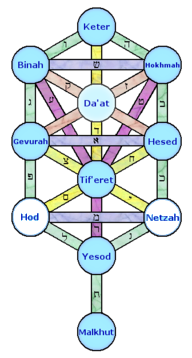
Hod is the counterpoint to Netzach. While Netzach strives to connect, Hod ensures that the power and energy in that striving is appropriate and acceptable. As we said earlier, it makes no sense to impress a student if the information is just too much to assimilate. Hod assembles the information to match the capacity of the receiver.

Hod tempers the force of Netzach, which, unchecked, can create distance rather than closeness. We have all experienced the colleague who is so effusive about his proposal that people simply stop listening. We have seen good ideas go ignored because an empathetic heart did not balance the Netzach exuberance. Empathy lies at the core of a caring relationship.

-Rabbi Laibl Wolf
“Hod: Creating Empathy” (pg 181)
Practical Kabbalah: A Guide to Jewish Wisdom for Everyday Life

If you’ve been reading my blog for the past week or so, you’ll know that I’ve been participating in an ongoing dialogue on the issue of Christmas trees and pagan practices in a number of online venues including Boaz Michael’s Facebook page, Jacob Fronczak’s Hope Abbey blog, and Judah Himango’s blog Kineti L’Tziyon. While the content on the blog pages themselves is reasonable (regardless of whether or not you or I may agree with that content), some of the comments made in response were not. I felt they represented an attack on Christianity or at least on those Christians who choose to put a Christmas tree in their homes, decorate it with tinsel, ornaments, and lights, and put gifts under it.

But I did’t write this “extra meditation” to talk about that again. I’m pretty much “talked out” as far as “Christmasphobia” is concerned and would just end up repeating myself if I tried to blog on it one more time. Instead, I’m here to talk about the communication dynamics I saw in those conversations and more in general, how methods of communication sell or sink our message as believers.

Most of the people who regularly read this blog probably aren’t interested in Kabbalah and some of you may be strongly opposed to its study, but in reading Rabbi Wolf’s discussion of Hod and Netzach, I recognized some of the common issues we all have when we want to get out point across.

Christians generally believe we have received a mandate from Jesus in what is called “the Great Commission.”

And you, go to all the nations. Make disciples; immerse them for the name of the Father, and the Son, and the Holy Spirit, and teach them to keep all that I have commanded you. And see, I am with you all the days until the end of the age. Amen. –Matthew 28:19-20 (DHE Gospels)

For nearly 2,000 years, Christians have, in one form or another, been attempting to tell the world about the Good News of Jesus Christ and the promise of salvation. We haven’t always done a good job at it, though. I’d say the various Crusades, Inquisitions, and Pogroms the church has lead can be described as a dismal failure of our evangelical directive. Even today, many non-believers cringe when a Christian asks them questions such as, “If you were to die tonight, do you know where your soul would go?” We are often depicted as judgmental, rigid, sexist, backward, superstitious “Bible-thumpers” and that description isn’t always particularly inaccurate.

It’s not so much the message we are trying to deliver that communicates such a dismal picture of the church, but how that message is transmitted. Christians really can be judgmental, inflexible, and insensitive to the needs of others, particularly of how people need to hear what we have to say (whether they choose to agree with us or not). We’ve gotten to the point where some folks want to run away when they think we’re about to try to convert them.

If you re-read the quotes I presented above, I’m sure you can immediately recognize that when we people of faith get such responses, we are likely leading with Netzach at the expense of Hod. This can especially be a problem with “text-only” communications on the Internet, such as in Facebook and blog comments, because most of what we use to communicate (body language, vocal tone and inflection) is completely absent. All we have is plain text and without anything to modify it, what we think we’re saying clearly can be terribly misunderstood. A message we think we’ve said with warmth and compassion can come across at hostile and uncaring. When confronted with such a message, it’s very easy to get worked up and fire back a response that is actually angry. The web conversation goes downhill from there, and I’m as guilty of such a transgression as anyone else.

Modeh AniWhat’s missing is illustrated by Rabbi Wolf in how he explains the Modeh Ani blessing which is recited by every observant Jew at the very moment when they realize they’re awake each morning.

The Kabbalah explains that this morning affirmation, known as Modeh Ani, provides the space to enter into the magical moments characterized by the transition from the unconsciousness of sleep into the light of day. The term Modah Ani is enunciated first thing in the morning. It means “I accept,” “I surrender,” or “I acknowledge,” or “I bow in front of you.” It is linked etymologically to the word for “thank you” in Hebrew (Todah)…

When we say “thank you” we are withdrawing and creating a comfort zone for another person. We touch their essence and draw it toward us. “Thank you” is a verbalization of the Hod flow. That is why it is so important to teach youngsters to say “thank you,” even if the deeper import is not yet fully understood. It trains children to express humility and an acknowledgment of others.

People who show humility invite more relationships into their lives.

-Rabbi Wolf (pp 185-7)

Putting Kabbalah and even the Modeh Ani aside, pay attention to the key phrase in Rabbi Wolf’s narrative: “we are withdrawing and creating a comfort zone for another person.” If we want someone else to hear us, regardless of our message, we must create a “comfort zone” for them, not for us. Yet we often do the exact opposite, creating a comfort zone for us and putting the listener on the defensive. This is especially easy to do on the Internet, even if it’s not our intent, because most of the elements of complete communication are not available. On top of that, we sometimes “pull rank” by explaining our abundant qualifications to be able to transmit our message. I don’t mind learned people and even “experts” in a particular field who have something to say, but a person who repeatedly has to outline their “quals” while making their point is an immediate turn off to me. The more you have to tell people, “I’m important and a big deal”, the more most people (me included) will believe that you’re not.

In one of the conversations I mentioned, one fellow responded like this:

I am a Hebrew. I am a Messianic Jew. A Kohen Levi. I am not one of the lost 12 tribes, nor do I believe in it.
My credentials…

I have no doubt all that is true for this person and you might say something like, “What’s wrong with what he said if it’s true? Is there a problem telling the truth?”

My answer: yes and no.

I don’t know how many conversations, both online and in person, I’ve been involved in (and where I was being put on the defensive) where the person talking to me responded to my resistence by saying, “well, it’s the truth!” Truth though it may be, if you can’t tell me the truth in a way that doesn’t drag me or other people through the mud (whether you really are or it just sounds that way), am I likely to listen? I’m not saying that you will or won’t convince me of your point of view, but there’s more than one way to present it. If you shove pure “Netzach” in my face while “Hod” has been left ten miles behind in the conversation, doesn’t this create a problem? It doesn’t matter what your family or cultural lineage is, how learned you are, how many languages you speak, and how much of a “Torah expert” you happen to be, if your message is delivered with all the tact of a barbarian horde riding madly across the seven hills of Rome, bent on the destruction, mayhem, and looting. No, I’m not saying that your intent is bad, just your delivery (OK, for some people, the intent is bad too, but it’s almost impossible to separate intent from inadequate communication over the web).

You Christians trying to fulfill your responsibility to share the Gospel with unbelievers, you are no different. Zeal is one thing and frankly, it is very important, but if you don’t create a space in the relationship where the person you’re talking to can feel comfortable, or at least a space where they don’t feel like they’re about to be spiritually jumped on and beaten up, you won’t “win a soul for Christ” (and I really hate the implications of that statement) or even convince the other person that you’re a half-way nice human being.

Being too empathetic makes you look wishy-washy and your message becomes completely ineffective. Being too zealous makes you look like a judgmental crusader out to bash someone’s head in with a Bible and your message becomes immediately disgarded by your audience.

Remember what I said a few days ago about being out of balance?

I’m not trying to bash anyone reading this or anyone who posted a comment in Facebook or on the blogs I mentioned. I’m imploring you to please, please look at the state of your intent and the balance of your Netzach and Hod. It doesn’t matter if you don’t use those terms. I doesn’t matter if you’ve never heard of Kabbalah or don’t like what you’ve heard about it. Take the labels off everything I’ve said and look at the dynamics of communication under the hood. That’s what matters. It matters a lot because we’re supposed to be God’s representatives in the here and now. I’ve already mentioned how it really matters what we “loose on earth” because it is also “loosed in heaven” (Matthew 18:18). Being careless about what we say and how we say it when presenting ourselves as people of faith, can elicit not only a poor response in the immediate circumstance, but create a long-term and even potentially eternal problem in the much larger spiritual realm.

One of the exercises Rabbi Wolf suggests in his book to help people develop Hod, is to participate in conversations where you wait three to five seconds to respond after your conversational partner says something. The exercise directs you to use the time to consider what to say and how to say it. Use the time to consider the impact of your response on your partner. What would happen if we did that all of the time? What would happen if we cared enough about other people to create a comfort zone for them in our conversations, if we listened to what they had to say, and if we stopped and considered their feelings and understanding before launching into our reply?

This probably isn’t true, but imagine this is the reason why God rarely answers our prayers immediately. Maybe He’s waiting until we are in our comfort zone with Him. Maybe He’s considerate enough to carefully craft His reply to us so it will be the most useful reply possible. Maybe God loves us that much. Imagine if we loved each other that much.

Freeing the Broken Heart

Then the chief cupbearer told his dream to Joseph. He said to him, “In my dream, there was a vine in front of me. On the vine were three branches. It had barely budded, when out came its blossoms and its clusters ripened into grapes. Pharaoh’s cup was in my hand, and I took the grapes, pressed them into Pharaoh’s cup, and placed the cup in Pharaoh’s hand.” Joseph said to him, “This is its interpretation: The three branches are three days. In three days Pharaoh will pardon you and restore you to your post; you will place Pharaoh’s cup in his hand, as was your custom formerly when you were his cupbearer. But think of me when all is well with you again, and do me the kindness of mentioning me to Pharaoh, so as to free me from this place. For in truth, I was kidnapped from the land of the Hebrews; nor have I done anything here that they should have put me in the dungeon.”

When the chief baker saw how favorably he had interpreted, he said to Joseph, “In my dream, similarly, there were three openwork baskets on my head. In the uppermost basket were all kinds of food for Pharaoh that a baker prepares; and the birds were eating it out of the basket above my head.” Joseph answered, “This is its interpretation: The three baskets are three days. In three days Pharaoh will lift off your head and impale’ you upon a pole; and the birds will pick off your flesh.”

On the third day — his birthday — Pharaoh made a banquet for officials, and he singled out his chief cupbearer and his chief baker among his officials. He restored the chief cupbearer to his cupbearing, and he placed the cup in Pharaoh’s hand; but the chief baker he paled-just as Joseph had interpreted to them.

Yet the chief cupbearer did not think of Joseph; he forgot him.Genesis 40:9-23 (JPS Tanakh)

This story certainly makes for high drama, but why were all these farfetched developments necessary? Why didn’t divine providence manifest itself in a simpler way? Couldn’t Joseph’s release and rise to power have been effected through more commonplace events?

The commentators explain that Joseph’s release from prison is meant to serve as a paradigm of the ultimate in human emancipation.

-Rabbi Naftali Reich
“Freeing the Spirit”
Commentary on Prashas Vayeishev
Torah.org

I have a hard time understanding God sometimes. I suppose that’s quite an understatement and I imagine most people reading this “morning meditation” share my confusion on occasion. Take yesterday’s Torah Portion for example. I know Joseph’s brothers hated him, but did they really think they could get away with murder? Didn’t it hurt anyone besides Judah to see their father reduced to a mere shell of a man out of his heartbreaking grief at the loss of his favored son? What about the parallels between the wife of Potiphar trying to seduce Joseph and Judah’s “relationship” with his daughter-in-law Tamar?

And why, when sold into slavery and with no hope of ever being reunited with his family again, did Joseph, who started out as a spoiled and selfish 17 year old brat at the beginning of this narrative, eventually rise not only in stature and power, but in spiritual strength and holiness to be a savior to his family and the world? It seems obvious that his tenure as slave and prisoner was to train him for the role of a man who would all but rule the vast empire of Egypt, much like Moses had to live both as prince and as shepherd to finally take on the mantle of Prophet and “King” of the nation of Israel.

The First Fruits of Zion (FFOZ) commentary on Vayeishev draws the obvious comparision between Joseph and the Messiah, but it does something else.

Yet the story of Joseph is not an allegory, written merely to serve as type, shadow, and symbol. Too often believers have diminished the Torah’s literal reading for the sake of messianic interpretations. It is a story in its own right and a great story at that. Joseph is a real character; his adventures and misadventures are his own. If we are able to look into the Joseph story and perceive the person of Messiah, that is only to be expected, because God is the author of salvation both then and now. Joseph’s story is simply an example of what it looks like when God saves His people.

Sometimes Jewish scholars complain about how some Christian pundits tend to interpret every possible occurence in the Torah of a mysterious or symbolic figure as “the pre-incarnate Jesus.” As the joke goes, they say such Christians don’t engage in Biblical exegesis but rather, Biblical “I see Jesus.” FFOZ is saying something along those lines but in a much more platable way. Much of the Christian world looks at Joseph as a “type and shadow” of the Jesus to come without crediting Joseph to a life and purpose of his own. We also have a tendency to discount what people like Joseph can show us about ourselves and the larger context of our own “Messianic” role in the world.

Tikkun Olam or “Repairing the World” is one of my favorite themes because it not only empowers us to help others but requires us to enter into (junior) partnership with God in fixing our broken world. There are just tons of ways to do this, from promoting environmental causes to volunteering at your local homeless shelter. Even people with modest incomes can donate one can of soup a week to their community foodbank. Joseph fed the population of the entire civilized world for seven years. We can at least feed one person one simple meal once a week. We just have to realize that we are not the most helpless and downtrodden person on earth and to rise up and act on the behalf of someone less fortunate than we are.

The Satmar Rav, zt”l, spent one summer Shabbos in Ardiov, a city where many great tzaddikim and talmedei chachamim spent time during the summer. He ate the Friday night meal at the tisch of Rav Moshe of Shinova, zt”l, an exceptional tzaddik who only thought about doing God’s will. Many other luminaries were present at the crowded tisch which had an uplifted yet comfortable feel to it.

After singing some inspiring melodies, the kugel was served. It was a very scrumptious kugel. So much so that some of those at the tisch whispered to one another that they hadn’t tasted such a delectable kugel in a long time. To the surprise of all, Rav Moshe immediately got up and went into the kitchen. After a short time he returned.

Everyone wondered what the rebbe had been doing in the kitchen. When Rav Moshe noticed their wonderment, he told them where he had been. His deep sensitivity for others revealed by his unabashed statement completely astounded the Satmar Rav. “I heard people saying that the kugel is exceptional. Since the cook is a poor orphan girl, I immediately went into the kitchen to tell her. How could I wait until later to gladden her broken heart?”

Daf Yomi Digest
Stories Off the Daf
“Gladdening an Orphan’s Heart”
Bechoros 32

This story teaches two important and hopefully obvious lessons. The first is that, no matter how exalted and learned you are, you have a responsibility to gladden the heart of someone less fortunate. The second lesson is that you should do it as soon as possible.

Like Joseph, we have been slaves and prisoners, but in our case it is the imprisonment of our own humanity. Joseph had to be reduced down to about as low as you can go as a human being so that he could find out that freedom isn’t the absence of chains, but the presence of mercy. This is the answer to the mystery of Joseph and it is the answer to our mystery as well. As disciples of Jesus and believers in the God of Joseph, we have it within us to not only be free of our chains but to free others as well. All we have to do to escape our jail cells is to realize that we are sitting on the keys.

The scroll of Yeshayah the Prophet was given to him, and he opened the scroll and found the place where it is written,

The spirit of HaShem is upon me in order to anoint me to bring good news to the humble. He has sent me to care for the brokenhearted, to proclaim freedom for the exiles, and for the blind an opening release … to send the oppressed away free … to proclaim a year of favor for HaShem.

When he rolled up the scroll, returned it to the chazzan, and sat, the eyes of all who were in the synagogue were focused on him. –Luke 4:17-20 (DHE Gospel)

We don’t have to be Jesus or even Joseph to save the world. We can partner with them and be a “savior” too, one heart at a time.

Vayeishev: If I Were a Rich Man

If I were rich, I’d have the time that I lack
To sit in the synagogue and pray,
And maybe have a seat by the Eastern wall,
And I’d discuss the learned books with the holy men Seven hours every day–
That would be the sweetest thing of all…
Oy!

from If I Were a Rich man
written by Sheldon Harnick and Jerry Bock
for the musical Fiddler on the Roof

Now Jacob was settled in the land where his father had sojourned, the land of Canaan.Genesis 37:1

Rabbi Eli Touger’s commentary on Torah Portion Vayeishev says in part, that Jacob desired to live in prosperity, as do all righteous men, but was unable to (according to Rashi) because of his distress over the disappearance and apparent death of his son Joseph. I’ve written previously about the fallacy of “prosperity theology” in the church, so can we conclude (assuming Rashi is correct) that Jacob’s desire to live in prosperity is a problem for me? Rabbi Touger quotes Rashi’s response to this question.

Yaakov desired to dwell in prosperity, but the distress of Yosef’s [disappearance] beset him. The righteous desire to dwell in prosperity, but the Holy One, blessed be He, says: “Is not what is prepared for them in the World to Come enough for the righteous? Must they also desire prosperity in this world?”

Rashi’s statement is problematic, for a casual reading gives the impression that G-d does not approve of the righteous wanting prosperity. On the other hand, the fact that “the righteous” follow this path of conduct indicates that the desire for prosperity is a positive trait and not a character flaw. (Rashi’s apparent source is Bereishis Rabbah 84:3)

This difficulty can be resolved by focusing on the fact that Rashi speaks about a desire for prosperity expressed by the righteous. Why only the righteous? Everyone wants to enjoy an abundance of good without strife, contention, or difficulty.

On the surface, this interpretation seems to support the prosperity theology position that the righteous “should” want to have wealth and comfort in the present world as well as rewards in the world to come. But it’s amazing to me that Rashi, a French medieval Talmudic sage, should agree with a modern Christian doctrine. Is God so simple that he rewards the righteous with material wealth and punishes the less worthy with poverty and hardship? The history of both righteous Christians and Jews would seem to deny this, since many faithful men and women have suffered great difficulties and even died penniless for the sake of God.

And what does “Fiddler on the Roof” have to do with anything?

When a person is beset… with sickness, war, and hunger, he cannot occupy himself neither with wisdom nor with mitzvos. For this reason, all Israel and [in particular,] their prophets and sages have desired the Era of the Mashiach. (Mishneh Torah, Hilchos Teshuvah 9:2)

The Sages and the prophets did not yearn for the Era of the Mashiach so that [the Jewish people] would rule the world… nor to eat, drink, and celebrate. Rather, their aspiration was to be free [to involve themselves] in the Torah and its wisdom, without anyone oppressing or disturbing them. (Ibid., Hilchos Melachim 12:4.)

That sounds like Tevye’s wish as well. But as noble as this wish appears, it has a serious flaw. The righteous receive their reward in the Kingdom of Heaven (Matthew 6:20) and not on Earth (at least not always) and in fact, the Master said that:

“So when you give to the needy, do not announce it with trumpets, as the hypocrites do in the synagogues and on the streets, to be honored by others. Truly I tell you, they have received their reward in full. But when you give to the needy, do not let your left hand know what your right hand is doing, so that your giving may be in secret. Then your Father, who sees what is done in secret, will reward you. –Matthew 6:2-4

The Master is saying a couple of things. The first is that if we have the means, we should use them to benefit the poor. Nowhere does he say that our primary duty is to be occupied in study but rather the mitzvot related to helping the needy. He also says that if we receive our reward here in the form of wealth and prestige (maybe wealth, if used in secret to help others and not just to make ourselves look good is OK), it is in full and there may be no additional reward (which isn’t the same as salvation) in Heaven. Interestingly enough, his point finds its parallel in Rabbi Touger’s teaching:

Nevertheless, a distinction must be made. The World to Come represents G-d’s reward to man just recompense for man’s Divine service. This is a departure from the pattern of our present existence, of which it is said, “Today to perform them (the mitzvos); tomorrow to receive their reward.”

So was Jacob’s desire, as interpreted by Rashi, in vain? I still think the answer is still in Tevye’s song.

The righteous, by contrast, are not concerned with reward. On the contrary, to refer to the passage cited above, they long to involve themselves in the Torah and its mitzvos. Their aspiration is only that they be freed from external difficulties. They want to grow in understanding and personal development. Why must they be confronted with challenges from the outside? Let all their efforts be devoted to the internal challenges of spiritual growth.

I can’t say if this truly speaks to Jacob’s desire, but what we see here is that a righteous person, when desiring prosperity, isn’t thinking of reward in the conventional sense. They are thinking probably what you and I have considered at one point or another. If we could be freed from the constraints of a “normal” life of work and problems, we could spend more time serving God and ministering to people, even devoting our great material possessions to the well being of those around us. I think that would work for a truly righteous person, such as Joseph, who used the exalted position given to him by Pharaoh, King of Egypt (and ultimately God), to save his family and the world. For the rest of us though, we would be enormously tempted to use our wealth and “free time” for less than noble pursuits.

My opinion is that the toil and hardship of day-to-day life, though it limits the amount of time and energy we have to pray, to perform mitzvot (acts of kindness and righteousness), and to honor God, also focuses those few hours we do have through a lens whereby we can see God and do His will more effectively, without the temptations material prosperity brings. I tend to think that the truly righteous can manage extreme poverty and extreme wealth with equal grace as Paul said he had learned to do (Philippians 4:12-13).

Please understand that I’m not making a simple statement that the very rich and the very poor are always righteous. We know that wealth and poverty visit the just and the unjust alike. We know that God grants us what He chooses to grant us and doesn’t owe us an explanation for how things work out in our lives. Our circumstances aren’t a particularly accurate barometer of our state of holiness and relationship with the Almighty. But it is one type of challenge we may face as part of His plan for our lives.

In addition to our material state of being, we can also experience spiritual prosperity or poverty. Since God’s gifts are endless in this arena, I have to believe that we have the majority of control in this area of our existence. This has nothing to do with dollar signs or a “feeling” of peace inside, and everything to do with a burning desire to draw closer to Him and to do His will. The pursuit of “spiritual reward” is also fraught with problems because we poor, dumb, human beings have a tendency to get our priorities and desires mixed up with His. I can’t count the number of times I’ve heard Christians report that they prayed about a certain decision they had to make and then “felt a peace” about the decision they wanted to make anyway. Was that drawing closer to God or using God as an excuse to fulfill their personal wants rather than God’s requirements?

When Christians say that Jesus freed them from the Leviticus 11 food laws, I sometimes want to ask them, if God came to them right now and really told them to give up their ham sandwiches, and they really, really knew it was from God, would they give up the pork, or find an excuse not to? I use this as an example and not to say that I think the Torah kosher laws necessarily apply to the Gentile, but it’s a good illustration. In keeping with my theme for the past week or so, I might ask Gentile Messianics if God told them to be forgiving and tolerant of Christians who put up Christmas trees instead of reviling them and “standing their ground” against paganism, would they be truly forgiving and tolerant, or would they argue with God that the Christmas tree people deserved to be condemned?

I have to say at this point, that I am somewhat heartened how some of the detractors of Christmas on Boaz Michael’s Facebook page seem to be softening their approach and being clear that they are not actually attacking Christians. I’m also thankful to Jacob Fronczak for posting the very well researched article The Syncretism Boogeyman on his blog, which provides excellent information on the history of cultic practices in ancient times, including during the time of Moses. I’m stepping off my soapbox now. Back to the topic at hand.

Wayward SonFrom my own personal experiences (humble though they may be), I’ve become convinced that when God actually speaks to me (rather than the voice of my own desires and ego in my head), He surprises me and frankly, asks me to say and do things that aren’t naturally easy for me. He asks me to take on duties I don’t feel comfortable with and requires that I surrender behaviors and even thoughts with which I am very at ease. That’s the nature of God, to push us forward, to urge us to move further on and in directions we would never consider on our own.

So be careful in the sorts of rewards you ask from God and in what role you seek to play in His service. He just may give you a type of reward and prosperity you don’t expect and require that you actually rise to the challenge. How many years was Joseph a slave and prisoner in Egypt before he became all but a king? How many years did Jacob live in grief and abject sorrow, though materially wealthy, before he was comforted by his son in Egypt?

Good Shabbos.

"When you awake in the morning, learn something to inspire you and mediate upon it, then plunge forward full of light with which to illuminate the darkness." -Rabbi Tzvi Freeman