
 Although many prosperity churches hold seminars on financial responsibility, Catherine Bowler of the Duke Divinity School alleges that they often offer poor advice. Rosin argues that prosperity theology contributed to the housing bubble that caused the financial crisis of 2007–2010. She maintains that home ownership was heavily emphasized in prosperity churches and that reliance on divine intervention caused people to make unwise choices.
Prosperity Theology page at Wikipedia
Once, I asked Garay how you would know for certain if God had told you to buy a house, and he answered like a roulette dealer. “Ten Christians will say that God told them to buy a house. In nine of the cases, it will go bad. The 10th one is the real Christian.” And the other nine? “For them, there’s always another house.”
-Hanna Rosin
“Did Christianity Cause the Crash?”
the Atlantic
As our forefather Yaakov (Jacob) prepared to encounter his brother Esav again after 34 years, he did three things: sent presents, readied for war, and prayed. He balanced his prayers and trust in G-d with appropriate “worldly” efforts. He neither trusted in his own efforts, nor expected G-d to protect him with open miracles.
Not everyone knows how to strike this balance correctly. At one end of the spectrum are the people who believe that everything is up to them, who panic when they encounter a challenge or pat themselves on the back when things go well. At the other end of the spectrum, perhaps, is the rabbi of a town seated downstream from a dam that was about to break.
-Rabbi Yaakov Menken
“Balanced Trust”
Commentary on Torah Portion Vayishlah
Project Genesis
I suppose there are Christian Pastors who preach a balanced approach to a life of faith, but I more often find such a lesson taught by Rabbis. It seems like, in our current and rather dismal economy, that the poorly-considered Prosperity Theology promoted at some of the rather famous megachurches, is just power-surging through Christianity these days. This phenomena reminds me of how some Christians believe people get sick and even die, just because they don’t have enough faith. After all, if you have enough faith, God will heal you of any injury or disease, right? The mother who died of breast cancer or the father who perished from a sudden heart attack just weren’t “real Christians”, right? There have been “men of God” such as Jimmy Swaggart, Jim Bakker, Benny Hinn, and Joel Osteen who have, at one time or another, preached the basic message that God wants all Christians to be wealthy in this lifetime and if we have enough faith, money and prosperity will drop in our laps like proverbial “pennies from heaven.”
That’s hardly the reality of the Bible. A quick look at any of the Prophets in the Tanakh (Old Testament) and the lives of the Apostles, including Paul and Peter, shows us that often a life of extraordinary faith is also one of extraordinary hardship. No, I’m not saying that a life of faith always results in hardship, but it’s ridiculous to believe that being a “true Christian” means always being “filthy rich”. God has a wide variety of paths for each of us. Some people are “rewarded” (seemingly) in this life and some, by faith, live in financial difficulty and believe they have a reward in the world to come (Matthew 6:19-21). Rabbi Menken uses Jacob as an example of a man who, through a lot of hard work and faith, did well materially, though not without sacrifice. Jacob was a man who, in spite of success, continued to struggle with the world around him and with the Divine, but who was balanced sufficiently to make his own best effort, to pray, and then to trust God.
Most of us aren’t that well-organized and, as people of faith, we forget many of the lessons God has taught us.
People, despite their wealth, do not endure;
they are like the beasts that perish.This is the fate of those who trust in themselves,
and of their followers, who approve their sayings.
They are like sheep and are destined to die;
death will be their shepherd
(but the upright will prevail over them in the morning).
Their forms will decay in the grave,
far from their princely mansions.
But God will redeem me from the realm of the dead;
he will surely take me to himself.
Do not be overawed when others grow rich,
when the splendor of their houses increases;
for they will take nothing with them when they die,
their splendor will not descend with them.
Though while they live they count themselves blessed—
and people praise you when you prosper—
they will join those who have gone before them,
who will never again see the light of life.People who have wealth but lack understanding
are like the beasts that perish. –Psalm 49:12:20
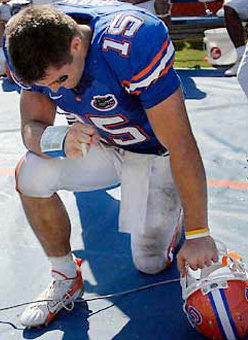
 We cannot rely only on our faith nor only on our own efforts; rather it is a combination of both that God expects of us (James 2:14-26). But sometimes we get lazy and jump at the sort of message that says God will “do it all” as long as we “bathe it in prayer” and have enough faith. Lack of prosperity, in this particular spiritual framework, means it’s our fault when we don’t prosper, and we haven’t prayed hard enough or prayed some sort of “magical” or “secret prayer” someone wrote a book about, as if God could be manipulated to give us our wishes like a genie in a lamp.
The flip side is when we have success and attribute it entirely to our own efforts, ignoring the graciousness of God. We look at our own magnificence and tell ourselves that people who are destitute are just lazy slackers who want the Government to give them everything rather than really working hard, like we did. The examples of people who are out of balance in one way or another are just endless. Here’s the end of Rabbi Menken’s story to illustrate my point (and I’m sure you’ve heard this joke before):
The sheriff found the rabbi sitting calmly on his front porch, studying. “Rabbi!” yelled the sheriff, “it’s a flood, we have to evacuate!”
“Don’t worry,” said the rabbi, “G-d will help me. I don’t need to go.”
Soon the water flooded the town, and firemen in motorboats were picking up the stragglers. One of them noticed the rabbi, and called him to come with them.
“Don’t worry,” said the rabbi, “G-d will help me. I don’t need to go.”
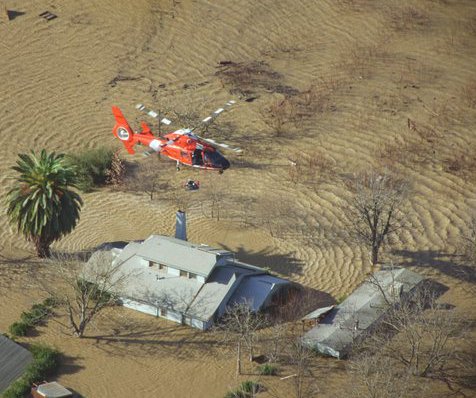
But the waters rose, and rose, and by the time a helicopter was sent to find the last residents, the rabbi was calmly sitting on his roof. Yet once again, the rabbi refused to go.
Once in Heaven, the rabbi demanded an explanation. “I followed Your ways, I learned Your Torah, I did Your will… why didn’t You help me?!”
“What do you mean?” came the response. “I sent a car. I sent a boat. I even sent you a helicopter, but you refused to be helped!”
The reason the joke is so well-known is because it tells something true about people of faith who only have faith. We look for supernatural miracles as the only answer to prayer, but often God sends us very real-world solutions to our dilemmas which require that we take some sort of definitive action. God opens the door, but we still have to get up off of our rear ends and walk through it.
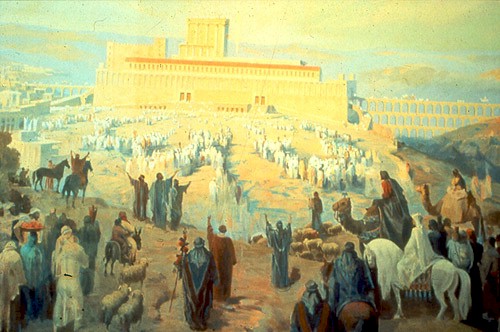 Rabbi Label Lam at Torah.org quotes the pre-World War II treatise of Rabbi Elchonon Wasserman ztl, “The Epoch of the Moshiach” as an example of how many of the Jews in Europe trusted in the powers of the world around them for safety and prosperity and instead were led into the Holocaust.
“Before the redemption, the Jews will err after various forms of idol- worship… “Any matter which appears to man as a controlling factor independent of HASHEM’s will, and as capable of doing good or evil is included in the definition of idolatry. (Sanhedrin) …
He writes, “Let us now review all the “idols” which were worshipped in the last one hundred years. The Enlightenment of Berlin promised a great salvation. As soon as the breeze of liberalism began to blow, the Jews hastened to stand in the ranks of the foremost exponents. After Liberalism had made its exit, they turned to Democracy (worship of public opinion), Socialism, Communism, and to other “isms”… To these idols they made sacrifices of blood and money- and were betrayed by all of them. Not even one justified the faith that was pinned on it…”
Anything can become an idol if we depend on it beyond God’s will, even faith itself. Having faith in a “system” of Government or economic strategy can and has led to tragic consequences, but walking out in the middle of a busy street, standing directly in the path of a speeding truck, and expecting God to send His angels to rescue us from our own folly is also a kind of idolatry. Whether it’s some corrupt “holy man” telling us what we want to hear or we are telling ourselves the same foolish message, we are not so strong that we do not need God, nor can we neglect the responsibilities God has given us and not expect to collide with the consequences. Like Jacob, we must do the equivalent of “sending gifts, praying, and preparing for war” in every challenge we face. Only then are we fully equipped and worthy children of our Father.













 Morning Meditations