Masei: In the Desert

The Sinai DesertThe Torah portion Masei begins by stating: “These are the journeys of the Children of Israel who left Egypt..” (Numbers 33:1) The Torah then goes on to recount all the places where the Jews resided during their 40-year trek from Egypt to the Promised Land.

Our Sages (in Alshich ibid. See also Klei Yakar and Orach Chayim ibid.) ask: By recounting the places where the Jewish people camped rather than the journeys themselves, the Torah is indicating that the resting places are more important than the journeys. This being so, the verse should have stated: “These are the encampments .,” rather than “These are the journeys .” Especially so, since the Jews spent the majority of these 40 years in their encampments, and not in travel.

The ultimate purpose of both the Jews’ travels and encampments was, of course, to enter Eretz Yisrael. The encampments were therefore also termed “journeys,” for they served no purpose in and of themselves.

-Based on the teachings of the Lubavitcher Rebbe,
Rabbi Menachem M. Schneerson for Torah Portion Masei

These concepts are reflected in this week’s Torah reading, Parshas Masei. Masei means “journeys,” and the reading enumerates the 42 different stages in the journey of the newborn Jewish nation from the land of Egypt until its entry into Eretz Yisrael. The Baal Shem Tov explains (As quoted in Degel Machaneh Ephraim, Parshas Masei) that these 42 stages in our people’s journey are mirrored in the life of every individual as he proceeds from birth his personal “exodus from Egypt” until his entry into “the Land of Life” the spiritual counterpart of Eretz Yisrael.

This entire journey through the wilderness (and through life) is intended to reflect continual spiritual growth. Even those stages which are associated with negative events have a positive impetus at their source.

-from a Commentary by Rabbi Eli Touger
Adapted from
Likkutei Sichos, Vol. II, p. 348;
Vol. VI, p. 111ff, 235ff; Vol. XXIII, p. 224

About twelve years ago, I found myself “between careers” and the only job I could find was a temporary position with the Postal Service. I worked from 11 p.m. until sometimes 11 a.m. at a big, mail processing plant, doing just about any kind of manual labor that anyone required of me. I barely saw my family. I only saw the sun as I was driving home after work to go to sleep. I didn’t make very much of an income…but thank Hashem that He provided me with the means to continue to support my family during a difficult period.

Back then, it was easy to complain to myself and to God about my work situation and conditions, but one of the supervisors at “the plant”, who was a Christian, told me this was my “wilderness period”. He turned out to be right.

I learned a great deal doing different kinds of jobs as a “casual” for the Postal Service during the several years I was with them. I don’t mean just the technical aspects of the different assignments I was given, but I learned a lot about patience, humility, respect, tolerance, and graciousness. I performed tasks that I didn’t think I was physically capable of and learned organizational skills I’d never needed before.

All the while, I prayed and prayed and prayed for God to deliver me from the wilderness…and eventually He did. But before that, He took away my ability to rest on the Shabbat (because of the necessity for me to work Saturdays) so I would appreciate the Shabbat. He taught me to cherish every day I had a day off because I could enjoy the light of day and the companionship of my wife and children. And He actually got me into really good physical shape.

The Baal Shem Tov characterizes our life, our experiences between birth and death as “the wilderness”, but within that great desert expanse, I believe we have more definite “wanderings”, challenges, and “dry parts” of our life that God provides so that we will learn something we desperately need in order to draw closer to Him and to be a better servant and child of the Father.

Now look again that the two quotes I inserted at the top of this blog post. It’s the 40 years of traveling and the 42 individual encampments that God used to hone and shape the vessel that was the Children of Israel so when the time came, they would be ready to enter into and possess the Land of Canaan. We saw that the generation which came out of Egypt was not ready (with a few exceptions) and they were not able to make the transition from a people enslaved to a free nation. It took 40 years and the next generation to take that crucial step.

Night RoadAs the Baal Shem Tov states, the journey of Bnei Yisrael can also be thought of as the journey we take as individuals along our path of faith. We wander. Our path isn’t linear. Sometimes we backtrack and revisit old haunts and habits. Every step, every “encampment” along the way, we learn something we need to know; we have an experience that gives us a vital skill, even if we don’t realize it at the time. The Children of Israel knew they would be wandering for 40 years, but we don’t usually know how long it will be for us. As I said, within the “desert” of our lifetimes, we encounter paths that are more rocky and desolate. Often the length of time we wander depends on whether we learn quickly and dilgently the lessons God has provided, or whether we resist and cling stubbornly to our past, our sins, our frustrations, our sorrows, and our “slavery”.

If we are obedient, we finally arrive, but that’s only the beginning. Once they crossed the Jordan, the Children of Israel went on to conquer a nation. Once we are finished wandering, we must conquer the greater desert of ourselves and more.

No, in all these things we are more than conquerors through him who loved us. For I am convinced that neither death nor life, neither angels nor demons, neither the present nor the future, nor any powers, neither height nor depth, nor anything else in all creation, will be able to separate us from the love of God that is in Christ Jesus our Lord. –Romans 8:37-39

For though we live in the world, we do not wage war as the world does. The weapons we fight with are not the weapons of the world. On the contrary, they have divine power to demolish strongholds. We demolish arguments and every pretension that sets itself up against the knowledge of God, and we take captive every thought to make it obedient to Christ. And we will be ready to punish every act of disobedience, once your obedience is complete. –2 Corinthians 10:3-6

“On the move” means there is no comparison between a person’s former state and his present one – the individual has totally departed from his previous level.

The verse therefore emphasizes “the journeys ,” indicating that a Jew should never be satisfied with moving from one level to a comparable one. Rather, he must constantly “journey” in a manner whereby his next stage is infinitely higher than his current one.

This latter manner of “travel” contains two elements: departing from the previous level and attaining the infinitely higher one. As long as there has not been a complete departure from the former level, the higher level cannot be attained.

This, then, is the meaning of “These are the journeys of the Children of Israel who left Egypt ..” Why was it necessary for there to be many “journeys” in order to leave Egypt; it would seem that with the first journey the Jewish people already departed Egypt?

Egypt is symbolic of spiritual limitations. Thus, the “encampments” – the spiritual achievements en route – did not constitute complete redemption from “Egypt.” In order to arrive at the Promised Land, there had to be a total departure from previous “encampments,” for each stopping – no matter how lofty the waystation – itself represented a lingering within the state of “Egypt.”

-Based on Likkutei Sichos Vol. XXIII, pp. 224-227.

Let us finally leave “Egypt” and may the God of Abraham, Isaac, and Jacob grant us a swift and safe journey to our own “Promised Land”, a place within us where we find His glory and peace.

Amen.

Within the Sound of Silence

Alone in silenceA parable:

A father answers the questions of his child and they are happy together, in joyful dialogue.

Then the child asks a question, and the father must think deeply—not just for the answer, but to reach to the essence of this answer so he may bring it to the world of his child. For a long while, the father is quiet.

And so, the child becomes anxious and begins to cry. “Father, where are you? Why do you no longer talk to me? Why have you deserted me for your own thoughts?”

And then the father begins to speak, but this time it is the deepest core of his mind that flows into the mind and heart of the child. Such a flow that with this the child, too, may become a father.

The child is us. The time of silence is now.

When the spirit of Man is dark, when the flow gates of Above seem all but sealed, prepare for liberation.

Rabbi Tzvi Freeman
From the wisdom of the Lubavitcher Rebbe, of righteous memory
“A Time of Silence”
Chabad.org

There’s an old joke that says the difference between a man and a woman is that a man can sit with his friend without them talking to each other for five minutes and not worry that his friend is angry with him. It’s meant to illustrate the different approaches to communication and relationship men and women seem to naturally take, but as with many such jokes, there’s a kernel of truth at the core.

But beyond a certain point, even the most stoic man or woman gets a little uncomfortable being with another person who isn’t talking to them at all. Certainly, if you are in a very close relationship such as Father and Son, you’d expect fairly frequent exchanges of thoughts, feelings, and ideas when you’re together. Sometimes when someone close to you isn’t talking to you, you can interpret the silence as anger or disinterest or even emotional abandonment.

We have one of the world’s most poignant examples of this at our fingertips:

From noon until three in the afternoon darkness came over all the land. About three in the afternoon Jesus cried out in a loud voice, “Eli, Eli, lema sabachthani?” (which means “My God, my God, why have you forsaken me?”). –Matthew 27:45-46

How many times did Jesus say, “I and the Father are One” (John 10:29) and “Anyone who has seen me has seen the Father” (John 14:9)? Yet, it was necessary for there to be a temporary and devastating silence between Father and Son, in this case, for the sake of the entire world (and see Acts 13:32-33 for a parallel to the Rebbe’s words, “Such a flow that with this the child, too, may become a father”).

How about the silences between us and God? You may not be aware of all the times when God experiences your silence and your lack of attention toward Him, but you are acutely aware of when you desperately need to hear from God and instead, find only His silence. Like the child in the parable quoted above, and like Jesus on the cross, you may cry out in your loneliness and fear that God has abandoned you in your pain. But has He?

There is an old proverb that says “Sometimes silence is the best answer.”

Silence is generally something we try to avoid. We aren’t comfortable with it. Think about the awkward silences we’ve each encountered and how often our response is to say something. We have a need to break the silence and perhaps too often we ignore the actual need FOR silence.

from the Gathering Sparks blog.

Sometimes silence is part of the necessary response of God to us, not because He doesn’t care, but because we need to exist for a certain amount of time, in silence. We intensely want to hear from God when we are afraid, alone, or in pain, but at times, God only gives us what we need, and does so for our benefit.

Turn, LORD, and deliver me;
save me because of your unfailing love.
Among the dead no one proclaims your name.
Who praises you from the grave?

I am worn out from my groaning.

All night long I flood my bed with weeping
and drench my couch with tears.
My eyes grow weak with sorrow;
they fail because of all my foes. –Psalm 6:4-7

On my bed I remember you;
I think of you through the watches of the night.
Because you are my help,
I sing in the shadow of your wings.
I cling to you;
your right hand upholds me. –Psalm 63:6-8

Sometimes we draw closer to God when we don’t hear from Him and when we, in our anguish, remember who He is and what He has done; when we in faith and trust, acknowledge His Kingship and Glory, though His voice is silent.

Then, when we do hear from Him, it is at the right time and from God’s deepest core, we are given the strength to overcome and to be liberated.

Light in the Darkness

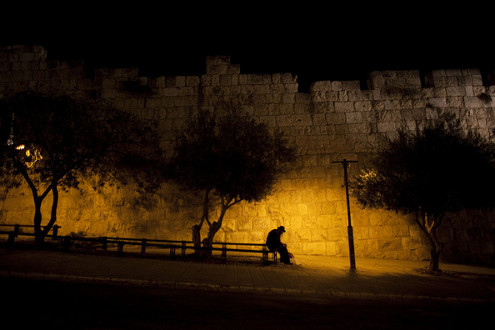
Man in the DarknessAs impossible as it sounds, as absurd as it may seem: The mandate of darkness is to become light; the mandate of a busy, messy world is to find oneness.

We have proof: for the greater the darkness becomes and the greater the confusion of life, the deeper our souls reach inward to discover their own essence-core.

How could it be that darkness leads us to find a deeper light? That confusion leads us to find a deeper truth?

Only because the very act of existence was set from its beginning to know its own Author.

As it says, “In the beginning . . . G-d said, ‘It shall become light!’”

Rabbi Tzvi Freeman
From the wisdom of the Lubavitcher Rebbe, of righteous memory
“Mandate Unmasked”
Chabad.org

When God began to create heaven and earth – the earth being unformed and void, with darkness over the surface of the deep and a wind from God sweeping over the water — God said, “Let there be light”; and there was light. God saw that the light was good, and God separated the light from the darkness.Genesis 1:1-5 (JPS Tanakh)

When Jesus spoke again to the people, he said, “I am the light of the world. Whoever follows me will never walk in darkness, but will have the light of life.” John 8:12

Yesterday’s morning meditation borrowed from the daf for Chullin 29 in describing a person who has fallen far from the light of God. Yesterday, I also quoted from Rabbi Freeman’s interpretation of the Rebbe’s wisdom in which he says, among other things, that we “only fall down in order to bounce back even higher”. It is said that every descent we must make is for the sake of an ascent. Every fall brings us to the point where we will rise. Drop a heavy chunk of ice into a swimming pool. First, it will sink under the surface, but then it will rise back up.

The words of Rabbi Freeman quoted above are taken from a collection called Meditations on Moshiach (Messiah). Both Christians and Jews long for the coming (or return) of the Messiah and the day when he will heal our injured, bleeding world and us along with it. Put another way, lock anyone in utter and complete darkness and they will search, perhaps in vain, for even the tiniest glimmer of light.

That’s what we’re doing. We are people in the dark, straining our eyes and our spirits, seeking to glimpse a spark of the Moshiach and a sign of his Kingdom come.

Whenever things got worse, Jews would say, “This is a sign! Moshiach is coming!”

But in those days, a messianic era would have meant a radical change in the natural order of things.

Today, though the human soul sleeps a deep slumber of materialism, the material world itself is prepared.

Rabbi Freeman’s Good Signs commentary reminds me of many in the church or even some self-styled “Messianics”. There seems to be an obsession about the “end times” and “end time prophesy”, as if people are looking for secrets and conspiracies worthy of some sort of “spiritual X-Files”. Every earthquake, every flood, every war is “a sign” that vaguely and tenuously points to some scripture confirming that the Messiah’s coming is just around the corner. However, as we see from history, our world is replete with signs and with would-be Messiahs, and yet the world is still here and we’re still waiting in the dark.

Rabbi Freeman’s interpretations of the Rebbe continue:

The final war is not fought on battlefields, nor at sea, nor in the skies above. Neither is it a war between kings or nations. It is fought in the heart of each human being, with the armies of his or her deeds in this world.

Holding onto the lightIndeed, the final battle or in my point of view, our “daily battle”, is not one of great wars, terrible disasters, or supernatural and miraculous events taking place in the larger world or in cosmic realms, but rather, it is fought moment-by-moment, hour-by-hour, in the heart and soul of each individual who professes trust and faith in God.

We are still in the dark, but it is a mistake to look to the future or to the outside, or to mystic prophecies of epic, panoramic events to see the Messiah. To find him, we must look to the light within and be mindful of where we are and what we are doing at this very moment:

At that time if anyone says to you, ‘Look, here is the Messiah!’ or, ‘There he is!’ do not believe it. For false messiahs and false prophets will appear and perform great signs and wonders to deceive, if possible, even the elect. See, I have told you ahead of time. –Matthew 24:23-25

While Christians sit passively, seeking signs of his coming in the world outside or in arcane interpretations of scripture, Jews understand that people, all people, have an active part in bringing the Messiah. Not that we can control the day or hour of his coming, but we can prepare the way, by ordering our lives, turning more fully to God, and helping to repair the world, fixing one small, broken piece at a time. The Rebbe knew this when he said:

There is no need to tell a Jew what he or she must do to bring Moshiach. Our job is only to wake them up. Once awake, every Jew knows what he or she must do.

If it is not evil, we must use it for good.
If it can be raised higher, we cannot leave it in the dirt.
For everything He made, He made for His glory.

Do not leave yourself in the dirt, pining for what may be coming outside of your senses. Stand up now. Act in God’s Name to make the world a better place, no matter how small or seemingly insignificant your efforts. Who knows? Even the most humble prayer of a sincere and righteous disciple could make the difference. Your actions may be modest, but the cause you join is magnificent:

When journeying upon the path of wisdom, do not seek to follow in the footsteps of the wise. Seek what they sought. –Matsuo Basho

A Jew never gives up. We’re here to bring Mashiach, we will settle for nothing less. –Harav Yitzchak Ginsburgh

Broken

Broken FaithA certain man was profoundly depressed. He perceived his many flaws and failings and they pained him, but he did not feel confident that he could atone for them. How could he possibly rectify such serious wrongs?

When Rav Yissachar Dov of Belz, zt”l, was asked what someone in this state of mind should do, he offered powerful words of encouragement. “You must understand that God never rejects the Jewish community, as we find in Chullin 29. The halachah is that if an individual is defiled within the community, he can bring his korban Pesach along with them. His personal sacrifice is not rejected because he is part of the community.

“By the same token, someone who takes stock of himself and finds himself riddled with faults should not give up. Although his feelings of inadequacy push him to abandon his efforts to serve God altogether, God forbid, he must take heart and do what he can. It is true that he is defiled, but if he becomes one with the Jewish community, God will enable him to rectify his many transgressions.”

The Ohr HaChaim HaKadosh, zt”l, offered different advice to help fight feelings of spiritual inadequacy, however. “A person may contemplate the many mitzvos in the Torah and say, ‘How can I possibly fulfill them as required?’ Similarly, someone who has transgressed many sins should beware of what his yetzer haram (evil inclination) will surely claim: ‘How can you rectify so many evil deeds?’

“It is for this person that Moshe warns us, ‘And you should know today.’ He was alluding to Shabbos, regarding which the verse states, ‘Today is Shabbos.’ Moshe was telling us to how to answer such discouraging claims. We must say in our hearts: ‘Our sages explain that keeping Shabbos is likened to fulfilling the entire Torah. Through learning the laws of Shabbos and keeping them carefully, week after week, God will help me rectify my spiritual failings.’”

Daf Yomi Digest
Stories Off the Daf
“Joining the Community”
Chullin 29

If you’re a Christian, you may find several things about this commentary that trouble you. For one, it’s addressed to the Jewish people, so how can it apply to you? It also talks about a Jewish person’s difficulty in fulfilling all of the Torah commandments, which doubtlessly, you believe don’t apply to you. Also, the vast majority of Christians either don’t see the relevance of keeping the Shabbat as Jews do, or they believe that going to church on Sunday and then doing “whatever” afterward, fulfills this requirement.

Take a closer look.

While I agree that the commentary was written specifically to apply to Jews and that the 613 commandments Jews believe they are obligated to fulfill do not apply to non-Jewish Christians (or the vast majority of them, anyway), there is a lesson to be learned here. Despite being “saved” by Jesus Christ, a Christian still can feel as if he or she is spiritually deficient. It’s not like it’s impossible for a Christian to sin or even impossible for a Christian to suffer under multiple, habitual sins. It’s hardly impossible or a Christian to feel terrible guilt over having committed many sins and to experience a profound distance from God.

Some Christians in this situation simply give up their faith and surrender to their sins and the values of a fallen world.

The message of the esteemed Ravs we see quoted above is a message of hope that we Christians can look to as well. We are grafted in to the “cultivated olive tree” and “if the root is holy, so are the branches” (Romans 11:16). But while Rav Yissachar Dov suggests that a Jew can draw strength from the larger Jewish community, and the Ohr HaChaim HaKadosh states that when a Jew observes the mitzvot applying to the Shabbat, it’s as if he fulfilled all of the Torah commandments, where does that leave us? How can a Christian overcome a profound sense of guilt over committing not just a few, but many sins across a long time period while professing faith in Christ?

The answer really isn’t that different. One of the reasons we gather in groups and worship communally is to gather strength and encouragement from each other:

Therefore encourage one another and build each other up, just as in fact you are doing. –1 Thessalonians 5:11

But encourage one another daily, as long as it is called Today, so that none of you may be hardened by sin’s deceitfulness. –Hebrews 3:13

SorrowYou may not want to open up and expose the full truth of your being to your entire congregation or Sunday school class, but you can find someone on the Pastoral staff whom you feel you can trust, a compassionate Bible teacher, or a close Christian friend, and ask them for help. Yes, turn to God in prayer, repent in the name of Jesus, ask for forgiveness and the strength to stand tall under temptation, but don’t forget the kindness, grace, and support you can receive from a believing neighbor or friend. God provides us human comforters for a reason.

The other point also applies, though it may be more difficult to see.

In yesterday’s morning meditation, I suggested that it is appropriate and even beneficial for Christians to observe and keep the Shabbat in a manner similar to the Jewish people. That is, to keep an entire 24-hour period of time devoted to drawing nearer to God and to separating from the routine and stress of day-to-day life. Christians tend to see keeping a Sabbath in this manner as a list of what they can’t do (can’t go shopping, can’t go out to lunch, can’t mow the lawn), but it’s more about freedom than about restriction. It’s the freedom to put down the load you carry the other six-days of the week and to spend time focusing who you are; putting all of your attention on God, on prayer, on Bible study, on discussing the teachings of Jesus with others.

Christianity doesn’t have a tradition that says fulfilling one set of holy acts somehow fulfills all of them, but we don’t generally look at things that way. We know that Jesus atoned for our sins, so we don’t concern ourselves with all of the separate actions we would have to take to atone for all of the different sins we committed. We aren’t responsible for making the atonement ourselves, only for accepting the fact that Jesus is our atonement.

Still, as Christians, we can be overwhelmed by the amount and the depth of our sins and how we can ever manage to break the cycle of our disobedience. How can we remove all of the darkness from our souls and know that we are clean after leading sinful lives for months or even years? Wouldn’t a lifetime of sin and hypocrisy as a Christian take a lifetime to undo? How can we be forgiven if we still sin? Rather than trying to see the end result, we can take the “a journey of a thousand miles” point of view on the matter. We can start by focusing on just the first step.

Here’s the deal. Your life is a mess. You’ve really screwed up and you’ve been screwing up for a long time. Maybe your married life is worse than Arnold Schwarzenegger’s or you’ve severely “abused” Google’s image search feature on your computer to view women “inappropriately”. Perhaps your business dealings have been less than “open and above board” or you’ve been putting your hand in the boss’s till rather than helping your employer earn a profit.

Maybe you’ve been calling yourself a “Christian” and going to church on Sunday, but behaving no differently than the atheists and agnostics that populate your community, your workplace, and your neighborhood.

There’s hope. There’s always hope. You can turn it around. It won’t be easy and it won’t be quick. I know you’d like it to be. I know it might seem easier to just give up, but that only puts more distance between you and God and trust me, you’ll regret it in the long run. God said, “”Turn to me and be saved, all you ends of the earth; for I am God, and there is no other” (Isaiah 45:22) and please notice that He is addressing “all you ends of the earth” and not the Children of Israel exclusively.

Faith and belief in Jesus isn’t enough to help you. Knowing God exists and leaving it at that isn’t the answer. James, the brother of the Master, said that we must have faith and deeds (James 2:14-24). We must trust that when we turn from sin to God and desire return, that God will be there with open arms waiting for us, like the Father of the prodigal son (Luke 15:11-32). We must not only believe God will accept our repentance, we must actually take the “risk” of returning and abandoning the sins that keep us from Him.

The only mistake you can make that is absolutely fatal is to walk away from God and never look back. Short of that, while you’re alive, you have hope. The world may be broken, but God can heal your brokenness.

There’s no such thing as defeat. There’s always another chance. To believe in defeat is to believe that there is something, a certain point in time that did not come from Above.

Know that G-d doesn’t have failures. If things appear to worsen, it is only as part of them getting better. We only fall down in order to bounce back even higher.

From the wisdom of the Rebbe
Menachem M. Schneerson
as compiled by Rabbi Tzvi Freeman in his book
Bringing Heaven Down to Earth

Gateway to Eden

Gateway to EdenNow the serpent was more crafty than any of the wild animals the LORD God had made. He said to the woman, “Did God really say, ‘You must not eat from any tree in the garden’?”

The woman said to the serpent, “We may eat fruit from the trees in the garden, but God did say, ‘You must not eat fruit from the tree that is in the middle of the garden, and you must not touch it, or you will die.’”

“You will not certainly die,” the serpent said to the woman. “For God knows that when you eat from it your eyes will be opened, and you will be like God, knowing good and evil.”Genesis 3:1-4

We are all familiar with the story of Adam and Eve and their sin with the fruit of the Tree of Knowledge (Genesis 3). As the story goes, the Serpent, most “cunning” of all the animals, comes along and tempts Eve to taste of the fruit, promising that it would open the eyes of man, making her and Adam “as gods knowing good and evil” (v. 5). Eve decides that the Tree is tempting to behold and both eats of the fruit and gives her husband to eat.

This, however, presents a difficultly. If Adam and Eve themselves had no evil inclination, how could they have *wanted* to sin? How could they — entirely spiritual beings — desire anything other than goodness and closeness to G-d? Where could a desire to rebel against G-d stem from?

-Rabbi Dovid Rosenfeld
The Primordial Sin, Part I (2006)
Torah.org

Christianity and Judaism see “the Fall of Man” event in Genesis very differently, but there are obvious parallels. “In the beginning”, Adam and Eve are sinless beings, created by God and knowing an incredible intimacy with the Source as completely spiritual yet physical beings. In Judaism, people originally had no internal inclination toward evil but upon disobeying the one commandment given by God, the external temptation, represented by the Serpent, became internalized. Man separated himself from God and the nature of the world became broken.

Rabbi Rosenfeld goes on in Part III of the series to ask some difficult questions:

To this we explained that man sinned in order to make life more challenging. Before the Sin, man had only a single mitzvah (commandment) — not to partake of the fruit of the Tree. There was, it seemed, very little for him to accomplish. Now, as a physical being desiring evil, life would be so much more challenging. There would be so much more potential growth in store for man. Eventually mankind would require the rigorous and demanding 613 Commandments to curb the animal within and redirect him G-dward. Thus, man — *spiritual* man — *desired* the greater challenge that would now be in store for mankind.

This, however, still does not suffice. Why would man desire a greater challenge? So that he would have more opportunities for spiritual growth? But isn’t he basically just backing up in order to reach the same goal? The ultimate goal of life — self-evident to the spiritual person — is closeness to G-d. If man was created close to G-d, why not *stay* there — perform his single mitzvah and perfect himself? What was so enticing about making life more difficult?

From Christianity’s point of view, there was no justifiable reason for Adam and Eve to sin; to disobey God. It was a terrible, ghastly mistake that sent both humanity and the nature of Creation down a dark and dismal path, away from God and into the arms of darkness, requiring that God give “His one and only Son, that whoever believes in him shall not perish but have eternal life” (John 3:16).

Judaism says that, amidst what Christians can only view as a total spiritual disaster, there is something salvageable and even perhaps desirable to be gleaned:

The deepest, most profound desire a human soul has is to feel it exists — to feel it is not just a passive entity, acted upon and taken care of by others. A person needs to feel he is an independent being — what the Serpent called a “god” (and our mishna calls a “king”) — who can accomplish, grow and make a difference in the world. There is nothing more painful — *spiritually* painful — than feeling that one’s life makes no difference to anyone or anything, that he exists only as a person acted upon by others or by natural forces, and that he has done nothing to express his own existence.

This was man’s dilemma in the Garden of Eden. Man at first, as lofty as he was, was an almost entirely passive, “created” being. He was given existence by G-d. He was placed in the Garden of Eden with all his wants and needs satisfied and with only a single mitzvah to perform. Man wanted to feel he truly existed — that he was not just a plaything of the Almighty. He wanted to be a god himself. How could he do it? By forcing upon himself greater challenges. Adam and Eve would no longer be passive beings, practically created in G-d’s presence. They would now have to earn it. Spirituality would come only through the greatest of efforts — *their* efforts. It would be the challenge they would have to face to achieve their purpose — and in order to exist.

From what Rabbi Rosenfeld presents, man faced two options: live life close to God, obeying the single commandment provided by the Almighty, but never having the opportunity to truly carve out his own path and the ability to rise spiritually, or deliberately distancing himself from God, lowering his spiritual status, and then struggling back up the ladder, rung by rung, to drive himself ever closer to God and Eden.

I suppose a challenge like that would tempt the spiritual Sir Edmund Hillarys of the world, but for the rest of us, we see the “downside” to such a decision in terms of the pain, suffering, and anguished death of billions upon billions of human beings across the long march of millennia between the dawn of man and the current age.

And yet, here we are. “Our physical flesh (is) now a confused mixture of good and evil. We know the passing of the seasons as we age, and we know decay and death. We are separated from the infinite Spirit. The struggle against evil and the abyss is no longer an external enemy, but rather, it is part of who we are inside. Judaism longs for the coming of the Messiah and Tikkun Olam. Christianity looks to the day when Jesus will return and mankind will be redeemed from a fallen world.

But what if we don’t have to wait? Rabbi Yitzchak Ginsburgh says that we don’t:

After the primordial sin, Adam and Eve heard “the voice of God” walking through the garden. They heard God, He spoke to them, and they answered. This is the consciousness of “hearing,” the height of our consciousness of Godliness (God and His Divine Providence) is our lives subsequent to the primordial sin, the consciousness of the weekdays, the workdays (“By the sweat of your brow…”).

But on Shabbat we return to the pristine state of consciousness of God as it was prior to the primordial sin (and as it will be universally in the future). In the terminology of Kabbalah, during the weekdays our consciousness is at the level of understanding (“hearing” in Hebrew means also “understanding”) whereas on Shabbat our consciousness rises to the level of wisdom (direct insight into the mysteries of creation hidden within reality, and into the “mystery of mysteries,” the Creator of reality, the true and absolute Reality).

Throughout the week everything that happens around us, all that we see and hear, “tells” us about God and His Providence. On Shabbat we don’t have to be told about God, we experience Him directly.

ShabbatOne of the mistakes of the early (non-Jewish) Christian church was to casually discard the commandment, “Remember the Sabbath day by keeping it holy” (Exodus 20:8). The church alternately says that Jesus did away with Sabbath observance with the rest of the Law or that the “Sabbath” was mysteriously moved over one day, to coincide with the “Day of the Lord” and the resurrection of the Master. I personally think that the 2nd and 3rd century church found it necessary to separate themselves from anything “too Jewish” and simply shifted the “Holy Day” over by 24 hours to achieve this, and then used specific points of Scripture to justify the decision.

Today, Christians miss out on an opportunity, however limited, to return to Eden. For contained in the Shabbat isn’t just a day to go to church or synagogue, but in fact, we discover an opportunity to remove oneself from the other six days of the week, of the toil, of the work, of the worries, of the laboring, and to totally devote ourselves as spiritual and physical beings to the God of the Universe and the King of Righteousness, as in days of old.

Six days you shall labor and do all your work, but the seventh day is a sabbath to the LORD your God. On it you shall not do any work, neither you, nor your son or daughter, nor your male or female servant, nor your animals, nor any foreigner residing in your towns. For in six days the LORD made the heavens and the earth, the sea, and all that is in them, but he rested on the seventh day. Therefore the LORD blessed the Sabbath day and made it holy. –Exodus 20:9-11

Both Christians and Jews are going to disagree with me here, particularly since this mitzvot was directed at the Children of Israel, but I believe we Christians cheat ourselves terribly out of the experience to turn one-seventh of our lives into a time to walk personally with God. I think Rabbi Ginsburgh has a point to make, not only to Jews, but to Christians as well. But more gateways to Eden exist:

There are two exceptions to the above distinction between Shabbat and the weekdays, two times that we rise to the consciousness of Shabbat during the otherwise mundane time of the week. The Arizal teaches that our consciousness in the times of prayer, every day of the week three times a day, is at the level of Shabbat. The times of prayer, when we turn to God and address Him directly, are the Shabbat as its light shines into and permeates the week.

Also, a true Torah scholar is referred to in the Zohar as Shabbat. Continuously in communion with God through the means of His Torah (which ultimately in one with Himself) he experiences Shabbat-consciousness the entire week.

Whenever we immerse ourselves in the things of God, we are drawing closer. It happens when we pray, when we give to charity, when we help our neighbor with his yard work, when we hold a small child’s hand to cross the street, when we study the Bible, when we turn away from sin and turn, in obedience, to God.

While the mystic aspects of this process may be confusing or even a little frightening, it is clear that we are separated from God by the nature of humanity and the nature of the world, but we don’t have to be that way always. While waiting for the King of Kings to come to us, we do not have to wait helplessly. We can choose, whether commanded to or not, to observe a Shabbat where we are completely devoted to God. We can take one day of our week and separate it from the rest, separate it from the office, from phone calls, from the Internet, from worry, from work, from care. We can pray, study, speak of God and the Bible with others as we break bread together.

We can create isolated pockets of Eden in the Sabbath and even during the week when we pray and beg to come close to the Throne of Heaven. We can be like “little Messiahs”, helping to fix a broken world one dent and crack at a time by performing even one single act of kindness and humility.

Sin happened. Humanity fell. The world is a broken top spinning hopelessly off the table of existence. We can’t go back to fix it but we can choose to go forward toward God. We can choose to visit Eden on Shabbat. We can cross the threshold of the gates of Paradise every day, every time we pray. We can walk with God in the Garden every time we love our neighbor more than we love ourselves.

However you want to interpret these words, observe Shabbat, return to Eden, walk with God. You can never be lost as long as you are seeking God. You can never be lost as long as God wants you to find Him.

“Do not seek greatness for yourself and do not crave honor. Do more than you have studied and do not desire the ‘table’ of kings. For your table is greater than their table, and your crown is greater than their crown. And your Employer can be trusted to pay you the reward for your efforts.”
Pirkei Avot
Chapter 6, Mishna 5(a)

Days of Mourning

MourningDuring the 3 weeks from 17 Tammuz leading up to Tisha B’Av, the 9th of Av, the Jewish people mourn the loss of the Holy Temple. The Talmud attributes this loss to the prevalence of Sinas Chinam, baseless hatred, among the Jewish people. While hatred towards others is a serious offense, how does it explain the loss of the Temple, and sending the Jewish people into a bitter, arduous exile for nearly 2000 years? Surely there are much greater crimes!

Recall that our relationship with the Al-mighty is not simply servant to master — it’s much deeper. He’s not only Malkeinu, our King, but Avinu Malkeinu, our Father, our King. A mere servant follows orders, but a child does what he knows his father wants most. While G-d did not record baseless hatred in His Torah as a punishable crime, we know that the deep pain it causes the Al-mighty, as it were, far exceeds even the most cardinal of sins. (Nesivos Shalom, Bamidbar 146)

I encourage you to read the words offered in eulogy (pgs 1 & 16) by Rabbi Binyomin Eisenberg , spiritual leader of the synagogue attended by Leiby Kletzky’s family, and one who had a close personal relationship with the pure, innocent Neshama (soul) summoned back to heaven last week. While one can only speculate what G-d’s message is to us, and undoubtedly there are many amidst such a profound tragedy, Rabbi Eisenberg noted the outpouring of assistance, thousands of volunteers, who helped in the search for Leiby and eventually helped lay his body to its final rest. He then asked a painful question: “Why do we need a tragedy to provide water in the streets for strangers?” “Let’s help each other – always,” he said. “If you pick up the phone, it stops ringing. If we Daven (pray) and help each other, we hopefully won’t need tragedies.”

Rabbi Mordechai Dixler
Program Director, Project Genesis – Torah.org

The three weeks of mourning, which started on Tammuz 17, began on July 19th this year, and will culminate on August 9th; Tisha b’av. The 9th day of the month of Av observes a series of tragic events that have befallen the Jewish people throughout history. It is said that both the First and Second Temples were destroyed on the 9th of Av. The Bar Kochba revolt (133 CE) was ended with the slaughter of the Jewish rebels by the Romans on the 9th of Av. On this same date in 1290 CE, the Jews were expelled from England and Spain banished Jews from their land in 1492 on the 9th of Av. Chabad.org has more facts on this day, which holds so many harsh events for the Jewish people.

Why continue to mourn? What purpose could continuing to commemorate the three weeks serve except as a depressing reminder of so much suffering, pain, and death? Why would the Jewish people want to make this a permanent part of their religious calendar and to relive such terrible times?

What did Rabbi Dixler say?

The reminder isn’t what the world has done to the Jews. The reminder is how they failed God, defining the failure as “the prevalence of Sinas Chinam, baseless hatred, among the Jewish people”.

I don’t say this to insult or denigrate the Jewish people. In fact, we all fail God, each and every one of us, and on a rather frequent basis. What lessons can Christians take from the three weeks of mourning and the fast days of 17 Tammuz and 9 Av? Christianity often focuses on how we are saved from sin and death, which isn’t necessarily a bad thing, but we have a tendency to gloss over our own faults, mistakes, and errors, all because we are “saved”. In fact, our salvation seems to make some Christians a little cocky and even arrogant. For them, being “saved” means if you mess up, all you have to do is shoot a quick prayer of “I’m sorry, God” up to heaven and you’re good to go.

Really?

MourningI think not, but sadly, I do think a lot of Christians proceed on this rather self-satisfied and self-serving assumption. If Christians would take their failures a little more seriously, consider displaying a more contrite attitude toward God and other people they have failed, and humble themselves (ourselves) before God and those people, wouldn’t we be better servants of God and better disciples of Jesus? Jesus emptied himself of all glory and honor and humbly accepted an unjust and undeserved death on a stake as a criminal. Where is our fasting, our mourning, our prayers of sorrow for the failures of our lives?

Rabbi Yehudah Prero offers a description of what observant Jews practice during these three weeks:

We are now in the final days of the Three Weeks, the period of time between the fasts of the 17th of Tamuz and the 9th of Av. These three weeks are spent in a state of mourning. We do not conduct weddings, we do not cut our hair, and we refrain from enjoying music. During the last nine days, we do not eat meat, drink wine, nor do we bathe. The sorrow of our exile surrounds us at every moment during this time of the year. While we are to mourn the loss of the Holy Temple, the Bais HaMikdosh and the destruction of Jerusalem, and pray for the end of this lengthy exile, we must remember that Hashem is with us, watching us, ready to lift the burden of exile from upon us at the proper time.

Granted, this type of observance is more common among Orthodox Jews, but it does set a standard of behavior that includes solumn reflection and prayer among the Jewish people as well as the reassurance that God is with them and, at the right time, that He will rescue them. It commemorates the “incompleteness” of the redemption of the Jewish people from exile and the desire for the coming of the Messiah to accomplish the final return of the Jews to Israel and to God:

We have been in exile for a long time. Our families have been subject to spiritual and physical persecution. During the Three Weeks, our behavior reflects the sadness of this time period, the recognition of the great suffering which we still endure. Although we mourn and lament, we must still keep in mind that Hashem is watching over us. He has already put in place the mechanisms for our redemption. We cannot allow that spark of hope within us to be extinguished. We must recognize that the exile will end. That end has been planned for and provided for by G-d. With our striving to be better people, with our repenting, our studying of the Torah, the redemption, our light at the end of the tunnel, is clearly within sight.

Christians don’t consider themselves in exile, but perhaps we should. Although Christianity doesn’t have the same relationship to Land of Israel as the Jewish people, there is definitely something we are missing. We still live in a broken world. We still live in a world where sin and immorality reign and where the values of God and truth are treated with contempt. When will we be “returned” to our “homeland”, where we will live in peace and be ruled by our just and merciful King? When will Jesus come?

As long as we are waiting for him, we are also in exile. While we celebrate our salvation, let us mourn the fact that it was for our sins that Jesus suffered terribly and died. We share some measure of grief and sorrow for the destruction of the Temple and the exile of the Jews from Israel, because these are all events that are inexorably tied to the death of the Messiah and the spreading of the Gospel of Christ. The Prophet Micah said that someday, all people from the nations will stream to the mountain of God. For that reason, we too must long for the day of its return and for the restoration of the Jews to Israel, as we do for the return of Christ. Let us fast and mourn as for an only son who we have lost and pray for the day when he will come into the world again, in glory and honor and joy. One day, we will all be restored in the courts of our Father and our King.

In the last days
the mountain of the LORD’s temple will be established
as the highest of the mountains;
it will be exalted above the hills,
and peoples will stream to it.

Many nations will come and say,

“Come, let us go up to the mountain of the LORD,
to the temple of the God of Jacob.
He will teach us his ways,
so that we may walk in his paths.”
The law will go out from Zion,
the word of the LORD from Jerusalem.
He will judge between many peoples
and will settle disputes for strong nations far and wide.
They will beat their swords into plowshares
and their spears into pruning hooks.
Nation will not take up sword against nation,
nor will they train for war anymore.
Everyone will sit under their own vine
and under their own fig tree,
and no one will make them afraid,
for the LORD Almighty has spoken.
Micah 4:1-4

"When you awake in the morning, learn something to inspire you and mediate upon it, then plunge forward full of light with which to illuminate the darkness." -Rabbi Tzvi Freeman