Tag Archives: Bible

Slandering the Image of God

The Sages tell us, “What is the remedy for one who has spoken leshon hara (slanderous speech)? If he is a Torah scholar, let him engage in Torah study.” (Arachin 15b). Leshon hara defaces man’s “image of God”, and Torah study restores it.

According to the Midrash (Tanchuma, Kedoshim #13, and Nedarim 32a), Avraham was punished for his reaction to God’s promise in the Bris bein Habesarim that He would grant him possession of the land of Canaan. God told him, as it were, “You want to know? Here is something you can know (Bereshis 15:13): ‘Know with certainty that your offspring will be strangers.’”

Daf Yomi Digest
Distinctive Insight
“The power of word”
Arachin 15

There is one who speaks [harshly] like piercings of a sword, but the tongue of the wise heals. True speech is established forever, but a false tongue is only for a moment. –Proverbs 12:18-19 (Stone Edition Tanakh)

I suppose I’ve been on something of a mission lately to try and emphasize that, among people of faith and disciples of the Master, we have an obligation to treat each other with the same love and respect that Jesus has for his people, both the “lost sheep of Israel” and we non-Jews sheep who are “other sheep…not of this fold” (John 10:16). I know I’ve said this before, and blogs and sermons on the topic of “lashon hara” (the evil or slanderous tongue) are plentiful, but it is a lesson that we can’t seem to get enough of. I say this because, if we were taking this teaching to heart and incorporating it into our lives (and our speech), then there wouldn’t be so much harmful speech, insults, and character assassinations in the religious blogosphere.

And I would be writing about something else this morning.

It’s interesting what the Daf has to say about the “cure” for “evil speech”. “What is the remedy for one who has spoken leshon hara (slanderous speech)? If he is a Torah scholar, let him engage in Torah study.” Is the same remedy available for those of us who are not Torah scholars? I hope so (though I can’t speak from Jewish halacha on the matter). Where else can we find a cure for the evil that resides inside us than within the Word of God?

The commentary on the Daf tells us why speech is so important and how it can be so potentially lethal:

Rav Shach once explained that the uniqueness of man in creation — the “image of God” that was bestowed upon him—lies in the fact that he is a “living soul”, which Onkelos renders as “a speaking spirit.” It is the ability to speak that sets man apart from the beasts. The power of speech is indeed a reflection of “God’s image.” Just as God’s very word is capable of accomplishing the same as an actual deed, as it says (Tehillim 33:6): “By the word of God the Heavens were created,” so too is man’s power of speech capable of “establishing the heavens and settling a foundation for the earth” (Yeshaya 51:16). We must therefore ensure that our speech is pure and exact, in order not to corrupt the “image of God” within us.

This is why Avraham was punished for his expression, “How can I know,” although this was seemingly only a minor impropriety of speech. Similarly, Moshe was taken to task for asking God (Shemos 5:22; see Rashi ibid., 6:1), “Why have You treated this people badly?” There are many other examples of improper expressions and harsh penalties for them — all because of the fact that to misuse the gift of speech is to tarnish man’s image of God.
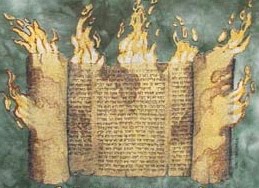
One way I choose to read this is that the “power” of speech comes from our being made in the “image of God” and that it defiles something about our Creator when we misuse this unique gift that he has provided only to humanity. Also, when we use this unique gift to harm another, we are injuring something of that “image” in the other person. Harmful speech damages not only that aspect of God in which we were made, but the same aspect in the other human. It is as if we are using “the power of the word” to damage or destroy “the power of His Word.” So we are hurting ourselves, hurting someone else, and “hurting” God when we commit “lashon hara”. Why is it so easy (I say this, because such speech is exceptionally common in the blog comments I read in the religious blogosphere) for us to spew our insults and harsh words on other brothers and sisters in the faith?

Haven’t we read what the Master said about this?

It is not what enters the mouth that contaminates the person, but what comes out from the mouth – that contaminates the person. –Matthew 15:11 (DHE Gospel)

Even the brother of the Master teaches this lesson.

Not many of you should become teachers, my brothers, for you know that we who teach will be judged with greater strictness. For we all stumble in many ways. And if anyone does not stumble in what he says, he is a perfect man, able also to bridle his whole body. If we put bits into the mouths of horses so that they obey us, we guide their whole bodies as well. Look at the ships also: though they are so large and are driven by strong winds, they are guided by a very small rudder wherever the will of the pilot directs. So also the tongue is a small member, yet it boasts of great things.

How great a forest is set ablaze by such a small fire! And the tongue is a fire, a world of unrighteousness. The tongue is set among our members, staining the whole body, setting on fire the entire course of life, and set on fire by hell. For every kind of beast and bird, of reptile and sea creature, can be tamed and has been tamed by mankind, but no human being can tame the tongue. It is a restless evil, full of deadly poison. With it we bless our Lord and Father, and with it we curse people who are made in the likeness of God. From the same mouth come blessing and cursing. My brothers, these things ought not to be so. Does a spring pour forth from the same opening both fresh and salt water? Can a fig tree, my brothers, bear olives, or a grapevine produce figs? Neither can a salt pond yield fresh water. –James 3:1-12 (ESV)

If you’ve been a Christian for any length of time, you already know these lessons and you know what they mean. If you then continue to deliberately use your speech (or what you write in blog comments or discussion threads on the Internet) to hurt someone else, you must realize that you are also deliberately disobeying the teachings of Jesus and spitting on the will of God. Please keep that in mind.

I am sometimes questioned about how I can use Jewish teachings to help me better focus on the lessons of Jesus (and no, I am not a “mere imitator of Judaism” in my faith or practice), but I find many seemingly associated themes. I don’t know that they are directly connected in any manner, but I find them comforting nonetheless.

Today’s daf discusses the negative consequences of speaking leshon hara.

Once a certain father heard that a child of the rebbe of Toldos Aharon, zt”l, wished to make a match with his daughter. He was overjoyed…until someone told him that the young man was not in his right mind. Obviously, the father was distressed. He was also worried about how to ascertain the truth; surely a maggid shiur or other person within the Toldos Aharon system wouldn’t say anything negative about the rebbe’s grandson.

He finally decided to ask the rebbe himself, since he was certain that the tzaddik would not deceive him. When this question was put to the rebbe he denied the claim against his grandson. “I know that child since he was born. No one has ever thought there was anything wrong with him.”

The father was very glad to hear this, but also furious at the one who had slandered the innocent bochur, and immediately blurted out, “Do you know who told me? It was…”

“Just a moment,” the rebbe firmly interrupted, “It is a question of leshon hara. Perhaps you are forbidden to tell me. Working out whether this is permitted is no simple matter. I am going on a fundraising trip for two weeks in the next few days. When I return you are welcome to come back and I will tell you the halachah.” When the rebbe was away, he learned the entire Sefer Chofetz Chaim through twice with great care. When he returned, the father of the girl—now engaged to the rebbe’s grandson—came to ask whether he was permitted to tell the rebbe who had slandered the bochur.

The Rebbe of Toldos Aharon said, “I learned the sugya very carefully while I was away and I concluded that if you don’t derive any pleasure in the telling, you are permitted to tell me who slandered the young man.”

Before the man could say a word, however, the rebbe stopped him with a motion. He astounded the man with his concluding words, “It may be permitted, but nevertheless, I do not wish to hear about it!”

Daf Yomi Digest
Stories Off the Daf
“A Question of Leshon Hara”
Arachin 15

We may not be able to prevent our brother from using harmful speech or trying to “stir the pot,” but we can certainly control our own tongues (or fingers on the keyboard). And like the Rebbe of Toldos Aharon, when someone is about to speak in such a manner, even if it is “permitted,” we can refuse to listen and refuse to respond.


The Many Paths of God

It is very difficult to fathom how two opposing opinions can both be correct. The Ritva explains this in a wondrous manner: “When Moshe received the Torah at Sinai, God provided him with forty-nine perspectives to declare a matter pure, and forty-nine to declare it impure. Moshe Rabbeinu asked, ‘Master of the universe, why are these necessary?’ God answered, ‘So that they should be transmitted to the sages of every generation, that the law will be determined by them in accordance with the needs of their time.'”

This teaches that there are many valid paths to genuine Torah observance, all of which were received by Moshe on Sinai. But of course not all statements made are the words of the living God. As we find on today’s daf, sometimes a statement thought to be a mishnah is no mishnah at all. This means that sometimes what appears to be part of the chain of tradition is actually not and needs to be clarified as such.

Rav Menachem Mendel of Rimanov, zt”l, explains how the baalei mishnah reached a state in which they could draw down an authentic mishnah. “The baalei ha’mishnah explain how the oral Torah emerges from the written Torah. They could only draw down a genuine mishnah by completely nullifying all of their physical senses and immersing themselves absolutely in learning Torah. Once they reached this state they touched the inner essence of Torah and could determine the halachah and set down various mishnayos. When the sages perceived that a certain statement was not reached through this arduous process they declared it incorrect.

Daf Yomi Digest
Stories Off the Daf
“This is Not a Mishnah!”
Bechoros 56

Ohmygosh! What did I just say?

This teaches that there are many valid paths to genuine Torah observance, all of which were received by Moshe on Sinai.

That statement is bound to cause something of a stir in various religious circles. It is doubtful that Christianity will accept that there are many valid paths to genuine obedience to God since we have the Master’s own words saying that there is only one way to the Father, and that is through the Son (John 14:6). Of course this is midrash we’re talking about, so it’s not as if we have to believe the “conversation” between Moses and God actually took place as recorded in our “story off the daf”. I seriously doubt that many people participating in the “Messianic” movement will be enthusiastic about this midrash either, since most of the arguments I see in the blogosphere are about obeying the Torah in only one possible way.

That, of course, doesn’t make a lot of sense from a Jewish perspective, because there really is more than one way to perform a mitzvah, depending on various circumstances. For instance, how Askenazi Jews perform some of the mitzvot and how Sephardic Jews perform those mitzvot may vary drastically. And while there may be some debate between those two groups, no one is suggesting that the Ashkenazi are the only ones who “do it right” and that the Sephardic Jews “do it wrong”…or vice versa. And frankly, even if that suggestion exists, it’s not enough to compel one group or the other to change their traditions. How a Jew performs the mitzvot and understands his or her duty to God is largely based on tradition.

But how can the midrash dare to quote a conversation between Moses and God that, in all likelihood, never took place? Remember what I said in The Rabbinization of Abraham. In order to carry the Torah forward with Judaism in the centuries after the destruction of the Second Temple, Talmudic Judaism found it necessary to “refactor” the past, projecting the view of the Rabbis of the Common Era back onto Abraham and Moses. You and I may not find this “refactoring” to be accurate or factual, but if you understand the function and purpose of Chasidic Tales, you’ll understand that many great and important truths can and must be transmitted without necessarily being based totally on fact. Christians have a tough time understanding this, but it is also likely that not everything (hold on to your hats) in the Gospel accounts of the days of Jesus is literal fact.

Did that surprise you? If you think about it for a few minutes, it probably won’t.

(I should say that this point that when I realized this, I went into a crisis of faith and struggled a great deal with the idea that my faith was based on a book that was neither a legal document in full, or a newspaper reporter’s account of the “facts”).

If you don’t believe me, pop over to Derek Leman’s blog and read this write up, Passover, Last Supper, Crucifixion: 2011 Notes, Part 2. Leman illustrates in no-nonsense terms how the different Gospel versions of the Master’s death cannot be reconciled with each other, no matter how much literary and scriptural “slight of hand” you choose to employ.

So why shouldn’t we use midrash to understand mishnah and scripture? Perhaps they are useful tools after all.

This brings us back to the idea that there may be more than one way to obey God. This brings us back to the idea that there may be one way for a Jew to obey God relative to the Messiah and Torah, and a different but still correct way for a Gentile disciple of the Master to obey God. Are these two covenants? That suggestion is usually viewed with horror, especially if taken to the extreme and seen as “the Jews have Moses and the Gentiles have Jesus.” I’m not suggesting that (although the dynamics involving religious Jews who are not “Messianic” is certainly complex). I’m suggesting that for Jews who are disciples of Jesus and for Gentiles who are disciples of Jesus, there may be two paths to obedience based on identity and “covenant connection” (Jews were at Sinai and any Gentiles who were also present were absorbed into the Children of Israel, probably within three generations). The Jews have the Mosaic covenant connection which was not designed to accommodate non-Jews except for those Gentiles who were on the “multi-generational conversion track”. The Messianic covenant is unique in that it accommodates Jewish identity, allowing “Messianic Jews” to remain Jews (this is all heavily flavored by my opinions here) and also it allows Gentiles to enter into a covenant relationship with God, being “grafted in” as “wild branches” onto the “civilized tree” (note that the grafted in wild branches remain wild for the lifetime of the tree and don’t “morph” into civilized branches) and they can still remain Gentiles…forever.

Now we come back to the key phrase in today’s midrash.

This teaches that there are many valid paths to genuine Torah observance, all of which were received by Moshe on Sinai.

If you’re a non-Jew and you’re upset with how someone else is interpreting Gentile “Torah obedience”, figuring your way is right and their way is wrong, hold up a minute. First off, you Gentiles may not have any sort of “Torah obedience” based on the Mosaic covenant, so you may be traveling on the wrong path all together. Second, even within Judaism, as I previously mentioned, there is more than one accepted halacha to performing the mitzvot.

Hopefully, this will shake up someone’s moral certitude the next time they get into an Internet argument about how the Torah is supposed to be obeyed. If you continue to do your studying and are honest about it, you may find your assumptions challenged. The great Hillel was the master of teaching this lesson to potential converts, as recorded at SaratogaChabad.org.

Let us use the famous story of Shammai, Hillel and the three converts (Shabbos 31) to demonstrate the fusion of Halacha and Aggadah,: A gentile once came to Shammai, and wanted to convert to Judaism. But he insisted on learning the whole Torah while standing on one foot. Shammai rejected him, so he went to Hillel, who taught him: “What you dislike, do not do to your friend. That is the basis of the Torah. The rest is commentary; go and learn!” Another gentile who accepted only the Written Torah, came to convert. Shammai refused, so he went to Hillel. The first day, Hillel taught him the correct order of the Hebrew Alphabet. The next day he reversed the letters. The convert was confused:”But yesterday you said the opposite!?” Said Hillel: “You now see that the Written Word alone is insufficient. We need the Oral Tradition to explain G-d’s Word.” A third gentile wanted to convert so he could become the High Priest, and wear the Priestly garments. Shammai said no, but Hillel accepted him. After studying, he realized that even David, the King of Israel, did not qualify as a cohen, not being a descendant of Aaron

The convert was not just acting silly by standing on one foot; he was actually symbolizing his quest for true unity. This gentile had left behind a confusing plethora of pagan gods and multiple deities. He searched and finally found Monotheism, One Torah and One G-d, wanting to live by a single unifying principle, the ‘one foot’ on which all else stands. Hillel taught him that the underlying principle that unites all is Jewish Love. The second convert, had rejected the other man-made religions as human concoctions, was attracted to the Divine Torah, which consisted solely of G-d’s word. He was shocked to find that we follow a Rabbinical tradition. He wasn’t being rebellious, but sincerely asking a valid question; “I wish to observe G-d’s word alone, not any human additions.” Hillel creatively showed him that the two Torahs are not two separate systems, but are one and the same. The written word and the oral traditions complement each other. It is as basic as the Aleph Bais, where you can’t have one without the other. Indeed, the Torah itself bids us to follow the enactments of the sages. The third convert, disillusioned with pagan shallowness, aimed for a higher meaning to life. He yearned to reach the highest level, assuming that being a High Priest is the ultimate spiritual fulfillment.

Hillel didn’t just chase these would-be converts away, he (seemingly) accepted them on their own terms but allowed them to study and discover their own errors. Once they did so, they put aside their original assumptions and realized that in order to convert, they had to accept the Torah as it was within the Jewish framework of their day.

May God grant us the ability, wisdom, and will do to the same.

Fighting Words

Teshuvas Minchas Yitzchok was asked about people who daven in the summer in a field, how far apart they could be spread and still constitute a minyan. Does the matter depend upon whether they could see one another, whether they could all hear the sh’liach tzibbur or perhaps they have to stand within four amos of one another since the pasuk (Devarim 23:15) indicates that a person’s camp is four amos. He responded that combining for a minyan depends upon two factors. The first prerequisite is that everyone must be able to hear the sh’liach tzibbur. This is based on Shulchan Aruch’s ruling that if nine people do not listen to the sh’liach tzibbur it may be that the berachos recited by the sh’liach tzibbur are berachos l’vatalos. The second prerequisite is that the participants in the minyan have to be capable of seeing one another. This is based on Pri Chadash’s ruling that when two groups of people are in different rooms they combine to make a minyan if some of them could see one another. Although there are authorities who disagree, in the case of an open field all opinions would agree since there is no wall dividing the group into two that seeing one another is sufficient for them to combine.

Our Mishnah teaches that animals combine for tithing if they are in an area “as large as an animal’s grazing range.” This is defined by the Mishnah as an area of sixteen mil. Rashi explains that this refers to the size of an area in which animals could spread out but still be watched by a single shepherd. Sefer Imrei Devash also wondered whether the discussion in our Mishnah has bearing on the question of how far apart a group of people may be spread out and still constitute a minyan. Perhaps they can be as far apart as sixteen mil since they should be able to see one another but perhaps forming a minyan follows a different set of rules. He leaves the matter unresolved.

Daf Yomi Digest
Halacha Highlight
“Forming a minyan in a field”
Bechoros 54

I recently wrote an article about tradition and how our religious traditions add context and meaning to our worship of God. This is true in any religion I believe, but especially true in Judaism. Perhaps for that reason, Christianity tends to give Judaism a really hard time because of all its “man-made traditions.” The problem for most Christians, even those who otherwise find great beauty in Jewish religious practice and study, is that Jewish traditions are given the weight of authority and even appear to override the plain meaning of the Torah text, seemingly positioning the Rabbinic sages above God. While Judaism doesn’t have this perspective, the ability of most Christians to see from a Jewish point of view is extremely limited, which produces a lot of misunderstanding and, to my way of thinking, unjustified criticism.

I’ve been involved in conversations regarding tradition and Talmudic rulings at a number of blogspots recently including those written by Judah Himango and Derek Leman. Derek especially has been vocally dynamic in this area, writing two subsequent blog posts answering specific questions posed by individuals: Answering Dan and Answering Peter. Although most if not all of the people involved in the discussions on these blogs are in some way attached to the Messianic Jewish and Hebrew Roots movements, there is a great deal of difficulty in understanding and accepting how tradition and rabbinic authority work in the Jewish world and particularly within Orthodox Judaism.

For some people, it’s not enough to understand that, if you don’t belong to an Orthodox community (and especially if you’re not Jewish), you do not have to consider yourself bound by their rulings and traditions. You can choose your own traditions and make them as flexible and non-binding as you’d like (though you probably shouldn’t imagine that your own traditions create a formal “Judaism”). For some of these individuals though, it is important to prove that Jewish tradition is “wrong” and goes against God. The presumption for the other side of the coin is that their own interpretation of the Bible is “right” and can be used to manufacture a “true” Jewish or Hebrew Roots religion more in line with God. Scriptures such as Mark 7:1-23 are often cited to support how Jesus disdained Jewish man-made traditions and supposedly taught only from the “pure” Word of God (although we have a good indication in John 10:22 that Jesus celebrated the tradition of Chanukah).

I specifically quote the “Halacha Highlight” above because of the following line:

Perhaps they can be as far apart as sixteen mil since they should be able to see one another but perhaps forming a minyan follows a different set of rules. He leaves the matter unresolved.

The collection of talmudic rulings and judgments and their associated commentaries are vast and it literally requires years of study to become even somewhat proficient at understanding their wisdom and meaning. Here we also see that these rulings and commentaries are not always definitive. That is, they don’t always take the force of “thou shalt not” or “thou shalt” and many discussions on halakhic matters are left “unresolved.” In fact, the validity of judgments and how (or if) they are to be enacted can be hotly debated to this very day in Rabbinic circles. There is not always absolute agreement about how these “man-made traditions” are to be lived out in everyday Jewish existence. Local authorities often contradict more historic and global sages and typically, a Jew will form their religious practice around the decisions of their Rebbe or local synagogue Rabbi.

So why should you care?

If you’re not Jewish, you don’t have to. Even if you are Jewish, if you don’t consider any rulings of any Rabbis anywhere, including what we have recorded in Talmud, as authoritative, then you don’t have to care either (unless you suspect that somewhere inside those rulings is the will of God). There are plenty of atheist Jews who work on Saturday, eat ham sandwiches and shrimp scampi, and who have never worn a tallit (let alone prayed to God). They apparently don’t care about what the Talmud says and if you are a Jewish person who is religious but not in a traditional Jewish manner, then you can also decide not to care.

That doesn’t mean the Rabbinic sages don’t have authority within their communities, it just means you choose not to consider them having authority over you and your community. God will sort all that out at some point and then we’ll know for sure. Right now, there’s enough doubt to result in their being many different ways to live as a religious Jew let alone as a religious Christian (including Gentile Messianic and Hebrew Roots). Either God accepts the variations we have created with the patience of a kind Father toward small and confused children or He’ll show us all where we “got it wrong” in the end of days.

However, human nature says we’re going to continue to jockey for position, so to speak, and attempt to establish our own authority and “correctness” relative to the people and groups with which we disagree. We see that happening all of the time, even within the context of the Talmud itself. Judaism isn’t always about “getting it right” but rather, it’s sometimes about struggling with the Torah, other Jews, and God. It’s not a crime to disagree in Judaism (but don’t try it in Christianity or the “Messianic” worlds unless you want to get into the spiritual equivalent of a bar fight), it’s expected, and on just about any subject.

A few days ago, I was talking with my wife about a topic on which I was emotionally sensitive and she started arguing with me. I have to admit, I got kind of put out by her attitude and started to walk away when she stopped me. She reminded me that we’ve been married for almost 30 years and that she’s always argued. She then said something like, “I’m Jewish. I argue. That’s what we do.” In other words, she was saying, “Don’t take it personally.” I like a good debate every now and then (though obviously, not on every possible occasion) and one of the things I try to promote is being able to disagree without personalizing conflict. This is quite possible, even outside of a Jewish context. I’ve seen a prosecuting and a defense attorney practically come to blows in open court during a trial only to become best friends and make dinner plans together after the trial was over and the jury left the courtroom.

It’s tough not to take religious arguments personally because our faith is the most personal thing about who we are. When someone disagrees with how we perceive our faith, we hear that disagreement as “them’s fightin’ words”, to employ an old, Western TV show phrase. In fact, they aren’t “fightin’ words” unless we choose to make them such. Still, the best many of us can do is “agree to disagree” and drop the conflict as “unresolved” (see my opening quote at the top of the page). Like it or not, that’s the way we are going to have to leave many of our questions and disagreements…until the time of Messiah’s return.

Until then, may we all find the ways of peace with each other, no matter how differently we see ourselves and God.

The blessing Jacob gives Judah concludes with the words: “his eyes will redden from wine, and his teeth white from milk.” Rabbi Yochanan says homiletically (Kesubos 111b) that you can read it as “teeth whiter than milk” — to give a smile to a friend is even greater than giving him nourishment.

When someone comes collecting charity, it is a difficult and often thankless job. Rejection can break a person’s spirits and keep him or her from continuing, no matter how important the cause. So, as it happens, a smile may be one of the most important things you can give — you can brighten that person’s spirits and enable him or her to persevere.

Closer to home, there is no one who doesn’t have a “hard day” now and then. There are great people who have tremendous internal reserves of happiness, so that no matter what, it seems like they are always happy. Even people like that need an encouraging word now and then — much less the rest of us, who sometimes just want to crawl back into bed and start over tomorrow, if not next week!

To be generous of spirit is at least as important as being generous with money — and when it comes to smiles, the more you give, the more you have!

-Rabbi Yaakov Menken
“Brother, Can you Share a Smile?”
Commentary on Torah Portion Vayechi
ProjectGenesis.org

Vayechi: Living Forever

When the Tzemach Tzedek was a young boy, his cheder teacher taught him the verse: “And Yaakov lived in the land of Egypt for 17 years,” explaining that these were the best years of Yaakov’s life. The Tzemach Tzedek asked his grandfather, the Alter Rebbe: How was it possible that the best years of Yaakov’s life would be spent in a depraved land?

The Alter Rebbe answered him: Even before he arrived, Yaakov sent Yehudah to Egypt to establish a yeshivah. When one studies the Torah, one comes close to G-d. This closeness allows one to live with true and genuine vitality, even in Egypt. Indeed, the depravity of Egypt enhanced the vitality experienced by Yaakov. For the transformation of darkness reveals a higher quality of light. Yaakov’s establishment of Torah life amid the darkness of Egyptian society expressed the essential vitality he possessed and endowed to his children.

-Rabbi Eli Touger
In the Garden of Torah
“True Life”
Commentary for Torah Portion Vayechi
Adapted from
Likkutei Sichos, Vol. X, p. 160ff; Vol. XV, p. 422ff;
Sichos Shabbos Parshas Vayechi, 5751
Chabad.org

For most of us, the idea that Jacob had established a yeshivah in Egypt prior to taking his family down into that land seems a little farfetched. About a month ago, I wrote a missive on the Rabbinization of Abraham that tried to make some sort of sense of the Talmudic writers “reinventing” ancient events in the post-Second Temple world. However, in a metaphorical and perhaps spiritual sense, I think we can understand the words I just quoted in a way that can apply to those of us who are people of faith today.

How can we say that Jacob’s last 17 years of life in the idolatrous land of Egypt were the happiest of his life? One way is to realize that for the previous two decades, Jacob thought that Joseph was dead; ripped apart and probably consumed by a wild beast. Jacob never fully recovered from this event and lived in grief and sorrow from that time on…until discovering Joseph was alive. Joseph saved his family from the continuing famine by relocating them to the rich and fertile region of Goshen in Egypt. What could Jacob desire now that his family was safe and cared for and that he was reunited with his beloved son? What more could he want now that he lived even to see and bless his grandchildren by Joseph in Egypt?

But he lived in Egypt which is usually, to put it mildly, is a “spiritual no-no.” Assuming he wasn’t studying Torah in the “tents of Shem”, so to speak, besides what I mentioned in the previous paragraph, is there any other reason Jacob should have considered his old age in Egypt as the best years of his life?

So Israel set out with all that was his, and he came to Beer-sheba, where he offered sacrifices to the God of his father Isaac. God called to Israel in a vision by night: “Jacob! Jacob!” He answered, “Here.” And He said, “I am God, the God of your father. Fear not to go down to Egypt, for I will make you there into a great nation. I Myself will go down with you to Egypt, and I Myself will also bring you back; and Joseph’s hand shall close your eyes.” –Genesis 46:1-4

Jacob had God’s promise that he would see Joseph, which he did, that Joseph would “close his eyes”, which he did, that God would make his descendents into a great nation in Egypt, which He did, and that God would escort Israel out of Egypt and bring them back to the land of promise, which He did. Although Jacob lived his declining years in relative comfort, even if he were poor and half-starved, I still suspect they might have been his “best years” if only because of God’s promises. The exile wasn’t permanent. Even in the land of idols, God was with Israel, even in the land where his children would become slaves.

What does that say about us? If this Torah Portion can’t be applied to us, it makes an interesting study but little else. However, there are lessons we can take and use in our own lives as we work, play, marry, raise families, and grow old within the context of a fallen world, surrounded by the idols of our society. We have God’s promises, too.

Therefore, there is now no condemnation for those who are in Christ Jesus, because through Christ Jesus the law of the Spirit who gives life has set you free from the law of sin and death. For what the law was powerless to do because it was weakened by the flesh, God did by sending his own Son in the likeness of sinful flesh to be a sin offering. And so he condemned sin in the flesh, in order that the righteous requirement of the law might be fully met in us, who do not live according to the flesh but according to the Spirit. –Romans 8:1-4

As for you, you were dead in your transgressions and sins, in which you used to live when you followed the ways of this world and of the ruler of the kingdom of the air, the spirit who is now at work in those who are disobedient. All of us also lived among them at one time, gratifying the cravings of our flesh and following its desires and thoughts. Like the rest, we were by nature deserving of wrath. But because of his great love for us, God, who is rich in mercy, made us alive with Christ even when we were dead in transgressions—it is by grace you have been saved. And God raised us up with Christ and seated us with him in the heavenly realms in Christ Jesus, in order that in the coming ages he might show the incomparable riches of his grace, expressed in his kindness to us in Christ Jesus. –Ephesians 2:1-7

Pouring waterRabbi Touger’s commentary says something more to us.

True life can be ascribed only to G-d, as it is written: “And G-d your L-rd is true; He is the living G-d.” Just as Truth is uninterrupted and unchanging, so too life is in essence unchanging and eternal. Thus our Sages describe a stream as “living water” only when it flows constantly.

On the last day of the festival of Sukkot, the Master declared that he is the living water (John 7:37-41) and thus our “true life” is in him. We also know that no one who has perished trusting God has actually died, for God is a God of the living (Luke 20:38). Rabbi Touger also tells us this.

The above enables us to understand why the Torah reading is named Vayechi “And he lived” although it speaks of Yaakov’s death. As the events of the reading demonstrate, Yaakov’s life was one of connection to G-d that transcended material settings. And since he shared this quality with his descendants, it was perpetuated beyond his mortal lifetime. As our Sages say: “Yaakov, our ancestor, did not die. As his descendants are alive, he is alive.”

We also know that our “Egypt”, just as Jacob’s, is not forever.

Therefore, Yaakov called his sons together with the intent of revealing the time of the Redemption to them. He assured them that they would be redeemed from Egypt, promising: “G-d will be with you, and He will bring you back to your ancestral land.” For it is in Eretz Yisrael and more particularly, in the Eretz Yisrael of the Redemption that Yaakov and his descendants will truly flourish.

We have that promise as well.

Then I saw “a new heaven and a new earth,” for the first heaven and the first earth had passed away, and there was no longer any sea. I saw the Holy City, the new Jerusalem, coming down out of heaven from God, prepared as a bride beautifully dressed for her husband. And I heard a loud voice from the throne saying, “Look! God’s dwelling place is now among the people, and he will dwell with them. They will be his people, and God himself will be with them and be their God. ‘He will wipe every tear from their eyes. There will be no more death’ or mourning or crying or pain, for the old order of things has passed away.” He who was seated on the throne said, “I am making everything new!” –Revelation 21:1-5

Regardless of where we live, how we live, our day-to-day circumstances, our fears, our mistakes, our illnesses, and our woes, we are His if we know our God and trust in Him. The promises come to us from the Master, the Savior, the Messiah, the Son of God so that we can be reconciled and also be considered sons and daughters of the Most High. If we allow our souls to sail upon the winds of hope, we too will never die because God lives forever.

To one whose self is his body, death of the body is death of the self. But for one whose self is his love, awe and faith, there is no death, only a passing. From a state of confinement in the body, he makes the passage to liberation. He continues to work within this world, and even more so than before.

The Talmud says that Jacob, our father, never died. Moses, also, never died. Neither did Rabbi Judah the Prince. They were very high souls who were one with Truth in an ultimate bond—and since Truth can never die, neither could they.

Yes, in our eyes we see death. A body is buried in the ground, and we must mourn the loss. But this is only part of the falseness of our world. In the World of Truth, they are still here as before.

And the proof: We are still here. For if these high souls would not be with us in our world, all that we know would cease to exist.

-Rabbi Tzvi Freeman
“High Souls”
Based on letters and talks of the Rebbe
Rabbi M. M. Schneerson
Chabad.org

Transform darkness into light. Good Shabbos.

God is in the Backyard

We don’t say a person “will be going to heaven.”
We say this person is “a child of the world to come.”

Heaven is not just somewhere you go.
It is something you carry with you.

-Rabbi Tzvi Freeman
“Heaven”
Based on letters and talks of the Rebbe
Rabbi M. M. Schneerson
Chabad.org

Well, I – I think that it – it wasn’t enough to just want to see Uncle Henry and Auntie Em – and it’s that – if I ever go looking for my heart’s desire again, I won’t look any further than my own back yard. Because if it isn’t there, I never really lost it to begin with! Is that right?

-Dorothy
The Wizard of Oz (1939)

Sometimes I don’t think we know what we want as people or faith. Sometimes I don’t think we know what we have. We are always looking off to the horizon, off to the brightest star in the sky or at the furthest cloud on the wind. We look for God in Heaven and long for the return of Jesus but we forget that we are right here and that God is with us. We forget that we have a job to do here. We forget that God expects us to be His junior partners in repairing a broken world and paving the way for the Messiah’s coming.

Earlier this month, I wrote a blog post called The New Testament is Not in Heaven, the title of which, is a play on the words of the Torah in Deuteronomy 30:12. Here we see Moses giving the Children of Israel his final, impassioned speech before he proceeds to his own death and sends the nation of Israel across the Jordan and into war without his leadership.

The Torah is not in Heaven. What does this mean except that what we need from God is not far from us at all. What we have, as Rabbi Freeman tells us, is what we carry with us. Dorothy too tells us that if we think we are missing something, it isn’t missing at all. It’s as close as our “own back yard.” Why do we pretend that God is distant and His will is far away?

“Teacher, which is the greatest commandment in the Law?”

Jesus replied: “‘Love the Lord your God with all your heart and with all your soul and with all your mind.’ This is the first and greatest commandment. And the second is like it: ‘Love your neighbor as yourself.’ All the Law and the Prophets hang on these two commandments.” –Matthew 22:36-40

He has told you, O man, what is good; and what does the LORD require of you but to do justice, and to love kindness, and to walk humbly with your God? –Micah 6:8

I’ve written about all this before, using the same scriptures and perhaps even repeating some of what I’ve written for today. Yet those who claim the cause of Christ still look far away for God, still think He can be captured in a list of “dos” and “don’ts”, still think it is pagan to want to feed the hungry rather than condemn a fir tree decorated with lights. Perhaps for those who pursue a spirit of disdain, God is far away. How can we ever share the good news of Christ while we’re spilling out the darkness in our hearts and calling it light?

Why do you see the speck that is in your brother’s eye, but do not notice the log that is in your own eye? –Matthew 7:3

Take the plank out of your eye and start looking for God. I think he’s in the backyard near the flower bed.

The Difference Between Night and Day

In creating the whole of existence, G-d made forces that reveal Him and forces that oppose Him –He made light and He made darkness. One who does good brings in more light. One who fails, feeds the darkness.

But the one who fails and then returns transcends that entire scheme. He reaches out directly to the Essential Creator. Beyond darkness and light.

And so, his darkness becomes light.

-Rabbi Tzvi Freeman
“Returning Light”
Based on letters and talks of the Rebbe
Rabbi M. M. Schneerson
Chabad.org

How do you tell the difference between night and day? In a literal sense, all you have to do is look outside to see if it is light or dark. You can also check any of the devices that tell us what time it is on a 24-hour clock, usually available through the Internet, so that you know not only whether it is day or night, but the precise time as well.

How do you tell the difference between fact and fiction? Well, we know that the things we see on TV shows and movies such as Star Trek are pretty much fiction. No one can really visit other planets, “beam” to destination from tens of thousands of miles away, or diagnose complex medical ailments with a wave of a “tricorder”. We do know that we can only barely visit the moon, which we haven’t done in manned-exploration in decades, launch rockets to an orbiting space station on a semi-regular basis, and that while modern medical technology can diagnose many illnesses, much of what people suffer from remains a mystery.

How do you tell the difference between truth and falsehood? I don’t mean whether or not a used car salesman is trying to cheat you by lying about the condition of a car you are thinking of purchasing, but what about God’s truth? How do you know what is true about God and what is not? You may think you know the answer to that question in some canned way (“the truth is in the Bible”) but it’s not that easy.

Yesterday, Messianic blogger Derek Leman published a missive called Mainstream vs. Crackpot Scholarship, and I enthusiastically congratulate him on this effort. In virtually every established religious tradition, there is solid, well-researched information that acts as the basis for the beliefs and faith of the adherents of said-religious traditions. There is also a bunch of “junk scholarship” which is based on bad interpretation of holy writings, wishful thinking, and outright lies. Before continuing here, please visit Derek’s blog via the link above and see what he has to say in detail.

Learning in the “information age” has become exponentially confusing. Anyone can create a website, blog, or YouTube video in minutes spouting off their particular brand of theology, philosophy, or teaching on “truth”. The proponents of “black helicopters” are no longer confined to “fringie” TV or radio broadcasts. Now they are available via Google and for the many who lack formal training in Biblical scholarship, it can be very difficult to separate the wheat from the chaff.

How does one tell the difference between junk and quality teaching? Besides consulting reliable sources, which Derek has offered to provide, you might want to start by examining your “wishful thinking”. We all have a “theological ax to grind” so to speak. We all have our sacred cows that we are unwilling to slaughter on the altar of established Biblical reality. There are things that we don’t want to give up in our belief system, not necessarily because they are solid religious truth, but because they make us feel better and they sound just so “cool”.

However “cool” is not necessarily “truth”.

In an absolute sense, we search for truth all of our lives. This isn’t just a statement applied to religious people but to all people. We want to find the meaning and purpose of our lives so that we have some sort of context for our existence and our actions. We want a direction. We want a moral and ethical compass. Where do we find it? Some find their reality in secular humanism and the established scientific facts (and I remind you that facts and truth are not the same thing). Some find it among the plethora of religious disciples that exist in the world today. Some find it in sex, drugs, booze, entertainment venues, or whatever distractions and pleasures we find in the society around us. In the latter case, they don’t concern themselves with a “truth” outside of their personal existence, they just hide in a cocoon of unreality and hope for the best.

Some, as Derek pointed out, seek their truth in the fantastic, the amazing, the “gee whiz” junk scholarship that exists at the far edges of more legitimate religions, as if a faith in the One, Supreme, Creative, God were not “fantastic” enough for their imaginations.

What are we looking for? Truth? Not exactly.

We’re looking for a truth that fits who we think we are. We want a truth that we can easily accept without having to turn ourselves inside out and anguish over having possibly been wrong about our existence and about God for all of our lives up to this point. We want a truth that we have control over. To do that, we have to take truth away from God.

OK, to be fair, there is no one person or one denomination or sect that can say they have absolute ownership of total and untainted truth from God. There are plenty of traditions that make this claim, but none of those claims can be established without question. Within Judaism and within Christianity, there are many different traditions and ways to understand truth but they are not truth in and of themselves. We cannot access “pure truth” from God. Perhaps no person has, not even Abraham or Moses, though they certainly came closer than we have today. I would say that Jesus knew that truth first hand, but the Messiah is unique and though we Christians aspire to be like him, we can only travel up the path but not fully achieve the destination, at least not this side of paradise.

Some people just settle for less and after a time, they pretend that they have discovered what they want. Then they truly believe the illusion is real. Here’s what I mean.

The Midrash Tanchuma in Shemini tells a very striking story about how overindulgence in wine can warp one’s understanding: “When a drunk is inebriated he sits joyfully as though in Gan Eden. There was a pious man whose father drank publicly, much to the humiliation of his son. The pious man said, ‘Father, I will purchase fine wine and bring it to your house if you will only stop frequenting taverns. When you go to such places you shame me and yourself.’ Each day he would bring his father spirits to drink in the morning and the evening. When his father would pass out, the son would place him in bed to sleep it off.

‘One rainy day, as the upstanding man walked through the market on his way to shul, he noticed a drunk lying in the middle of the marketplace. Water was streaming over him as children hit him and threw dirt in his face and stuffed it in his mouth. The son thought, ‘I will bring my father here. Seeing the shame of this drunk will finally cure him of his obsession to drink wine.’ When his elderly father witnessed this spectacle, he bent down to the drunk and whispered in his ear. His son was horrified to over hear his father ask, ‘Tell me, my friend. In which pub did you procure such potent liquor?’ The mortified son cried, ‘Father is that what I brought you here for? Do you not see the incredible embarrassment this man suffers because of his habit?’

“The elderly father replied, ‘My son, I have no pleasure in life besides drinking. This is my Gan Eden!’”

Mishnah Berura Yomi Digest
Stories to Share
“The Drunkenness of Lot”
Siman 128 Seif 37-38

I know a secular person could read what I’ve written so far and say to me that by accepting my religious convictions as truth, I have given up and am pretending that my “fiction” is real. I don’t blame that secular individual, because what any person who has faith and trust in God believes certainly seems fictional to one who is not so oriented. Paul even spoke to this person.

The natural person does not accept the things of the Spirit of God, for they are folly to him, and he is not able to understand them because they are spiritually discerned. –1 Corinthians 2:14 (ESV)

Unfortunately, a person that subscribes to what I consider beliefs based on junk scholarship may also say that the “spirit” revealed these “truths” to him. Some months ago, I wrote a blog post called The Irrelevant Drunkard which addressed many of the issues I bring up today. In that “meditation”, I urged my readers not to judge other variants of our faith too harshly, for how indeed to we know in absolute terms that they are always wrong and we are always right? How do we know that there is only one way to pray and it is the way that we pray? How do we know that there is only one way to conduct a worship service and it is the way we conduct a worship service? How do we know that we have our facts and particularly our truth lined up with God and that only we have the inside scoop to those facts and that truth?

We don’t. But we have a place to start.

We have a way to tell the difference between night and day, but to use it, we have to do something we don’t want to do. We have to temporarily suspend our beliefs and our assumptions, then access established and reliable sources of information about our faith. That means, no matter how attractive and fanciful a source may seem, we have to discard it, if it is on the list marked “junk scholarship”. I said before that no person or tradition has unfettered and unfiltered access to God’s truth and the same goes for God’s Bible. It is interpreted. In Judaism, it is impossible to understand the Bible apart from established tradition. You don’t just get to shoot from the hip and call it “spiritual exegesis”.

When you pray to God for wisdom and truth, try very hard not to imagine how God will answer that prayer. In fact, expect God to answer you in a way that you totally didn’t anticipate. If God responds to you in exactly the manner in which you envisioned, perhaps it’s not the Spirit of God speaking but the “spirit” of your own wants, needs, and desires. God rarely gives us what we want in exactly the way we want it, only speaking to confirm that our human imagination was “right” all along.

What is the difference between day and night? In a way, we spend all of our time looking out the window, going outside, moistening our finger and testing the wind, just to try to find out. There is truth. God is truth. I believe that. I trust that very much. But it is not something that once established, can be safely locked inside a drawer in a cabinet after being filed under “T” for truth. It is something that we examine and pour over every minute of every day, like trying to decipher a code written by men separated from us by thousands of miles and tens of centuries. It’s like attempting to loosen an infinite knot looped and tied within the fabric of an endless and inscrutable reality.

Rabbi Jerome Epstein once wrote:

As a Jew, I believe that the coming of the Messiah does not depend on my belief that he will come, nor does it rest solely in God’s hands. I believe it remains our task to bring the Messiah — that he will arrive only when we are in a state of readiness to bring him, to welcome him, to appreciate him. Salvation must be earned. And thus it is what we do, as Jews, that will determine the time of the Messianic arrival.

Rabbi Epstein’s belief is based partly on the fact that he is a Jew. It’s not as if all Jews believe as he does, but he allows his Jewish identity to define his truth. It is not the same truth as other Jews have and certainly not the same truth people who are not Jewish have. A Christian would not typically accept this truth because the Rabbi says that “salvation must be earned” which goes against the church’s belief that salvation through Jesus Christ is a free gift, as if our relationship with God were a completely passive experience for us.

Truth is something of an active choice. I believe there is an absolute truth in God, but no man can access it. We use our religion and our holy books as a kind of “interface” to allow us access to God, but that interface is somewhat symbolic. It’s like the operating system on your computer provides a “graphical user interface” that allows you come control over the hardware and software of your machine, but not direct and complete access. There are interfaces that are better than others. There are interfaces where the code is better written and that perform better and with fewer errors. Like the wise consumer looking for the best computer with the most useful interface, we go shopping. Pursuing the truth is the same. Even once we have “purchased”, we continue to explore our device by accessing and exploring the interface. We discover errors in the user’s manual on occasion. We locate a bug or two. Most of all, if we’re honest, we differentiate between a bug in the program and our own misunderstanding. We admit that how we thought the interface would work wasn’t actually how is actually supposed to work, according to the manufacturer.

The problem isn’t with the interfaces or the truths or the Bibles or the religions, the problem is with our choices; which ones we make and why we make them. The problem is that, having once made a choice, we stop checking in on the purchase. We stop making sure we understand how it works and what our part is in investigating new “truths” about the interface and what lies beneath. We cannot settle. We cannot arrive at the belief that lying drunk in a gutter is Gan Eden. We have to keep searching for God everyday along our path and we have to choose reliable markers on that path rather than fog and illusion. We have not yet arrived at total truth and we will never arrive until the say of the blowing of the great Shofar that announces the Messiah’s return.

But we have a traveling companion along the path and he urges us everyday to be honest with ourselves. The path to truth begins with sometimes brutal honesty, not in satisfying our dreams and wants. God is truth. We just have to want to listen to Him more than we listen to ourselves.

Then our eyes will be able to see when it is day and when it is night, at least as through a mirror dimly (1 Corinthians 13:12).