Tag Archives: Bible

Awaiting Dawn

Waiting for DawnPeople ask, “But how could you see so much good in the future when so much evil predominates now —-and it grows day by day?”

But such is the order of things: Darkness was only placed in the world to challenge light. As the light intensifies, the darkness thickens to defy it.

-Rabbi Tzvi Freeman
“Defiant Darkness”
Chabad.org

Kletzky’s parents marked the end of their seven-day grieving period Wednesday morning with a religious tradition of walking outside their Brooklyn home. Nachman and Esty Kletzky, surrounded by relatives, walked around their block at 15th Ave. in Borough Park at about 6 a.m. “It’s a sign that your escorting the soul to its resting place,” said Jack Meyer, of Misaskim, an organization that provides services to grieving families.

Story from NYDailyNews.com

“In the midst of cruelty and horror, human beings can respond in such a warm and caring way it restores our faith in the world and mankind. That is the atmosphere I feel here right now,” said Rabbi Alvin Kass, describing public support for the Kletzy family.

Story from CBS New York News

This is the third “morning mediation” that has been prompted by the death of 8-year old Leiby Kletzky. Perhaps I’ve got this matter too much on my mind, but when something so horrible happens in the world, we should not disregard it after it has been discussed for only a week or so. Certainly Leiby’s parents will not be free of their mourning in so short a time, if at all. Yet the questions I pose here must also be at the forefront of their thoughts and feelings, only with far greater intensity and sharpness. I continue to search for answers within their own context and from the Rebbe, who knew their Brooklyn community and every soul in it so well.

They say the most profound darkness comes just before the dawn. The harshest oppression of our forefathers in Egypt came just before their liberation.

That was a coarse darkness of slavery of the body. Today it is a darkness of the soul, a deep slumber of the spirit of Man. There are sparks of light, glimmerings of a sun that never shone before —-but the darkness of night overwhelms all.

Prepare for dawn.

I woke up much earlier than I expected to this morning. It was still dark outside with no hint of dawn on the horizon. When you are the only one awake in your household, it can feel especially empty, no matter how many people are asleep in their beds. The first subtle bands of light in the east may be only minutes away, but they might as well be on the other side of midnight. Yet we wait for the light, not just out of expectation, but with enduring faith.

“Arise, shine, for your light has come,
and the glory of the LORD rises upon you.
See, darkness covers the earth
and thick darkness is over the peoples,
but the LORD rises upon you
and his glory appears over you.
Nations will come to your light,
and kings to the brightness of your dawn. –Isaiah 60:1-3

Tree of LifeThe Jewish people today exist in an unbroken line between the present and the ancient days when the words of the Prophet Isaiah were first spoken, so it is no surprise that in their darkest hours, they would turn to the light. Through Jesus Christ, the rest of the world can become attached; grafted in to these words and promises and become sharers of the light and indeed, disciples of the light of the world, who we all long to see come.

After 33 centuries, all that’s needed has been done. The table is set, the feast of Moshiach is being served with the Ancient Wine, the Leviathan and the Wild Ox —-and we are sitting at it. All that’s left is to open our eyes and see.

[Adapter’s Note: These words I write, but I do not understand. But then, if I understood them, I suppose I would not need to be told to open my eyes.] -Rabbi Tzvi Freeman

I say to you that many will come from the east and the west, and will take their places at the feast with Abraham, Isaac and Jacob in the kingdom of heaven. –Matthew 8:11

Rabbi Freeman quotes from a letter written by the Rebbe:

Before I had even started school, a picture of liberation was already forming in my mind.
Such a liberation, and in such a way, that it would truly make sense of all the suffering, all the oppression and persecution we have undergone.

It is not that there will be no more darkness, no more suffering, that those things shall cease to exist.
It will be such an essence-light that darkness itself will become light
—even the darkness and suffering of the past.

While the Rebbe wouldn’t have considered the following, we who are the disciples of the Master cannot help but recall these words of prophecy and hope as we continue to wait for him to come:

And I heard a loud voice from the throne saying, “Look! God’s dwelling place is now among the people, and he will dwell with them. They will be his people, and God himself will be with them and be their God. ‘He will wipe every tear from their eyes. There will be no more death’ or mourning or crying or pain, for the old order of things has passed away. –Revelation 21:3-4

In the midst of pain, all we can do is cry and call out, “Abba! Father!”, endure the suffering, and look forward to the days when there indeed will be no more tears, pain, and death. When sorrow will be abolished from the earth and the King will reign in justice, mercy, and bringing joy and peace to the subjects of the Kingdom. May the Moshiach come soon and in our days. Amen.

“They (Mr. and Mrs. Kletzky) have had thousands of people who came to show them moral support,” he said. “Now the trying time starts. They’re all alone. … Now they’ve got to cope with it on their own.” -Jack Meyer of Misaskim

Everyone will sit under their own vine
and under their own fig tree,
and no one will make them afraid,
for the LORD Almighty has spoken.
All the nations may walk
in the name of their gods,
but we will walk in the name of the LORD
our God for ever and ever. –Micah 4:4-5

As If Considering Angels

Broken AngelFor this very reason, make every effort to add to your faith, goodness; and to goodness, knowledge; and to knowledge, self-control; and to self-control, perseverance; and to perseverance, godliness; and to godliness, mutual affection; and to mutual affection, love. For if you possess these qualities in increasing measure, they will keep you from being ineffective and unproductive in your knowledge of our Lord Jesus Christ.2 Peter 1:5-8

Said Rabbi Joshua the son of Levi: Every day, an echo resounds from Mount Horeb, proclaiming and saying: “Woe is to the creatures who insult the Torah.” For one who does not occupy himself in Torah is considered an outcast, as is stated “A golden nose-ring in the snout of a swine, a beautiful woman bereft of reason.” And it says: “And the tablets are the work of G-d, and the writing is G-d’s writing, engraved on the tablets” ; read not “engraved” (charut) but “liberty” (chairut)—for there is no free individual, except for he who occupies himself with the study of Torah. And whoever occupies himself with the study of Torah is elevated, as is stated, “And from the gift to Nahaliel, and from Nahaliel to The Heights.”Ethics of the Fathers 6:2

I know these two quotes may not seem to go together, but consider this. Peter says that we should add faith to goodness and then add goodness to knowledge. What knowledge? Where does this knowledge come from? Rabbi Joshua ben Levi implies that knowledge comes from Torah by expressing the inverse that one who does not occupy himself with Torah “is considered an outcast” and is like a “golden nose-ring in the snout of a swine, a beautiful woman bereft of reason”.

Sounds pretty harsh, but then, so does Peter:

This is especially true of those who follow the corrupt desire of the flesh and despise authority. Bold and arrogant, they are not afraid to heap abuse on celestial beings; yet even angels, although they are stronger and more powerful, do not heap abuse on such beings when bringing judgment on them from the Lord. But these people blaspheme in matters they do not understand. They are like unreasoning animals, creatures of instinct, born only to be caught and destroyed, and like animals they too will perish. –2 Peter 2:10-12

I’ve been involved in a series of online discussions lately that have been critical of Talmud study among Christians. Specifically, the allegation is that the sages who documented the Oral law and established a system of rulings for the Jewish people, were the inheritors of the tradition of the Pharisees and that Jesus had nothing good to say about the Pharisees, citing examples such as this:

Then Jesus said to the crowds and to his disciples: “The teachers of the law and the Pharisees sit in Moses’ seat. So you must be careful to do everything they tell you. But do not do what they do, for they do not practice what they preach. They tie up heavy, cumbersome loads and put them on other people’s shoulders, but they themselves are not willing to lift a finger to move them. “Everything they do is done for people to see: They make their phylacteries wide and the tassels on their garments long; they love the place of honor at banquets and the most important seats in the synagogues; they love to be greeted with respect in the marketplaces and to be called ‘Rabbi’ by others. –Matthew 23:1-7

This is just one of the examples in the Gospels which cast all Pharisees everywhere in a particularly bad light, but as I commented recently, Jesus is upset with this group of Pharisees, not because they taught bad things, but because they didn’t practice what they taught! Keep that in mind. If the Pharisees had behaved consistently with their teachings, Jesus wouldn’t have had a problem with them at all. His only beef with the Pharisees is that they were hypocrites, not false teachers.

Think about it. If, as some have stated, the Talmudic scholars and sages have inherited the mantle of the Pharisees and they behaved consistently with their own teachings, then it is quite possible that the “Rebbe of Nazaret” wouldn’t have any problem with them either.

I know there are a lot of variables to consider and we won’t know for sure until Jesus returns to us, but based on this small bit of simple logic, we cannot reasonably discard or disdain anything in the Talmud based on the behavior of a collection of hypocritical religious authorities that operated in Roman-Judea in the time of Jesus. We can’t also reasonably apply the following to the Rabbis of the Talmud:

The Lord says: “These people come near to me with their mouth and honor me with their lips, but their hearts are far from me. Their worship of me is based on merely human rules they have been taught. Therefore once more I will astound these people with wonder upon wonder; the wisdom of the wise will perish, the intelligence of the intelligent will vanish.” –Isaiah 29:13-14

I know it’s enormously tempting to apply the words of the Prophet not only to the Pharisees but to the Talmudic sages as well. Certainly, if we think of the Talmudic writings as only the rules of men with no Biblical source, then we might be justified in doing so, but taken out of context, we don’t know if Isaiah is even considering the Oral Law (which he would have seen as Torah) or the Rabbinic commentaries and rulings on said-Oral Law (and Written Law), which are recorded in the Talmud. The rulings of the Rabbis don’t overwrite and contradict Torah, but rather, are intended to interpret and make sense of the Written and Oral Law for each generation of Jews as they met new challenges in applying a Torah lifestyle in an ever-changing world.

Here’s something else to consider:

At that time Jesus said, “I praise you, Father, Lord of heaven and earth, because you have hidden these things from the wise and learned, and revealed them to little children. Yes, Father, for this is what you were pleased to do. –Matthew 11:25-26

Taken together with some portions of the quote from Isaiah 29:13-14, these words of the Master might suggest that it’s bad to be intelligent, well-read, and educated. Why bother to learn how to read at all if intelligence is not to be trusted and if it’s better to be ignorant and untaught? I don’t think this is what the Master means here, but rather, he’s saying you don’t have to be a scholar to have access to the grace of God. Of course, he’s not saying grace is denied the learned sage, either.

It’s been suggested that Rabbinic judgments and rulings are not to be trusted and that the wisdom of the average individual, as guided by the Spirit, reading the Bible in English and outside of its history, culture, and other contexts, is far preferable to trusting and learning from people who have spent all of their lives pouring over Scripture and striving to master the teachings of God.

And yet Peter was critical “of those who follow the corrupt desire of the flesh and despise authority”. Further, he said that “First of all, understand this; no prophecy of Scripture is to be interpreted by an individual on his own, for never has prophecy come as a result of human willing – on the contrary, people moved by the Ruach HaKodesh (the Holy Spirit) spoke the message from God”. (2 Peter 1:20-21 [CJB]).

Cutting BranchesWe could be tempted to say Peter is confirming that all a person; any person, needs is the Holy Spirit to interpret the Bible, but he’s also speaking of Prophets like Isaiah, not the average guy on the street. We read the prophecies of Isaiah because he was a prophet of God and we’re not. We read the teachings of Jesus because he’s the Messiah and we’re not. Also, lest we forget, Paul, the Apostle to the Gentiles, and the key to bringing the Gospel of Jesus Christ to the nations of the world, was a very well-educated man…in fact, far more educated than many of Christ’s inner circle who were what we would consider today as blue-collar workers and laborers.

There’s no problem with who Jesus chose to be close to him as being, relatively speaking, uneducated, because, as I’ve already mentioned, the love of Christ isn’t primarily accessed through “book-learning”. But on the other hand, the fact that Paul was chosen by Jesus says that education and authority isn’t a problem either. Certainly, being learned and possessing authority requires that such a position be used with justice, honor, and humility. The Ethics of the Fathers 6:5 speaks to this:

Do not seek greatness for yourself, and do not lust for honor. More than you study, do. Desire not the table of kings, for your table is greater than theirs, and your crown is greater than theirs, and faithful is your Employer to pay you the rewards of your work.

In fact, from the same chapter (Chapter 6:6), we find that study of Torah (which includes Talmud in this context) yields people who have qualities such as:

love of G-d, love of humanity, love of charity, love of justice, love of rebuke, fleeing from honor, lack of arrogance in learning, reluctance to hand down rulings, participating in the burden of one’s fellow, judging him to the side of merit, correcting him, bringing him to a peaceful resolution [of his disputes], deliberation in study, asking and answering, listening and illuminating, learning in order to teach, learning in order to observe, wising one’s teacher, exactness in conveying a teaching, and saying something in the name of its speaker.

As long as the teacher behaves consistently with these, and the other teachings in the Torah and Talmud, what problem could this present? What problem could it present for any person of faith and good will who wishes to devote time to pondering this wisdom?

We see that taking Scripture out of context and applying an overly simple interpretation to what may turn out to be very complex matters of principle actually results in a disservice to the Prophets and Apostles, as well as to the later sages, and finally to Jesus and to God the Father.

We should all be very, very careful how we interpret and apply Scripture, especially if we use it to malign our teachers and scholars and, by inference, every religious Jew who has ever lived or will live, for they too revere the sages and attempt to live their lives by the principles of Torah, which have been established and interpreted across the ages.

I will bless those who bless you, and whoever curses you I will curse; and all peoples on earth will be blessed through you.” –Genesis 12:3

I do not want you to be ignorant of this mystery, brothers and sisters, so that you may not be conceited: Israel has experienced a hardening in part until the full number of the Gentiles has come in, and in this way all Israel will be saved. As it is written: “The deliverer will come from Zion; he will turn godlessness away from Jacob. And this is my covenant with them when I take away their sins.” –Romans 11:25-27

All Israel has a share in the World to Come, as is stated: “And your people are all righteous; they shall inherit the land forever. They are the shoot of My planting, the work of My hands, in which I take pride.” –Sanhedrin 11:1

for there is no free individual, except for he who occupies himself with the study of Torah. –Ethics of the Fathers 6:2

Do not denigrate the root, lest your branch be cut off from it.

Who Are Our Teachers?

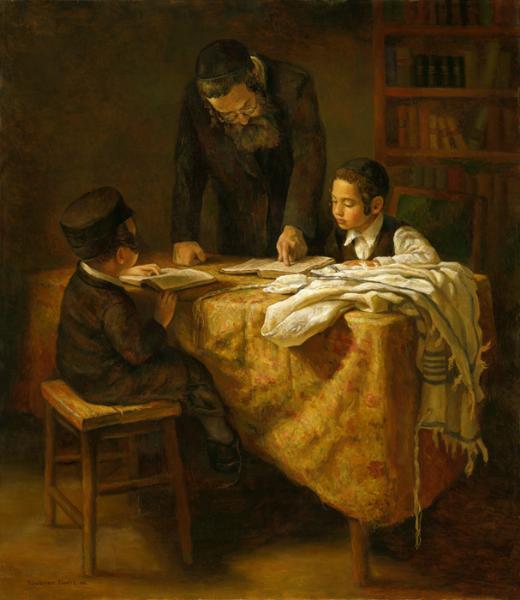
A Rabbi TeachingIf King David, who learned nothing from Achitofel except for two things alone, nevertheless referred to him as his “master,” “guide,” and “intimate,” it certainly goes without saying that one who learns from his fellow a single chapter, a law, a verse, a saying, or even a single letter of Torah, is obligated to revere him.

-Ethics Of The Fathers, 6:3

Our sages tell us, “There are three partners to the creation of man: G-d, his father, and his mother.” The capacity to procreate is, in essence, a distinctly Divine nature…The same is true regarding the “regenerative power” contained in a teaching: when G-d is a partner to their endeavor, the teacher-student relationship yields an infinite progeny.

Commentary on Ethics of Our Fathers: Chapter 6
Tammuz 11, 5771 * July 13, 2011
“Fertile Wisdom”
Chabad.org

I’ve mentioned before that the student-teacher relationship can yield enormous benefits, assuming an honest, knowledgeable, and inspired teacher and a student willing to be open. However, as we see from the quotes above, the teacher isn’t necessarily the most important partner in the transaction, which is good, since human beings are fallible. God is always present when Torah is taught and learned, which makes the act of study not only educational but holy. The Creator is the indispensable element in the room whenever people come together to learn the Word of God.

Rabbi Chalafta the son of Dosa of the village of Chanania would say: Ten who sit together and occupy themselves with Torah, the Divine Presence rests amongst them, as is stated: “The Almighty stands in the community of G-d.” And from where do we know that such is also the case with five? From the verse, “He established his band on earth.” And three? From the verse, “He renders judgment in the midst of judges.” And two? From the verse, “Then the G-d-fearing conversed with one another, and G-d listened and heard.” And from where do we know that such is the case even with a single individual? From the verse, “Every place where I have My name mentioned, I shall come to you and bless you.” –Ethics of The Fathers 3:6

“For where two or three have gathered together in My name, I am there in their midst.” –Matthew 18:20 (NASB)

But from who can we learn? It’s desirable to find a worthy teacher; one we can call our “Rebbe”, but there are problems with this. There are many unworthy teachers out there who are anxious to gather a following out of their own ambition, men and women who believe they have a special insight and who are entitled to share their particular “theological axe” which they desire to “grind”. From these “teachers” we learn there are those who are not to be trusted. Also, Christian tradition, unlike Judaism, doesn’t have a history of “Rebbes” or exalted teachers who pass their knowledge, wisdom, and compassion from one generation of disciples to the next. We are (often rightly) suspicious of gurus, cult leaders, and false teachers who ultimately lead people away from God. Christians even distrust the study of Torah and Talmud from valid and worthy Jewish Rabbis for fear this will lead the Christian away from Jesus.

And yet we are commanded to obey our leaders and teachers in the community of faith:

Have confidence in your leaders and submit to their authority, because they keep watch over you as those who must give an account. Do this so that their work will be a joy, not a burden, for that would be of no benefit to you. –Hebrews 13:17

We also see from David’s example with Achitofel that we are to honor a person who teaches us “a single chapter, a law, a verse, a saying, or even a single letter of Torah.” While we can seek to learn the teachings of an honored Rebbe such as Rabbi Menachem M. Schneerson, of blessed memory (and I’m learning much from his teachings as related by Rabbi Tzvi Freemen in the book Bringing Heaven Down to Earth), we see from the following that a good teaching can come from even a bad source:

It is possible to utilize for G-d’s service, [in a manner] according to Torah, all behavior-traits. This includes those traits that are unwholesome, and even those that are evil, as their names and descriptions indicate. For example, the tzadik Rabbi Meshulam Zushya of Anipoli, of blessed memory, learned [from his Rebbe, the Maggid of Mezritch] a number of ways of serving G-d from [the ways of] a thief:

  1. He works quietly without others knowing.
  2. He is ready to place himself in danger.
  3. The smallest detail is of great importance to him.
  4. He labors with great toil
  5. [and] Enthusiasm.
  6. He is confident and optimistic.
  7. If he did not succeed the first time, he tries again and again.

-[From HaYom Yom by the Lubavitcher Rebbe, translated by Uri Kaploun (Kehot)].
found at Chabad.org

This shouldn’t be so surprising, since the Master, our own great Rebbe in Christianity told us this:

Then Jesus said to the crowds and to his disciples: “The teachers of the law and the Pharisees sit in Moses’ seat. So you must be careful to do everything they tell you. But do not do what they do, for they do not practice what they preach. They tie up heavy, cumbersome loads and put them on other people’s shoulders, but they themselves are not willing to lift a finger to move them. –Matthew 23:1-4

Look at what Jesus is saying. He’s not telling his audience to ignore or disregard the teachings of the Pharisees. He’s saying “you must be careful to do everything they tell you”. What? Aren’t Pharisees hypocrites, liars, untrustworthy, and “under the Law”? Don’t they deny the true teachings of God and the grace of Jesus Christ? Why did Jesus tell his disciples to obey everything the Pharisees told them to do?

It’s because what the Pharisees taught was correct and consistent with the Torah, however the Pharisees of that day were corrupt and indeed, they were hypocrites who, under the Roman occupation, exalted themselves and did not “practice what they preached”, so to speak.

But what they actually taught was worthy of being learned and obeyed.

It’s also important to realize that not every single Pharisee was corrupt and no good. After all, Nicodemus was a Pharisee and he ended up becoming a disciple of Jesus. After the crucifixion of the Master, Nicodemus and Joseph of Arimathea, a wealthy member of the Sanhedrin, approached Pilate and asked permission to bury the Master’s body before the Sabbath began (we aren’t quite clear as to whether this was the eve of Passover or the weekly Sabbath). Not all Pharisees and members of the Sanhedrin were evil and corrupt, so we shouldn’t paint them all with the same broad brush.

KindergartenLook at the teaching of the Rebbe about how to learn from a thief. He doesn’t say the thief is a good and worthy teacher and that we must devote our lives to learning at the feet of a criminal. He says that, by simply observing the thief, there are habits we can learn and adapt to a life of holiness. The same is true of learning from anyone, even if they are unworthy, a hypocrite, or a thief, simply by watching them and listening to them, we can learn much, as long as we continue to use our powers of discernment and to view everything through the lens of the Bible and the Spirit of God.

Remember, in any transaction between two people, one being a teacher and the other being the student, God is there as the indispensable partner in the exchange. Being a student and disciple does not mean being a mindless sponge with no will of your own. In fact, your will, your judgment, and your questioning nature is as necessary to being a student as your attention, openness, and eagerness to learn. You cannot be taught corruption if you are paying attention and you do not have to take anything at face value without asking questions. Even the Bereans didn’t take Paul at his word and checked everything he taught against scripture (Acts 17:10-12). If you feel you have been lead astray by a teacher, look to yourself when asking the question, “how did this happen?”.

I’m sure you’ve heard or read the list compiled by Robert Fulghum, All I Really Need to Know I Learned in Kindergarten. From this, we learn that small children can teach us something. Even the Prophet Isaiah said “and a little child will lead them.” (Isaiah 11:6).

The Maggid also taught Rabbi Zushya, his disciple that we can learn three things from a child:

  • Never for a moment is he idle.
  • When he needs something, he demands it vigorously.
  • He is merry for no particular reason.

-[From The House of Rizhin by Rabbi Menachem Brayer [Mesorah].]

The Pirkei Avot; The Ethics of the Fathers teaches us that a life of learning and performing Torah yields many rewards:

The sages expounded in the language of the Mishnah (blessed is He who chose them and their learning):
Rabbi Meir would say: Whoever studies Torah for Torah’s sake alone, merits many things; not only that, but [the creation of] the entire world is worthwhile for him alone. He is called friend, beloved, lover of G-d, lover of humanity, rejoicer of G-d, rejoicer of humanity. The Torah enclothes him with humility and awe; makes him fit to be righteous, a chassid, correct and faithful; distances him from sin and brings him close to merit. From him, people enjoy counsel and wisdom, understanding and power, as is stated, “Mine are counsel and wisdom, I am understanding, mine is power.” The Torah grants him sovereignty, dominion, and jurisprudence. The Torah’s secrets are revealed to him, and he becomes as an ever-increasing wellspring and as an unceasing river. He becomes modest, patient and forgiving of insults. The Torah uplifts him and makes him greater than all creations. –The Ethics of the Fathers 6:1

Being a student, a disciple, and a person of faith is not a passive activity. Learning isn’t something you only do sitting at someone’s feet or taking notes in a classroom. It’s not always accomplished by reading a book or by visiting inspirational websites. A disciple is always moving, always asking questions, always observing, always sharing their insights with others and asking for feedback. Most importantly, in any learning situation (which is to say, in every waking moment of our lives), we are always turning to the “silent” voice in the room, the indispensable partner in the teaching of Torah. God is with us and He sent us a counselor who will teach us all things (John 14:26). Even when reading the Bible by ourselves at night, we are never alone.

Our teachers can be anyone. Our teachers can be anywhere. We just have to be paying attention to where we are and what we’re doing.

“A brilliant mind without faith is like a beautiful face without eyes.” -Shalom Cohen

Good Shabbos

Searching for Sparks

Holding SparksAt one time there were tzaddikim who would look into the soul of a disciple, see the place where the G-dly sparks were awaiting this soul and tell the disciple to go to that place to liberate those sparks.

All that has changed is the perception of the disciples. If you are where you are with the blessing of the Rebbe, you are where you belong. And you are there with a profound purpose.

Rabbi Tzvi Freeman
from the wisdom of the Rebbe
Menachem M. Schreerson
Bringing Heaven Down to Earth

Well, I – I think that it – it wasn’t enough to just want to see Uncle Henry and Auntie Em – and it’s that – if I ever go looking for my heart’s desire again, I won’t look any further than my own back yard. Because if it isn’t there, I never really lost it to begin with! Is that right?

Dorothy
The Wizard of Oz (1939)

It is said that we contain Divine Sparks from our Creator and those parts of us that belong to Him yearn to return to the Source. It’s what causes people to search for something beyond themselves; sometimes not even knowing what they are looking for or how to find it. It’s the part of us that brings some people to God and others to less than noble destinations, believing some false teaching is the answer they need.

It’s also believed that there are other sparks in the world that correspond to those we contain and that finding and liberating those sparks defines the purpose of our lives. Put in less mystic terms, we all have a purpose that gives meaning to our lives. We only need to discover that purpose in order to experience accomplishment, fulfillment, and to understand why we were created by God.

Some people search for this all their lives and die with the truth about themselves still undiscovered. While Hamlet calls death the undiscovered country, I think that “country” is rather the truth of our existence which we must discover while we are still alive. Even David said that once dead, we can offer nothing:

Among the dead no one proclaims your name.
Who praises you from the grave? –Psalm 6:5

It is not the dead who praise the LORD,
those who go down to the place of silence;
it is we who extol the LORD,
both now and forevermore.
Praise the LORD. –Psalm 115:17-18

Continuing with this theme, Vine of David’s commentary on Levertoff’s Love and the Messianic Age tells us:

“Although every man has the divine potential of a godly soul planted within him, this is not a guarantee that every man will enter into a relationship with HaShem or even that every soul will be redeemed. Instead, the soul is separated from God by a wall of partition – sin and guilt. HaShem removes the wall of partition between man and Himself through the work of the Messiah. When the wall is removed, then the soul can connect with HaShem. Then He can “use it for the gathering of these ‘sparks’.”

We journey near and far looking for and gathering sparks in order to fulfill the script of our lives written by God on our souls. But must we necessarily travel to distant and strange lands to find what we seek? Rabbi Freeman gives us part of that answer as he again relates the Rebbe’s wisdom:

People want to run away from where they are, to go to find their Jerusalem. Wherever you are, whatever you are doing there, make that a “Jerusalem”.

I wonder if the Rebbe ever saw The Wizard of Oz?

Hide and SeekGod is mindful of the days of our lives, where we go, what we are doing. He watches us as a father might watch his small son take his first, halting steps. We watch our children as they learn to walk, almost willing them in how to take the next step and in which way they should go. We cannot interfere unless they are about to be hurt, because otherwise, they’d never discover how to walk on their own. God is like that with us. The difference is, we should know that we are learning how to walk and be paying attention to the path. We should know that our Father is watching over us and that He’s ready to keep us from harm. Often, we don’t:

A certain chassid who had suffered a major financial loss stood before Rabbi Schneur Zalman of Liadi and lamented over his debts. “All you are telling me,” Rabbi Schneur Zalman replied, “is what you need. Who needs you, you don’t say much about. Do what G-d expects from you, and He will provide what you want from Him.”

Lest you think that God only expects us to serve and that He doesn’t care about who we are, our fears, our needs, and our concerns, we have two messages that console us; one from the Rebbe, and the other from “the Maggid of Nazaret”, Jesus:

The teaching of the Baal Shem Tov: Not only is the movement of a leaf as it falls off a tree, the quivering of a blade of grass in the wind-each and every detail of existence directed, vivified and brought into being at every moment from above-but beyond that: Every nuance is an essential component of a grand and G-dly scheme, the gestalt of all those vital minutiae.

Meditate on this. And then think: How much more so the details of my daily life.

-The Rebbe
as related by Rabbi Tzvi Freeman

“Therefore I tell you, do not worry about your life, what you will eat or drink; or about your body, what you will wear. Is not life more than food, and the body more than clothes? Look at the birds of the air; they do not sow or reap or store away in barns, and yet your heavenly Father feeds them. Are you not much more valuable than they? Can any one of you by worrying add a single hour to your life?

“And why do you worry about clothes? See how the flowers of the field grow. They do not labor or spin. Yet I tell you that not even Solomon in all his splendor was dressed like one of these. If that is how God clothes the grass of the field, which is here today and tomorrow is thrown into the fire, will he not much more clothe you—you of little faith? So do not worry, saying, ‘What shall we eat?’ or ‘What shall we drink?’ or ‘What shall we wear?’ For the pagans run after all these things, and your heavenly Father knows that you need them. But seek first his kingdom and his righteousness, and all these things will be given to you as well. –Matthew 6:25-33

Finally, in our little game of “hide-and-go-seek” with the Divine in ourselves and in the Universe, Rabbi Freeman presents the Rebbe’s teachings on this matter, again from his book Bringing Heaven Down to Earth:

G-d is not something of a higher realm that you cannot reach Him. Nor is He made of stuff ethereal that you cannot touch Him. G-d is “That Which Is” – He is here now, everywhere, in every thing and in every realm – including that realm in which you live. The only reason you do not perceive Him is because it is His desire that you search for Him.

Life is a game of hide and seek. G-d hides, we seek.

God does not play “hide the ball” with the Universe. He means for us to not only find Him, but everyday, to find who we are in Him. Start gathering the sparks. He’s there. And so are you.

Top Hat and Shoes

Top Hat and ShoesAbsolute truth is hard to come by. Many gedolim made it their life goal to speak and act only in accordance with their true level. Rav Yerucham Levovitz, zt”l, gave an interesting explanation of why one should not act above his level.

He said, “This can be compared to a person who wears a luxurious top hat but is absolutely barefoot. Surely all who see him will remark at the inappropriateness of such an imbalance in this man’s apparel! The same is true in spiritual matters. One must first put on his shoes, which are the foundation middos. Then he can aim for higher.

Daf Yomi Digest
Stories off the Daf
“Perhaps He is Not His Father…”
Chullin 11

I’m immediately reminded of two other stories; the story of The Emperor’s New Clothes by Hans Christian Anderson, and Kabbalah and the Art of Tying Your Shoelaces by Rabbi Yitzchak Ginsburgh. The former tells a tale of self-delusion which others are willing to buy into, and the latter assures us that the Torah was given so that even the most mundane acts in our lives can be seen as holy.

Besides the clothing motif, what do they have in common? Let me explain.

Rav Levovitz shows us that, as people of faith, we strive to achieve higher spiritual goals. If we are at all connected with God and we’re on speaking terms, we “know” that we can be closer to Him and we can be better people. We can be the people God designed us to be. However, it’s not that easy.

Have you ever set a goal for yourself that, in retrospect, you realized was unrealistically high. Have you ever aimed at achieving something lofty before doing the ground work and laying a foundation for what comes next? I know I have. I believe it’s a fairly common human behavior. We fail, not because we are lazy or don’t have high aspirations, but because we don’t look at the entire sequence of events between where we are and where we want to go. We try to jump from “A” to “Z”, without going through the intervening letters of the alphabet. We fool ourselves into thinking that we don’t have to.

Rabbi Ginsburgh puts what we need to do very simply and elegantly:

First put on your right shoe, then your left shoe, then bind your left shoe, and finally bind your right shoe. That’s the way Jews do it.

Hans Christian Andersen shows us what happens when we cut corners and don’t pay attention to the difference between fantasy and reality.

If you feel like you’re in a rut in your church life, in your synagogue life, in your prayer life, in your spirituality…it’s probably because you are.

A relationship with God is like being married. When you first get married, it’s all exciting and romantic and thrilling. Then five years go by. Ten. Fifteen. Suddenly, you realize you’ve been married for almost thirty years and sometimes, life at home seems pretty boring. Not much romance is going on. No thrills have happened for months, maybe years. Is this the goal you were shooting for?

Let’s go through that story again with a slight twist. You’ve been married for fifteen, twenty, twenty-five years. Some days are better than others. The “magic” in the marriage comes and goes, waxes and wanes. It’s sometimes pretty good and sometimes not so good, but in the end, you find that nothing really gets better or more intimate. Stuck in a rut again.

Let’s apply that back to your relationship with God.

You desire but do not have, so you kill. You covet but you cannot get what you want, so you quarrel and fight. You do not have because you do not ask God. When you ask, you do not receive, because you ask with wrong motives, that you may spend what you get on your pleasures. –James 4:2-3

In marriages, sometimes a breakdown in communication makes it difficult to understand your spouse. Since God always understands us, the breakdown in our relationship with Him can only come from us. We don’t know what to ask or we ask with bad motives. Who am I? Who is God? What do we have in common? How can we communicate? How can I get closer to Him? I put on my best top hat, but I forget to put on socks and shoes. What can I do? Maybe Rav Yerucham has the answer:

In Kotz, a certain chassid who served God with his entire heart once exclaimed while praying, “Oy, Tatte! Oh, Father!”

A fellow Kotzker heard this and quoted a statement on today”s daf, “And maybe he is not his father…”

This shook the chassid up quite a bit and pushed him to consult with the Kotzker Rebbe. Although the rebbe gave many short shrift, he gave this man encouragement. The rebbe said, “You need to cry out, ‘Oy, Tatte,’ so much that He becomes truly like a father to you!”

That sounds almost like:

I will proclaim the LORD’s decree: He said to me, “You are my son; today I have become your father. –Psalm 2:7

Going to GodA few days ago, I wrote about how a spiritual leader can profoundly affect our lives, not just by what he teaches or by his example, but by inspiring us to be better people. It is said that the Rebbe who is head of a Yeshiva is like a father to his students. Indeed, the Rebbe is considered even more of a father than the student’s actual father. A father brings physical life to a child but a Rabbi and teacher brings the student to the Torah and to God, which gives life beyond measure.

Both in Judaism and in Christianity, we call God “Father”, but we don’t recognize Him as our Father until we desperately cry out to Him with all our strength. At that moment, He becomes our Father and we become sons and daughters. All people were created in God’s own image, so regardless of your religious tradition or even if you have no faith at all, you are still God’s child. You only need to recognize that fact and call out to Him.

For those of you who know you are sons and daughters, but who seem to be spinning your wheels in your relationship with Him, cry out to Him. Tell Him you need Him (He knows this, but you might have to remind yourself). Whether you call out “God” or “Father” or “Abba”, you are calling Him. As Christians we are told that what we pray to God in the name of Christ, will be heard in Heaven and answered.

It’s time to move out of apathy and into action. It’s time to reach new heights in your relationship with Him, or perhaps develop a relationship with Him for the first time. Go to God. Put on your finest clothes for the occasion. Just remember to put on your shoes so you can keep your balance.

Awakening Messiah

AriseIn each one glows a spark of Moses. He is our teacher. A teacher’s job is to open a small window for the inner knowledge to pour down into the conscious mind.

How do you awaken Moses? By waking yourself.
How do you awaken yourself? By finding someone in whom Moses is awake.

Only the awakened can waken others.

Rabbi Tzvi Freeman
“Moses Inside”
Chabad.org

In Judaism, none like Moses has ever appeared upon the earth again; a man who spoke to God “face-to-face”. In Christianity, only one person has appeared who is greater than Moses:

When Jesus came to the region of Caesarea Philippi, he asked his disciples, “Who do people say the Son of Man is?”

They replied, “Some say John the Baptist; others say Elijah; and still others, Jeremiah or one of the prophets.”

“But what about you?” he asked. “Who do you say I am?”

Simon Peter answered, “You are the Messiah, the Son of the living God.” –Matthew 16:13-16

If we extend Rabbi Freeman’s statement into the life of a Christian, what can we say? Perhaps the clue is in a commentary from this week’s Torah Portion Balak:

The Torah portion Balak relates how Balak, king of Moav, hired the prophet Bilam to curse the Jewish people. G-d, however, frustrated the king’s scheme and caused Bilam to utter praises and blessings of the Jewish people.

Among Bilam’s words of praise and blessing, we find the following: “I see him [Israel] from the peak of flintrocks, and gaze upon him from the heights; it is a nation dwelling alone, entirely dissimilar to other nations.”

In explaining the words: “I see him [Israel] from the peak of flintrocks,” Rashi comments: “I gaze upon their beginnings and their roots, and see them braced and as strong as these flintrocks and rocky heights, on account of their Patriarchs and Matriarchs.” Bilam’s statement was thus allegorical.

The true power of a Jew lies not in his physical might but in his spiritual prowess, particularly his power of mesirus nefesh , a submission to the Divine that is so profound that he is willing to lay down his life if necessary for the realization of G-d’s will. The soul that possesses the power of mesirus nefesh is referred to as “the peak of flintrocks.” This power emanates from a Jew’s mighty, firm and immutable faith in G-d, a faith so powerful that a Jew will offer his very life in order not to renounce G-d.

The Alter Rebbe thus explains that the power to act with mesirus nefesh is a byproduct of G-d’s shining within every Jewish soul, for mesirus nefesh flies in the face of nature; a living creature doesn’t do things that cause its own negation.

-Based on the teachings of the Lubavitcher Rebbe, Rabbi Menachem M. Schneerson for Torah Portion Balak
“A View from Above”
Chabad.org

This fits very well with what Rabbi Freeman wrote earlier and illustrates that strength comes from the presence of the Divine within each individual and within the community as a whole. We see something similar in the writings of Paul:

I know what it is to be in need, and I know what it is to have plenty. I have learned the secret of being content in any and every situation, whether well fed or hungry, whether living in plenty or in want. I can do all this through him who gives me strength. –Philippians 4:12-13

Among his many blessings upon the Children of Israel, Balaam prophesied the coming of the Messiah (Numbers 24:17-19). This is a hope that both the Jewish people and Christianity looks to, though each with a different understanding:

In writing about Moshiach (Messiah), the Rambam states in his Code of Law, Yad HaChazakah : “Whoever does not believe in him or does not await his coming, denies not only [the statements of] the other prophets, but also [those of] the Torah and of Moshe, our teacher, for the Torah attests to his coming, stating: ‘And the L-rd your G-d will bring back your captivity and have compassion upon you.’

-Based on the teachings of the Lubavitcher Rebbe, Rabbi Menachem M. Schneerson for Torah Portion Balak
“The Prophecies of Bilam”
Chabad.org

Arise and ShineWe see that failing to have faith in the coming of the Messiah is failing to have faith in all the Prophets that came before him and indeed, the entire record of the actions of God among mankind. The twelfth of Rambam’s Thirteen Principles of Faith states this message clearly, and we are to make our trust and hope a centerpiece in our life of faith:

I believe with complete faith in the coming of the Messiah. And even though he may delay, nevertheless, every day I anticipate that he will come.

It is in that hope that Jews and Christians sustain themselves, regardless of hardship and the struggles of our lives. In addition to what we’ve read so far, Christians look to the following:

As it is written:

“For your sake we face death all day long;
we are considered as sheep to be slaughtered.”

No, in all these things we are more than conquerors through him who loved us. For I am convinced that neither death nor life, neither angels nor demons, neither the present nor the future, nor any powers, neither height nor depth, nor anything else in all creation, will be able to separate us from the love of God that is in Christ Jesus our Lord. –Romans 8:36-39 (quoting Psalm 44:22)

Three times I pleaded with the Lord to take it away from me. But he said to me, “My grace is sufficient for you, for my power is made perfect in weakness.” Therefore I will boast all the more gladly about my weaknesses, so that Christ’s power may rest on me. That is why, for Christ’s sake, I delight in weaknesses, in insults, in hardships, in persecutions, in difficulties. For when I am weak, then I am strong. –2 Corinthians 12:8-10

To awaken the Messiah within us, we must find someone in whom the Messiah is awake. If the Messiah is awake in you, awaken him in others. Make his power perfect.

Arise, shine, for your light has come,
and the glory of the LORD rises upon you. –Isaiah 60:1

Good Shabbos.