Tag Archives: book review

Building Fellowship

Galatians by D.T. Lancaster“We ourselves are Jews by birth and not Gentile sinners; yet we know that [whether Jewish nor Gentile] a person is not justified by the works of the law [i.e., conversion, circumcision, etc.] but through faith in Jesus Christ, so we [the Jewish believers] also have believed in Christ Jesus, in order to be justified by faith in Christ and not by the works of the law, because by the works of the law no one will be justified. But if, in our endeavour to be justified in Christ, we too were found to be sinners [by eating and fellowshipping with Gentiles], is Christ then a servant of sin? [In other words, does becoming a believer mean we forsake Torah? Is eating and fellowshipping with Gentiles really a sin against Torah?] Certainly not! For if I rebuild what I tore down, I prove myself to be a transgressor. –Galatians 2:15-18

That is to say to Peter, “If you of all people, Peter, rebuild a sharp division between Jew and Gentile by removing yourself from table fellowship with Gentiles, you are rebuilding the barrier that you originally tore down. If you refuse to eat and worship with them, you rebuild the barrier that you originally tore down. You yourself were the first of the apostles to tear that separation down. If now you are putting it back up, then you are admitting that you were wrong in the first place, and you are proving yourself to have been living in sin and transgression.”

-from D. Thomas Lancaster’s book

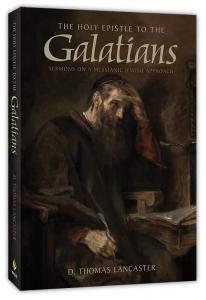
The Holy Epistle to the Galatians

I received an advance copy of Lancaster’s book from First Fruits of Zion (FFOZ) yesterday and have since been eagerly devouring it. I’m not ready to write my full review, but Sermon 8: The Antioch Incident (the book is a compilation of 26 sermons, with each sermon organized as a chapter, given by Lancaster at Beth Immanuel Fellowship in 2008) brought up some interesting questions, and perhaps even a few answers.

For those of you who may not know, FFOZ is an educational ministry which produces informational materials, including books, audio lectures, and such, to both Jewish and non-Jewish believers in Jesus (Yeshua) in Messianic Judaism (MJ), although they have a wider audience in more traditional Christian (and perhaps more traditional Jewish) circles. One of the ongoing discussions in different branches of MJ is the relationship between Jewish and non-Jewish believers and the relationship those two groups have to the commandments of the Torah.

Without going into a lot of detail, some advocate for Gentiles in MJ to be obligated to the same 613 commandments that observant Jews are taught to obey, while others believe that Gentiles are only obligated to a small subset of those commandments (see Acts 15). The latter group believes that Gentiles who state that they are obligated to the full “yoke of Torah” obliterate Jewish covenant distinctiveness and “blend” Jews and Gentiles in Jesus into one, featureless mass. How Jewish and Gentile believers are supposed to interact given “distinctiveness boundaries”, including in matters of table fellowship, common observance of the Shabbat and the Festivals, has at times become hotly debated.

In reading Lancaster’s “Galatians”, we find this is not a new issue.

Lancaster (and FFOZ) support maintaining distinctions between Jewish Messianics and the Gentiles in MJ and Lancaster states:

We are one body, many parts. The foot is not the eye; the eye is not the foot. Oneness is not sameness. We can be one in the body but not have the same function or calling. Oneness is not sameness. There is one faith, one baptism, and one body, but that body has many parts.

D.T. LancasterLancaster is obviously referencing 1 Corinthians 12:12-31, but what is typically interpreted as a commentary on the struggles between different members of the Christian body sorting out the diversity of their spiritual gifts, Lancaster applies to the distinctions between Jewish and Gentile believers in Christ. I think his application is valid since it holds water in the Galatians context as Paul presents his argument, but that may come as a bit of a surprise if you do not believe that Jewish observance to the covenant of Moses was upheld by the early Jewish apostles for Jews and not for non-Jewish Christians. In other words, you may have a problem with Lancaster’s conclusions if you were taught that the law was done away with for Jews as well as for non-Jewish believers.

My primary interest in this subject, and in Lancaster’s book as a whole, is not from the perspective of Messianic Judaism. At this stage of my spiritual journey, I see myself as a Christian,married to a (non-believing) Jewish wife, who in immersing myself in Jewish Talmudic, mystic, and storytelling sources and traditions in order to better understand Christ who lived, died, and was resurrected a Jew and who taught, spoke, lived, and breathed in a completely Jewish manner and lifestyle. I don’t think you can understand who Jesus is unless you understand not only the Judaism of his day, but Judaism and Torah as they wind their way back to the beginning of Creation and forward to the current age.

This is the lens by which I look at the book and the pen by which I chronicle my thoughts, feelings, and the cries of my spirit.

I have friends who are Jewish believers in Christ and who are fully observant Jews, while I am a Gentile Christian. How are we to interact? Can we eat together? Can we pray together? In what manner may I observe the Shabbat, Passover, Shavuot, and Sukkot? How may I fast and pray on Yom Kippur (and does this offend Jesus who died to remove my sins once and for all)?

These are the questions that underlie “The Antioch Incident” and the entire “Galatians” book. These are the questions that, if you don’t consider them important to you now as a Christian or believing Jew, you definitely will when the Messiah comes.

So what are the answers? I believe I know them and I try to live them out as best I can. Paul worked with great effort as the apostle to the Gentiles to create and support communities where believing Jews and non-Jews freely interacted. Here is how Peter responded to Paul:

After much discussion, Peter got up and addressed them: “Brothers, you know that some time ago God made a choice among you that the Gentiles might hear from my lips the message of the gospel and believe. God, who knows the heart, showed that he accepted them by giving the Holy Spirit to them, just as he did to us. He did not discriminate between us and them, for he purified their hearts by faith. Now then, why do you try to test God by putting on the necks of Gentiles a yoke that neither we nor our ancestors have been able to bear? –Acts 15:7-10

Paul struggled with James, the Jerusalem Council, and other believing Jews as to whether or not Gentiles, once they came to faith in the Jewish Messiah, should be circumcised and convert to Judaism. Indeed, history records that some did, but Paul, who received his “Gospel” from the Messiah and Heaven and not from men, understood that it wasn’t necessary. Jesus is the gateway for the people of the world to enter into the Kingdom of Heaven and yet remain non-Jewish. All who are in the Messiah are One and God’s Name is One, but the members of the Messiah’s body, though one in baptism and spirit, are diverse in type and function. Just as my wife and I are different (being female and male, Jew and Christian) and yet “one flesh”, Jews and Gentiles in the Messiah are two and yet one.

I look forward to continuing this book and will post my full review when I finish.

Blessings.

Addendum: The full book review is now available.

The Author

In the BeginningWhen someone asked the Radvaz, zt”l, why the Torah lacks vowels he gave an interesting response.

He said, “To understand this we must realize why the angels asked God not to give Torah to mankind, since they wanted God to give it to them. Moshe refuted them with an apparently simple reply, ‘What does it say in the Torah? Do not kill; do not commit adultery. Can angels murder? Is it possible for an angel to commit adultery? Why, then, do you need the Torah?’ ”

He continued, “Not surprisingly, the angels conceded this point. What is strange is what they had in mind in the first place. It seems clear that the angels had a very different way to read the Torah. When read in this manner it had much to teach them, and they wanted it so that they could receive it in the manner suited to them, on their level. Our sages tell us that the entire Torah is formed of Divine Names. The angels wished to read it spiritually at one time without interruption. In this manner, the Torah makes up one long name of God.”

Daf Yomi Digest
Stories off the Daf
No Wasted Letter
Menachos 87

Sometimes I think the Torah has a life of its own. It’s certainly easier and reasonable to think of the Torah as a document that we can examine and learn from, much like any other document. On the other hand, the Torah is also the foundation of our understanding of God, the Prophets, the Writings, Israel, and the Messiah. We cannot simply treat it as if it were a good book on philosophy. Then, there are its mystic properties, such as how the Torah was with God when He created the world:

In the beginning was the Word, and the Word was with God, and the Word was God. He was with God in the beginning. Through him all things were made; without him nothing was made that has been made. In him was life, and that life was the light of all mankind. The light shines in the darkness, and the darkness has not overcome it. –John 1:1-5

The Word became flesh and made his dwelling among us. We have seen his glory, the glory of the one and only Son, who came from the Father, full of grace and truth. –John 1:14

Reading John, the Torah does have a life of its own and a human life at that. No wonder the Angels were fascinated (though, it’s likely that the Radvaz, zt”l did not have Jesus in mind when he wrote his commentary).

The Torah seems to exist in a sort of “multi-dimensional” state, operating differently depending on who is using it and how it is being used. We very much can treat the Torah, and indeed, all of Holy Scripture, as a document to be examined and learned from. I recently reviewed an analysis of the Great Isaiah Scroll recovered from the Dead Sea Scrolls near the ruins of Qumran, and what scholars Steven Lancaster and James Monson reveal about the Messiah is fascinating.

But however illuminating a rational and literary approach to the Torah may be, there is so much more to be discovered if you just change your angle of approach, as the Radvaz, continues to state in our “Story off the Daf”:

“Moshe explained to them that this is not the purpose of the Torah. The point of the Torah is for us to fulfill its material reading, by keeping mitzvos: eating kosher, avoiding non-kosher, and the like. Since there are many ways to read the Torah it is obvious why it is written without vowels or notes—to leave it open to an infinity of possible readings.”

The Radvaz concluded, “This also explains why the oral Torah was not recorded within the body of the Torah itself. It also explains why some stories or statements appear unnecessary while other essentials are virtually left out. This apparent discrepancy is because the Torah has many levels. Believe me, there is not one superfluous letter in the entire Torah. Place this principle before you always and you will always succeed.”.

The Torah is an enormously flexible resource that serves different purposes and has different meanings depending on its audience and its context. I have sometimes wondered why the Torah seems to include information that doesn’t make sense or why other information that would seem absolutely vital to know was “omitted”. God is unchanging but He is also infinite. There is no limit to His being and ultimately, no knowing His objective essense and thus, He can and must contain everything. Since the Torah has to be accessible by human beings, it must be finite which limits what it can contain, but by the explanation presented on the daf, we see that the Torah was created in a manner that conceals how versatile it actually is. We can read the Torah year after year, study the Oral Traditions and the commentaries of the sages, and yet never grow tired of how it speaks to us of things even Angels want to know.

The Word of God calls to each of us in a unique way. Each man or woman hears something different and we respond to the Torah as who we are at the moment we’re listening. A year later, the Torah speaks the same words again, but what we hear is different because the Torah was designed to reach us in a different way as we change and grow.

I am not the same person today as I was a year ago. What the Torah of Moses and the Spirit of God whisper to me out of Heaven captures me in a different way each time I hear it. I don’t always understand what He’s trying to say, but as I draw nearer to God, it becomes impossible for me not to strain my hearing and strive to perceive every word, every sound, and every breath, as one might listen to a lover whisper secrets in the night.

Listening to God through His Torah and His Spirit tells us how to order our lives and more. As we draw closer to Him; as we draw closer to the One who loves us without limit, bit by bit, He shows us the inner nature of the author of our souls.

People think the Torah is all about laws and customs and quaint stories, with a mystical side as well.

In truth, the Torah is entirely spiritual. But when you cannot perceive the spiritual, all you see are laws and quaint stories.

-Rabbi Tzvi Freeman
“More Than Stories”
Chabad.org

Two Worlds

What are you looking for? Wealth? Prestige? Position? You have all these right now. You should be altogether happy. And yet you are miserable – I can feel it for all your brave speech. Can you not be satisfied? And this way of living that fills you with restlessness and discontent – I am not a Jew but even I have sensed something lovely in Judaism, in its faith and in its morality with its emphasis on pity. Even its rituals are not without poetic grace. See how many Gentiles have been converted to your religion. Does that not prove that it possesses virtues which the Greek world lacks? These are at your disposal now. What more do you want?

-Nicholaus to Elisha in the book:
As a Driven Leaf
by Milton Steinberg

Steinberg’s classic is set at the beginning of the Talmudic age in Palestine during the Roman occupation, some fifty years after the destruction of the Second Temple. The book’s protagonist, Elisha ben Abuyah was born a Jew but raised by a Jewish father who disdained the traditional beliefs and who pursued pagan philosophies instead. Nicholaus was Elisha’s Greek tutor when he was a child but the tutor was dismissed when Abuyah died (Elisha’s mother died in childbirth). Abuyah’s brother then took charge of Elisha, providing him with a Jewish education rooted in Torah and tradition.

Elisha eventually abandons his Greek education and as a disciple of the sage Joshua, he not only becomes a Rabbi in his own right, but a member of the Sanhedrin as well.

Yet a series of personal and political conflicts throws Elisha into a crisis of faith and pulls his heart between the Jewish and Greek worlds. A chance meeting with his old tutor Nicholaus many years later in a bookstore in Caesarea, provides the stage for a confrontation between the spiritually tortured Elisha and his former teacher. But rather than support Elisha’s pursuit of “truth” by guiding him back into Greek beliefs, Nicholaus pushes Elisha toward the only path that seems sensible and right for a Jew; the path of Moses.

In some ways, I can relate to both Elisha and Nicholaus. Like Nicholaus, as a non-Jew, I can see great beauty, wisdom, and meaning in the fabric of Jewish ritual, learning, and understanding. Like Elisha, I feel as if I’m struggling to stand between two worlds; the Christian world which is the source of my faith, and the Jewish world which provides clarity and purpose to that faith. I too know what it’s like to be self-tormented, searching the path looking for divine sparks and not letting myself be satisfied with what I already possess.

Elisha’s anguish, and my own, reflects that of Job’s in our shared search for meaning and God, expressed here in Elisha’s own words:

“‘Wherefore,’ he demanded, ‘hidest Thou Thyself from me? Wilt Thou harass a driven leaf?’
“I know how he felt. The great curiosity is like that. It is not a matter of volition. It is a stark inner compulsion, dire necessary. And he against whom it moves has no more choice than a leaf driven by a gale. No, there is no retreat. Forward is the only way.”

Why do you hide your face
and consider me your enemy?
Will you torment a windblown leaf?
Will you chase after dry chaff? –Job 13:24-25

For the past year, I have also been enduring a crisis of faith and like Elisha, seeking answers in unusual places..well, “unusual” relative to modern Christianity which doesn’t typically see a great deal of validity in seeking the Christ within the pages of Talmud and Kabbalah. Yet I have seen the Messiah in the Chasidic writings and found his fingerprints on the pages of the Zohar. How can I relent, when Jewish sages from Hillel to Maimonides teach wisdom that so clearly points to the Master?

In his desperation, Elisha desires to seek out those who his Jewish disciples and peers would categorically reject as pagans and heretics:

“Two courses are before me. I wish first of all to make contact with the Christians and the Gnostics here in Caesarea.”

“What good will that do you?” Nicholaus inquired, wary now.

“It is not impossible that they can teach me some principle to give me direction.”

While a Christian might read these words and rejoice that a Jew is seeking out the grace and salvation of Jesus, for Elisha, this could very well turn out to be a disaster. It is not so much that he sees in Christianity what Judaism lacks, but that he has not allowed his faith to rest on the foundation of his fathers, and for that matter, on the rock of Torah, which the Jewish Messiah continually taught and lived when he walked among men.

Ironically, Elisha’s quest threatened to cost him the very thing he already possessed in Judaism:

“A man has happiness if he possesses three things – those whom he loves and who love him in turn, confidence in the worth and continued existence of the group of which he is a part, and last of all, a truth by which he may order his being.”

AbyssIn a sense, I am prepared to do what Elisha has done and leave my group and to some degree, the truth they follow, in order to seek out what I believe is right for me. Like Elisha, I’m taking a risk of falling completely away from my current expression of faith in order to seek out a greater closeness with God. Like Elisha, I am convinced in the existence of God but am uncertain as to how He may be understood and approached.

Unlike Elisha, I was not born into a people and a tradition built on the holy mount in Jerusalem and forged by the Shechinah at Sinai.

Here’s the danger:

“But look here,” Nicholaus cried, discerning a possibility he had not envisaged before. “Suppose the results of your experiment are not consistent with the Jewish religion?”

Elisha’s voice was strained, as though his throat had tightened, but he did not falter.

“I have considered that possibility, too. I hope it may never become an actuality. Yet, should that be my destiny, I am prepared to assume it.”

Here is what I face:

“I tell you, whoever acknowledges me before others, the Son of Man will also acknowledge him before the angels of God. But whoever disowns me before others will be disowned before the angels of God.” –Luke 12:8-9

Here is a trustworthy saying:
If we died with him,
we will also live with him;
if we endure,
we will also reign with him.
If we disown him,
he will also disown us;
if we are faithless,
he remains faithful,
for he cannot disown himself. –2 Timothy 2:11-13

I don’t say this is a great danger to me, but the challenge exists. Nicholaus called Elisha’s effort an “experiment” but for me, what I am doing is taking a journey and I expect that I will be traveling all of my life. I walk the path before me and risk losing my way. I travel in darkness while seeking the light. I pray that God travels with me and shows me who He is and who I am in Him. May my footsteps follow His as I climb a holy mountain.

As a Driven Leaf is a cautionary tale; it’s Steinberg’s warning that a Jew cannot live in two worlds without the danger of falling away from everything that gives meaning to being a Jew. Friedrich Nietzsche said that “if you gaze into the abyss long enough, the abyss gazes also into you.” Yet like Elisha, I am driven by forces I do not always understand and cannot control, to seek out God in the places where He may be found, even in the darkness of the abyss.

That’s why I write. That’s why I’m here. I am the leaf driven before the wind. Where will I finally alight and take rest?

Only time and God can answer me.