Tag Archives: Christianity

The Garden of Ha’azinu

Hands of the GardenerAt every moment, your Creator must decide, “Should I put up once again with this little creature’s imperfections and blunders, or is it time to measure things by the scale?”

Then He looks at the scale you use to measure others. And with that same measure, He measures you.

-Rabbi Tzvi Freeman
“Reciprocal Tolerance”
Based on letters and talks of the Rebbe
Rabbi M. M. Schneerson
Chabad.org

What, after all, is Apollos? And what is Paul? Only servants, through whom you came to believe—as the Lord has assigned to each his task. I planted the seed, Apollos watered it, but God has been making it grow. So neither the one who plants nor the one who waters is anything, but only God, who makes things grow. The one who plants and the one who waters have one purpose, and they will each be rewarded according to their own labor. For we are co-workers in God’s service; you are God’s field, God’s building.1 Corinthians 3:5-9

The First Fruits of Zion (FFOZ) commentary on this week’s Torah Portion Ha’azinu compares the teachings of the Torah given to the Children of Israel to the acts of the Apostles spreading the Good News of Jesus Christ to the people of Corinth. Paul was the first to bring the Gospel message to the Gentiles there, but if he “planted the seed”, then he credits Apollos with “watering” it. Yet the seed, the water, and the growing of the plants all come from God.

And look what we’ve done with what He’s provided. I don’t necessarily say that as a compliment to humanity.

Rabbi Freeman shows us that perhaps God considers our lives each day and ponders about whether or not to extend our existence into tomorrow. This is based on the measure of how we show or fail to show kindness and grace to others. What a terrible way to judge us.

Rosh Hashanah begins at sundown this coming Wednesday (1 Tishrei), and it is believed in Judaism, that at the “head of the year”, God opens the Book of Life, in which are inscribed the names of those who will be extended into the coming year. From Rosh Hashanah, it is said that we have ten days until Yom Kippur to be inscribed into the Book of Life. Perhaps God does “reconsider” our existence from time to time, or at least annually.

That may not fit your view of God or your view of your continuing life, particularly if you are a Christian. In Christ, we believe that we have been redeemed once and for all, thanks to the gift of God’s grace through the atoning death of Jesus. Nevertheless, this does not mean we cannot fail the Creator and it does not mean that we can’t be better tomorrow than we are today. It also doesn’t mean that there are no further consequences for our actions, including the consequence of death.

The FFOZ commentary on Ha’azinu includes this parable:

Consider the story of a foolish gardener. In the spring he planted some seeds and watered them. He was pleased when they began to grow, and he assumed that he could simply wait for the harvest. He did not think to water the young plants again. “After all, I have already watered them,” he said to himself. The plants shriveled up and died.

If God is our gardener, then we are indeed fortunate, for God will not neglect us or fail to water and care for us. But we are self-willed “plants” and we have some control over whether or not we allow ourselves to be “watered”. Words of Torah rain on us from heaven (Deuteronomy 32:2) but do we allow our “roots” to soak up what we need for life? Even though we’ve been “saved”, and even if you believe that salvation is difficult if not impossible to forsake, can you still not forsake living the life God has given to you? Unlike the plants in a garden, God offers care but we must willingly accept it. We can say “yes” or “no” or simply ignore the provision of rain, sunshine, careful weeding, and fertilizer. Who we are in Him depends as much on us and how we choose to live, as it does the generous hand of God.

In Judaism, a new year is coming soon. It’s an opportunity to hit the “cosmic reset button” in our lives. If we have failed Him, and we most certainly have (Romans 3:10), then we too, as Christians, can take this opportunity to turn our “no” into a “yes”. The gardener is here. Let Him sow good things in us so that we can be the good fruit of His harvest.

L’shanah tovah tikatev v’taihatem. May you be inscribed and sealed for a good year.

The Words of His Image

Hebrew FirePlants live in a world of earth, water, air and sunshine. Animals live in a world of the body and its senses. Human beings live within a world of their own words.

The sages called us “the speaking being,” saying that our soul is filled with words. When our words leave us, our very being goes out within them. We conquer with them. We declare our mastery over Creation with them. Our words tell us that we exist.

For us, nothing truly exists until we find a word for it. All our thoughts of every object and every event are thoughts of words. Our world is a world not of sensations and stimuli, but of words.

Build your world with precious words. Fill your days with words that live and give life.

Memorize words of Torah and of the sages. Have them ready for any break in your day. Wherever you go, provide that place an atmosphere of those powerful words.

-Rabbi Tzvi Freeman
“Life in Words”
Based on letters and talks of the Rebbe
Rabbi M. M. Schneerson
Chabad.org

All kinds of animals, birds, reptiles and sea creatures are being tamed and have been tamed by mankind, but no human being can tame the tongue. It is a restless evil, full of deadly poison.

With the tongue we praise our Lord and Father, and with it we curse human beings, who have been made in God’s likeness. Out of the same mouth come praise and cursing. My brothers and sisters, this should not be. Can both fresh water and salt water flow from the same spring? My brothers and sisters, can a fig tree bear olives, or a grapevine bear figs? Neither can a salt spring produce fresh water.James 3:7-12

People are very careless with their words. Even the best among us tends to slip in what we say from time to time. More often than not, these “slips” are an indication of the difference between how we publicly present ourselves and what we’re really thinking and feeling inside. In that, we use our words, not to represent the person we are, but the person we want others to believe we are.

We demolish arguments and every pretension that sets itself up against the knowledge of God, and we take captive every thought to make it obedient to Christ. –2 Corinthians 10:5

Yes, we are supposed to “take captive every thought”, but that’s easier said than done. As we see from both Rabbi Freeman and James, words are extremely powerful and have tremendous impact, for good or for ill. Words of Torah, kindness, and compassion are wonderful and can change the world around us for the better. But if we use the same mouth to utter words of praise to God, yet speak curses to men, what are we telling people about our inner being and what are our words allowing to become “real” in the world?

Taming the tongue and the mind that generates our words takes a lot of discipline. But there are rewards:

If you see someone’s faults hanging out and you truly want to help—whether it be a friend, a spouse, your child, or even your nemesis—don’t say a word about what you have found wrong.

Find something wondrous about that person, perhaps something that nobody ever mentions, and talk about it—to yourself, to those who will listen and sympathize.

In very little time, you will see such a new person, you will believe you are a maker of wonders.

Indeed, we all are.

-Rabbi Freeman
“Wonder Making”
Chabad.org

For God did not appoint us to suffer wrath but to receive salvation through our Lord Jesus Christ. He died for us so that, whether we are awake or asleep, we may live together with him. Therefore encourage one another and build each other up, just as in fact you are doing. –1 Thessalonians 5:9-11

Our words create wonders and even miracles in other people, if we choose them carefully. It’s amazing to think that something as simple as a word spoken by a single human being could be so powerful. Yet if our words can possess such might, remember that with a word, God created the universe:

In the beginning God created the heavens and the earth. Now the earth was formless and empty, darkness was over the surface of the deep, and the Spirit of God was hovering over the waters. And God said, “Let there be light,” and there was light. God saw that the light was good, and he separated the light from the darkness. –Genesis 1:1-4

By the word of the LORD the heavens were made,
their starry host by the breath of his mouth.
He gathers the waters of the sea into jars;
he puts the deep into storehouses.
Let all the earth fear the LORD;
let all the people of the world revere him.
For he spoke, and it came to be;
he commanded, and it stood firm. –Psalm 33:6-9

In the beginning was the Word, and the Word was with God, and the Word was God. He was with God in the beginning. Through him all things were made; without him nothing was made that has been made. –John 1:1-3

The words of God are immense, and when they reach the hearing of man, it is no small and simple thing:

When the people saw the thunder and lightning and heard the trumpet and saw the mountain in smoke, they trembled with fear. They stayed at a distance and said to Moses, “Speak to us yourself and we will listen. But do not have God speak to us or we will die.” –Exodus 20:18-19

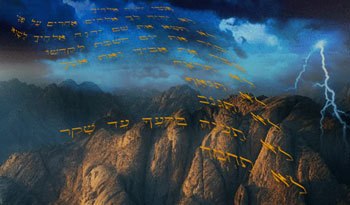
Torah at SinaiAnd yet when God speaks, His words are always for our benefit. God gave the words of Torah at Sinai to the Children of Israel, and the Torah detailed every aspect of the Jewish lives as a unique community. But there are so many “words”:

But why so many mitzvos? Why so many dimensions to Torah? We have positive and negative commandments. The mitzvos also include logical laws, logic-defying laws, and everything in between. We have intellectual mitzvos, emotional mitzvos, agricultural mitzvos, business mitzvos, mitzvos dealing with food, dress, housing, and family life. The Torah include every medium of teaching known to man: stories, legal codes, numerological calculations, history, philosophy, ethics, poetry, metaphorical and mystical works.

Ethics of Our Fathers commentary
“Multiplicity”
Elul 22, 5771 * September 21, 2011
Chabad.org

It is said that God made man because He desired to dwell in “the world below”, in our world. To prepare the world, He gave the Torah to the Children of Israel, His “light to the world”. However, for God to truly inhabit our realm, “then the Divine presence must permeate its every aspect.” Man must be refined by the word of God “down to his every element and component” so that the human life will “become a vehicle for the fulfillment of the Divine will.”

While the Torah as given at Sinai was not expected to be placed upon the shoulders of the rest of humanity, not even the non-Jewish disciples of the Master (see Acts 15), we are not left wanting in this regard. That said, it isn’t always clear what are the specifics of Christian obligation to God. Put another way, if the Torah is the Word of God to the Children of Israel, is there a separate “Word” for Christianity?

The “official stance” of the church is that the Law (Torah) has been wholly replaced by the Grace of Christ for everyone (Jewish and Gentile Christians) and the Law is therefore irrelevant. The “One Law” branch of Messianic Judaism declares that Jewish and Gentile believers are equally obligated in lifestyle to all of the 613 commandments that typically believe constitutes the Torah. Jews (including many Messianic Jews) see Gentiles (Christians and otherwise) as being obligated to only those “words” spoken to Noah in Genesis 9, commonly referred to as the Seven Noahide Laws (although some in the Messianic community believe this is modified for Christians by the Acts 15 letter specifically and by the teachings in the Gospels and Epistles generally). Most people settle on “the system” that works for them. Some of us continue seeking His will daily.

(I previously examined the difference between Noahides or “God-fearers” and Gentile Christians in two blog posts: The Sons of Noah and Children of God)

Both Jews and Christians spend all their lives looking at the Bible, reading, studying, and gleaning insights from inspired teachers and Rabbis. We’re trying to understand who we are and who we are supposed to be in the eyes and words of God. What are the commandments of God for our lives? How are they different from person to person? How are they different from generation to generation? How are they different between Jew and Christian? How can we teach others what we are always trying to know in ourselves?

The Word of God and the words of men are tremendously important and powerful. But while God is not careless with His Words, men most certainly are. The Word of God is wielded with great care lest disaster should strike existence. If man would utilize an equal amount of care over his words, how blessed we would be, for in speaking kindness, charity, compassion, and words of Torah, we would re-make the world in His image.

So shall it be in the days of Messiah.

Nitzavim-Vayeilech: Standing Before God

Standing before GodNo moment in human history was as sad as the moment in which the Lord said to Moses, “and I will surely hide My face in that day on account of all the evil which they have done, because they have turned to other Gods (Deuteronomy 31:18)

-Abraham Joshua Heschel
God in Search of Man
Page 155

You have seen all that the Lord did before your very eyes in the land of Egypt, to Pharaoh and to all his courtiers and to his whole country: the wondrous feats that you saw with your own eyes, those prodigious signs and marvels. Yet to this day the Lord has not given you a mind to understand or eyes to see or ears to hear.Deuteronomy 29;1-3 (JPS Tanakh)

Faith is an act of the whole person, of mind, will, and heart. Faith is sensitivity, understanding, engagement, and attachment; not something achieved once and for all, but an attitude one may gain and lose. -Heschel, page 154

That’s a terrifying thought. As the month of Elul wanes and the High Holidays approach, we seek to remove the burden of our sins from us and re-establish our connection with God and with our fellow human beings. To do this, we must connect to our faith, not as mere belief in the existence of God, but in the total knowledge and dedication that God exists and that He is alive and involved in the matters of mankind and in the lives of each of us individually. However our faith and understanding must transcend our own biases and personalities, for it is so easy to confuse our will with His will.

The thoughtless believes every word, but the prudent looks where he is going –Proverbs 14:15

Now the Berean Jews were of more noble character than those in Thessalonica, for they received the message with great eagerness and examined the Scriptures every day to see if what Paul said was true. –Acts 17:11

And why dost Thou permit faith to blend so easily with bigotry, arrogance, cruelty, folly, and superstition? -Heschel, page 155

The prophet Isaiah even lays this last question at the feet of God.

O Lord, why dost Thou make us err from thy ways and harden our heart, so that we fear Thee not? –Isaiah 63:17

Even when we seek God earnestly and with great energy, we often make the hideous mistake of substituting our personality flaws for His justice, mercy, and will. This is the reason that secular people turn away from God and claim that “religion” is the root cause of all evil acts in the world. It is exactly because, in our worst moments, we people of “faith” really are guilty of all that we are accused, including intolerance, bigotry, hatred, and violence. And we claim that all of this error and sin is in the Name of our God and not sprouting from our own faulty human reasoning and emotions.

God saw the truth and spoke it to Moses in the hours before the great Prophet’s death, as recorded in Torah Portion Vayeilech:

The Lord said to Moses: You are soon to lie with your fathers. This people will thereupon go astray after the alien gods in their midst, in the land that they are about to enter; they will forsake Me and break My covenant that I made with them. Then My anger will flare up against them, and I will abandon them and hide My countenance from them. They shall be ready prey; and many evils and troubles shall befall them. And they shall say on that day, “Surely it is because our God is not in our midst that these evils have befallen us.” Yet I will keep My countenance hidden on that day, because of all the evil they have done in turning to other gods. –Deuteronomy 31:16-18 (JPS Tanakh)

What a bitter epitaph to the life of the Prophet Moses, who had dedicated everything he was to the preservation of the Children of Israel, in obedience and devotion to the God of his fathers. How can we go on in the face of such disappointment and failure?

This is the certainty which overwhelms us in such moments: man lives not only in time and space but also in the dimension of God’s attentiveness. God is concern, not only power. God is He to whom we are accountable. -Heschel, page 158

And yet:

Blessed by GodMore particularly, the word nitzavim the core of the blessing given by G-d does not mean merely “standing.” It implies standing with power and strength, as reflected in the phrase: nitzav melech (I Kings 22:48. See Or HaTorah, Nitzavim, p. 1202.), “the deputy serving as king,” i.e., G-d’s blessing is that our stature will reflect the strength and confidence possessed by a king’s deputy.

This blessing enables us to proceed through each new year with unflinching power; no challenges will budge us from our commitment to the Torah and its mitzvos. On the contrary, we will “proceed from strength to strength” in our endeavor to spread G-dly light throughout the world.

What is the source of this strength? Immutable permanence is a Divine quality. As the prophet proclaims: “I, G-d, have not changed,” (Malachi 3:6) and our Rabbis explain that one of the basic tenets of our faith is that the Creator is unchanging; (See Rambam, Guide to the Perplexed, Vol. I, ch. 68, et al.) nothing in our world can effect a transition on His part. Nevertheless, G-d has also granted the potential for His unchanging firmness to be reflected in the conduct of mortal beings, for the soul which is granted to every person is “an actual part of G-d.” (Tanya, ch. 2) This inner G-dly core endows every individual with insurmountable resources of strength to continue his Divine service.

-Rabbi Eli Touger
Commentary on Torah Portion Nitzvaim: Standing Before G-d
Adapted from Likkutei Sichos, Vol. II, p. 398ff; Vol. XIX, p. 173ff
Chabad.org

It is God’s blessing upon us that gives us the strength to respond to Him with unswerving faith and that “our stature will reflect the strength and confidence possessed by a king’s deputy.” We can only speculate who the “king’s deputy” is, although I have my own opinion on the matter. However, in our personal struggle to approach God and stand before the King, we must never forget that the battle does not belong to us only as individuals.

Only that which is good for all men is good for every man. No one is truly inspired for his own sake. He who is blessed, is a blessing for others.

There are many ways but only one goal. If there is one source of all, there must be one goal for all. The yearnings are our own, but the answer is His. -Heschel, page 162

And yet:

In moments of insight God addresses Himself to a single soul. -Heschel, page 163

We can only see the world from our own point of view, but God sees everything from everyone’s perspective. He knows our wants and needs as individuals and He also hears the cry of His united Creation. For a Jew, Heschel says that even “the individual who feels forsaken remembers Him as the God of his fathers.” But the rest of us who don’t share that history and lifeline, must also remember that “God created mankind in his own image, in the image of God he created them; male and female he created them.” (Genesis 1:27). He created mankind, men and women, all of us in His own image. We are all His and in that, we can all be said to be “one”.

May our standing before G-d “as one” on Rosh HaShanah lead to a year of blessing for all mankind, in material and spiritual matters, including the ultimate blessing, the coming of Mashiach. -Rabbi Touger

As we watch the approach of this year’s end and another year beginning to dawn, may we know before whom we stand and have faith and trust that the strength we need to appear before the King, He has already granted us through His blessing, to the Jew and the Gentile alike.

May the Messiah come soon and in our days.

Good Shabbos.

God is Searching

AbyssMost theories of religion start out with defining the religious situation as man’s search for God and maintain the axiom that God is silent, hidden and unconcerned with man’s search for Him. Now, in adopting that axiom, the answer is given before the question is asked. To Biblical thinking, the definition is incomplete and the axiom false. The Bible speaks not only of man’s search for God but also of God’s search for man. “Thou dost hunt me like a lion,” exclaimed Job (10:16).

“From the very first Thou didst single out man and consider him worthy to stand in Thy presence.” (The liturgy of the Day of Atonement) This is the mysterious paradox of Biblical faith: God is pursuing man. (adapted from Kuzari II 50 and Kuzari IV 3) It is as if God were unwilling to be alone, and He had chosen man to serve Him. Our seeking Him is not only man’s but also His concern, and must not be considered an exclusively human affair. His will is involved in our yearnings. All of human history as described in the Bible may be summarized in one phrase: “God is in search of man.” Faith in God is a response to God’s question.

-Abraham Joshua Heschel
God in Search of Man
Page 136

For the past several mornings, I’ve been exploring the wine-dark depths of the soul. Naturally, the soul is found wanting (Romans 3:10). It’s not a pretty picture to sit at the bottom of a deep well and contemplate both the physical darkness and the darkness of the human spirit. I know that God wants us to repent, to turn from sin and to return to Him. More than that, He wants us to sweep away the barriers that inhibit such a return; barriers like discouragement, depression, guilt, and conflict. I’ve heard that we are what we think, but thought is a habit, like cigarettes. Even when we know some thoughts are bad for us, it’s not so easy to quit.

Up until now, I’ve been picturing this struggle as one we have to fight alone, or at least one in which we are expected to do most of the heavy lifting. If I got myself into that deep, nasty hole, I’m supposed to get myself out again, right? God’s waiting at the top encouraging me, but I’ve still got to make the climb alone.

Now Rabbi Heschel is suggesting that God is climbing down after us with a rope ladder and a flashlight.

I’ve heard that before.

I’ve heard that when Israel went down into Egypt, God went down with them:

“I am God, the God of your father,” he said. “Do not be afraid to go down to Egypt, for I will make you into a great nation there. I will go down to Egypt with you, and I will surely bring you back again. And Joseph’s own hand will close your eyes.” –Genesis 46:3-4

It is said that when the Jews were exiled into the diaspora and Herod’s Temple was utterly destroyed, God went into exile with His chosen ones. It is said that He was also imprisoned in the camps with His people during the Holocaust. Whenever the Jews suffered, God suffered with them. Whenever they were raised up from the depths, God lifted them.

For God is not always silent, and man is not always blind. His glory fills the world; His spirit hovers above the waters. There are moments in which, to use a Talmudic phrase, heaven and earth kiss each other…Some of us have at least caught a glimse of the beauty, peace, and power that flow through the souls of those who are devoted to Him. There may come a moment like thunder in the soul, when man is not only aided, not only guided by God’s mysterious hand, but also taught how to aid, how to guide other beings. The voice of Sinai goes on for ever; “These words the Lord spoke unto all your assembly in the mount out of the midst of the fire, of the cloud, and of the thick darkness, with a great voice that goes on for ever.” (Deut. 5:19 Aramaic translation of Onkelos and Jonathan ben Uzziel and to the interpetation of Sanhedrin 17b; Sotah, 10b; and to the first interpretation of Rashi) -Heschel page 138

But that’s Sinai. What allows the rest of us to also hear “a great voice that goes on for ever.” except perhaps the death of the tzaddik, the great Rebbe of Nazaret, Jesus the Christ? But even if we dare to claim a portion of the Kingdom of Heaven through the blood of the Lamb, what else might prevent the God of Israel from finding the son of Noah in the abyss?

However, it is the evil in man and the evil in society silencing the depth of the soul that block and hamper our faith. -Heschel page 141

ShekhinahIt seems I’ve come full circle, or have I?

The Shechinah, the presence of God, is not found in the company of sinners; but when a man makes an effort to purify himself and to draw near to God, then the Shechinah rests upon him. -Heschel page 147

In the spirit of Judaism, our quest for God is a return to God; our thinking of Him is a recall, an attempt to draw out the depth of our suppressed attachment. The Hebrew word for repentance, “teshuvah”, means “return”. Yet it also means “answer”. Return to God is an answer to Him. For God is not silent. “Return O faithless children, says the Lord.” (Jeremiah 3:14) -Heschel page 141

But all this says is that God is in search of the Jew. Is he also in search of his other creations, of the rest of humanity?

What choice do we have but to believe this is true; that God seeks everyone, the Jew and Gentile alike. To not believe this is to abandon hope forever. Christians take it for granted that they are close to God but closer to Jesus. Unfortunately, a careful examination of that certainty shows that one of the requirements is the belief that God draws closer to Christians at the cost of becoming more distant from the Jew.

The approaching dissolution of the Jewish economy, and the erecting of the evangelical state, shall set this matter at large, and lay all in common, so that it shall be a thing perfectly indifferent whether in either of these places or any other men worship God, for they shall not be tied to any place; neither here nor there, but both, and any where, and every where.

-Matthew Henry, Commentary on John 4:21-23
as found at Derek Leman’s blog

I can’t accept that. God is a God of all or He is a God of no one.

So if the faith of both Jew and Christian leads us to believe that God is meeting all people halfway, so to speak, then we must, even without waiting to see His light, reach up to Him as He is reaching down to us. We must take the hand He is extending, grasp tightly, and begin to climb.

He has found us.

We must not wait passively for insights. In the darkest moments we must try to let our inner light go forth. “And she rises while it is yet night” (Proverbs 31:15) -Heschel page 143

Who is the King?

Lion of JudahMoshe received the Torah at Sinai and transmitted it to Joshua; Joshua to the Elders; the Elders to the Prophets; and the Prophets transmitted it to the Members of the Great Assembly (Avot 1:1). The entire body of Judaic Law, written and oral, came through Moshe, who received it directly from God. God did not give it directly to the Jews. Why not?

The Talmud relates: The Emperor told Rabbi Yehoshua ben Chananya that he wanted to see God. Rabbi Yehoshua took him outside and told him to look at the sun. “This is not possible!” exclaimed the Emperor, to which Rabbi Yehoshua answered: “If you cannot even look upon the servant of God, how can you expect to look at God Himself?!” (Chullin 59b).

-Rabbi Chaim Kramer
“Tzaddik: Leader, Teacher, Intermediary?”
Breslov.org

He who is to be a good ruler must have first been ruled. -Aristotle

Several days ago, I compared the crucifixion of Jesus at the hands of the Romans to the murder of Rabbi Abuhatzeira in the morning meditation, The Death of the Tzaddik. I was trying to re-cast Jesus in the role of tzaddik and thus into a proper Jewish context, as well as communicating that, through the lens of Jewish mysticism, how both of these deaths can be considered to atone for “evil burdens”. After reading Rabbi Kramer’s commentary on tzaddikim, this “extra” meditation pretty much created itself.

But that’s not all:

Every time you people talk about the messianic era, and “the Moshiach” (which I assume equates with “messiah”), you insist on talking about him as a king. Well, we started guillotining kings over two hundred years ago, and they haven’t really been in fashion since then. We have found liberal democracies much more adept at protecting the rights of the individuals, and working for the maximum benefit of the maximum number of people. Kings, as a whole, were pretty lousy at all that.

So how about we just call him (or her) an “enlightened spiritual leader”? The “king” title seems such an anachronism.

Question written to Rabbi Tzvi Freeman
quoted in “Who Needs a King?”
Moshiach 101
Chabad.org

The different roles that Jesus plays can be really confusing. Servant, King, Tzaddik, Savior, Messiah. Just who is Jesus and what is the relationship between who he was, who he is, and who he will become? Also, since Judaism en masse rejects the possibility of Jesus actually fulfilling the role of the Moshiach (Messiah), is there any way we can look to Jewish sources (as opposed to Christian scholarship and commentary which, after all, is biased in a certain direction) and possibly see where Jesus might actually fit in?

I believe there is.

No, my case won’t be iron clad and I can’t present it all in a simple blog. Also, I lack the educational and scholarly “chops” to be able to prove anything to anyone. Still, I see patterns in some of what I read. I saw a pattern and wrote about it in my previous blog post and I see one today.

To continue reading from Rabbi Kramer:

With this in mind, we can attempt to examine the role of the Tzaddik. In Judaism, the Tzaddik is a leader, a guiding light to his followers. In general, people have a need for leadership. The average person is for the most part unsure of his responsibility in life and how to go about fulfilling it. He must learn this from the Tzaddik. Therefore, what is needed is true leadership; truly knowledgeable people with an understanding of what someone else’s capabilities are and what is demanded and required of that individual.

Let’s compare this to what Rabbi Freeman has to say about the role of the Moshiach in the Messianic age:

If so, in such a state, who needs a king? Who needs any government at all? Let the people, so fully enlightened and aware of their Creator and their responsibility to His creation, self-organize and work things out between one another. I mean, do you really expect enlightened beings to hurt, steal, extort, or otherwise cause bodily or monetary harm to one another? So who needs government in such a world, never mind a king?

Okay, to get to that point, we may well need an outstanding individual, a great leader who could deal with the oppressors and dictators and other powerful shmendriks of the world. As Maimonides puts it, someone who will strengthen the Torah and “fight the wars of G-d” (Mishneh Torah, Laws of Kings 11:4..) — not necessarily military wars, but actions that have very powerful political and social ramifications.

But once that mission is complete and the world is at peace, buzzing with wisdom until even the leopards and wolves are behaving and the very earth itself is full of knowledge, then everything changes. What would be crucial at such a point would be not a king, but a teacher. Yes, the world is enlightened, but it is still a world emerging into enlightenment. The Moshiach, as a teacher, would guide people to see and to understand this new world into which they had entered.

Now remember the quote from Aristotle?

He who is to be a good ruler must have first been ruled.

OK, I’m probably not playing fair bringing Aristotle into the argument, so I’ll let the Master speak for himself:

An argument started among the disciples as to which of them would be the greatest. Jesus, knowing their thoughts, took a little child and had him stand beside him. Then he said to them, “Whoever welcomes this little child in my name welcomes me; and whoever welcomes me welcomes the one who sent me. For it is the one who is least among you all who is the greatest.” –Luke 9:46-48

When he had finished washing their feet, he put on his clothes and returned to his place. “Do you understand what I have done for you?” he asked them. “You call me ‘Teacher’ and ‘Lord,’ and rightly so, for that is what I am. Now that I, your Lord and Teacher, have washed your feet, you also should wash one another’s feet. I have set you an example that you should do as I have done for you. Very truly I tell you, no servant is greater than his master, nor is a messenger greater than the one who sent him. Now that you know these things, you will be blessed if you do them. –John 13:12-17
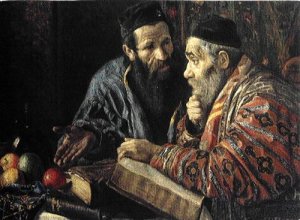
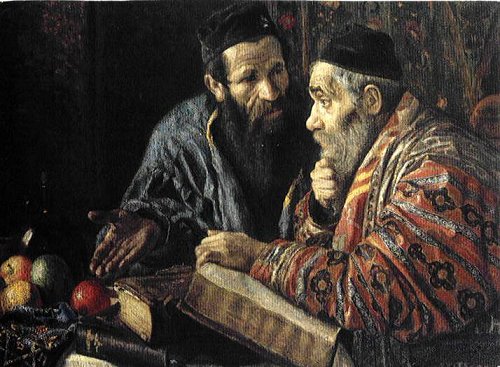
Talmudic RabbisThe Master himself set the prerequisite for being a leader and a tzaddik as being first a servant to others. Rabbi Kramer teaches that a tzaddik must be a leader and Rabbi Kramer and Rabbi Freeman tell us that a tzaddik and the Moshiach (respectively) must also be a teacher:

Torah is the instrument which conveys God’s Infinite Wisdom to man. Who among us can honestly say that he is wise enough to look at that medium and grasp what is required of him? The Talmud, Midrash and Shulchan Arukh stress the importance of receiving from a teacher, so that one’s understanding of Torah be clear. Thus, a teacher or rabbi has to have received from his teacher, and so on, back to Moshe Rabeinu. To look directly into the Torah and say “I know and understand,” is to say “I don’t know and never will, because I consider myself capable enough to glance at God by myself.” As the Talmud teaches: Even one who has studied, as long as he has not received from a Talmid Chakham, a qualified teacher, is still considered an ignoramus (Berakhot 47a). And: How foolish are those who stand up for the Torah Scroll, but do not stand up for the Sage (Makot 22b). The Torah can actually mislead a person who follows it, without the benefits of true guidance and leadership.

Using Moshe (Moses) as an example and a starting point, Rabbi Kramer shows us that one of the main functions of a tzaddik is to present the correct and proper interpretation of the Bible to his disciples (for Christians, substitute “Bible” for “Torah”). Jesus did this continually in the Gospels, with one noteworthy example being the Sermon on the Mount (see Matthew 5). This also goes back to a point I have been trying to make in various blog posts. We cannot simply read the Bible in English with our own understanding, without any training or scholarly background, and expect to always understand what God is trying to say to us. Rabbi Kramer makes this clear when he says, “Even one who has studied, as long as he has not received from a..qualified teacher, is still considered an ignoramus” (quoting Berakhot 47a). Christianity dispenses with the roles of Rebbi and tzaddik as authoritative teachers at our own peril. This model of learning is one of the reasons I am attached to Judaism as a teaching platform.

But why will King Moshiach also need to be a teacher? Here’s Rabbi Freeman’s response:

This will also be the character of the Moshiach. Yes, he will be a teacher—because that’s what those times will be all about: learning, knowing, gaining divine wisdom. But a teacher—a good teacher—limits his lesson to that for which the student is ready and can handle. The Moshiach will be a teacher, but one with a kingly character: as enlightened as they may be, he will see far beyond. And yet, as a teacher-king, he will be capable of transmitting that transcendental knowledge to all of us as well. Perhaps not cognitively, but in some form in which it can be shared.

This teacher, then, is the ultimate of teachers. For he will show us the very core essence of our souls, and how they are rooted in the Core Essence of All Being.

So from Christianity’s point of view, we see that Jesus was required to teach the “lost sheep of Israel” and, through the Gospels, teach all of the subsequent generations of Jewish and Gentile disciples throughout the ages up to the current day, and then beyond. We also see that in the Messianic Age, he will still continue to teach and be the authority for our understanding of the Word of God and how that lamp will completely illuminate our souls.

Even in the beginning, the way Christ taught was considered astonishing:

When Jesus had finished saying these things, the crowds were amazed at his teaching, because he taught as one who had authority, and not as their teachers of the law. –Matthew 7:28-29

Typically, no Rabbi taught in his own name. He taught in the name of his Master; his Rebbe, who also taught in the name of his Master, and so on. Not that there couldn’t be exceptions:

This does not mean that there are no exceptions to the rule. The Talmud speaks of those unique individuals who did succeed in Torah study, though they did not follow the prescribed approach to study outlined by our Sages (see Avodah Zarah 19a). But these singular human beings are very few and far between. One must receive at least the basics of learning from a rabbi, whose task it is to see that the material taught conveys its true meaning (Bava Batra 21a,b).

With apologies to Rabbi Kramer, Jesus would have been even more unique in having “learned” the Torah from his Father, the One God of Heaven. On the other hand, when Rabbi Kramer says, “One must receive at least the basics of learning from a rabbi”, is it such a stretch to consider Christ’s teacher and Rabbi to also be his Father?

The Tzaddik is also an intermediary. He is an agent between God and ourselves. Yet, he is not an intermediary at all. God forbid that anyone should think he needs a medium between the Almighty and himself; not from his side, and certainly not from God’s. Rather, because the Tzaddik is one who has conquered the physicality of this world and entered the spiritual realm, he serves as an agent and a catalyst for bringing spirituality to this world. Having attained the wisdom and understanding necessary for serving God in a true and proper manner, the Tzaddik serves Him by bringing His will to mankind and by getting people to recognize God in all aspects of their lives. The average person cannot perceive God’s will, and therefore has to turn to someone who can. Thus, in this sense, the Tzaddik is an intermediary.
Who is Moshiach?And so, though Rabbi Kramer wouldn’t present it this way, Jesus is an intermediary between us and God as our great High Priest in the Heavenly Court (Hebrews 4:14-16). He “serves as an agent and a catalyst for bringing spirituality to this world”. We are not alone nor are we, even though not Jews and recipients of the gift of Sinai, without one to petition the Father with our needs.

Rabbi Freeman tells us the role our teacher plays out for us today and where it will lead tomorrow:

An interesting idea, because it fits so well into the idea of what the messianic era is all about and how it fulfills the purpose of creation—as Rabbi Schneur Zalman writes, “everything depends on our work throughout the time of exile.”

Meaning that through the toil of our hard work, our struggle and persistence in the most trying times right up until that glorious era, we will draw into the world a deep light, an essence-light, such as could never have been revealed without that labor. It is that essence-light that the Moshiach will have the job of revealing to us. Something entirely transcendental, and yet, something that each of us touches; something from which each of us draws strength every time we defy the confusion and darkness of our present world to do what we know is right and beautiful.

I cannot help but see Jesus as the Messiah through the teachings of the Rabbis. In fact, I see him more clearly as I read the words of Rabbis Kramer and Freeman than I do in the books written by traditional and modern Christian scholars. I see Jesus in the words of Talmud, as interpreted by such Rabbis (again, I emphasize that these Rabbis would never have intended that I take such a meaning. This is due to Jesus being completely “re-painted” in the image of a Gentile Christian “god” by the church). How can I not? I must seek him where he is to be found.

The Moshiach is found among his people; among his Father’s chosen ones; His Am Segulah, God’s treasured, splendorous children. As servant and teacher, whose death atoned for an evil decree upon mankind, as Intermediary, Priest (Hebrews 6:20), and Messiah King, he first came for Israel but is the redeemer of all the world. We seek him and God sent him to us so that we, in seeking God, could be found by Him and return home.

A Storm is Coming

Facing the stormThat day when evening came, he said to his disciples, “Let us go over to the other side.” Leaving the crowd behind, they took him along, just as he was, in the boat. There were also other boats with him. A furious squall came up, and the waves broke over the boat, so that it was nearly swamped. Jesus was in the stern, sleeping on a cushion. The disciples woke him and said to him, “Teacher, don’t you care if we drown?”

He got up, rebuked the wind and said to the waves, “Quiet! Be still!” Then the wind died down and it was completely calm. He said to his disciples, “Why are you so afraid? Do you still have no faith?”

They were terrified and asked each other, “Who is this? Even the wind and the waves obey him!”Mark 4:35-41

“Serenity is not freedom from the storm, but peace amid the storm.” -Unknown

I remember reading a story about a Jewish Chasid who went to his Rebbe and complained of terrible problems. He had various difficulties in his life, including matters of finance and was distracted all of the time. He begged the Rebbe to help him find peace of mind, so he could return to his Yeshiva studies.

The Rebbe instead became angry and said something like, “All you have been doing is telling me about your problems and how you want peace of mind. What about all you could be doing to help others?”

I can’t recall the source of the parable, so I’m reconstructing it from memory, but I think I’ve captured its essence. The Chasid wanted what we all want at times; peace of mind and relief from the struggles of day-to-day life. He wanted to return to a state where he could calmly, quietly contemplate the things of God and allow his spirit to ascend the heights of the courts of Heaven. Instead his Rebbe, the man who he felt was close enough to God to understand his concerns, completely sidestepped his worries, turned him around, pointed him at the problems of other people, and told him to go out there and be a solution.

Wasn’t that kind of heartless?

Not really.

For the past couple of mornings, I’ve been chronicling the personal struggles we all face in confronting sins, desiring to repent, the roadblocks of despair, depression, and discouragement, and how it seems that hitting the reset button on life during the Jewish High Holidays is more fantasy and wishful thinking than practical reality. After all, how is it possible to rid ourselves of our human frailties and grow closer to God when life will not stop long enough to give us a break? How can we enjoy the sunshine and the gentle breezes of an early fall when the raging storms of winter will absolutely not let up for a second?

“Serenity is not freedom from the storm, but peace amid the storm.” -Unknown

Easier said than done.

The disciples woke him and said to him, “Teacher, don’t you care if we drown?”

He got up, rebuked the wind and said to the waves, “Quiet! Be still!” Then the wind died down and it was completely calm.

He said to his disciples, “Why are you so afraid? Do you still have no faith?”

Was Jesus being unreasonable with his disciples? Who wouldn’t have been terrified? Where was his compassion?

We are not passive observers of this universe, but rather partners in its creation. We are the ones who assign each thing its meaning, who bring definition and resolution to an otherwise ambiguous world.

In fact, we are legal witnesses who determine a matter of life or death: For each thing we hold, each event that enters our life, our word declares whether it breathes with G-dly life or simply idles itself into oblivion.

-Rabbi Tzvi Freeman
“Defining Your World”
Based on letters and talks of the Rebbe
Rabbi M. M. Schneerson
Chabad.org

LionBut where is God amid the storm? Does God hear the screams of the countless victims of the rape gangs in the Congo? Where is God when the persecuted Christians in China and Afghanistan cry out? Where is God six months after the Japan earthquake and tsunami when the victims still face the long struggle to rebuild their nation and their lives (and now one million Japanese must flee a typhoon)?

While the storm in your life and mine may not be so devastating, where is God when we struggle and sometimes fail? Where is He in the storm?

The LORD said, “Go out and stand on the mountain in the presence of the LORD, for the LORD is about to pass by.”

Then a great and powerful wind tore the mountains apart and shattered the rocks before the LORD, but the LORD was not in the wind. After the wind there was an earthquake, but the LORD was not in the earthquake. After the earthquake came a fire, but the LORD was not in the fire. And after the fire came a gentle whisper. When Elijah heard it, he pulled his cloak over his face and went out and stood at the mouth of the cave. –1 Kings 19:11-13

I don’t have the answers. I can’t tell you why people suffer horribly. I can’t tell you why some people suffer horribly and yet retain an almost mystical trust in God.

Though he slay me, yet will I hope in him;
I will surely defend my ways to his face. –Job 13:15

Most of us aren’t Job. But what choice do we have? If we give up and abandon our faith in the face of our sins and as the storm clouds approach, how are we better off? But how can God give us serenity in the midst of the storm? Paul knew:

I am not saying this because I am in need, for I have learned to be content whatever the circumstances. I know what it is to be in need, and I know what it is to have plenty. I have learned the secret of being content in any and every situation, whether well fed or hungry, whether living in plenty or in want. I can do all this through him who gives me strength. –Philippians 4:11-13

Most of us aren’t Paul. But what choice do we have? The answer is there somewhere, beyond the simplistic platitudes of “you just need to have more faith”. Somehow it’s possible. Somehow, it’s even practical to be able to trust God to the degree that it defies all reasonable expectations. God won’t send away the storm. We must learn how to rely on Him strongly enough to be able to endure the wind and the rain and the chaos.

Somehow.