Tag Archives: Christianity

Remembering Jerusalem

poor-israel…and when James and Cephas and John, who seemed to be pillars, perceived the grace that was given to me, they gave the right hand of fellowship to Barnabas and me, that we should go to the Gentiles and they to the circumcised. Only, they asked us to remember the poor, the very thing I was eager to do.

Galatians 2:9-10 (ESV)

James, Peter, and John gave Saul and Barnabas “the right hand of fellowship.” They commissioned them to go to the Gentiles while they themselves continued to witness Messiah to the Jewish people. Saul says, “They only asked us to remember the poor – the very thing I also was eager to do” (Galatians 2:10). How should this single caveat be understood?

It does not mean the apostles laid upon the Gentile believers no greater obligation to Torah than the commandment of giving charity generously to the poor. Saul did not say, “Only they asked the Gentiles to give charity to the poor.” He said, “Only they asked us to remember the poor.” In this context, “us” must be Saul and Barnabas.

In his commentary on Galatians, Richard Longenecker identifies “the Poor” in Galatians 2:10 as a shorthand abbreviation for the longer title that Paul gives them in Romans 15:26, where he refers to them as “the poor among the saints at Jerusalem…” Saul and Barnabas were to remember the Poor Ones of the apostolic assembly of believers in Jerusalem: the pillars, the elders, the assembly of James and the apostles.

D. Thomas Lancaster
Torah Club, Volume 6: Chronicles of the Apostles
from First Fruits of Zion (FFOZ)
Torah Portion Va’era (“and I appeared”) (pp 362-3)
Commentary on Galatians 2:1-18, Acts 12:25

I’ve talked about charity very recently. It was less than two months ago that I discovered that some folks at the church I attend believe that Christians have a special duty to support the poor of Israel based on the following:

Then the righteous will answer him, saying, ‘Lord, when did we see you hungry and feed you, or thirsty and give you drink? And when did we see you a stranger and welcome you, or naked and clothe you? And when did we see you sick or in prison and visit you?’ And the King will answer them, ‘Truly, I say to you, as you did it to one of the least of these my brothers, you did it to me.’

Matthew 25:37-40 (ESV)

I was trying to describe this to my (Jewish) wife just the other day, but I’m not sure she believed me. It’s not typical behavior from many churches. On the other hand, as we see from Lancaster’s teaching on Galatians 2, there is a rather clear Biblical precedent for the Gentile believers to “remember” the poor of Israel.

OK, I know that according to Lancaster, James and the Apostolic council was telling Saul (Paul) and Barnabas to remember the poor of Israel, but look at the context. On the very heels of the council validating Paul’s mission to the Gentiles to bring them to covenant relationship with God through Messiah without requiring that the Gentiles convert to Judaism, and sending Paul and Barnabas back to the Goyim with their good graces, James, Peter (Cephas), and John added the caveat to remember the poor. How could that message then not be transmitted by Paul from the Apostolic council to the Gentiles in the diaspora?

Still don’t believe me?

Now concerning the collection for the saints: as I directed the churches of Galatia, so you also are to do. On the first day of every week, each of you is to put something aside and store it up, as he may prosper, so that there will be no collecting when I come. And when I arrive, I will send those whom you accredit by letter to carry your gift to Jerusalem.

1 Corinthians 16:1-3 (ESV)

We want you to know, brothers, about the grace of God that has been given among the churches of Macedonia, for in a severe test of affliction, their abundance of joy and their extreme poverty have overflowed in a wealth of generosity on their part. For they gave according to their means, as I can testify, and beyond their means, of their own accord, begging us earnestly for the favor of taking part in the relief of the saints…

2 Corinthians 8:1-4 (ESV)

Which “saints” do you think Paul was taking about?

It sure looks like Paul was imploring, directing, even commanding the Gentile churches in the diaspora to take up a collection to be used as a donation to the poor among the Apostolic community in Jerusalem, even from the poor among the Gentile churches.

poor-israel2I’m not trying to beat a dead horse, I’m trying to inspire some life in the one we have, but the one we often ignore, most likely through ignorance. I said just yesterday that we translate and interpret the Bible based on our traditions and theologies. The obligation of the Christian church to support the poor among Israel has fallen through the cracks of our creaky theology for nearly twenty centuries. It’s time to fix the floorboards, firm up the foundation, and take back the responsibility that we were given by the first Apostles and the men who walked with Christ.

This does not absolve us of our responsibility to the poor of the nations, the poor of our country, our city, within our neighborhoods and our own churches. But it opens the door in our lives and in our spirits to remember Jerusalem, to remember Israel, and God’s special covenant people, our mentors, and the root of our salvation.

If I forget you, O Jerusalem, let my right hand forget its skill! Let my tongue stick to the roof of my mouth, if I do not remember you, if I do not set Jerusalem above my highest joy!

Psalm 137:5-6 (ESV)

If you’re hard pressed to know where to begin, then consider visiting meirpanim.net, colelchabad.org, or chevrahumanitarian.org. That’s just for starters.

Missing Author

empty-bibleWho wrote the Torah? Most people you ask — depending on your circle of friends — will answer, “A group of very wise men got together and wrote it.” For the past 3,300 years the Jewish people have lived with the consciousness that the Almighty dictated the Torah to Moses who wrote it down word for word, letter by letter. Every Torah-educated Orthodox Jew believes that. Are they fools, fantasizers, misguided religious fanatics?

It will surprise some people to know that for the past 3,300 the Jewish people have taught their children the evidence for the belief that there is a God and that He dictated the Torah to Moses. Actually, I am sure that for the first hundred or two hundred years after the giving of the Torah at Mt. Sinai the authorship of the Torah was not even a question. For generations all a Jewish child had to do was to ask his father if he was at Mt. Sinai or if his father or grandfather was there. Even Moses himself tells all generations to “Go and ask … has a people ever heard the voice of God speaking … as you have heard and survived?” (Deuteronomy 4:32-35).

-Rabbi Kalman Packouz
“Shabbat Shalom Weekly”
Commentary on Torah Portion Vaeira
Aish.com

This post may trouble some readers. It really shouldn’t. Religious leaders in some circles have sought to suppress the overwhelming evidence that something like the Documentary Hypothesis is true. Attacks against this idea usually claim that those who believe this theory simply disbelieve God. Such attacks also tend to refer to Julius Wellhausen and his views, which actually do not represent what is essential about the Documentary Hypothesis. The Documentary Hypothesis (DH) has many forms and is better known as JEDP. In my opinion, the best developed understanding of the DH is found in Richard Friedman’s work, including the very readable Who Wrote the Bible? (which was a bestseller).

-Derek Leman
“Exodus 6:2-3 and the Documentary Hypothesis”
Messianic Jewish Musings

I haven’t revisited this topic in a long time and even after I read Derek’s blog post, I was determined not to regurgitate it again from the murky depths so that it could come back up into the cold light of day. Then I read Rabbi Packouz and I was reminded that there is a fair distance between the stories we tell ourselves about the Bible and the story that the Bible tells us about itself (I know these gentlemen are specifically discussing the Torah, the Five Books of Moses, but I’m choosing to expand the discussion to the Bible as a whole).

I don’t mean the story the Bible tells in the actual text, but the history and evolution of the creation of the Bible as we have it today. I’m no scholar, but even I’ve read enough to realize that the Bible has lots and lots of warts, bruises, wrinkles, and other imperfections. No reliable and trustworthy Bible scholar would suggest that God literally dictated the Bible word-for-word to its various human authors.

So where is God in the Bible? No I don’t mean where is God mentioned, but is there anything of God in the actual composition of the Bible? Or is the Bible just the stories we tell ourselves about it? Frankly, we have told ourselves some pretty interesting stories about the Bible.

One way to establish and support an acceptance of Talmudic interpretation and judgment relative to Torah for post-Second Temple Judaism is to project the values and even the “reality” of Talmud (and later, Kabbalah) not only forward in time but backward. Peering at the Patriarchs through this lens, we can indeed “see” Abraham, Isaac, and Jacob studying Torah and Talmud in the study house of Shem when by historical knowledge and a plain reading of the Torah, such events seem very unlikely to have actually taken place.

-from my blog post:
The Rabbinization of Abraham

study-in-the-darkI periodically wrestle with this issue. Back on my previous blog, I wrote such articles as Reading the Bible in the Dark, The Bible is a Mystery Novel, and Who to Believe. I manage to “tame” the questions and conundrums by reading the Bible as if it were a series of Chassidic, or in my case, Messianic Tales. Maybe that’s the only way to make sense of the Bible, and especially the Gospels.

He read the Gospels in German. Then he obtained a Hebrew version and reread them. Though he was in the midst of a Gentile, Christian city where Jesus was worshiped in churches and honored in every home, Feivel felt the Gospels belonged more to him and the Chasidic world than they did to the Gentiles who revered them. He found the Gospels to be thoroughly Jewish and conceptually similar to Chasidic Judaism. He wondered how Gentile Christians could hope to comprehend Yeshua (Jesus) and His words without the benefit of a classical Jewish education or experience with the esoteric works of the Chasidim.

Taken from Jorge Quinonez:
“Paul Philip Levertoff: Pioneering Hebrew-Christian Scholar and Leader”
Mishkan 37 (2002): 21-34
as quoted from Love and the Messianic Age

But this presents a problem. During last Sunday’s sermon, Pastor said (I don’t have my notes with me, so what I’m about to write isn’t an entirely accurate quote) that the only way to show an unbeliever how to encounter God and come to faith in the Father through Jesus Christ is by reading and using scripture.

Um…whoa. Waitaminute.

Given everything I’ve said above, plus Derek’s commentary, plus just a boatload of Biblical scholars , scripture is not and cannot be the literally dictated words of the God of Heaven as whispered into the little, shell-like ears of the prophets and other writers of the books of the Bible.

In fact, I’m hard-pressed to tell you what the Bible is and who actually wrote it. Even portions of the New Testament weren’t in all likelihood, written by the people whose names are attached to them. Not all of the epistles written by Paul? Probably not. Did the Apostle John who (supposedly) wrote the Gospel of John also write Revelation?

Once you stop taking the Bible for granted, a lot of new territory opens up in front of you…in front of me.

In defense of the Bible (the Torah actually), Rabbi Packouz has this to say:

Perhaps the most powerful example is Shmitah (the Sabbatical year for the land). Modern agriculture science has taught us the value of letting the land rest and replenish itself. A sensible law would be to divide the Land of Israel into 7 regions and each year let one region lie fallow while people eat from the crops of the other 6 regions. However, that’s not the law of the Torah! The Torah writes, “For six years you may plant your fields … but the seventh year is the Sabbath of the land in which you may not plant your fields nor prune your vineyards (Leviticus 25:36).

The WHOLE land is to rest all at the same time! What happens to an agrarian society that stops farming for one year? Starvation! And how long does a religion last that advocates letting the whole land rest in the 7th year? My guess … about 6 years!

Perhaps they could avoid starvation by buying food from surrounding countries? A good idea and a reasonable idea … but the Torah has other plans. The Almighty says, “I have commanded My blessing to you in the sixth year and you will have produce for three years” (Leviticus 25:20-22).

Either one has to be God to have the “audacity” to make a law for the whole land to rest and then to promise a bounty crop 3 times as large as usual in the sixth year — or a stark raving mad lunatic!

Yet, the Jewish people neither starved nor abandoned the Torah! 3,300 years later a sizable portion of our people still adhere to the laws of Torah and still trust in the promises of the Almighty!

How could any human being promise in writing something that requires powers totally beyond his control?

And furthermore, why would anyone be willing to risk his own credibility and the legitimacy of his religion, when it would be easier to present a more rational solution and avoid the credibility issues.

Going to GodCan we accept that somewhere in the pages of the Bible we might actually be able to encounter the Divine? If so, where and how (apart from Shmitah)? If we can’t take the Bible as literally, page-by-page, the Word of God, then what do we consider it? If God is in there somewhere, then is it an intellectual and scholarly race to discover the secret location of the well of God’s Spirit?

Derek Leman seems to think that it’s possible to have a very questioning view of the Bible and yet still have faith:

People get from their religious background the idea that “Moses wrote all” or “Moses wrote almost all” of the Torah. For example, people will say “Moses wrote Genesis.”

This is complicated by things like Yeshua referring to “Moses and the prophets.” People take this to mean that Yeshua, who they suppose was omniscient during his earthly sojourn (but he was not) affirmed that Moses wrote all of Gen-Deut. He did not. His references to Moses actually writing all concern commandments, not narratives. With Moses as the originator of the commandments (or original vessel through whom they were revealed), all the five books are called “of Moses” but this need not mean authorship.

Anyway, because some of the earliest people to doubt Moses as the final author of Torah were skeptics, it is common for people to think anyone with a more complicated view than “Moses wrote it” are doing so because of a small faith or a lack of faith or a dislike of faith.

But I’ve never heard a satisfactory explanation of how other people do it. I only have how I do it and my “method” requires usually suspending disbelief for the sake of faith. I have encountered God before, so in an extraordinarily subjective way, I know He is real, He is alive, and He is God. I’m not going through the crisis of faith I had when I first faced this particular realization, but I do allow myself to periodically become aware of just how fragile a knowledge of God is if based solely on the Bible. On the other hand (and I’ve alluded to this already), basing knowledge of God solely on our experiences with the Holy Spirit can be just as hazardous, because most human beings have very little ability to tell the difference between an emotional experience and a spiritual one (barring the occasional saint or tzaddik).

I may not be able to take everything I read in the Bible and everything that Christianity and Judaism says about those events as actual, factual events (though some of them probably are), but I can still take what I read and what I study and try to apply them so that I can learn to live a better life.

The Patriarch Abraham was tested (by God) ten times and withstood them all. This proves Abraham’s great love for God.

-Ethics of the Fathers 5:3

Abraham was tested with ten trials of progressively increasing severity, ultimately culminating in the test of sacrificing his beloved son Isaac if God so willed.

Abraham successfully passed all the tests. Still, while he did demonstrate his intense loyalty and devotion to God, how did it prove his love for God?

In yesterday’s message we learned that God does not challenge people beyond their capacities. It follows, then, that as they advance in spiritual growth and strength, they actually render themselves vulnerable to trials of greater intensity. In the course of his many trials, Abraham detected this pattern. He could have logically decided to avoid any further spiritual progression, because it might subject him to even greater ordeals than those he had already sustained.

Abraham decided otherwise. He desired so much to come closer to God that he was willing to pay any price. Thus, when he was put to the ultimate task – to sacrifice Isaac – Abraham was not taken aback. He had fully anticipated such an eventuality.

We are not of the mettle of Abraham, and we pray every day, “Do not put us to test.” While we indeed wish to advance spiritually, we ask to be spared the distress of trial. Yet, should we experience adversity in life, we would do well to realize that this may be a testimony to our spiritual strength.

looking-upToday I shall…

try to advance myself spiritually. Although I pray to be spared from distress, I will try not to recoil if adversity does occur.

-Rabbi Abraham J. Twerski
“Growing Each Day, Tevet 26”
Aish.com

Thomas Gray once penned the famous words, “Where ignorance is bliss, ’tis folly to be wise” (in the poem “Ode on a Distant Prospect of Eton College,” 1742). I suppose many “Bible-believing Christians” feel very blissful as long as they don’t consider the rather troubling questions I’m bringing up this morning. On the other hand, once the “bliss bubble” is popped, then we can only face the painful trial of reality, if not the wisdom, of whatever we have left.

Chances are, Abraham never faced the ten challenges, at least as we see chronicled in Pirkei Avot (but not the Bible). Chances are Abraham, Isaac, and Jacob never studied Torah in the academies of Shem and Eber as we learn from the Talmud. Maybe the only place we really encounter God is in our prayers. Or maybe we encounter God everyday, as long as we continue to seek Him.

According to Gedaliah Nigal’s book The Hasidic Tale, some of the goals of the hasidic story are to “rouse its hearers into action for the service of God” and to win “adherents, among them some outstanding individuals, to hasidim.” In relation to this, I’ve said:

The “Chasidim” of Jesus also made sure the stories of their Master were passed on from generation to generation, eventually being recorded and passed on to the future…to us.

Paul Philip Levertoff thought that the teachings of Jesus read like a collection of Chasdic tales. Perhaps as Gentile Christians reading tales of the Chasidim, we can also find a connection to the Messiah, the Prophet, and the greatest Tzadik, whose own death atoned for not just a few, but for all.

Having gone through all this again, I feel reassured.

Message to the Sons of Solomon

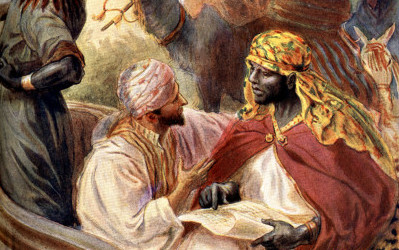
philip_and_the_ethiopianAnd King Solomon gave to the queen of Sheba all that she desired, whatever she asked besides what was given her by the bounty of King Solomon. So she turned and went back to her own land with her servants.

1 Kings 10:13 (ESV)

Now an angel of the Lord said to Philip, “Rise and go toward the south to the road that goes down from Jerusalem to Gaza.” This is a desert place. And he rose and went. And there was an Ethiopian, a eunuch, a court official of Candace, queen of the Ethiopians, who was in charge of all her treasure. He had come to Jerusalem to worship…

Acts 8:26-27 (ESV)

The Ethiopian history described in the Kebra Negast, or “Book of the Glory of Kings,” relates that Ethiopians are descendants of Israelite tribes who came to Ethiopia with Menelik I, alleged to be the son of King Solomon and the Queen of Sheba (or Makeda, in the legend) (see 1 Kings 10:1-13 and 2 Chronicles 9:1-12). The legend relates that Menelik, as an adult, returned to his father in Jerusalem, and then resettled in Ethiopia, and that he took with him the Ark of the Covenant.

-Budge, Queen of Sheba, Kebra Negast, chap. 61.
quoted from Wikipedia

I’ve written before about the section of Acts 8 that chronicles the encounter between Philip and the Ethiopian eunuch in relation to D. Thomas Lancaster’s commentary in Volume 6 of the Torah Club: Chronicles of the Apostles. Today (as I write this “church report”), it was Pastor Randy’s turn to teach us his perspective during Sunday services where I go to church.

It was also Charlie’s turn to discuss it in Sunday school and it was interesting. I already knew that Charlie believed the Ethiopian was Jewish but as Pastor started delivering his message, he shared with us that he just that week had changed his opinion about the Ethiopian and now believes that he must have been a Jew! Interesting.

I’m torn between whether to write about the history of the Ethiopian Jews, which is a topic of some controversy and speculation, or if I should focus on why God found it necessary to send an angel to tell Philip to find the Ethiopian (Acts 8:26). I think I’ll focus on the latter.

Let me explain.

In teaching the Sunday school lesson, Charlie remarked more than once how unusual he thought it was for God to send “an angel of the Lord” to tell Philip to stop everything he was doing in Samaria and travel south on the desert road to find one man who was returning to his native Ethiopia after a pilgrimage to Jerusalem. Why was this one man so important?

From a traditional evangelical Christian point of view, converting a high-ranking official of a foreign country to faith in Jesus Christ is a great way to spread the gospel message to all of the other high-ranking government officials in that country as well as to the general body of citizens. But I don’t think we can exactly map 21st Century evangelical strategies to First Century CE Jewish devotion to the sect of “the Way.” Charlie thought, given how the message of Christ was transmitted first to the Jews, then to the Samaritans, and finally to the rest of the nations, that God believed the Jewish population in Ethiopia was close to the heart of their Creator, and that the “Good News” of Messiah was a message God intended for all Jews to embrace. After all, much of the New Testament text addresses the spread of the Gospel into Europe, Asia, and the Near East. What about the Jews to the south?

This is all speculation of course, and only one part of a single chapter in the New Testament is devoted to transmitting such a message in that particular direction, but what Charlie also said more than once got my attention. He said that God wanted to make sure all of the Jews got the message that God had changed the rules.

What? What rules?

(I should say at this point, when Charlie made his comment about “changing rules” I was seriously considering what I should say or do in response. I chose not to say or do anything, but given my sensitivity to the matter of supersessionism in the church, I was afraid that I would have to defend against such a theology at the cost of my budding relationship among these fellow believers. Fortunately, it didn’t come to that.)

Actually, something important did change thanks to Christ.

Go therefore and make disciples of all nations, baptizing them in the name of the Father and of the Son and of the Holy Spirit…

Matthew 28:19 (ESV)

While Israel had always been intended to be a “light to the nations” (Isaiah 49:6), this is the first indication that the Messiah wanted people from all of the nations, and not just from Israel, to become disciples of the Master and grafted in sons and daughters of God. As we progress forward and especially attending to Acts 10 and beyond, we see that God’s intent was not to require the Gentiles to convert to Judaism or abandon their own national and ethnic uniqueness in order to become disciples. The Holy Spirit was just as available to the Gentile disciple as to the Jew.

Walking TogetherIn this specific sense, something had changed. Prior to this moment in time, if a Gentile wanted to worship the God of Israel in a covenant relationship, he or she had to embrace Judaism (that’s more or less an exact quote from Pastor Randy). With the command of Christ, which the church calls “the great commission,” anyone from anywhere could worship God in a covenant relationship without converting to Judaism (the concept of conversion is complicated…it probably didn’t exist as such during the days of Moses or David, but it was a recognized practice during the late Second Temple period and beyond).

Did God want Philip to tell the Ethiopian that God changed the rules? A plain reading of the text doesn’t suggest such a thing. From my point of view, what God wanted Philip to tell the Jewish Ethiopian was the good news of the Messiah who had come and will come again, as revealed by Isaiah 53. Why God wanted this event to occur is up for grabs, but what the Ethiopian carried back with him to his land and to his people was the gospel message, or as much of it as Philip was able to transmit in the time they were together and related to the passages from Isaiah. What fruit resulted upon the eunuch’s homecoming and in the years and centuries to follow, we cannot know.

But if God changed anything, it wasn’t His “rules” or His Torah but rather access. God opened up covenant access to Himself for all peoples. There are two portions to the good news of Christ. Of course, there is the good news for the Gentile, that we can now come to God in covenant through the blood of His son. However, Christianity rarely considers the good news of Christ to the Jew who already had such a covenant relationship (which would include the Jews in Ethiopia), that the Messiah had come, the King of Israel had been born, that he died and rose and sits at the Father’s right hand, and that at the proper time, Messiah would cause a scattered Israel to be gathered together as a nation and one day, the King would rule from Jerusalem (I’m not suggesting two, separate paths of salvation, one for Gentiles and one for Jews, but because of Israel’s special unique relationship with God, the Messiah has more and different good news for the Jews in addition to the good news he has for the Gentiles).

On Friday May 24, 1991: Over the course of 36 hours, a total of 34 El Al Hercules c-130s – with their seats removed to maximize passenger capacity – flew non-stop.

14,325 Ethiopian Jews came home to Israel, to be greeted by thousands of Israelis who gathered at temporary absorption centers, hotels and hostels to welcome their brethren.

Operation Solomon saw the rescue of twice the number of Ethiopian Jews in Operations Moses and Joshua put together.

-from bluestarpr.com

A Christian group said Tuesday, June 7, it would help organize “the return of the last 8,700 Ethiopian Jews to Israel” by sponsoring what are known as “Aliyah” flights, the coming months.

“Last Ethiopian Jews to Return to Israel, Christian Group Says”
-from worthynews.com, June 8, 2011

I know I’m stringing together bits and pieces of scripture, news, and commentary in a less than rock-solid structure, but consider for a moment that Jews from all across the nations have been returning to Israel and are being gathered to their people. God has never forgotten them nor will He ever forsake them. Perhaps that’s why He made it a point to send an angel to Philip and to insure that the message of the Messiah would reach all of his people, including the Jewish Ethiopians.

Just a thought.

The Evolution of Judaism, Part 6: Evolutions

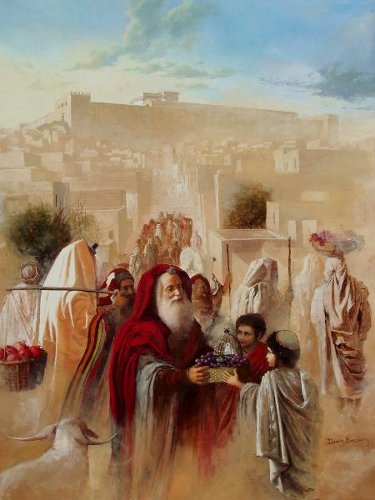
ancient_jerusalemThe best evidence that the temple was the locus of prayer during the First and Second Temple periods is the book of Psalms. Virtually all the biblical psalms, even those that lament personal or national catastrophes or that hail a king at this coronation, are hymns of praise to God. They range in date from the period of the monarchy, if not earlier (some of them are Israelite versions of Canaanite or Egyptian hymns), to that of the Maccabees.

All these texts imply that the recitation of prayers was a prominent feature of Jewish piety, not just for sectarians like the Jews of Qumran but also for plain folk. Jews who lived in or near Jerusalem prayed regularly at the temple. This is the plausible claim of Luke 1:10, “Now at the time of the incense offering, the whole assembly of the people was praying outside [the temple],” and Acts 3:1, “One day Peter and John were going up to the temple at the hour of prayer, at three o’clock in the afternoon.”

By the third century BCE, diaspora Jews began to build special proseuchai, which literally means “prayers” but probably should be translated “prayer-houses.” Instead of “prayer-houses,” the Jews of the land of Israel had synagogai, which literally means “gatherings” but probably should be translated “meeting-houses.” Whether they prayed regularly in their “meeting-houses,” which are not attested before the first century CE, is not entirely clear.

The history of this (Amidah or Eighteen Benedictions) prayer is immensely complicated, but its basic contours were established no later than the second century CE, and its nucleus certainly derives from the latter part of the Second Temple times. It bears obvious similarities to the Lord’s Prayer (Matt. 6:9-13 and Luke 11:2-4).

…by the end of the Second Temple period, sections of the Torah were read publicly in synagogues every week.

The purpose of all these rituals was, as the Torah repeatedly says, to make Israel a “holy” people (Exod. 19:6; Lev. 19:2; Deut. 7:6). To better achieve this objective, the Jews of the Second Temple period developed new rituals, broadened the application of many of the laws of the Torah, and in general intensified the life of service to God.

After the destruction of the temple, the petition was changed from a prayer for acceptability of the sacrifices to a prayer for their restoration, and the petition entered the Eighteen Benedictions. In rabbinic times, the prayer was still in flux.

This practice is based on the idea that God can be worshiped through the study of his revealed word.

-Shaye J.D. Cohen
Chapter 3: The Jewish “Religion:” Practices and Beliefs
From the Maccabees to the Mishnah, 2nd Ed.

Forgive the rather lengthy history lesson from different portions of this chapter in Cohen’s landmark book, but as I’ve continued to read from his work, I’ve been struck by how Judaism developed significantly in practice and in its comprehension of a life of devotion to God from the days of the Mishkan (Tabernacle) in the desert to the post-Second Temple era. Some time ago, I began a series of blog posts intended to outline the evolution of Judaism as it applies to Yeshua (Jesus), halakhah, and the “acceptability” of the various Judaisms in any given age and across time to the God who established Israel as a nation. You can follow the link at the end of Part 1 of the series to review all of my comments to date, which ends at Part 5. I had intended for Messiah in the Jewish Writings, Part 1 to be the “sixth” part of the series, but it was pointed out to me that certain “weaknesses” in the scholarship of the material from which I was quoting made it unsuitable for that purpose.

Before proceeding, you should probably review Noel S. Rabbinowitz’s paper “Matthew 23:2-4: Does Jesus Recognize the Authority of the Pharisees and Does He Endorse their Halakhah?” which can be found as a PDF as published in the Journal of the Evangelical Theological Society 46:3 (September 2003): 423-47. That, along with reading the other “Evolution” blog posts in this series, should provide the foundation for continuing (and ultimately concluding) the discussion here.

In providing the series of quotes from Cohen’s book, I intended to illustrate how what was acceptable Jewish practice in worship, Temple sacrifice, and prayer developed over time and was never a single, static set of religious rules and procedures that perfectly reflected the intent of the Torah and God in the life of Israel. Sometimes in certain corners of Christianity and its variants, we find people who sincerely are seeking a more authentic method of practicing their faith, based on some sort of idealized and perfect template or model that was established, either by Moses or Jesus. Somehow that particular set of behaviors is believed to be what God wants us to do and is the only valid model by which we should construct our faith practices in the present age.

But as the title of this series implies, perhaps the human practice of worshiping God can never be static nor was it ever intended to be a single set of rigid rules and concrete regulations that never modified in the slightest across the long centuries between Sinai and the present.

I don’t mean that right and wrong don’t have timeless value and that God changes His requirements for humanity at a whim, but humanity changes, circumstances change, and what seems right to do at one point in human history seems very much different at another point on the timeline of existence. Surely how Solomon viewed what was proper worship differed greatly from what the Rambam might have considered right Jewish practice, and yet can we say that either one of them (or both) was wrong? They were both certainly convinced that they were doing what God required, but who they were, where they lived, and the demands of history upon both of these men (and the untold scores that lived before and since) were radically dissimilar.

But while you may understand this relative to the history of the Jewish people, what at all does this have to do with believers in Jesus and who we are in Christ?

Agrippa’s first full year as king over Judea (41/42 CE) was a Sabbatical year. Drought had already begun to hamper the land. The people were gathered for Sukkot to pray for rain and to hear the new king read from the Torah (see Deut. 31:10-11). The apostles and the disciples of Yeshua were present along with the rest of the pious of Israel to witness the historic event. Their hearts burned within them, jealous for the Master. They longed for the day when King Messiah will stand in the Temple and read the Torah aloud to the assembly of Israel.

-D. Thomas Lancaster
Torah Club, Volume 6: Chronicles of the Apostles
from First Fruits of Zion (FFOZ)
Torah Portion Shemot (“Names”) (pg 329)
Commentary on Acts 12:1-24
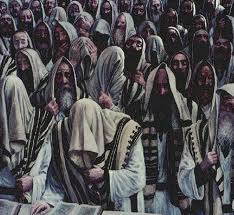
Yom Kippur prayersLancaster is no doubt taking a bit of poetic license in describing whether or not the hearts of the apostles were “burning” on this occasion, but it does cast the early Jewish disciples of “the Way” in a light that integrates them with overall Jewish religious and social participation. In the church, we tend to think of the “early Christians” as a body wholly apart from the various Judaisms that surrounded them, but as I’ve mentioned before, the Jews who were devoted to the Messiah as part of “the Way,” were just as much a valid sect of Judaism as any of the other Judaisms (Pharisees, Essenes, and so on) with which they co-existed.

In fact, the Jewish disciples of the Master in the days recorded by Luke in the book of Acts can only be separated from overall, normative Judaism anachronistically.

The King James Version of Acts 12:4 translates the Greek “pascha” as “Easter.”

The Greek word “pascha” (which transliterates the Hebrew “pesach”) occurs 27 times in the New Testament. In every instance except Acts 12:4, the King James translators rendered it as “Passover.” In Acts 12:4, they retained William Tynsdale’s anachronistic, Christian rendering and translated it as “Easter.”

The translation betrays a theological bias. It assumes Christianity replaced Judaism. Christ cancelled the Torah, and the Christian Jews would not have been keeping Passover any longer. In reality, the apostles had never heard of a festival called Easter. They had no special Christian festivals. They kept the Passover along with all Israel in remembrance of the Master, just as He had instructed them… (Luke 22:19)

-Lancaster, pg 338

Lancaster continues in his commentary, explaining that the separate Christian observance of Easter wouldn’t be established until the Second Century CE as the Gentile believers in Rome began to neglect observing Passover, but began to revere the Sunday that fell during the week of Unleavened bread as the day of Christ’s resurrection. As you can see, the passage of time and the demands of history have resulted in both Judaism and Christianity evolving and changing how they practice their divergent methods of worshiping God. In fact, the divergence of “the Way” from the rest of the Judaisms post-Second Temple is likely part of those historical requirements.

Is all this desirable? Probably not. That is, it would be great to have a Christianity that actually remained a normative part of Judaism and was able to include Gentile practitioners who came to faith in the Messiah, but such was not to be.

Lest you be wise in your own sight, I do not want you to be unaware of this mystery, brothers: a partial hardening has come upon Israel, until the fullness of the Gentiles has come in.

Romans 11:25 (ESV)

Paul seems to be telling us that the schism between the Gentile and Jewish believers was inevitable for the sake of the Gentiles and that, referencing Isaiah 59 and Jeremiah 31, by doing so, all Israel will be saved. (see Romans 11:26-27)

If Judaism was practiced differently and in fact, in radically different ways between the ancient times of Moses, David, and Solomon, the time of the Babylonian exile, the time of Herod, the Second Temple, and the rise of “the Way,” and in the post-Second Temple rabbinic period, can we say that all of these Judaisms are “valid?” I don’t think we have much of a choice but to say that they are. If you disagree, then you have to point to some place in history and say “here’s where the Jews made their big mistake.” I know that many Christians will point to Jesus and say that the Jewish rejection of their own Messiah caused them to become lost and gave rise to the “age of the Gentiles,” but be careful. For the first fifteen years post-ascension, only Jews were disciples of Jesus Christ. Even after Peter’s fateful meeting with Cornelius and the subsequent mission of Paul to the Gentiles of the diaspora, Jews remained in total control of the “Jesus movement” within Judaism until the fall of Jerusalem and the scattering of the vast majority of the Jewish population among the nations (there has always been a remnant of Jews living in the Land). It is rumored that there were Jews in synagogues acknowledging Yeshua as Messiah into the second, third, and possibly even up to the fifth century CE or later.

Rabbi Joshua Brumbach wrote a blog post called Rabbis Who Thought for Themselves which records the lives of a number of prominent 19th century Rabbis who all came to the knowledge and faith of the Messiah in the person of Yeshua (Jesus), and we know of a remnant of Jews in the 21st century who also have come to faith and yet have lives that are completely consistent with modern Jewish halakhah.

At no one point in history will you find the quintessential moment where you can say “that is the true Judaism” or for that matter, “that is the true Christianity.” Humanity in all our forms has been struggling with our relationship with God, what it means, and how to live it out since the days when God walked with Adam in the Garden. We never get it quite right because we live in a broken world and our vision of who we are, who God is, and what it all means is fractured and distorted, even with the Spirit of God residing with us as a guide.

staring-at-the-cloudsWe can look at the mistakes we have made and are making even now, but we cannot say that “at such and thus time, we got it all right.” We never got it right, we just made different mistakes. But faith and devotion have been a constant thread running through the tapestry and that is what we can find tied to our own heartstrings. We can then grab hold of that thread and pull ourselves along the line, touching the lives of the saints and tzaddikim who came before us, who like us, got some things right and some things wrong, but who like us, did their very best to serve the God of Heaven.

It’s easy to point a finger at history and at men who have been dead for hundreds or thousands of years, and vilify them in order to make ourselves look better, but in reality, they were no different from us in the important ways of how human beings work. Our only constant is love of God and of each other. We look to God to be the unchanging part of our own ever-changing universe. And we wait for the day when King Messiah will stand before Israel in Jerusalem and before the body of believers from the nations, and read the Torah aloud, and we will all hear his voice, and we will all know that we are his.


Shemot: Trusting God

trust2In this week’s Torah portion the Torah tells us “There arose a new king over Egypt who did not know Joseph.” There is a disagreement whether it was truly a new king or whether the king (Pharaoh) chose to ignore any debt of gratitude to Joseph and his people for saving Egypt and the world from the 7 year famine. Obviously, trusting in people — especially heads of governments — is problematic. Who do you trust? Who can you trust?

In my youth there was a television show entitled, “Who Do You Trust?” The show was not entitled “Is There Anyone You Trust?,” because, in the end all of us trust in someone or something. People trust in their intelligence, their power, their charm, their knowledge, their connections, their political candidate, and in their wealth. For those who trust (or trusted…) in their wealth, it is ironic that on the American dollar bill it advises “In God We Trust.”

Ultimately, what will help all of us to weather these difficult times is strengthening our trust in God. Trust in God gives a person peace of mind, the ability to relax and to be free of stress and worry. It helps one to deal with frustrations and difficulties.

Like all intelligent discussions, we first have to start with a definition. Trust in God is believing, knowing, internalizing that all that the Almighty does for us if for our good. It is knowing that the Almighty loves us greater than any love one human being can have for another person. He totally knows and understands us and our personal situations. Only the Almighty has the power to impact your situation. He has a track record. You can rely on Him. Everything the Almighty does for you is a gift; there are no strings attached.

-Rabbi Kalman Packouz
“Who Do You Trust?”
Commentary on Torah Portion Shemot
Aish.com

That sounds fine as far as it goes, but it’s not as simple as all that. Trusting in God does not mean that you are guaranteed a problem-free life. In fact, as we’ve recently seen, Many people suffer horrible tragedy and tremendous loss regardless of their trust, or lack thereof, in God. The hurricane devastates the righteous and unrighteous alike and loss of a child will break anyone’s heart.

However, Rabbi Packouz provides a handy list of 7 Principles for Trusting in God for our review. Here they are:

  1. The Creator of the universe loves me more than anybody else in the world possibly can.
  2. The Almighty is aware of all my struggles, desires and dreams. All I need is to ask Him for help.
  3. The Almighty has the power to give me anything I want.
  4. There is no other power in the universe other than the Almighty. Only He can grant me success and give me what I want.
  5. The Almighty has a track record for giving me more than I am asking for.
  6. The Almighty gives with no strings attached. I don’t need to earn it or deserve it. He will give it to me anyway.
  7. The Almighty knows what is best for me and everything He does is only for my good.

Although Christianity and Judaism are two different religions (with a common root), I think the list above can be applied just as well to the non-Jewish believer as to the Jewish person.

Does God love you more than anybody else in the world can? The New Testament is full of comments about God’s love, the most obvious being John 3:16. Yes, God does love you and He loves me, and He loves all Christians, and all Jews, and all Muslims, and all Buddhists, and all human beings who have ever lived and who will ever lived.

And yet disaster can strike at any moment and human history is replete with tragedies and disasters. The road of our lives and the lives of all who came before us is littered with broken bodies and broken hearts and broken spirits.

Certainly God is aware of all our needs and struggles since nothing is hidden from Him, but point two suggests that all we have to do to be relieved of our pain is to ask Him for help. Does everyone who has a sincere faith and prays to God receive immediate relief from suffering? Ask the parents of those children who were murdered at Sandy Hook Elementary school.

God really does have the power to give you, me, and everyone else anything we want, but that doesn’t mean He will grant us anything we want. In fact, it is very likely that God will not grant us anything we really want most of the time.

From a Christian’s, Jew’s, or Muslim’s point of view, there is only one power in the universe: God. Only God can grant success and comfort. But as I already said, there’s a difference between what He can do and what He will do.

Does God have a track record of giving us more than what we ask for? I’m not even sure how to measure such a thing. I think that’s probably true in some cases, but not in others. Ask six million Jews who died during the Holocaust while praying for God to grant them mercy. Was death the only mercy He decided to give?

no-strings-attachedGod gives with no strings attached. Hmmm. Is that true? Probably in more cases than not, but there’s a presupposition that even in giving, God is trying to get our attention, especially if those receiving His gifts do not have faith. On the other hand, referring back to John 3:16, God is the grand master of unconditional love, so who am I to talk?

God knows what is best for me. I can’t argue against that and this seventh point could be used to explain the other six. We may ask for something and not get it and then conclude that we didn’t get what we wanted because it wasn’t good for us. On the other hand, the parents of 26 murdered children only want this all to be a bad dream and for their precious little ones to be restored to them. Is that not “good for them?”

No, I’m not trying to be a downer and “diss” trusting in God, but such an abiding trust is difficult to come by.

Blessed are You, O God … Who has provided me my every needs.

-Siddur

One of the great tzaddikim lived in abject poverty, yet always had a happy disposition. He was asked how he managed to maintain so pleasant an attitude in the face of such adverse conditions.

“Each day I pray to God to provide all my needs,” he said. “If I am poor, that means that one of my needs is poverty. Why should I be unhappy if I have whatever I need?”

Tzaddikim are great people and we are little people who may not always be able to achieve the intensity of trust in God that would allow us to accept adversity with joy. But even if we cannot attain it to the highest degree, we should be able to develop some sincere trust.

When our children are little, we as parents know what they need. They might prefer a diet of sweets, but we give them nourishing foods. They certainly despise receiving painful injections that immunize them against dreadful diseases, but we forcibly subject them to these procedures because we know what is good for them.

Some people do not believe in God. But to those that do, why not realize that He knows our needs better than we do, and that even some very unpleasant experiences are actually for our own betterment?”

Today I shall…

try to bear adversity with less anger and resentment, remembering that God is a compassionate Father, and that He gives me that which He knows, far better than I, that I truly need.

-Rabbi Abraham J. Twerski
“Growing Each Day, Tevet 20”
Aish.com

The Hebrew word bitachon is typically translated as “trust” in English, but that hardly does it justice. Trusting God isn’t about God always giving us what we want or us experiencing God as always doing what we think of as good. It’s the realization that God is always good regardless of our experiences.

Consider any of the “holy men” you may admire and revere from the Bible. From Abraham to Paul, they all led less than perfect lives. Yes, God granted them many gifts, but He also allowed much hardship. Abraham and Sarah were childless and without an heir for most of their lives and into extreme old age until God granted them Isaac. Jacob was hated by his brother Esau, kept in virtual slavery by his relative Laban for twenty years, his daughter was raped and held captive, his favorite son Joseph was lost and presumed dead. Another son Judah married outside of the Hebrews and two of his three sons died. Joseph was a slave and a prisoner for years in a strange land before being elevated to great power, but only on the condition that he conceal his identity, even from his own brothers. When Joseph died, every one of his descendants for generations was kept as slaves in Egypt. Even their rescuer Moses was unable to lead his people into Canaan and instead wandered with them in the desolate wilderness for forty years until finally dying with almost everyone else in his generation without walking in Israel for himself.

Dietrich BonhoefferThe “saints” of the New Testament fared no better. Consider the stoning of Stephen, the harsh life of Paul leading only to death in Rome, and the martyrdom of Peter and every other Apostle. No, trust and faith did not result in comfort of life.

No, trust in God cannot be based on experience with God because if it were, none of these people would have been able to trust Him. In fact it seems that one must trust God in spite of our life experience. Rabbi Packouz’s list does little good, since God does not perform good on command. Knowing that God can spare us pain and suffering doesn’t help and is a bitter irony when God doesn’t spare us pain and suffering. Job’s most famous line (for me) illustrates what it is to trust in God.

Though he slay me, I will hope in him; yet I will argue my ways to his face.

Job 13:15 (ESV)

This gives us a picture of the Jewish method of trusting God, since it doesn’t preclude telling God how we feel about what’s happening to us.

Rabbi Twerski tells us that only a great tzaddik, a very holy and spiritual person, can truly trust God at the level I’m talking about here. But he also says that it’s not impossible for we “ordinary folk” to trust God, either. In his own declaration on the matter, Rabbi Twerski states, Today I shall try to bear adversity with less anger and resentment, remembering that God is a compassionate Father, and that He gives me that which He knows, far better than I, that I truly need.

In our own times of hardship and anguish, maybe this is the best we can do as well.

For what we proclaim is not ourselves, but Jesus Christ as Lord, with ourselves as your servants for Jesus’ sake. For God, who said, “Let light shine out of darkness,” has shone in our hearts to give the light of the knowledge of the glory of God in the face of Jesus Christ. But we have this treasure in jars of clay, to show that the surpassing power belongs to God and not to us. We are afflicted in every way, but not crushed; perplexed, but not driven to despair; persecuted, but not forsaken; struck down, but not destroyed; always carrying in the body the death of Jesus, so that the life of Jesus may also be manifested in our bodies. For we who live are always being given over to death for Jesus’ sake, so that the life of Jesus also may be manifested in our mortal flesh. So death is at work in us, but life in you.

2 Corinthians 4:5-12 (ESV)

Good Shabbos.

Why Are We Needed?

i-need-youThe sixth Lubavitcher rebbe, Rabbi Yosef Y. Schneerson, recounted the following story some 64 years ago:

Rabbi Schneur Zalman of Liadi, the first Chabad rebbe, had a disciple who was also a great philanthropist. Two causes that were particularly dear to him were supporting the Jewish community in the Land of Israel and ransoming captives.

This wealthy chassid had already married off his children and begun pledging dowries for his less-affluent relatives, when the wheel of fortune turned, and his finances suffered.

He was forced to borrow money, and at the end he was left penniless. Overwhelmed and pursued by creditors, he did what any chassid would do: he traveled to his rebbe and unburdened his heavy heart.

After listening intently to his complaints, Rabbi Schneur Zalman addressed him: “You speak about what you need, but say nothing of what you are needed for!”

In this week’s Torah portion, the first one of the book of Exodus, we read about the beginning of the harsh Egyptian exile. But with the disease comes the cure: in the same portion we read about the birth of Moses, the man who was to lead the Jewish people out of their bondage.

One of the first things we hear about Moses is that how he helps another person. Emerging from a sheltered existence as a member of Pharaoh’s household, he sees an Israelite slave being cruelly beaten by an Egyptian, and rescues him.

There are times in our lives when it may be challenging to think about anyone other than ourselves, but the message of Rabbi Schneur Zalman to the anonymous chassid rings true: You speak about what you need, but say nothing of what you are needed for!

Often, the best response to adversity is to break out of our comfort zones and extend a helping hand to another person with love and gratitude for all the good that we have.

-Rabbi Shaul Wertheimer
“What Are You Needed For?”
Commentary on Torah Portion Shemot
Chabad.org

I’ve recently lamented about the relative significance of our lives to God and His purposes, but I suppose the above-commentary, part of which I’ve read before, provides us with something of an answer. Still, it’s difficult when we have needs, to set those aside and to consider instead what we are needed for. When it is our heart that hurts and our eyes that grow dim, how can we view ourselves as the pilgrim instead of the exile? Yet we see that in God causing Moses to rise up among his Jewish brothers, that He created Moses to become both.

Some time after that, when Moses had grown up, he went out to his kinsfolk and witnessed their labors. He saw an Egyptian beating a Hebrew, one of his kinsmen. He turned this way and that and, seeing no one about, he struck down the Egyptian and hid him in the sand. When he went out the next day, he found two Hebrews fighting; so he said to the offender, “Why do you strike your fellow?” He retorted, “Who made you chief and ruler over us? Do you mean to kill me as you killed the Egyptian?” Moses was frightened, and thought: Then the matter is known! When Pharaoh learned of the matter, he sought to kill Moses; but Moses fled from Pharaoh. He arrived in the land of Midian, and sat down beside a well.

Exodus 2:11-15 (JPS Tanakh)

I can only imagine that after having grown up in Pharoah’s court, becoming a shepherd in Midian was something of a let down for Moses, at least at first. But in my imagination, I think of Moses finally marrying, raising sons, and eventually coming to terms and to a peace with the simple life, tending to his flock in the shadow of the mountain of God.

But then, God had other plans for Moses.

“You speak about what you need, but say nothing of what you are needed for!”

-Rabbi Schneur Zalman

But Moses said to the Lord, “Please, O Lord, I have never been a man of words, either in times past or now that You have spoken to Your servant; I am slow of speech and slow of tongue.” And the Lord said to him, “Who gives man speech? Who makes him dumb or deaf, seeing or blind? Is it not I, the Lord? Now go, and I will be with you as you speak and will instruct you what to say.” But he said, “Please, O Lord, make someone else Your agent.” The Lord became angry with Moses, and He said, “There is your brother Aaron the Levite. He, I know, speaks readily. Even now he is setting out to meet you, and he will be happy to see you. You shall speak to him and put the words in his mouth — I will be with you and with him as you speak, and tell both of you what to do — and he shall speak for you to the people. Thus he shall serve as your spokesman, with you playing the role of God to him, And take with you this rod, with which you shall perform the signs.”

Exodus 4:10-17 (JPS Tanakh)

Most of us have never been a prince in Egypt or even a wealthy philanthropist and chassid, but I’m sure many of you reading this have been poor (or are poor) and in need and have been focused more on your own desperation than the plight of the world around you. It’s only natural that when we are confronted with our own pain, we direct all our attention to it and ask for help. It is only natural that, when presented with a task or a mission that seems well beyond our capacities, we should try to turn it down or ask that it be assigned to someone else.

But sometimes God asks the most unlikely people to do the most unusual things.

For some days he was with the disciples at Damascus. And immediately he proclaimed Jesus in the synagogues, saying, “He is the Son of God.” And all who heard him were amazed and said, “Is not this the man who made havoc in Jerusalem of those who called upon this name? And has he not come here for this purpose, to bring them bound before the chief priests?” But Saul increased all the more in strength, and confounded the Jews who lived in Damascus by proving that Jesus was the Christ.

Acts 9:19-22 (ESV)

micah6-8And what does God ask us to do?

He has told you, O man, what is good; and what does the LORD require of you but to do justice, and to love kindness, and to walk humbly with your God?

Micah 6:8 (ESV)

For kindness is Yours, O God, when You compensate each person according to his actions.

Psalms 62:13

In our productivity-oriented society, we tend to place value on the product rather than on the process. Success is praised and failure is condemned, and we have little interest in the circumstances under which others function.

This attitude might be justified in the marketplace, since commerce lives by the bottom line. Still, our preoccupation with commerce should not influence us to think that people’s successes and failures should be the yardsticks for how we value them.

God does not judge according to outcome. God knows that people have control only over what they do, not over the results. Virtue or sin are determined not by what materializes, but by what we do and why.

Since the Torah calls on us to “walk in His ways,” to emulate God as best we can, we would do well to have a value system so that we judge people by their actions, not their results. This system should be applied to ourselves as well. We must try to do our utmost according to the best ethical and moral guidance we can obtain. When we do so, our behavior is commendable, regardless of the results of our actions.”

Today I shall…

try to be considerate of others and of myself as well, and realize that none of us is in control of the outcome of our actions, only of their nature.

-Rabbi Abraham J. Twerski
“Growing Each Day, Tevet 19”
Aish.com

You and I speak of our needs to God and He desires this. But He also desires that ask Him what we are needed for. The answer is the reason we are all alive today.