Tag Archives: disciple

Burning the Plow

So he departed from there and found Elisha the son of Shaphat, who was plowing with twelve yoke of oxen in front of him, and he was with the twelfth. Elijah passed by him and cast his cloak upon him. And he left the oxen and ran after Elijah and said, “Let me kiss my father and my mother, and then I will follow you.” And he said to him, “Go back again, for what have I done to you?” And he returned from following him and took the yoke of oxen and sacrificed them and boiled their flesh with the yokes of the oxen and gave it to the people, and they ate. Then he arose and went after Elijah and assisted him.

1 Kings 19:19-21 (ESV)

Rabbi Joseph Soloveitchik concludes his classic book The Lonely Man of Faith with a comparison of Elisha and Elijah as archetypal figures representing the “two Adams” or two different types of men of faith: material and spiritual man. I recently suggested that what makes the man of faith lonely isn’t just the inability to adequately connect to God, but the difficulty in developing a true relationship between the spiritual and material persons that “live” inside each of us.

How do we resolve this conflict, or is it unresolvable? I’m inclined to believe the latter, since Rabbi Soloveitchik introduced his book thus:

I have no problem-solving thoughts. I do not intend to suggest a new method of remedying the human situation which I am about to describe; neither do I believe that it can be remedied at all. The role of the man of faith, whose religious experience is fraught with inner conflicts and incongruities, who oscillates between ecstasy in God’s companionship and despair when he feels abandoned by God, and who is torn asunder by the heightened contrast between self-appreciation and abnegation, has been a difficult one since the times of Abraham and Moses.

-Soloveitchick from the Foreword of his book

So if there are no “problem-solving thoughts” and no “new method of remedying the human situation” of the man (or woman) of faith, then why continue to belabor the point? Faith will always isolate us from God, from society, from each other, and even from our own personalities. But Soloveitchick did not end his book on a note of despair or futility.

Elisha was a typical representative of the majestic community. He was the son of a prosperous farmer, a man of property, whose interests were centered around this-worldly, material goods such as crops, livestock, and market prices. His objective was economic success, his aspiration – material wealth. The Bible portrays him as efficient, capable, and practical, remindful of a modern business executive. When Elijah met him, we are told, he was supervising the work done by the slaves. He was with the twelfth yoke in order not to lose sight of the slave-laborers. What did this man of majesty have in common with Elijah, the solitary covenantal prophet, the champion of God, the adversary of kings, who walked as a stranger through the bustling cities of Shomron, past royal pomp and grandeur, negating the worth of all goods to which his contemporaries were committed, reproaching the sinners, preaching the law of God and portending His wrath?

Yet unexpectedly, the call came through to this unimaginative, self-centered farmer. Suddenly the mantel of Elijah was cast upon him. While he was engaged in the most ordinary, everyday activity, in tilling the soil, he encountered God and felt the transforming touch of God’s hand. The strangest metamorphosis occurred. Within seconds, the old Elisha disappeared and a new Elisha emerged. Majestic man was replaced by covenantal man.

This isn’t really what I was looking for. Elijah represented the covenantal man, the man of God, while Elisha possessed the role of majestic, material man, in command of his environment, aware of God but not consumed by Him. The answer to the dilemma of how to connect spiritual and material man seems to be to convert one to the other. Elisha effectively becomes Elijah, and one man is substituted for the other rather than resolving the conflicts and distance between the two which would have allowed them to co-exist.

Interestingly enough, this wouldn’t be the last time such a conflict is described in the Bible and such a resolution is attempted.

To another he said, “Follow me.” But he said, “Lord, let me first go and bury my father.” And Jesus said to him, “Leave the dead to bury their own dead. But as for you, go and proclaim the kingdom of God.” Yet another said, “I will follow you, Lord, but let me first say farewell to those at my home.” Jesus said to him, “No one who puts his hand to the plow and looks back is fit for the kingdom of God.” –Luke 9:59-62 (ESV)

The transactions between Jesus and those he called to be his disciples seem to be functionally similar to the interaction between Elijah and Elisha. Jesus, the “ultimate covenental man” encounters various “material men” in the process of performing their usual routines and commands them to follow him. Those who hesitate or who desire to fulfill their material obligations first, he says are unfit for the Kingdom of God.

The response of material man to spiritual man it seems, must be immediate or it does not work at all. So what did Elisha do according to Soloveitchik?

He slew the oxen and fed the meat to the slaves who, half-starved, tilled the soil for him and whom he, until that meeting with Elijah, had treated with contempt. Moreover, covenantal man renounced his family relationships. He bade farewell to father and mother and departed from their home for good.

The level of commitment called for both by Elijah and by Jesus seems abrupt and absolute and anything less is considered a failure in terms of entering the Kingdom of God. But that isn’t the end of the story.

Elisha’s withdrawal from majesty was not final. He followed the dialectical course of all our prophets. Later, when he achieved the pinnacle of faith and arrived at the outer boundaries of human commitment, he came back to society as a participant in state affairs, as an adviser of kings and a teacher of the majestic community. God ordered him to return to the people, to offer them a share in the covenantal drama and to involve them in the great and solemn colloquy.

I’m not satisfied. The book ends with Elisha lonely but not despairing, discovering triumph in defeat, hope in failure, and sheltering the Word of God in his bones like an all-consuming fire burning in his heart. In his loneliness, Elisha discovers a God who resides in the recesses of transcendental solitude.

But is that all there is?

None of us bear the mantle of prophet and holy man in the way of Elijah and Elisha, but we see that a similar process occurs when Jesus calls each of us into discipleship. We are all called to leave our former life, to metaphorically burn our plow and slaughter our oxen in order to feed the poor and enslaved, and then to follow the Master on a completely new course of life, interacting with the material world as a messenger for the spiritual world. Is that what’s supposed to happen?

And I am no longer in the world, but they are in the world, and I am coming to you. Holy Father, keep them in your name, which you have given me, that they may be one, even as we are one. While I was with them, I kept them in your name, which you have given me. I have guarded them, and not one of them has been lost except the son of destruction, that the Scripture might be fulfilled. But now I am coming to you, and these things I speak in the world, that they may have my joy fulfilled in themselves. I have given them your word, and the world has hated them because they are not of the world, just as I am not of the world. –John 17:11-14 (ESV)

We aren’t taken out of the world to become completely one with the spiritual realm. There’s an interactivity between who we are as spiritual people and the role we play in the material world around us. We cannot serve the purpose God created us for if we merely retreat into our spiritual reality and ignore the majestic and material environment where we happen to live.

Soloveitchik is right. There is no cure for the loneliness of a man of faith but that’s to be expected. We don’t belong here, none of us. We are the proverbial strangers in a strange land, pilgrims in a broken world, carrying a message from the Master to everyone else not to give up hope. It’s a hope that no political figure or celebrity can offer because they are wholly one with the material and are limited by the boundaries of their devotion to only the physical. The hope we offer as messengers of our Master is the love of God and the promise of redemption, not only of created world, but of our very beings.

The loneliness of the man of spirit will end, but not yet.

Impossible Light

Shulchan Aruch rules that one should not kindle the Chanukah lights before shekiah; rather one should kindle the lights at the end of shekiah. Mishnah Berurah explains that when Shulchan Aruch refers to the end of shekiah he refers to tzeis hakochavim – the emergence of stars. That is the time that people are in the streets and thus the miracle will be publicized.

He then notes that according to many Rishonim the intent of the Gemara is that one should kindle the lights at the beginning of the second shekiah which is about a quarter of an hour before tzeis hakochavim. Poskim write that if one kindles the lights within half an hour of sunset (shekiah according to Gaonim) and they remain lit until half an hour after tzeis hakochavim one fulfills both opinions.

Mishna Berura Yomi Digest
Halacha Highlight
“Lighting after plag hamincha”
Siman 672 Seif 1

That the spark of G-d within us will ponder G-d, what is the surprise?

But when the animal lifts its eyes to the heavens, when the dark side of Man lets in a little light, that is truly wondrous. How can darkness know light? How can earth know heaven?

Only with the power of He who is beyond both darkness and light, heaven and earth.

-Rabbi Tzvi Freeman
“Dark Knowing Light”
Based on letters and talks of the Rebbe
Rabbi M. M. Schneerson
Chabad.org

Yesterday’s “morning meditation” Shine was an attempt to reach some sort of thematic connection between the miracle of the light of Chanukah and Jesus Christ, the light of the world. I also brought up the rather important point that we disciples of the Master are considered by him as “lights to the world” as well.

“You are the light of the world. A town built on a hill cannot be hidden. Neither do people light a lamp and put it under a bowl. Instead they put it on its stand, and it gives light to everyone in the house. In the same way, let your light shine before others, that they may see your good deeds and glorify your Father in heaven. –Matthew 5:14-16

While it would be more convenient for us if Jesus could stay as that light or if we could let Israel carry the burden (Isaiah 49:6), the master specifically expanded the mandate to include all of his disciples among the nations. We, like the ancient Israelites lifting their eyes to Heaven that they might live (Numbers 21:4-9), are the darkness lifting our eyes to the light and seeking life. Now let’s “marry” this idea back to the quote from the “Halacha Highlight” for Siman 672 Seif 1 and accept the responsibility to “lift” the miracle of the Savior of the world with our light, just as the Jewish people announce the miracle of Chanukah by lighting the menorah.

In my commentary for Torah Portion Vayeishev, I addressed how it would be so much easier to shine that light if we didn’t have to deal with the problems and pitfalls of day to day life. However, God has determined that the value of the light we shine is especially great when it illuminates a life that struggles in the same fashion as our neighbors. I think that was His point when He caused the “Word to become an ordinary human being and to live among us” (John 1:14). My humble opinion is that Jesus did not come as King but as pauper the first time around, so that he could show us we don’t have to be freed of an ordinary life in order to serve Heaven.

Going back to the life of Joseph, before he became “king”, he was also a slave and then a prison inmate. In both of these situations (which were far more difficult than the average “ordinary” life of a person in America), he served God so well that, relative to his position, he was exalted to the highest status a slave and prisoner could attain. Before Moses could lead an entire nation and speak to God as one speaks to a friend, he had to live as a prince and then a shepherd. Before Jesus comes as King and Lord, he first had to come as carpenter and itinerant teacher among his people Israel, living a life not substantially different than any other Jew and associating primarily with what today we would call “the working class”.

I’m saying all this to show that the typical “wear and tear” we take on every day doesn’t absolve us from our responsibilities to God and to other people. Sure, we’re busy people, but we can hardly tell God, when he calls us, that we are too preoccupied with our work to respond to Him. And even if we are, we still have to do something about it.

When this question reached Rav Yosef Shalom Eliyashiv, shlit”a, he ruled decisively and also gave sound advice. “A doctor who treats patients when the time to light the menorah arrives should first finish his shift, and then go home and light. In the case of a doctor who works a long shift in the hospital which encompasses the entire time that it is possible for him to light the menorah… Since he cannot go home in the middle because he is busy working the entire time, he is absolved from the mitzvah. This falls under the category of one who is involved in a mitzvah who is discharged from other mitzvos during this time.

Rav Eliyashiv added an essential point. “This is only true regarding one who lives alone. If the doctor has family he should instruct them to light when the time comes and he is discharged even if he comes home while it is still possible to light. And even if he lives alone he is obligated to designate a messenger to light for him when the time comes.”

Mishna Berura Yomi Digest
Stories to Share
“Occupied with a Mitzvah”
Siman 672 Seif 1

I’m stretching my metaphor pretty thin here, but bear with me. The Rav rules that a doctor who is treating patients at the time when the Chanukah menorah is to be lit is absolved of the mitzvah because of his important responsibilities, but only to the degree that he does not have to perform the mitzvah personally. The important part of this ruling states, “even if he lives alone he is obligated to designate a messenger to light for him when the time comes.” Putting that back into the topic I’m presenting, even if we feel we are “too busy” to perform the will of God as we understand it, do we also have the responsibility to make sure God’s will is done “by proxy?” The Rav first says if the doctor is married, he can have his wife perform the mitzvah, but then he says the doctor is still obligated, even if he lives alone. If we are alone, perhaps we still have a duty to make sure that whatever we believe God requires of us at any point in time is still be performed.

Of course, we have examples of people who literally dropped everything when Jesus called and followed him.

As Jesus was walking beside the Sea of Galilee, he saw two brothers, Simon called Peter and his brother Andrew. They were casting a net into the lake, for they were fishermen. “Come, follow me,” Jesus said, “and I will send you out to fish for people.” At once they left their nets and followed him.

Going on from there, he saw two other brothers, James son of Zebedee and his brother John. They were in a boat with their father Zebedee, preparing their nets. Jesus called them, and immediately they left the boat and their father and followed him. –Matthew 4:18-22

We also have examples of people who were in the middle of important work and asked to wait until that work was done, sometimes even though it would take a number of years as with the following person.

He said to another man, “Follow me.” But he replied, “Lord, first let me go and bury my father.” Jesus said to him, “Let the dead bury their own dead, but you go and proclaim the kingdom of God.” –Luke 9:59-60

In the latter example, Jesus took a dim view of this person wanting to wait until after his father died (the guy was being a dutiful son and working to help his father, presumably on the “family farm”, so he was fulfilling the commandment to honor his parents) and he put his father’s affairs in order before being free to follow Christ’s calling (It’s examples like this that some Jews use to prove Jesus couldn’t be the Messiah, since it looks like Jesus is telling this son to abandon his responsibilities to his parents, but I digress) .

I’m probably muddying up the waters here saying on the one hand, that we actually might be too busy to answer the call to a mitzvot but we must make sure it is done, even by proxy, and on the other hand saying that we must follow immediately and any delay will be viewed by Jesus in a negative light. This is the struggle we face in letting our light shine every single second in our lives. As human beings, we can be distracted, confused, upset, grief-stricken, afraid, or experience some other circumstance or state that seems to take us away from being that “light to the world”. You’ve probably seen examples of people who you know are believers who, when set upon by difficult problems, retreat into a human response and away from God.

But you’ve also probably seen people of faith who, even when undergoing the most difficult hardships, still are able to shine with a kind of light that communicates peace and love surpassing all human understanding (Ephesians 3:19, Philippians 4:7). It’s possible for us to continue shining our light in the midst of the mundane and perhaps even when disaster seizes us.

What can I say to all this? Do your best? That’s a good place to start. We’re in a relationship with God as junior partners in Tikkun Olam or “repairing the world”. We can only do what is humanly possible. When we seemingly shine an “impossible light” it is not just us and it is not just God, it is both of us. As people, we do one kind act at a time, one generous deed, one word of encouragement, and during Chanukah, we light one candle a night, so that we might show the world the miracle of God. It’s never easy but with God, it’s always possible (Matthew 19:26).

Happy Chanukah.

The Master’s Rebuke

peters-denialThe Ahavas Chaim of Viznitz, zt”l, was a huge scholar with profound yir’as shamayim, like all of those who received semichah from the Maharsham, zt”l, one of the undisputed gedolim of his generation.

The rebbe did not flatter anyone. He was always careful to rebuke the Chasidim when they acted inappropriately. For example, as is well known, it is the custom for a rebbe to distribute shiyarim during the tisch. Many Chasidim would push their fellow and grab whatever they could get as if it was a matter of life and death. In Viznitz, the rebbe would often rebuke them for this. “How can you grab shirayim? Don’t you know that the modest kohanim would not grab a portion of the show breads? Clearly, one should not push and grab even in holy matters. Instead of shoving one’s fellows, he should relax and take shiyarim only if he can do so without pushing his friend.”

Daf Yomi Digest
Stories Off the Daf
“Proper Rebuke”
Chullin 133

A man in the crowd answered, “Teacher, I brought you my son, who is possessed by a spirit that has robbed him of speech. Whenever it seizes him, it throws him to the ground. He foams at the mouth, gnashes his teeth and becomes rigid. I asked your disciples to drive out the spirit, but they could not.” “You unbelieving generation,” Jesus replied, “how long shall I stay with you? How long shall I put up with you?Mark 9:17-19

We see that Jesus and the Ahavas Chaim of Viznitz have something in common. They both find it necessary to rebuke their disciples when they display inappropriate or even faithless behavior. Both Masters seem to be a little harsh, but perhaps that’s because there’s so much at stake. If the ordinary Jew is commanded to rebuke a fellow Jew who is sinning or about to sin (based on Leviticus 19:17), how much more so should a Teacher be obligated to rebuke his disciples?

In Judaism (and I’ve said this before) the commandment to rebuke the sinner is compared to saving someone’s life. If a Jew sees a fellow Jew moving away from God by entering into sin and does nothing, it’s like being a lifeguard, seeing a person drowning in the ocean, and not lifting a finger to save him. If one regular person has that level of responsibility toward another, then a Teacher and Rabbi must have a tremendous responsibility to guide his disciples into a proper way of relating to other people and to God. To fail to do so, from his exalted position as Rabbi and tzaddik, would be not only failing his students, but failing God.

However, if you’ve ever been rebuked by an angry, yelling teacher, boss, or parent, you know it doesn’t feel good. Not only that, but you know that being yelled at might not result in you correcting your behavior. If you are even the slightest bit rebellious, your response on the surface might be to appear to be obedience, but inside, your opposition might continue to grow, leading your closer to sin rather than returning you to God.

The story from the daf continues, showing us a different path.

But there is another—often more effective—way to deal with those who are wayward. When Rav Dovid Tzvi Shneiblag, zt”l, was confronted with a student who did not comport himself properly, he would call the student in and open a meseches Chulin to a different statement on today’s daf. He would begin to read in a very emotional tone, . As he did so he shed copious tears. “Rav Yehudah says, ‘One who teaches an improper student falls into Gehinom…Teaching an improper student is like throwing a stone to Merucules…’ ”

As he read, crying, the student could not help but feel moved, until he also cried. The rav would gently explain that certain actions were not befitting for a ben Torah and the young man would tearfully agree to change. Many students later recounted that it was this short time with the rav which galvanized them to make a complete change of direction.”

I don’t believe we have any specific example of Jesus using such a method of “rebuke” when addressing his disciples, but I do not doubt there was a time when the disciples did shed tears and likely did recall everything that Jesus was trying to teach them. Sadly, it was when they thought it was too late that they came to this realization. Peter is an especially poignant example.

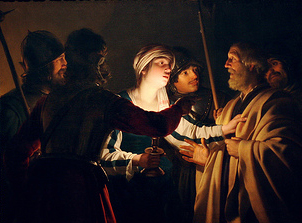
While Peter was below in the courtyard, one of the servant girls of the high priest came by. When she saw Peter warming himself, she looked closely at him. “You also were with that Nazarene, Jesus,” she said.

But he denied it. “I don’t know or understand what you’re talking about,” he said, and went out into the entryway.

When the servant girl saw him there, she said again to those standing around, “This fellow is one of them.” Again he denied it.

After a little while, those standing near said to Peter, “Surely you are one of them, for you are a Galilean.”

He began to call down curses, and he swore to them, “I don’t know this man you’re talking about.”

Immediately the rooster crowed the second time. Then Peter remembered the word Jesus had spoken to him: “Before the rooster crows twice you will disown me three times.” And he broke down and wept. –Mark 14:66-72

The Death of the MasterAfter all of his protests to the contrary, Peter utterly failed his Master. His tears at that moment were bitter but they must have been much worse once Jesus was dead and the disciples went into hiding. Small wonder that, when at the first of the week, Miriam of Magdalah told the disciples that the tomb was empty, Peter ran all the way to see for himself (John 20:1-4). Hope beyond possibility had given him a second chance. But the agony of his failure and even the tears were not over yet.

When they had finished eating, Jesus said to Simon Peter, “Simon son of John, do you love me more than these?” “Yes, Lord,” he said, “you know that I love you.”

Jesus said, “Feed my lambs.”

Again Jesus said, “Simon son of John, do you love me?”

He answered, “Yes, Lord, you know that I love you.”

Jesus said, “Take care of my sheep.”

The third time he said to him, “Simon son of John, do you love me?”

Peter was hurt because Jesus asked him the third time, “Do you love me?” He said, “Lord, you know all things; you know that I love you.”

Jesus said, “Feed my sheep. –John 21:15-17

Peter denied Jesus three times. After the resurrection, Jesus asks Peter three times if he really loves him. Peter would have to be sure of this, for the days were coming when the Master would not be with him, and Peter would have to carry his faith without doubt.

Tears can be more difficult than a loud, angry rebuke, but they can also be the instrument by which we feel the sorrow, rather than angry rebellion, that will inspire us to repent, to turn to God, and to really go in the other direction, walking away from the person opposing God we once were, and to the man or woman of God we were created to be.

Gateway to Eden

Gateway to EdenNow the serpent was more crafty than any of the wild animals the LORD God had made. He said to the woman, “Did God really say, ‘You must not eat from any tree in the garden’?”

The woman said to the serpent, “We may eat fruit from the trees in the garden, but God did say, ‘You must not eat fruit from the tree that is in the middle of the garden, and you must not touch it, or you will die.’”

“You will not certainly die,” the serpent said to the woman. “For God knows that when you eat from it your eyes will be opened, and you will be like God, knowing good and evil.”Genesis 3:1-4

We are all familiar with the story of Adam and Eve and their sin with the fruit of the Tree of Knowledge (Genesis 3). As the story goes, the Serpent, most “cunning” of all the animals, comes along and tempts Eve to taste of the fruit, promising that it would open the eyes of man, making her and Adam “as gods knowing good and evil” (v. 5). Eve decides that the Tree is tempting to behold and both eats of the fruit and gives her husband to eat.

This, however, presents a difficultly. If Adam and Eve themselves had no evil inclination, how could they have *wanted* to sin? How could they — entirely spiritual beings — desire anything other than goodness and closeness to G-d? Where could a desire to rebel against G-d stem from?

-Rabbi Dovid Rosenfeld
The Primordial Sin, Part I (2006)
Torah.org

Christianity and Judaism see “the Fall of Man” event in Genesis very differently, but there are obvious parallels. “In the beginning”, Adam and Eve are sinless beings, created by God and knowing an incredible intimacy with the Source as completely spiritual yet physical beings. In Judaism, people originally had no internal inclination toward evil but upon disobeying the one commandment given by God, the external temptation, represented by the Serpent, became internalized. Man separated himself from God and the nature of the world became broken.

Rabbi Rosenfeld goes on in Part III of the series to ask some difficult questions:

To this we explained that man sinned in order to make life more challenging. Before the Sin, man had only a single mitzvah (commandment) — not to partake of the fruit of the Tree. There was, it seemed, very little for him to accomplish. Now, as a physical being desiring evil, life would be so much more challenging. There would be so much more potential growth in store for man. Eventually mankind would require the rigorous and demanding 613 Commandments to curb the animal within and redirect him G-dward. Thus, man — *spiritual* man — *desired* the greater challenge that would now be in store for mankind.

This, however, still does not suffice. Why would man desire a greater challenge? So that he would have more opportunities for spiritual growth? But isn’t he basically just backing up in order to reach the same goal? The ultimate goal of life — self-evident to the spiritual person — is closeness to G-d. If man was created close to G-d, why not *stay* there — perform his single mitzvah and perfect himself? What was so enticing about making life more difficult?

From Christianity’s point of view, there was no justifiable reason for Adam and Eve to sin; to disobey God. It was a terrible, ghastly mistake that sent both humanity and the nature of Creation down a dark and dismal path, away from God and into the arms of darkness, requiring that God give “His one and only Son, that whoever believes in him shall not perish but have eternal life” (John 3:16).

Judaism says that, amidst what Christians can only view as a total spiritual disaster, there is something salvageable and even perhaps desirable to be gleaned:

The deepest, most profound desire a human soul has is to feel it exists — to feel it is not just a passive entity, acted upon and taken care of by others. A person needs to feel he is an independent being — what the Serpent called a “god” (and our mishna calls a “king”) — who can accomplish, grow and make a difference in the world. There is nothing more painful — *spiritually* painful — than feeling that one’s life makes no difference to anyone or anything, that he exists only as a person acted upon by others or by natural forces, and that he has done nothing to express his own existence.

This was man’s dilemma in the Garden of Eden. Man at first, as lofty as he was, was an almost entirely passive, “created” being. He was given existence by G-d. He was placed in the Garden of Eden with all his wants and needs satisfied and with only a single mitzvah to perform. Man wanted to feel he truly existed — that he was not just a plaything of the Almighty. He wanted to be a god himself. How could he do it? By forcing upon himself greater challenges. Adam and Eve would no longer be passive beings, practically created in G-d’s presence. They would now have to earn it. Spirituality would come only through the greatest of efforts — *their* efforts. It would be the challenge they would have to face to achieve their purpose — and in order to exist.

From what Rabbi Rosenfeld presents, man faced two options: live life close to God, obeying the single commandment provided by the Almighty, but never having the opportunity to truly carve out his own path and the ability to rise spiritually, or deliberately distancing himself from God, lowering his spiritual status, and then struggling back up the ladder, rung by rung, to drive himself ever closer to God and Eden.

I suppose a challenge like that would tempt the spiritual Sir Edmund Hillarys of the world, but for the rest of us, we see the “downside” to such a decision in terms of the pain, suffering, and anguished death of billions upon billions of human beings across the long march of millennia between the dawn of man and the current age.

And yet, here we are. “Our physical flesh (is) now a confused mixture of good and evil. We know the passing of the seasons as we age, and we know decay and death. We are separated from the infinite Spirit. The struggle against evil and the abyss is no longer an external enemy, but rather, it is part of who we are inside. Judaism longs for the coming of the Messiah and Tikkun Olam. Christianity looks to the day when Jesus will return and mankind will be redeemed from a fallen world.

But what if we don’t have to wait? Rabbi Yitzchak Ginsburgh says that we don’t:

After the primordial sin, Adam and Eve heard “the voice of God” walking through the garden. They heard God, He spoke to them, and they answered. This is the consciousness of “hearing,” the height of our consciousness of Godliness (God and His Divine Providence) is our lives subsequent to the primordial sin, the consciousness of the weekdays, the workdays (“By the sweat of your brow…”).

But on Shabbat we return to the pristine state of consciousness of God as it was prior to the primordial sin (and as it will be universally in the future). In the terminology of Kabbalah, during the weekdays our consciousness is at the level of understanding (“hearing” in Hebrew means also “understanding”) whereas on Shabbat our consciousness rises to the level of wisdom (direct insight into the mysteries of creation hidden within reality, and into the “mystery of mysteries,” the Creator of reality, the true and absolute Reality).

Throughout the week everything that happens around us, all that we see and hear, “tells” us about God and His Providence. On Shabbat we don’t have to be told about God, we experience Him directly.

ShabbatOne of the mistakes of the early (non-Jewish) Christian church was to casually discard the commandment, “Remember the Sabbath day by keeping it holy” (Exodus 20:8). The church alternately says that Jesus did away with Sabbath observance with the rest of the Law or that the “Sabbath” was mysteriously moved over one day, to coincide with the “Day of the Lord” and the resurrection of the Master. I personally think that the 2nd and 3rd century church found it necessary to separate themselves from anything “too Jewish” and simply shifted the “Holy Day” over by 24 hours to achieve this, and then used specific points of Scripture to justify the decision.

Today, Christians miss out on an opportunity, however limited, to return to Eden. For contained in the Shabbat isn’t just a day to go to church or synagogue, but in fact, we discover an opportunity to remove oneself from the other six days of the week, of the toil, of the work, of the worries, of the laboring, and to totally devote ourselves as spiritual and physical beings to the God of the Universe and the King of Righteousness, as in days of old.

Six days you shall labor and do all your work, but the seventh day is a sabbath to the LORD your God. On it you shall not do any work, neither you, nor your son or daughter, nor your male or female servant, nor your animals, nor any foreigner residing in your towns. For in six days the LORD made the heavens and the earth, the sea, and all that is in them, but he rested on the seventh day. Therefore the LORD blessed the Sabbath day and made it holy. –Exodus 20:9-11

Both Christians and Jews are going to disagree with me here, particularly since this mitzvot was directed at the Children of Israel, but I believe we Christians cheat ourselves terribly out of the experience to turn one-seventh of our lives into a time to walk personally with God. I think Rabbi Ginsburgh has a point to make, not only to Jews, but to Christians as well. But more gateways to Eden exist:

There are two exceptions to the above distinction between Shabbat and the weekdays, two times that we rise to the consciousness of Shabbat during the otherwise mundane time of the week. The Arizal teaches that our consciousness in the times of prayer, every day of the week three times a day, is at the level of Shabbat. The times of prayer, when we turn to God and address Him directly, are the Shabbat as its light shines into and permeates the week.

Also, a true Torah scholar is referred to in the Zohar as Shabbat. Continuously in communion with God through the means of His Torah (which ultimately in one with Himself) he experiences Shabbat-consciousness the entire week.

Whenever we immerse ourselves in the things of God, we are drawing closer. It happens when we pray, when we give to charity, when we help our neighbor with his yard work, when we hold a small child’s hand to cross the street, when we study the Bible, when we turn away from sin and turn, in obedience, to God.

While the mystic aspects of this process may be confusing or even a little frightening, it is clear that we are separated from God by the nature of humanity and the nature of the world, but we don’t have to be that way always. While waiting for the King of Kings to come to us, we do not have to wait helplessly. We can choose, whether commanded to or not, to observe a Shabbat where we are completely devoted to God. We can take one day of our week and separate it from the rest, separate it from the office, from phone calls, from the Internet, from worry, from work, from care. We can pray, study, speak of God and the Bible with others as we break bread together.

We can create isolated pockets of Eden in the Sabbath and even during the week when we pray and beg to come close to the Throne of Heaven. We can be like “little Messiahs”, helping to fix a broken world one dent and crack at a time by performing even one single act of kindness and humility.

Sin happened. Humanity fell. The world is a broken top spinning hopelessly off the table of existence. We can’t go back to fix it but we can choose to go forward toward God. We can choose to visit Eden on Shabbat. We can cross the threshold of the gates of Paradise every day, every time we pray. We can walk with God in the Garden every time we love our neighbor more than we love ourselves.

However you want to interpret these words, observe Shabbat, return to Eden, walk with God. You can never be lost as long as you are seeking God. You can never be lost as long as God wants you to find Him.

“Do not seek greatness for yourself and do not crave honor. Do more than you have studied and do not desire the ‘table’ of kings. For your table is greater than their table, and your crown is greater than their crown. And your Employer can be trusted to pay you the reward for your efforts.”
Pirkei Avot
Chapter 6, Mishna 5(a)

As If Considering Angels

Broken AngelFor this very reason, make every effort to add to your faith, goodness; and to goodness, knowledge; and to knowledge, self-control; and to self-control, perseverance; and to perseverance, godliness; and to godliness, mutual affection; and to mutual affection, love. For if you possess these qualities in increasing measure, they will keep you from being ineffective and unproductive in your knowledge of our Lord Jesus Christ.2 Peter 1:5-8

Said Rabbi Joshua the son of Levi: Every day, an echo resounds from Mount Horeb, proclaiming and saying: “Woe is to the creatures who insult the Torah.” For one who does not occupy himself in Torah is considered an outcast, as is stated “A golden nose-ring in the snout of a swine, a beautiful woman bereft of reason.” And it says: “And the tablets are the work of G-d, and the writing is G-d’s writing, engraved on the tablets” ; read not “engraved” (charut) but “liberty” (chairut)—for there is no free individual, except for he who occupies himself with the study of Torah. And whoever occupies himself with the study of Torah is elevated, as is stated, “And from the gift to Nahaliel, and from Nahaliel to The Heights.”Ethics of the Fathers 6:2

I know these two quotes may not seem to go together, but consider this. Peter says that we should add faith to goodness and then add goodness to knowledge. What knowledge? Where does this knowledge come from? Rabbi Joshua ben Levi implies that knowledge comes from Torah by expressing the inverse that one who does not occupy himself with Torah “is considered an outcast” and is like a “golden nose-ring in the snout of a swine, a beautiful woman bereft of reason”.

Sounds pretty harsh, but then, so does Peter:

This is especially true of those who follow the corrupt desire of the flesh and despise authority. Bold and arrogant, they are not afraid to heap abuse on celestial beings; yet even angels, although they are stronger and more powerful, do not heap abuse on such beings when bringing judgment on them from the Lord. But these people blaspheme in matters they do not understand. They are like unreasoning animals, creatures of instinct, born only to be caught and destroyed, and like animals they too will perish. –2 Peter 2:10-12

I’ve been involved in a series of online discussions lately that have been critical of Talmud study among Christians. Specifically, the allegation is that the sages who documented the Oral law and established a system of rulings for the Jewish people, were the inheritors of the tradition of the Pharisees and that Jesus had nothing good to say about the Pharisees, citing examples such as this:

Then Jesus said to the crowds and to his disciples: “The teachers of the law and the Pharisees sit in Moses’ seat. So you must be careful to do everything they tell you. But do not do what they do, for they do not practice what they preach. They tie up heavy, cumbersome loads and put them on other people’s shoulders, but they themselves are not willing to lift a finger to move them. “Everything they do is done for people to see: They make their phylacteries wide and the tassels on their garments long; they love the place of honor at banquets and the most important seats in the synagogues; they love to be greeted with respect in the marketplaces and to be called ‘Rabbi’ by others. –Matthew 23:1-7

This is just one of the examples in the Gospels which cast all Pharisees everywhere in a particularly bad light, but as I commented recently, Jesus is upset with this group of Pharisees, not because they taught bad things, but because they didn’t practice what they taught! Keep that in mind. If the Pharisees had behaved consistently with their teachings, Jesus wouldn’t have had a problem with them at all. His only beef with the Pharisees is that they were hypocrites, not false teachers.

Think about it. If, as some have stated, the Talmudic scholars and sages have inherited the mantle of the Pharisees and they behaved consistently with their own teachings, then it is quite possible that the “Rebbe of Nazaret” wouldn’t have any problem with them either.

I know there are a lot of variables to consider and we won’t know for sure until Jesus returns to us, but based on this small bit of simple logic, we cannot reasonably discard or disdain anything in the Talmud based on the behavior of a collection of hypocritical religious authorities that operated in Roman-Judea in the time of Jesus. We can’t also reasonably apply the following to the Rabbis of the Talmud:

The Lord says: “These people come near to me with their mouth and honor me with their lips, but their hearts are far from me. Their worship of me is based on merely human rules they have been taught. Therefore once more I will astound these people with wonder upon wonder; the wisdom of the wise will perish, the intelligence of the intelligent will vanish.” –Isaiah 29:13-14

I know it’s enormously tempting to apply the words of the Prophet not only to the Pharisees but to the Talmudic sages as well. Certainly, if we think of the Talmudic writings as only the rules of men with no Biblical source, then we might be justified in doing so, but taken out of context, we don’t know if Isaiah is even considering the Oral Law (which he would have seen as Torah) or the Rabbinic commentaries and rulings on said-Oral Law (and Written Law), which are recorded in the Talmud. The rulings of the Rabbis don’t overwrite and contradict Torah, but rather, are intended to interpret and make sense of the Written and Oral Law for each generation of Jews as they met new challenges in applying a Torah lifestyle in an ever-changing world.

Here’s something else to consider:

At that time Jesus said, “I praise you, Father, Lord of heaven and earth, because you have hidden these things from the wise and learned, and revealed them to little children. Yes, Father, for this is what you were pleased to do. –Matthew 11:25-26

Taken together with some portions of the quote from Isaiah 29:13-14, these words of the Master might suggest that it’s bad to be intelligent, well-read, and educated. Why bother to learn how to read at all if intelligence is not to be trusted and if it’s better to be ignorant and untaught? I don’t think this is what the Master means here, but rather, he’s saying you don’t have to be a scholar to have access to the grace of God. Of course, he’s not saying grace is denied the learned sage, either.

It’s been suggested that Rabbinic judgments and rulings are not to be trusted and that the wisdom of the average individual, as guided by the Spirit, reading the Bible in English and outside of its history, culture, and other contexts, is far preferable to trusting and learning from people who have spent all of their lives pouring over Scripture and striving to master the teachings of God.

And yet Peter was critical “of those who follow the corrupt desire of the flesh and despise authority”. Further, he said that “First of all, understand this; no prophecy of Scripture is to be interpreted by an individual on his own, for never has prophecy come as a result of human willing – on the contrary, people moved by the Ruach HaKodesh (the Holy Spirit) spoke the message from God”. (2 Peter 1:20-21 [CJB]).

Cutting BranchesWe could be tempted to say Peter is confirming that all a person; any person, needs is the Holy Spirit to interpret the Bible, but he’s also speaking of Prophets like Isaiah, not the average guy on the street. We read the prophecies of Isaiah because he was a prophet of God and we’re not. We read the teachings of Jesus because he’s the Messiah and we’re not. Also, lest we forget, Paul, the Apostle to the Gentiles, and the key to bringing the Gospel of Jesus Christ to the nations of the world, was a very well-educated man…in fact, far more educated than many of Christ’s inner circle who were what we would consider today as blue-collar workers and laborers.

There’s no problem with who Jesus chose to be close to him as being, relatively speaking, uneducated, because, as I’ve already mentioned, the love of Christ isn’t primarily accessed through “book-learning”. But on the other hand, the fact that Paul was chosen by Jesus says that education and authority isn’t a problem either. Certainly, being learned and possessing authority requires that such a position be used with justice, honor, and humility. The Ethics of the Fathers 6:5 speaks to this:

Do not seek greatness for yourself, and do not lust for honor. More than you study, do. Desire not the table of kings, for your table is greater than theirs, and your crown is greater than theirs, and faithful is your Employer to pay you the rewards of your work.

In fact, from the same chapter (Chapter 6:6), we find that study of Torah (which includes Talmud in this context) yields people who have qualities such as:

love of G-d, love of humanity, love of charity, love of justice, love of rebuke, fleeing from honor, lack of arrogance in learning, reluctance to hand down rulings, participating in the burden of one’s fellow, judging him to the side of merit, correcting him, bringing him to a peaceful resolution [of his disputes], deliberation in study, asking and answering, listening and illuminating, learning in order to teach, learning in order to observe, wising one’s teacher, exactness in conveying a teaching, and saying something in the name of its speaker.

As long as the teacher behaves consistently with these, and the other teachings in the Torah and Talmud, what problem could this present? What problem could it present for any person of faith and good will who wishes to devote time to pondering this wisdom?

We see that taking Scripture out of context and applying an overly simple interpretation to what may turn out to be very complex matters of principle actually results in a disservice to the Prophets and Apostles, as well as to the later sages, and finally to Jesus and to God the Father.

We should all be very, very careful how we interpret and apply Scripture, especially if we use it to malign our teachers and scholars and, by inference, every religious Jew who has ever lived or will live, for they too revere the sages and attempt to live their lives by the principles of Torah, which have been established and interpreted across the ages.

I will bless those who bless you, and whoever curses you I will curse; and all peoples on earth will be blessed through you.” –Genesis 12:3

I do not want you to be ignorant of this mystery, brothers and sisters, so that you may not be conceited: Israel has experienced a hardening in part until the full number of the Gentiles has come in, and in this way all Israel will be saved. As it is written: “The deliverer will come from Zion; he will turn godlessness away from Jacob. And this is my covenant with them when I take away their sins.” –Romans 11:25-27

All Israel has a share in the World to Come, as is stated: “And your people are all righteous; they shall inherit the land forever. They are the shoot of My planting, the work of My hands, in which I take pride.” –Sanhedrin 11:1

for there is no free individual, except for he who occupies himself with the study of Torah. –Ethics of the Fathers 6:2

Do not denigrate the root, lest your branch be cut off from it.

Who Are Our Teachers?

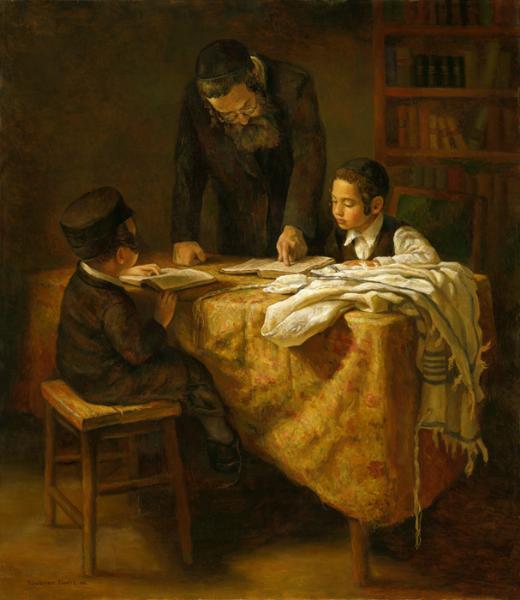
A Rabbi TeachingIf King David, who learned nothing from Achitofel except for two things alone, nevertheless referred to him as his “master,” “guide,” and “intimate,” it certainly goes without saying that one who learns from his fellow a single chapter, a law, a verse, a saying, or even a single letter of Torah, is obligated to revere him.

-Ethics Of The Fathers, 6:3

Our sages tell us, “There are three partners to the creation of man: G-d, his father, and his mother.” The capacity to procreate is, in essence, a distinctly Divine nature…The same is true regarding the “regenerative power” contained in a teaching: when G-d is a partner to their endeavor, the teacher-student relationship yields an infinite progeny.

Commentary on Ethics of Our Fathers: Chapter 6
Tammuz 11, 5771 * July 13, 2011
“Fertile Wisdom”
Chabad.org

I’ve mentioned before that the student-teacher relationship can yield enormous benefits, assuming an honest, knowledgeable, and inspired teacher and a student willing to be open. However, as we see from the quotes above, the teacher isn’t necessarily the most important partner in the transaction, which is good, since human beings are fallible. God is always present when Torah is taught and learned, which makes the act of study not only educational but holy. The Creator is the indispensable element in the room whenever people come together to learn the Word of God.

Rabbi Chalafta the son of Dosa of the village of Chanania would say: Ten who sit together and occupy themselves with Torah, the Divine Presence rests amongst them, as is stated: “The Almighty stands in the community of G-d.” And from where do we know that such is also the case with five? From the verse, “He established his band on earth.” And three? From the verse, “He renders judgment in the midst of judges.” And two? From the verse, “Then the G-d-fearing conversed with one another, and G-d listened and heard.” And from where do we know that such is the case even with a single individual? From the verse, “Every place where I have My name mentioned, I shall come to you and bless you.” –Ethics of The Fathers 3:6

“For where two or three have gathered together in My name, I am there in their midst.” –Matthew 18:20 (NASB)

But from who can we learn? It’s desirable to find a worthy teacher; one we can call our “Rebbe”, but there are problems with this. There are many unworthy teachers out there who are anxious to gather a following out of their own ambition, men and women who believe they have a special insight and who are entitled to share their particular “theological axe” which they desire to “grind”. From these “teachers” we learn there are those who are not to be trusted. Also, Christian tradition, unlike Judaism, doesn’t have a history of “Rebbes” or exalted teachers who pass their knowledge, wisdom, and compassion from one generation of disciples to the next. We are (often rightly) suspicious of gurus, cult leaders, and false teachers who ultimately lead people away from God. Christians even distrust the study of Torah and Talmud from valid and worthy Jewish Rabbis for fear this will lead the Christian away from Jesus.

And yet we are commanded to obey our leaders and teachers in the community of faith:

Have confidence in your leaders and submit to their authority, because they keep watch over you as those who must give an account. Do this so that their work will be a joy, not a burden, for that would be of no benefit to you. –Hebrews 13:17

We also see from David’s example with Achitofel that we are to honor a person who teaches us “a single chapter, a law, a verse, a saying, or even a single letter of Torah.” While we can seek to learn the teachings of an honored Rebbe such as Rabbi Menachem M. Schneerson, of blessed memory (and I’m learning much from his teachings as related by Rabbi Tzvi Freemen in the book Bringing Heaven Down to Earth), we see from the following that a good teaching can come from even a bad source:

It is possible to utilize for G-d’s service, [in a manner] according to Torah, all behavior-traits. This includes those traits that are unwholesome, and even those that are evil, as their names and descriptions indicate. For example, the tzadik Rabbi Meshulam Zushya of Anipoli, of blessed memory, learned [from his Rebbe, the Maggid of Mezritch] a number of ways of serving G-d from [the ways of] a thief:

  1. He works quietly without others knowing.
  2. He is ready to place himself in danger.
  3. The smallest detail is of great importance to him.
  4. He labors with great toil
  5. [and] Enthusiasm.
  6. He is confident and optimistic.
  7. If he did not succeed the first time, he tries again and again.

-[From HaYom Yom by the Lubavitcher Rebbe, translated by Uri Kaploun (Kehot)].
found at Chabad.org

This shouldn’t be so surprising, since the Master, our own great Rebbe in Christianity told us this:

Then Jesus said to the crowds and to his disciples: “The teachers of the law and the Pharisees sit in Moses’ seat. So you must be careful to do everything they tell you. But do not do what they do, for they do not practice what they preach. They tie up heavy, cumbersome loads and put them on other people’s shoulders, but they themselves are not willing to lift a finger to move them. –Matthew 23:1-4

Look at what Jesus is saying. He’s not telling his audience to ignore or disregard the teachings of the Pharisees. He’s saying “you must be careful to do everything they tell you”. What? Aren’t Pharisees hypocrites, liars, untrustworthy, and “under the Law”? Don’t they deny the true teachings of God and the grace of Jesus Christ? Why did Jesus tell his disciples to obey everything the Pharisees told them to do?

It’s because what the Pharisees taught was correct and consistent with the Torah, however the Pharisees of that day were corrupt and indeed, they were hypocrites who, under the Roman occupation, exalted themselves and did not “practice what they preached”, so to speak.

But what they actually taught was worthy of being learned and obeyed.

It’s also important to realize that not every single Pharisee was corrupt and no good. After all, Nicodemus was a Pharisee and he ended up becoming a disciple of Jesus. After the crucifixion of the Master, Nicodemus and Joseph of Arimathea, a wealthy member of the Sanhedrin, approached Pilate and asked permission to bury the Master’s body before the Sabbath began (we aren’t quite clear as to whether this was the eve of Passover or the weekly Sabbath). Not all Pharisees and members of the Sanhedrin were evil and corrupt, so we shouldn’t paint them all with the same broad brush.

KindergartenLook at the teaching of the Rebbe about how to learn from a thief. He doesn’t say the thief is a good and worthy teacher and that we must devote our lives to learning at the feet of a criminal. He says that, by simply observing the thief, there are habits we can learn and adapt to a life of holiness. The same is true of learning from anyone, even if they are unworthy, a hypocrite, or a thief, simply by watching them and listening to them, we can learn much, as long as we continue to use our powers of discernment and to view everything through the lens of the Bible and the Spirit of God.

Remember, in any transaction between two people, one being a teacher and the other being the student, God is there as the indispensable partner in the exchange. Being a student and disciple does not mean being a mindless sponge with no will of your own. In fact, your will, your judgment, and your questioning nature is as necessary to being a student as your attention, openness, and eagerness to learn. You cannot be taught corruption if you are paying attention and you do not have to take anything at face value without asking questions. Even the Bereans didn’t take Paul at his word and checked everything he taught against scripture (Acts 17:10-12). If you feel you have been lead astray by a teacher, look to yourself when asking the question, “how did this happen?”.

I’m sure you’ve heard or read the list compiled by Robert Fulghum, All I Really Need to Know I Learned in Kindergarten. From this, we learn that small children can teach us something. Even the Prophet Isaiah said “and a little child will lead them.” (Isaiah 11:6).

The Maggid also taught Rabbi Zushya, his disciple that we can learn three things from a child:

  • Never for a moment is he idle.
  • When he needs something, he demands it vigorously.
  • He is merry for no particular reason.

-[From The House of Rizhin by Rabbi Menachem Brayer [Mesorah].]

The Pirkei Avot; The Ethics of the Fathers teaches us that a life of learning and performing Torah yields many rewards:

The sages expounded in the language of the Mishnah (blessed is He who chose them and their learning):
Rabbi Meir would say: Whoever studies Torah for Torah’s sake alone, merits many things; not only that, but [the creation of] the entire world is worthwhile for him alone. He is called friend, beloved, lover of G-d, lover of humanity, rejoicer of G-d, rejoicer of humanity. The Torah enclothes him with humility and awe; makes him fit to be righteous, a chassid, correct and faithful; distances him from sin and brings him close to merit. From him, people enjoy counsel and wisdom, understanding and power, as is stated, “Mine are counsel and wisdom, I am understanding, mine is power.” The Torah grants him sovereignty, dominion, and jurisprudence. The Torah’s secrets are revealed to him, and he becomes as an ever-increasing wellspring and as an unceasing river. He becomes modest, patient and forgiving of insults. The Torah uplifts him and makes him greater than all creations. –The Ethics of the Fathers 6:1

Being a student, a disciple, and a person of faith is not a passive activity. Learning isn’t something you only do sitting at someone’s feet or taking notes in a classroom. It’s not always accomplished by reading a book or by visiting inspirational websites. A disciple is always moving, always asking questions, always observing, always sharing their insights with others and asking for feedback. Most importantly, in any learning situation (which is to say, in every waking moment of our lives), we are always turning to the “silent” voice in the room, the indispensable partner in the teaching of Torah. God is with us and He sent us a counselor who will teach us all things (John 14:26). Even when reading the Bible by ourselves at night, we are never alone.

Our teachers can be anyone. Our teachers can be anywhere. We just have to be paying attention to where we are and what we’re doing.

“A brilliant mind without faith is like a beautiful face without eyes.” -Shalom Cohen

Good Shabbos