Tag Archives: doctrine

Taking the Fork in the Road: Discussing Arminianism and Calvinism, Part 2

tulipThis is the second part of a rather lengthy two-part blog post on the first two chapters of Dr. Manfred E. Kober’s article “Divine Election or Human Effort,” a paper based on a workshop given by Kober on October 25, 1971 in a faculty meeting at Faith Baptist Bible College, and provided to answer student questions about Arminianism and Calvinism. If you haven’t done so already, please read Part 1 of this post before proceeding here.

I want to talk a little bit about Calvinism and TULIP (Total Depravity, Unconditional Election, Limited Atonement, Irresistible Grace, Perseverance of the Saints) and to do so, I looked up TULIP on the Calvinist Corner website:

The doctrine of Total Depravity is derived from scriptures that reveal human character: Man’s heart is evil (Mark 7:21-23) and sick Jer. 17:9). Man is a slave of sin (Rom. 6:20). He does not seek for God (Rom. 3:10-12). He cannot understand spiritual things (1 Cor. 2:14). He is at enmity with God (Eph. 2:15). And, is by nature a child of wrath (Eph. 2:3). The Calvinist asks the question, “In light of the scriptures that declare man’s true nature as being utterly lost and incapable, how is it possible for anyone to choose or desire God?” The answer is, “He cannot. Therefore God must predestine.”

When talking about part of this with Pastor Randy, he’s the one who brought up man being created in the Image of God. That means, in some sense, that even though human beings are fallen, there is still something of us that carries a spark of the Divine. Jewish mysticism makes a great deal about these “sparks,” but I won’t open up that topic right now. I do want to say that I don’t believe the “T” in TULIP takes “the Image of God” in man into account. It’s what separates human beings from the rest of creation. Plants and animals behave the way they do because they are responding to their design. While we humans also respond to our design, part of that design is to seek God. Most of the time we fail but the drive to do it is inborn. It’s woven into the fabric of our being. It’s the image of God in man.

God does not base His election on anything He sees in the individual. He chooses the elect according to the kind intention of His will (Eph. 1:4-8; Rom. 9:11) without any consideration of merit within the individual. Nor does God look into the future to see who would pick Him. Also, as some are elected into salvation, others are not (Rom. 9:15, 21).

The “U” in TULIP seems to assume that we live in a “flat” universe where God and man operate on the same level or plane of existence (of course, God being infinitely powerful). It also assumes that God is subject to linear time (note the “look into the future” language above) as Kober states:

These acts are the result, not the cause of God’s choice. Election therefore was not determined by or conditioned upon any virtuous quality or act foreseen in man.

-Kober, “Chapter 2: The Decrees of God,” pg 7

Kober’s statements are just saturated with references to linear time and causality when I believe it is totally inappropriate to attribute those qualities to God or to believe God is subject to them.

Kober writes that the main point of Calvinism is that God saves sinners. I don’t deny that, but from Kober’s viewpoint, the statement would be better rendered God saved sinners since he did so from before the creation of the earth. There’s no active process, it’s just a “done deal” and was a done deal before we were ever born.

Yet, from a lived human experience here on the ground, people are unsaved, are in the process of approaching a decision for salvation, are saved by God’s grace through Jesus Christ. If Calvin was right, why bother preaching and teaching the word of God. Saved is saved and unsaved is unsaved. It’s already happened. The “decision” of the people involved isn’t even a formality since there’s nothing for them to decide.

It occurred to me that Calvinism also seems to contradict prophesy.

But this is the covenant that I will make with the house of Israel after those days, says the Lord: I will put my law within them, and I will write it on their hearts; and I will be their God, and they shall be my people. No longer shall they teach one another, or say to each other, “Know the Lord,” for they shall all know me, from the least of them to the greatest, says the Lord; for I will forgive their iniquity, and remember their sin no more.

Jeremiah 31:33-34 (NRSV)

Then afterward I will pour out my spirit on all flesh; your sons and your daughters shall prophesy, your old men shall dream dreams, and your young men shall see visions. Even on the male and female slaves, in those days, I will pour out my spirit.

Then everyone who calls on the name of the Lord shall be saved.

Joel 2:28-29, 32

Pouring waterOne day everyone will “know God” and the Spirit of the Lord will be poured out upon “all flesh.” Depending on your point of view, either that means all human beings everywhere or all human beings who have turned to God. Either way, these events have yet to occur and are signposts of the Messianic Age. But according to Calvinism, the “elect” already “know God” and those who were not chosen never will.

For that matter, referring back to Jeremiah, why would the prophet write something like “know the Lord” as if it really mattered; as if we really had a choice to know God or not know Him if Calvinism is true? “Knowing the Lord” is totally irrelevant to those who were specifically chosen by God not to know Him. And yet they are horribly and eternally punished for this “non-decision.”

In summarizing Arminianism (page 11), Kober states that the Arminianist position is that “Divine sovereignty is incompatible with free will and therefore God’s sovereignty is limited.” There’s another “either-or” statement. I disagree that God’s sovereignty and humanity’s free will are mutually exclusive states. They are from a human standpoint since we are limited in how we can conceptualize this “mystery,” but I don’t doubt that from God’s point of view, there is no dissonance and that He is both sovereign and people also experience choice.

On pages 12 through 14, Kober writes about “The Sequence of the Decrees.” I remember Pastor Randy mentioning that last Wednesday, and I remember objecting to imposing “sequencing” on God because it (again) makes God subject to linear time. It’s funny how all of the linear time and either-or arguments are a human effort at limiting God’s sovereignty over His own existence and experience while we discuss God’s sovereignty over man and salvation.

But as part of this section of his chapter, Kober cites Henry Clarence Thiessen, Lectures in Systematic Theology (Grand Rapids: Wm. B. Eerdman’s Publishing Co., 1949), pp. 343-344 in describing different variations on Calvinism including Supralapsarian view, Intralapsarian view, Sublapsarian view, and Modified Sublapsarian view. I won’t list all of the points of each perspective, but they illustrate that even within Calvinism, there is a variability about how the “mechanism” of Calvinistic salvation operates. Not all Calvinists everywhere agree on all the details. Does that mean it isn’t all that evident from scripture exactly how God saves?

Calvinists are wrestling with each other over how salvation works but perhaps they’d be better off wrestling with God and living with a particular amount of uncertainty, rather than trying to pin God down, so to speak, so that we can believe we have the last word on the Word of God. MacArthur said the Bible was sufficient, not that it contained literally all the information we desire. I believe God left some stuff out of the Bible. It may not be able to tell us certain things, at least down to the finest details.

But false prophets also arose among the people, just as there will be false teachers among you, who will secretly bring in destructive opinions. They will even deny the Master who bought them—bringing swift destruction on themselves.

2 Peter 2:1 (NRSV)

Kober quotes this verse on page 16 as he’s describing Biblical support for Modified Calvinism. This is a school of thought that supports all five of the TULIP points except for Limited Atonement, what is considered the weakest link in TULIP’s chain. Apparently, according to this perspective, Christ’s redemption is universal, and Kober says that some people “insist that even Calvin accepted the unlimited theory of the atonement later in life.”

Again, there’s a certain amount of “wiggle room” within the Calvinistic blanket.

I keep thinking about a couple of things.

I call heaven and earth to witness against you today that I have set before you life and death, blessings and curses. Choose life so that you and your descendants may live, loving the Lord your God, obeying him, and holding fast to him; for that means life to you and length of days, so that you may live in the land that the Lord swore to give to your ancestors, to Abraham, to Isaac, and to Jacob.

Deuteronomy 30:19-20 (NRSV)

If the choice were made for the Israelites, then why would God exhort them to “choose life” and to love and obey God and His commandments?

One day, while he was teaching, Pharisees and teachers of the law were sitting near by (they had come from every village of Galilee and Judea and from Jerusalem); and the power of the Lord was with him to heal. Just then some men came, carrying a paralyzed man on a bed. They were trying to bring him in and lay him before Jesus; but finding no way to bring him in because of the crowd, they went up on the roof and let him down with his bed through the tiles into the middle of the crowd in front of Jesus. When he saw their faith, he said, “Friend, your sins are forgiven you.” Then the scribes and the Pharisees began to question, “Who is this who is speaking blasphemies? Who can forgive sins but God alone?” When Jesus perceived their questionings, he answered them, “Why do you raise such questions in your hearts? Which is easier, to say, ‘Your sins are forgiven you,’ or to say, ‘Stand up and walk’? But so that you may know that the Son of Man has authority on earth to forgive sins”—he said to the one who was paralyzed—“I say to you, stand up and take your bed and go to your home.” Immediately he stood up before them, took what he had been lying on, and went to his home, glorifying God.

Luke 5:17-25 (NRSV)

welcome-to-faithJesus saw the faith of the men who brought the paralyzed man to him through the roof. He forgave the man of his sins and then healed him. Was the paralyzed man all part of “the plan,” already saved from before the creation of eternity, paralyzed for the glory of God so he could be forgiven and healed by the Son of Man?

What about this?

Jesus asked the father, “How long has this been happening to him?” And he said, “From childhood. It has often cast him into the fire and into the water, to destroy him; but if you are able to do anything, have pity on us and help us.” Jesus said to him, “If you are able!—All things can be done for the one who believes.” Immediately the father of the child cried out, “I believe; help my unbelief!”

Mark 9:21-24 (NRSV)

Did the boy’s father believe or not? Did he have faith or not? Did he progress from a state of unbelief to a state of belief and did Jesus help with that process?

Jesus was often critical of his disciples and others around him having “little faith” as if they had some sort of control of their faith. According to Calvinism, we have no control of our faith. It’s either present or not, like a light switch flipped to either on or off. Yes these passages seem to introduce a set of inconsistencies that question many Calvinistic assumptions.

Kober mentions that the beginning roots of Arminianism and Calvinism stretch all the way back to the fifth, fourth, and even the third centuries C.E. but both Arminius and Calvin lived during the time of the Reformation in the 16th century. James, Peter, Paul and the other apostles were dead for 1600 years by the time these doctrines had been constructed and both theories have experienced modifications and adjustments for the last 400 or so years.

I wonder what Paul would think if he could read the first sixteen pages of Dr. Kober’s article or for that matter, what would he think of the history of the Baptist church and the other denominations of modern Christianity? The theories of Arminius and Calvin are largely based on the Gospels and on Paul’s letters, so I imagine the ancient sage and emissary to the Gentiles might have an opinion or two on this matter.

I’ll continue to read Dr. Kober’s article. I’m sorry if it seems that I’ve been a little rough on him. It’s not my intent and I really don’t feel “hot under the collar” about all this. I just think that all of the arguments pitting Arminianism and Calvinism against each other are making a tragic mistake by assuming that God has to construct spiritual realities the way we write scholarly papers on theology and church doctrine.

The Bible is supposed to be a source of illumination, not a straight-jacket.

Whereas the Greek philosophical way includes defining things and relationships with precision, the Israelite way was to define things with story.

Derek Leman

113 days.

Taking the Fork in the Road: Discussing Arminianism and Calvinism, Part 1

arminianism-calvinism-debateThe following paper is based on a faculty workshop given by the writer on October 25, 1971, in a faculty meeting at Faith Baptist Bible College. Frequent questions by students in the area of the sovereignty of God have prompted the writer to put his notes into a more permanent form. Although recognizing the differences that exist among evangelicals, the author believes that the position stated herein approximates most closely the Biblical and historical Baptistic view. This paper must not be construed a the official position of the school. However, it is sent forth with the prayer that it might generate more light than heat and be found profitable by the ever inquiring students…

-Manfred E. Kober, Th.D.
“Divine Election or Human Effort?”

Pastor Randy gave me a copy of this paper during our Wednesday night talk last week and I’m just now getting into it. I’ve read the first two chapters (17 pages) and can’t restrain my response any longer. I’ll write more as I progress through the 50+ pages of Dr. Kober’s paper and hopefully I too will generate “more light than heat.”

Before proceeding, a few things. First of all, I told Pastor Randy that I tend to think of myself as a “generic Christian with a Jewish twist” rather than align with a particular denomination, Baptist or otherwise. I also believe it’s quite possible to be a perfectly well-functioning Christian without declaring to be an Arminianist or a Calvinist. After all, these are systems constructed by theologians and honed by other theologians over the course of many centuries. Sure, they’re both based on scripture, but they are derived from scripture; interpreted from scripture. That doesn’t mean that either system is presupposed by scripture, let alone God. I could wad up both Arminianism and Calvinism in all their variations like so much waste paper and toss them into the trash can, then move on to other matters. My existence as a disciple of the Jewish Messiah does not hinge on making such a decision. Theologians, teachers, and preachers in a formal Christian sense must come up on one side or another but as a plain old “vanilla” Christian, I don’t.

Now on with the show.

The primary task for a theologian is to interpret God’s Word for man. But interpretation is both an art and a science. This means that any exposition of the Bible is guided by specific rules and checks which guard against personal whims and prejudices of the interpreter. The application of these rules demands the greatest care in judgment that the godly and dedicated interpreter can bring to bear upon the text. In that sense interpretation is an art.

-Kober
“Chapter 1: The Duty of the Theologian,” pg 1

I can grasp the science of Biblical translation and interpretation but we must admit that it is the “art” that makes things elusive and ambiguous on occasion. If theology was an “exact science,” we wouldn’t have so many different ideas about what the Bible means. Or would we? After all, even a hard science such as astronomy contains many varying points of view on phenomena we can observe through the electromagnetic spectrum, and sometimes what we see can surprise us and challenge our long-held positions.

Kober has already somewhat contradicted himself (I’m sure he doesn’t see it quite that way and I am stretching my interpretation of “contradicted” a bit) by saying in the introduction that he’s presenting his material from the “historical Baptistic view” and in Chapter 1, he says that the science of Biblical interpretation follows rules and checks “which guard against personal whims and prejudices.” Maybe those rules and checks guard against the interpreter’s personal bias, but what about the bias built into the “historical Baptist view?”

Which aspect of salvation does God the Holy Spirit accent? Is it God’s sovereignty in salvation or the effort of man?

-Kober, pg 2

I’m crying “foul” here. Kober makes it sound like the question at hand is “Does God save or do people save themselves?” Not being a Calvinist, I can still agree that God and only God saves, but the question is, do human beings have any ownership of the process at all. It is God’s “effort” that saves, all a human being has to do is to effectively surrender to God. Is surrender an “effort?” Why do we have to be so “either-or?”

This is something of a side note, but I couldn’t resist finding the following statement somewhat ironic.

Frequently, one encounters a strangely resigned attitude on the part of believers toward certain areas of God’s truth, especially that of election, such as “Oh, well, we will know it all by and by!” This is true of course. But the point is that God has revealed more about His majestic plan of redemption than Christians sometimes realize.

-Kober, pp 2-3

beth-immanuelGiven the multitude of blog posts I’ve just written giving my own interpretation of how Messianic Judaism understands God’s revelation of His “majestic plan of redemption,” I wonder what Dr. Kober would say to the suggestion that he, like the Christians he references, may be unconscious of certain viewpoints on the redemption and salvation of Israel as well as the people of the nations called by God’s Name as presented from outside his own framework?

But back to the main focus on this “meditation.”

There are two basic ways of approaching the doctrine of salvation. One way is to stress the importance of man and his free will to choose for or against christ; this school of interpretation is called Arminianism, named after James Arminus. The other way of approaching salvation is to stress the importance of God and His sovereign will in bringing men to Himself through Christ; this school of Interpretation is called Calvinism, named for John Calvin. It is unfortunate that one must call himself an Arminian or Calvinist but for theological purposes every Christian is either one or the other.

-Kober
“Chapter 2: The Decrees of God,” pg 4

Is it better to be feared or respected? — I say, is it too much to ask for both?

-Tony Stark (Robert Downey Jr)
Iron Man (2008)

When you come to a fork in the road, take it.

Yogi Berra

That’s kind of my resolution to the problem in a nutshell, and it’s way too early to tip my hand, but I’m doing it anyway. I know people reading this blog post will probably classify me as an Arminian because I’m not a huge fan of God running roughshod over humanity, approving this one for salvation and tossing that one into the fires of the damned for all eternity without so much as a by your leave.

On page 4 of the paper, Kober quotes J.I. Packer saying:

The difference between them is not primarily one of emphasis but one of content. Once proclaims a God who saves; the other speaks of a God who enables man to save himself.

Again, I cry foul because Packer, like Kober, is looking at the picture as an “either-or” equation. Either God is supremely sovereign and saves who He wills and condemns who He wills, all outside the awareness let alone the consent of the people involved (you are saved or “unsaved” before you are ever conceived and born and draw your first breath of life according to a Calvinist) or God has handed some sort of authority over to the human who then does the job of saving himself. It’s not that concrete a choice.

I suppose I’ll be busted because I can’t point to a part of the Bible that says “it can be both” but is that entirely true? I’m going to try to find out and then show you some examples but let me introduce something first.

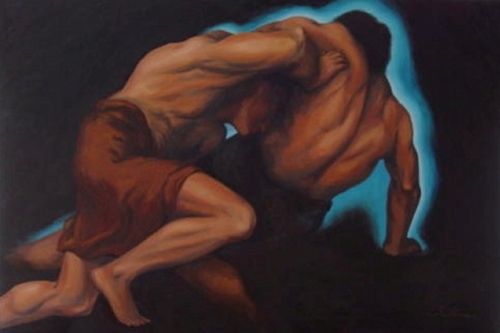
Jacob was left alone; and a man wrestled with him until daybreak. When the man saw that he did not prevail against Jacob, he struck him on the hip socket; and Jacob’s hip was put out of joint as he wrestled with him. Then he said, “Let me go, for the day is breaking.” But Jacob said, “I will not let you go, unless you bless me.” So he said to him, “What is your name?” And he said, “Jacob.” Then the man said, “You shall no longer be called Jacob, but Israel, for you have striven with God and with humans, and have prevailed.” Then Jacob asked him, “Please tell me your name.” But he said, “Why is it that you ask my name?” And there he blessed him. So Jacob called the place Peniel, saying, “For I have seen God face to face, and yet my life is preserved.”

Genesis 32:24-30 (NRSV)

The name “Israel” can be interpreted a number of ways, but one common meaning is one who struggles with God and prevails (wins). If Jacob struggled with a personified God or an angel of God, logic tells us that a flesh and blood mortal cannot hold his own let alone defeat a supernatural being, particularly if that being is literally the Creator of the Universe or some incarnation of Him.

In some areas of Judaism, it is thought that Jacob’s struggle with God is a picture of how the Jewish people struggle with the difficulties of understanding God’s perfection in an imperfect world. I’ve sat in a local synagogue and listened to the Rabbi disagree with another person’s understanding of God’s sovereignty and say something like “I’m willing to struggle with God on this one.” (not an exact quote)

What if the difficulties we have with the doctrine of salvation are built into the text of the Bible and built into our lives as believers so we can “struggle with God” over them and our relationship with Him? I’m not saying it has to be that way, but it seems like Christians always want definite “either-or” answers to all of the difficult sayings in the Bible, while many religious Jews are willing to live in a state of uncertainty on certain matters, “wrestling with God” over them.

Six million Jews were slaughtered in Hitler’s Holocaust. Many of the Jewish survivors lost their faith and turned their backs on God, and from a human point of view, this is understandable. But many other Jewish survivors found a stronger faith in God as they moved forward with their lives, ultimately raising children and grandchildren with that same abiding faith. How were they able to “wrestle with God” over a seemingly enormous injustice committed or at least allowed by God against His treasured, splendorous people?

Because Arminius was not the systematic theologian that John Calvin was, he did not clearly define his thinking on salvation. As a result, the followers of Arminius distorted his system with views Arminius simply did not hold.

-Kober, pg 5

While this can be taken as a statement of fact regarding the relative backgrounds of Arminius and Calvin, it also reveals (again) the writer’s bias. He is predisposed to select Calvinism over Arminianism, so you could say the paper I’m reading is hardly a balanced and objective examination of the two viewpoints. Nevertheless, I choose to believe that Kober is an honest person who is just trying to “clear the air” about this debate. It doesn’t mean I have to accept the either-or premise of his argument, though.

As I’ve already mentioned, I have a problem with “either-or” and believe that, on some level, the answer can be “both.” While most people may not think of it this way, by “forcing” a decision about God’s thoughts and actions, even based on scripture, we assume that we can know God’s process and intentions to an absolute or at least reasonably knowable and concrete degree, then drag it down from Heaven, so to speak, and into the realm of human understanding at ground level.

It’s almost arrogant to say that the “mechanism” of salvation cannot be mysterious on any level and that we can wholly know all of the little nuts and bolts about how God “does it.” Actually, even the author must admit that we are rather “slippery” on just how many screws God used to put salvation together, and what type of battery he powers the thing with (I’m speaking metaphorically, of course). I’ll get to that tomorrow.

On page six, in describing the “five points of Arminianism,” Kober says, “The faith which God foresaw and…” This wouldn’t be the last time Kober would say or intimate that from the point of creation or before (if “before,” “during,” and “after” have any meaning to God), God looked into the future and saw what was going to happen, like some cheap fortune-teller wielding a crystal ball and some Tarot cards.

New WorldI wrote a response to this idea in relation to Calvinism about a month ago and suggested that God exists outside of time and thus is not subject to its passing as we are. Unlike human beings, God isn’t “trapped” in a little pocket of linear time being carried forward one day at a time whether He wants to be or not. I can’t prove this, but it makes sense (to me anyway) for God to “experience” all of “timespace” as a single instantaneous event, as if everything from the creation of the earth, to Moses parting the Reed sea, to the giving of the Torah at Sinai, to David seeing Bathsheba bathing on a rooftop, to the first birth cries of Mary (Miriam) as Jesus is about to leave her womb, to Jesus breathing his last on the cross, to the first crusade, to the first inquisition, to the first ship to sail to the new world, to the first footstep of man on the moon, as if all those events, and everything else, were happening simultaneously.

God doesn’t “foresee” anything. He just knows because all of Creation from alpha to omega is before Him always. It’s only from our point of view that, when God chooses to touch a specific moment within Creation, we human beings experience God within the context of linear timespace.

Which may be part of the “solution” to the “either-or” problem of God’s Sovereignty vs. Man’s free will. Remember, as Kober writes his paper, he’s the observer. His readers are the observers. We are all the observers of God and it’s our point of view we depend upon. We experience choice and free will because that’s what it looks like from down here. We’re powerless to glean even a hint of God’s perspective and who knows what all this looks like as He sits enthroned in the Heavenly Court?

I have no problem with God being ultimately sovereign and at the same time with humanity experiencing a sense of “partnership” with God in the affairs of the world and in the workings of our lives.

This blog post took on a life of its own and I had to split it into two parts. I continue my discussion of Chapter 2 of Dr. Kober’s article in tomorrow’s morning meditation.

114 days.

The Transcendent Path

Tree of LifeIf you find yourself affixed to a single path to truth—the path of prayer and praise, or the path of kindness and love,or the path of wisdom and meditation,or any other path of a singular mode—you are on the wrong path. Truth is not at the end of a path. Truth transcends all paths. Choose a path. But when you must, take the opposite path as well.

-Rabbi Tzvi Freeman
“Two at Once”
Based on letters and talks of the Rebbe, Rabbi M. M. Schneerson
Chabad.org

As human beings, we have a tendency to compartmentalize and specialize our lives. This comes as no surprise to me, since organization of the different elements of life into “categories” is how we understand ourselves. We have an order and a set of habits to what we do. We also have an awareness of what we’re good at and what we aren’t; a set of “gifts” to which we lean upon and if we are kind, offer to others. Organizing our lives by categorization is necessary so we can conceptualize events, circumstances, and objects and make sense of the world around us.

But it can also be a limitation if we believe we are only defined be these categories. Saying, “I’m only good at this, so I won’t try that,” may rob someone who needs you to do “that” for them rather than “this.”

I’m as guilty of this sort of thinking and behaving as anyone. I’m a writer, both professionally and “for fun.” I find that I can clarify my own thinking and understand better what some people are saying to me if I write about those experiences. My Wednesday night meetings with Pastor Randy are a perfect example. He might say a few sentences to me on Wednesday that will fuel my blog posts for an entire week, because I use writing to continually process what he has been teaching.

But I cannot allow writing to be the totality of my identity and my activity. Someone who needs me to give them a lift to a doctor’s appointment because their car broke down won’t be helped if I only write about their need. I should offer them a ride to and from the appointment in my car. I should do something that I’m not accustomed to considering as an “expertise” of mine in order to meet another human being’s need.

Earlier today, I was writing about giving chesed to the stranger, showing someone who needs you a kindness, not because they are your friend or neighbor, but just because they need you.

In the world of “religious blogging,” most of us have a tendency to write about what we’re interested in, and again, I’m no exception. We often write about the theological or doctrinal specifics with which we identify. Jews write about Judaism and Christians write about Christianity. Nothing strange about that. Even within a particular religious structure, we tend to write about those areas of which we are particularly fond or in which we are interested.

I’ve written lately on Divine Election because I was processing that information. For another person, that might be a rather meaningless topic. I’ve read blogs recently about the Leviticus 11 kosher laws, Bibles limited to the New Testament and the Psalms, Shomer Negiah, Good Friday, and other religious subjects. Nothing wrong with writing about any of those religious topics…

…unless they limit what else we should be doing.

We tend to choose a path and then walk it, but then we only walk that path and no other. According to what Rabbi Freeman said above, that’s not the right path. If we are on the path of prayer and praising God but a homeless person on the street needs us to give them something to eat, then we are on the wrong path, at least for that moment. If we are busy donating our time at a shelter or food kitchen, but God needs us to read and meditate upon His Word, then we are on the wrong path, at least for that moment.

The individual’s avoda must be commensurate with his character and innate qualities. There may be one who can drill pearls or polish gems but works at baking bread (the analogy in the realm of avoda may be easily understood). Though baking bread is a most necessary craft and occupation, this person is considered to have committed a “sin.”

“Today’s Day”
Friday, Nissan 25, 10t day of the omer, 5703
Compiled by the Lubavitcher Rebbe
Translated by Yitschak Meir Kagan
Chabad.org

white-pigeon-kotelAvoda is a Hebrew word that is commonly translated as “work,” but among the Chassidim, it “generally refers to Divine service (or worship). For example, it’s part of the Divine service to serve God with joy.” Is who we are as servants of God limited to our theology or our religious identity, or is there something that transcends all that information, and unites us as living, human creations of the Most High God?

We often drone on and on and on about our insights into the Bible, our own theological pet peeves, or about how people with different theological pet peeves annoy us and are guilty of “false teaching,” but do we take the time to transcend our categories, our pigeon-holed lives, and realize that truth is much, much larger than the box we’ve put ourselves in?

And if your brother is not close to you and you do not know him.

Deuteronomy 22:2

Perhaps the reason that other people are not close to you is because you do not know them.

The Chassidic master of Apt said: “As a young man, I was determined to change the world. As I matured, I narrowed my goals to changing my community. Still later, I decided to change only my family. Now I realize that it is all I can do to change myself.”

Some things in the world are givens, and others are modifiable. The only thing we can really modify is ourselves. All other people are givens. Unfortunately, many people assume the reverse to be true. They accept themselves as givens and expect everyone else to change to accommodate them.

(There is one limited exception. When our children are small, we can teach and guide them. When they mature, however, we can no longer mold them.)

Trying to change others is both futile and frustrating. Furthermore, we cannot see other people the way they truly are, as long as we are preoccupied with trying to change them to the way we would like them to be.

The people we should know the most intimately are those who are closest to us. Yet it is precisely these people whom we wish to mold into the image we have developed for them. As long as this attitude prevails, we cannot see them for what they are. How ironic and tragic that those we care for the most may be those we know the least!

Today I shall…

…try to focus any desires to change on myself and let other people determine for themselves who and what they wish to be.

-Rabbi Abraham J. Twerski
“Growing Each Day, Nissan 20”
Aish.com

light-of-the-worldTo extend Rabbi Twerski’s metaphor, we can only change the world by changing ourselves. We can only serve God and change the world, by accepting that others will always be different from us and then realize that’s not always a bad thing. We, in the end, are only responsible for who we are. God will not judge us on what other people have done but only on what we have done with our lives. If we have treated others kindly, our theology, doctrine, dogma, or any of the other boxes and pigeon holes we’ve used to categorize and identify ourselves in this world will be worth less than who we are in Christ.

If anyone else thinks he has reason for confidence in the flesh, I have more: circumcised on the eighth day, of the people of Israel, of the tribe of Benjamin, a Hebrew of Hebrews; as to the law, a Pharisee; as to zeal, a persecutor of the church; as to righteousness under the law, blameless. But whatever gain I had, I counted as loss for the sake of Christ. Indeed, I count everything as loss because of the surpassing worth of knowing Christ Jesus my Lord. For his sake I have suffered the loss of all things and count them as rubbish, in order that I may gain Christ.

Philippians 3:4-8

Paul isn’t saying that his being Jewish is literally worthless, and I’m not suggesting that how we study and understand the Word of God is meaningless, either. What I am saying is that, like Paul, there is something much, much greater. The Master taught us that loving God to our fullest extent and loving other human beings as ourselves are the essence of everything in the Bible. He also taught that we would be known as his disciples specifically by our love of one another, a love that goes so far that we would be willing to give up our lives for another if required.

If anything can be said to transcend all of our paths, our categories, our religious posturing, it is love…even love for the unlovable and the unlikable ..especially love for those who otherwise make us feel hurt and angry and aggravated. If we can authentically show them love, then we are better than all of the sermons and blog posts about theology that we could ever produce. Then, we are written in His Book of Life because we have loved.

“When I was young, I admired clever people. Now that I am old, I admire kind people.”

-Abraham Joshua Heschel

We must be more.

Dogma on a Leash

dogma-on-a-leashChristian theology is the enterprise which seeks to construct a coherent system of Christian belief and practice. This is based primarily upon the texts of the Old Testament and the New Testament as well as the historic traditions of Christians. Christian theologians use biblical exegesis, rational analysis, and argument to clarify, examine, understand, explicate, critique, defend or promote Christianity. Theology might be undertaken to help the theologian better understand Christian tenets, make comparisons between Christianity and other traditions, defend Christianity against objections and criticism, facilitate reforms in the Christian church, assist in the propagation of Christianity, draw on the resources of the Christian tradition to address some present situation or need, or for a variety of other reasons.

“Christian theology”
Wikipedia

Your pastor Randy seems to be a Calvinist. Calvinism is one of the most disturbing (and erroneous) christian theologies that I’ve come across.

I extensively addressed the issue of Calvinism on my old blog site and I found that no other topic inspired so many hostile comments:

In your article you write:

“Think about it. It’s all Adam’s and Eve’s fault. They are the only ones who ever had a choice. According to ‘Divine Election,’ “

However the Calvinist view isn’t even as “fair” as that. According to Calvin:

“God not only foresaw that Adam would fall, but also ordained that he should….I confess it is a horrible decree; yet no one can deny but God foreknew Adam’s fall, and therefore foreknew it, because he had ordained it so by his own decree” (Cal. Inst., b. 3, c. 23, sec. 7).

-Onesimus, from comments he made on the blog post
Lancaster’s Galatians: Sermon Three, Paul’s Gospel, and the Unfair Election

I had a kind of revelation this morning (as I write this) while driving to work. Christians have a strong tendency to be critical of the “man-made rulings” of the Jewish sages and rabbis that are binding to various branches of Judaism. Particularly in Orthodox Judaism, Christians see the rabbinic rulings overriding the word of God and elevating the sages to a higher standing than God’s written word.

But I think Christians do exactly the same thing. Consider the words of Onesimus I quoted above. There are all manner of Christian “sages,” such as John Calvin, who issue proclamations that are considered binding by their followers.

I’m really ignorant of all the different doctrines, creeds, and dogmas running around out there, so it’s difficult for me to compare them, let alone claim a specific path for my very own. Trying to look up a comparative list of Christian doctrines is difficult, and the best I could do was About.com. In comparing, for example, Calvinism and Arminianism relative to Divine Election, I found this:

  • Calvinism – Before the foundation of the world, God unconditionally chose some to be saved. Election has nothing to do with man’s future response.
  • Arminianism – Election is based on God’s foreknowledge of those who would believe in him through faith. In other words, God elected those who would choose him of their own free will. Conditional election is based on man’s response.

These are both perfectly acceptable Christian doctrines, but they contradict each other. They are also binding doctrines in terms of the individuals and churches who follow them. How is that different from Jews who choose to follow the dictates of Reform Judaism, vs. those who adhere to Orthodox Judaism or even the Chabad?

The first Big Issue is this: If I’m going to switch my focus to the New Testament, should I continue following all the rules of the Hebrew Bible? In other words, should I keep my beard and fringes? Or should I break out the Gillette Mach3 and order shrimp fajitas?

After asking this question to pretty much every Christian expert I meet, I’ve come to this definitive conclusion: I don’t know.

You can find a small group – a very small group – of Christians who say that every single Old Testament rule should still be followed by everyone. The ultralegalist camp.

On the other end of the spectrum are those Christians who say that Jesus overrode all rules in the Old Testament. He created a new covenant. His death was the ultimate sacrifice, so there’s no need for animal sacrifice – or, for that matter, any other Old Testament laws. Even the famous Ten Commandments are rendered unnecessary by Jesus.

-A.J. Jacobs
“Month Nine: May”, pp 254-5
The Year of Living Biblically: One Man’s Humble Quest to Follow the Bible as Literally as Possible

AJ-Jacobs-bibleI just finished this book, which Pastor Randy lent me, and Jacobs illustrates quite graphically how the Bible, and particularly Christianity, seems so strange when looked at from a complete outsider’s point of view. He had some familiarity with religious Judaism since he’s a secular liberal Jewish person and has religious relatives.

However, in his inventory of the different “Christianities” he was able to contact, he showed his readers quite dramatically how hard it would be to choose one particular path and call it the “right” one. He contacted a number of Christian scholars and pastors to act as advisors, and visited such diverse groups as Answers in Genesis, Jerry Falwell’s MegaChurch, a Gay men’s Christian Bible Study in New York, and a group of “snake handlers” in Tennessee. It doesn’t get more “mixed bag” than this.

Day 292. I’ve got a decent biblical library going now. Perhaps a hundred books or so. And I’ve divided them into sections: Moderate Jewish. Fundamentalist Jewish. Moderate Christian. Fundamentalist Christian. Atheist. Agnostic. Religious Cookbooks.

I’ve tried to keep the conservative books on the right side and the liberal ones on the left. When I started my year, I thought that nothing would go to the right of my Falwell collection. But of course, I was wrong…

-Jacobs, pg 292

Of course, Jacobs was trying to live the Bible as literally as possible, so he skewed his sampling of Judaism and Christianity to those branches that express themselves in a more literal and often, fundamentalist manner. But even restricting himself to those particular “Christianities,” it was still confusing.

There’s a phrase called “Cafeteria Christianity.” It’s a derisive term used by fundamentalist Christians to describe moderate Christians. The idea is that the moderates pick and choose the parts of the Bible they want to follow. They take a nice helping of mercy and compassion. But the ban on homosexuality? They leave that on the countertop.

Fundamentalist Jews don’t use the phrase “Cafeteria Judaism,” but they have the same critique. You must follow all of the Torah, not just the parts that are palatable.

The point is, the religious moderates are inconsistent. They’re just making the Bible conform to their own values.

The year showed me beyond a doubt that everyone practices cafeteria religion. It’s not just the moderates. Fundamentalists do it too. They can’t heap everything on their plate. Otherwise, they’d kick women out of church for saying hello (“the women should keep silence in the churches. For they are not permitted to speak…” -1 Corinthians 14:34) and boot out men for talking about the “Tennessee Titans” (“make no mention of the names of other gods…” -Exodus 23:13).

-Jacobs, pp 327-8

There’s nothing like having an outsider sincerely look at your faith to give you (or me, in this case) fresh perspective.

In reading Jacobs’ book or reviewing the websites I’ve mentioned so far, I wasn’t really satisfied that I got a good look at the different “Christianities” so I kept searching and found a chart of the differences between denominations at religionfacts.com.

It’s too long to quote from in any meaningful fashion, but if you take a look that page, you’ll see how many different ways there are to apply the different Christianities to different doctrines and topics (Trinity, Nature of Christ, Holy Spirit, Original Sin, Free Will, and on and on and on).

So when Pastor presents his point of view and backs it up with scripture, it’s not the only valid Christian point of view. If I disagree with him or even if I am aghast at something he says, it doesn’t automatically mean I have to agree with him, even if I can’t immediately come up with Bible verses that state another perspective.

I remember being told (in a seminary class) that we must choose between Armenian or Calvinist theology. I found it strange to be forced into an either/or position like that.

-Ruth on Facebook

If I were to run all this past the Apostle Paul, what would he say? Would any of this even make sense to him? Would he advise me to take a Calvinist or Armenian approach, or would he think both were equally dodgy? I don’t know. I have said that I think religion evolves over time to meet the needs of each generation, but there’s a difference between adaptation to adjust to new technologies or social situations, and totally new ways of understanding the basic nature a completely unchanging God.

rabbinThe following story is said of Moses (see Menachot 29b.) that when he was about to receive the Torah from God, he saw God attaching crowns to the letters. Moses asked why God was doing this and God answered, “There is a man who will live many generations after you and his name is Akiva, son of Yosef. He will examine every single spike of every letter and draw from them piles upon piles of halachot.”

To help Moses understand, God allowed Moses to visit a class of Rabbi Akiva. As Moses listened to the esteemed Rabbi’s teaching, he couldn’t follow any of it and “became weak with despair.” At the end of the Rabbi’s explanation, a student asked him, “Where do you learn this from,” and the Rabbi replied, “This is an oral tradition passed down from Moses.”

“By those words, Moses was set at ease.”

(see Is It Really the Torah, Or Is It Just the Rabbis for more)

This is midrash and I don’t believe God literally sent Moses forward in time to visit Rabbi Akiva in the early First Century of the common era (but what do I know?), but this tale is meant to illustrate how there can be new interpretations of our original Biblical data designed to illuminate subsequent generations. There are no doubt many matters in Judaism that Moses could not anticipate, so he wouldn’t have looked at the Torah in those ways.

No doubt, there are many issues in modern Christianity that would have escaped Paul, so he wouldn’t have written any of his letters addressing them.

Still, how far afield can Christian doctrine go before it completely escapes the bounds of the intent of the writers of the Bible and more than that, the intent of God? Does God require that we choose between Armenian or Calvinist theology or can we be servants of the Most High and disciples of our Master without doing so?

Is that like asking if a religious Jew can be a good Jew and not choose between the halachot specific to a particular branch of Judaism? If it is, then Christianity is doing almost exactly what Judaism is doing. The only substantial difference, is for Christianity the required responses are largely conceptual (what you believe), and for Judaism the required responses are largely behavioral (what you do).

Maybe we Christians should cut religious Jews some slack or stop being so dogmatic with our doctines…or both.