
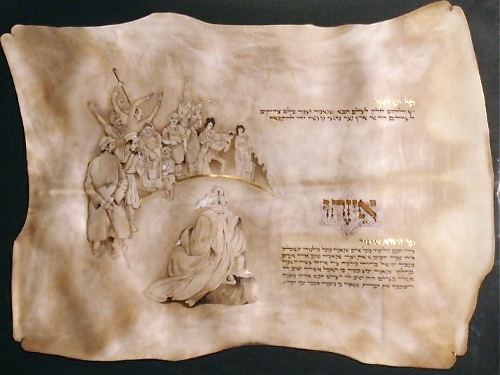
 Moses received the Torah from [G-d at] Sinai and gave it over to Joshua. Joshua gave it over to the Elders, the Elders to the Prophets, and the Prophets gave it over to the Men of the Great Assembly. They [the Men of the Great Assembly] would always say these three things: Be cautious in judgment. Establish many pupils. And make a safety fence around the Torah.
-Pirkei Avot (Ethics of Our Fathers) 1:1
Our first order of business must be to determine the meaning of the phrase “the Seat of Moses”… The precise meaning of the term remains a subject of much debate among scholars. Resolving this question is important, because it has direct bearing upon our understanding of the Pharisees authority and influence in Second Temple Judaism. If Jesus uses “the Seat of Moses” pejoratively, this weakens the argument that the Pharisees exercised any real, or at least any legitimate, authority within the religious and social life of Israel. If, however, he uses the term positively, or as a statement of fact, this strengthens our conviction that the Pharisees had become the authoritative interpreters of the Torah and that their halakhic decisions were accepted by most people within Israel.
-Noel S. Rabbinowitz
“Matthew 23:2-4: Does Jesus Recognize the Authority of the Pharisees
and Does He Endorse their Halakhah?”
Journal of the Evangelical Theological Society 46:3 (September 2003): 423-4 (PDF)
Yes, I know…another series. But this has been on my mind for awhile and during the Rosh Hashanah celebration, I decided to put it into words.
I’m hoping some of my loyal readers who are educationally equipped to examine this information will comment on this topic as it is quite complex and controvertial. Keep in mind, that’s not a promise that I’ll always accept whatever is posted as a response. Your priorities and perspectives may not agree with my own. For example, I reject the common Christian viewpoint that Jesus dismissed all Jewish oral tradition and halakhah of his day, as well as the Torah outright, and replaced it with grace. You’ll see support for my opinion in a minute.
This blog post quotes heavily from Noel Rabbinowitz’s paper “Matthew 23:2-4: Does Jesus Recognize the Authority of the Pharisees and Does He Endorse their Halakhah?” which was published in Journal of the Evangelical Theological Society 46:3 (September 2003): 423-47. I want to acknowledge that I first found this paper linked to the Rosh Pina Project blog post, “Did Jesus Recognize Halakhah?” Although I don’t frequently visit their site, Rosh Pina has a good reputation in the Messianic Jewish space and they’re considered a good and fair source of information.
Why am I writing this?
There have been numerous suggestions on the web that there is no validity in the authority of the Talmudic sages to establish halakhah that would apply to the Messianic Jewish community. By “Messianic Jewish,” I specifically mean a form of Judaism, in its ideal expression, that is wholly “owned and operated” by people who are halachically Jewish (having at least a mother who is Jewish) and (again, ideally) raised in a Jewish home, possessing of a Jewish education, and who are fully identified as ethnically, culturally, and religiously Jewish.
OK, that’s a tall order, since even in the most “Jewish” of Messianic Jewish congregations, the majority of members, and probably a good number of the leaders, are non-Jews. But the idea is that people who come from a very Jewish lived experience and who have come to faith in Yeshua (Jesus) as the Jewish Messiah King, must have a completely appropriate synagogue setting at which to worship, daven in a minyan, celebrate the holidays, and be part of a fully Jewish community that is dedicated to the Jewish Messiah.
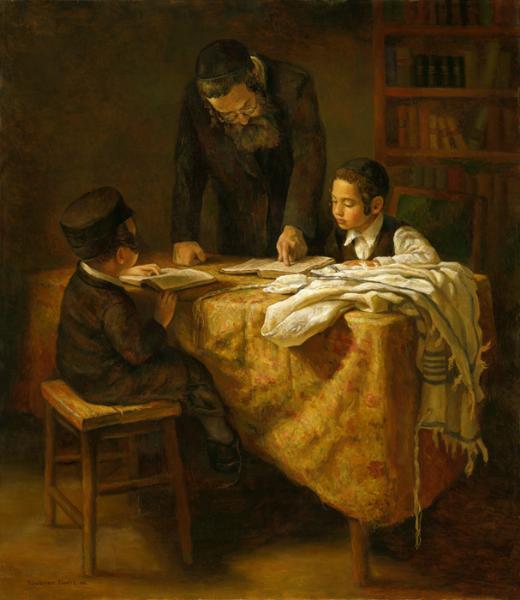 The problem is that a significant number of non-Jews who are loosely associated with the Messianic Jewish movement via Hebrew Roots, One Law, and Two-House groups, mildly to vehemently oppose any authority outside of the written Torah, as having the ability to dictate religious and ritual practice. This sort of makes sense given the fact that all of the non-Jews and most of the Jews who make up any portion of Messianic Judaism and Hebrew Roots entered the movement through the church. There’s an enormous perceptual and conceptual hold over from the church in the minds of these folks that says Jesus replaced, if not the Law, halakhah and oral tradition with a type of “grace” and pure interpretation of the Torah that doesn’t require Rabbinic judgments or rulings.
But if you’re Jewish in a fully lived and experiential sense and it is your complete identity, then one does not simply do away with the Talmud with a bit of theological slight-of-hand. My dear wife keeps trying to tell me that it’s impossible to understand and interpret the Torah apart from the traditions. For a Jew, this is obvious. For a Christian (and I include Hebrew Roots in this category), it is practically heresy.
But to delete the Talmud or even to substantially alter it such that it becomes more palatable to Christian Gentile theology and doctrine (again, I’m including Hebrew Roots here), results in the deletion of anything “Jewish” in that theology and doctrine. Jews get a little nervous when someone comes along and tries to invalidate their entire religious and cultural lifestyle.
The detractors and “enemies” of Talmudic authority say that they only recognize Jesus Christ has having authority to interpret Torah and establish a type of “Messianic halakhah” for at least Gentiles and maybe Jews in the modern Messianic movement. But doing away with Jewish “Rabbinics” to define Jewish (including Messianic) practice means that these detractors must discover or recover a complete understanding of how the First Century CE church was organized and operated…
…and we don’t have that. Right from the start, recreating the Church as it actually was in the day of Peter, Paul, and James is doomed to fail.
But maybe it doesn’t matter. Maybe it’s OK for the Judaism and Christianity of today to not be exactly the same as it was 2,000 years ago. Maybe it’s even impossible to work from a twenty century old model of these ancient religious forms.
What if we don’t have to?
One of the problems with accepting modern Jewish halakhah as authoritative, is the question of whether or not Jesus even accepted the halakhah that existed in the Second Temple era. That’s where Rabbinowitz’s paper comes in. I intend to use his work to address the question of whether or not Jesus was likely to have accepted even some of the halakhah of his day. If he was, my next question (which will be the subject of a future “meditation”) will be whether or not, at his second coming (assuming it occurs within the reasonably forseeable future) he might accept modern Jewish halakhah. I know, that requires speculation and more guesswork than I probably should consider, but it’s a compelling question.
This also addresses a larger and related topic: Do religions evolve and is that acceptable to God? Yes, we know that Christianity today isn’t the same as it was when Paul was planting his first churches. Modern Judaism as well is, by requirement, practiced in a different manner than when the sacrifices could still be offered in the Temple of God.
But is “evolution” of religion reasonable, expected, and acceptable to God? I suppose there’s no way to know this in an absolute way, but we can take a stab at it. The first step is an examination of Rabbinowitz’s paper, “Matthew 23:2-4: Does Jesus Recognize the Authority of the Pharisees and Does He Endorse their Halakhah?”
 The first question we look at in the paper is whether or not Jesus accepted the scribes and the Pharisees legitimately possessing the authority to interpret the Torah for the Jewish population and to establish and enforce specific halakhah?
Rabbinowitz suggests (pp. 429-30) that “the scribes and Pharisees were the authorized and legitimate teachers of the Torah.”
But even if authorized, did Jesus endorse the Halakhah of the Pharisees? What did Jesus mean when he said, (Matthew 23:3 ESV) “…so practice and observe whatever they tell you—but not what they do.”
When Jesus said to practice what the Pharisees taught, did he say this in reference to their teachings regarding the Torah or was he referring to Pharisaic halakhah as well?
-Rabbinowitz (p. 435)
What’s really interesting, and perhaps exceptionally relevant to our conversation, is the footnote (62) for this text:
“It is unlikely that any group of early Christians ever acknowledged without further ado the authority of non-Christian teachers.” On the other hand, they insist that “the extra-canonical halakhah on tithing is neither dismissed nor belittled but affirmed” (Matthew 3.269–70, 295).
Further commentary adds illumination to whether or not it was even possible for Jesus to have separated Torah from halakhah.
Stein states that disciples were to practice what the Pharisees taught regarding the OT but not regarding their “oral traditions.” We must ask, however, is such a bifurcation possible? Can exegesis be so neatly separated from application and practice?
…Jesus’ own observance of oral tradition creates a very strong argument that “all things” includes at least some halakhic traditions. Even though Matthew is unrelenting in his criticism of the Pharisees, he nevertheless presents Jesus as adhering to the halakhah of his day. Contra Banks, Moo is most certainly correct when he states that “the verdict that there is no evidence that Jesus kept any of the oral law cannot be sustained.”
(pp. 435-6)
This is the same today in modern Judaism where one cannot properly read and interpret the Torah apart from halakhah and the traditions. Rejecting halakhah is only conceivable in religious groups existing wholly outside the ancient and modern structure of Judaism.
Rabbinowitz further nails his point home with the following:
The very fact that Jesus even engages Pharisaic halakhah implies that it possessed a certain legitimacy in contradistinction to other traditions. He acknowledges the authority of the Pharisees but rebukes them for violating the very law they claimed to protect (Matt 15:1–6). Jesus does not reject Pharisaic purity laws concerning the eating of food (Matt 15:10–11) or the washing of vessels (Matt 23:24–25), but he does excoriate the Pharisees for their moral and ethical failure to understand the Law’s true intent. Likewise, he upholds Pharisaic halakhah regarding the tithing of herbs but repudiates the Pharisees because they have stressed that point and neglected the Law’s emphasis upon justice, mercy, and faithfulness (Matt 23:23).
(p. 437)
According to Rabbiniowitz, Jesus didn’t have a problem with the fact that authority to interpret Torah was legitimately in the hands of the Pharisees, nor did he object to their halakhah, his problem was “for they do not practice what they preach.” (Matthew 23:3 NIV)
 Interestingly enough, to those critics of Rabbinic Judaism who accuse the Talmudic scholars and judges of continuing to be afflicted with the “leaven of the Pharisees,” it should be noted that Rabbinic Judaism is also critical of the Pharisees.
Our final observation concerns rabbinic Judaism’s own critique of Pharisaic hypocrisy. Weinfeld demonstrates that Jesus’ accusations of Pharisaic hypocrisy are identical to charges of hypocrisy leveled against the Pharisees in the rabbinic material. To cite but one example, the rabbinic literature condemns the arrogant demonstration of piety by the Pharisees. Regarding the midrash on Eccl 4:1, we find the following condemnation of “Pharisaic pea-cockery”…
(p. 441)
The problem that most Christians (and probably some Jews) have with understanding Jesus upholding Pharisaic halakhah is encapsulated by Rabbinowitz:
To the modern reader, halakhic regulations regarding minute aspects of the Law may indeed seem legalistic and onerous. This perception, at least in part, arises out of the fact that the Torah is no longer the central structure around which we organize our daily lives. We no longer ask the all-important question, “How do I fulfill these commandments today?” But for the messianic Jews of Matthew’s Gospel, this was a very real and very practical question.
(p. 443)
Actually, in modern Judaism and especially among the Orthodox, this is a question that is very prominent, very real, and very practical today. Why shouldn’t it be a real and practical matter for some Messianic Jews as well?
Now that we’ve seen evidence that it is reasonable to believe Jesus could have accepted Pharisaic authority to establish ancient halakhah and that he not only upheld portions of that halakhah but practiced it as well, (see the full text of Rabbinowitz for details) Part 2 will examine the “reasonableness” of Christianity and Judaism evolving or developing from ancient to modern forms. After examining that point, we shall try to see if it is even possible for a returning Jewish Messiah King to accept the halakhah that will exist on the day of his return to Jerusalem.
Is the continuing authority of Talmud sustainable in 21st century Judaism? I’m not a Jew so I’m probably not qualified to respond, but maybe the following makes the most sense, given the context:
“We don’t see things as they are, we see them as we are.”
 Morning Meditations