Tag Archives: faith

Flight of the Sparrow

Devastating News Today, darn it!

Heidi’s tumor markers not only went up but doubled. So this new chemotherapy failed completely, like the one they tried in December/January. We will hear what option(s) are left sometime tomorrow.

My own outpatient surgery is tomorrow morning at 8am, another unwelcome surprise.

We’re really grateful to all of you for your kindness and support.

My beloved wife has metastatic breast cancer (spread to lungs, bone, liver). I am a prostate cancer survivor and my bladder cancer is in remission. We are both treated at Seattle Cancer Care Alliance. But we love God, we love life’s adventures, we love our family & friends. And will do so until God takes us Home. We are followers of Christ.

-Joe Hendricks
Tuesday, April 2nd, 2012

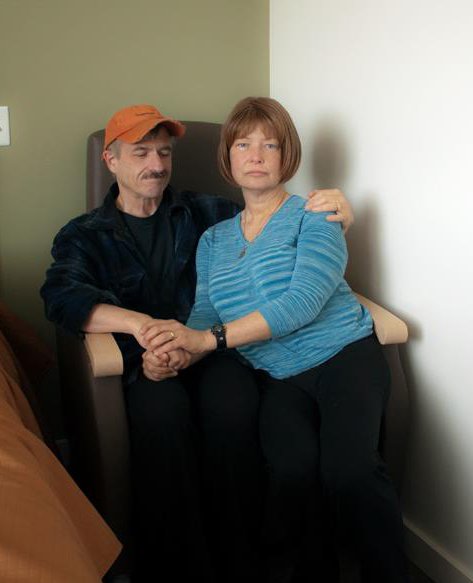
I’ve never met Joe and Heidi Hendricks face to face. I suppose I could, since we live only about a day’s drive away from each other. However, through the “magic” of Facebook, I have shared the last few years of their cancer battle together. The photo I’ve posted is number 56 in their scenes from our cancer battle.

The most startling thing for me about photo 56 is that Joe and Heidi aren’t smiling. No, I don’t expect them to smile after such terrible news, but if you go through their “photo album,” even in the most dire of circumstances, they’re always smiling and joking and pressing on through adversity. Humor is almost the last tool to fail when all other tools have long since burned out in the course of such a tremendous physical and emotional drain. I must admit, mine would have been shot through like swiss cheese in a hail storm long before this. But Joe particularly always makes me laugh.

But not today.

Besides their sense of humor, the thing I admire most about Joe and Heidi is their faith. A lot of Christians say they have faith and trust in God…that is, until something really bad happens. Then it all goes flying out the window and it’s “Why did you let this happen to me, God?” and “How could you be so cruel to me, God?” I’m sure I’d be among that group if I had to face the scenes from Joe and Heidi’s cancer battle first hand.

But no matter how grim it’s been for them, they’ve always grasped tightly onto the hand of God and never let go, just as love has bonded Joe and Heidi together and the never let go of each other.

I’m angry. No, not at God…well, not exactly. I don’t who or what I’m angry at. I think it’s that I feel really helpless and frustrated. Sounds strange, eh? There is horrible tragedy happening all over the world. Every day, someone suffers. Every day, someone dies. Every day, some act of injustice is committed, the helpless are victimized and have no defender, the innocent are made to pay for the crimes of the oppressor. It’s a broken world.

But in the face of all that, I’m angry at the news of Joe and Heidi’s cancer battle today. I know the world isn’t fair, but I’m still angry. It isn’t fair.

It’s like my feelings have mass and can be affected by gravity. It’s like the muscles that hold up my feelings are tired and my sadness is a lead weight, pulling my shoulders down and anchoring me to my seat. I feel as if I’m slowly being pulled to the floor. It’s as if my only light is losing its brightness, and I’m just getting more heavy and silent and it’s getting dark all around me.

The light of laughter is going out in the world.

And where is God?

How many people of faith have asked that question across the long stretch of centuries? How many Christians and Muslims and Jews and whoever else have asked God where He went off to when horrible news, disease, injury, and death stalked us one by one? Is this what ancient man felt like, cowering in some cave in the night, listening to the predators crying out at the moon and declaring to the grey, reflected light that they would find you and consume you?

Is that what it feels like knowing that there is a cancer inside of you and it’s taking over and it won’t be chased away?

I’ve heard the words “God is in control” said countless times in countless church services, but what do the words really mean? God is in control, but people still get sick. God is in control but people still get hurt. We’re alone, and we’re scared, and we need to be able to hang on when our strength, and our stamina, and finally our laughter is dried up like the last drop of water feeding the last wilted flower in the brilliant summer sun baking the vast and endless desert.

I realize that there are forces in the world and forces in our body that we can fight but we can’t always control. At some point, no matter how much you put into the struggle, you (I can only imagine, since I haven’t had to face this) have to let your shoulders relax, let the weight pull you down, look up, put your tiny hand in God’s immense grasp and say, “No matter what happens, please don’t go away.”

I hate crying.

God, don’t go away. Stay with Joe and Heidi, no matter what happens. We all want a miracle, but the greatest miracle is that You even care. If not even one tiny sparrow falls to the earth apart from the will of the Father, then You are mindful of Joe and Heidi, for they are worth much, much more than sparrows.

Stay with them God and, if it is Your will, don’t let them fall. Let them fly.

I Will Awake the Dawn!

My heart is steadfast, O God! I will sing and make melody with all my being! Awake, O harp and lyre! I will awake the dawn!

I will give thanks to you, O Lord, among the peoples; I will sing praises to you among the nations. For your steadfast love is great above the heavens; your faithfulness reaches to the clouds. Be exalted, O God, above the heavens! Let your glory be over all the earth! That your beloved ones may be delivered, give salvation by your right hand and answer me!

Psalm 108:1-6 (ESV)

Wake up by your own body clock, before the alarm. King David said, “I will wake the morning”—not that the morning woke him. You see, if you are only awake because it is morning, you are not really awake—you are sleepwalking. If it is morning because you are awake, however, then you are truly awake and in control.

-Rabbi Tzvi Freeman
“How to Get Out of Bed…and really mean it”
from the Multimedia Guide to Jewish Prayer series
Chabad.org

I hadn’t noticed that David said, “I will awake the dawn” before. I think most of us, when we first get up, are “sleepwalking” for some period of time, as Rabbi Freeman describes. We are waiting for morning, or our first cup of coffee, to wake us up. In his article on getting out of bed from which I’m quoting, Rabbi Freeman provides rather detailed instructions on what to do, from the first moment you realize you’re awake, through the process of entering into morning prayer. These steps are traditional for a religious Jew and so may not be particularly adaptable for the Christian.

On the other hand, there may be a thing or two we can take into our own morning routine as we prepare to greet our Creator.

As I previously mentioned, the first thing a Jew does after waking up is to recite the Modeh Ani blessing, thanking God for returning his soul to him and restoring his life. Immediately afterwards comes the Netilat Yadayim or the traditional handwashing, followed by other specific routines to prepare for prayer.

You can read Rabbi Freeman’s article in full at the links I’ve already provided, so I won’t go into a step-by-step description of the awakening process of a Jew preparing for prayer. Frankly, I don’t believe most of it specifically applies to the Christian and that these are rituals uniquely Jewish in nature.

However, there are a few things we might want to pay attention to, especially activities that a Jew should avoid prior to tefillah (prayer):

  • Don’t eat a meal.
    Eat what you need to focus your mind in tefillah. Maybe that’s just a hot drink. Maybe a light snack. But stop there. First connect your soul, then feed the body.
  • Don’t check the news.
    Sure it’s important to know what’s going on in the world. Starting from the event of the greatest, earth-shaking import. And that is that you are about to talk to the Creator of the Universe. Keep your head clear. You’ll need it.
  • Don’t visit a friend.
    This is a classic, mentioned in Talmud. You’re about to greet your Maker, so it’s not good protocol to visit someone else first. If you do see someone you haven’t seen for a while, the custom is to not say, “Shalom Aleichem” or even “Shalom”. Shalom (peace) is a name of G-d, so we don’t use it for anyone else until we’ve spoken with Him personally. “Good morning, how are you?” is fine.
  • Don’t check your email or otherwise take care of business.
    Getting tough? Consider each day to be like a mini-week, and the late night and early morning comprise the mini-Shabbat.
  • Don’t get into distracting conversations.
    You don’t have to be rude. But once those conversations start, there’s no end. When you try to put your head into meditation before tefillah, everything you heard and said that morning keeps rattling around in your head. Why add noise, when it’s already so hard to quiet down the mind?

Do you pray in the morning before launching into your day? I must admit that I don’t do so very often. I have a morning routine, but while it contains time to read from the Psalms and the Gospels, it doesn’t accommodate itself to a specific and formal prayer time. I’m not saying that I’m right in this, only that I don’t feel really good about formal prayer while I’m still in my PJs or unshowered, and by the time I take a shower, it’s time to zoom out the door to work.

Would my day go better if I read from the Bible and regularly prayed in a formal manner to God? I can only assume it would. So why don’t I?

Habit, I suppose. Here’s what a typical (actually ideal) morning looks like for me during the week.

  • Wake up and recite Modeh Ani.
  • Use the bathroom.
  • Make coffee and drink a glass of water while I’m waiting.
  • Read various comic strips on the computer which helps my brain wake up.
  • Finish one cup of coffee and one glass of water and then (if I’m very good) head off to they gym.
  • Return home after the gym, drink more water, and publish the day’s “morning mediation” blog.
  • Eat breakfast.
  • Shower, brush my teeth, and shave.
  • Read from the Bible, usually a page of Psalms and a chapter from the Gospels.
  • Pack my lunch for the day and head out the door.

Believe it or not, including the workout at the gym, that covers from 4 a.m. to 7 a.m. and I make it to work by around 7:30 a.m. depending on traffic.

Pouring waterDoesn’t sound much like how Rabbi Freeman describes a morning for a traditional religious Jew.

I hate to make this sound dry, but in many ways, holiness is a habit. Like many people, I tend to do the same things each morning when I get up as a matter of routine, not because it’s better or worse than any other way of waking up. I suppose there are some very diligent Christians and Jews who have extremely disciplined morning routines that are infused with the presence of God. There may also be a large number of Christians and Jews who have a routine that is more or less like mine.

A Christian tends to think of prayer life, like most other aspects of the Christian lifestyle, as “free,” that is, you can pray pretty much any time you’d like. This is true and it’s true in Judaism as well. However, there is also a formal aspect to Jewish prayer that dictates specific times when one is to pray (ideally with a minyan) in a ritual manner. The morning prayer service is called Shacharit and is one of the three times a day a Jew is commanded to enter into prayer.

I mentioned in my last morning meditation that God desires we voluntarily enter into a relationship with Him, and this is true. However, I also mentioned that for the Jew, there is a certain set of connections, rituals, and traditions that are part and parcel of being a Jew. There is a “belonging” and a “commandedness” to being a Jew that few Christians truly understand. I don’t know if this is a good thing or a bad thing, only that it is a Jewish thing.

A few months ago, I wrote that the Roman Centurion Cornelius (see Acts 10) seemed to have adopted the Jewish tradition of fixed prayers, probably because having come to faith in the God of Israel, it was the only available model for his prayers. This suggests that fixed times of prayer are not forbidden to the Christian, even though they are not formally commanded of us by God.

I can find all kinds of reasons why I should pray in the morning, but it is entirely up to me to choose to initiate such prayer or to disregard it. To incorporate morning prayer as a daily routine, I will need to change my habits which, as I’m sure you’re aware (assuming you have habits, too) is easier said than done.

But having admitted a need to improve certain areas of my life, which includes a more intimate relationship with God, what else can I do but either take God seriously or discard His presence?

When I imagine other Christians or anyone who shares a faith in the God of Abraham, Isaac, and Jacob, I imagine them in the morning, entering into deep and meditative periods of prayer with God. But that’s my imagination and it can be used to fuel a sense of guilt, because I don’t have such a time in my morning, admittedly by choice. On the other hand, I’ve heard numerous Christians say they “share” their first cup of coffee with Jesus, praying to him in the morning (but even Jesus said we are only to pray to God the Father) as if they were talking to a neighbor or acquaintance sitting around the kitchen table.

I apologize if this sounds offensive, but I’ve always been put off by that image. One does not approach the throne of the King with a cup of coffee in one hand and a folding chair in another, sit down next to His Throne, and then address the King of the Universe in the same way as you’d chit chat with a casual acquaintance.

I think that’s one of the reasons I hesitate to pray in the morning. When am I really prepared to enter into the presence of the King? When am I clean enough? How should my hair be combed? Should I be hungry or full? Should I be sleepy or well “caffeinated?”

Is it just my own “hang up” that I think morning prayer or any formal, regular prayer should contain a sense of formality, respect, and awe of God? Is this something that only the Jews have retained and that the church has tossed in the gutter, in favor of a casual dip into the shallow pools of grace and freedom?

But I’ll never be “good enough” to actually enter into the august and majestic Throne room of the Almighty and All-encompassing King of Everything. How do you even do that? Is that why Christians “dumb down” prayer for the most part? Should I emulate the Jewish “style” even though I’m not a Jew, for lack of any better model?

I’m tossing this question out to you readers. What do you think?

You might think that the more lowly the created being, the lower the divine spark it contains.

Just the opposite: Only the highest of sparks could descend to the lowest of places and retain their power to sustain such an existence.

That is why the deepest truths are so often found in the darkest of places.

-Rabbi Tzvi Freeman
“The Taller They Are…”
Based on letters and talks of the Rebbe
Rabbi M. M. Schneerson
Chabad.org

How can I wake up the dawn?

I’m Alive!

“Be who you are and say what you feel because those who mind don’t matter and those who matter don’t mind.” -Dr. Seuss

I admit, thank, surrender before You, to Your essential being, O King, He who speaks the world into being and who is the source of all being, who is alive and the source of life, and who is enduring, sustaining, and unchanging. Because You have returned within me and You are recharging me with my breath of life by and with Your gracious compassion. Great and magnificent is Your faithfulness.

Modeh anee lifanecha melech chai vikayam, she-he-chezarta bee nishmatee b’chemla, raba emunatecha.

-Modeh Ani

You just woke up. I just woke up. It’s a new day and we’re alive!

I’m continuing to follow the path of preparing a day before God. I’ve written about the activities that ideally lead up to this moment including An Introduction to a Prayer, Dream Not of Today, and Morning Rebirth, to mention just a few of the most recent blog posts in this series. In preparing for this moment, you have allowed yourself (again, ideally) to  dedicate your evening to reading, and studying, and meditating on God and His eternal Word, and praying the Bedtime Shema. Then, within the confines of His arms and blessing, you have fallen asleep.

And now it’s morning. And now you’re awake. What are the first thoughts that come to you? According to Rabbi Freeman, those thoughts should be of God, which is what you’d expect, and how grateful you are for returning you to this life, since sleep is where you approach the realm of death. You are reborn for another day. The breath of life has been restored to you, much in the same way God breathed life into the first man (Genesis 2:7). I can’t imagine what Adam must have thought in those first few moments of his existence, and if he really understood that prior to that moment, he did not exist at all, and then he was alive and the first living man. If he could possibly have comprehended all that God had done, how God had created the entire Universe for the sake of a man, how grateful would Adam have been?

There’s no way for us to understand the experience of the first man, but we can understand our own experience upon awakening, when we realize we are alive and we have lived to see another day.

I realize that most of you take that for granted. When you go to sleep, you expect to wake up the next morning. You expect to get up, use the bathroom, get a cup of coffee, check your email, take a shower, brush your teeth, get dressed, and so on, and so forth, just like you have a thousand mornings before.

Just like the sun is supposed to rise in the east every morning like clockwork. You don’t even worry that it won’t.

But what if you were severely ill? What if your living from day to day wasn’t such a sure thing? What if you had a medical condition that might result in you dying in your sleep. Even trying to go to sleep might make you anxious or even terrified, if you thought you might not wake up again…ever. If you expected that you could die in your sleep and then found yourself awake the following morning alive and feeling well, wouldn’t you be grateful to God for returning your life?

It is said that each beat of our heart requires the will of God, and should God withdraw His will, our heart would stop in an instant. We really take our beating heart for granted because it’s never let us down yet, has it? If it had, we would be dead. So we assume that if it’s worked all of this time without a problem, then it will just keep on going and going and going, like the Energizer Bunny.

Frankly, if we worried second by second all day long about whether or not God was going to extend our life into the next minute or the next hour, we probably would be a nervous wreck and would never be able to just get on with our day to day routine.

So, for the most part, we don’t worry. But then, are we grateful?

If you do so at no other time, the moment when you first wake up is a terrific time to express your gratitude to God for who you are and the fact that you made it to the start of another day. And just as you pondered the ancient texts and the oft-repeated tales of the greatness of God and all that He has done while you were getting ready for sleep, you can allow the awareness of Him to enter into you, and to fill you with His light as you wake up.

In today’s study, Rabbi Freeman presented a detailed, step-by-step breakdown of Modeh Ani, from which I took my rather literal translation of the Hebrew at the beginning of today’s meditation. While we won’t always be aware of the full weight and import of this deceptively short and easy morning blessing each time we say it to ourselves and to God, we should at least be aware of what we are saying before we commit to using these words to express our gratitude.

Depending on who you are, and how you conceive of God and your relationship to Him, you may never choose to adopt this particular blessing as part of your process of waking up each morning and re-entering the world that God has made.

But I hope and pray you choose (if you haven’t already done so) something similar. It’s not only because God deserves our gratitude and praise, but because we need to make the effort to integrate who we are into who He is. Otherwise, what is our life without His love?

“While there’s life, there’s hope.” -Marcus Tullius Cicero

Morning Rebirth

Envision that the Creator, whose glory fills the earth, He and His presence are continually with you. This is the most subtle of all experiences.

Rejoice constantly. Ponder and believe with complete faith that the Divine Presence is with you and protecting you; that you are bound up with the Creator and the Creator is bound up with you, with your every limb and every faculty; that your focus is fixed on the Creator and the Creator’s focus is fixed upon you.

Tzavaat Harivash 137
as quoted from Chabad.org

He then reached into his pocket and took out his wallet. Under the isinglass window was a card on which were written some words. He shoved the wallet across the table and said, “There, son, read that. That is my formula, and don’t give me the song and dance that it won’t work either. I know better from experience.”

The obstacle man picked up the wallet and with a strange look on his face read the words to himself.

“Read them out loud,” urged the owner of the wallet.

This is what he read in a slow, dubious voice, “I can do all things through Christ which strengtheneth me.” (Philippians 4:13)

-Norman Vincent Peale
“Chapter 8: I Don’t Believe in Defeat”
The Power of Positive Thinking

In continuing to review Rabbi Freeman’s series A Multimedia Guide to Jewish Prayer, I found surprising (to me) similarities between the advice of the Chasidim and that of a Christian Pastor. Despite the rather unpalatable presentation of Peale’s book, if you scrape away the “Christianese” and the rather improbable circumstances he describes, there is a kernel of truth lying underneath. I suppose his style and language appeal to his primary audience (which somehow doesn’t include “Christian” me) but while not being Jewish, I find the same set of instructions easier to read from Jewish sources.

In religious Judaism, sleep is considered “one-sixtieth of death,” which is why a Jew will pray for the protection of the angels when reciting the Bedtime Shema before retiring, and then gratefully thank God for returning his life to him by reciting the Modeh Ani immediately upon awakening. Rabbi Freemen teaches to this point.

If sleep is one-sixtieth of death, then waking up is a miniature rebirth. As your eyes blink open to greet the morning sun, you are a newborn child, a seed of a person ready to sprout forth from under the soil, spread forth branches and grow.

I suppose you’ve heard the saying that goes, “today is the first day of the rest of your life,” which tends to shut the door on whatever goof ups and agony occurred in whatever past you had before today, and opens up a whole new world of fresh possibilities starting right now. However, in real life, it’s difficult to let the past stay in the past or, putting it another way, it’s hard to let “whatever happens in Vegas, stay in Vegas,” especially if we have people in our lives who have been hurt by what we did “in Vegas.”

The Lord is merciful and gracious,
slow to anger and abounding in steadfast love.
He will not always chide,
nor will he keep his anger forever.
He does not deal with us according to our sins,
nor repay us according to our iniquities.
For as high as the heavens are above the earth,
so great is his steadfast love toward those who fear him;
as far as the east is from the west,
so far does he remove our transgressions from us.
As a father shows compassion to his children,
so the Lord shows compassion to those who fear him.
For he knows our frame;
he remembers that we are dust. –Psalm 103:8-14 (ESV)

Even if our trust in God’s boundless forgiveness and mercy is completely solid, the human beings in our life are most likely not going to be as compassionate and forgiving.

And then there’s how or if you forgive yourself.

It’s only a brand new day if you decide it is. For that matter, I only face a brand new, fresh, clean day before me if I can let go of the past and put my sins as far from me as “as the east is from the west.” It may be difficult or even impossible to expect everyone to forgive you for everything you’ve done to hurt them, but it can be equally difficult (or impossible) to receive forgiveness from yourself.

I have a vague memory of playing a game in childhood where you could call “do-overs.” Outside of science fiction, there is no way to go back and change the past in order to recreate yourself and your history. But is there a way in the realm of God?

Jesus answered him, “Truly, truly, I say to you, unless one is born again he cannot see the kingdom of God.” Nicodemus said to him, “How can a man be born when he is old? Can he enter a second time into his mother’s womb and be born?” Jesus answered, “Truly, truly, I say to you, unless one is born of water and the Spirit, he cannot enter the kingdom of God. That which is born of the flesh is flesh, and that which is born of the Spirit is spirit. Do not marvel that I said to you, ‘You must be born again.’ The wind blows where it wishes, and you hear its sound, but you do not know where it comes from or where it goes. So it is with everyone who is born of the Spirit.” –John 3:3-8 (ESV)

This is where we get the concept of being a “born again Christian,” but in my case, I’m talking about being “reborn” not just once and for all, but each and every morning. As difficult as life is and as many mistakes as we make, just being “reborn” once won’t cut it. I’m convinced our greatest failures don’t occur before we become believers, but after we dedicate our lives to Christ. That’s when we should “know better” and when there is so much more at stake when we make a mistake or commit evil in the world.

Because when a Christian sins, what hope is there for recovery unless we can somehow have that sin washed away as if it had never happened?

For God did not send his Son into the world to condemn the world, but in order that the world might be saved through him. Whoever believes in him is not condemned, but whoever does not believe is condemned already, because he has not believed in the name of the only Son of God. –John 3:17-18 (ESV)

It would be nice to wake up one morning and not be…or even feel condemned by God and by other people…and by myself.

Rabbi Freeman quotes extensively from Tzavaat Haribash 137 in order to help his audience understand that when you wake up, being aware of God as your first conscious thought can mean “becoming aware of your existence within an existence larger than your own.”

Tell yourself, “He is the Master of all that occurs in the world. He can do anything I desire. And therefore, it makes no sense for me to put my confidence in anything else but Him, may He be blessed.”

Rejoice constantly. Ponder and believe with complete faith that the Divine Presence is with you and protecting you; that you are bound up with the Creator and the Creator is bound up with you, with your every limb and every faculty; that your focus is fixed on the Creator and the Creator’s focus is fixed upon you.

And the Creator could do whatever He wants. If He so desired, He could annihilate all the worlds in a single moment and recreate them all in a single moment. Within Him are rooted all goodness and all stern judgments in the world. For the current of His energy runs through each thing.

And you say, “As for me, I do not rely upon nor do I fear anyone or anything other than Him, may He be blessed.”

Jesus says that a man must be born again of water and spirit. Chasidic teachings instruct us to consider ourselves as reborn “within an existence larger than your own.” Waking up in the morning is not only the start of a brand new “existence,” but a reminder that we are already a “brand new person in Christ” (2 Corinthians 5:17). To create that awareness, the first words that come to you once you are awake enough to develop a coherent thought are the most important.

“I gratefully thank you, living and existing King, for returning my soul to me with compassion. Abundant is your faithfulness.” -Modeh Ani

Sitting at the bottom of the abyss as I attempt to arise from sleep, the first rung of the ladder of God is sitting in front of me. If I choose to believe so, at that moment, there is no past but only the potential for a future inside of a new day and inside the grandeur of the existence of God.

The Modeh Ani is said before washing your hands, while still lying half-awake in your bed. Unlike other tefillot, you don’t have to ensure that your hands, your body or the place where you are sleeping is clean before saying it. The simple reason is because it does not contain any name of G-d or any verses of Torah. Yet there is a deeper reason: because it comes from a place that no impurity can contaminate, from the spark of G-d within, a place where you and your G-d are one, where not even the worst contamination in the world could come between you.

We call that level of the soul yechidah. Just as a person may have different names that he is called according to the role that he takes (father, husband, son, teacher, student), so the soul has different names according to the relationship it takes with the body.

According to Rabbi Freeman, the Yechidah or “Essence” is the first rung on the ladder of prayer. You can find a more detailed explanation of the five levels of the soul, as Chasidic Judaism sees them, by referring back to today’s lesson in prayer (you may have to scroll down a bit, and I encourage you to read the entire article).

To sum up:

Right now, first thing in the morning, I’m going to latch on to that essence. That way, it will be with me when I climb up the first rung of my ladder. And the second, and the third, and even at the fourth, highest level—everything I attain will be because I started with that essential point.

There’s a point of newness and fresh experience when we first wake up; before anything has happened and before we have even gotten out of bed. We can’t say what will happen today, even if we have made plans, because the day hasn’t happened yet. Such is life for a newborn. He can’t say what will happen later in life because it hasn’t happened yet. When you are born or born again, there is no past, there is only a future. If God really does cast our sins away from Him and from us, as far away as the east is from the west, then it’s as if they do not exist for Him. If we continue to insist that they exist from us, then we have denied ourselves the opportunity to benefit from our state of “newness” and it’s as if we were not reborn at all.

And yet, like Nicodemus, accepting even such a simple truth is enormously difficult, and especially so as we get older, because there is so much more to remember and to regret. I gratefully thank you, living and existing King, for restoring my soul to me. May you help me truly accept that this is a “new” soul, untainted by yesterday and before yesterday, and that it is possible for me to spring forth from sleep as a new sprout from a seed and a new soul from the ashes of the old.

Abundant is your faithfulness.

Dream Not of Today

Yes, I know you’re exhausted. I also know about irresponsible roommates, colicky babies, infants with croup, calming kids with school anxiety, waiting up for teenagers at night, and sleeping with arthritis—and that’s only one thin slice of the gamut of life’s sleep disorders. What I’m trying to do here is present at least an ideal towards which, on those occasions that permit some degree of control, you can at least strive.

Study some Torah. Even if it’s late, just immerse yourself in some words of Torah, so that you will sleep with those thoughts. Maimonides writes that a person gains most of their wisdom from Torah studied at night. Fill your mind with it, so that it will process in your dreams. Often, solutions to Torah that you study at this time will come to you in your dreams.

A neat trick is to finish by marking the place from where you’ll start learning the next day. That primes your mind for productive learning in the morning.

Relax, maybe have a hot shower, or go for a walk so you will sleep well and wake up refreshed.

Review the day in your mind. Think of something that went well. Think of something that could be fixed or improved. Think of all the wonderful blessings you have in your life—friends, parents, children—all the things that have real value. Don’t beat yourself—this is not an exercise in self-blaming and guilt. The point is to get a clear perspective of yourself and your day, where you are coming from and where you are going to.

-Rabbi Tzvi Freeman
“Nighttime Activities”
from the series A Multimedia Guide to Jewish Prayer
Chabad.org

This is a direct continuation of yesterday’s “morning meditation” An Introduction to a Prayer. I mentioned that Rabbi Freeman believes the best way to start the day is to prepare yourself the night before. As such, the last thing a religious Jews does before he or she retires to bed is to recite the Bedtime Shema. Rabbi Freeman deconstructs and presents all of the elements of this blessing in his article on Bedtime Countdown, so not only do you have the text of this set of prayers but their purpose and meaning from a Chasidic perspective.

I’ve been told that many of the mitzvot in Judaism aren’t forbidden to the Gentile as long as the Gentile does not perform them in the manner of the Jew. This not only has to do with the specific “mechanics” of performing a mitzvah such as prayer, but also not considering oneself as obligated to performing the mitzvah as is the Jewish person. However, given the number of times Jesus and his disciples refer to prayer in their teachings, I hardly think it is forbidden, in general, for a Christian to pray. What is in question is how or if a Christian should perform anything that resembles the Bedtime Shema.

To answer the question for myself, I perform a truncated version of this blessing at bedtime:

A song of ascents. Praiseworthy is each person who fears HASHEM, who walks in His paths. When you eat the labor of your hands, you are praiseworthy, and it is well with you. Your wife shall be like a fruitful vine in the inner chambers of your home; your children shall be like olive shoots surrounding your table. Behold! For so is blessed the man who fears HASHEM. May HASHEM bless you from Zion, and may you gaze upon the goodness of Jerusalem, all the days of your life. And may you see children born to children, peace upon Israel.

Tremble and sin not. Reflect in your hearts while on your beds, and be utterly silent. Selah.

Master of the universe. Who reigned
before any form was created,
At the time when His will brought all into being —
then as “King” was His Name proclaimed.
After all has ceased to be,
He, the Awesome One, will reign alone.
It is He Who was, He Who is,
and He Who shall remain, in splendor.
He is One — there is no second
to compare to Him, to declare as His equal.
Without beginning, without conclusion —
His is the power and dominion.
He is my God, my living Redeemer,
Rock of my pain in time of distress.
He is my banner, a refuge for me,
the portion in my cup on the day I call.
Into His hand I shall entrust my spirit
when I go to sleep — and I shall awaken!
With my spirit shall my body remain.
HASHEM is with me, I shall not fear.

I do not believe it is forbidden for the Gentile to desire God to be with us during our nightly rest and to watch over us and, if your last thoughts before entering “the realms of Morpheus” are of God, perhaps your first thoughts upon awaking will be of Him as well (and I’ll cover those “first thoughts” in a subsequent “meditation”).

Like my comments in yesterday’s meditation, I wonder just how practical some of Rabbi Freeman’s suggestions are for late night activities. I know the sages would study Torah late into the evening and even all night, but much after 9 p.m., my head feels like it’s stuffed with cotton candy and rusty Brillo pads. Nothing really complicated “computes” very much, and if I try to read, I find myself in that situation where I read a few sentences and immediately forget what I’ve read, or I try to read the same few sentences over and over again. If I’m not feeling sleepy before reading, “cozying up” in my bed becomes my primary desire after about five minutes of pouring over the printed page, regardless of what I’m reading.

Sorry, I’m not a “night owl.”

I suppose that’s one of the reasons I say a short version of the Bedtime Shema, besides avoiding any appearances of trying to pray like a Jewish person. A few minutes of prayer is all I have brain power for before my mind starts wandering down random paths.

I can’t deny that Rabbi Freeman’s principles are sound, and I suppose if I had a lifetime of habit and training in this sort of prayer life behind me as a foundation, it would be second nature by now, but as the Master said, “Watch and pray that you may not enter into temptation. The spirit indeed is willing, but the flesh is weak.” (Matthew 26:41) As I recall, he was chiding his closest disciples and friends over falling sleep during prayer as well.

I must admit to being kind of glad the Rabbinic rulings don’t apply to non-Jews if, for no other reason, than the following:

The Talmud (Berachot 13b.) is adamant about not sleeping on your back or on your stomach, but only on your side. Maimonides, who was not only a great codifier and philosopher but also one of the great doctors in history, suggests that you get in the habit of sleeping the first part of the night on your left, and end off on your right.

I tend to fall asleep on my right side but also on my stomach. Once asleep, people move around in bed hundreds of times during the night, so how could I possibly have control of my position? This is certainly an area of Jewish thought that completely eludes me. I also wonder about this:

Best insurance for sweet dreams: read tales of tzaddikim in bed until you fall asleep.

Either the Jewish sages weren’t married or they didn’t sleep with their wives. Can you imagine reading late into the night when your wife is trying to sleep right beside you?

“Moshe! Turn out the light. Can’t you see I’m trying to sleep here?”

On the other hand, how many times have you gone to bed in defeat or disgust because some problem or argument could not be resolved and laid to rest before the end of the day? I have far too many nights just like that. What Rabbi Freeman suggests would be far better, it only it were possible.

Be confident that you’ve put this day behind you, cleared up any misdemeanors between you and G-d, and made peace in your heart with other people. Get ready to turn in a wonderful report of all of G-d’s kindnesses and wonders.

I know Rabbi Freeman’s teachings are generally optimistic and encouraging (otherwise, why would we read them), which includes this brief commentary, taken from the lessons of the Rebbe, Rabbi M. M. Schneerson, called Maturity of the Soul:

The ultimate elevation of the soul is to find it has purpose. To discover that it is not here simply to be, but to accomplish, to heal, to make better. In that moment of discovery, the soul graduates from being G-d’s little child to become His representative.

However, I’m not going to let Rabbi Freeman have the last word this time. Someone commented in response to his wee missive with something just as (or more) profound:

Perhaps our purpose is to “to be” G-d’s little child. It may be that we need to go through a life where we feel we need to accomplish, to heal and to make better, only to find ourselves coming full circle into simply “being” G-d’s child. Perhaps the journey of “finding” our purpose is needed to make this discovery …

“click your heels 3 times … you’ve always had the power … you just didn’t believe it”.

Walking in faith, sometimes you can stand up and actually take a step or two and sometimes you fall flat on your butt. Compared to actually walking with God in faith and trust, being a toddler learning how to take his first steps is child’s play.

Meditation, forgiveness, regret, and supernal compassion. Do night blessings always result in a blessed life? What will happen when I wake up tomorrow?

An Introduction to a Prayer

Skill testing question:

Which of these two will be better able to focus on tefillah, and thereby have a great day:

Activity

Goldstein

Goldberg

Retiring to bed Falls asleep watching a rerun of Brain Dead while washing down pizza with cola on the couch. Mentally reviews the day, says the Shema Yisrael, falls asleep in bed reading Baal Shem Tov stories.
Waking up Rudely awakened by e-mail alert. Checks more e-mail and stock report before falling back asleep. Repeats until resigning himself to getting off the couch. Wakes up by circadian rhythm. Says Modeh Ani as approaching consciousness. Smiles when recalling Baal Shem Tov dreams.
Washing up Jumps off the couch in frenzied panic. Grabs mug, car keys and cellphone charger. Runs frantically to the car. Gently slides out of bed to greet the sunrise. Washes, takes care of bodily necessities and gets dressed. Washes hands and says morning blessings.
Breakfast Stumbles into Starbucks on the way to shul to grab a hyper-caffeinated brew. Gets into a yelling match with the attendant over the bill / change / brew / temperature / politics / whatever. Sips a hot drink while engaged in a half-hour Tanya class with the rabbi.
Meditation Listens to news and traffic report on car radio while sipping coffee, texting clients and hurling imprecations at fellow drivers. Sits quietly, pondering the morning lesson. Visualizes the continuous act of creation unfolding about us.
Prayers Takes care of some business decisions by cellphone while the minyan “warms up.” Jumps in late but catches up in no time. Sticks around to chat, then runs out in yet another mad rush. Phone is on buzz. Starts with the minyan, saying each word out loud. Ignores the buzzes.

-Rabbi Tzvi Freeman
from the article “Prepare for Takeoff”
as part of the A Multimedia Guide to Jewish Prayer
Chabad.org

I have to admit that my first thought upon reading this comparison was, “Does Goldberg have a job?” My next question was, “Is Goldberg married?” Frankly, the way he starts his day seems absolutely wonderful and it goes along with the “mission statement” for my own blog:

When you awake in the morning, learn something to inspire you and mediate upon it, then plunge forward full of light with which to illuminate the darkness.

But as pleasant and ideal as those thoughts happen to be, they aren’t always compatible with my lifestyle.

No, I’m not all that much like Goldstein. I don’t fall asleep watching TV, but by the time I’m ready for bed, my mind feels numb and it’s difficult to make it through even a truncated version of the Bedtime Shema. I hate alarm clocks, but I don’t have the luxury of waking up by circadian rhythm either, since I have a schedule to keep, usually even on the weekends. I do recite the Modeh Ani when I’m ready to get out of bed, but it’s short and easy to memorize (at least in English). I don’t think I’ve ever dreamed about the Baal Shem Tov.

I do get out of bed and take care of “bodily necessities” but usually grab my first cup of coffee and read the funnies online as my initial entry into the day. Then, I’ll either eat breakfast in front of the computer or head for the gym to sweat for 45 minutes or so.

I hardly have the time for a half-hour Tanya class, even if I had access to such a resource, nor do I have the time to “sit quietly, pondering the morning lesson” and visualizing “the continuous act of creation unfolding about us.” It goes without saying that I don’t pray with a minyan.

I’m only sort of like Goldstein though, in that I’m not usually in such a hurry to get out of the house. I have my routine pretty well down, so I’m able to leave most mornings right on time at 7 a.m. I don’t stop for overpriced Starbucks swill, but I do listen to the radio, primarily for oldies rock and the traffic report. I’m not always happy with the other drivers I encounter on the morning commute.

And it looks like even Goldstein is able to pray with a minyan, although in his typical “rushed” fashion.

I know what Rabbi Freeman is saying and a lot of it is aimmed at Jews who live a religious Jewish lifestyle. There’s no reason why some of this couldn’t be adapted to a Christian morning routine, except I’d have to wake up at 3 a.m. instead of “by circadian rhythm” in order to have to time to meditate and pray in the measured and orderly fashion the Rabbi describes, and still have time for the gym and breakfast.

He’s right, though. If it were possible, the “Goldberg” style of going to bed and waking up is better for the body, the mind, and the spirit. If a person could establish and maintain such an evening and morning rhythm, they would be more likely to experience a sense of peace with themselves and with God.

But then, it would be much easier to accomplish if you lived alone and didn’t share the world with other people and other priorites. If you lived in a world that was ordered in complete consistency with such a spiritual lifestyle, it might work out. But for most of us, and particularly me, my world is not at all consistent with such a lifestyle, more’s the pity.

In the Mishna Berua Yomi Digest “Stories to Share” section for Shulchan Aruch Siman 447 Seif 8, the commentary “A Difficult Situation” describes such a person who is “out of sync” religiously with her husband, and much more than her peace of mind is at stake.

A woman who was a recent baalas teshuvah was approaching her first Pesach. Her husband absolutely refused to consider avoiding chometz, and she was at a loss as to how to proceed. Should she insist that she cannot live without him agreeing to no chometz in their home on Pesach, he was likely to divorce her, leaving her alone. She could try to convince him to let her leave for the holiday but was afraid he would refuse. She wondered if there was a halachic way to permit her to stay at home even if her husband had chometz there.

When she asked this question to her rabbi, he was baffled. “I have to admit that this is out of my league. I will take it to someone qualified to respond and see what he says…”

When this question reached Rav Yosef Shalom Eliyashiv, shlit”a, he ruled that there was a halachic way for the woman to live at home even though her husband kept chometz—which he ate—in their house. “The best thing is if she can stay away from home on Pesach. But if this is impossible she can make a neder not to eat chometz. There is a precedent that even when we don’t believe that someone will avoid a prohibition for whatever reason, we are certain he or she will not forget if it is also prohibited for another reason like a vow. If she makes a neder, she can stay in their home if there is no choice.”

A woman who has committed to a greater religious lifestyle than her husband faced the horrible choice of keeping her commitment to Judaism and to God and losing her husband or preserving her marriage and forsaking God. In an interesting way, her story is not unlike that of another woman who is trying to make a similar commitment.

I am Jewish. It is how I identify myself. My father is Jewish. My mother is Christian.

My Judaism is a beautiful challenge; one I happily accept.

But the faith of my forefathers, of my peers, and of my family often frustrates me on a level that I cannot capture in words. Judaism cuts to the essence of who I am and challenges my identity. Judaism brings me a lot of joy; it also brings me pain…

In a letter to Ovadiah, Maimonides writes, “There is no difference whatever between you [the convert] and us… do not consider your origin as inferior.”

Maimonides’ words are a small part of a larger Jewish tradition that teaches to love the convert as oneself. Yet, the convert is also often reminded of his or her non-Jewish heritage. For example, he/she cannot make the declaration during the Bikkurim ceremony that “G-d swore to our forefathers, and to us” [Mishnah Bikkurim1:4].

I recently stopped dating someone, not because we were incompatible as people, but because he is a Kohen and I am a convert. If my origin is not supposed to be considered inferior, and if I am supposed to be loved as oneself, how am I supposed to feel when I am told that I cannot marry a Kohen because as a convert I am considered promiscuous? I grew up in a world surrounded by Jewish people. I am no more likely to have slept with a non-Jewish man than many of my fully Jewish counterparts.

-by “Ruth”
“A convert in a strange land”
Sunday, March 18, 2012/Adar 24, 5772
The Times of Israel

All I’m trying to do is “uncomplicate” my life and to find a sense of peace within myself and within my relationship with God. What complicates my plan is not only the struggles inside of myself but the world around me, starting with my immediate household and the practicalities of relationships, schedules, and priorities. I am religiously incompatible with my wife and daughter, but it’s not nearly as extreme as we see in the examples I quoted above. Both of those Jewish women find themselves at odds with either their spouse or with Judaism as a faith and as a people. They are both alike in their desire to “be more Jewish” and to have a closer relationship with the God of Israel.

In that very last part, I’m like them, too. But like them, I’m also facing the realities of the world and the people around me. The world will not become perfect this side of the Messiah, nor can I wait for that event to occur before attempting to climb the first rung of the ladder and lift myself from the bottom of the abyss.

According to Rabbi Freeman, the secret to being awake to God is how you fall asleep and even how you dream. I’m still sitting at the bottom of my dusty but not uncomfortable well. I’m still contemplating the first rung to the ladder God has set before me. But maybe this too is just a dream, and I am perpetually waiting to wake up.

It will be Monday morning when you read this and the rush of the beginning of the work week will have already begun. How did I sleep last night? What did I dream? When I woke up, where was my spirit, and where is God?