Tag Archives: faith

Invitation to a Point of Peace

From the time you begin to breathe, a war rages within.

From the time you attain citizenship of this world, you must struggle with your own frailties to stand upright, as a human being was meant to stand.

From the time you yearn to reach higher, you must engage the animal that comes dressed within this meat and bones, to carry it up with you. You must play its own game on its own turf, speak to it in its own language, meditate upon those matters that can inspire it, bear with it until you can bring it to the side of peace.

You must descend to a place of chaos and madness to redeem yourself from there.

And so this battle plays out not only in the spiritual arena of meditation and prayer, but also in the very human world of eating your meal, of raising a family, of worldly pursuits, infiltrating that world so as to conquer it, to rip away its veil and reveal the G-dly sparks it contains, as Jacob dressed in the clothes of Esau, wrestling with his angel on the cold, sodden earth of a night to which he does not belong.

Yet at all times and in every situation you retain access to a point of perfect oneness within, a place where there is no opposition to fight, no choices that could be made, no existence at all, nothing other than “the Creator of all things to whom I am bound as one.”

It is not the battle that defines you, nor the role in which you must invest yourself, nor the opponent with whom you fight. You are none of these. You are that point of peace within.

And so, even your battle is in peace.

—based on the Rebbe’s discourse on the verse “He has rescued my soul in peace,” 5739

-Rabbi Tzvi Freeman
“War and Peace”
Based on letters and talks of the Rebbe
Rabbi M. M. Schneerson
Chabad.org

The struggle with chaos and madness is very much how I see “the human condition” and particularly my own role in humanity, both in the world outside and the one inside of me. Over the past several days, I’ve engaged in a series of “battles” in this “meditation” venue with the various “religious wars” that spike during the month of December. It’s not pleasant to confront other people who have the same basic viewpoint on life and God as you do and to realize that you and they are still light years apart. It’s also dismaying to see people who claim to be speaking for God or at least of God, and to read words, not of encouragement, but of disdain and criticism disguised as “truth”.

But let me change the subject.

Some part of me likes science, particularly astronomy and physics. Alas, I don’t have a brain that likes math, and so a career in these fields was never an option for me, but I still like following news on these subjects. You probably have heard of the Large Hadron Collider (LHC) and particularly of its use in the recent search for the Higgs Boson particle (sometimes referred to as the “God” particle) which current science says must exist in order for anything to have mass. I found the following quote from the New Scientist article very interesting.

If our ideas about the Higgs boson turn out to be correct, then everything we see is a kind of window dressing based on an underlying fabric of reality in which we shouldn’t exist. The particles that make us up – which bind together to form protons, neutrons, nuclei and ultimately atoms – have mass. Without the Higgs, these particles would be massless, like photons.

Let’s take a closer look at part of that quote:

…then everything we see is a kind of window dressing based on an underlying fabric of reality in which we shouldn’t exist.

A reality in which we shouldn’t exist. Interesting. Now take a moment to notice your physical existence. Look in the mirror. Yep, you’re still there. Snap your fingers. Do a few jumping jacks. Still feel like you exist? Good. But if we discover that Higgs isn’t real, then we shouldn’t exist at all, at least if how we currently conceptualize the universe is in any way accurate.

Go back and revisit the quote from Rabbi Freeman and then re-read the New Scientist quote again. Existence, both physically and spiritually seems so complicated, confusing, and messy. There are all of these details we keep running up against that don’t quite fit together in our puzzle when we try to build what we think Creation looks and acts like. It’s like the Biosphere2 experiment in Arizona where people tried to create a completely self-contained biosphere, isolated from our actual environment, that would be totally self-sustaining. In essense, we tried to build a little Earth inside of a bubble that would work just like the big Earth that God created.

God holds the worldIt failed miserably. In fact, back in the early 1990s, Bioshpere2 was involved in a huge scandal where the project managers secretly bled out CO2 from inside the dome because the “natural processes” inside weren’t getting rid of the stuff (kind of like how climate scientists today describe the global warming process). We just don’t know enough about how Earth’s biosphere works to be able to recreate it in an enclosed environment. We just don’t know enough about long-term weather and climate patterns and systems to be able to accurately predict whether or not it will rain next week or next month or next year, let alone how to make effective and beneficial changes in Earth’s climate over the next several decades. We don’t know why things have mass and what really happened in the first few thousandths of a millisecond after the Big Bang when physics were really haywire.

I’m not saying we shouldn’t pursue the answers. God gave us a universe that runs by a system of rules and laws (which we don’t always understand) and I think that system is observable and understandable in the long haul, at least for the most part.

But…

What if we allow ourselves to turn all that stuff off just once and awhile. I think it’s why God sanctified the Seventh Day back in Genesis 2 and I think it’s why the Jewish people (and arguably the rest of the world) should observe the Shabbat. It’s a time when we can turn it all off, all the machines, all of the head-scratching puzzles, all of the mysteries and mazes, and just accept God’s invitation to join Him and to be at a point of peace.

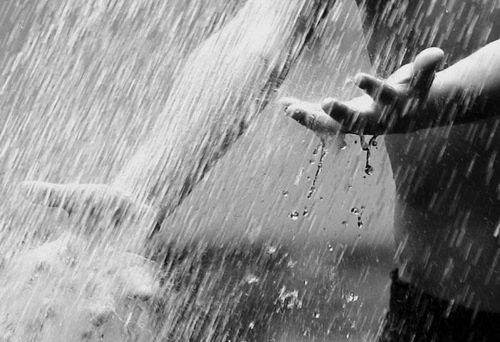
The friendly looking guy offering his hand to you in the photo at the top of today’s “meditation” is a friend of mine who, in spite of the amazing challenges he and his wife face, continues to pursue God’s peace. His name is Joe Hendricks and both he and his wife Heidi are actively undergoing cancer treatment. God has given both of them the personalities and the spirits to be encouraging and to approach life with a zeal for living when people like you or I would want to just hide under our beds and curl up into a ball. Peace isn’t just emotional state.

I am not saying this because I am in need, for I have learned to be content whatever the circumstances. I know what it is to be in need, and I know what it is to have plenty. I have learned the secret of being content in any and every situation, whether well fed or hungry, whether living in plenty or in want. I can do all this through him who gives me strength. –Philippians 4:11-13

Peace is a way of life, like pursuing the Spirit, like pursuing God. We find what we look for and we are looking all our lives.

To our God and Father be glory for ever and ever. Amen. –Philippians 4:20

nightsky1

Something New

When Reuben returned to the pit and saw that Joseph was not in the pit, he rent his clothes. Returning to his brothers, he said, “The boy is gone! Now, what am I to do?” Then they took Joseph’s tunic, slaughtered a kid, and dipped the tunic in the blood. They had the ornamented tunic taken to their father, and they said, “We found this. Please examine it; is it your son’s tunic or not?” He recognized it, and said, “My son’s tunic! A savage beast devoured him! Joseph was torn by a beast!” Jacob rent his clothes, put sackcloth on his loins, and observed mourning for his son many days. ALL his sons and daughters sought to comfort him; but he refused to be comforted, saying, “No, I will go down mourning to, my son in Sheol.” Thus his father bewailed him. The Midianites, meanwhile, sold him in Egypt to Potiphar, a courtier of Pharaoh and his chief steward.Genesis 37:29-36 (JPS Tanakh)

Beginnings are hard. For good reason. If they were easy, we would prowl into each new venture like a snug fat cat.

When you begin pent up in an iron cage, a tiger comes out. A tiger that breaks through the door of its cage and pounces with a vengeance.

Bless those cages, those impossible brick walls, those rivers of fire that lie at the outset of each worthwhile journey. Without them we would be only as powerful as we appear.

-Rabbi Tzvi Freeman
“Release”
Based on letters and talks of the Rebbe
Rabbi M. M. Schneerson
Chabad.org

As we see in the example from this week’s Torah Portion Vayeishev, making a new beginning, even in something that will ultimately turn out to be very worthwhile, can be very hard. Of course, when Joseph was stripped and thrown into a pit by his brothers, then kidnapped and sold into slavery, he hardly thought this was a good “new beginning”. In fact, it was the lowest point of his life up until then. He had no idea of the grandeur he would eventually attain as Viceroy in Egypt and savior of the civilized world.

I can hardly compare myself to Joseph, but I know what it’s like to make a new beginning. We all do, really. Anyone who has gotten married, who has had a child, who has moved to a new city, who has taken a new job knows what it is like to make a new beginning. Even when what you are achieving is ultimately good and desirable, it can still be difficult and stressful. Change always is.

I also know what it’s like to make a new beginning spiritually. I’ve done this more than once. Of course there was the moment when I came to faith in Jesus. I like to “joke” that almost immediately afterward, my life fell apart. I went through some very difficult times after coming to faith which is the exact opposite of what I’d expected, but then, God had to step in and help me make some significant changes once I declared my faith and was baptized. He’s still doing that work and sometimes, it really hurts.

During the past couple of years, I put myself through another significant spiritual change. For a year, starting in the summer of 2010, I started challenging all of my long-held religious assumptions, began studying new materials, and ultimately, at the end of that year, took my religious worship life in a very different direction. It wasn’t easy. I had to leave a congregation where I had been a trusted leader and teacher and where I had many friends (they’re still my friends) because of the new convictions at which I had arrived. I started a journey that still has no definitive destination and where I encounter uncertainty often. I believe this is the right thing to do for me, but doing the right thing is often disturbing and disconcerting.

Sometimes, even when you know that a new beginning is required, you don’t know what to do first. In fact, right after I had come to faith, the first question I asked my Pastor was, “What do I do now?”

Today’s daf discusses teaching Torah. Rav Moshe Shapira, shlit”a, explains that today’s world of kiruv is a new chapter that needs to be understood in its own context. For example, although the Shulchan Aruch writes that a rebbe must instill fear in his students—for this purpose he may not eat with them or be overly familiar with them—today is very different. When dealing with young people who need to be drawn closer, following such halachos will only cause an unhealthy distance between student and rebbe.

Another example of a complex kiruv issue was faced by a certain maggid who would travel around Eretz Yisrael encouraging our estranged brothers to draw closer to God. He wondered what to do with those who are distant but could be persuaded to take on some new religious practice. Most would only be willing to take on a single mitzvah, and pushing for more would only serve to destroy any willingness to advance. The question was: which mitzvah comes first?

When he brought this question to Rav Yosef Shalom Eliyashev, shlit”a, he replied concisely. “It doesn’t matter too much what they start with. But try to find a d’oraisa mitzvah that you think will make the greatest impact on them. Speak and encourage them to take on this mitzvah.”

The heads of Hidabrut, the famous Belzer kiruv organization in Eretz Yisrael, also had a kiruv conundrum. When a person is at the point where he will either take on wearing a kippah or tzitzis, which is more important?

Rav Eliyashev’s response will surprise many. “It is better to convince him to begin wearing a kippah. Although tzitzis is obviously a Torah commandment, wearing a yarmulke is superior since a man who wears a yarmulke feels especially Jewish since he publicly associates himself with religious Jews.”

Daf Yomi Digest
Stories Off the Daf
“New Students”
Bechoros 29

Truth be told, one of the reasons why some Christians are attracted to the “Messianic” movement is that worship and faith is demonstrated in so many physical ways. The wearing of a yarmulke and tzitzit is very compelling and even a little addictive. I tend to believe that non-Jews in the movement go through a set of developmental steps, not all of them beneficial, but all of them seem to be necessary. One of the first steps is to become enamored with all the “Jewish stuff”. Sometimes the “stuff” is so seductive, that the non-Jewish participants never get past the “physicality” of their worship and dig into the spiritual context and meaning. They also get “sucked into” the idea that their “stuff”, because much of it can be found in Bible commandments, is better than the “Christian stuff” (and Christians don’t have nearly as much symbolic physical paraphernalia so they don’t seem as “cool”). Fortunately most people get past this stage. Some sadly, don’t.

However, if you’re immature in your faith, often the very first step onto a path of maturity is a material object, such as giving a child their very first Bible or cross necklace. The object takes on a transitional value, if seen and used properly, to escort the newly spiritual person into a faith that doesn’t require material objects to validate their relationship with God.

For an observant Jew, a siddur, talit gadol, kippah, and tefillin all are a part of daily prayer and worship and only under unusual circumstances will a Jew pray without obeying the mitzvot attached to these holy artifacts. But for a Christian and especially for the Gentiles in the Messianic movement, sometimes it’s helpful to put all of the “stuff” away, go off someplace where you can be alone, and just let it be you and God.

Try something uncomfortable and new. See how it works out. When Joseph did it (although it wasn’t his idea), it turned out pretty well. But it wasn’t easy and it wasn’t quick.

The Rabbi and the Flood

Although many prosperity churches hold seminars on financial responsibility, Catherine Bowler of the Duke Divinity School alleges that they often offer poor advice. Rosin argues that prosperity theology contributed to the housing bubble that caused the financial crisis of 2007–2010. She maintains that home ownership was heavily emphasized in prosperity churches and that reliance on divine intervention caused people to make unwise choices.

Prosperity Theology page at Wikipedia

Once, I asked Garay how you would know for certain if God had told you to buy a house, and he answered like a roulette dealer. “Ten Christians will say that God told them to buy a house. In nine of the cases, it will go bad. The 10th one is the real Christian.” And the other nine? “For them, there’s always another house.”

-Hanna Rosin
“Did Christianity Cause the Crash?”
the Atlantic

As our forefather Yaakov (Jacob) prepared to encounter his brother Esav again after 34 years, he did three things: sent presents, readied for war, and prayed. He balanced his prayers and trust in G-d with appropriate “worldly” efforts. He neither trusted in his own efforts, nor expected G-d to protect him with open miracles.

Not everyone knows how to strike this balance correctly. At one end of the spectrum are the people who believe that everything is up to them, who panic when they encounter a challenge or pat themselves on the back when things go well. At the other end of the spectrum, perhaps, is the rabbi of a town seated downstream from a dam that was about to break.

-Rabbi Yaakov Menken
“Balanced Trust”
Commentary on Torah Portion Vayishlah
Project Genesis

I suppose there are Christian Pastors who preach a balanced approach to a life of faith, but I more often find such a lesson taught by Rabbis. It seems like, in our current and rather dismal economy, that the poorly-considered Prosperity Theology promoted at some of the rather famous megachurches, is just power-surging through Christianity these days. This phenomena reminds me of how some Christians believe people get sick and even die, just because they don’t have enough faith. After all, if you have enough faith, God will heal you of any injury or disease, right? The mother who died of breast cancer or the father who perished from a sudden heart attack just weren’t “real Christians”, right? There have been “men of God” such as Jimmy Swaggart, Jim Bakker, Benny Hinn, and Joel Osteen who have, at one time or another, preached the basic message that God wants all Christians to be wealthy in this lifetime and if we have enough faith, money and prosperity will drop in our laps like proverbial “pennies from heaven.”

That’s hardly the reality of the Bible. A quick look at any of the Prophets in the Tanakh (Old Testament) and the lives of the Apostles, including Paul and Peter, shows us that often a life of extraordinary faith is also one of extraordinary hardship. No, I’m not saying that a life of faith always results in hardship, but it’s ridiculous to believe that being a “true Christian” means always being “filthy rich”. God has a wide variety of paths for each of us. Some people are “rewarded” (seemingly) in this life and some, by faith, live in financial difficulty and believe they have a reward in the world to come (Matthew 6:19-21). Rabbi Menken uses Jacob as an example of a man who, through a lot of hard work and faith, did well materially, though not without sacrifice. Jacob was a man who, in spite of success, continued to struggle with the world around him and with the Divine, but who was balanced sufficiently to make his own best effort, to pray, and then to trust God.

Most of us aren’t that well-organized and, as people of faith, we forget many of the lessons God has taught us.

People, despite their wealth, do not endure;
they are like the beasts that perish.

This is the fate of those who trust in themselves,
and of their followers, who approve their sayings.
They are like sheep and are destined to die;
death will be their shepherd
(but the upright will prevail over them in the morning).
Their forms will decay in the grave,
far from their princely mansions.
But God will redeem me from the realm of the dead;
he will surely take me to himself.
Do not be overawed when others grow rich,
when the splendor of their houses increases;
for they will take nothing with them when they die,
their splendor will not descend with them.
Though while they live they count themselves blessed—
and people praise you when you prosper—
they will join those who have gone before them,
who will never again see the light of life.

People who have wealth but lack understanding
are like the beasts that perish. –Psalm 49:12:20

We cannot rely only on our faith nor only on our own efforts; rather it is a combination of both that God expects of us (James 2:14-26). But sometimes we get lazy and jump at the sort of message that says God will “do it all” as long as we “bathe it in prayer” and have enough faith. Lack of prosperity, in this particular spiritual framework, means it’s our fault when we don’t prosper, and we haven’t prayed hard enough or prayed some sort of “magical” or “secret prayer” someone wrote a book about, as if God could be manipulated to give us our wishes like a genie in a lamp.

The flip side is when we have success and attribute it entirely to our own efforts, ignoring the graciousness of God. We look at our own magnificence and tell ourselves that people who are destitute are just lazy slackers who want the Government to give them everything rather than really working hard, like we did. The examples of people who are out of balance in one way or another are just endless. Here’s the end of Rabbi Menken’s story to illustrate my point (and I’m sure you’ve heard this joke before):

The sheriff found the rabbi sitting calmly on his front porch, studying. “Rabbi!” yelled the sheriff, “it’s a flood, we have to evacuate!”

“Don’t worry,” said the rabbi, “G-d will help me. I don’t need to go.”

Soon the water flooded the town, and firemen in motorboats were picking up the stragglers. One of them noticed the rabbi, and called him to come with them.

“Don’t worry,” said the rabbi, “G-d will help me. I don’t need to go.”

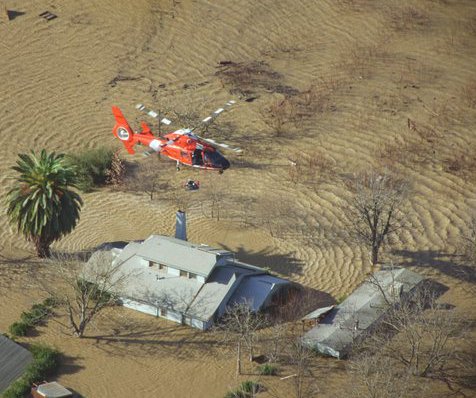
But the waters rose, and rose, and by the time a helicopter was sent to find the last residents, the rabbi was calmly sitting on his roof. Yet once again, the rabbi refused to go.

Once in Heaven, the rabbi demanded an explanation. “I followed Your ways, I learned Your Torah, I did Your will… why didn’t You help me?!”

“What do you mean?” came the response. “I sent a car. I sent a boat. I even sent you a helicopter, but you refused to be helped!”

The reason the joke is so well-known is because it tells something true about people of faith who only have faith. We look for supernatural miracles as the only answer to prayer, but often God sends us very real-world solutions to our dilemmas which require that we take some sort of definitive action. God opens the door, but we still have to get up off of our rear ends and walk through it.

Rabbi Label Lam at Torah.org quotes the pre-World War II treatise of Rabbi Elchonon Wasserman ztl, “The Epoch of the Moshiach” as an example of how many of the Jews in Europe trusted in the powers of the world around them for safety and prosperity and instead were led into the Holocaust.

“Before the redemption, the Jews will err after various forms of idol- worship… “Any matter which appears to man as a controlling factor independent of HASHEM’s will, and as capable of doing good or evil is included in the definition of idolatry. (Sanhedrin) …

He writes, “Let us now review all the “idols” which were worshipped in the last one hundred years. The Enlightenment of Berlin promised a great salvation. As soon as the breeze of liberalism began to blow, the Jews hastened to stand in the ranks of the foremost exponents. After Liberalism had made its exit, they turned to Democracy (worship of public opinion), Socialism, Communism, and to other “isms”… To these idols they made sacrifices of blood and money- and were betrayed by all of them. Not even one justified the faith that was pinned on it…”

Anything can become an idol if we depend on it beyond God’s will, even faith itself. Having faith in a “system” of Government or economic strategy can and has led to tragic consequences, but walking out in the middle of a busy street, standing directly in the path of a speeding truck, and expecting God to send His angels to rescue us from our own folly is also a kind of idolatry. Whether it’s some corrupt “holy man” telling us what we want to hear or we are telling ourselves the same foolish message, we are not so strong that we do not need God, nor can we neglect the responsibilities God has given us and not expect to collide with the consequences. Like Jacob, we must do the equivalent of “sending gifts, praying, and preparing for war” in every challenge we face. Only then are we fully equipped and worthy children of our Father.

Vayishlah: The Running Shliach

That same night he arose, and taking his two wives, his two maidservants, and his eleven children, he crossed the ford of the Jabbok. After taking them across the stream, he sent across all his possessions. Jacob was left alone. And a man wrestled with him until the break of dawn. When he saw that he had not prevailed against him, he wrenched Jacob’s hip at its socket, so that the socket of his hip was strained as he wrestled with him. Then he said, “Let me go, for dawn is breaking.” But he answered, “I will not let you go, unless you bless me.” Said the other, “What is your name?” He replied, “Jacob.” Said he, “Your name shall no longer be Jacob, but Israel, for you have striven with beings divine and human, and have prevailed.” Jacob asked, “Pray tell me your name.” But he said, “You must not ask my name!” And he took leave of him there. So Jacob named the place Peniel, meaning, “I have seen a divine being face to face, yet my life has been preserved.” The sun rose upon him as he passed Penuel, limping on his hip.Genesis 32:23-32 (JPS Tanakh)

As he prepared to face Esau, Jacob experienced a strange mystical encounter with God. He had sent his family, his servants and his possessions across a river ahead of him. He was about to follow when he was suddenly attacked by an assailant. Jacob wrestled the man through the night. The attacker turned out to be none other than the angel of the LORD.

“A Life-Changing Encounter”
First Fruits of Zion (FFOZ) commentary on
Torah Portion Vayishlah

I know. Everybody teaches and writes on Jacob wrestling with the angel. It gets a little cliche’ after awhile. Who was the angel? Was it Jesus? Was it God? Was it Jacob’s “evil inclination?” Was it the angel embodying the spirit of Esau? All of the above, some of the above, none of the above? Who knows?

And what does it have to do with us?

The FFOZ commentary goes on to say that the name change of Jacob to Israel, as a result of the patriarch’s encounter with the Divine, altered the course of his life, changing his nature from “trickery and deceit” to one who is “authorized to receive the blessing.” The commentary concludes with this:

A genuine encounter with God is life-changing. It is a sort of wrestling match. The apostles teach us that, through faith in Yeshua, we are born again as new creations. In Messiah we have a whole new identity. Paul speaks of our old identity as the “old self.” He declares that, for the believer, the “old self was crucified with [Messiah], in order that our body of sin might be done away with, so that we would no longer be slaves to sin” (Romans 6:6). “Therefore if anyone is in Messiah, he is a new creature; the old things passed away; behold, new things have come” (2 Corinthians 5:17).

The commentary assumes, like Abraham before him (Genesis 17:5), that Jacob’s name was changed immediately and permanently and that “Israel” would never be referred to as “Jacob” again.

So Israel set out with all that was his, and he came to Beer-sheba, where he offered sacrifices to the God of his father Isaac. God called to Israel in a vision by night: “Jacob! Jacob!” He answered, “Here.” And He said, “I am God, the God of your father. Fear not to go down to Egypt, for I will make you there into a great nation. I Myself will go down with you to Egypt, and I Myself will also bring you back; and Joseph’s hand shall close your eyes.”

So Jacob set out from Beer-sheba. The sons of Israel put their father Jacob and their children and their wives in the wagons that Pharaoh had sent to transport him; and they took along their livestock and the wealth that they had amassed in the land of Canaan. Thus Jacob and all his offspring with him came to Egypt: he brought with him to Egypt his sons and grandsons, his daughters and granddaughters — all his offspring.

These are the names of the Israelites, Jacob and his descendants, who came to Egypt. –Genesis 46:1-8

As you can see here, the names “Jacob” and “Israel” seem to be used interchangeably. Unlike Abraham who was never called “Abram” again after his name was changed, Jacob seemed to exist as both “Jacob” and “Israel” depending on the situation or the role he was playing. Someone once told me that the patriarch was called “Jacob” when he was being referred to as an ordinary person and “Israel” when he was fulfilling his prophetic and “national” role. I have no idea if this is correct or not, but it seems to fit what we read in the Torah.

But what does this have to do with us and encountering God as if we were meeting a stranger along our path? How are we changed by that meeting and what is the nature of the change?

From a personal point of view, I feel the “aftermath” of my personal encounter with God (coming to faith) is more like Jacob’s than Abraham’s. I feel like my “name change” isn’t quite permanent, and that I toggle back and forth between one nature and the other. I know you probably think that’s a terrible thing to say. After all, who can deny that once we come to faith in Jesus, that we are changed to a “new man” (2 Corinthians 5:17) and that we’ve left our old sin nature completely behind us. Of course, my struggle could be an indication that I’m “double-minded” (James 1:8) which is certainly not a good thing.

But do we abruptly change? Really?

Poof! All at once, you came to faith and transformed into a completely new human being that has absolutely no resemblance to the person you were ten seconds before? Really?

It didn’t happen that way for me. Not by a long shot.

After I came to faith and even after I was baptized in the Boise River, I didn’t suddenly feel like an emotional and spiritual stranger to my “former self”. In fact, I was disappointed to discover that I felt and thought in exactly the same way as I did the day before. What a let down. I was expecting this mystical transformative experience, but it didn’t happen that way.

In fact, over many, many years, my life has gone through various twists and turns, some of which were extremely unpleasant, and looking back, I can see that my way of looking at things and reacting to my surroundings and to people has very gradually begun to change. In fact, the process is still going on today, although at a pace that would make a glacier’s movement seem like the electric speed of “Lightning McQueen” in the Pixar film Cars (2006).

There are times when I experience my life as truly different than it was before I came to faith. Sadly, there are times when I still feel like that flawed and limited human being I was before I even considered the idea that there is a God. In fact, I don’t ever think I’ve felt “perfect” in anything (Matthew 5:48).

What happened?

I don’t think “perfection” is something we achieve and then rest on our laurels but rather, I think a life of faith and unity in God is a goal was always strive for. Some days are better than others. Some days can be just lousy. Occasionally, we are magnificent, but I think for most of us (especially me), those days are rare.

There are times when I just want to know it all and to be it all but it’s sort of like my goals at the gym. No matter how much I psych myself up for a workout, when I actually hit the machines, I can only lift so much weight so many times, and then I run out of gas. Sometimes I exceed my expectations, sometimes I fail miserably, and most of the time, I break even. Kind of disappointing to shoot for the stars and to land in the mud.

Tear off a piece of your bread before you eat. You cannot fit it all into your mouth.

Do the same with wisdom. For Truth does not begin with Mind.

-Rabbi Tzvi Freeman
“Wisdom and Bread”
Based on letters and talks of the Rebbe
Rabbi M. M. Schneerson
Chabad.org

Do you not know that those who run in a race all run, but only one receives the prize? Run in such a way that you may win. –1 Corinthians 9:24

I’ve always been such a terrible runner. I don’t know if that means I’m not really “in Christ” and thus I never transformed into that mystical, magical “new creature,” or if this is what most believers experience (or would admit to if it is their experience) most of the time. From where I sit in the mud, having fallen down in my race in the rain for the ten-thousandth time, a life of faith is lived one day at a time and the bread is eaten one chunk at a time. In the end, God will make the judgment about whether or not I’m good enough for what comes next. All I can do is drag my sweaty, out-of-shape body out of the mud hole one more time, and try to force my dead, lead-heavy legs to run for one more mile. As I rise to run the race again, I strain to see if the sages understand this puzzle.

As we apply ourselves to our mission, we also internalize it. Not only do we effect changes in the world, we ourselves change. Just as an agent must be identified with his principal, we must give ourselves over to G-d’s will and identify with it.

There are tzaddikim, righteous men, whose commitment to G-dliness dominates their personality; every aspect of their being is permeated with G-dliness. Their thoughts and even their will and their pleasure reflect G-d’s.

This, however, is a rung which most people cannot attain. But the second level in which each person remains an independent entity although his deeds are not his own is within the reach of more individuals. For the mitzvos we perform are not human acts; they are G-dly, so a person who performs them selflessly expresses their inner G-dly power.

There are individuals at an even lower level; they are not concerned with the G-dly nature of the mitzvos they perform. Nevertheless, they perform mitzvos for even “the sinners of Israel are filled with mitzvos as a pomegranate is filled with seeds” and the consequences of the deeds they perform represent an expression of G-d’s will. Thus they also contribute toward the transformation of the world.

Regardless of the differences between individuals, all mankind possesses a fundamental commonalty: we are all G-d’s agents, charged with various dimensions of a shared mission. The setting in which each individual functions, the task he is given, and the intent with which he performs it may differ, but the goal is the same.

This is the message of Parshas Vayishlach : that every one of us is a shliach, an agent of G-d.

-Rabbi Eli Touger
Commentary on Torah Portion Vayishlach
“Changing Ourselves as We Change the World”
Adapted from
Likkutei Sichos, Vol. IX, pgs. 323-324;
Sefer HaSichos 5748, p. 138ff;
Sichos Simchas Torah, 5748
Chabad.org

We are each an agent of God. We are sent. We run. We fall. We get up and run again.

Addendum: Rabbi Joshua posts a more conventional interpretation of this Torah reading at Yinon Blog.

Good Shabbos.

The Insurmountable Wall

freestyle1All the elaborate proofs, all the philosophical machinations, none of that will never stand you firmly on your feet. There’s only one thing that can give you that, and that’s your own inherent conviction.

For even as your own mind flounders, you yourself know that this is so, and know that you believe it to be so. It is a conviction all the winds of the earth cannot uproot, that has carried us to this point in time, that has rendered us indestructible and timeless.

For it comes from within and from the heritage of your ancestors who believed as well, back to the invincible conviction of our father, Abraham, a man who took on the entire world.

The doubts, the hesitations, the vacillations, all these come to you from the outside. Your challenge is but to allow your inner knowledge to shine through and be your guide.

Inside is boundless power.

-Rabbi Tzvi Freeman
“Conviction”
Based on letters and talks of the Rebbe
Rabbi M. M. Schneerson
Chabad.org

“Any intelligent fool can make things bigger, more complex, and more violent. It takes a touch of genius — and a lot of courage — to move in the opposite direction.”

Albert Einstein

It’s no small feat to try to understand God. In truth, we never will. Religion and theology is the interface by which we try to make some sense out of a God that exists in the realm beyond reason and comprehension. Even the systems we develop that allow us to build a religious interface can be exceedingly complex and practically impossible to navigate. For instance, take my situation. I’m trying to shift my focus from a traditional Gentile Christian perspective to one that includes at least some elements from Jewish wisdom and learning.

It’s not easy. Here’s what I mean.

As we will see shortly, not all rabbinic sources share the view that the Oral Torah was received as a discrete and finite set of traditions. Later controversies between the Rabbanites (early medieval inheritors of rabbinic tradition) and the Karaites (those who rejected the authority of the rabbinic tradition) made this view of Oral Torah particularly appealing to those who accepted the authority of rabbinic tradition.

-Elizabeth Shanks Alexander
“The Orality of Rabbinic Writing” (p. 42)
As published in The Cambridge Companion to the Talmud and Rabbinic Literature
Edited by Charlotte E. Fonrobert and Martin S. Jaffee

Here’s another example from the same source.

In contrast with the Talmud, the Mishnah itself nowhere advances the theory of the Oral Torah and, aside from the opening paragraphs of Avot, seldom calls itself “Torah” or associates itself with either Moses or Mount Sinai.

-Shane J.D. Cohen
“Judaean Legal Tradition and Halakhah of the Mishnah” (p. 122)

Not easy material for the non-Jew to wrap his brain around. Catherine Hezser, in her article for the same publication “Roman Law and Rabbinic Legal Composition” (pp 144-5) agrees.

Rabbinic texts are not easily accessible to modern readers with little exposure to classical rabbinic educations. Even a cursory glance will reveal the imposing compositional nature of these texts.

alone-desert
After three days, I had hoped to leave this topic and move on, but the concept of being an “intelligent fool” is something that I continue to dwell upon. And yet (if I dare to contradict Einstein), I don’t see how to make the vast body of Jewish religious and intellectual law, interpretation, and commentary into anything less than a dizzying conundrum. However, I take some comfort in Rabbi Freeman’s words since he not only describes the “doubts, the hesitations, the vacillations” of my mind in trying to grasp what is beyond me, but says that it’s conviction, not comprehension, that allows “inner knowledge to shine through and be your guide.”

Periodically in my journey of faith, I become lost in the maze of information and details, not just because of its vastness but because of its alien nature. God is alien to humanity and Jewish wisdom is alien to the Gentile (and yet tantalizingly familiar, somehow). I know somewhere there is a bit of cheese waiting for me at the end of the maze if I’m able to correctly trace my route, but I can’t quite figure out which turn to make next.

Yesterday, I quoted from the lyrics of the Jackson Browne song, “Looking into You” (1972) which include:

The great song traveler passed through here
And he opened my eyes to the view
And I was among those who called him a prophet
And I asked him what was true
Until the distance had shown how the road remains alone
Now I’m looking in my life for a truth that is my own

Compare what Browne is saying to Rabbi Freeman:

The doubts, the hesitations, the vacillations, all these come to you from the outside. Your challenge is but to allow your inner knowledge to shine through and be your guide.

I know. I tend to get in trouble when I compare information from vastly different sources, but both men seem to be saying that depending solely on outside information to define reality and meaning isn’t going to work. Yes, study is important, knowledgeable and insightful teachers are important, but while God does speak to us from those sources, He also speaks to us.

I said earlier that religion and theology is the interface by which we interact with God. That’s true. Without them, we could never be able to operationalize a life of faith. We wouldn’t have a starting point or any idea of what actions we should take to enact holiness. But we also need to own our end of the relationship. It has to be part of us and probably it has to be the core of us. Not understanding the complexities of Mishnah, Talmud, and Gemara isn’t a death sentence and particularly for the Gentile, there is nothing specific that commands us to adopt such comprehension and to define our relationship with God by its tenets. I pursue that path of learning because I feel driven to do so, but I also must stop and realize that, with or without that learning, God is here.

There is something of God in each of us, with or without the Bible, with or without the church and synagogue, with or without the wisdom of the sages and the writings of the church fathers. They provide vital context, but they are not God, nor are they the actual relationship, the conduit between man and Divine. It’s that relationship and what we can take from man-on-a-mazeit that is “the truth that is our own” and the “inner knowledge that shines and guides” us to God.

It’s at times like these, when I open my eyes and really see the immense vastness of what I am trying to understand, encounter it with awe, feel overwhelmed, and realize that I have no idea what I’m doing, that I have to close the books for a few minutes, find some quiet place where I won’t be interrupted, and begin, “Our Father who is in heaven.”

The Master’s Rebuke

peters-denialThe Ahavas Chaim of Viznitz, zt”l, was a huge scholar with profound yir’as shamayim, like all of those who received semichah from the Maharsham, zt”l, one of the undisputed gedolim of his generation.

The rebbe did not flatter anyone. He was always careful to rebuke the Chasidim when they acted inappropriately. For example, as is well known, it is the custom for a rebbe to distribute shiyarim during the tisch. Many Chasidim would push their fellow and grab whatever they could get as if it was a matter of life and death. In Viznitz, the rebbe would often rebuke them for this. “How can you grab shirayim? Don’t you know that the modest kohanim would not grab a portion of the show breads? Clearly, one should not push and grab even in holy matters. Instead of shoving one’s fellows, he should relax and take shiyarim only if he can do so without pushing his friend.”

Daf Yomi Digest
Stories Off the Daf
“Proper Rebuke”
Chullin 133

A man in the crowd answered, “Teacher, I brought you my son, who is possessed by a spirit that has robbed him of speech. Whenever it seizes him, it throws him to the ground. He foams at the mouth, gnashes his teeth and becomes rigid. I asked your disciples to drive out the spirit, but they could not.” “You unbelieving generation,” Jesus replied, “how long shall I stay with you? How long shall I put up with you?Mark 9:17-19

We see that Jesus and the Ahavas Chaim of Viznitz have something in common. They both find it necessary to rebuke their disciples when they display inappropriate or even faithless behavior. Both Masters seem to be a little harsh, but perhaps that’s because there’s so much at stake. If the ordinary Jew is commanded to rebuke a fellow Jew who is sinning or about to sin (based on Leviticus 19:17), how much more so should a Teacher be obligated to rebuke his disciples?

In Judaism (and I’ve said this before) the commandment to rebuke the sinner is compared to saving someone’s life. If a Jew sees a fellow Jew moving away from God by entering into sin and does nothing, it’s like being a lifeguard, seeing a person drowning in the ocean, and not lifting a finger to save him. If one regular person has that level of responsibility toward another, then a Teacher and Rabbi must have a tremendous responsibility to guide his disciples into a proper way of relating to other people and to God. To fail to do so, from his exalted position as Rabbi and tzaddik, would be not only failing his students, but failing God.

However, if you’ve ever been rebuked by an angry, yelling teacher, boss, or parent, you know it doesn’t feel good. Not only that, but you know that being yelled at might not result in you correcting your behavior. If you are even the slightest bit rebellious, your response on the surface might be to appear to be obedience, but inside, your opposition might continue to grow, leading your closer to sin rather than returning you to God.

The story from the daf continues, showing us a different path.

But there is another—often more effective—way to deal with those who are wayward. When Rav Dovid Tzvi Shneiblag, zt”l, was confronted with a student who did not comport himself properly, he would call the student in and open a meseches Chulin to a different statement on today’s daf. He would begin to read in a very emotional tone, . As he did so he shed copious tears. “Rav Yehudah says, ‘One who teaches an improper student falls into Gehinom…Teaching an improper student is like throwing a stone to Merucules…’ ”

As he read, crying, the student could not help but feel moved, until he also cried. The rav would gently explain that certain actions were not befitting for a ben Torah and the young man would tearfully agree to change. Many students later recounted that it was this short time with the rav which galvanized them to make a complete change of direction.”

I don’t believe we have any specific example of Jesus using such a method of “rebuke” when addressing his disciples, but I do not doubt there was a time when the disciples did shed tears and likely did recall everything that Jesus was trying to teach them. Sadly, it was when they thought it was too late that they came to this realization. Peter is an especially poignant example.

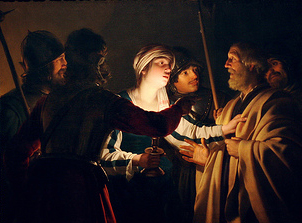
While Peter was below in the courtyard, one of the servant girls of the high priest came by. When she saw Peter warming himself, she looked closely at him. “You also were with that Nazarene, Jesus,” she said.

But he denied it. “I don’t know or understand what you’re talking about,” he said, and went out into the entryway.

When the servant girl saw him there, she said again to those standing around, “This fellow is one of them.” Again he denied it.

After a little while, those standing near said to Peter, “Surely you are one of them, for you are a Galilean.”

He began to call down curses, and he swore to them, “I don’t know this man you’re talking about.”

Immediately the rooster crowed the second time. Then Peter remembered the word Jesus had spoken to him: “Before the rooster crows twice you will disown me three times.” And he broke down and wept. –Mark 14:66-72

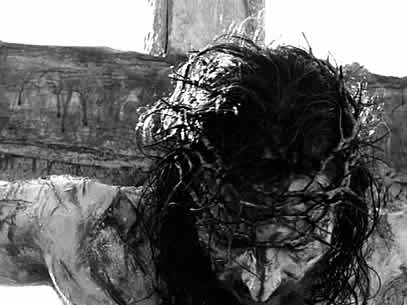
The Death of the MasterAfter all of his protests to the contrary, Peter utterly failed his Master. His tears at that moment were bitter but they must have been much worse once Jesus was dead and the disciples went into hiding. Small wonder that, when at the first of the week, Miriam of Magdalah told the disciples that the tomb was empty, Peter ran all the way to see for himself (John 20:1-4). Hope beyond possibility had given him a second chance. But the agony of his failure and even the tears were not over yet.

When they had finished eating, Jesus said to Simon Peter, “Simon son of John, do you love me more than these?” “Yes, Lord,” he said, “you know that I love you.”

Jesus said, “Feed my lambs.”

Again Jesus said, “Simon son of John, do you love me?”

He answered, “Yes, Lord, you know that I love you.”

Jesus said, “Take care of my sheep.”

The third time he said to him, “Simon son of John, do you love me?”

Peter was hurt because Jesus asked him the third time, “Do you love me?” He said, “Lord, you know all things; you know that I love you.”

Jesus said, “Feed my sheep. –John 21:15-17

Peter denied Jesus three times. After the resurrection, Jesus asks Peter three times if he really loves him. Peter would have to be sure of this, for the days were coming when the Master would not be with him, and Peter would have to carry his faith without doubt.

Tears can be more difficult than a loud, angry rebuke, but they can also be the instrument by which we feel the sorrow, rather than angry rebellion, that will inspire us to repent, to turn to God, and to really go in the other direction, walking away from the person opposing God we once were, and to the man or woman of God we were created to be.