Tag Archives: faith

A Small Light Against the Darkness

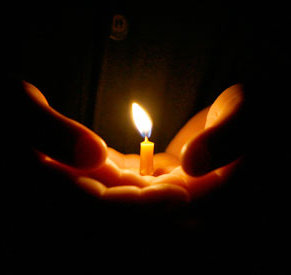
candleSome think life is all about doing good and keeping away from evil. To them, struggle has no purpose of its own — to have struggled is to have failed. Success, they imagine, is a sweet candy with no trace of bitterness.

They are wrong, very wrong. Struggle is an opportunity to reach the ultimate, when darkness itself becomes light. In the midst of struggle, an inner light is awakened. Light profound enough to overwhelm the darkness, encasing it and winning it over. But if darkness never fights back, how will it ever be conquered?

-Rabbi Tzvi Freeman
“Perpetual Struggle”
Based on letters and talks of the Rebbe
Rabbi M. M. Schneerson
Chabad.org

I watched an interview quite sometime ago with Oprah and actor Will Smith. He shared his insight about dealing with negative people. He asks this profoundly important question to himself on a frequent basis: “Is there someone in your life who is not contributing to your life and not helping you move forward?” If your answer to this question is a resounding: Yes! Then: “Why do you insist on allowing them to remain in your life?” A big A-ha moment for me! There must be some payoff for you if you continue allowing these negative influences in your life. When you know better you do better. If you want to change your life you have to also change the folks you chose to surround yourself with.

-Debra Moser
“What Are Your Personal Boundaries?”
MorningCoach.com

Oddly enough, I do read the occasional “inspirational” blog, though I don’t put a lot of stock in them. I find the advice they offer is often superficial and overly optimistic. Of course, the writers of such blogs have to keep the content short in order to hold the attention of their readers. Most people won’t read web content beyond a certain length, so if you want to get your point across, you have to make it short and sweet.

I can live with the short part, though it comes with liabilities, but sometimes such blogs are just a little too “sweet” for a middle-age “curmudgeon” like me.

I suppose that’s one of the reasons why I like reading the Bible (I know this will probably sound irreverent). It doesn’t soften the blow and it doesn’t pull any punches. In fact, I’ve heard some people say they aren’t religious just because some of the “advice” offered in the Bible is too harsh (see 2 Thessalonians 3:10 for example). On the other hand, there are times when the ancient sages and today’s “life-coaches” seem to be saying the same thing.

Nitai the Arbelite would say: Distance yourself from a bad neighbor, and do not cleave to a wicked person. -Ethics of our Fathers, 1:7

Debra Moser said something quite similar and, unlike Nitai the Arbelite, provides methods for “weeding out the negative nellies in her life”. Actually, that’s not fair. The commentary for Pirkei Avot 1:7 is just as illuminating as Moser and probably more so.

On the surface, Nitai the Arbelite appears to be conveying a simple, if redundant, message: Stay away from bad people. In truth, however, a much deeper lesson is implicit in his words. In fact, a close examination of his phraseology yields an altogether different sentiment.

What is the difference between a “bad neighbor” and a “wicked person”? And why must one go so far as to “distance oneself” from the former, while, concerning the latter it is enough to avoid “cleaving” to him?

A “bad neighbor” means just that: not a bad person, but one whose proximity to yourself is detrimental to you. It may be that he is a righteous person, and that his path in life is, for him, most suitable and desirable; but if for you it is wrong and destructive, keep your distance.

On the other hand, a “wicked person” is not necessarily a bad neighbor if he is not in the position to influence you. From him you need not, and must not, distance yourself: on the contrary, befriend him, draw him close and help him improve himself, all the while taking care not to cleave to him and emulate his ways.

In other words: The evil in another is never cause for your rejection of him—only your susceptibility to what is evil for you. On the contrary, the “wickedness” of your fellow it is all the more a reason to become involved with him, and prevail upon him to cleave to the positive in yourself.

I am always amazed at how the sages provide teachings so like the Master.

While Jesus was having dinner at Levi’s house, many tax collectors and sinners were eating with him and his disciples, for there were many who followed him. When the teachers of the law who were Pharisees saw him eating with the sinners and tax collectors, they asked his disciples: “Why does he eat with tax collectors and sinners?”

On hearing this, Jesus said to them, “It is not the healthy who need a doctor, but the sick. I have not come to call the righteous, but sinners.” –Mark 2:15-17

By comparison, Moser’s advice is something of a mixed bag. Of course, her goal isn’t to help her audience help others, it’s to help her audience enhance their own lives.

When you value and love yourself those loving and thoughtful people will come into your life. They are a direct reflection of how you see yourself. Be your own person and don’t allow others to define you. These positive people have your interests at heart and celebrate you with the world. There is no animosity and jealousy; just love and acceptance for the unique person you are. The people in my personal and professional life add to my life and that is a wonderful feeling.

against the darkThat’s a little too “warm and fuzzy” for me. But while there’s nothing wrong with that advice as far as it goes, the goal starts and stops with the individual: you. It has little to do with anyone else unless those other people in your world are only there to support and augment your “personal and professional life”. This is Madison Avenue marketing meets personal life development meets New Age “all-about-me-ism”. It’s certainly not the message the Master or Nitai the Arbelite are sending. Pirkei Avot advices that we distance ourselves from a bad neighbor, not because they’re a bad person, but because they can be a bad influence on us (and Debra Moser would agree with this part). However, we are not to avoid a “wicked person” because, as long as we don’t cleave to them and adopt their ways, we may become a positive influence on them, turning them away from sin.

As the Master taught, it “is not the healthy who need a doctor, but the sick.” Part of tikkun olam, repairing the world, isn’t keeping all of the “health” to yourself like some self-esteem King Midas, but giving it back to others and to “love your neighbor as yourself” (Lev. 19:18; Mark 12:31).

To be fair, Moser did very briefly touch upon the matter of influencing others, but immediately returned to her primary subject.

You do make a positive difference in someone’s life. Believe in yourself. When you’re not in a good mood STOP and get back to your positive mindset and look with gratitude around you and see what an incredible life you have. Living with gratitude and coming from a loving heart space attracts loving positive people into your life.

Again, to be fair, I expect that if I could give Debra Moser an opportunity for rebuttal, she could expand upon her viewpoint and I suspect provide added dimension to what she writes, including how to be a better support and influence on others who need the help.

One of the 613 commandments in Judaism is to “rebuke the sinner”, based on Leviticus 19:17. The deeper meaning of the commandment has little to do with chiding someone for their faults but instead, it’s more like saving someone’s life. If you see someone in moral and spiritual trouble, and if you have the opportunity and ability to help, you are obligated to help. A Jew must become involved rather than let a fellow Jew fall into or remain within their sins. If they fail to do so, the penalty their fellow will suffer for his sins will also fall upon the person who didn’t help.

Jesus seems to be communicating the same thing to his audience in both Mark 2 and Mark 12 (as well as in other scriptures). Of course there is always a danger involved. Like a lifeguard swimming against hazardous ocean currents to save a drowning person, there’s always the risk that you’ll be pulled under yourself, but its a risk you’ve accepted. A lifeguard accepts the risk by virtue of accepting the position of being a lifeguard. As disciples of Christ, we accept the risk by virtue of virtue; by the fact that we accepted the man with the cross and the God of Heaven.

It’s not easy. That’s what most advice blogs leave out of their content. It’s not a walk in the park. Like any discipline, it takes time and practice. You’ll make mistakes. Sometimes you’ll get hurt. With perseverance, you’ll get better at it. You’ll probably never be perfect. There will be days when you are magnificent and other days when you’ll want to stay in bed and hide. There are even days when you will feel like it’s not worth it and want to give up. But even when we don’t like hearing it, we were created for a very simple reason, to help God help the world. Rabbi Freeman interprets the Rebbe’s teaching on this topic thus:

For all that is, physical or spiritual or Divine, was only created to be part of the repair of this world of action. And once that repair is done, all that will be true are those things that made it happen.

In every thought, look for the power to change the world.

It’s the struggle that creates the light that holds back the dark abyss. Without our struggle, we are only silhouettes fading into the night.

We were so close there was no room
We bled inside each others wounds
We all had caught the same disease
and we all sang the songs of peace
Some came to sing, some came to pray
Some came to keep the dark away
So raise the candles high
’cause if you don’t we could stay
black against the sky
Oh oh raise them higher again
and if you do we could stay dry against the rain

-Melanie Safka
Candles in the Rain (1970)

The road

If life is a strugle, it doesn’t mean that you’ve failed. You only drown when you stop struggling against the waves.

The Tent of God

Downtown Dewey Square is crammed with tents and tarps of Occupy Boston protesters, but organizers made sure from the start of this weeks-old encampment that there was room for the holy.

No shoes are allowed in the “Sacred Space” tent here, but you can bring just about any faith or spiritual tradition.

A day’s schedule finds people balancing their chakras, a “compassion meditation” and a discussion of a biblical passage in Luke. Inside, a Buddha statue sits near a picture of Jesus, while a hand-lettered sign in the corner points toward Mecca.

“Religion claims its place in Occupy Wall Street”
-by Jay Lindsay
found at news.yahoo.com

We tend to think of religious and secular activities as isolated from one another. Secular people rally around “separation of church and state” (though that’s not exactly what the Constitution says) while at least some Christians say that the United States was founded as a Christian nation (which isn’t really true, either). However, there is a distinct impression of polarity between what some might think of as “faith vs. facts”. Reality isn’t quite so clear cut, though.

For instance, a number of weeks ago, I came across an article at Network World called Science and religion can and do mix, mostly. The takeaway blurb says:

Rice study shows only 15% of scientists at major US research universities see religion and science as always in conflict.

That’s not the impression you get from the news media, at least when religion and science come up in the same story. There’s a tendency to believe that people of faith and people of science are mortal enemies. One avenue of evidence many atheists use against religious people is that the various sciences “prove” or at least support, an origin of the universe and of the earth that does not match up with how Genesis describes those events in the Bible. Science is also used in some manner or fashion, to support natural rather than supernatural processes for the creation and development of life, and of course, there’s no direct, scientific observation that supports the existence of God.

Rabbi Abraham Joshua Heschel in his book God in Search of Man : A Philosophy of Judaism said that science was not an adequate tool for determining the existence of God, since science, as a method of examination, can only investigate those things that are available for examination within the scope of our universe. God is “extra-universal”, so to speak, and escapes all methods of man trying to capture God and put Him under the microscope.

That probably sounds like a convenient excuse to some, but I’m not going to present a detailed defense for God’s existence against the various scientific disciples. They operate on completely different playing fields. To be fair to the Biblical rendition of the Creation event in Genesis though, I don’t believe it was written as a “cookbook” on how God created the universe, nor do I believe it can be understood outside of a deeply mystic frame of reference. I’m not the only one with this viewpoint. For instance, Rabbi Joshua Brumbach on his blog Yinon, recently replied to a commenter:

I don’t believe the intention of Genesis is meant to be a scientific account, but rather a theological one. As such, I am not necessarily a literal 6 days person. IMHO, like you, I don’t think the Biblical text and Science are in conflict with each other.

There’s no real reason to say that the “big bang” theory, which is accepted by the vast majority of the scientific community as the most likely explanation for the origin of the universe, should be at odds with the acceptance of the Genesis story in the Bible. And while the scientific understanding of the big bang event has evolved over time, it still has some uncertainty attached to it as reported by Space.com:

“The problem is, there’s no reason whatsoever to believe general relativity in that regime,” said Sean Carroll, a theoretical physicist at Caltech. “It’s going to be wrong, because it doesn’t take into account quantum mechanics. And quantum mechanics is certainly going to be important once you get to that place in the history of the universe.”

So the very beginning of the universe remains pretty murky. Scientists think they can pick the story up at about 10 to the minus 36 seconds — one trillionth of a trillionth of a trillionth of a second — after the Big Bang.

So in the time that existed just prior to “one trillionth of a trillionth of a trillionth of a second” before the big bang, could the hand of God have been at work? I believe so, but then, that’s an opinion based on faith. To say that God absolutely could not have been involved requires as much faith, if only because there’s no way to be so definite on that point without invoking faith, either in God or in God not existing.

So we find God in odd places, places we wouldn’t expect to find Him, such as at an Occupy Wall Street demonstration in Boston. Of course:

The tent is one way protesters here and in other cities have taken pains to include a spiritual component in their occupations. Still, Occupy Wall Street is not a religious movement, and signs of spiritually aren’t evident at all protest sites.

So we discover God, or our faith in Him at least, is involved in human affairs because God is involved in us. If the world was not created for the sake of humanity, would the universe exist? That’s like the old “if a tree fell in the forest and there was no one to hear it, would it make a sound” question, and as there are no observers at either event (except God), we have no way of knowing for sure.

To fly in the face of science, God is not a God of facts, but a God of experiencing. We know He is real because we experience Him in ways that defy logic, science, and traditional observation. We believe He has inserted Himself into the lives of human beings and into the course of history, but it still requires faith to see His face shining and His hands working at places like Eden, Sinai, and Jerusalem. Although God is omnipresent, He is most likely found in the places where we carry Him. His being can and has and does manifest anywhere, but He is most often seen, and heard and felt where the people of God are. We are His emissaries to those who have no other method of experiencing Him. The people of God allow the invisible God to be seen by the righteous and the unrighteous alike.

Right now, in downtown Boston, He is sitting in a small tent along with a statue of Buddha, a picture of Jesus, and a hand-lettered sign pointing to Mecca. He was carried there along with those objects and He would be there, even if those other objects didn’t exist. For the method of transport for God into that small tent in Boston, and in all the other places we find God, wasn’t by hands, but by the container of faith He has helped us build within ourselves. And we people of faith, though hardly 99% of the population, are not always who you would expect us to be or where you would expect to find us.

Addendum October 30, 2011: Christians are supporting the “Occupy London” protests. Read about it at guardian.co.uk.

Unanticipated Atonement

Shofar as sunriseIt’s all up to you. Everything about Yom Kippur, coming up this Friday night, points to you: In times of old, one High Priest serving our one G-d in His one Temple on His one holiest day on behalf of His one people elicited G-d’s atonement for the entire world. Today, one person, with one turn of his or her personal page, doing one good deed, or making one good resolution – can also change the course of the entire world for the good.

-Rabbi Zalman Shmotkin
Director, Chabad.org

Wait! Can you back up a second? What was that?

In times of old, one High Priest serving our one G-d in His one Temple on His one holiest day on behalf of His one people elicited G-d’s atonement for the entire world.

Now that’s confusing, at least to me. My reading of Leviticus 16 makes it seem rather obvious that the Yom Kippur service specifically atones for the sins of Israel, and it says nothing about atoning for the sins of the entire world. How could such a thing be possible?

There’s a profound lack of resources on the web (as far as I can tell) regarding Rabbi Shmotkin’s comment. I really hate to use Wikipedia as a source, but they’re about the only site that corroborates the Rabbi’s statement:

The following summary of the Temple service is based on the traditional Jewish religious account described in Mishnah tractate Yoma, appearing in contemporary traditional Jewish prayerbooks for Yom Kippur, and studied as part of a traditional Jewish Yom Kippur worship service.

While the Temple in Jerusalem was standing (from Biblical times through 70 C.E.), the Kohen Gadol (High Priest) was mandated by the Torah to perform a complex set of special services and sacrifices for Yom Kippur to attain Divine atonement, the word “kippur” meaning “atone” in Hebrew. These services were considered to be the most important parts of Yom Kippur because through them the Kohen Gadol made atonement for all Jews and the world.

Just to be clear, the source Wikipedia is relying on for this information is:

Arnold Lustiger, Michael Taubes, Menachem Genack, and Hershel Schachter
Kasirer Edition Yom Kippur Machzor With Commentary
Adapted from the Teachings of Rabbi Joseph B. Soloveitchik.
New York: K’hal Publishing, 2006. pp. 588–589 (summary); 590–618.

This pretty much balances with what Rabbi Shmotkin said but then maybe the Rabbi didn’t mean literally the whole world, but just all of the Jews in the world. Then again, maybe not.

Proceeding on the assumption that we’re talking about the whole world of everyone (it won’t be my last assumption), the difficult thing for me to grasp is that Yom Kippur, from the best of my understanding, provides atonement for the people of Israel (as stated in the Wikipedia quote) in part because the people of Israel want atonement. That is, there is a deliberate, cooperative desire among the Israelites to have their sins atoned for as a nation and the sense of tremendous anticipation as the High Priest enters the Holy of Holies on their behalf. It’s not as if Yom Kippur atonement works by remote control, whether you’re aware of it or not.

But that’s exactly how it would have to work if Aaron had entered the Holy of Holies in the Mishkan in the desert and made atonement for Israel and the entire population of the world.

Let’s take a few examples that are more familiar to the Christian community.

For God so loved the world that he gave his one and only Son, that whoever believes in him shall not perish but have eternal life. –John 3:16

But if anybody does sin, we have an advocate with the Father—Jesus Christ, the Righteous One. He is the atoning sacrifice for our sins, and not only for ours but also for the sins of the whole world. –1 John 2:1-2

Standing before GodHere we see the atoning sacrifice of Jesus being depicted as applying to the whole world, yet it doesn’t literally work that way, at least not without the active agreement and volition of the individuals populating the world. In other words, you have to agree to a certain set of conditions in order for the sacrifice of Christ to atone for your sins. It isn’t applied globally to all human beings whether they want it, or are even aware of it, or not.

But when Christ came as high priest of the good things that are now already here, he went through the greater and more perfect tabernacle that is not made with human hands, that is to say, is not a part of this creation. He did not enter by means of the blood of goats and calves; but he entered the Most Holy Place once for all by his own blood, thus obtaining eternal redemption. The blood of goats and bulls and the ashes of a heifer sprinkled on those who are ceremonially unclean sanctify them so that they are outwardly clean. How much more, then, will the blood of Christ, who through the eternal Spirit offered himself unblemished to God, cleanse our consciences from acts that lead to death, so that we may serve the living God!

For this reason Christ is the mediator of a new covenant, that those who are called may receive the promised eternal inheritance—now that he has died as a ransom to set them free from the sins committed under the first covenant. –Hebrews 9:11-15

Here is our High Priest in the Heavenly Temple; the Heavenly Holy of Holies, applying his own blood in place of bulls and goats, making atonement for the whole world, but it’s a world populated by people who are cooperating with and agreeing to being atoned for. It’s possible for there to be people who are not atoned for by the act of Jesus as High Priest, because (I know I’m being redundant) they haven’t agreed to being atoned for and for many people, they do not want it because they do not want to comply with the conditions required for atonement (namely coming to faith and living a Holy life).

In one of my recent blog posts I used the analogy of God as a gardener and humanity as plants in the garden. I made it a point to illustrate that we are plants who must cooperate with the gardener unlike actual plants which are completely passive as they are watered, given fertilizer, weeded, and so forth.

I realize that God desires that none should perish (2 Peter 3:9), but unlike tomato plants, we have to do something about it. Atonement and forgiveness don’t just happen by the will of God, they happen by human willingness, too. Even being healed by Jesus requires an act of faith on the part of the person being healed:

And a woman was there who had been subject to bleeding for twelve years, but no one could heal her. She came up behind him and touched the edge of his cloak, and immediately her bleeding stopped.

“Who touched me?” Jesus asked.

When they all denied it, Peter said, “Master, the people are crowding and pressing against you.”

But Jesus said, “Someone touched me; I know that power has gone out from me.”

Then the woman, seeing that she could not go unnoticed, came trembling and fell at his feet. In the presence of all the people, she told why she had touched him and how she had been instantly healed. Then he said to her, “Daughter, your faith has healed you. Go in peace.” –Luke 8:43-48

If an act of faith is required for healing, how much more should an act of faith be required for atonement, forgiveness, and reconciliation with God?

I had meant to write something more solemn and dignified, with just a hint of joy, on this final Day of Awe, as Erev Yom Kippur is at hand and Jews all over the world prepare for Kol Nidre, but this is what happened instead.

The Death of the MasterI know I lack the information and dimension to understand what Rabbi Shmotkin wrote and what it means. For all I know, I’ve gotten what he said completely wrong. But if indeed, the High Priest in the Holy Temple in Jerusalem did enter the Holy of Holies on Yom Kippur and atoned for the sins of the nation of Israel and every other nation on Earth while we did not have access to the Messiah and his covenant for humanity (I’m continuing to make assumptions here), then God is gracious in the extreme. That is an atonement in which we really did have to provide nothing and that was freely given by God to all people everywhere.

The world was atoned for every year by the Israelite High Priest, and yet the world was completely unaware. How much more should the world be aware that atonement is available now through the Jewish people in the body, blood, and spirit of Jesus Christ, who died once, so that we could live with God forever. What a wonderful and gracious Father.

Draw near to God and he will draw near to you. Cleanse your hands, you sinners, and purify your hearts, you men of double mind. Be wretched and mourn and weep. Let your laughter be turned to mourning and your joy to dejection. Humble yourselves before the Lord and he will exalt you. –James 4:8-10

Your child is not like everyone else; your child is you.

And yet, your child is not you; your child is his own person. A paradox.

Our souls are that paradox – on a greater scale: the nexus between G-d and His universe, where His own breath becomes His creation.

That is why we are called His children. And we call Him our Father.

-Rabbi Tzvi Freeman
“We Are the Child”
Based on letters and talks of the Rebbe
Rabbi M. M. Schneerson
Chabad.org

L’shanah tovah tikatev v’taihatem. May you be inscribed and sealed for a good year. May you also have an easy fast and may the blessings of the Messiah be upon you.

A Voice of Silence

Infinite darknessAllow me to relate a story a friend of mine tells about one of his early childhood experiences. This is how he relates the event:

“When I was about four years old, I awoke from my nap one day, ventured out of my room, and walked through the house. No one was there. I tentatively called out for my mother, but there was no reply. Slowly, a realization dawned on my little mind: ‘It’s finally happened. My parents have abandoned me…’

“I raced to the phone on the kitchen wall and dialed the operator. ‘That’s it,’ I told her, between sobs, ‘my parents are gone; I’m all alone now.’ The operator stayed on the phone with me until, sure enough, my mother did come home. She had slipped out for a few minutes to pick up some milk. It was, however, an experience I shall never forget.”

Now, if you will, perform a little mental exercise. Imagine for a moment that you are four years old. Your parents are everything to you. Consider the terror you would feel thinking they have abandoned you, leaving you to somehow manage life on your own. Of course, as an adult, you know that this would never happen. However, as a child, you would not have known this. The threat would have seemed real. How does that terror feel?

-David Fohrman
“Holy Days: A Relationship with God”
Torah.org

So He said, “Go forth and stand on the mountain before the LORD.” And behold, the LORD was passing by! And a great and strong wind was rending the mountains and breaking in pieces the rocks before the LORD; but the LORD was not in the wind. And after the wind an earthquake, but the LORD was not in the earthquake. After the earthquake a fire, but the LORD was not in the fire; and after the fire a sound of a gentle blowing.I Kings 19:11-12 (NASB)

In his book God in Search of Man (page 186), Abraham Joshua Heschel says the words translated as “a sound of a gentle blowing” (more commonly translated as “a small, still voice”) in Hebrew are literally “a voice of silence”. It was as if Elijah heard something and yet nothing at all. Does “silence” make a sound?

We know from the larger narrative in I Kings that Elijah felt very much alone and abandoned, and that he expected to die, either by the hand of his pursuers or by God’s. Like David Fohrman’s “abandoned” four-year old, how many of us feel abandoned and alone because we think God has left us and because of God’s “voice of silence”?

In Judaism it is believed that God opens the Book of life on Rosh Hashanah and closes it again at the end of Yom Kippur. Between those two events, there are ten days of teshuvah; ten days in which a Jew still has time to turn from his sins, abandon them completely, throw himself at the feet of God, and beg that his name be inscribed in the Book for another year. Right now, we are in the middle of those ten days.

But how would he know? Unless God explicitly reveals to the person that his name has been written in the Book of Life, how would he know, except for the fact that day by day, he doesn’t die? Where is the voice of God when call to Him and ask, “Have You written me in the Book?”

If you are a Christian, you probably think such concerns are ridiculous or at least misplaced. You’ve been taught that once you were saved when you initially accepted Jesus, your salvation was secure and your place in Heaven was carved in stone. Of course, none of that means you can’t die at any second or that you don’t carry some burden of sins from one day to the next. Christians tend to take salvation for granted and even get a little lazy in their “Christian walk” from time to time (Christian blogger Antwuan Malone commented on this a few days ago).

How do we know when we’re forgiven? How does God reveal this to us? Do we even understand when He is speaking? For that matter, how did the great prophets of old such as Moses know when God was speaking? It certainly seemed a mysterious process to Elijah. Was it also a mystery at Sinai?

“It is very difficult to have a true conception of the events at Sinai, for there has never been before nor will there ever be again anything like it.” (Maimonides, The Guide of the Perplexed, Book II, ch. 33) “We believe,” says Maimonides, “that the Torah has reached Moses from God in a manner which is described in Scripture figuratively by the term ‘word,’ and that nobody has ever known how that took place except Moses himself to whom that word reached. -Heschel, pg 185

We may sometimes feel absolutely certain we have heard from God, but articulating that experience to others is almost impossible, probably for the same reasons Heschel believes that we will never understand the experience of Moses at Sinai or at the burning bush. He goes on to say (pg 185):

This is why all the Bible does is to state that revelation happened; how it happened is something they could only convey in words that are evocative and suggestive.

Stand aloneHeschel shoots down the hopes and dreams of many Bible literalists by stating that the “surest way of misunderstanding revelation is to take it literally” (pg 178) and that we do not give the Bible or God what is owed by interpreting the words literally because we almost always impart an understanding that “would be a partial, shallow understanding; because the literal meaning is but a minimum of meaning.” In other words, the Prophets, and the Apostles most likely didn’t exaggerate their claims but simply described the ineffable experience of God within the inadequate limits of human language. God, after all, is so much more than what the Bible could possibly contain.

Meanwhile, here we are, trapped in the ten days of teshuvah and waiting for the silent and elusive voice of God. Here we are, trapped on Earth in a mortal life, struggling with sin, hardship, and sometimes tragedy, begging for God to answer our cries, pleading with Him not to leave us alone and defenseless in a harsh and cold universe. What Jews experience within the ten days, should be what rest of us experience in the course of our lives:

Herein lies a connection to the above concepts. Our Sages describe the days preceding Yom Kippur with the verse: “Seek G-d while He may be found, call upon Him while He is near.” At this time, everyone has the potential to feel close to G-d, and therefore the Arizal says: “If a person does not cry during the Ten Days of Teshuvah, his soul is not complete.” Reading Parshas Haazinu before Yom Kippur highlights the fact that each of us is “close to the heavens.”

-Rabbi Eli Touger
“Close to the Heavens”
Adapted from
Likkutei Sichos, Vol. I, p. 415;
Vol. IX, p. 204; Vol. XX, p. 266
Chabad.org

Faith is believing God is near when we cannot perceive Him. Faith is knowing that God is speaking even when we can hear only a complete and total silence. Faith is a four-year old waking up from a nap, finding himself home alone, but knowing his mother will be right back. But like a four-year old home alone, crying for his mother and hearing no reply, how can we help but believe that we really have been abandoned, even when faith tells us we’re not? Even if we experience an unexplanable “something”, how do we know it is God except that faith guides us to believe?

The word of God is not just information and it is not just comfort, it is the very air we breathe and the very food that sustains us:

Jesus answered, “It is written: ‘Man does not live on bread alone, but on every word that comes from the mouth of God.'” –Matthew 4:4 (Deut. 8:3)

In the absence of the words of God, we are not only alone and terrified, but we are starving and gasping for our last breath!

The revelation of God is a paradox. He is near because His Word is near, but He is also a God with a voice that is silence and who dwells in unknowable darkness.

The LORD reigns, let the earth be glad;
let the distant shores rejoice.
Clouds and thick darkness surround him;
righteousness and justice are the foundation of his throne. –Psalm 97:1-2

God made Himself known to the Children of Israel violently and in raging fire at Sinai (Exodus 19:18; Deuteronomy 4:11) yet spoke in less than a whisper to Elijah and somehow, He speaks to us, though we may not ever hear Him.

“Every intelligent person knows” that when the Bible asserts that the people saw and heard the voice at Sinai, it does not refer to a “perception by the eye” or “a perception of the ear,” but to a spiritual perception. -Heschel pg 188

A man without the Spirit does not accept the things that come from the Spirit of God, for they are foolishness to him, and he cannot understand them, because they are spiritually discerned. –1 Corinthians 2:14

HopeThe only way we can experience God is through His Spirit for without it, we are blind and deaf, though God may be “shouting”. In the ten days of teshuvah, Jews stand apart from the din of the world and listen for the “small, still voice,” straining to hear God speaking while He turns the pages of the Book of Life. We shudder in fear and awe at any sound that may be Him writing our name into that Book. Even a Christian knows that there will be a day of reckoning when the Book will be opened and then closed one final time and our fate will be sealed within. A Jew does not take for granted that all is secure, even though he may pray three times daily while facing Holy Jerusalem. While we believers are certain of the grace of Christ, why should our confidence turn into arrogant presumption? Let us also tremble before God, for we cannot know ourselves and our lives as He knows us. And we cannot know Him as He knows Himself.

Christianity has no time in its calendar like the Days of Awe. Not even the passion of Easter approachs it; when man and God become almost inseparably close, though for man, it still feels as if the expansive gulf of the universe stands between us and Him. God will never abandon us, but we can be far from Him. Imagine you had only ten days to somehow bridge the immense gap between human beings and the Divine. Impossible? Do you feel the terror welling up inside of you at the prospect? What will you do? Where will you look? How will you know when God is close? What will His voice “sound” like?

We must look, but not with our eyes. We must listen, but not with our ears. We must reach out, but not with our hands.

He is speaking. But His voice is silent and His light shines in unbroken darkness.

Reach for hope. He is coming.

Even now – the word of Hashem – return to Me with all your heart, with fasting, with weeping, and with lamentation. Rend your hearts and not your garments, and return to Hashem your God, for He is gracious and merciful, slow to anger and of great kindness, and He relents of evil. Whoever knows, let him repent and regret. and it will leave a blessing behind it, for meal-offering and libation to Hashem your God. –Joel 2:12-14 (Stone Edition Tanakh)

Nitzavim-Vayeilech: Standing Before God

Standing before GodNo moment in human history was as sad as the moment in which the Lord said to Moses, “and I will surely hide My face in that day on account of all the evil which they have done, because they have turned to other Gods (Deuteronomy 31:18)

-Abraham Joshua Heschel
God in Search of Man
Page 155

You have seen all that the Lord did before your very eyes in the land of Egypt, to Pharaoh and to all his courtiers and to his whole country: the wondrous feats that you saw with your own eyes, those prodigious signs and marvels. Yet to this day the Lord has not given you a mind to understand or eyes to see or ears to hear.Deuteronomy 29;1-3 (JPS Tanakh)

Faith is an act of the whole person, of mind, will, and heart. Faith is sensitivity, understanding, engagement, and attachment; not something achieved once and for all, but an attitude one may gain and lose. -Heschel, page 154

That’s a terrifying thought. As the month of Elul wanes and the High Holidays approach, we seek to remove the burden of our sins from us and re-establish our connection with God and with our fellow human beings. To do this, we must connect to our faith, not as mere belief in the existence of God, but in the total knowledge and dedication that God exists and that He is alive and involved in the matters of mankind and in the lives of each of us individually. However our faith and understanding must transcend our own biases and personalities, for it is so easy to confuse our will with His will.

The thoughtless believes every word, but the prudent looks where he is going –Proverbs 14:15

Now the Berean Jews were of more noble character than those in Thessalonica, for they received the message with great eagerness and examined the Scriptures every day to see if what Paul said was true. –Acts 17:11

And why dost Thou permit faith to blend so easily with bigotry, arrogance, cruelty, folly, and superstition? -Heschel, page 155

The prophet Isaiah even lays this last question at the feet of God.

O Lord, why dost Thou make us err from thy ways and harden our heart, so that we fear Thee not? –Isaiah 63:17

Even when we seek God earnestly and with great energy, we often make the hideous mistake of substituting our personality flaws for His justice, mercy, and will. This is the reason that secular people turn away from God and claim that “religion” is the root cause of all evil acts in the world. It is exactly because, in our worst moments, we people of “faith” really are guilty of all that we are accused, including intolerance, bigotry, hatred, and violence. And we claim that all of this error and sin is in the Name of our God and not sprouting from our own faulty human reasoning and emotions.

God saw the truth and spoke it to Moses in the hours before the great Prophet’s death, as recorded in Torah Portion Vayeilech:

The Lord said to Moses: You are soon to lie with your fathers. This people will thereupon go astray after the alien gods in their midst, in the land that they are about to enter; they will forsake Me and break My covenant that I made with them. Then My anger will flare up against them, and I will abandon them and hide My countenance from them. They shall be ready prey; and many evils and troubles shall befall them. And they shall say on that day, “Surely it is because our God is not in our midst that these evils have befallen us.” Yet I will keep My countenance hidden on that day, because of all the evil they have done in turning to other gods. –Deuteronomy 31:16-18 (JPS Tanakh)

What a bitter epitaph to the life of the Prophet Moses, who had dedicated everything he was to the preservation of the Children of Israel, in obedience and devotion to the God of his fathers. How can we go on in the face of such disappointment and failure?

This is the certainty which overwhelms us in such moments: man lives not only in time and space but also in the dimension of God’s attentiveness. God is concern, not only power. God is He to whom we are accountable. -Heschel, page 158

And yet:

Blessed by GodMore particularly, the word nitzavim the core of the blessing given by G-d does not mean merely “standing.” It implies standing with power and strength, as reflected in the phrase: nitzav melech (I Kings 22:48. See Or HaTorah, Nitzavim, p. 1202.), “the deputy serving as king,” i.e., G-d’s blessing is that our stature will reflect the strength and confidence possessed by a king’s deputy.

This blessing enables us to proceed through each new year with unflinching power; no challenges will budge us from our commitment to the Torah and its mitzvos. On the contrary, we will “proceed from strength to strength” in our endeavor to spread G-dly light throughout the world.

What is the source of this strength? Immutable permanence is a Divine quality. As the prophet proclaims: “I, G-d, have not changed,” (Malachi 3:6) and our Rabbis explain that one of the basic tenets of our faith is that the Creator is unchanging; (See Rambam, Guide to the Perplexed, Vol. I, ch. 68, et al.) nothing in our world can effect a transition on His part. Nevertheless, G-d has also granted the potential for His unchanging firmness to be reflected in the conduct of mortal beings, for the soul which is granted to every person is “an actual part of G-d.” (Tanya, ch. 2) This inner G-dly core endows every individual with insurmountable resources of strength to continue his Divine service.

-Rabbi Eli Touger
Commentary on Torah Portion Nitzvaim: Standing Before G-d
Adapted from Likkutei Sichos, Vol. II, p. 398ff; Vol. XIX, p. 173ff
Chabad.org

It is God’s blessing upon us that gives us the strength to respond to Him with unswerving faith and that “our stature will reflect the strength and confidence possessed by a king’s deputy.” We can only speculate who the “king’s deputy” is, although I have my own opinion on the matter. However, in our personal struggle to approach God and stand before the King, we must never forget that the battle does not belong to us only as individuals.

Only that which is good for all men is good for every man. No one is truly inspired for his own sake. He who is blessed, is a blessing for others.

There are many ways but only one goal. If there is one source of all, there must be one goal for all. The yearnings are our own, but the answer is His. -Heschel, page 162

And yet:

In moments of insight God addresses Himself to a single soul. -Heschel, page 163

We can only see the world from our own point of view, but God sees everything from everyone’s perspective. He knows our wants and needs as individuals and He also hears the cry of His united Creation. For a Jew, Heschel says that even “the individual who feels forsaken remembers Him as the God of his fathers.” But the rest of us who don’t share that history and lifeline, must also remember that “God created mankind in his own image, in the image of God he created them; male and female he created them.” (Genesis 1:27). He created mankind, men and women, all of us in His own image. We are all His and in that, we can all be said to be “one”.

May our standing before G-d “as one” on Rosh HaShanah lead to a year of blessing for all mankind, in material and spiritual matters, including the ultimate blessing, the coming of Mashiach. -Rabbi Touger

As we watch the approach of this year’s end and another year beginning to dawn, may we know before whom we stand and have faith and trust that the strength we need to appear before the King, He has already granted us through His blessing, to the Jew and the Gentile alike.

May the Messiah come soon and in our days.

Good Shabbos.

God is Searching

AbyssMost theories of religion start out with defining the religious situation as man’s search for God and maintain the axiom that God is silent, hidden and unconcerned with man’s search for Him. Now, in adopting that axiom, the answer is given before the question is asked. To Biblical thinking, the definition is incomplete and the axiom false. The Bible speaks not only of man’s search for God but also of God’s search for man. “Thou dost hunt me like a lion,” exclaimed Job (10:16).

“From the very first Thou didst single out man and consider him worthy to stand in Thy presence.” (The liturgy of the Day of Atonement) This is the mysterious paradox of Biblical faith: God is pursuing man. (adapted from Kuzari II 50 and Kuzari IV 3) It is as if God were unwilling to be alone, and He had chosen man to serve Him. Our seeking Him is not only man’s but also His concern, and must not be considered an exclusively human affair. His will is involved in our yearnings. All of human history as described in the Bible may be summarized in one phrase: “God is in search of man.” Faith in God is a response to God’s question.

-Abraham Joshua Heschel
God in Search of Man
Page 136

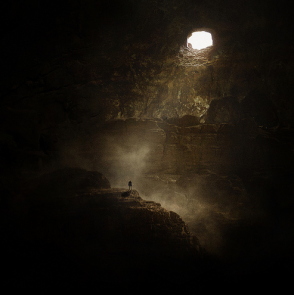
For the past several mornings, I’ve been exploring the wine-dark depths of the soul. Naturally, the soul is found wanting (Romans 3:10). It’s not a pretty picture to sit at the bottom of a deep well and contemplate both the physical darkness and the darkness of the human spirit. I know that God wants us to repent, to turn from sin and to return to Him. More than that, He wants us to sweep away the barriers that inhibit such a return; barriers like discouragement, depression, guilt, and conflict. I’ve heard that we are what we think, but thought is a habit, like cigarettes. Even when we know some thoughts are bad for us, it’s not so easy to quit.

Up until now, I’ve been picturing this struggle as one we have to fight alone, or at least one in which we are expected to do most of the heavy lifting. If I got myself into that deep, nasty hole, I’m supposed to get myself out again, right? God’s waiting at the top encouraging me, but I’ve still got to make the climb alone.

Now Rabbi Heschel is suggesting that God is climbing down after us with a rope ladder and a flashlight.

I’ve heard that before.

I’ve heard that when Israel went down into Egypt, God went down with them:

“I am God, the God of your father,” he said. “Do not be afraid to go down to Egypt, for I will make you into a great nation there. I will go down to Egypt with you, and I will surely bring you back again. And Joseph’s own hand will close your eyes.” –Genesis 46:3-4

It is said that when the Jews were exiled into the diaspora and Herod’s Temple was utterly destroyed, God went into exile with His chosen ones. It is said that He was also imprisoned in the camps with His people during the Holocaust. Whenever the Jews suffered, God suffered with them. Whenever they were raised up from the depths, God lifted them.

For God is not always silent, and man is not always blind. His glory fills the world; His spirit hovers above the waters. There are moments in which, to use a Talmudic phrase, heaven and earth kiss each other…Some of us have at least caught a glimse of the beauty, peace, and power that flow through the souls of those who are devoted to Him. There may come a moment like thunder in the soul, when man is not only aided, not only guided by God’s mysterious hand, but also taught how to aid, how to guide other beings. The voice of Sinai goes on for ever; “These words the Lord spoke unto all your assembly in the mount out of the midst of the fire, of the cloud, and of the thick darkness, with a great voice that goes on for ever.” (Deut. 5:19 Aramaic translation of Onkelos and Jonathan ben Uzziel and to the interpetation of Sanhedrin 17b; Sotah, 10b; and to the first interpretation of Rashi) -Heschel page 138

But that’s Sinai. What allows the rest of us to also hear “a great voice that goes on for ever.” except perhaps the death of the tzaddik, the great Rebbe of Nazaret, Jesus the Christ? But even if we dare to claim a portion of the Kingdom of Heaven through the blood of the Lamb, what else might prevent the God of Israel from finding the son of Noah in the abyss?

However, it is the evil in man and the evil in society silencing the depth of the soul that block and hamper our faith. -Heschel page 141

ShekhinahIt seems I’ve come full circle, or have I?

The Shechinah, the presence of God, is not found in the company of sinners; but when a man makes an effort to purify himself and to draw near to God, then the Shechinah rests upon him. -Heschel page 147

In the spirit of Judaism, our quest for God is a return to God; our thinking of Him is a recall, an attempt to draw out the depth of our suppressed attachment. The Hebrew word for repentance, “teshuvah”, means “return”. Yet it also means “answer”. Return to God is an answer to Him. For God is not silent. “Return O faithless children, says the Lord.” (Jeremiah 3:14) -Heschel page 141

But all this says is that God is in search of the Jew. Is he also in search of his other creations, of the rest of humanity?

What choice do we have but to believe this is true; that God seeks everyone, the Jew and Gentile alike. To not believe this is to abandon hope forever. Christians take it for granted that they are close to God but closer to Jesus. Unfortunately, a careful examination of that certainty shows that one of the requirements is the belief that God draws closer to Christians at the cost of becoming more distant from the Jew.

The approaching dissolution of the Jewish economy, and the erecting of the evangelical state, shall set this matter at large, and lay all in common, so that it shall be a thing perfectly indifferent whether in either of these places or any other men worship God, for they shall not be tied to any place; neither here nor there, but both, and any where, and every where.

-Matthew Henry, Commentary on John 4:21-23
as found at Derek Leman’s blog

I can’t accept that. God is a God of all or He is a God of no one.

So if the faith of both Jew and Christian leads us to believe that God is meeting all people halfway, so to speak, then we must, even without waiting to see His light, reach up to Him as He is reaching down to us. We must take the hand He is extending, grasp tightly, and begin to climb.

He has found us.

We must not wait passively for insights. In the darkest moments we must try to let our inner light go forth. “And she rises while it is yet night” (Proverbs 31:15) -Heschel page 143