Tag Archives: faith

Stories are Miracles

R. Jacob Kaidaner heard from R. Pinhas Reises of Shklov that “once he was on the way with the holy rebbe [R. Shneur Zalman of Lyady], when the skies suddenly grew dark and a pouring rain began to fall. His honoured holiness said that once the Ba’al Shem Tov had been travelling, and a pouring rain began, and he recited a single verse and the rain stopped. He told us the verse that he [the Ba’al Shem Tov] had recited, and he also expounded for us the mystical intent of the verse. And before he finished the exposition, we saw a true wonder, namely, a torrent on both sides of the wagon, while the wagon itself was completely dry, indescribably so, not a single drop..and when we came to the inn and his holiness took his feet out of the wagon, it immediately was filled from the rain.

Kaidaner, Sipurim nora’im
as told in Gedaliah Nigal’s book
The Hasidic Tale

One day Jesus said to his disciples, “Let us go over to the other side of the lake.” So they got into a boat and set out. As they sailed, he fell asleep. A squall came down on the lake, so that the boat was being swamped, and they were in great danger.
The disciples went and woke him, saying, “Master, Master, we’re going to drown!”

He got up and rebuked the wind and the raging waters; the storm subsided, and all was calm. “Where is your faith?” he asked his disciples.

In fear and amazement they asked one another, “Who is this? He commands even the winds and the water, and they obey him.”-Luke 8:22-25

Besides the fact that both of these stories have to do with storms and involve miracles, you may be wondering what they have in common. If we look outside their immediate context and theme though, we find that they are linked by how they affect the audience and how they reveal God.

Yesterday, I spent some time in my “morning mediation” describing and comparing the tales of the Chasidim to the tales of the Messiah’s “Chasidim”. However, from a traditional Christian point of view, the two types of “storytelling” I just quoted seem as different as apples and canaries. But remembering that Jesus has a great deal in common with Rabbis and tzadikim (holy or righteous “saints”), the connection to me seems to be more than clear.

I’ve been reading Nigal’s book, but I don’t seem to be able to get more than a few pages when the way Nigal tells his own story of the Chasidic tales inspires one of my own. Here’s what started me off today:

A fourth characteristic of the hasidic story is its intrinsic ability to perform miracles and wonders. The Ba’al Shem Tov was asked by R. David Forkes how one could pray for a sick person through stories, and indeed, tsadikim succeeded in healing the ill in this manner: R. Berisch of Oshpetzin healed a sick woman through stories, and a young man who suffered from melancholy was cured in the same way. Problems of many other kinds, too, were solved by the power of the tsadik’s storytelling.

Christians are accustomed to how Jesus and his disciples performed miracles, but we don’t see them doing so by telling stories. Often, we see the disciples invoking the name of Jesus, in the same manner as any disciple of any Jewish Rabbi or Maggid does when acting in his Master’s name, and then performing the miraculous act. The Chasidim use stories the way I sometimes think of the therapeutic metaphors of Milton Erickson, but perhaps therapy, healing, and the hand of God are not really different things.

There are ways of making the connection between who we are and who our Master is by using stories, and these stories let us work in mystic ways or bring the Divine within our awareness and perhaps within our grasp:

“Will the Lord reject forever?
Will he never show his favor again?
Has his unfailing love vanished forever?
Has his promise failed for all time?
Has God forgotten to be merciful?
Has he in anger withheld his compassion?”

Then I thought, “To this I will appeal:
the years when the Most High stretched out his right hand.
I will remember the deeds of the LORD;
yes, I will remember your miracles of long ago.
I will consider all your works
and meditate on all your mighty deeds.” –Psalm 77:7-15

I remember the days of long ago;
I meditate on all your works
and consider what your hands have done.
I spread out my hands to you;
I thirst for you like a parched land.

Answer me quickly, LORD;
my spirit fails.
Do not hide your face from me
or I will be like those who go down to the pit. –Psalm 143:5-7

True, these are songs and prayers, but they are also meditations, recollections, and indeed, even stories about the mighty deeds of God and how He has rescued His people time and again. In telling the stories of God and putting our trust in Him as we hear these tales, what wonders and miracles can we receive? Maybe the answer to prayer is contained in a story.

What about when you read the Bible? What do you experience? Hopefully, a feeling of encouragement and maybe even a touch of wonder, but is that it? What if you were to recite some of the stories of Jesus? The time he healed the woman of the issue of blood, perhaps. How about when he spoke to the woman at the well? You could even recall some of the stories Jesus himself told. The parable of the prodigal son, for example, or the parable of the talents, or the one about the sower.

Why did Jesus tell these parables hidden in riddles? Just to describe the Kingdom of God in metaphor? Sure, at least that much. But what if the stories he told also performed their own miracles, winning the hearts of the sons of Israel for their Father? What do the stories about Jesus do for us? What do they do for someone who hears them for the first time?

When you turn your heart away from sin and to the Savior of the world, isn’t that a miraculous healing, just as miraculous as halting a storm? Isn’t it a wonder beyond the reason of our world when anyone turns to God?

Let me tell you one more story:

Rav Elchonon Halperin, shlit”a, explains this practice with a statement brought on today’s daf. “Our sages tell us in Menahcos 97 that one’s table atones for him (in the place of the altar in the Beis HaMikdash; the Holy Temple in Jerusalem). Rashi explains that one’s table atones in the merit of feeding poor people at the table. Yet imagine the embarrassment of destitute people who have no choice but to take their meals as charity at another’s table. Surely only a very rare person can give the poor food in a manner which will not be a huge embarrassment. Most people eating at the table of another out of necessity feel nothing less than bitter darkness.

“But at the table of tzaddikim, everyone eats for free. Both the poor and the wealthy join together and one who is hungry can obtain as much food as he wants in an honorable manner. No one feels above his friend, since everyone is there for the same reason and is treated the same way. All those who attend a tisch feel a sense of togetherness that emerges out of holy love and companionship. With such a pleasant atmosphere is it any wonder that we cannot imagine the great atonement of a chassidic tisch?”

Daf Yomi Digest
Stories off the Daf
“The Atoning Table”
Menachos 97

While the vast majority of Christians might say that it is laudable to feed the poor from your own table, this act of charity and kindness has no power to atone for sins nor could it replace any of the sacrifices Jews once offered at the Temple. Only confession of sins and faith in Jesus Christ atones for sins.

Of course, the vast majority of Jews don’t see it that way, and with the Temple gone these past 2000 years, acts of charity and prayer are believed to substitute for the Temple offerings.

But what is the story telling us?

Does the act of performing a kindness, feeding the poor at your own table and at the same time, treating the disadvantaged with respect and as equals to even the very wealthy eating beside them…does that mean something? Does it do something? What is burning in your heart? It’s one thing to repent of your sins and turn to God, but words don’t reveal that you have really changed as clearly and definitely as performing acts of kindness and righteousness.

I said a little while ago that the “Messianic Tales” can perform the miraculous act of turning a stone heart into one of flesh; of turning a heart of sin into one that accepts and performs righteousness. Yet do we turn to God only because of us? Well, yes…probably at first. People can be very self-centered. But here is another miracle.
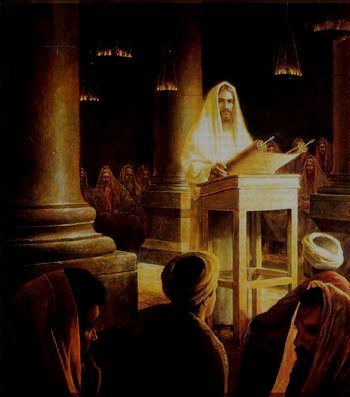
StoriesBy hearing a story about a person feeding poor people at his own table and relieving them of the burdens of shame and embarrassment, not only are the poor fed but so are the poor in spirit…us. Hearing the story, having faith in the tales of the tzadikim, letting it turn our hearts, and causing us to perform acts of righteousness is a miracle and a wonder and who knows what else God may do because of our trust?

God is a storyteller. Why else did He leave us with such a marvelous book of sagas involving tragedy, wonder, courage, and despair? For it is the stories told by God that fill the world with miracles. When we retell those stories, we cause the miracles to be infused in the world around us, in the people that we meet, and within our very souls.

In the beginning God created the heavens and the earth. Now the earth was formless and empty, darkness was over the surface of the deep, and the Spirit of God was hovering over the waters. –Genesis 1:1-2

In the beginning was the Word, and the Word was with God, and the Word was God. He was with God in the beginning. Through him all things were made; without him nothing was made that has been made. In him was life, and that life was the light of all mankind. The light shines in the darkness, and the darkness has not overcome it. –John 1:1-5

And the word became a human being and walked among us. What a wonderful and miraculous story.

Let these commandments that I command you today be on your heart. Teach them thoroughly to your children and speak of them while you sit in your home, while you walk on the way, when you retire and when you arise. –Deuteronomy 6:6-7

Your Young Men Will See Visions

Receiving the SpiritAnd afterward, I will pour out my Spirit on all people.
Your sons and daughters will prophesy,
your old men will dream dreams,
your young men will see visions.
Joel 2:28

In the last days, God says,
I will pour out my Spirit on all people.
Your sons and daughters will prophesy,
your young men will see visions,
your old men will dream dreams.
Acts 2:17

Are you a Christian? If you are, has this happened to you? Have you ever rendered a prophesy? I mean have you ever rendered a prophesy like in the days of the Prophets of Israel? Have you ever spoken in languages that you did not know? Have you?

No?

You should have…that is, if you received the Holy Spirit.

Let me explain.

In Acts 2:17, Peter is quoting the Prophet Joel to explain the following event:

When the day of Pentecost came, they were all together in one place. Suddenly a sound like the blowing of a violent wind came from heaven and filled the whole house where they were sitting. They saw what seemed to be tongues of fire that separated and came to rest on each of them. All of them were filled with the Holy Spirit and began to speak in other tongues as the Spirit enabled them. –Acts 2:1-4

During the festival of Shavuot (the celebration of the giving of the Torah at Sinai), the Holy Spirit came upon the core group of the Jewish disciples of Jesus and when it did, they were enabled to speak in languages they didn’t actually know. Many of the Jews from the diaspora heard the disciples speaking in their languages and were amazed. Some though, thought the disciples were drunk. Peter defended them, denying that they were intoxicated at nine in the morning, and then he quoted from the Prophet Joel to further illuminate the meaning of the event.

But all this had happened before:

So Moses went out and told the people what the LORD had said. He brought together seventy of their elders and had them stand around the tent. Then the LORD came down in the cloud and spoke with him, and he took some of the power of the Spirit that was on him and put it on the seventy elders. When the Spirit rested on them, they prophesied – but did not do so again.

However, two men, whose names were Eldad and Medad, had remained in the camp. They were listed among the elders, but did not go out to the tent. Yet the Spirit also rested on them, and they prophesied in the camp. A young man ran and told Moses, “Eldad and Medad are prophesying in the camp.”

Joshua son of Nun, who had been Moses’ aide since youth, spoke up and said, “Moses, my lord, stop them!”

But Moses replied, “Are you jealous for my sake? I wish that all the LORD’s people were prophets and that the LORD would put his Spirit on them!” Then Moses and the elders of Israel returned to the camp. –Numbers 11:24-30

It may have been a bit of a stretch to expect the Jews of Judea, Cappadocia, Pontus, Egypt, and Rome, visiting Jerusalem for the festival of Shavuot in obedience to the commandment, to realize that the disciples were speaking through the power of God’s Spirit, but the most amazing thing was yet to come.

While Peter was still speaking these words, the Holy Spirit came on all who heard the message. The circumcised (Jewish) believers who had come with Peter were astonished that the gift of the Holy Spirit had been poured out even on Gentiles. For they heard them speaking in tongues and praising God.

Then Peter said, “Surely no one can stand in the way of their being baptized with water. They have received the Holy Spirit just as we have.” So he ordered that they be baptized in the name of Jesus Christ. Then they asked Peter to stay with them for a few days. –Acts 10:44-48

Up to this point, Peter and the other Jewish disciples of the Jewish Messiah had witnessed the Spirit coming upon other Jews. It was a totally astonishing event to see the non-Jewish “God-fearers” also receive the Spirit in an identical manner. Christianity today tends to blow past just how amazing this was for the Jewish believers. For the first time, God’s Spirit became available to a people who were not of the Mosaic covenant. The Children of Israel no longer had exclusive access to God. The Gentiles could be saved!

But that’s not why I’m bringing this all up. I want to talk about the “accepting-the-spirit” experience recorded in Numbers and in Acts. In each case, the person receiving the spirit was suddenly (though temporarily) granted extraordinary powers, such as speaking the languages of other people groups and having the ability to render prophesy.

I ask again Christian, did that ever happen to you? Did you ever gain supernatural abilities when you came to faith? Why do I ask? Because it never happened to me. In fact, I don’t think I’ve met a single Christian who, upon accepting Jesus as Lord and Savior, was abruptly able to speak foreign tongues or render prophesies.

A fellow I used to know told me his “coming to faith” story and how the person at the “altar call” basically tried to force him to speak in tongues. My friend, through a number of events in his life, had come to faith in Christ. In a local church during an evening service, he answered the “altar call” and, with many others, he went up and met a man who prayed with him to receive the Spirit. One by one, the others who had gone up with him (apparently) received the Spirit and as time passed, the crowd diminished and the church started to empty.

But no matter how much he wanted to, my friend didn’t start speaking in supernatural languages. The person “guiding” him urged him on and even began to browbeat my friend.

DreamingI should mention at this point, that the person in question is a brilliant scholar and is fluent in several languages including Biblical Hebrew and Greek. He had these talents long before he came to faith.

Finally, out of desperation, my friend started speaking in the various languages that he already knew. This seemed to satisfy the Christian who was praying with my friend at the altar and, looking at his watch and mentioning that his wife was waiting for him in the parking lot, the man walked away and left my friend alone.

OK, not the ideal “conversion” story, but it does illustrate that some (but perhaps not all) churches expect when a person receives Christ and accepts the Holy Spirit, that they should have an experience similar to what we’ve read about in Acts 2 and Acts 10. As I’ve said though, neither my friend nor I…nor any other Christian I’ve ever met can say we gained access to temporary supernatural powers when we became believers.

I’ve never openly examined this matter before and asking this type of question is a departure from my usual sort of writings on this blog. But when you become a Christian, when you accept Jesus into your life, how do you know that the Holy Spirit comes upon you? Why don’t we prophesy? Why don’t we speak in “tongues”? Where are our visions? Where are our dreams?

Two Sons

Then you shall say to Pharaoh, ‘Thus says the Lord: Israel is My first-born son”.Exodus 4:22 (JPS Tanakh )

All Israel has a share in the World to Come, as is stated: “And your people are all righteous; they shall inherit the land forever. They are the shoot of My planting, the work of My hands, in which I take pride.”Sanhedrin, 11:1

In what way is G-d our “father”? There are, of course, the obvious parallels. G-d creates us and provides us with sustenance and direction. He loves us with the boundless, all-forgiving love of a father.

Chassidic teaching delves further into the metaphor. It examines the biological and psychological dynamics of the father-child model, and employs them to better understand our relationship to each other and to our Father in Heaven.

Physically, what began in the father’s body and psyche is now a separate, distinct and (eventually) independent individual. Yet there is a good reason we say, “Like father like son.” On a deeper level, the child remains inseparable from his begetter.

In the words of the Talmud, “A son is a limb of his father.” At the very heart of his consciousness lies an inescapable truth: he is his father’s child, an extension of his being, a projection of his personality. In body, they have become two distinct entities; in essence they are one.

-from “The Awareness Factor”
Minding the Child: The Soul of a Metaphor commentary on
Ethics of Our Fathers (Avot Pirkei)
Chabad.org | Sivan 7, 5771 * June 9, 2011

Israel, the Jewish people, is the first-born son of God. The Father has lavished great love and blessings upon the son, and even when the son was disobedient and burdened with exile, persecution, and extreme hardships, God’s love never wavered. When Jacob and his family went down into Egypt, an act which ultimately would see the Children of Israel become slaves (Genesis 46:3-4), God went down with them. It is said that God went into exile with the Jews after the destruction of the Second Temple and the exile of His people from Israel. It is said that when the Jews went into the camps, Auschwitz-Birkenau, Dachau, Treblinka, and all the others, God went in with His people. God has “suffered” with his first-born son Israel for thousands of years because of His love of them and now He is bringing them back.

But what about the rest of us? Can the nations claim any “sonship” before God, and if so, under what circumstances?

It depends on who you ask.

The Seven Laws of Noah demonstrate that almighty G-d has rules and laws for all human beings …and that G-d loves us all. He does not leave anyone, Jew or non-Jew without guidance. To the non-Jew He has given the Seven Commandments.

-from noahide.org

To the Jewish people G-d gave the entire Torah [teaching] as their Law. They therefore have a special responsibility—with special commandments—to be the priesthood of the world, a “light unto the nations.”

What about the rest of the world? What is G-d’s will for them?

G-d gave Noah and all his descendants (B’nei Noach or “children of Noah”) seven commandments to obey. These seven universal laws (known as the “Seven Noahide Laws”) were reaffirmed with Moses and the Jewish people at Mt. Sinai in what is now known as the Oral Torah, establishing modern observance of these laws. These seven commandments (mitzvos), actually seven categories of hundreds of specific laws, are G-d’s will for all non-Jews.

-from noahide.com

The vast majority of the Jewish world believes that all of humanity is loved and cherished by God and may merit a place in the world to come if they obey God’s commandments to them. The Children of Israel have a very special covenant status in relation to God with equally special duties and responsibilities, but that doesn’t leave the rest of humanity out in the cold. While the Children of Israel were charged with being “a light to the nations”, we, the nations, were charged with being attracted to and learning from “the light” that our responsibilities to God (perhaps as “second-born sons”) are encompassed in the Seven Laws of Noah. The first-born son is “B’nei Yisrael” (the Children of Israel) and those of us who cling to God and conform to the Noahide commandments are considered “B’nei Noach” (Children of Noah).

The Christian viewpoint regarding non-Jewish “sonship” differs quite a bit. Judaism says that a non-Jew doesn’t have to convert to Judaism to be loved and cared for by God. Christianity requires that everyone, even Jews (who already have a covenant relationship with the Creator) must convert to Christianity and in the process, surrender the Mosaic covenant for a “better” one, abandoning all that it is to be a Jew. Only once you convert to Christianity, whether you’re a Jew or otherwise, are you truly included in God’s love.

I know. It doesn’t make much sense to me, either.

Yet, Jesus did bring the non-Jews something special and unique that we cannot possess otherwise, even as B’nei Noach.

Praise be to the God and Father of our Lord Jesus Christ, who has blessed us in the heavenly realms with every spiritual blessing in Christ. For he chose us in him before the creation of the world to be holy and blameless in his sight. In love he predestined us for adoption to sonship through Jesus Christ, in accordance with his pleasure and will… –Ephesians 1:3-5

I can’t read ancient Greek (or modern Greek for that matter), but I’ll accept the biblegateway.com commentary on Ephesians 1:5 that the “Greek word for adoption to sonship is a legal term referring to the full legal standing of an adopted male heir in Roman culture”. Since Paul wouldn’t consider that the Jewish people needed to be “adopted” by God since they are His “first-born son”, then in this context, Paul must be writing to a non-Jewish group of Christian disciples.

Through the process of coming to faith in God by trusting in the life, death, and resurrection of Christ, anyone can become an adopted child of the Most High as a full covenant member. This does not mean a full covenant member of the Mosaic covenant, the Torah and its 613 commandments, but it does grant us a special status to approach the throne, side-by-side, with our Jewish “older brother”.

Most Jews don’t see it that way, and given the heinous treatment of the Jews by the church over the last two thousand years or so, I don’t blame them. Nevertheless, as Christians, here we are, and by faith and God’s providence, here we stay. We can learn from our mistakes and repent, give glory to God, and remember that the Jews honored and cherished the Torah, the Shabbat, and God’s sovereignty for several millennium, while the non-Jewish nations were bowing to pieces of wood and stone and passing their children through sacrificial fires.

“When he came to his senses, he said, ‘How many of my father’s hired servants have food to spare, and here I am starving to death! I will set out and go back to my father and say to him: Father, I have sinned against heaven and against you. I am no longer worthy to be called your son; make me like one of your hired servants.’ So he got up and went to his father.

“But while he was still a long way off, his father saw him and was filled with compassion for him; he ran to his son, threw his arms around him and kissed him.

“The son said to him, ‘Father, I have sinned against heaven and against you. I am no longer worthy to be called your son.’

“But the father said to his servants, ‘Quick! Bring the best robe and put it on him. Put a ring on his finger and sandals on his feet. Bring the fattened calf and kill it. Let’s have a feast and celebrate. For this son of mine was dead and is alive again; he was lost and is found.’ So they began to celebrate. –Luke 15:17-24

This parable is typically (and correctly) interpreted as Christ’s desire to redeem “the lost sheep of Israel” and not a commentary on the “unsaved” nations, but please permit me to add a personal understanding.

While the Children of Israel were close to God, the rest of us were far off if, for no other reason, than we had not even heard of the God of Israel. We see examples in the Apostolic scriptures (Acts 10:1-3 and Acts 17:10-12, for example) of those non-Jews who did hear of and come to faith in the God of Israel and who worshiped at synagogues as “God-fearers” (Noahides?) but we have every indication that though worshipers of God, they had no covenant status, no “sonship” relating to the Almighty. However, we were welcomed out of paganism and into “sonship” through the Jewish Messiah, who gives the true meaning of the Torah and redeems the lost of Israel and also grants the right to the Gentiles to become sons and daughters of God.

In my family, I am the oldest son. I have one younger brother who was born when I was ten. Because I am the first-born, my father doesn’t love my brother any less than he loves me. Sure, my brother and I are really different people, especially due to our age difference, and our father has a different sort of relationship with each of us based on our personalities and such, but the love is the love. We are sons. He is our father.

I won’t go into the dynamics of families who have “born” and “adopted” children but as you can imagine, it’s not uncommon for the adopted kids, especially if they were adopted at an older age, to wonder if they are just as loved as the “born” children. I can’t speak for all adopted families and what they experience, but I can say with confidence that, with God as our Father, we are all loved equally (Galatians 3:28); the first-born son and the adopted son.

There is no truth about G‑d.
Truth is G-d.

There is no one who learns Truth.
You become Truth.

There is no need to search for Truth.
You have inherited it and it is within you.

You need only learn quietness
to listen to that inheritance.

-Rabbi Tzvi Freeman
“Become Truth”
Chabad.org

God loves both sons and all we have to do to realize it is to “learn quietness and to listen to that inheritance”. But given the long and difficult history between Christians and Jews, do we love each other?

The Otzar HaYir’ah, zt”l, explains why shekalim serve to unify every Jew with the community. “We give specifically half-shekels to teach an important lesson: that without the community we are nothing. Since every individual has a mission to fulfill which no one else can achieve, it is easy to feel uniquely different. We must never feel separated from our friends since, at the root, all Jews are one.

“To teach that we all need each other, each person gives half a shekel – which is only completed through another Jew’s half shekel. This shows that we are only complete when we are unified with our friend. This brings to great feelings of brotherhood and nullifies our natural tendency towards feeling uniquely alone.”

Daf Yomi Digest
Stories off the Daf
“The Power of Community”
Menachos 93

While the Otzar HaYir’ah, zt”l is speaking of the Jewish community and the need one Jew has for his people, I would like to extend the metaphor to include how we “sons” need each other, the Jewish and the Christian sons. We may have a difficult time relating as “siblings” (not all that uncommon in some families), but we can try to learn to trust each other, to forgive the insults and injuries of the past, to turn to a common Father, and through His love for us, learn to love each other.

Starting to Walk

WalkingThe Torah is a living document, to be applied to all societies and all generations of history. Thus, the Almighty entrusted the sages and Torah authorities of each generation with the responsibility of interpreting the Torah and implementing it in the specific conditions and circumstances of their time and place.

-from the Chabad.org commentary for
Avot Pirkei (Ethics of our Fathers) Chapter 1
“Barrier and Gateway”

First put on your right shoe, then your left shoe, then bind your left shoe, and finally bind your right shoe. That’s the way Jews do it. The Torah was given to sanctify the mundane.

-Rabbi Yitzchak Ginsburgh
Kabbalah and the Art of Tying Your Shoelaces

For the past several days, I’ve been blogging on topics related to the Torah and the meaning it has for not just the Jewish people, but for all of us. I’ve also been trying to describe that the Torah is more than just a document and in an almost mystic way, it transcends its own physical nature and becomes both the blueprint and container for Creation.

As the Chabad commentary I quoted above states, the Torah has an expansive mission to address all people everywhere and as Rabbi Ginsburgh suggests, part of that purpose is to help us understand that holiness and sanctity are infused in everything we encounter.

The Chabad.org commentary for Chapter 2 of Avot Pirkei introduces an additional mystery in how we are supposed to understand what the Torah, the book of instructions for living in a created world, is to be understood and lived out:

Rabbi [Judah HaNassi] would say: Which is the correct path for man to choose? Whatever is harmonious for the one who does it, and harmonious for mankind…
Ethics of the Fathers, 2:1

[Rabbon Gamliel the son of Rabbi Judah HaNassi] would say… Make that His will should be your will, so that He should make your will to be as His…
Ethics of the Fathers, 2:4

On the surface, Rabbi Judah HaNassi’s statement appears to go against the grain of the rest of the Ethics and, indeed, the essence of Judaism itself.

Simply stated, the basis of the Jewish faith is the belief that the Torah is G-d’s blueprint for existence. In the words of the Midrash, “An architect who builds a palace does not do so on his own. He has scrolls and notebooks which he consults how to place the rooms, where to set the doors. So it was with G-d: He looked into the Torah and created the world.”

So how can Rabbi Judah say that the “correct path” is defined by “whatever is harmonious for the one who does it, and harmonious for mankind”? Imagine the worker who consults the original state of his materials rather than the architect’s plan. “The blueprint calls for a square plank,” he muses, “but the log I have is round. Perhaps we can edit the plans a little?” This is what man is doing when he refers to the “way things are” in his own nature, in society or in the world at large for guidance as to how to live his life. Indeed, why labor to change the world if we can conform our moral vision to reflect it?

To the Jew, the “correct path for man to choose” is determined by the Divine revelation at Sinai, not by what is comfortable or what goes down well in the prevailing moral climate. To be a partner in creation means that one must, at times, contest the opinion polls as well as one’s own nature.

This is why the Ethics, which is the Talmud’s summarization of the Jew’s moral philosophy, opens with the words “Moses received the Torah at Sinai.” Morality, for the Jew, is not the product of man’s subjective thinking but of Divine revelation.

However, if “the Torah will go out from Zion, the word of the LORD from Jerusalem” (Isaiah 2:3), then this teaching and the ethics attached cannot be limited to the Jewish people. All of humanity becomes God’s partner in Tikkun Olam; the repairing of a broken world, and in the mission to prepare existence itself, starting with our own lives, for the coming of the Messiah. This effort at once requires that we submit to the demands of the Torah but also to interweave the Torah’s fabric with our own, fusing its life with our soul, resulting in a life made holy by God.

Antignos of Socho received the tradition from Shimon the Righteous. He would say: Do not be as slaves, who serve their master for the sake of reward. Rather, be as slaves who serve their master not for the sake of reward. And the fear of Heaven should be upon you. –Avot Pirkei 1:3

Paul, a servant (or slave) of Christ Jesus, called to be an apostle and set apart for the gospel of God – the gospel he promised beforehand through his prophets in the Holy Scriptures regarding his Son, who as to his earthly life was a descendant of David… –Romans 1:1-3

Here is a painting of “slaves” of God but not slaves who serve out of a desire for self-gain or reward, but out of “fear of Heaven”. This doesn’t necessarily mean fear of punishment but rather an intense awe of God, His Holiness, His purposes, and the immense task of which we are a part. An observant Jewish man wears a yarmulke or kippah on his head to cause him to be always aware of the One who is constantly over him. The Word of God reminds us of the God we serve and who we are in Him.

It’s that awareness that gives us the drive to learn how to serve God and then to devote our lives to that service. The renowned Torah sages Hillel and Shammai both commented on this:

Hillel would say: Be of the disciples of Aaron—a lover of peace, a pursuer of peace, one who loves the creatures and draws them close to Torah. –Avot Pirkei 1:12

Shammai would say: Make your Torah study a permanent fixture of your life. Say little and do much. And receive every man with a pleasant countenance. –Avot Pirkei 1:15

Many of the opinions recorded in the Mishnah seem inconsistent about whether or not it is praiseworthy to devote an entire life to Torah study. Is it better to study Torah, forsaking all other pursuits or should a person both study and practice the Torah, balancing life between student and “doer”? Torah scholars are still subsidized in Israel today and exempted from military duty and other societal responsibilities, but there is this principle to consider:

Rabban Gamliel the son of Rabbi Judah HaNassi would say: Beautiful is the study of Torah with the way of the world, for the toil of them both causes sin to be forgotten. Ultimately, all Torah study that is not accompanied with work is destined to cease and to cause sin. –Pirkei Avot 2:2

It is very similar to lessons we find in Christianity:

For even when we were with you, we gave you this rule: “The one who is unwilling to work shall not eat.” –2 Thessalonians 3:10

Anyone who does not provide for their relatives, and especially for their own household, has denied the faith and is worse than an unbeliever. –1 Timothy 5:8

A desire to serve God and to immerse oneself in His Word does not excuse a person from the mundane chores in life or the requirements of his family. In fact, it actually becomes a sin to study the Torah to the exclusion of all other activities and supposed acts of holiness can become an excuse for disobeying God:

But you say that if anyone declares that what might have been used to help their father or mother is Corban (that is, devoted to God) – then you no longer let them do anything for their father or mother. Thus you nullify the word of God by your tradition that you have handed down. And you do many things like that. –Mark 7:11-13

That brings us back to Rabbi Ginsburg and the art of tying our shoes.

Shoes allow us to walk the face of the earth, to contact physicality and move around as we wish freely. More than any other material artifact that we possess and utilize daily, shoes symbolize our involvement with the mundane. As we walk forward to achieve our goals in life they protect our feet from the stones and thorns that cover the ground upon which we tread.

But so long as we have not sanctified the earth in its entirety to be a sanctuary for God we need shoes to protect our feet, while continuously on the move, doing our utmost to make this world a better place – a meeting ground for us and our Creator.

Tying ShoesThe world is a work in progress and so are we. Everything we do is a transition from the mundane to the holy. We constantly are on a quest to see the holy in every ordinary object, act, and person. Even getting out of bed in the morning and getting dressed is both common and sacred. People often “get into a rut” by doing the same things in the same way day-in and day-out. We can become bored, numb, burned-out, and tired of life. As Rabbi Ginsburgh says though, the “Torah was given to sanctify the mundane.” Studying and living out God’s Word, God’s blueprint, God’s plan, opens our eyes so that we can see beyond the surface appearance of the world and people around us, and it enables us to see beyond the surface of the Torah itself.

In stripping off the outer layers or reality, we see the mystical substance which makes up the “truer reality” of everything. The world was created through more-than-natural processes in a manner that transcends human understanding and what we think of as “the laws of the universe”. In the Torah, is the lens by which we can take brief glimpses of that reality and from it, gain the strength to get out of bed for another day, get dressed, put on our shoes, and find holiness in tying our shoelaces.

Then we begin to walk on whatever road God sets before us.

“Which is exactly what he will not concede. As he sees it, the Jewish people possesses a unique religious truth, an unsurpassable morality of peace, mercy, justice and human equality-all indispensible to a man’s salvation-and, in addition, a Tradition or way of life in which they are embodied. It is for these and their communication to the nations of the world that we have been appointed. No sacrifice on our part can be too great for the fulfillment of so heroic a destiny. What is more, no power on earth can destroy us, provided always that we remain loyal to our purpose.”

-Pappas to Elisha
in Milton Steinberg’s book
As a Driven Leaf

Candle in Obsidian

Rising SparksFrom the moment that they were sundered apart, the earth has craved to reunite with heaven; physical with spiritual, body with soul, the life that breathes within us with the transcendental that lies beyond life, beyond being.

And yet more so does the Infinite Light yearn to find itself within that world, that pulse of life, within finite, earthly existence. There, more than any spiritual world, is the place of G-d’s delight.

Towards this ultimate union all of history flows, all living things crave, all of human activities are subliminally directed. When it will finally occur, it will be the quintessence of every marriage that has ever occurred.

May it be soon in our times, sooner than we can imagine.

-Rabbi Tzvi Freeman
“Cosmic Marriage”
Chabad.org

The 213th mitzvah is that we are commanded to acquire [by kiddushin] a woman before marrying her [n’suin]: either by giving her something [of sufficient value]; by giving her a document [of marriage]; or by having marital relations [for the purpose of kiddushin]. This is the mitzvah of kiddushin.

This mitzvah is hinted to in the Torah in the verse, “When a man acquires a woman and has relations with her….” This implies that he can acquire her through having relations.

-Rabbi Berel Bell
“Marriage: Positive Commandment 213”
Sefer Hamitzvot in English
Chabad.org.

Therefore what God has joined together, let no one separate.Mark 10:9

There are all kinds of “marital metaphors” in the Bible. In the Tanakh, Israel is often described as God’s bride (sometimes as a faithless lover) and in the Apostolic Scriptures, “the church” is referred to as the Bride of Christ. This language implies a special type of intimacy between God and his redeemed community (depending on your point of view regarding who is “redeemed”). While we’d like to think of ourselves as “intimate” with God, Rabbi Freeman points out that as long as heaven and earth are separate environments, man and God are like forlorn lovers, separated by a broad and dark sea, yearning for each other as if estranged paramours in a tale by Chaucer.

I once quoted Paul Philip Levertoff’s commentary on this from his work Love and the Messianic Age thus:

From this life and light proceeds the divine “spark” which is hidden in every soul. Not all men succeed in rising to this close union with God at prayer, because this spark is imprisoned in them. “Yea, even the Shechinah herself is imprisoned in us, for the spark is the Shechinah in our souls.

We are all made in the image of God and what He has placed in us yearns to return to the Source. Those of us who call ourselves “believers” are receptacles for His Holy Spirit and as such we find that we are with God and of God, yet still apart. It’s as if we can see each other and yearn for each other, but are still somehow separated. The Vine of David commentary on Levertoff says it this way:

Although every man has the divine potential of a godly soul planted within him, this is not a guarantee that every man will enter into a relationship with HaShem or even that every soul will be redeemed. Instead, the soul is separated from God by a wall of partition – sin and guilt. HaShem removes the wall of partition between man and Himself through the work of the Messiah. When the wall is removed, then the soul can connect with HaShem. Then He can “use it for the gathering of these ‘sparks’.”

But even after we confess our sin to God and receive forgiveness, redemption, and reconciliation, there is still a “wall of partition” between us. We live in a broken world and that “brokeness” in Creation and in the nature of man, mars the intimacy of who would otherwise be perfect lovers.

Rabbi Bell’s interpretation of the 213th positive commandment speaks of how Jews see the mitzvah of marriage. A man may join with a woman by presenting her with a gift, a document of marriage, or by being physically intimate with her for the purpose of marriage. In the case of the Children of Israel, God in the role of the groom, presented His gift, the Torah, to the entire assembly, His bride, at Sinai. For the nations of the world, the marriage document “became a human being and dwelt among us” (John 1:14) and the other document (of divorce) that condemned us and separated us from this gift was destroyed when “the Word made flesh” died on our behalf (Colossians 2:14).

We have access to an intimate relationship with God. So why do I often feel alone? Perhaps it’s because we don’t have such a relationship between ourselves or even within ourselves.

Candle in ObsidianWhile God is perfect, the human beings in the community of faith are not. We are as flawed and as broken as the world we live in. We seek to fly up like sparks into heaven while our feet are stuck in the mud and roots of a sullied earth. The Master said Therefore what God has joined together, let no one separate, yet we put barriers between each other and between us and God all the time. We may gather together all of the “Divine Sparks” in the world but still struggle to reunite them to Heaven:

At a certain point, each of us, through all our many journeys through life, will have found and redeemed all the Divine sparks in our share of the world. Then the darkness that holds such mastery, such cruelty, such irrational evil that it cannot be elevated—all this will simply vanish from its place, like a puff of steam in the midday air.

-Rabbi Tzvi Freeman
“Completion”
Chabad.org

Rabbi Freeman paints a very optimistic picture but the truth is, gathering together these sparks is easier said than done. If it weren’t, we would all be shining with God’s light and the darkness would not exist. Rabbi Freeman completes his thought:

All that we salvaged and used for good, on the other hand, will shine with a tremendous light beyond even the light of the G-dly realm. The world will have arrived.

More’s the pity that we must await the Messiah to ignite the final bowl of the Menorah. Our own light is not enough to illuminate the abyss of a world shrouded in darkness. What should be the courtship of estranged but impassioned lovers burning like a forest fire has become a dim flame frozen in obsidian:

I sit before my only candle,
like a pilgrim sits beside the way
Now this journey appears before my candle
As a song that’s growing fainter, the harder I play
That I fear before I end, will fade away
I guess I’ll get there, but I wouldn’t say for sure

-from “Song for Adam”
by Jackson Browne

Two Worlds

What are you looking for? Wealth? Prestige? Position? You have all these right now. You should be altogether happy. And yet you are miserable – I can feel it for all your brave speech. Can you not be satisfied? And this way of living that fills you with restlessness and discontent – I am not a Jew but even I have sensed something lovely in Judaism, in its faith and in its morality with its emphasis on pity. Even its rituals are not without poetic grace. See how many Gentiles have been converted to your religion. Does that not prove that it possesses virtues which the Greek world lacks? These are at your disposal now. What more do you want?

-Nicholaus to Elisha in the book:
As a Driven Leaf
by Milton Steinberg

Steinberg’s classic is set at the beginning of the Talmudic age in Palestine during the Roman occupation, some fifty years after the destruction of the Second Temple. The book’s protagonist, Elisha ben Abuyah was born a Jew but raised by a Jewish father who disdained the traditional beliefs and who pursued pagan philosophies instead. Nicholaus was Elisha’s Greek tutor when he was a child but the tutor was dismissed when Abuyah died (Elisha’s mother died in childbirth). Abuyah’s brother then took charge of Elisha, providing him with a Jewish education rooted in Torah and tradition.

Elisha eventually abandons his Greek education and as a disciple of the sage Joshua, he not only becomes a Rabbi in his own right, but a member of the Sanhedrin as well.

Yet a series of personal and political conflicts throws Elisha into a crisis of faith and pulls his heart between the Jewish and Greek worlds. A chance meeting with his old tutor Nicholaus many years later in a bookstore in Caesarea, provides the stage for a confrontation between the spiritually tortured Elisha and his former teacher. But rather than support Elisha’s pursuit of “truth” by guiding him back into Greek beliefs, Nicholaus pushes Elisha toward the only path that seems sensible and right for a Jew; the path of Moses.

In some ways, I can relate to both Elisha and Nicholaus. Like Nicholaus, as a non-Jew, I can see great beauty, wisdom, and meaning in the fabric of Jewish ritual, learning, and understanding. Like Elisha, I feel as if I’m struggling to stand between two worlds; the Christian world which is the source of my faith, and the Jewish world which provides clarity and purpose to that faith. I too know what it’s like to be self-tormented, searching the path looking for divine sparks and not letting myself be satisfied with what I already possess.

Elisha’s anguish, and my own, reflects that of Job’s in our shared search for meaning and God, expressed here in Elisha’s own words:

“‘Wherefore,’ he demanded, ‘hidest Thou Thyself from me? Wilt Thou harass a driven leaf?’
“I know how he felt. The great curiosity is like that. It is not a matter of volition. It is a stark inner compulsion, dire necessary. And he against whom it moves has no more choice than a leaf driven by a gale. No, there is no retreat. Forward is the only way.”

Why do you hide your face
and consider me your enemy?
Will you torment a windblown leaf?
Will you chase after dry chaff? –Job 13:24-25

For the past year, I have also been enduring a crisis of faith and like Elisha, seeking answers in unusual places..well, “unusual” relative to modern Christianity which doesn’t typically see a great deal of validity in seeking the Christ within the pages of Talmud and Kabbalah. Yet I have seen the Messiah in the Chasidic writings and found his fingerprints on the pages of the Zohar. How can I relent, when Jewish sages from Hillel to Maimonides teach wisdom that so clearly points to the Master?

In his desperation, Elisha desires to seek out those who his Jewish disciples and peers would categorically reject as pagans and heretics:

“Two courses are before me. I wish first of all to make contact with the Christians and the Gnostics here in Caesarea.”

“What good will that do you?” Nicholaus inquired, wary now.

“It is not impossible that they can teach me some principle to give me direction.”

While a Christian might read these words and rejoice that a Jew is seeking out the grace and salvation of Jesus, for Elisha, this could very well turn out to be a disaster. It is not so much that he sees in Christianity what Judaism lacks, but that he has not allowed his faith to rest on the foundation of his fathers, and for that matter, on the rock of Torah, which the Jewish Messiah continually taught and lived when he walked among men.

Ironically, Elisha’s quest threatened to cost him the very thing he already possessed in Judaism:

“A man has happiness if he possesses three things – those whom he loves and who love him in turn, confidence in the worth and continued existence of the group of which he is a part, and last of all, a truth by which he may order his being.”

AbyssIn a sense, I am prepared to do what Elisha has done and leave my group and to some degree, the truth they follow, in order to seek out what I believe is right for me. Like Elisha, I’m taking a risk of falling completely away from my current expression of faith in order to seek out a greater closeness with God. Like Elisha, I am convinced in the existence of God but am uncertain as to how He may be understood and approached.

Unlike Elisha, I was not born into a people and a tradition built on the holy mount in Jerusalem and forged by the Shechinah at Sinai.

Here’s the danger:

“But look here,” Nicholaus cried, discerning a possibility he had not envisaged before. “Suppose the results of your experiment are not consistent with the Jewish religion?”

Elisha’s voice was strained, as though his throat had tightened, but he did not falter.

“I have considered that possibility, too. I hope it may never become an actuality. Yet, should that be my destiny, I am prepared to assume it.”

Here is what I face:

“I tell you, whoever acknowledges me before others, the Son of Man will also acknowledge him before the angels of God. But whoever disowns me before others will be disowned before the angels of God.” –Luke 12:8-9

Here is a trustworthy saying:
If we died with him,
we will also live with him;
if we endure,
we will also reign with him.
If we disown him,
he will also disown us;
if we are faithless,
he remains faithful,
for he cannot disown himself. –2 Timothy 2:11-13

I don’t say this is a great danger to me, but the challenge exists. Nicholaus called Elisha’s effort an “experiment” but for me, what I am doing is taking a journey and I expect that I will be traveling all of my life. I walk the path before me and risk losing my way. I travel in darkness while seeking the light. I pray that God travels with me and shows me who He is and who I am in Him. May my footsteps follow His as I climb a holy mountain.

As a Driven Leaf is a cautionary tale; it’s Steinberg’s warning that a Jew cannot live in two worlds without the danger of falling away from everything that gives meaning to being a Jew. Friedrich Nietzsche said that “if you gaze into the abyss long enough, the abyss gazes also into you.” Yet like Elisha, I am driven by forces I do not always understand and cannot control, to seek out God in the places where He may be found, even in the darkness of the abyss.

That’s why I write. That’s why I’m here. I am the leaf driven before the wind. Where will I finally alight and take rest?

Only time and God can answer me.