Tag Archives: faith

Silent Faith at the Sea

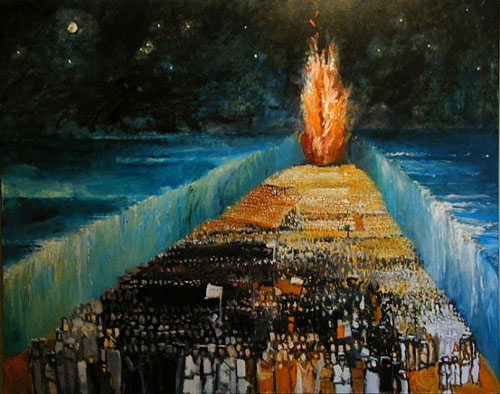
exodus-reed-seaWhen the king of Egypt was told that the people had fled, Pharaoh and his courtiers had a change of heart about the people and said, “What is this we have done, releasing Israel from our service?” He ordered his chariot and took his men with him; he took six hundred of his picked chariots, and the rest of the chariots of Egypt, with officers in all of them. The Lord stiffened the heart of Pharaoh king of Egypt, and he gave chase to the Israelites. As the Israelites were departing defiantly, boldly, the Egyptians gave chase to them, and all the chariot horses of Pharaoh, his horsemen, and his warriors overtook them encamped by the sea, near Pi-hahiroth, before Baal-zephon.

As Pharaoh drew near, the Israelites caught sight of the Egyptians advancing upon them. Greatly frightened, the Israelites cried out to the Lord. And they said to Moses, “Was it for want of graves in Egypt that you brought us to die in the wilderness? What have you done to us, taking us out of Egypt? Is this not the very thing we told you in Egypt, saying, ‘Let us be, and we will serve the Egyptians, for it is better for us to serve the Egyptians than to die in the wilderness’?” But Moses said to the people, “Have no fear! Stand by, and witness the deliverance which the Lord will work for you today; for the Egyptians whom you see today you will never see again. The Lord will battle for you; you hold your peace!”

Then the Lord said to Moses, “Why do you cry out to Me? Tell the Israelites to go forward.

Then Moses caused Israel to set out from the Sea of Reeds. They went on into the wilderness of Shur; they traveled three days in the wilderness and found no water. They came to Marah, but they could not drink the water of Marah because it was bitter; that is why it was named Marah. And the people grumbled against Moses…

Exodus 14:5-15; 15:22-24 (JPS Tanakh)

The miracle of the splitting of the Red Sea is the culmination of the Exodus. One week after the calamitous plague of the First Born, once again Pharaoh is chasing after the Jews to enslave them. As he advances, the Jews are trapped between the sea and the advancing Egyptian army.

Groups of Jews suggest a variety of responses to the impending disaster. God tells Moses to cease praying and travel toward the sea. In a heroic act of faith, Nachshon, prince of the tribe of Judah, throws himself into the sea, and it splits. (Talmud – Sotah 37a)

-Rabbi Dave Rudman
“Chumash Themes #11: Splitting of the Sea”
Commentary on Torah Portion Beshalach
Aish.com

One of the arguments I sometimes hear (though fortunately, not lately) about how Christians are ultimately superior to the ancient Israelites, has to do with faith. Basically, I’ve heard that Christians have an abundance of faith in God through Jesus Christ and the Israelites had none. The “proof” of the latter has to do with the continual grumbling of the Israelites (as I’ve tried to illustrate above) and how it seems to be a characteristic of them for the next forty years. That first generation out of Egypt never seems to get it right. It appears amazing after all, since they witnessed miracles of God that would stagger the senses. They saw the plagues against Egypt. They saw the parting of the Reed Sea. The entire population of Israel directly encountered God at Sinai and received the Torah “as one man.”

How could they not know that God is was with them?

The response to that question is much bigger than I’m able to answer, particularly in a blogging format, but through metaphor, midrash, and a little Chasidic mysticism, I want to use a tiny bit of the Exodus narrative to tell a story about us…about you and me…about people of faith.

When the Jewish people left Egypt, they were the spiritual equivalent of children. Their active participation in the Ten Plagues and the Exodus was negligible. The plagues were accomplished in a completely miraculous way through the agency of Moses and Aaron. The Exodus itself was predicated on the covenant that God promised Abraham to redeem his descendants from slavery. (Genesis 15:13-14)

Therefore, the Jewish people needed to mature and interact with God on their own.

-Rabbi Rudman

And he said to them, “Do you not understand this parable? How then will you understand all the parables? The sower sows the word. And these are the ones along the path, where the word is sown: when they hear, Satan immediately comes and takes away the word that is sown in them. And these are the ones sown on rocky ground: the ones who, when they hear the word, immediately receive it with joy. And they have no root in themselves, but endure for a while; then, when tribulation or persecution arises on account of the word, immediately they fall away. And others are the ones sown among thorns. They are those who hear the word, but the cares of the world and the deceitfulness of riches and the desires for other things enter in and choke the word, and it proves unfruitful. But those that were sown on the good soil are the ones who hear the word and accept it and bear fruit, thirtyfold and sixtyfold and a hundredfold.”

Mark 4:13-20 (ESV)

sower-seedThe full “Parable of the Sower” can be found in Mark 4:1-20 and I find it an interesting parallel to what Rabbi Rudman said about the Children of Israel being “spiritual children” at the point when they’re leaving Egypt. They were a people but not yet a nation. Their bodies had been freed from slavery but not their minds and hearts. They moved forward with joy but were terrified at every setback.

Here’s another way of looking at the choices we make as cited in a more “mystic” source:

A king had lost a costly pearl. He sent his three sons to look for it. The first son was of the opinion that his father did not need him anymore, and he did not return to him. The second son did not think about the pearl at all, he only wanted to be back home with his father. The third son understood that he had been sent out for this purpose: to become completely independent. So he searched for the pearl and found it and brought it to his father.

It is very much like that with humanity. One person is deeply involved in this world. For him it would have been better if he had never been born. Another strives his whole life to get back home to his Source, to his Father; but he is thereby thinking only about himself. Still other men seek after and find the precious pearl. They return the holy sparks of God which have been scattered in the world back to their original Source again. Such men are the true redeemers of mankind.

Paul Philip Levertoff
“Repentance and Redemption”
Religious Ideas of the Chasidim
Chapter 1, Sections 12 and 13
as quoted from Messiah Journal, Issue 112 (Fall 2013/5773), pp 79-80

Now how does all that compare to us?

young-levertoffYou may have been a Christian for so long that you’ve forgotten what it was like to be a brand new believer. You may have initially come to faith as a child within the context of a Christian family, so you may never have encountered God without the support of a church and loved ones, just you and Him alone and unfiltered. Taking the Master’s parable as a model, and given all that I’ve just said, you may have never faced nurturing a new and fragile faith that just about anything could blow away if you let it…like when the Adversary comes to take the word back out of your heart, or when you don’t allow the word to take root, or when you let the problems and worries of the world around you distract you and choke your faith to death. The challenge of letting faith and the word grow in good soil is to protect it long enough to become strong.

I suppose that’s one of the advantages I have in coming to faith later in life, although it comes with many disadvantages as well. Faith is something I’ve had to fight for within myself and it remains a struggle, sometimes between me and God.

Therefore, the Jewish people needed to mature and interact with God on their own. This was the purpose of the second phase of the Exodus, the splitting of the sea. In order to bring the Jews to this degree of independence, God directs them on a specific journey…

-Rabbi Rudman

I frequently refer to a life of faith as a journey taken along a path and I think the metaphor serves quite well. I sometimes feel that the first generation out of Egypt were never meant to enter the Holy Land of Israel, and that the trial of slavery in Egypt was just too much for them to overcome on the journey, even though God was with them.

But what was Egypt to them and why would it have left such an indelible brand on its slaves, at least as certain “mystic” viewpoints in Judaism see it today?

Mitzrayim (Egypt) expresses constriction, limitation. The spiritual Egyptian exile is the animal soul’s restricting and concealing the G-dly soul so severely that the G-dly soul is compressed to the degree that it is diminished and obscured. “Exodus from Egypt” is the removal of the constriction and bounds; i.e. the intellect in the brain illuminates the heart, bringing about fine character traits translated into actual practice.

“Today’s Day”
Sunday, Sh’vat 4, 5703
Compiled by the Lubavitcher Rebbe
Translated by Yitschak Meir Kagan
Chabad.org

They had been slaves all their lives, their parents, their grandparents, and all of their people had been slaves in Egypt for almost as long as their collective memory could recall. I sometimes feel as if they existed to prepare their children to inherit the promises God made to Abraham, Isaac, and Jacob.

But I’ll never know, I suppose. That’s just my imagination. I’ll never know if the journey was for the sake of the children who left Egypt and the children who were the first generation of Israelites born in freedom after several hundred years of enthrallment. The journey had a purpose, but it may not have been the one that we think of when we read of the forty years of wandering.

But what about us? It would be an immense tragedy to try to apply the forty years of wandering and the ultimate death of that first generation as a metaphor of us as individual believers. It would mean that the lives of some Christians who don’t quite make it in their faith are only illustrations for the witnesses to their lives. That sounds unfair to them and maybe I’m being unfair to the first generation to leave Israel as well. I don’t know.

But I do know that the journey has a purpose, even when it doesn’t appear that such a purpose exists. Each miracle, each tragedy, each meal of manna, each harsh encounter with Moab or the Amalakites…all of that shaped and molded the journey and shaped and molded the Israelite faith in the presence and purpose of God who was among them.

It is just the same with our journey as well. In reading and re-reading the Torah cycle each year, we are witnesses to the Israelite journey and as witnesses, we can try to learn the lessons their path is teaching us about our own trip through life. As we see their struggle, it is one of human beings contending with God. Can God save them from the latest calamity or must the Israelites take matters into their own hands and return to Egypt? Can Moses and Aaron be trusted to lead the people, or should Korach and his associates take over?

As far as we’re concerned, when difficulties happen to us, who should we trust and what should we do?

Sometimes you see that things have been taken out of your hands and are following a supernatural order. At this point, just do your best at what you have to do—and stay out of G‑d’s way.

-Rabbi Tzvi Freeman
“Getting Out of the Way”
Based on letters and talks of the Rebbe
Rabbi M. M. Schneerson
Chabad.org

WateringThis doesn’t mean we have no responsibility to act on our own behalf or on the behalf of others as circumstances require, but on the other hand, it doesn’t mean we have license to always drive ourselves into each problem as if God doesn’t exist, either. There is a time to act and a time to let God act and have faith that, even though things seem hard or even impossible, He will prevail.

Moses said to the people, “Do not fear. Stand still, and see the salvation of G-d that He will show you today: for the Egyptians whom you have seen today, you shall never see them again. G-d will fight for you, and you shall be silent.”

Exodus 14:13-14

Talmud Yerushalmi – Ta’anit 2:5 explains:

  • One group felt they could not win this battle. So rather than be captured alive, they wanted to commit suicide by casting themselves into the sea. To this, the response was “stand still.”
  • Another group of Jews desired to return to Egypt and surrender. To them, the response was, “the Egyptians whom you have seen today, you shall never see them again.”
  • A third group desired to go to battle. But Moses told them, “God will fight for you.”
  • For those who wanted to pray, Moses said, “Be silent.”

I told you midrash would be involved.

Listen to God and do what you are required, as best as you can comprehend, to address your life as it exists each day because it is faith in God that gives us courage to act. This helps us to mature and interact with God on our own. But remember that it is also faith and courage to “stand still” and to “be silent” and let God take care of you as well.

Searching for the Writer of Life

writer-of-lifeThe Jews recognized that God no longer spoke to them in the same way as in the past. The prophets who persisted in seeing heavenly visions and hearing heavenly voices saw and heard in a manner very different from those of earlier times. As a consequence (cause?) of the cessation or permutation of prophecy, the Jews began to seek the word of the Lord not from people but from texts. The sacred traditions of the past were compiled and redacted, and the Torah was created. The words of the great prophets of the past were similarly compiled and redacted. This process, whose ultimate result was the formation of the Bible, raised two important questions. First, which books were to be considered canonical? Second, how were the canonical books to be interpreted, and who was authorized to interpret them?

-Shaye J.D. Cohen
Chapter 5: Sectarian and Normative, pg 126
From the Maccabees to the Mishnah, 2nd Ed

It is one of the oldest puzzles in the world. Investigators have been wrestling with it practically since the Bible was completed. As it happens, it did not start as an investigation into the authorship of the Bible. It simply began with individuals raising questions about problems that they observed in the biblical text itself. It proceeded like a detective story spread across centuries, with investigators uncovering clues to the Bible’s origin one by one.

It began with questions about the first five books of the Bible: Genesis, Exodus, Leviticus, Numbers, and Deuteronomy. These books are known as the Pentateuch (from Greek, meaning “five scrolls”) or the Torah (from Hebrew, meaning “instruction”). They are also known as the Five Books of Moses. Moses is the major figure through most of these books, and early Jewish and Christian tradition held that Moses himself wrote them, though nowhere in the Five Books of Moses themselves does the text say that he was the author. But the tradition that one person, Moses, alone, wrote these books presented problems.

-Richard Elliott Friedman
Introduction: Who Wrote the Bible? pp 15, 16-17
Who Wrote the Bible?

Yes, this is a continuation of yesterday’s morning meditation. I was prompted by the mention of Friedman’s book on Derek Leman’s blog post to check and see if my local public library had a copy available. It did and so I checked it out over my lunch hour (I work about a ten minute walk from the Boise Public Library’s main branch).

Depending on your thoughts and feelings about the origins of the Bible we have today, this could be dangerous stuff. In fact, questioning the traditions we have about the Bible has historically been very dangerous stuff.

At the first stage, investigators still accepted the tradition that Moses wrote the Five Books, but they suggested that a few lines were added here or there. In the eleventh century, Isaac ibn Yashush, a Jewish court physician of a ruler in Muslim Spain, pointed out that a list of Edomite kings that appears in Genesis 36 named kings who lived long after Moses was dead. Ibn Yashush suggested that the list was written by someone who lived after Moses. The response to his conclusion was that he was called “Isaac the blunderer.”

-Friedman, pp 18-19

But that’s not the half of it.

He (Bonfils) still thought that the passages in question were written by “one of the later prophets.” He was only concluding that they were not written by Moses. Still, three and a half centuries later, his work was reprinted with the references to this subject deleted.

Van Maes suggested that a later editor inserted phrases or changed the name of a place to its more current name so that readers would understand it better. Van Maes’ book was placed on the Catholic Index of Prohibited Books.

De la Peyrere’s book was banned and burned. He was arrested and informed that in order to be released he would have to become Catholic and recant his views to the Pope. He did.

Spinoza had been excommunicated from Judaism. Now his work was condemned by Catholics and Protestants as well. His book was placed on the Catholic Index, within six years thirty-seven edits were issued against it, and an attempt was made on his life.

Simon was attacked by other Catholic clergy and expelled from his order. His books were placed on the Index. Forty refutations of his work were written by Protestants. Of the thirteen hundred copies printed of his book, all but six were burned.

-Friedman, pp 18-21

jewish-traditionAt least up to the 17th century, it was worth your life to suggest that Moses didn’t literally write every single word that appears in the first five books of the Bible. Jewish, Catholic, and Protestant tradition vehemently defended this viewpoint and if you were a scholar who studied such matters, it was better to keep any opinions that deviated from tradition strictly to yourself.

But what about now? Are we as a body of believers more tolerant of serious, scholarly study of the Bible?

The answer is probably yes and no. I don’t believe that anyone in the modern era has ever been put in prison or (gulp) executed for having non-traditional beliefs about the Bible, but you rarely hear controvertial views on scripture spoken of in a Sunday morning sermon. For that matter, how much controversy about the Bible makes its way into the Rabbi’s discussion of the Torah portion on Shabbat?

In addition to the written scriptures we have an “Oral Torah,” a tradition explaining what the above scriptures mean and how to interpret them and apply the Laws. Orthodox Jews believe G-d taught the Oral Torah to Moses, and he taught it to others, down to the present day. This tradition was maintained only in oral form until about the 2nd century C.E., when the oral law was compiled and written down in a document called the Mishnah.

-from “Torah: Oral Torah, the Talmud”
Judaism 101

Within these four methods of understanding Torah, there exist countless possible avenues of understanding. For example: There are many different ways to understand the Torah according to Peshat. That’s why there are many Torah commentators who concentrate on Peshat — Rashi, Ibn Ezra, Rashbam and many more – and they will very often (it seems, more often than not…) disagree on the literal meaning of a verse. In fact, according to Kabbalastic teachings there are 600,000 ways to understand Peshat, 600,000 ways to understand Remez, 600,000 ways to understand Drush, and 600,000 ways to understand Sod!

Any insight in Torah is acceptable as long as it (makes sense and) does not contradict any of our fundamental beliefs.

-Rabbi Naftali Silberberg
“How is the Torah Interpreted?”
Chabad.org

My wife tells me that in Judaism, one does not interpret Torah outside of tradition, so at least from an Orthodox point of view (her perspective was likely learned from the local Chabad Rabbi), it would be unacceptable practice to consider interpreting Torah from any viewpoint other than established Jewish halachah.

But what about Christianity?

The Bible is God’s Word. But some of the interpretations derived from it are not. There are many cults and Christian groups that use the Bible, claiming their interpretations are correct. Too often, however, the interpretations not only differ dramatically but are clearly contradictory. This does not mean that the Bible is a confusing document. Rather, the problem lies in those who interpret and the methods they use.

We need, as best as can be had, the guidance of the Holy Spirit in interpreting God’s Word.

Because we are sinners, we are incapable of interpreting God’s word perfectly all of the time. The body, mind, will, and emotions are affected by sin and make 100% interpretive accuracy impossible. This does not mean that accurate understanding of God’s Word is impossible. But it does mean that we need to approach His word with care, humility, and reason. Additionally, we need, as best as can be had, the guidance of the Holy Spirit in interpreting God’s Word. After all, the Bible is inspired by God and is addressed to His people. The Holy Spirit helps us to understand what God’s word means and how to apply it.

On the human level, to lessen the errors that come in our interpretations, we need to look at some basic biblical interpretive methods. I’ll list some of the principles in the form of questions and then apply them one at a time to a passage of Scripture.

-Matt Slick
“How to Interpret the Bible”
Christian Apologetics and Research Ministry

You can click on the link I provided to read Mr. Slick’s ten principles for interpreting the Bible and everything else he has to say. I selected this resource basically because it was at the top of the Google search results for the “how do christians interpret the bible” search string. However, Mr. Slick and the carm.org web site don’t address the role of tradition in interpreting the Bible (except unintentionally by mentioning more than once that in Christian tradition, the Holy Spirit is required and considered always available to interpret the Bible).

How the Bible is translated from its ancient languages to English, for example, is driven by theology and tradition. Consider how Christian and Jewish translators address the text of the “Old Testament” let alone how they interpret its meaning. Sure, for the most part, reading a Christian Old Testament and a Jewish Tanakh will produce a similar experience, but it won’t be identical. Also consider, for example, how the text of Isaiah 56 is interpreted between Christians and Jews. Christianity largely believes that the Messiah, that is, the Christ, is being described, while its traditional in Judaism to say that Israel itself is the “suffering servant.”

Sofer-Sefer-TorahNot only is the origin of the Bible understood by various traditions, but what the text is supposed to mean is also interpreted in that manner, at least for the most part. I don’t doubt that there are certain individuals who are willing to take a wider look and a less dogmatic approach to the Bible, and certainly there are numerous scholars who will broach the subject of the authorship of the Bible, but how many of us, the “rank and file” of the church (or synagogue) are willing to take such a risk?

I say “risk” because if we aren’t able to detach our traditions from our faith, at least temporarily, in the study of the Bible, then we are likely to find ourselves approaching the edge of a very steep precipice and risk falling into the abyss of crisis. For some people, faith hangs in the balance.

But so does enlightenment. Frankly, if your faith can’t stand being shaken up a time or two, it probably isn’t very strong. Also, no one grows spiritually by playing it safe. Sure, it’s comfortable, and nice, and warm, and cozy inside the cocoon of tradition and pre-programmed belief systems, but who we are as disciples of the Master requires a modicum of courage at a minimum. Paul commended the Bereans (Acts 17:11) for examining the scriptures daily in order to verify what Paul was teaching. Can we do any less when addressing the scriptures themselves, including their sometimes mysterious authors?

Some people who do this, exit faith completely, unable to reconcile their relationship with God with the dissonance about the Bible. Some people abandon critical examination of the Bible and retreat into their former comfort zone, manufacturing some explanation about why such an examination is in error if not heretical. But some people actually grow.

I’m finding that Cohen’s and Friedman’s books seem to work well when read in parallel. However, it is important (to me, anyway) to stay grounded in the world of faith and not to stray too far into the area of objectification of the Bible. I still “just plain read” the Bible every day and more recently, I go to church every week. Every other week, I meet with a friend who has been a Christian for forty years. All this acts as an anchor on the shore as I also choose to explore deep (well, deep for me) waters.

In his book (Chapter 5), Cohen writes:

Judaism is a relativistic construct of human beings, and no variety of Judaism is any more correct or authentic than any other. This is the perspective of the historian.

Judaism is a body of absolute truths revealed by God and/or sanctioned by tradition, and those interpretations of Judaism that are more nearly approximate these absolute truths are truer and more authentic than those that do not. This is the perspective of the believer.

Following those definitions, of himself, Cohen writes:

In this book, I write as a historian.

I can see how the above definitions can be applied to how we view Christianity as well as Judaism, so it is possible to look at the Bible and its origins from either the historian’s or the believer’s point of view. I’m a believer but it is my opinion that my life as a believer can be enhanced by also looking at the Bible as a historian (with the aid or real historians and scholars such as Cohen and Friedman). It’s an adventure and as such, it presents a set of challenges and dangers.

If that doesn’t scare you off, I invite you to participate in the adventure along with me as I continue to read and comment upon Cohen and Friedman and their revelations about the Bible, tradition, history, and faith. May we all learn together and may we all draw closer to the One who is the Author of our lives and the Lover of our souls.

Crying Out to God

Standing before GodWhen the son of Reb Michel Blinner of Nevel was in mortal danger, he asked Rabbi Menachem Mendel of Lubavitch, the “Tzemach Tzedek,” for a blessing. The Tzemach Tzedek responded, “Awaken the power of trust in G‑d with simple faith that He, blessed be He, will save your son. Thought helps. Think good and it will be good.”

And so it was that Reb Michel’s son was saved.

-Rabbi Yosef Yitzchaak Schneerson of Lubavitch
Igrot Kodesh (letters), vol. 7, pg. 197
Quoted from Chabad.org

A request is an expression of what we want, but the most effective prayer is an expression of what we desperately need. Rabbi Aharon Leib Shteinman, one of today’s great Torah sages, once told a visitor, “Last year you said you wanted this. So I asked you then, ‘Who says G-d wants this too?’ This year you said you needed this. In that case you should be successful in getting it, because our Father makes sure His children have what they need.”

-Rabbi Mordechai Dixler
“Who Needs Him?”
ProjectGenesis.org

I wrote my “morning meditation” Shemot: Trusting God yesterday, and so it wasn’t until last night that my wife sent me a link to Rabbi Tzvi Freeman’s article Is the Law of Attraction a Jewish Idea?

According to Wikipedia, the Law of attraction “is the name given to the belief that “like attracts like” and that by focusing on positive or negative thoughts, one can bring about positive or negative result.” It’s also the source of more books and materials than you can shake a stick at including The Law of Attraction: The Basics of the Teachings of Abraham by Esther and Jerry Hicks (no, I haven’t read it) and the very famous Think and Grow Rich by Napoleon Hill (no, I haven’t read this one, either).

But as Rabbi Freeman says, the “law of attraction places the human being smack in the center of the universe, pulling all the strings. You create your own reality.” For this to work, a person must make himself his own god and then have complete faith in that god. Sounds silly from a Christian’s point of view, but what if there’s something to all this “attraction” business after all?

The Law of Attraction is a popular idea that states that a person’s attitude attracts matching happenstance. Pessimism attracts misfortune, while optimism attracts good fortune.

The power of attitude to change the flow of a person’s life is a tacit assumption of much of Torah literature, particularly in that most influential source of common wisdom, the Psalms. “One who trusts in G‑d, kindness surrounds him!” (Psalm 32:10) “Fortunate is the man who puts his trust in G‑d!” (Ibid 40:5)

The sages of the Talmud similarly appear to take this law for granted. For example, in dismissing as useless superstition a folk-omen to determine whether one’s journey will meet with success or doom, the sages advise, “But don’t do it.” Why not? “Because perhaps the omen will be negative, the person will worry, and his fortune will go sour.” (Horayot 12a)

The idea is correct, at least according to Jewish philosophy and mysticism, but people tend to put their focus and trust on themselves rather than the One and true living God.

I quoted Rabbi Kalman Packouz in my earlier meditation, and I mentioned his list of 7 Principles for Trusting in God:

  1. The Creator of the universe loves me more than anybody else in the world possibly can.
  2. The Almighty is aware of all my struggles, desires and dreams. All I need is to ask Him for help.
  3. The Almighty has the power to give me anything I want.
  4. There is no other power in the universe other than the Almighty. Only He can grant me success and give me what I want.
  5. The Almighty has a track record for giving me more than I am asking for.
  6. The Almighty gives with no strings attached. I don’t need to earn it or deserve it. He will give it to me anyway.
  7. The Almighty knows what is best for me and everything He does is only for my good.

For Rabbi Freeman’s conceptualization of the “law of attraction” to work, we must trust in the God of Heaven for all things rather than in ourselves. If we trust that God will provide, then it stands to reason He will, at least according to Rabbi Freeman. If we are constantly worried, on the other hand…

“Therefore I tell you, do not be anxious about your life, what you will eat or what you will drink, nor about your body, what you will put on. Is not life more than food, and the body more than clothing? Look at the birds of the air: they neither sow nor reap nor gather into barns, and yet your heavenly Father feeds them. Are you not of more value than they? And which of you by being anxious can add a single hour to his span of life? And why are you anxious about clothing? Consider the lilies of the field, how they grow: they neither toil nor spin, yet I tell you, even Solomon in all his glory was not arrayed like one of these. But if God so clothes the grass of the field, which today is alive and tomorrow is thrown into the oven, will he not much more clothe you, O you of little faith? Therefore do not be anxious, saying, ‘What shall we eat?’ or ‘What shall we drink?’ or ‘What shall we wear?’ For the Gentiles seek after all these things, and your heavenly Father knows that you need them all. But seek first the kingdom of God and his righteousness, and all these things will be added to you.

“Therefore do not be anxious about tomorrow, for tomorrow will be anxious for itself. Sufficient for the day is its own trouble.

Matthew 6:25-34 (ESV)

Tree of LifeI mentioned Jewish mysticism before. Here is the parallel to the above from the Zohar:

The Lower World is always ready to receive and is called a precious stone. The Upper World only gives it according to its state. If its state is of a bright countenance from below, in the same manner it is shone upon from above; but if it is in sadness, it is correspondingly given judgment. Similarly, it is written, “Serve G‑d with joy!”—because human joy draws another supernal joy. Thus, just as the Lower World is crowned, so it draws from above.

-Zohar, volume 3, 56a

I’m not holding up Kabbalah as, in any sense, equal to the words of the Master, but I do want to show that there are different directions from which we can approach trusting God and having confidence that He will provide. It’s in that confidence that we are healed.

And there was a woman who had a discharge of blood for twelve years, and though she had spent all her living on physicians, she could not be healed by anyone. She came up behind him and touched the fringe of his garment, and immediately her discharge of blood ceased. And Jesus said, “Who was it that touched me?” When all denied it, Peter said, “Master, the crowds surround you and are pressing in on you!” But Jesus said, “Someone touched me, for I perceive that power has gone out from me.” And when the woman saw that she was not hidden, she came trembling, and falling down before him declared in the presence of all the people why she had touched him, and how she had been immediately healed. And he said to her, “Daughter, your faith has made you well; go in peace.”

Luke 8:43-48 (ESV)

Maybe I’m taking this too far, but look again at what Jesus says in verse 48: “Daughter, your faith has made you well.”

He didn’t say “I have made you well” but rather Your faith has made you well.”

Let’s take another example:

And as Jesus passed on from there, two blind men followed him, crying aloud, “Have mercy on us, Son of David.” When he entered the house, the blind men came to him, and Jesus said to them, “Do you believe that I am able to do this?” They said to him, “Yes, Lord.” Then he touched their eyes, saying, “According to your faith be it done to you.” And their eyes were opened. And Jesus sternly warned them, “See that no one knows about it.”

Matthew 9:27-30 (ESV)

Look at the question Jesus asks in verse 28: “Do you believe that I am able to do this?” The two blind men had to ascent that they did believe Jesus could restore their sight. Once they did (I guess Jesus didn’t necessarily take them at their word), the Master said, “According to your faith be it done to you.” In other words, the ability of Jesus to heal these two men was directly related to their faith in his ability to do so.

Woman prayingOK, I don’t want to create a formula or mechanical set of steps for healing and manipulating God, but this does seem to positively connect back to what Rabbis Freeman and Packouz have been saying about trusting God and its effects. No, I’m not saying that God is powerless in the face of a faithless humanity, but I am saying that it seems as if those of us who are aware of God are in some mysterious sense “partners” in His activity in our lives.

In my examples from the Gospels, we seem to see that a lack of faith would have resulted in few or no miracles from Jesus and that, conversely, great faith (even without the conscious awareness of Christ in the case of the woman with the “issue of blood”) produces great miracles. We further see this relationship between faith and “attracting” the power of God here:

And he did not do many mighty works there, because of their unbelief.

Matthew 13:58 (ESV)

Again, I don’t want to suggest that we can exploit some sort of “system” for getting God to do what we want Him to do. After all, how many people of sincere and fervent faith have prayed for the healing of a loved one and instead of a bodily healing, the person being prayed for died? (I know of a number of such people and families)

I’ve said before that there are no guarantees and that we trust in God because, as believers, we simply have no choice. Except we have a choice and we often choose not to trust God. It gets more complicated when we realize that trust or lack thereof, isn’t a matter of our just doing or not doing something, since even a person with supreme trust in the Almighty is still expected to take an active role, not only in prayer, but any other activity involved in achieving what we need.

A meditation for when things get rough:

The world was brought into being with Goodness. And the ultimate good for Man is that he should not be shamed, but feel as a partner in the fulfillment of the divine plan. Free bread is to us bread of shame—such is the nature of Man.

That is why nothing good comes without toil. And according to the toil can be known the harvest that will be reaped in the end.

-Rabbi Tzvi Freeman
“Toil”
Based on letters and talks of the Rebbe
Rabbi M. M. Schneerson
Chabad.org

Groaning by itself won’t do a bit of good. A groan is only a key to open the heart and eyes, so as not to sit there with folded arms, but to plan orderly work and activity, each person wherever he can be effective…

“Today’s Day”
Thursday, Tevet 23, 5703
Compiled by the Lubavitcher Rebbe
Translated by Yitschak Meir Kagan
Chabad.org

Blessed by GodI suppose I’m writing all of this because I’m trying to convince myself to just “let go and let God,” as the popular Christian saying goes. But it’s still not that easy.

Where were you when I established the earth?

Job 38:4

One who reads the book of Job cannot but have compassion for just and pious Job, who appears to be unfairly subjected to suffering. All the rational arguments that his friends offer to account for his innocent suffering appear hollow, and the only acceptable answer is God’s remark to Job, “Where were you when I established the earth?”

In other words, a human being can see only a tiny fragment of the universe, an infinitesimally small bit of time and space. Our vantage point is much like a single piece of a huge jigsaw puzzle, a tiny fragment of the whole picture, which makes no sense on its own. Only when the entire puzzle is assembled do we realize how this odd-shaped piece fits properly. Since no human being can have a view of the totality of the universe in both time and space, we cannot possibly grasp the meaning of one tiny fragment of it.

This explanation does not tell us why the innocent may suffer, but only why there cannot be a satisfactory explanation. Acceptance of suffering therefore requires faith in a Creator who designed the universe with a master plan in which everything that happens has a valid reason. This belief may not comfort a sufferer nor prevent the sufferer from becoming angry at the Designer of the universe. The Torah does not in fact condemn the anger of the sufferer (Bava Basra 16b), but does require that he accept adversity with trust that God is just (Deuteronomy 32:4).

Acceptance does not mean approval, but it does allow us to avoid the paralyzing rage of righteous rage, and to go on with the business of living.

Today I shall …

… try to realize that nothing ever happens that is purposeless, and that I must go on living even when I disapprove of the way the world operates.

-Rabbi Abraham J. Twerski
“Growing Each Day, Tevet 23”
Aish.com

Which in my mind, leads to this:

Be kind, for everyone you meet is fighting a hard battle.

attributed to Plato

I’m trying to write a more optimistic counterpoint to my earlier “Shemot” commentary, but I’m not doing a very good job. I can’t seem to summon up the will, the trust, or whatever it takes to just say “God is good,” and leave it at that. I continue to look at my life and at the world around me and find things that could be better (I’m employing understatement here). We’re all fighting a hard battle and we are begging God to please be kind. We don’t always receive the kindness we ask for, sometimes even in spite of our faith and trust.

But my wife sent me the link to the “law of attraction” article for a reason, so regardless of what I see or what I think about it, perhaps it wouldn’t hurt (and maybe…just maybe it would help) to be a little more trusting and optimistic.

My wife was listening to “When the Heart Cries” by Sarit Hadad on YouTube the other evening. Somehow, it seems appropriate to include that in this “extra meditation” as well.

Tent of David: Returning to Faith

TeshuvahFirst, the Christian church has forgotten that Jesus was and is a practicing Jew. Second, Christians have forgotten the centrality of Israel in God’s plan to redeem the world and her continued covenant status as God’s chosen people. Third, Christianity has an extremely low view of the Torah itself and the commandments God gave to the Jewish people. Fourth, the Christian gospel message, having replaced the broad and majestic vision of the kingdom of heaven with a knowledge-based individualistic salvation, has been emptied of its power.

-Boaz Michael
Chapter 2: The Church Needs to Change (pg 61)
Tent of David: Healing the Vision of the Messianic Gentile

If anything in the above-quoted paragraph shocked you as a Christian, then you probably need to get a copy of Boaz’s book and read it all the way through. However, I’m not writing this “meditation” today to shock you, but to remind you of something.

One of the objections I hear about “going to church” from believers who are not church-goers is that the church gives a whitewashed, “feel good” message, that doesn’t communicate the reality of the Bible, sin, and salvation. That may be true in other churches but it wasn’t in the one I attended last Sunday. It was anything but “whitewashed, feel-good.” The quote I opened this “meditation” with is part of that message. The message is that just because you believe, you may not have a terrifically realistic grip on the consequences of your belief. If you call yourself a Christian or a believer, but still can violate the Word of God with no feelings of guilt, anguish, or remorse, what you have may not even be what is called “faith.” Believing isn’t enough.

-from Day Zero

I mentioned in my last “church report” blog that Pastor Randy delivered anything but a “feel good” sermon about Christians and salvation. In fact, he was very pointed that “just believing” was not enough. We have to remember who Christ is and who we are in him and above all, why he had to die.

Interestingly enough, Boaz’s point about the Christian gospel message being emptied of its power seems to connect quite well to the Pastor’s sermon. Boaz continues.

Yeshua (Jesus) surely preached the gospel; his message – “Repent, for the kingdom of heaven is at hand” – is just as much “the gospel” today as it was two thousand years ago. When Peter adjured the crowds after the coming of the Spirit on Shavuoat in Acts 2:38-39, his message was not “believe in Jesus; go to heaven.” It was “Repent and be baptized every one of you in the name of Jesus Christ for the forgiveness of your sins, and you will receive the gift of the Holy Spirit. For the promise is for you and for your children and for all who are far off, everyone whom the Lord our God calls to himself.

-Michael, pg 87

Admittedly, Peter was delivering this message, the message of salvation, to a totally Jewish audience, and so there is no misunderstanding, let me verify that this message is for the “rest of us” who once were far off.

Therefore remember that at one time you Gentiles in the flesh, called “the uncircumcision” by what is called the circumcision, which is made in the flesh by hands—remember that you were at that time separated from Christ, alienated from the commonwealth of Israel and strangers to the covenants of promise, having no hope and without God in the world. But now in Christ Jesus you who once were far off have been brought near by the blood of Christ.

Ephesians 2:11-13 (ESV)

We non-Jews were also once “far off,” as Peter said, but now we too have been brought near thanks to the Messiah, the Christ.

But if Peter says “Repent, for the kingdom of heaven is at hand,” what does that mean? Does it mean what you think it means?

That is the gospel message. Repent – change the way you live and your life and begin to obey the commandments of God. For the kingdom of heaven is at hand – you can, in some way, bring God’s rule down to earth through your actions; it is possible to “live now for the realization of this Messianic Age” (quoting Levertoff, “Love and the Messianic Age” (Marshfield, Mo: Vine of David, 2009), 32).

-Michael, pg 89

That’s probably not quite what Pastor Randy was getting at in his sermon last Sunday. Pastor was talking about people who have made an intellectual assertion that Jesus is Lord without ever incorporating that knowledge into an actual, lived faith…without any realization that Jesus died for my sins and that I have a personal responsibility to repent and beg for forgiveness.

awareness-of-godThat’s not the wrong thing to do of course, but looking at what Boaz is writing, salvation means more than just the saving of individual upon individual by giving out “go to heaven free” cards. The kingdom of heaven isn’t heaven, according to Boaz, and it has little to do with personal salvation as such, at least not as much as most of us were led to believe. Making a commitment of faith to God through Christ is an entire change of lifestyle in the here and now that has the power to change everything in the here and now. Salvation isn’t just the promise that we’ll go to heaven, it’s the promise that we’ll receive the power to, in some sense, bring heaven to earth.

As Boaz says, Yeshua didn’t simply teach “believe in me and go to heaven when you die.” If you read the Gospels carefully, you’ll see that he doesn’t really mention anything about what happens to you when you die. He mentions what happens to you when you live, if you repent and come to a true and saving faith.

The church needs to change, but not because the church is bad or that Christians are bad. The church needs to change because much of Christianity has taken the message of the Gospel and reduced it down to a simple “get saved” footnote and missed the larger point of what happens while we’re alive. No, it’s not a “works-based” salvation, but one of Pastor Randy’s scripture examples in last Sunday’s sermon was from James.

What good is it, my brothers, if someone says he has faith but does not have works? Can that faith save him? If a brother or sister is poorly clothed and lacking in daily food, and one of you says to them, “Go in peace, be warmed and filled,” without giving them the things needed for the body, what good is that? So also faith by itself, if it does not have works, is dead.

But someone will say, “You have faith and I have works.” Show me your faith apart from your works, and I will show you my faith by my works. You believe that God is one; you do well. Even the demons believe—and shudder! Do you want to be shown, you foolish person, that faith apart from works is useless? Was not Abraham our father justified by works when he offered up his son Isaac on the altar? You see that faith was active along with his works, and faith was completed by his works; and the Scripture was fulfilled that says, “Abraham believed God, and it was counted to him as righteousness”—and he was called a friend of God. You see that a person is justified by works and not by faith alone. And in the same way was not also Rahab the prostitute justified by works when she received the messengers and sent them out by another way? For as the body apart from the spirit is dead, so also faith apart from works is dead.

James 2:14-26 (ESV)

You cannot have a true and saving faith unless it has changed your life. If your every action does not conform to the message of James and you are not behaving in a manner that reflects faith, then you probably should ask yourself if you ever repented at all when you “confessed Christ.” And beyond the “generic” helping to repair the world, as I learned recently (and this is also echoed in Boaz’s book), when we are adjured to help the needy, we in the church have a special duty to assist the poor, the sick, and the needy of Israel as it is said:

Then the King will say to those on his right, ‘Come, you who are blessed by my Father, inherit the kingdom prepared for you from the foundation of the world. For I was hungry and you gave me food, I was thirsty and you gave me drink, I was a stranger and you welcomed me, I was naked and you clothed me, I was sick and you visited me, I was in prison and you came to me.’ Then the righteous will answer him, saying, ‘Lord, when did we see you hungry and feed you, or thirsty and give you drink? And when did we see you a stranger and welcome you, or naked and clothe you? And when did we see you sick or in prison and visit you?’ And the King will answer them, ‘Truly, I say to you, as you did it to one of the least of these my brothers, you did it to me.’

“Then he will say to those on his left, ‘Depart from me, you cursed, into the eternal fire prepared for the devil and his angels. For I was hungry and you gave me no food, I was thirsty and you gave me no drink, I was a stranger and you did not welcome me, naked and you did not clothe me, sick and in prison and you did not visit me.’ Then they also will answer, saying, ‘Lord, when did we see you hungry or thirsty or a stranger or naked or sick or in prison, and did not minister to you?’ Then he will answer them, saying, ‘Truly, I say to you, as you did not do it to one of the least of these, you did not do it to me.’ And these will go away into eternal punishment, but the righteous into eternal life.”

Matthew 25:34-46 (ESV)

sukkoth-feastI know I’ve said a lot of this before, but I want to illustrate that Boaz Michael’s book has a much broader scope than you may have gathered from my previous review. It’s not just directed at those non-Jewish “Messianic” believers who are in the church or who are contemplating returning to church…it’s a message for all believers everywhere who may not have a complete understanding of what the Gospel is trying to tell us.

This is a message about who we are, who we are in Christ, and most importantly, what to do with the rest of our lives. It’s not a message about packing our bags and getting ready for the trip to heaven, it’s about what we do as disciples of the Master and sons and daughters of the living God. Where do we find God? Why are we needed by other people? How do we inspire hope in the world around us and be a light in the darkness?

This is the kingdom of heaven being drawn near to us and to the people around us…by who we are in our faith.

Vayechi: Being Strong Until the End

Lion of JudahThe scepter shall not depart from Judah, nor the lawgiver from his descendants, until the Moshiach comes . . .

Genesis 49:10

Every soul possesses a spark of the soul of Moshiach

—Rabbi Israel Baal Shem Tov

After the passing of Rabbi DovBer of Mezeritch in 1772, Rabbi Menachem Mendel of Horodok led a group of chassidim to settle in the Holy Land.

One day, a somewhat deluded individual climbed the Mount of Olives in Jerusalem and sounded a shofar. Soon the rumor spread that Moshiach had arrived, setting off a great commotion in the street. Rabbi Mendel went to his window and sniffed the air. “No,” he said, “unfortunately, the redeemer has not yet arrived. On that day, ‘the world shall be filled with the knowledge of G‑d as the waters cover the sea,’ and ‘all flesh will perceive’ (Isaiah 11:9 and 40:5) the reality of the Creator. I do not sense the divine truth that will permeate the world in the era of Moshiach.”

Said the renowned mashpia, Rabbi Grunem Estherman: “Why did Rabbi Mendel need to go to the window to sniff for the presence of Moshiach? Because the all-pervading truth of G‑d was already a tangible reality within the walls of Rabbi Mendel’s room.”

-Rabbi Yanki Tauber
“Moshiach in the Air”
Chabad.org

I know this commentary seems rather fanciful and not particularly realistic (can you smell Moshiach in the air?), but as I read it, I was reminded of how in certain corners of Christianity, the topic of the end times and the second coming are very prominent, almost to the point of obsession. It’s as if we haven’t read the Gospels in our own Bibles.

Then if anyone says to you, ‘Look, here is the Christ!’ or ‘There he is!’ do not believe it. For false christs and false prophets will arise and perform great signs and wonders, so as to lead astray, if possible, even the elect. See, I have told you beforehand. So, if they say to you, ‘Look, he is in the wilderness,’ do not go out. If they say, ‘Look, he is in the inner rooms,’ do not believe it. For as the lightning comes from the east and shines as far as the west, so will be the coming of the Son of Man. Wherever the corpse is, there the vultures will gather.

Matthew 24:23-28 (ESV)

Why are we so worried about the coming Messiah? He gave us great advice about what worry is all about.

But if God so clothes the grass of the field, which today is alive and tomorrow is thrown into the oven, will he not much more clothe you, O you of little faith? Therefore do not be anxious, saying, ‘What shall we eat?’ or ‘What shall we drink?’ or ‘What shall we wear?’ For the Gentiles seek after all these things, and your heavenly Father knows that you need them all. But seek first the kingdom of God and his righteousness, and all these things will be added to you.

“Therefore do not be anxious about tomorrow, for tomorrow will be anxious for itself. Sufficient for the day is its own trouble.

Matthew 6:30-34 (ESV)

But as I said before, it’s very difficult for us to change our thinking and to rise up out of the darkness as a light. It is very difficult to let the world be the world, to just do our best, and to have faith and trust that everything will work out according to God.

And will not God give justice to his elect, who cry to him day and night? Will he delay long over them? I tell you, he will give justice to them speedily. Nevertheless, when the Son of Man comes, will he find faith on earth?”

Luke 18:7-8 (ESV)

Who is Moshiach?Is waiting and rumor a test of faith? It’s been nearly 2,000 years since the ascension and we’ve been waiting ever since. Jews cry out “Moshiach now” but Moshiach has yet to come. Rabbi Mendel said that the world will be filled with the knowledge of God before the Messiah’s coming (return) but that’s just one of many different thoughts about what must happen beforehand. We can’t be that sure of our facts. In many ways, the Bible is a mystery containing clues we struggle all our lives to interpret.

This Shabbos is called Shabbos Chazak, “the Shabbos of reinforcement,” because of the custom of declaring, Chazak, Chazak, Vinischazaik (“Be strong, be strong, and may you be strengthened”) at the conclusion of the Torah reading, in acknowledgment of the completion of the Book of Genesis.

The awareness nurtured by the reading of Vayechi generates strength. When a Jew knows he has been granted a heritage of life expressed through a connection with the Torah, and that there will come a time when this connection will blossom, he will acquire the inner strength to confront the challenges presented by his environment.

By heightening the expression of this potential in our people as a whole, we hasten the coming of its fruition in the Era of the Redemption. May this take place in the immediate future.

-Rabbi Eliyahu Touger
“True Life”
Adapted from
Likkutei Sichos, Vol. X, p. 160ff; Vol. XV, p. 422ff;
Sichos Shabbos Parshas Vayechi, 5751
Commentary on Torah Portion Vayechi
Chabad.org

So Joseph and his father’s household remained in Egypt. Joseph lived one hundred and ten years. Joseph lived to see children of the third generation of Ephraim; the children of Machir son of Manasseh were likewise born upon Joseph’s knees. At length, Joseph said to his brothers, “I am about to die. God will surely take notice of you and bring you up from this land to the land that He promised on oath to Abraham, to Isaac, and to Jacob.” So Joseph made the sons of Israel swear, saying, “When God has taken notice of you, you shall carry up my bones from here.”

Joseph died at the age of one hundred and ten years; and he was embalmed and placed in a coffin in Egypt.

Genesis 50:22-26 (JPS Tanakh)

chanukah-josephs-tombThe final verses of this Torah Portion and the book of Genesis find Jacob and Joseph dead and Jacob’s descendants continuing to live in Egypt. This sets the stage for the birth of Moses and the centuries of slavery of the Jewish people under a “new king who arose over Egypt and who did not know Joseph.” If Jacob understood prophesy, he must have known what was going to come after his death, just as Joseph did. True, he was reassured by God that He would go down into Egypt with Jacob and his family, and that God would bring Jacob’s descendants back out of Egypt (Genesis 46:4), and yet what a bitter thing to go to your grave knowing your children and your children’s children will suffer.

As Rabbi Touger states, at the end of this Torah portion, it is customary to declare “Chazak, Chazak, Vinischazaik (“Be strong, be strong, and may you be strengthened”).”

Where ever you are in your life and whatever your experiences are, however you anticipate your future, whether it be long or brief, you…we…all of us must be strong.

But that can be so very hard. Seek first the kingdom of God and His righteousness.

God be merciful, and may Moshiach come soon and in our days. Amen.

Good Shabbos.

So This Is Christmas

jewish-christmasAnd that “calendar conflict” seems to bother some Jews. Of course our problem with Christmas is nothing like the one that afflicted my parents in Poland. The only way we are assaulted today is by way of our eardrums, forced to endure the seemingly endless carols and Christmas songs that have become standard fare for this season. There are no attempts at forced conversions. No one makes us put up a miniature replica of the Rockefeller Center tree in our living rooms. No one beats us up because we choose not to greet others with a cheerful “Merry Christmas.” But still…

I hear it all the time. Jews verbalizing their displeasure with public displays of Christian observance. Jews worried that somehow a department store Santa Claus will defile their own children. Jews in the forefront of those protesting any and every expression of religiosity coming from those with a different belief system than ours. Christmas, they claim, is by definition a threat to Judaism and to the Jewish people.

And I believe they are mistaken.

-Rabbi Benjamin Blech
“Is Christmas Good For the Jews?”
Aish.com

Jesus has become a stranger to Jews just as he has become the property of Christians. What needs to happen is for many Christians to examine whether the Jesus of their faith has replaced Judaism or whether he is Judaism-friendly. It won’t be enough to say that Jesus was raised a Jew and that He kept Torah. The problem is that much Christian theologizing . . . and hymnody . . . enshrines a Jesus who outgrew or replaced Judaism. And as long as Christians think that way, don’t be surprised if Jews think of Jesus as at best a former Jew. And that is a concept as cold as a Brooklyn December.

-Rabbi Dr. Stuart Dauermann
“Toward Making Christmas Once Again A Jewish Holiday”
The Messianic Agenda

“So, this is Christmas,” to quote John Lennon. You’d expect Christians to be blogging about Christmas left and right, but what about so many Jews blogging about Christmas? In America, you can’t avoid Christmas no matter who you are, but what could possibly make Christmas a good thing for a Jew?

I’ve been critical of Christmas lately, not so much on theological or historic grounds as on the expectation that is presented by Christmas; the directive that one must be happy and of good cheer because of the holiday. If you read all of Rabbi Blech’s commentary, you know that at one point in the lives of his parents, Christmas in Poland was not such a good thing.

My parents told me many times how much they dreaded the Christmas season.

Living in a little shtetl in Poland, they knew what to expect. The local parish priest would deliver his sermon filled with invectives against the Jews who were pronounced guilty of the crime of deicide, responsible for the brutal crucifixion of their god and therefore richly deserving whatever punishment might be meted out against them.

No surprise then that the Christian time of joy meant just the opposite to the neighboring Jews. The days supposedly meant to be dedicated to “goodwill to all” were far too often filled with pogroms, beatings, and violent anti-Semitic demonstrations.

Rabbi Dr. Dauermann writes on a somewhat overlapping theme, seeing as how the birth of the Jewish Jesus has not been good news for Jews for a very long time.

Besides conceiving of Jesus as Judaism-friendly, there is a second challenge for those Christians who would have their Jewish friends see him as not only good news for the Jews, but also Jewish good news. And that challenge is for fine and aware Christians to reconnect with how the Christ who was born in Bethlehem, died at Calvary, and rose from the dead, remains the Lion of the Tribe of Judah, the Son of David, the King of the Jews who one day will return to bring to fruition all the promises God made to that chosen nation. The many Christians who deny that this is how the story ends should not be surprised when there is no room for their Jesus in the Jewish inn.

But while Rabbi Dauermann’s apparent goal is to reintroduce Jesus as the Jewish Messiah King to multitudes of Christians, Rabbi Blech sees Christmas presenting a different opportunity for Jews.

To be perfectly honest, Christmas season in America has been responsible for some very positive Jewish results. This is the time when many Jews, by dint of their neighbors’ concern with their religion, are motivated to ask themselves what they know of their own. To begin to wonder why we don’t celebrate Christmas is to take the first step on the road to Jewish self-awareness.

My parents were “reminded” of being Jewish through the force of violence. Our reminders are much more subtle, yet present nonetheless. And when Jews take the trouble to look for the Jewish alternative to Christmas and perhaps for the first time discover the beautiful messages of Chanukah and of Judaism, their forced encounter with the holiday of another faith may end up granting them the holiness of a Jewish holiday of their own.

family-chanukah-mea-shearimChristmas lights and music and decorations may have a wide variety of meaning to you, depending on who you are and what you believe. Very often, the religious aspects of the holiday conflict with the politically correct priorities of the culture around us, and a battle ensues over something as simple as saying “Merry Christmas” vs. “Happy Holidays.” But what Rabbi Blech points out as good news for Jewish people is actually good news for all of us. Christmas, even if we don’t celebrate it and even if don’t like it, offers us an opportunity, in observing those who do use Christmas as an overt expression of their faith, to take a look at who we are and what we believe. Even an atheist can take this opportunity to re-examine themselves and to either re-affirm their beliefs or reconsider their choices.

For those of us who are people of faith, we can do the same. If you’re a Christian, you can take Rabbi Dauermann’s advice and start viewing the Savior of the world as a Jew with good news for Jewish people. If the Christmas songs say “Born is the King of Israel,” then take the opportunity to look at Jesus as Israel’s King who will restore Israel as a nation above all other nations, and who will rebuild the Temple in Holy Jerusalem for the Jewish people.

If you’re a Jew who is not acquainted with the idea that there are Jews who seriously believe Jesus is the Jewish Messiah and are disciples of the “Maggid of Nazaret,” you might want to become familiar with some of these Jews, such as the Rabbi who loved Jesus (his identity and family line may surprise you).

If you are among the “Bah! Humbug!” brigade as I sometimes am, no matter how dismal you find the Christmas season, try to put that aside this year and see if watching those who truly do worship the “King of Israel” may, by example, have something to say to you. Take some time to ask yourself who you are, what you believe, and out of that, what you’re doing with your life.

If you don’t like the answer, then it’s time for a change.

Regardless of what you do or do not believe and celebrate about this day, may God grant you His mercy and kindness now and all the days of your life.