Tag Archives: forgiveness

In the Matter of True Teshuvah

Chovos HaLevavos lists seven things of which a sinner must be cognizant if he is to attain true teshuvah.

  1. He must be regretful and ashamed of his evil behavior.
  2. He must know that the deed was wrong, and recognize the wickedness of his act.
  3. He must know that Hashem is aware of his misdeed and that punishment (without forgiveness) is inevitable.
  4. He must understand that teshuvah is the cure that he requires.
  5. He should make an accounting of all the good that Hashem has done for him.
  6. He must contrast this with his own disobedience, and use it as a spur to his resolve not to sin further.
  7. He must take concrete steps to avoid sinning again.

One who undertakes to satisfy these requirements can attain true teshuvah.

-from “A Mussar Thought for the Day,” p.192
Tuesday’s commentary on Parashas Vayechi
A Daily Dose of Torah

“One who undertakes to satisfy these requirements can attain true teshuvah.”

True teshuvah.

I’ve written a lot about repentance, both in the past and more recently. But it’s something that’s difficult to maintain and easy to neglect, thus my mind and heart have drifted off into other topics lately.

But it’s as if God were “programming” my study materials to remind me and bring me back on course:

No enslavement and no tyranny are as ruthless and as demanding as slavery to physical desires and passions. Someone who is unable to resist a craving, and who must, like a brute beast, do whatever the body demands, is more profoundly enslaved than someone subject to a human tyrant. Addicted people are an extreme example of those who have become slaves to their bodies.

Dignity comes from freedom, in the capacity to make free choices, and hence, in our ability to refuse to submit to physical desires when our judgment indicates that doing so is wrong. Freedom from domination by the body is the first step toward spiritual growth.”

-Rabbi Abraham J. Twersky
from “Growing Each Day” for Tevet 8
Aish.com

PrisonAs Rabbi Twersky suggests, we each choose our own prison, but often, when attempting to make teshuvah and overcome a lifetime of error and disobedience, it seems as if you’re perpetually making a prison break. It can be very discouraging.

But then again…

In our Yom Kippur prayers, we say, “until the day of [a person’s] death, He waits for him; if he repents, He will accept him immediately.” This prayer reveals the tremendous mercy that Hashem shows toward his creations. A person may have been a sinner his entire life, doing evil constantly without regard for Hashem or His Torah. As his life is coming to an end, when he does not even have strength left to sin, he contemplates his future, and repents of his past. Surely this is a less than perfect teshuvah! Yet Hashem not only will accept it, He does so immediately, without reservation. As we say elsewhere in the Yom Kippur prayers, “we are filled with iniquity, but You are filled with mercy.”

-from “A Closer Look at the Siddur,” p.195
Tuesday’s commentary on Parashas Vayechi
A Daily Dose of Torah

This isn’t an excuse to wait for the last moment to repent, but rather is it encouragement and hope that no matter how long you have been buried in habitual sin, and no matter how far you have fallen, and no matter how distant you are from God, you can return and He will accept true teshuvah immediately.

But as we saw above, “true teshuvah” is no small thing. As I’ve said previously, it is hardly a matter of just saying “I’m sorry” and then it’s all good. Teshuvah is a life-changing event, and well it should be. It is turning your life around completely and starting off in a brand new direction, the polar opposite of the path you previously trod.

But we can’t do it alone. Without God, no one of us has the will to completely subdue our evil inclination and to make true teshuvah.

Create in me a clean heart, O God,
And renew a steadfast spirit within me.
Do not cast me away from Your presence
And do not take Your Holy Spirit from me.
Restore to me the joy of Your salvation
And sustain me with a willing spirit.

Psalm 51:10-12 (NASB)

I’m sure you recognize this as part of David’s sincere plea to God for forgiveness for the multiple and heinous willful sins he committed in the matter of Bathsheba. There is no sacrifice in the Temple for willful sin, and the only sacrifice that is acceptable before God for such sins is “a broken spirit and a broken and a contrite heart” (verse 17).

And this is exactly what God is waiting for from each of us:

As we pray each day, the knowledge that Hashem is not wrathful or vengeful, but is rather a merciful God Who desires our sincere repentance, should act as a powerful stimulant, giving us the fortitude to mend our ways and live our lives as servants of Hashem.

-“A Closer Look at the Siddur,” ibid

But as for me, I am like a green olive tree in the house of God;
I trust in the lovingkindness of God forever and ever.
I will give You thanks forever, because You have done it,
And I will wait on Your name, for it is good, in the presence of Your godly ones.

Psalm 52:8-9

PrayerIn the Days of Awe surrounding Rosh Hashanah and Yom Kippur, the shofar blast is meant to be something of a “wake up call” from God to the Jewish people to repent, for time is short. But actually we can repent at an moment, and God will listen and be merciful. However, this happens only if we’re diligent and serious about teshuvah, about turning around and returning to Him. We all must answer the call and answer today and everyday.

Amen.

Birds and Ladders: A Continued Story of Repentance

The idea of prayer is to inwardly have a private dialogue with the Creator. Speak to Him just as you might speak with a friend who is paying attention and listening.

All around you may be noise, traffic, planes, telephones. Inwardly, too, may be a preoccupation with hassles, business dealings, quarrels, competition, desires.

But prayer brings you suddenly to… quiet. The inward silence creates a barrier to the flow of noise, and it is as if there is silence and calm all around. Tranquility is yours!

(see Rabbi S. Wolbe – “Shal’hevesya,” p.34)

Daily Lift #180: Pray One-on-One
Aish.com

Rabbi Mordechai Rottman relates in his article Four Steps to Change that making teshuvah or repentance, requires for basic steps:

  1. Regret
  2. Leaving negativity behind
  3. Verbalization or confession
  4. Resolution for the future

About Verbalization, he says:

Why is it important to say it?

There is a power to saying things as opposed to just thinking about them. Verbalizing a thought brings the idea to a new level of reality, awareness and understanding.

The verbalization that is done after committing a transgression makes one more fully aware of what was done. It therefore heightens the regret and strengthens the resolution not to commit the act again.

This verbalization is not to be done before anyone other than God. Not even your rabbi needs to know about what you have done. It’s just between you and your Creator.

Granted, you don’t come to this stage of repentance until you’re fully immersed in the first two, but coupling R. Rottman’s commentary with R. Wolpe’s, we see that in talking to God, we don’t have to stand on ceremony, as it were. We can speak from the heart, one-on-one, confessing only to Him our feelings of regret and remorse, expressing our sorrow and guilt, and pleading with Him to be our strength in the face of our trials; our rock in overcoming our challenges.

In one of his commentaries on Torah Portion Vayaitzai, Rabbi Zelig Pliskin stated:

The Chofetz Chayim cited the idea expressed by many commentators that the ladder Yaakov saw in his dream symbolizes the situation of every person in this world. There are two actions a person performs on the ladder. Either he goes up from the bottom to the top, or else he goes down from the top to the bottom. Each day in a person’s life he faces new challenges. If he has the willpower and self-discipline to overcome those challenges, he goes up in his spiritual level. If, however, a person fails to exercise the necessary self-control, he lowers himself. This is our daily task, to climb higher every day. (Toras Habayis, ch.10)

-Rabbi Zelig Pliskin
“Climb higher on the spiritual ladder each day by growing from life’s challenges,” p.72
Based on Genesis 28:12
Growth Through Torah

However, this sentiment causes me to re-evaluate a teaching of the Master:

For whoever has, to him more shall be given, and he will have an abundance…

Matthew 13:12 (NASB)

weightliftingI know Yeshua (Jesus) was talking about blessings, but when a person finds the self-control, with God’s help, to overcome challenges, although we expect some sort of relief from strife, what most likely happens is another, stronger challenge appears. It’s like being an athlete who has exceeded a personal goal. Having done so, it’s not a matter of resting on his or her laurels, but finding the next goal, the next challenge, and tackling it. But on a moral and spiritual level, overcoming a personal challenge is often exhausting, and after a tough battle, all you want to do is rest.

Then the devil left Him; and behold, angels came and began to minister to Him.

Matthew 4:11

Even after he successfully overcame his trials, Yeshua got to rest. When facing a spiritual challenge, we have two fears. The first is that we will fail (again). The second is that we will succeed only to immediately face a much more serious challenge.

Why not stay where we are? It may not be the best situation, but at least it’s a known quantity.

Two reasons. The first is that by continuing in a state of sin or disobedience to God, you are not only damaging your relationship with Him, but likely with others around you including friends and loved ones. In fact, it might be the realization of their pain that spurs you into action and seeking repentance in the first place.

The second reason, as Rabbi Pliskin relates, is that being on the ladder is like being in a boat on the river. If you stop rowing, you don’t stay in one spot, you go backward. It’s only through constant effort that you make progress. Although a real ladder doesn’t work this way, spiritually, that’s what happens.

In spite of R. Pliskin’s metaphor, few of us start climbing the ladder and successfully master a rung a day. Conversely, few of us start at the top and steadily, unerringly make our way to the bottom. For most people, we struggle up two and down one, or up one rung, then down two, often for quite some time as we seek to master some part of ourself. As much as we’d like it to be otherwise, progress, spiritual or in any other way, is rarely linear like climbing a flight of stairs.

A person whose main focus is self-improvement and a striving for perfection will always check over his behavior to see what needs correction. Keep asking yourself, “Have I made mistakes?” When you do find a mistake, feel positive for the opportunity to correct the mistake for the future.

-R. Pliskin
“Keep checking your behavior to find ways to improve,” pp.73-4

Oh, if only it were that easy. The Rav makes it seem like we may or may not find that we’ve made mistakes, and yet what I know of human nature in general and my nature in specific tells me that we make mistakes every day, big and small. Of course, the more often we check our moral compass and the path we are traveling, the greater the likelihood that our course corrections will be frequent but small. That assumes, of course, that we generally are on the right course and don’t find ourselves in uncharted and undesirable territory.

It’s much more difficult when you have fallen far, to start climbing the ladder again. The distance from the bottom to the top seems so long, so insurmountable, and overcoming inertia to begin working from the basement of your soul up to that first rung is an almost unimaginable effort.

A word of caution. While self-criticism is a prerequisite for character improvement, one must be careful to have a healthy balance. Excessive self-condemnation will be extremely detrimental to one’s well-being. You need to master an attitude of joy for doing good and then self-criticism will add to that joy. Every fault that is found and worked on will give you the pleasure of knowing that you are improving.

ibid, p.74

I blame myselfStep two on Rabbi Rottman’s list of the four steps of teshuvah is “leaving negativity behind.” He is speaking of changing your environment and the various influences in your life to minimize or eliminate those that contribute to your being tempted to return to sin. However, from my point of view, one of those influences is yourself and what you are saying about your circumstances.

If you look at the ladder from the bottom and say that it’s impossible for you to climb even in a small way, then you are right. It is impossible. Then there you sit in the dust and continue sinking to some sub-level of iniquity.

As much as we’d all like God to “zap” our lives so that we find spiritual and moral growth easy and effortless, such is not the case. Grace may be free but repentance is really hard work. Leaving negativity behind is largely a matter of the stories you tell yourself about yourself. If you tell yourself you are helpless and hopeless, then you’re right. If you tell yourself you are capable and with God’s help, you can begin to climb the ladder and improve, you are also right.

The ladder is either a barrier that holds you down or an opportunity to lift yourself up. You don’t have to achieve spiritual miracles and jump from the bottom to the top in a day, a week, or even a year. Truth be told, the ladder is as long as your life and the challenges never end. But the one you face today that seems so huge and so terrifying, might seem like a small kitten a year from now if you are diligent in your work.

If you look at some temptation facing you and resist it this morning, by tonight you can look back and say that you have accomplished something. Yes, the temptation may be there tomorrow, but that’s another rung on the ladder.

Similarly, Rabbi Yisroel Salanter used to say that a person is like a bird. A bird has the ability to fly very high. But it must continually move its wings. If a bird stops flapping its wings, it will fall. Every person is similar. (cited in Tnuas Hamussar, vol.1, p.300)

When you see birds flying, let that serve as a reminder to you to make the necessary movements to raise yourself spiritually.

-ibid, p.72

Therefore let him who thinks he stands take heed that he does not fall. No temptation has overtaken you but such as is common to man; and God is faithful, who will not allow you to be tempted beyond what you are able, but with the temptation will provide the way of escape also, so that you will be able to endure it.

1 Corinthians 10:12-13

Five days a week, I wake up at 4 a.m. and make it to my local gym by five. It’s gotten easier to overcome sleepiness and to battle the drive in the dark to the gym to do this, and then to face the free weights, the workout machines, and the cardio exercise, fitting it all into an hour, but in the beginning it was very difficult.

Some days my workout is better than others. Some days, I skip a scheduled day, as I did last Friday, but pick it up the following day to make up for my lack of consistent effort.

It is the same when we face our challenges. We accept them upon ourselves for many reasons. We want to be a better person than the one we are today. We have many flaws which hurt our relationship with God and with our families and friends and we want to repair the damage. We are continually hurting ourselves, and need to become stronger and to heal.

soarChange can be terrifying but it can also be exciting. It’s like moving to a place you’ve never lived before. You have no connections or support, but you also have a brand new environment to explore and learn from.

The effort you make and the story you tell yourself about it will make the difference between falling and soaring. But you don’t have to make the effort alone. Talk to God. Ask for his help. With our eyes on our Master, we can learn to climb high and fly with eagles.

Repentance and Forgiveness in the Face of Tragedy

Even if a sharp sword rests upon a man’s neck he should not desist from prayer.

Berachos 10a

In the history of the Jewish people there were many times that could be called “lost opportunities.” Such opportunities existed, for example, before the sin of the Golden Calf, before the Jewish people entered the land, as well as during the times of Kings Saul and Solomon. Yet, the opportunity faded or did not turn into what it could have been.

-by Berel Wein adapted by Yaakov Astor
from “Hezekiah: The Messiah Who Was Not”
JewishHistory.org

I think just about anyone can be put in a situation where they feel helpless and hopeless. Even the most faithful Christian, Jew, or other religious person can face a crisis that tests their faith and trust. Sometimes that situation is the consequence of sin. Other times, it is just a life occurrence.

I’m reminded of Brittany Maynard, the 29-year-old woman who was diagnosed with brain cancer and chose to commit assisted suicide. Her diagnosis was terminal and she was given a scant six months to live. There have been a lot of arguments for and against her decision, however, I’m not writing to debate the choice she made. Suicide, at least in the case of an intelligent, mentally and emotionally capable individual, is often an attempt to take control of an otherwise uncontrollable situation. Brittany was going to die a terrible death and there was absolutely nothing she or anyone else could do about it…

…except preempt the conclusion by dying sooner and by different and more merciful means.

The sword was at her neck. But unlike the aphorism from Talmud which I quoted above, she chose to desist from prayer, if she had prayed at all, and allowed the “sword” to fall, so to speak.

Is there ever a circumstance where we are justified in giving up?

Not according to Berachos 10a which is based on the following scripture verses:

So the Lord sent a pestilence upon Israel from the morning until the appointed time, and seventy thousand men of the people from Dan to Beersheba died. When the angel stretched out his hand toward Jerusalem to destroy it, the Lord relented from the calamity and said to the angel who destroyed the people, “It is enough! Now relax your hand!” And the angel of the Lord was by the threshing floor of Araunah the Jebusite. Then David spoke to the Lord when he saw the angel who was striking down the people, and said, “Behold, it is I who have sinned, and it is I who have done wrong; but these sheep, what have they done? Please let Your hand be against me and against my father’s house.”

2 Samuel 24:15-17 (NASB)

Though He slay me, yet will I trust in Him.

Job 13:15

Even total reliance on the grace and mercy of God does not guarantee a perfect life free from stress, harm, or tragedy. It certainly doesn’t guarantee that God will remove the consequences of our errors, mistakes, and sins. It also, sadly, doesn’t mean that bad things will never happen to good people, though as the Master said no one but God is good (Matthew 19:17, Mark 10:18, Luke 18:19).

What does it feel like when the sword is resting on the back of your neck and you know it can and probably will fall within the next few seconds? It must feel pretty desperate.

It must feel like how the Children of Israel felt when Moses discovered their sin with the Golden Calf. It must feel like how the Children of Israel felt after they refused to take the Land of Canaan and then, once God’s protection was removed, when they tried to enter Canaan only to be routed in humiliation (Numbers 14). It must have felt like how Hezekiah felt when he was told he was about to die from his illness (Isaiah 38:1-2).

deathMost rational people don’t blame a sick person for being sick. Oh, there are probably some exceptions, such as how we might feel when we hear a chronic cigarette smoker is diagnosed with lung cancer, or when we find out an alcoholic has liver disease. Even Hezekiah’s illness was a consequence of his behavior or the lack of it, at least according to Midrash (Sanhedrin 94a):

On the night of Passover, in the middle of the night, an angel smote the army of Assyria and 185,000 died from a plague (II Kings 19:35).

Imagine — the Jewish people were staring annihilation in the face. An overwhelming implacable foe completely surrounded their last stronghold. There was a constant propaganda barrage against them in their native tongue. They had doubters from within. They went to sleep Passover night with no realistic hope.

However, they woke up the morning of Passover and the threat was suddenly gone. Someone had smitten the outstretched arm of the enemy with the sword it had raised against them.

At that moment, the Talmud remarks, Hezekiah had the chance to become the Messiah. All he had to do was sing the praises of God. Moses and the people had done so after the Egyptians were drowned in the sea. Had Hezekiah done the same he would have been the Messiah and history as we know it would have proceeded differently.

However, he did not sing. That is why he was not worthy to be the Messiah. The opportunity was lost.

But although it seemed as if God’s mind were made up as far as the King’s fate was concerned, Hezekiah continued to plead:

Then Hezekiah turned his face to the wall and prayed to the Lord, and said, “Remember now, O Lord, I beseech You, how I have walked before You in truth and with a whole heart, and have done what is good in Your sight.” And Hezekiah wept bitterly.

Then the word of the Lord came to Isaiah, saying, “Go and say to Hezekiah, ‘Thus says the Lord, the God of your father David, “I have heard your prayer, I have seen your tears; behold, I will add fifteen years to your life. I will deliver you and this city from the hand of the king of Assyria; and I will defend this city.”’

Isaiah 38:2-6

God listened and he relented, adding fifteen more years to Hezekiah’s life. He removed the sword from the King’s neck, so to speak, at least for another decade and a half.

Of course, Hezekiah had a “track record” of walking before God “in truth and with a whole heart.” If he had been sinful and disobedient as was Hezekiah’s father, it is unlikely that God would have spared his life.

So too it is with us.

defeatNo, not all of our woes involve terminal illness, but when we plead and beg God to take the pressure off, He is under no obligation whatsoever to do so, especially if we are still unrepentant of our sins. Keep in mind, even a perfectly repentant person, if there is such a thing, may still pray to God for mercy in relieving their illness or other problems and God may, for His own sovereign reasons, not provide the desired answer to prayer.

But how would you like to face tragedy and disaster in life, whether you deserve it or not…with a conscience right with God or still buried in your own iniquity?

I’m not preaching to you or being judgmental. I’m as human as anyone and I make plenty of mistakes. I’m writing this as much for me as for anyone else.

Be kind, for everyone you meet is fighting a hard battle.

That quote has been attributed to Plato, Philo of Alexandria, and Ian MacLaren among others, but the words are very true. Most of us don’t show any outward sign of the battles we fight every day and when we do, it usually means we’ve come to the end of our rope. I mentioned the other day about the importance of forgiveness and gratitude, and this is like it.

When you are tempted to “drop the hammer” or “lay down the law” on someone, even if they deserve it, stop for a moment and get in touch with your own “hard battle,” and then try to realize that the other person is also fighting as hard as they can. If you expect forgiveness from God for your own sins, then forgive the other person if it is at all possible.

But before all that, repent of your own sins and ask for forgiveness from your Heavenly Father. It requires being forgiven in order to forgive.

Be very, very humble.

-Ethics of the Fathers 4:4

Rabbi Raphael of Bershed complained bitterly to his teacher, Rabbi Pinchas of Koretz, that he was unable to eradicate feelings of vanity.

Rabbi Pinchas tried to help him by suggesting different methods, but Rabbi Raphael replied that he had already tried every one without success. He then pleaded with his mentor to do something to extirpate these egotistical feelings. Rabbi Pinchas then rebuked his disciple. “What is it with you, Raphael, that you expect instant perfection? Character development does not come overnight, regardless of how much effort you exert. Eradication of stubborn character traits takes time as well as effort. Today you achieve a little, and tomorrow you will achieve a bit more.

“You are frustrated and disappointed because you have not achieved character perfection as quickly as you had wished.

“Continue to work on yourself. Pray to God to help you with your character perfection. It will come in due time, but you must be patient.”

The Talmud states, “Be very, very humble,” to indicate that true self-betterment is a gradual process. We achieve a bit today, and a little more tomorrow.

Today I shall…

..try to be patient with myself. While I will do my utmost to rid myself of undesirable character traits, I will not become frustrated if I do not achieve instant perfection.

-Rabbi Abraham J. Twerski
from “Growing Each Day” for Kislev 7
Aish.com

praying aloneIf you aren’t patient with yourself and you don’t believe you can repent and be forgiven by God (and even if you know that although God may forgive you, some people never will), then you will cease to pray when you feel the sword rest on your neck or even when you see it coming. You won’t trust God that somehow, in some way, this too is for the good. Remember my previous quote of Rabbi Twersky who was quoting the Baal Shem Tov:

The Baal Shem Tov taught that God acts toward individuals accordingly as they act toward other people.

I think that includes how you act toward yourself. If you give up and won’t forgive yourself, how will God forgive you?

Why do parents love their children?
Because the lower world reflects the higher world. And above, there is a Parent and He loves His children.

Why do parents of an only child have such unbounded love for their child?
Because this is the truest reflection of the world above: Above, each one of us is an only child, and His love to us is unbounded.

-Rabbi Tzvi Freeman
“The Only Child”
Chabad.org

As We Have Forgiven Others

God is your shadow at your right hand.

Psalms 121:5

The Baal Shem Tov taught that God acts toward individuals accordingly as they act toward other people. Thus, if people are willing to forgive those who have offended them, God will similarly overlook their misdeeds. If a person is very judgmental and reacts with anger to any offense, God will be equally strict. The meaning of, God is your shadow, is that a person’s shadow mimics his or her every action.

At a therapy session for family members of recovering alcoholics, one woman told the group that she had experienced frustration from many years of infertility and tremendous joy when she finally conceived. Her many expectations were shattered, however, when the child was born with Down’s syndrome.

“I came to love that child dearly,” she said, “but the greatest thing that child has done for me is to make me realize that if I can love him so in spite of his imperfections, then God can love me in spite of my many imperfections.”

If we wish to know how God will relate to us, the answer is simple: exactly in the same way we relate to others. If we demand perfection from others, He will demand it of us. If we can love others even though they do not measure up to our standards and expectations, then He will love us in spite of our shortcomings.

Today I shall…

…try to relate to people in the same manner I would wish God to relate to me.

-Rabbi Abraham J. Twersky
from “Growing Each Day” for Kislev 3
Aish.com

I thought it appropriate to pause from the strife and drama that often characterizes the religious blogosphere and social media in general and take on a different tone. It is, after all, the American holiday of Thanksgiving which should, in theory, mean something more than gorging on turkey, stuffing, and pumpkin pie.

Given recent events and on which side of the fence people find themselves, it might be very difficult for some of them (us) to experience any sense of thankfulness or gratitude. In fact, the primary emotion many folks seem to be experiencing is about as far from peace and being grateful as you can get. There’s a lot of virtual yelling on the web and much, much worse going on in the real world.

Derek Leman
Derek Leman

I think it’s important to take a step back from all this and realize that how we treat each other matters.

A few days ago, Derek Leman posted a summary of his second day at the Society of Biblical Literature (SBL) Convention in San Diego. I was pleasantly surprised by what Derek wrote. Here’s a revealing sample:

Confession time. If you’ve read my blog over the years, you’ve seen me in fight mode before. I can be combative, rude, unpleasant. I have engaged in labeling and ad hominem. It is one of my character deficiencies.

So one theme of SBL this year has been running into people I have “done combat” with and making reconciliation. Seth Postell is a brilliant scholar and he and I see eye to eye on many things (but legitimately disagree on others). I did not remember that in an angry exchange I once (this is embarrassing) said he was anti-Semitic. He reminded me, not in anger, but graciously, when I asked him, “Have we ever actually met before.”

“Oh, yes, Derek, we’ve met,” he chuckled. “Don’t you remember?” And then he kindly let me know he had no hard feelings and that we could move forward as friends. It’s great to have people like that in the world.

The next person I made peace with might surprise you, if you’ve followed me for long. Tim Hegg. He’s always here working with Accordance Bible Software. I am an Accordance user and needed some help learning how to do more in-depth Hebrew searches. I approached Tim who simply smiled and received me as a friend.

If these names don’t mean anything to you, don’t worry. The point is that Derek encountered other theologians at the conference with whom he has “sparred” in the past and who nevertheless, were gracious and approachable.

I’m convinced that in times of strife, we all need to learn to get past our emotions and see the people with whom we are arguing, not as opponents or enemies, but as other people who are just like us, people who are also children of God and made in His Holy Image. Would we dare treat a holy person with disrespect? Would we have the audacity to spit in the face of the Holy Image?

Lakanta (Tom Jackson): What do you think is sacred to us here?

Wesley Crusher (Wil Wheaton): Maybe the necklace you’re wearing? The designs on the walls?

Lakanta: Everything is sacred to us – the buildings, the food, the sky, the dirt beneath your feet – and you. Whether you believe in your spirit or not, we believe in it. You are a sacred person here, Wesley.

Wesley Crusher: I think that’s the first time anyone’s used that particular word to describe me.

Lakanta: You must treat yourself with respect. To do otherwise is to desecrate something that is holy.

Wesley Crusher: Is that what you think I’ve been doing?

Lakanta: Only you can decide that.

-from “Journey’s End,” March 26, 1994
Star Trek: The Next Generation

While the focus in this scene is directed at how Wesley has been treating himself with disrespect and thereby desecrating a holy person, if we look through the opposite side of the lens, we can see how often we treat others with disrespect, especially in our online transactions…

tom jackson
Tom Jackson

…and thus desecrating many holy people.

I’m as guilty of this as anyone else, and so I must accept my share of responsibility for my failures. That means I am repenting of the harsh words and attitudes I’ve expressed toward some of you and am asking for forgiveness from each of you. I also forgive anyone who has offended me. May no one be punished because of me.

But this is a lot more serious than just being rude, and even a lot more dire than committing acts of desecration. Keep my quote of Rabbi Twersky in mind as you read the following:

“Pray, then, in this way:

‘Our Father who is in heaven,
Hallowed be Your name.
‘Your kingdom come.
Your will be done,
On earth as it is in heaven.
‘Give us this day our daily bread.
‘And forgive us our debts, as we also have forgiven our debtors.
‘And do not lead us into temptation, but deliver us from evil. For Yours is the kingdom and the power and the glory forever. Amen.’]

For if you forgive others for their transgressions, your heavenly Father will also forgive you. But if you do not forgive others, then your Father will not forgive your transgressions.”

Matthew 6:9-15 (NASB)

The Baal Shem Tov probably didn’t use Yeshua as his source material but they both seemed to think along the same lines.

When we treat others with disrespect, not only are we committing desecration against a holy person but we are inviting God to treat us with disrespect. Conversely, when we act respectfully toward another person, particularly someone with whom we previously have had “problems,” what does that say about how God will treat us, “problems” and all? When we forgive someone who has contended with us, will God not then forgive us of our contentious natures?

Here’s another example:

“For this reason the kingdom of heaven may be compared to a king who wished to settle accounts with his slaves. When he had begun to settle them, one who owed him ten thousand talents was brought to him. But since he did not have the means to repay, his lord commanded him to be sold, along with his wife and children and all that he had, and repayment to be made. So the slave fell to the ground and prostrated himself before him, saying, ‘Have patience with me and I will repay you everything.’ And the lord of that slave felt compassion and released him and forgave him the debt. But that slave went out and found one of his fellow slaves who owed him a hundred denarii; and he seized him and began to choke him, saying, ‘Pay back what you owe.’ So his fellow slave fell to the ground and began to plead with him, saying, ‘Have patience with me and I will repay you.’ But he was unwilling and went and threw him in prison until he should pay back what was owed. So when his fellow slaves saw what had happened, they were deeply grieved and came and reported to their lord all that had happened. Then summoning him, his lord said to him, ‘You wicked slave, I forgave you all that debt because you pleaded with me. Should you not also have had mercy on your fellow slave, in the same way that I had mercy on you?’ And his lord, moved with anger, handed him over to the torturers until he should repay all that was owed him. My heavenly Father will also do the same to you, if each of you does not forgive his brother from your heart.”

Matthew 18:23-35

ForgivenessI hope the interpretation of the above-quoted scripture is abundantly obvious. If we expect to be forgiven our debts or offenses to God, we must forgive the debts of others and how they may have offended us. The Master’s parable about forgiveness starkly outlines the consequences for failure.

Derek presents us with a positive example of forgiveness and I encourage you to click the link to his blog I provided above and read the full content.

Once relieved of the burden of grudges, bad attitudes, and an unforgiving spirit, I suspect that you and I will be able to find many things to be grateful for today and for the days that follow.

The Lord is your keeper;
The Lord is your shade on your right hand.
The sun will not smite you by day,
Nor the moon by night.
The Lord will protect you from all evil;
He will keep your soul.
The Lord will guard your going out and your coming in
From this time forth and forever.

Psalm 121:5-8

Amen.

Tisha B’Av, Lamentations, and Hope

How did Judaism manage to survive the destruction of its central sanctuary? According to the Book of Deuteronomy, which we always begin to read on the Shabbat before Tishah B’Av, it was to be the only link between heaven and earth. All sacrifices were to be offered there and no place else. The exclusive cult restricted to a single Temple seemed to reinforce the fragile belief in a single, omnipotent God…

…The destruction of his Temple in 586 B.C.E. could have ruptured the ties between God and Israel…

…I should like to suggest that the answer to this historical conundrum lies in the etymology of a single Hebrew word.

-Ismar Schorsch
“Transformation of Devir from Shrine to Book,” pg 583, August 1, 1998
Commentary on Torah Portion Devarim
Canon Without Closure: Torah Commentaries

Schorsch goes on to explain that the Hebrew word for the Holy of Holies in the Tabernacle and later the Temple is “devir”. He then traced a path from “devir” (Shrine) to “davar” (word), and across the ages to third century C.E. Babylonia and the founding of the rabbinic academy in Sura where the Persians used the proper noun “devir” for “book” (safra). For Judaism then, as Schorsch sees it, the survival mechanism employed once the Temple had been leveled by the Romans in 70 C.E. and the Jewish people were forcibly dispersed, was the investment in Talmud and Mishnah as the embodiment of the Holiness of the Temple; the conversion of the direct link between Jews and God from Shrine to Book.

This idea was also explored by the late Dr. Alan F. Segal in his book Rebecca’s Children: Judaism and Christianity in the Roman World. Dr. Segal suggested that with the destruction of the Temple and the elimination of a Judaism centered around the sacrifices and the Aaronic priesthood, two new religions emerged: Gentile Christianity and Rabbinic Judaism.

In a way, it’s not as farfetched an idea as it might seem but fails to take into account God’s planning for the continuation of His people Israel as well as the people of the nations who are called by His Name. While Judaism and Christianity both have “morphed” considerably over the past nearly two-thousand years and have traced divergent trajectories across history, we must remember that our course through space and time are always in the control of God and a single destination awaits us both: Messiah and the Kingdom.

As we rapidly approach the fast of Tisha B’Av, sorrow piles upon sorrow at the severe losses suffered by the Jewish people and the nation of Israel which, even now, is in a state of war and viciously maligned by the worldwide news media, multiple world leaders and celebrities, and people in general simply for defending themselves against the thousands of missiles and other attacks the terrorist group Hamas has launched against them.

And how do these events color Tisha B’Av this year? Like any other year, as Schorsch says elsewhere in his commentary:

No other religion is quite so self-critical. The Bible goes out of its way to record the flaws and errors of our people’s loftiest leaders. (pg 589)

As most of us should be doing whenever something goes wrong in our lives, the first place Israel looks for a cause when tragedy strikes is in the mirror and their relationship with God.

If a person sees that suffering befalls him, let him examine his deeds.

-Berachos 5a

Yes, one day the Messiah will rebuild the Temple, but it’s been so long and who knows when he will suddenly return? Yet in spite of all the tragedies that have befallen the Jewish people across the long centuries, God has always preserved them in many and varied ways, including, I believe, through what we refer to as Rabbinic Judaism and a devotion to studying Torah and Mishnah.

Most Christians believe that any legitimate connection between the Jewish people and God crumbled with the Temple and that their only hope is conversion to Christianity and worship of Jesus Christ. For most people in the Church, Rabbinic Judaism in all its expressions is a dry and vain effort, bereft of any presence of God; an invention of men who “missed the boat” of Messiah, so to speak, and now are continually bailing water out of a slowly sinking ship.
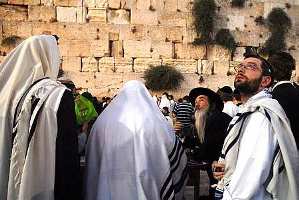
Tisha b'Av at the Kotel 2007But let us suppose, on the eve of one of the most grief-stricken observances on the Jewish religious calendar, that God didn’t abandon His people Israel after the advent of Messiah and the destruction of Jerusalem. Let us suppose that God chose to go into exile with His people, even as He maintained His presence among the devout ones of the Gentile disciples of Messiah. Is that so unreasonable an assumption? Does God have to abandon Sinai in order to occupy Calvary?

Hence when our sages read the story of Jacob and Esau as the tale of Israel and Rome in the time of the Christian emperors, as they did, they did not conceive that theirs was a reading distinct from the author’s original intention. And how could such a conception have taken root, when, after all, they knew that Torah, oral and written, came from God to Moses, or was the work of the Holy Spirit, or otherwise transcended the particularities of time, space, and circumstance?

-Jacob Neusner
from the Series Forward of (pg xii)
Israel After Calamity: The Book of Lamentations

Professor Neusner is attempting to explain to an audience with little knowledge of Mishnah how it is possible and even reasonable for the Sages to create interpretations of books of scripture that (apparently) couldn’t have been the author’s original intent, and yet have those interpretations be correct for the generation in which they were made (and later).

That requires believing that the inspiration of the Holy Spirit both encodes the Bible with messages that continually unfold with the passage of human history and believing that God really did infuse the Jewish sages with the authority, wisdom, and Spirit to create valid interpretations of the Bible after formal canonization was considered closed.

That’s a lot for most Christians to take in, since our general conceptual platform is founded on Greek thought and philosophy which is sort of a “connect the dots” way of thinking coupled with being “binary.” That is, things are either this way or that, left or right, up or down, and we continually move forward in time, leaving the past permanently preserved in amber, forever unchangeable, including by interpretation, as we progress step by step toward the return of Jesus. There is no room in our thinking for a God who can take both forks in a road simultaneously (with apologies to Yogi Berra).

If we accept that God is infinite, that God is Spirit, and believe all of the other supernatural and metaphysical things we’re supposed to believe, then it behooves us not to put God in a box (Schrödinger’s or any other kind), and make Him obey the rules we’ve created for the Bible and ourselves. If God is transcendent, then so is His Word and, for that matter, so is His relationship with His people Israel. God’s relationship with Israel survived the destruction of Solomon’s Temple. It can survive the destruction of Herod’s as well, plus such and thus many thousands of years hence.

Neusner’s book takes us through an analysis of Lamentations Rabbah, and in Parashah II Lamentations 2:3 (pp 95-6), we read:

But when the Israelites repent, the Holy One, blessed be he, will put the horns back in place: “All the horns of the wicked I will also cut off, but the horns of the righteous shall be lifted up” (Ps. 75:11).

The horns which the Righteous One of the world had cut off [will be restored].

When will he restore them to their place?

When the Holy One, blessed be he, exalts the horn of his messiah: “And he will give strength to his king and exalt the horn of his anointed” (1 Sam. 2:10).

grafted olivesEven in sorrow and mourning, Israel always has hope in the Promises of God for return and restoration, the promises of King Messiah and the New Covenant age.

This is purely poetic interpretation on my part, but when I read of the wicked horns being cut off and the righteous horns being restored by Messiah the Righteous One, I couldn’t help but think of this:

But if some of the branches were broken off, and you, being a wild olive, were grafted in among them and became partaker with them of the rich root of the olive tree, do not be arrogant toward the branches; but if you are arrogant, remember that it is not you who supports the root, but the root supports you. You will say then, “Branches were broken off so that I might be grafted in.” Quite right, they were broken off for their unbelief, but you stand by your faith. Do not be conceited, but fear; for if God did not spare the natural branches, He will not spare you, either. Behold then the kindness and severity of God; to those who fell, severity, but to you, God’s kindness, if you continue in His kindness; otherwise you also will be cut off. And they also, if they do not continue in their unbelief, will be grafted in, for God is able to graft them in again. For if you were cut off from what is by nature a wild olive tree, and were grafted contrary to nature into a cultivated olive tree, how much more will these who are the natural branches be grafted into their own olive tree?

Romans 11:17-24 (NASB)

As it says in Tsvi Sadan’s book The Concealed Light (pg 212):

To call Messiah Horn (keren) is supported by “There I will make a horn to sprout for David; I have prepared a lamp for My anointed” (Psalm 132:17 ESV).

But as it also says in Sadan’s book (pg 156):

Using the name Branch (netzer) for Messiah comes from a clear messianic prophecy that says: “There shall come forth a Rod (choter) from the stem of Jesse, and a Branch (netzer) shall grow out of his roots” (Isaiah 11:1 ESV).

Played back over Lamentations Rabbah and Neusner’s commentary, we can see some obvious parallels to Yeshua (Jesus), but as I said, the connections are poetic and shouldn’t be taken for more than that. Still, we are pointed back to a hope for the Jewish people and the rest of the world, that out of the ashes of the Temple will rise a King, and lifted from the lakes and oceans of Jewish tears shed over hundreds and thousands of years is lifted up the Moshiach.

…and He will wipe away every tear from their eyes; and there will no longer be any death; there will no longer be any mourning, or crying, or pain; the first things have passed away.

Revelation 21:4 (NASB)

But Israel has a part to play:

Israel is responsible for its own condition but also can so act to atone for what it has done and so regain God’s favor. A covenant governs Israel’s relationship to God, and therefore the condition of the holy people. When the covenant is broken, the result is God’s punishment; but then, when Israel atones, the covenant makes clear, Israel will repair its disastrous condition.

-Neusner, pg 104

But while the focus of disaster, repentance, and atonement is upon Israel, this also has applications on individual lives:

Rabbi Yisroel Salanter would utilize every opportunity to gain mussar insights and to motivate himself to further self-improvement. There were many occurrences when most people would think nothing of them, but Rav Yisroel would gain some lesson for growth. Rav Yisroel once was in the home of a shoemaker late at night and observed how he was doing his work by the light of the candle that was almost going out. “Why are you still working?” Rav Yisroel asked him. “It is very late and soon the candle will be extinguished.”

The shoemaker replied, “As long as the candle is still burning it is still possible to accomplish and to mend.”

Rabbi Salanter was very moved by this, and said, “If for our physical needs as long as the candle is burning one keeps mending, all the more so for our souls, as long as the light of the soul is still going we must make every effort to accomplish and mend.”

After this he would frequently repeat to himself, “As long as the candle is lit, accomplish and mend.” (Tnuas Hamussar, vol.1, p.315-6)

-Rabbi Zelig Pliskin
“Utilize the hints of others for self-improvement,” pg 379
Commentary on Torah Portion Devarim
Growth Through Torah

From Tsvi Sadan’s book (pg 10) we learn:

Light (or) to describe Messiah comes from the well-known verse, “And God saw the light, that it was good” (Genesis 1:4). Puzzled by this good light that was created before the sun and moon, the sages were drawn to another unique light, which David talks about when he says, “In Your light we see light” (Psalm 36:9).

This light within a light, says one midrash, is the light created on the first day, which David recognizes as King Messiah.

Yeshua also made this plain about himself:

Then Jesus again spoke to them, saying, “I am the Light of the world; he who follows Me will not walk in the darkness, but will have the Light of life.”

John 8:12 (NASB)

light-ohrThis year, Tisha B’Av begins the evening of Monday, August 4th and ends some forty minutes after sundown the following day. We enter our own darkness when we face Jewish grief, for although the sin of baseless hatred caused the destruction of the Temple and the exile of the Jewish people, those acts of destruction were brought about by Gentiles. For the past twenty centuries, the Goyim, including the Christian Church, has been piling sorrow upon sorrow on the Jewish people and are at it to this very day.

The Jewish people fast, pray, and repent on Tisha B’Av but as the instruments of their suffering, we should fast, repent, and pray as well, entering our own darkness so we can recognize, through faith, the light of our hope.

The redemption of Israel and, through it, all the world, depends on how well man perceives and acts upon that faith.

-Rabbi Meir Zlotowitz

Miketz and Chanukah: The Gift of Light

Joseph of EgyptThey said to one another, “Alas, We are being punished on account of our brother, because we looked on at his anguish, yet paid no heed as he pleaded With us. That is why this distress has come upon us.”

Genesis 42:21 (JPS Tanakh)

What lesson for our lives can we learn from their statement?

Rabbi Dovid of Zeviltov comments in the commentary Otzer Chaim: If a person did something wrong and recognizes that he has done wrong, he will be forgiven. However, if a person does something wrong and denies it, there is no atonement for him. When Joseph’s brothers previously said that they were innocent, Joseph responded by calling them spies. When they said that they were guilty, Joseph was full of compassion for them and cried.

Dvar Torah for Torah Portion Miketz
Based on Growth Through Torah by Rabbi Zelig Pliskin
Related by Rabbi Kalman Packouz
Aish.com

Rabbi Packouz also states that according to Rabbi Abraham J. Twerski in his book Twerski on Chumash, “there is no coincidence that Chanukah occurs during the week that we read about the epic of Joseph and his brothers.” But what can one have to do with the other? What can we learn about ourselves?

Well, for starters:

Many people deny their faults and the things that they have done wrong because they mistakenly think that others will respect them more. In reality people admire someone with the honesty and courage to admit his mistakes. It takes a braver person to say, “Yes, I was wrong.” This kind of integrity will not only build up your positive attribute of honesty, but will also gain you the respect of others. When you apologize to someone for wronging him, he will feel more positive towards you than if you denied that you did anything wrong. This awareness will make it much easier for you to ask forgiveness from others.

The Death of the MasterYesterday was Thanksgiving, an American national holiday dedicated to giving thanks to God for His bountiful goodness to us. All that we have, whether great or small, comes from the Holy One of Israel, the gracious and compassionate Provider and Creator. Even the ability to forgive and be forgiven by God is a blessing for which we should be thankful. Without such a gift, a single sin would forever separate us from God, and condemn us to our doom.

But as Rabbi Pliskin’s Dvar Torah states, we are only forgiven and freed from guilt, slavery, and destruction if we admit to our wrongdoings and ask for forgiveness. Our “free gift,” so to speak, actually comes with a price. True, as a Christian, I believe that the death of the greatest of all tzaddikim, Yeshua of Nazareth, paid that price, but forgiveness of sins is like a package wrapped in bright shiny paper decorated with a pretty bow. It just sits there until we accept it and open it up. To do that, we have to do something else. We have to admit our sins rather than deny them. For when we too say we are guilty, then the Father will welcome us back with open arms.

And the son said to him, ‘Father, I have sinned against heaven and in your sight; I am no longer worthy to be called your son.’ But the father said to his slaves, ‘Quickly bring out the best robe and put it on him, and put a ring on his hand and sandals on his feet; and bring the fattened calf, kill it, and let us eat and celebrate; for this son of mine was dead and has come to life again; he was lost and has been found.’ And they began to celebrate.

Luke 15:21-24 (NASB)

But what does any of this have to do with Chanukah?

“Rav Avraham Pam (former Rosh Yeshiva of Yeshiva Torah Vodaas) teaches us that we see this special love of God for the Jewish people regarding the many Jews at that time who had defected to Hellenism and then returned to Torah observance with the triumph of the Macabees — regarding their relationship with the Almighty after their return to the Torah. When a couple reconciles after a separation, the relationship often becomes one of peaceful coexistence, but the quality of love that they initially had for each other is rarely restored.

“Not so when Jews do teshuvah (repentance — returning to the Almighty and to the ways of the Torah). Rambam says that although a sinful person distances himself from God, once he does teshuvah he is near, beloved and dear to God. It is not that God “tolerates” the baal teshuvah (returnee), but rather that He loves him as He would the greatest tzaddik (righteous person). As the prophet says, “I will remember for you the loving-kindness of your youth, when you followed Me into the desert, into a barren land” (Jeremiah 2:2). The love of yore is fully restored.

“This is the significance of the miracle of the oil. It teaches us that with proper teshuvah our relationship with God is restored, as if we had never sinned.”

chanukah-candle-lightingAs believers, as disciples of Messiah, Son of David, the light of the world, the doorway to the Father, we too have been granted the ability to do teshuvah with the same results. It is not as if we are “damaged goods” that, once broken and dirtied, can only approach God just so far and no further. It’s as if we never left, as if we never sinned, as if we have always lived in the Father’s household as beloved sons and daughters. If I can extend the above commentary, God loves the baal teshuvah as He does His Son, His only Son, the one who saved us and redeemed us at the cost of blood and life.

During this week, people in Jewish homes will be lighting the Chanukah candles in remembrance of the miracle of the oil and the miracle of victory over the Greeks in battle. However, the Chanukah lights and the lesson learned by the brothers of Joseph should remind us of something more. As believers, when we light the menorah, we are reminded of God’s great forgiveness in our lives, and how He literally turned darkness into light in our hearts and souls.

In John 8:12, Jesus declared himself the light of the world. In Matthew 5:14-16 we discover that as his disciples, we too are the light to the world. In Jewish tradition, once the menorah is lit, it should be placed in a window for everyone to see. We too were encouraged to allow our own light to shine into the world, as a message of hope and peace, and as evidence that God does powerful miracles.

Love, hope, and redemption are powerful miracles indeed, and a tiny light shining in the darkness is evidence in our world of an overwhelming brightness shining from the Throne of Heaven.

Happy Chanukah and Good Shabbos.