Tag Archives: forgiveness

Another Chance

The Ishbitzer Rebbe, zt”l, explains the deeper meaning of yovel and why houses within cities walled since the time of Yehoshua bin Nun do not return during yovel. “Yovel teaches that everything has a time. God doesn’t remain angry at anyone forever. Even if someone’s sins force him to sell his portion or to be sold as a slave, this cannot be forever. Eventually he will be redeemed and his inherited field will return to him. But batei arei chomah are an exception. This alludes to the two chomos, the two barriers—teeth of bone and lips of flesh—that God gave us to rein in what we say, as discussed on Arachin 15…Indulging one’s arrogance by failing to hold back one’s anger at his friend is no simple matter. If the victim remained silent in the face of his rage, the sinner’s merits are transferred to the recipient of his anger.

“Unlike sins between man and his Creator, sins between man and his fellow do not have an automatic limit. These misdemeanors remain until his friend forgives him. One has only limited time to beg his friend’s forgiveness. Failure to do so causes his merits to remain with his friend. His inability to accept his wrongdoing and make it up to his friend causes him losses he would never have imagined.”

But the rebbe concluded with words of chizzuk. “Nevertheless, we find that kohanim and leviim can always sell and always redeem. This teaches that even if one has sinned, if he begins to serve God in earnest, he can always redeem what he has lost. Through the dynamic change he gains through his avodah he always has another chance!”

Daf Yomi Digest
Stories Off the Daf
“The Walled Cities”
Arachin 31

What is being said here? We learn from the construction or organization of the Ten Commandments brought down from Sinai that there are two general classifications of sin: sin between man and God and sin between man and man. Of the first, God will forgive by His own grace and mercy and not necessarily because of the merit of the sinner. We rely on God to give us something we could not possibly earn. However of the second, we will not be forgiven until (or unless) we ask for forgiveness from our fellow. In this, we must take a much more active role, otherwise forgiveness will never occur. We also learn that if we stubbornly refuse to admit our wrongdoing against our fellow, this affects our relationship with God as well, so we have in some sense, doubly sinned.

The commentary concludes that, “even if one has sinned, if he begins to serve God in earnest, he can always redeem what he has lost.” But how can this be? If you sin against a person, ignore your responsibility for that sin, and go on to seemingly “serve God in earnest,” are you really serving God while remaining unrepentant? The answer is in the last sentence of the teaching: “the dynamic change he gains through his avodah he always has another chance!”

I suppose this could be read as saying that by serving God, even though you have not sought forgiveness of the person you sinned against, your service to the Almighty somehow compensates. I don’t think that’s what is being said here, though, since the sin against your friend remains. I think it is much more likely that, by honestly and truly serving God, it will become necessary for your soul to turn to Him and in order to do so, you will have to see the stains on your own character. Once you do, and with your desire to serve God earnestly still intact, as part of that service, you must go back to the one you offended and beg forgiveness. Only then, can you return to God and have your response to Him gain real meaning.

So if you are offering your gift at the altar and there remember that your brother has something against you, leave your gift there before the altar and go. First be reconciled to your brother, and then come and offer your gift. –Matthew 5:23-24

We see that the Master is in agreement with the Ishbitzer Rebbe. Living a life in this world does not detract from living a life of holiness, as long as we keep our perspective.

It is not business, not money, nor career, nor human relationships that tears our souls from us and us from our G-d.

There is as much beauty in any of those as there is in any flower from the Garden of Eden. As much G-dliness as in any temple.

It is the way we lock ourselves inside each one, begging it to take us as its slave, refusing to watch from above, to preserve our dignity as human beings.

As you enter each thing, stay above it.

Rabbi Tzvi Freeman
“Unslavery”
Based on letters and talks of the Rebbe
Rabbi M. M. Schneerson
Chabad.org

As much as we fail and allow ourselves to become slaves of the world around us or even our own emotions and pride, God provides every opportunity for us to make amends and to succeed in serving God and serving our fellow. If we do not surrender to anger, frustration, and despair, and continue to seek Him, we will always have another chance.

Arguing with God

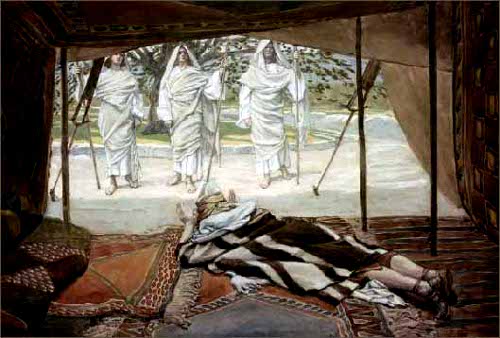
abrahams visitorsWhen G-d told Noah to build an ark before the world would be destroyed, Noah built an ark.

But when G-d told Abraham He was about to destroy the cities of Sodom and Gomorrah—cities corrupt and evil to the core—Abraham argued. He said, “Perhaps there are righteous people there! Will the Judge of All the Earth not do justice?”

Abraham felt a sense of ownership for the world in which he lived. If there was something wrong, it needed to be changed. Even if it had been decreed by the will of G-d.

-Rabbi Tzvi Freeman
“Noah and Abraham”
Based on letters and talks of the Rebbe
Rabbi M. M. Schneerson
Chabad.org

I have to admit, I was a little disturbed by how Rabbi Freeman illustrates the difference between Noah and Abraham. It makes it seem like Abraham cared more for the world he lived in than Noah. Of course both Jewish and Christian commenators generally agree that it took Noah about 120 years to build the ark and that, during that period of time, Noah was trying to convince the people around him to repent of their wickedness (he wasn’t successful). So it’s not as if God told Noah that he was going to drown everyone and Noah immediately blew off humanity, only caring that he and his family would be saved.

Still, we have a tendency, no matter how much we are otherwise instructed (Matthew 7:1-6), to judge others. Once we become aware that a person has sinned, especially a type of sin we are personally offended by (maybe because it’s a type of sin we are particularly tempted by), we cut them loose from our “this person can be saved” list and let them sail away into the spiritual darkness.

No wonder the church is called the only army that shoots its own wounded.

OK, I’m probably being unfair to the church and I’m sure that there are many, many forgiving and compassionate Christians who have great love for even the most immoral of human beings. Apparently, the Rabbis teach the lesson of compassion and love for the sinner as well.

It is human nature to believe in one’s potential to destroy, but not his ability to repair. This is especially true regarding a person who transgressed a sin which is punishable by kareis (being cut off from his people). Naturally, the sinner figures that it no longer matters what he does since he has completely severed his soul from its source. The Ohr HaChaim, zt”l, explains that the error of this attitude from a verse brought on today’s daf. “Even a person who transgressed a sin punishable by kareis must never give up. This is the deeper meaning of the verse regarding leaving pe’ah in the corner of one’s field. ‘— When you reap the harvest of your land.’ This can also be understood to refer to one who violated a sin for which the punishment is kareis. Although he has uprooted his soul from its source, this does not mean that he has uprooted his soul completely. The verse continues: ‘— you shall not reap the entire corner of your field.’ Do not continue ripping out your neshama’s connection to God by transgressing further. Even one who has violated a sin punishable by kareis has only uprooted the connection forged by acting—or refraining to act—in a certain manner which caused the cut off. But his soul is definitely still connected.

“This is clear from the Arizal’s teaching about holiness. He explains that the nature of holiness is to leave an eternal trace wherever it was. We see that every mitzvah acts to strengthen one’s bond to God, regardless of his negative behavior. The Gemara explicitly writes that teshuvah helps even for kareis—or worse. This is why teshuvha reaches the throne of glory. One who does teshuvah renews the connection of his neshmaha which was hewn out from beneath the throne of glory.”

Daf Yomi Digest
Stories Off the Daf
“Not Excised Completely”
Chullin 131

PleadExcept for the sentence of death, there was no worse consequence for a sin than to be cut off from your people (“kareis,” see examples in Genesis 17:14, Exodus 12:15, and Leviticus 23:29). There is debate on exactly what was supposed to happen if someone were worthy of kareis, but it is often thought to be some form of exile of the person from the community of Israel. It’s easy to read into this consequence a state of complete hopelessness and despair. If you are cut off from your people and from your God, what else is there? You have no place to go and there is no way back. Why continue living?

But the commentary on Chullin 131 doesn’t say there’s no hope. It does say that the person involved is in an extremely difficult and dire situation, but the “Gemara explicitly writes that teshuvah helps even for kareis—or worse. This is why teshuva reaches the throne of glory.” Even in the aftermath of the worst of all possible sins and failures, you are uprooted, but never completely cut off from God. Forgiveness is still possible. You can still turn back to Him.

The people in Noah’s time were given 120 years, as Noah built the ark, to become aware of the fatal judgment that was heading their way. They had time. They could have repented. They still chose not to. Abraham saw that God was going to destroy Sodom very soon and pleaded for whoever remained in there and who might repent and be saved (Genesis 18:16-33). In the following chapter of Genesis, you see the level of sin and depravity the inhabitants of Sodom exercised and it’s easy to imagine that the “outcry against Sodom and Gomorrah is so great and their sin so grievous” (Genesis 18:20) that they deserved complete and absolute destruction. Yet, Abraham still argued with God.

That’s a rather novel concept for a Christian. We’re generally told that God is always right and we should never argue. This has gotten us through plenty of moral puzzles in the Bible, such as those times when God has ordered the Children of Israel to completely destroy an entire people group, down to the last man, woman, child, and farm animal, because their sin was so great. But not only does Abraham question God’s judgment (very politely, though), but so does Moses, when God wants to destroy the Israelites (Exodus 32:9-10). When Jacob wrestled with the angel and won (Genesis 32:22-32), an interpretation of the event is that he was having a “moral struggle” with God. These are pictures that support humanity interacting with God on the plane of righteousness, questioning God and thereby struggling, not with God’s perfect righteous judgement, but with our own understanding of right and wrong.

Notice that in none of these examples is Abraham, Jacob, or Moses chastised or punished by God for their “effrontery” toward Him. I don’t think this means we can be casual in our relationship with God, but I do think we’re expected to be more than passive spectators in history and in life. If we can be considered “junior partners” with God in repairing the world, can we also not be involved, to some small degree, in the struggle to determine right and wrong and how justice shall be acted out in the world around us?

As people of faith, our sense of right and wrong is shaped by the Bible and how we understand its message. If some part of the Bible seems to be immoral by modern Christian or Jewish standards (or modern societal standards), what are we to do? Are we to blindly accept that the Bible is a static document with only one, static interpretation across time? Maybe we are expected to do what Jacob did and to “wrestle” with God and the text, struggling to take the underlying principles of what we are being taught and somehow apply them to a world that is far, far apart from the world in which the Bible was written.

ForgivenessThe more we develop as religious people, the more we must realize that we don’t have all the answers. The Bible doesn’t provide canned and complete responses for every possible moral and practical question. Like Abraham, we sometimes have to stand up and ask God if He really means something the way it’s written in the Bible or if there is some other alternate available. This is a very uncomfortable thing to do because we have to question matters of right and wrong in the world around us and in ourselves, rather than be satisfied that we’re right and “the other guy” is a hopeless sinner.

The next time you think the Bible is telling you to judge someone and that they deserve to be cut off from all civilized humanity or even to die for something they’ve done, or because of the person they are, it might be one of those times when you should be arguing with God (or perhaps yourself). That soul you are so willing to cut off may not be entirely uprooted from God and instead of casting it away, you may want to consider trying to replant it in more fertile soil.

For God loved the world with an abundant love, to the extent that he gave his only son so that all who believe in him will not perish, but will rather live eternal life. –John 3:16 (DHE Gospels)

Unanticipated Atonement

Shofar as sunriseIt’s all up to you. Everything about Yom Kippur, coming up this Friday night, points to you: In times of old, one High Priest serving our one G-d in His one Temple on His one holiest day on behalf of His one people elicited G-d’s atonement for the entire world. Today, one person, with one turn of his or her personal page, doing one good deed, or making one good resolution – can also change the course of the entire world for the good.

-Rabbi Zalman Shmotkin
Director, Chabad.org

Wait! Can you back up a second? What was that?

In times of old, one High Priest serving our one G-d in His one Temple on His one holiest day on behalf of His one people elicited G-d’s atonement for the entire world.

Now that’s confusing, at least to me. My reading of Leviticus 16 makes it seem rather obvious that the Yom Kippur service specifically atones for the sins of Israel, and it says nothing about atoning for the sins of the entire world. How could such a thing be possible?

There’s a profound lack of resources on the web (as far as I can tell) regarding Rabbi Shmotkin’s comment. I really hate to use Wikipedia as a source, but they’re about the only site that corroborates the Rabbi’s statement:

The following summary of the Temple service is based on the traditional Jewish religious account described in Mishnah tractate Yoma, appearing in contemporary traditional Jewish prayerbooks for Yom Kippur, and studied as part of a traditional Jewish Yom Kippur worship service.

While the Temple in Jerusalem was standing (from Biblical times through 70 C.E.), the Kohen Gadol (High Priest) was mandated by the Torah to perform a complex set of special services and sacrifices for Yom Kippur to attain Divine atonement, the word “kippur” meaning “atone” in Hebrew. These services were considered to be the most important parts of Yom Kippur because through them the Kohen Gadol made atonement for all Jews and the world.

Just to be clear, the source Wikipedia is relying on for this information is:

Arnold Lustiger, Michael Taubes, Menachem Genack, and Hershel Schachter
Kasirer Edition Yom Kippur Machzor With Commentary
Adapted from the Teachings of Rabbi Joseph B. Soloveitchik.
New York: K’hal Publishing, 2006. pp. 588–589 (summary); 590–618.

This pretty much balances with what Rabbi Shmotkin said but then maybe the Rabbi didn’t mean literally the whole world, but just all of the Jews in the world. Then again, maybe not.

Proceeding on the assumption that we’re talking about the whole world of everyone (it won’t be my last assumption), the difficult thing for me to grasp is that Yom Kippur, from the best of my understanding, provides atonement for the people of Israel (as stated in the Wikipedia quote) in part because the people of Israel want atonement. That is, there is a deliberate, cooperative desire among the Israelites to have their sins atoned for as a nation and the sense of tremendous anticipation as the High Priest enters the Holy of Holies on their behalf. It’s not as if Yom Kippur atonement works by remote control, whether you’re aware of it or not.

But that’s exactly how it would have to work if Aaron had entered the Holy of Holies in the Mishkan in the desert and made atonement for Israel and the entire population of the world.

Let’s take a few examples that are more familiar to the Christian community.

For God so loved the world that he gave his one and only Son, that whoever believes in him shall not perish but have eternal life. –John 3:16

But if anybody does sin, we have an advocate with the Father—Jesus Christ, the Righteous One. He is the atoning sacrifice for our sins, and not only for ours but also for the sins of the whole world. –1 John 2:1-2

Standing before GodHere we see the atoning sacrifice of Jesus being depicted as applying to the whole world, yet it doesn’t literally work that way, at least not without the active agreement and volition of the individuals populating the world. In other words, you have to agree to a certain set of conditions in order for the sacrifice of Christ to atone for your sins. It isn’t applied globally to all human beings whether they want it, or are even aware of it, or not.

But when Christ came as high priest of the good things that are now already here, he went through the greater and more perfect tabernacle that is not made with human hands, that is to say, is not a part of this creation. He did not enter by means of the blood of goats and calves; but he entered the Most Holy Place once for all by his own blood, thus obtaining eternal redemption. The blood of goats and bulls and the ashes of a heifer sprinkled on those who are ceremonially unclean sanctify them so that they are outwardly clean. How much more, then, will the blood of Christ, who through the eternal Spirit offered himself unblemished to God, cleanse our consciences from acts that lead to death, so that we may serve the living God!

For this reason Christ is the mediator of a new covenant, that those who are called may receive the promised eternal inheritance—now that he has died as a ransom to set them free from the sins committed under the first covenant. –Hebrews 9:11-15

Here is our High Priest in the Heavenly Temple; the Heavenly Holy of Holies, applying his own blood in place of bulls and goats, making atonement for the whole world, but it’s a world populated by people who are cooperating with and agreeing to being atoned for. It’s possible for there to be people who are not atoned for by the act of Jesus as High Priest, because (I know I’m being redundant) they haven’t agreed to being atoned for and for many people, they do not want it because they do not want to comply with the conditions required for atonement (namely coming to faith and living a Holy life).

In one of my recent blog posts I used the analogy of God as a gardener and humanity as plants in the garden. I made it a point to illustrate that we are plants who must cooperate with the gardener unlike actual plants which are completely passive as they are watered, given fertilizer, weeded, and so forth.

I realize that God desires that none should perish (2 Peter 3:9), but unlike tomato plants, we have to do something about it. Atonement and forgiveness don’t just happen by the will of God, they happen by human willingness, too. Even being healed by Jesus requires an act of faith on the part of the person being healed:

And a woman was there who had been subject to bleeding for twelve years, but no one could heal her. She came up behind him and touched the edge of his cloak, and immediately her bleeding stopped.

“Who touched me?” Jesus asked.

When they all denied it, Peter said, “Master, the people are crowding and pressing against you.”

But Jesus said, “Someone touched me; I know that power has gone out from me.”

Then the woman, seeing that she could not go unnoticed, came trembling and fell at his feet. In the presence of all the people, she told why she had touched him and how she had been instantly healed. Then he said to her, “Daughter, your faith has healed you. Go in peace.” –Luke 8:43-48

If an act of faith is required for healing, how much more should an act of faith be required for atonement, forgiveness, and reconciliation with God?

I had meant to write something more solemn and dignified, with just a hint of joy, on this final Day of Awe, as Erev Yom Kippur is at hand and Jews all over the world prepare for Kol Nidre, but this is what happened instead.

The Death of the MasterI know I lack the information and dimension to understand what Rabbi Shmotkin wrote and what it means. For all I know, I’ve gotten what he said completely wrong. But if indeed, the High Priest in the Holy Temple in Jerusalem did enter the Holy of Holies on Yom Kippur and atoned for the sins of the nation of Israel and every other nation on Earth while we did not have access to the Messiah and his covenant for humanity (I’m continuing to make assumptions here), then God is gracious in the extreme. That is an atonement in which we really did have to provide nothing and that was freely given by God to all people everywhere.

The world was atoned for every year by the Israelite High Priest, and yet the world was completely unaware. How much more should the world be aware that atonement is available now through the Jewish people in the body, blood, and spirit of Jesus Christ, who died once, so that we could live with God forever. What a wonderful and gracious Father.

Draw near to God and he will draw near to you. Cleanse your hands, you sinners, and purify your hearts, you men of double mind. Be wretched and mourn and weep. Let your laughter be turned to mourning and your joy to dejection. Humble yourselves before the Lord and he will exalt you. –James 4:8-10

Your child is not like everyone else; your child is you.

And yet, your child is not you; your child is his own person. A paradox.

Our souls are that paradox – on a greater scale: the nexus between G-d and His universe, where His own breath becomes His creation.

That is why we are called His children. And we call Him our Father.

-Rabbi Tzvi Freeman
“We Are the Child”
Based on letters and talks of the Rebbe
Rabbi M. M. Schneerson
Chabad.org

L’shanah tovah tikatev v’taihatem. May you be inscribed and sealed for a good year. May you also have an easy fast and may the blessings of the Messiah be upon you.

Backward On the Thread of Time

Backwards“It would be easier sometimes to change the past.”
-Jackson Browne
Fountain of Sorrow (1974)

“You can’t unring a bell.”
-Anonymous

Yes, we are physical beings; but there is something in us that transcends the physical. Man is an amalgam of matter and spirit, a marriage of body and soul. It is our spiritual self that persists in the belief that the past can be redeemed. It is our connection with the spiritual essence of our lives that grants us the capacity for teshuvah–the capacity to “return” and retroactively transform the significance of past actions and experiences.

What is this “spiritual essence” with which we seek connection? And how does it enable us to literally change the past?

-Rabbi Yanki Tauber
“How to Change the Past”
Based on letters and talks of the Rebbe
Rabbi M. M. Schneerson
Chabad.org

So, which is it? Can we change the past or not? Rabbi Tauber and musician Jackson Browne say “yes”, but our anonymous bell ringing philosopher says “no”. As we approach Yom Kippur, the holiest day in the Jewish religious calendar, we are reminded of the many mistakes we’ve made over the past year. While remembrance and regrets are part of what makes us human, we often want to forget and to undo those things that we have done. Is there a way? Here’s what Rabbi Tauber has to say:

Not just man, but every object, force and phenomenon has both a “body” and a “soul.” A thing’s body is its physical mass, its quantifiable dimensions, its “hard facts.” A thing’s soul is its deeper significance–the truths it expresses, the function it performs, the purpose it serves.

…man is a spiritual creature in that he imparts significance to his deeds and experiences. Things don’t just happen–they happen for a reason, they mean something, they further a certain objective. The same event can therefore mean different things to different people; by the same token, two very different events may serve the same purpose and elicit identical feelings, imbuing them with kindred souls despite the dissimilarity of their bodies.

The body of our lives is wholly subject to the tyranny of time–the “hard facts” cannot be undone. A missed flight cannot be unmissed; a harsh word uttered to a loved one cannot be unspoken. But the soul of these events can be changed. Here we can literally travel back in time to redefine the significance of what occurred.

So the answer is “yes” and “no”. We cannot physically travel back in time and change a single word uttered in anger or even one careless action, but we can change the soul of the event and we can change our soul, re-making the meaning not only of what we have said and done, but re-making the meaning of our lives. That’s what the Days of Awe are all about, not just saying you’re sorry, and not just asking for forgiveness for your misdeeds, but spiritually, metaphysically, mystically re-creating time and space so that they, and we, are brand new again.

We are also re-creating ourselves so that we are brand new again, clean and pure as we stand before the throne of God.

According to the writer of the book of Hebrews, Messiah has become our High Priest. He entered into the Holy of Holies in heaven—the actual throne room of God—and applied His own blood for atonement. He entered into the presence of God for us so that he might usher us in as well (Hebrews 9:11-12). Messiah is our High Priest, “a minister in the sanctuary and in the true tabernacle, which the LORD pitched, not man” (Hebrews 8:2). Therein he applied his atoning blood. Therefore, the ceremony of the Day of Atonement uniquely patterns the work of Messiah: His death, his sacrifice and the atonement of his blood. We boldly enter the presence of God because the blood of Messiah covers us. Today he stands interceding on our behalf before the throne of God, just like a high priest.

The Holiest Day of the Year
Commentary on Yom Kippur
FFOZ.org

Kol NidreIn the imagery from the Book of Hebrews, we can connect Judaism’s Yom Kippur with the atoning sacrifice of Christ. In Leviticus 16 God told Moses to tell Aaron, the High Priest of the Children of Israel, to enter the Holy of Holies only once a year to make atonement for the people. The FFOZ commentary illustrates how the Messiah, as our High Priest, has made that atonement once and for all on behalf of humanity, and in accordance with the Messianic covenant. He has opened the door and allowed the world to know God.

But Yeshua (Jesus) cried out again with a loud voice, and his spirit departed.

Then the curtain in the Sanctuary was torn from top to bottom into two pieces. The earth quaked, and the rocks were split. The tombs were opened, and many of the holy ones sleeping in the dusty ground were awakened. They came forth from the tombs after his resurrection and entered the Holy City, and they were seen by many.

And when the centurion and the men with him who were guarding Yeshua saw the earthquake and what had happened, they were very terrified, and they said, “Surely this was the son of God.” –Matthew 27:50-54 (DHE Gospels)

Yom Kippur is a solemn reminder of who Christ is and who we are in him and how, even though we cling to the fringes of his garment, we are still frail and prone to weakness.

An interpretation given to the Kol Nidre is that the congregation declares, by implication, at the beginning of Yom Kippur: “See, O Lord, what miserable sinners we are. We make promises to live better lives each year and yet always fall far short of keeping them. Therefore, help us, O Lord, and pardon us for our shortcomings.”

-Rabbi Dr. Louis Jacobs (1920-2006)
“Kol Nidrei: The evening service of Yom Kippur is named after this declaration”
As quoted from My Jewish Learning

As solemn as the Kol Nidre service is, held the evening of Yom Kippur, there is also a promise of the future, a door opens in the fabric of the universe allowing man access to God in humility, awe, and hope. For humanity, the key to the door is Jesus, and once he guides us into the presence of the Most High, we can turn back the clock on events, or perhaps even erase them altogether, through God’s lovingkindness.

On the material surface of our lives, time’s rule is absolute. But on its spiritual inside, the past is but another vista of life, open to exploration and development with the transformative power of teshuvah. -Rabbi Tauber

For as high as the heavens are above the earth,
so great is his steadfast love toward those who fear him;
as far as the east is from the west,
so far does he remove our transgressions from us.
As a father shows compassion to his children,
so the LORD shows compassion to those who fear him.
For he knows our frame;
he remembers that we are dust. –Psalm 103:11-14

Dancing on a stringMy friend Yahnatan on his blog Gathering Sparks posted the following quote from R.R. Reno’s First Things:

I am Christian and not Jewish. I have no real grasp of Hebrew and I only vaguely follow the prayers in my wife’s synagogue. Yet, in the final moments of Yom Kippur I have felt a terrible anguish, yearning to move, and yet immobile, wanting to rush to God’s side and yet nailed to my worldly life. I have shuddered as cantor cries out: “The doors are closing; the doors are closing.” For in those haunting words I hear Jesus saying: “Repent, for the Kingdom of God is at hand.”

I am also a Christian married to a Jewish wife but I don’t believe that applying Yom Kippur to a Christian faith is only for those few of us who are intermarried. God wants all of His people to live, not in the past and not in our sorrow and regrets, but in an active and joyful present life with Him. Heaven doesn’t have to wait. The Kingdom of God is as near as we want it to be. God is as close as the next beat of our hearts. Time is a river and we can swim in pursuit of God, moving upstream and down.

Sacred history may be described as an attempt to overcome the dividing line of past and present, as an attempt to see the past in the present tense (pp 211-12).

All generations of Israel, we are told, were present at Sinai…It was an act of transcending the present, history in reverse: thinking of the future in the present tense (pp 215-16)

Rabbi Abraham Joshua Heschel
God in Search of Man : A Philosophy of Judaism

When we break the fast of Yom Kippur, let us dance with God backward across the strand of time while looking forward to another year ahead in His Holy splendor.

God Have Mercy!

PleadIsn’t this strange, that a created being should take part in its own creation? Can a caricature hold the pencil in his artist’s hand? Can the characters of your own story edit your words? Can the figments of your own imagination tell you what to imagine?

Yet here we are, created beings pleading with our Creator, “Grant us life! Good life! Nice things! Be out there, in the open! Get more involved with your world!” Here we are, in the inner chamber of the Cosmic Mind, where it is determined whether we should be or not be, participating in that decision.

We are created beings, yet there is something of us that lies beyond creation.

-Rabbi Tzvi Freeman
“Pleading to Exist”
Based on letters and talks of the Rebbe
Rabbi M. M. Schneerson
Chabad.org

Earlier this week, I talked about how we are like plants in a garden that must cooperate with the gardener for our existence and well-being. Yesterday, I commented that we act as co-creators with God of the “rebooted” universe on Rosh Hashanah. In the words quoted from Rabbi Freeman above, we see that we are indeed unique created beings in that we participate in our own creation and continued development. We are the painting and God is the artist, but both God and man have their hands on the paints and brush. Yet, do we dare contend with God?

But who are you, a human being, to talk back to God? “Shall what is formed say to the one who formed it, ‘Why did you make me like this?’” Does not the potter have the right to make out of the same lump of clay some pottery for special purposes and some for common use? –Romans 9:20-21

Of course, God has the final say, as one of these men understood:

To some who were confident of their own righteousness and looked down on everyone else, Jesus told this parable: “Two men went up to the temple to pray, one a Pharisee and the other a tax collector. The Pharisee stood by himself and prayed: ‘God, I thank you that I am not like other people—robbers, evildoers, adulterers—or even like this tax collector. I fast twice a week and give a tenth of all I get.’

“But the tax collector stood at a distance. He would not even look up to heaven, but beat his breast and said, ‘God, have mercy on me, a sinner.’

“I tell you that this man, rather than the other, went home justified before God. For all those who exalt themselves will be humbled, and those who humble themselves will be exalted.” –Luke 18:9-14

Apparently, this is a lesson that the tax-collector knew all too well, but not so the Pharisee. The tax-collector wasn’t just asking God for goodness and favors, he was pleading for his very life. By comparison, the Pharisee was very confident in the status of his life and his relationship with God, but according to the Master, his confidence was very foolish. The Pharisee was depending only on his outward appearance and behaviors and assumed that if other people were impressed, God would be impressed, too. Not so.

“Woe to you, teachers of the law and Pharisees, you hypocrites! You clean the outside of the cup and dish, but inside they are full of greed and self-indulgence. Blind Pharisee! First clean the inside of the cup and dish, and then the outside also will be clean.

“Woe to you, teachers of the law and Pharisees, you hypocrites! You are like whitewashed tombs, which look beautiful on the outside but on the inside are full of the bones of the dead and everything unclean. In the same way, on the outside you appear to people as righteous but on the inside you are full of hypocrisy and wickedness. –Matthew 23:25-28

PrayingI’m not inditing all of the Pharisees and I don’t believe Jesus was either (consider Nicodemus), but he was declaring that many people in positions of religious authority were being hypocritical by behaving as if they were obeying God and harboring “hypocrisy and wickedness” inside.

It’s the same with us. Not only should we take the opportunity afforded by Rosh Hashanah to examine what we are doing, but what we have inside our hearts. Do we say we love our fellow man but curse him behind his back? Do we claim devotion to God but still deliberately sin in secret?

At sundown tonight, Rosh Hashanah begins and continues for two days. Like a certain tax collector, let us beg for God’s forgiveness, let us plead for a life with great dedication to God in the New Year ahead.

For the holiday, I won’t be submitting meditations on Thursday and Friday and because Shabbat begins when Rosh Hashanah ends, my next blog will be on Sunday morning.

L’shanah tovah tikatev v’taihatem. May you be inscribed and sealed for a good year.

Love and Be Perfect

ForgivenessThe Baal Shem Tov taught that a sin in itself is only the bite of the snake. The real damage comes from the poison that spreads afterwards, saying, “What a worthless thing you are. Look what you’ve done! Now you’re really lost.”

With those few words, all the gates of hell are opened.

-Rabbi Tzvi Freeman
“Aftermath”
Based on the letters and talks of the Rebbe
Rabbi M.M. Schneerson
Chabad.org

I spend a fair amount of time on this blog talking about tikkun olam, repairing the world. That’s probably because the world seems so “broken” and in need of repair. In fact, the world seems to be getting more broken all the time.

Yesterday, I discussed how Christianity could be breaking the world in how we treat the Jewish people. Even if we take no overt actions against Jews, what we harbor in our minds and hearts about them is just as much of a sin (see Genesis 12:3, Matthew 5:21-22, Romans 11:17-21, and 2 Corinthians 10:5).

But a broken world sometimes starts with a broken self.

In quoting Rabbi Freeman, I’m illustrating the sort of person who knows that they’re broken and who is caught in a loop of sin, discouragement, hopelessness, and sin some more. Disobedience to God is only the first step and in most cases, it’s a recoverable state. However, once you’ve convinced yourself that your sin makes you truly irredeemable, then why do you have to care whether you sin again or not? You already believe it’s too late for you so you’ve given up.

But what about the person who sins and justifies their behavior? Some people simply lie and say they didn’t sin when they know they did, but others really don’t believe that their sin is a sin or their mistake is a mistake. They have created a set of explanations for themselves, usually based on scripture, that either excuses their poor behavior or completely redefines it as good behavior.

But mark this: There will be terrible times in the last days. People will be lovers of themselves, lovers of money, boastful, proud, abusive, disobedient to their parents, ungrateful, unholy, without love, unforgiving, slanderous, without self-control, brutal, not lovers of the good, treacherous, rash, conceited, lovers of pleasure rather than lovers of God — having a form of godliness but denying its power. Have nothing to do with such people.

They are the kind who worm their way into homes and gain control over gullible women, who are loaded down with sins and are swayed by all kinds of evil desires, always learning but never able to come to a knowledge of the truth. Just as Jannes and Jambres opposed Moses, so also these teachers oppose the truth. They are men of depraved minds, who, as far as the faith is concerned, are rejected. But they will not get very far because, as in the case of those men, their folly will be clear to everyone. –2 Timothy 3:1-9

This is terrifying because Paul isn’t describing the dangers of the secular world. He’s describing the church. Welcome to “terrible times”. It’s become all too easy to teach poor doctrine and be wholly convinced that you are completely correct and in line with the Bible, yet be supporting the most vile of positions and even opposing God.

In the case of a person who knows they have sinned and who seeks forgiveness, once they have been forgiven by God, they must learn to forgive themselves:

“But the tax collector stood at a distance. He would not even look up to heaven, but beat his breast and said, ‘God, have mercy on me, a sinner.’ “I tell you that this man, rather than the other, went home justified before God. For all those who exalt themselves will be humbled, and those who humble themselves will be exalted.” –Luke 18:13-14

But what do you do about a person, a group of people, or an entire church who sins and yet refuses to admit it, even to themselves?

“If your brother or sister sins, go and point out their fault, just between the two of you. If they listen to you, you have won them over. But if they will not listen, take one or two others along, so that ‘every matter may be established by the testimony of two or three witnesses.’ If they still refuse to listen, tell it to the church; and if they refuse to listen even to the church, treat them as you would a pagan or a tax collector. –Matthew 18:15-17

Tikkum OlamWhen Jesus taught that, he may not have had the Internet in mind. It seems that so much of the bad teachings of Christianity happen online these days. If you attend a church with a Pastor or a Bible teacher who seems to have gone off the tracks, so to speak, you have the difficult choice of either confronting the problem or finding another church. That said, people usually select and attend a church based on agreeing with their doctrinal position in the first place.

On the Internet, opinions fly fast and furious and just about any viewpoint you could imagine, no matter how outrageous, is represented on someone’s blog somewhere. It’s easy to drop reading a blog or at least to not comment on it (depending on how much you need to fix it when someone’s wrong on the Internet) but what do you do about the people?

It would be easy just to give them up too, but do we have a responsibility to help a person to make amends with others and with God?

Do not hate a fellow Israelite in your heart. Rebuke your neighbor frankly so you will not share in their guilt. –Leviticus 19:17

This verse is the basis in Judaism for the commandment that one Jew should attempt to correct another Jew when the second Jew sins or is about to sin. Admittedly, we can’t say this necessarily applies to Christians as well, but can we say categorically that it doesn’t? Look at the example from Matthew 18:15-17 again. There is a certain amount of effort that goes into approaching someone who has sinned against you. You don’t get to brush them off at the initial affront. You are obligated to first approach them privately and, if they don’t listen, to take a couple of witnesses with you and try again. If the person still doesn’t respond, then you bring the matter to the entire congregation.

How do you do that on the Internet…or do you?

The Internet is a funny place. It fosters a false sense of intimacy based on our perceived anonymity. Because we think people don’t know who we are and can’t find out, we believe we can be more free with disclosing information about ourselves, including our opinions, than we would in a face-to-face encounter. On the other hand, because Internet relationships don’t have the “anchor” of a “real” relationship (the aforementioned “face-to-face”), we can feel very comfortable about cutting people off without even a glance backward to say “good-bye”.

There have been some folks on the web I’ve said good-bye to in one way or another and some I’ve been tempted to drop like an angry rattlesnake. But is that the right thing to do?

Very rarely is the person you disagree with “evil” or “irredeemable”. Most of the time, they’re probably not that much different from you. They are certainly just as loved by God as you are. They are often your brother and sister in Christ and even if they’re not, they have been created in the image of God, just as you have been. How can we walk away from people so casually, abandoning them to what is a problematic but correctable situation?

The oft-quoted “am I my brother’s keeper” (Genesis 4:9) comes to mind.

I don’t want to take endless amounts of abuse or rebuff in a hopeless attempt to get someone to change their minds on a matter of which they are fully convinced, but on the other hand, there’s this:

Then Peter came to Jesus and asked, “Lord, how many times shall I forgive my brother or sister who sins against me? Up to seven times?” Jesus answered, “I tell you, not seven times, but seventy-seven times. –Matthew 18:21-22

Forgiveness is one thing, reconciliation is something else. The web is full of concrete people with concrete opinions, based on what they think is a rock-solid interpretation of the Bible but interpretations can be and often are built on sand. A person may say that they are willing to listen to your side so you can “prove them wrong”, but how often do you really encounter someone who is willing to surrender their viewpoint because you devastated them with your overpowering logic?

People can be very afraid of even questioning their assumptions let alone giving them up. We pin a lot of our security on believing that, once we’ve made our mind up about something, the “something” will not change from being right to being wrong. We can justify hurting anyone in any way as long as we believe what we’re doing puts us on the side of right, virtue, and God. That’s how the various inquisitions and pogroms operated. That’s how the Nazis operated when they murdered six-million Jews. That’s how a lot of people operate, including a lot of religious people.

Loving OthersI can try to convince others that they are opposing God (and that is not their intent) but in the end, most will not be convinced. I can walk away from them, but it feels like abandoning a severely injured person trapped in a mass of twisted steel in the aftermath of a twelve-car pile up. In the end, it all belongs to God and not to me, but then what sin do I become guilty of by leaving them?

If we are our brother’s (or sister’s) keeper, then how heavy is the burden supposed to be and how long must we carry it? Seven times seventy? Seventy-seven times? What does that mean? What did the Rebbe say?

Anxieties, worries, feelings of inadequacy and failure — all these smother and cripple the soul from doing its job. You need to find the appropriate time to deal with them. But don’t carry them around the whole day.

During the day, you are Adam or Eve before they tasted the fruit of good and evil.

I had meant to write about learning to forgive yourself after sin, but a great deal of the time, these blogs end up having a will of their own and I’m only the fingers on the keyboard recording them. I don’t know what to do about repairing the world or even “repairing” other people. It seems like I spend a lot of time learning how to repair myself. Yet I know that my responsibilities to God extend outside of myself and into the world around me.

But then, there’s always this teaching from the Master:

“You have heard that it was said, ‘Love your neighbor and hate your enemy.’ But I tell you, love your enemies and pray for those who persecute you, that you may be children of your Father in heaven. He causes his sun to rise on the evil and the good, and sends rain on the righteous and the unrighteous. If you love those who love you, what reward will you get? Are not even the tax collectors doing that? And if you greet only your own people, what are you doing more than others? Do not even pagans do that? Be perfect, therefore, as your heavenly Father is perfect. –Matthew 5:43-48

Even on the Internet, I am required to love and to be perfect. Is this where I get to ask God for help in doing that?