Tag Archives: God

Intermediaries

The Torah at SinaiAny belief that an intermediary between man and God could be used, whether necessary or even optional, has traditionally been considered heretical. Maimonides writes “God is the only one we may serve and praise….We may not act in this way toward anything beneath God, whether it be an angel, a star, or one of the elements…..There are no intermediaries between us and God. All our prayers should be directed towards God; nothing else should even be considered.”

-from Jewish Principles of Faith (Wikipedia)

It is a positive precept to pray every day to the blessed God for Scripture says, “and Him shall you serve” (D’varim 6:13); and through the Oral Tradition our Sages of blessed memory learned (Talmud Bavli, Ta’anith 2a) that this service means prayer. For Scripture states, “and to serve Him with all your heart” (D’varim 11:13): What is service with the heart? – prayer.

-from The Concise Book of Mitzvoth
Compiled by The Chafetz Chayim

I’m continuing to read D. Thomas Lancaster’s book The Holy Epistle to the Galatians and this part of his commentary about Galatians 3:17-20 struck me as interesting:

Paul said angels put the Torah in place by an intermediary, which is Moses. The martyr Stephen made a similar statement in Acts 7:33 where he spoke of “the law delivered by angels”.

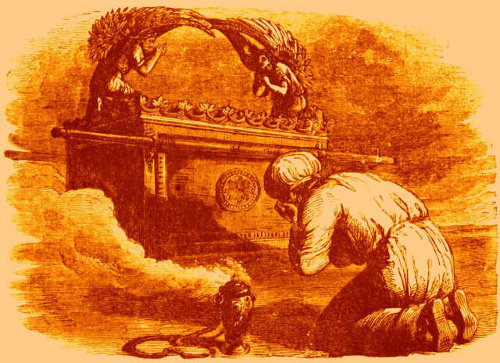
As we see in the previous quotes, one of the principle beliefs in Judaism is that there is no intermediary between a Jew and His God (I recall hearing my Jewish host at a Passover seder declare this in a toast over twenty years ago). Yet clearly, Moses was an intermediary. For that matter, so was Aaron and every High Priest after him, who entered the most Holy Place once a year on Yom Kippur to offer atonement for the nation of Israel.

Christians like to say, at the death of Jesus, when the parokhet (veil) was ripped top to bottom, exposing the most Holy Place (Matthew 27:51; Mark 15:18), that we were given direct access to God through prayer and are now able to “boldly approach the Throne of God” without an intermediary. And yet, both Hebrews 5:1-10 and Hebrews 7 describe Jesus as our High Priest in the Heavenly Court, interceding on behalf of humanity. Paul even said that:

In the same way, the Spirit helps us in our weakness. We do not know what we ought to pray for, but the Spirit himself intercedes for us with groans that words cannot express. –Romans 8:26

I know Jews don’t pray to Moses or Aaron, but at least during the time of the Tabernacle and Temple, Jews did go through the priesthood to offer korban to God. And do all Christians pray to God or, believing in the Trinity, do some pray directly to Christ?

If God is One and key parts of theology say there is no intermediary between man and God, regardless if you are a Jew or a Christian, then how can we reconcile all of these intermediaries?

Drawing Near

Kohen GadolThe name of this week’s Torah reading, Korach, provokes an obvious question: It is written: “The name of the wicked shall rot,” and on this basis, our Sages state that a person should not be named after a wicked man. Why then is an entire Torah reading named Korach? For with this title, Korach’s identity is perpetuated forever, since the Torah is eternal.

Among the explanations given is that Korach’s desire was, in essence, positive. Korach wanted to be a High Priest, to experience the absolute closeness with G-d that results from entry into the Holy of Holies. Indeed, when Moshe responded to Korach, he did not tell him this objective was unworthy. On the contrary, as Rashi relates, Moshe said he shared the same desire; he also wanted to be a High Priest.

Moreover, at Mount Sinai, G-d told the Jewish people that they are “a kingdom of priests,” and our Rabbis interpret this to refer to the level attained by a High Priest.

Rabbi Eli Touger
In the Garden of Torah
“Korach’s Positive Import”
Chabad.org

A third gentile wanted to convert so he could become the High Priest, and wear the Priestly garments. Shammai said no, but Hillel accepted him. After studying, he realized that even David, the King of Israel, did not qualify as a cohen, not being a descendant of Aaron…Hillel’s welcoming personality complements his saying: “Love people and bring them close to Torah.” (Avoth 1).

from -Hillel, Shammai and the Three Converts
Saratogachabad.com
citing Shabbos 31

“My job is not to distance anyone, but to draw them closer. If a person needs to be rebuked, let someone else take care of that.”

-from a letter of the Rebbe
quoted by Rabbi Tzvi Freeman
“Bringing Closer”
Chabad.org

I write a lot about praying, about reading Talmud, Chasidic stories, the Bible; and I write a lot about living out the life that God gave us, not just praying, reading, and studying. But what’s the point? Why do we do this? Why do I do this?

Why did the convert in the story about Hillel want to be a High Priest?

The motives are all the same. We want to draw closer to God. Even Korach, the subject of this week’s Torah Portion is said to have had good motives, though a bad way of expressing them. We all want to draw closer to God.

But what does that mean? I’m not sure anyone really knows.

What would we do if we were really close to God? You probably think you know the answer. You probably think it would the the most wonderful, peaceful, loving experience of your entire life. But do you know what you’re really asking for?

When the people saw the thunder and lightning and heard the trumpet and saw the mountain in smoke, they trembled with fear. They stayed at a distance and said to Moses, “Speak to us yourself and we will listen. But do not have God speak to us or we will die.” Moses said to the people, “Do not be afraid. God has come to test you, so that the fear of God will be with you to keep you from sinning.” –Exodus 20:18-20

When I saw him, I fell at his feet as though dead. Then he placed his right hand on me and said: “Do not be afraid. I am the First and the Last. I am the Living One; I was dead, and now look, I am alive for ever and ever! And I hold the keys of death and Hades. –Revelation 1:17-18

Do not be afraid? Are you crazy? who wouldn’t be afraid?

Sure, Abraham spoke with God “face-to-face” and Moses talked with God at the top of Mt. Sinai for forty days and forty nights, but that was Abraham and Moses. The Bible doesn’t relate tales of every one who encounters God having a perfectly comfortable and casual conversation and in fact, in the two scriptures from which I just quoted, we see that the more typical response of a meeting with the Divine was to expect to die in the next second or two. Why do we want to get closer to God?

We think we want to get closer to God when we imagine God is some sort of “cosmic teddy bear” who is all comfy and cozy and we can sit on His lap like kids telling Santa Claus what we want for Christmas. But it doesn’t work that way as we’ve seen in abundant measure. So why do we want to grow closer to God, abandoning all common sense and reason, desiring to have such an intimate and terrifying experience?

In Jewish mysticism, it’s believed that we contain a spark of the Divine; something of God, within each of us. That spark is always striving to return to the source. It’s like trying to hold a beach ball underwater in a swimming pool; the more you try to drive it downward, the more it pushes back toward the surface. The more darkness we pour into our being, the more sorrow and sin we find in the world, the more the Holy fire within us seeks out the conflagration of God.

From this life and light proceeds the divine “spark” which is hidden in every soul. Not all men succeed in rising to this close union with God at prayer, because this spark is imprisoned in them. “Yea, even the Shechinah herself is imprisoned in us, for the spark is the Shechinah in our souls.

-Paul Philip Levertoff
Love and the Messianic Age

Ezekiel's VisionIn yesterday’s morning meditation, I said that meeting God requires our “time, effort, and an unquenchable need to learn“. It’s that unquenchable, insatiable, unstoppable drive; like a spark seeking the fire, that pushes us forward, over the edge of the abyss, sometimes without our conscious will, pressing us across the threshold from our familiar world into the Presence of the Throne of God. This is what drives mystics to leave the universe and seek higher Heavens in vision and in spirit. This is what we see in the Merkabah or the Ezekiel’s chariot event and this is what John experienced in the vision he recorded in Revelation. Daniel’s visions all but drove him insane.

Most of us won’t have such intense encounters with God, but we seek something of Him nonetheless. It’s why we pray. It’s way we read the Bible. It’s why we study Talmud and Kabbalah. It’s why, night after night, we seek Him in our dreams and day after day, we call to Him to be with us along our way.

You shall teach them diligently to your children and you shall speak of them, while you sit in your home, while you walk on the way, when you retire, and when you arise. –Deuteronomy 6:7

This small portion of the Shema is part of what Jesus taught as one of the two greatest commandments; the commandments that are the “containers” for all of the Torah and the Prophets. Perhaps this is a clue telling us how we draw closer to God.

We know that Korach’s intentions were good, but intentions are not nearly as meaningful as the actions we take. His actions ultimately cost the lives of over 14,000 people. And while the actions of the convert who approached Hillel with the desire to become High Priest didn’t result in tragedy, he still was given the opportunity to learn a hard lesson in what it means to draw nearer to God.

Interestingly, the letter from the Rebbe quoted by Rabbi Freeman seems to speak somewhat of Hillel who, unlike his contemporary Shammai, did not rebuke the foolishness of the three converts but rather, welcomed them and gave them the time and the room to discover their mistakes. We make our own mistakes in trying to draw nearer to God. A lot of the errors we make have to do with arrogant presumption and the idea that the life, death, and life of Jesus Christ turned God the Father from a horrible, vengeful creature into everybody’s favorite uncle. Fortunately, God, like Hillel, gives us time and room to discover our errors.

It’s in our sincere attempts to encounter God that we actually discover when we’re walking the wrong path. Like Moses who saw only God’s “back” but not His “face”, when we’re ready, we realize just how vast and overwhelming even a momentary glimpse of God’s awesome glory is when it breaks into our world. However, to meet with God, we must make our humble efforts to seek Him out, in the pages of the Bible, in the halls of study, in the realms of prayer…and then we must wait.

From a mystic perspective, it is explained that Korach’s desires reflected the spiritual heights to be reached in the Era of the Redemption…The rewards of that age cannot, however, be attained prematurely, but only as a result of our Divine service. It is only through our selfless devotion to the Torah of Moshe and the directives of “the extension of Moshe in every generation” the Torah leaders of our people that we can elevate ourselves and the world to the point that “the world will be filled with the knowledge of G-d.”

-Rabbi Touger

Good Shabbos.

Soul on the Altar

Meal offeringWhen a person presents an offering of meal to the Lord, his offering shall be of choice flour; he shall pour oil upon it, lay frankincense on itLeviticus 2:1 (JPS Tanakh)

The word “soul” is not used in reference to any voluntary offerings except for the meal-offering. Yet, here, the verse (Vayikra 2:1) begins, “And when a soul will bring a meal-offering…” Whose practice is it to dedicate a meal-offering? It is the poor person. The Holy One, blessed is He, said: “Although the poor man’s offering is modest, I consider it as if he offered his soul.”

Daf Yomi Digest
Gemara Gem
“The precious offering of the poor”
Menachos 104

Who are you? What do you have to offer God? What is your worth to other human beings? Why does what you do matter?

We tend to judge ourselves in comparison to others. When we see that our accomplishments are better or more abundant than someone else’s we feel better about who we are. When another person has more money, more prestige, lives a more righteous life than we do, we tend to feel bad about ourselves.

That’s not a universal response among people, but it’s common and all too human. Yet, we’re not the same. How are we to understand this? Continuing the “Gemara Gem” commentary, we discover:

Two students sat in the same class. They heard the same lectures from their rebbe, and they each tried to record notes to summarize the lessons. After a week, the rebbe announced that an exam on the material would be given.

One student, who was quite bright, relied upon his memory and he exerted minimal effort in studying, but he managed to score a relatively high grade. The other student had a weaker ability. Despite great efforts in preparing, he scored quite low.

Surprisingly, the rebbe called the stronger student to his classroom after grading the tests, and he rebuked him. The rebbe expressed his disappointment in the score that he had earned, even though it was a relatively high grade, and he pointed out how that with a consistent effort, the student was certainly capable of achieving much more. The boy defended himself and pointed out that the weaker boy had scored even lower. The rebbe refused to accept his excuses, and he demanded that the strong student produce an effort commensurate with his abilities.

It is obvious that the excuse of the more capable student was without merit. It is clear that each person has his own talents and abilities, and, at least in spiritual matters, every individual must work and produce to meet his own potential. Some people are blessed with greater intellect, while others are emotionally charged and motivated to action. Every person is expected to achieve the maximum that he is capable of attaining.

We see that we don’t all come equipped with the same passions and identical skills, yet we’re expected to utilize what we have been given to the best of our efforts. This works well for the rich and the richly gifted if they apply themselves, but the poor cannot offer Rising Incensethe same abundance to other people and to God as the rich. How can a poor man dare to hold a banquet for a King? How can a person deep in sin ever hope to entertain the Righteous One?

The Ben Ish Chai, zt”l, explains…”A certain great king visited a large city in his kingdom. In the city were many noblemen and wealthy people, all of whom hoped to host the king for his first meal in their city. Obviously such wealthy people offered to prepare a banquet that would literally be fit for a king. But the king wished to go to his friend who was a poor shepherd and could never afford a repast approaching what is fitting for the king. If the king refuses the noblemen and wealthy to go to his poor friend, they can protest that eating such simple food is not honorable for the king.

“When it comes time for a meal and the greatest citizens are vying for his company – each with a feast prepared in case the king acquiesces to him – the king explains that he cannot eat any heavy food at all. ‘I am not feeling so well and must have a repast composed solely of light foods. I need sheep’s milk, yogurt, light cheese, butter and similar fare. Since the place where I will find these foods freshest is at a shepherd’s abode, I will take my meal with my poor friend.’”

Daf Digest Yomi
Stories off the Daf
“The King’s Special Meal”
Menachos 104

Once again Jesus went out beside the lake. A large crowd came to him, and he began to teach them. As he walked along, he saw Levi son of Alphaeus sitting at the tax collector’s booth. “Follow me,” Jesus told him, and Levi got up and followed him.

While Jesus was having dinner at Levi’s house, many tax collectors and sinners were eating with him and his disciples, for there were many who followed him. When the teachers of the law who were Pharisees saw him eating with the sinners and tax collectors, they asked his disciples: “Why does he eat with tax collectors and sinners?”

On hearing this, Jesus said to them, “It is not the healthy who need a doctor, but the sick. I have not come to call the righteous, but sinners.” –Mark 2:13-17

Rich man or poor, righteous tzadik or a person heavy with sin, we each are not called to offer God everything in the world but only our very best, even though our best may be the meal offering of the poor. While you may envy what the rich and the righteous can offer God in their abundance, out of the depths of despair and poverty, what you offer, though it seems small, is the most splendorous gift of all…your very soul on the altar of God.

May my prayer be set before you like incense; may the lifting up of my hands be like the evening sacrifice. –Psalm 141:2

Waiting for the Dawn

Waiting for the dawn“Therefore I tell you, do not worry about your life, what you will eat or drink; or about your body, what you will wear. Is not life more than food, and the body more than clothes? Look at the birds of the air; they do not sow or reap or store away in barns, and yet your heavenly Father feeds them. Are you not much more valuable than they? Can any one of you by worrying add a single hour to your life? Matthew 6:25-27

Rav Yisrael Salanter, zt”l, provides an incisive explanation of a statement on today’s daf. “On Menachos 103 we find that the curse in the verse (Devarim 28:66) – ‘And you will not believe in your life’—refers to one who must purchase bread daily from a baker.

“On the surface this seems very difficult to understand. Surely during our sojourn in the desert when the manna came down each day we were not in this category. Yet wouldn’t a person who had children wonder about his livelihood for the next day, since he was relying on another miracle for his family’s food? How can we understand this? Is it plausible to say that God told us about a punishment which will happen in terrible times if it was a curse we suffered daily for forty years?”

Daf Yomi Digest
Stories off the Daf
“Daily Bread”
Menachos 103

Give us today our daily bread.Matthew 6:11

Despite the words quoted above, I still worry. Not all the time, but sometimes. To be fair, I don’t doubt that you worry, too.

Yesterday morning, I woke up with the realization that I now have no congregation with which to worship on Shabbat. For reasons too numerous to mention, I found it necessary to end my relationship with a congregation where I had fellowship and taught for many years (though I did mention something about it in the first post in this blog series). I do have a “plan” in mind for my future, but I am also acutely aware that my plans aren’t the deciding factor in what is going to actually happen:

And he told them this parable: “The ground of a certain rich man yielded an abundant harvest. He thought to himself, ‘What shall I do? I have no place to store my crops.’

“Then he said, ‘This is what I’ll do. I will tear down my barns and build bigger ones, and there I will store my surplus grain. And I’ll say to myself, “You have plenty of grain laid up for many years. Take life easy; eat, drink and be merry.”’

“But God said to him, ‘You fool! This very night your life will be demanded from you. Then who will get what you have prepared for yourself?’” –Luke 12:16-20

I find it somewhat ironic that after Jesus told this parable, he delivered a message to his audience saying not to worry (Luke 12:22-32, also related in Matthew 6:25-34). I suppose the irony goes away when you consider the overall message is that we should not trust in our own abilities and plans to take care of our needs but rather, we should rely on God. That said, I still invest in a 401K and other, similar plans with an eye on retiring someday.

For the past two years, and very specifically during the past year, I have been considering and pondering the decision I’ve just recently made. If you’ve been reading the other posts on this blog or any of my “essays” on my previous personal blog, you’ll realize that I don’t think “the church” would be a good fit for my worship and faith needs. My viewpoint on God, Jesus, the Bible, and Judaism is too out-of-step with Christianity’s perspective on such things. I don’t believe the Law is dead (for Jews, that is). I don’t believe God undid or took back all of the covenent promises He made to the Children of Israel and transferred them to “the church” (non-Jewish Christians). I certainly don’t believe that God now requires that all Jewish people who want to worship the Jewish Messiah and the God of Abraham, Isaac, and Jacob must renounce their religious, ethnic, and cultural Jewish heritage.

I’m an oddball.

But where does that leave me?

I have not be able to worship with my wife for many years due to the gulf that exists between her faith context and mine. Part of the reason I recently left my former congregation was in an effort to reduce that gulf and hopefully even to fully bridge the gap. While I’m not giving up my faith, I would be content to worship with her in the same “house of study” since after all, God is One.

But that’s not entirely up to me.

WorryingIn turning myself over to God’s mercy in part, I am also turning myself over to my wife’s. In the latter case, “mercy” is probably not the right word, but she will have to want to worship with me in the same way I desire to share worship and prayer with her.

If she makes the decision not to, or just never considers the possibility that we can share time in worship as a married couple, then I will remain a man adrift at sea without motive power or even a rudder by which to steer. I can hardly believe that God would allow this to continue perpetually, but I’ve been wrong before.

Should I be worried?

“The answer is that it all depends on one’s attitude. As our sages say, one who has sustenance for today yet worries about tomorrow is a person of little faith. For such a person, lacking food for the future is surely a terrible curse since he spends his time worrying. But for one who has faith, this is not a curse at all. Since he trusts in God he does not worry. Instead of being a curse, this situation will be a blessing since it forces him to turn his heart to God.” -Rav Yisrael Salanter

“And why do you worry about clothes? See how the flowers of the field grow. They do not labor or spin. Yet I tell you that not even Solomon in all his splendor was dressed like one of these. If that is how God clothes the grass of the field, which is here today and tomorrow is thrown into the fire, will he not much more clothe you – you of little faith? So do not worry, saying, ‘What shall we eat?’ or ‘What shall we drink?’ or ‘What shall we wear?’ For the pagans run after all these things, and your heavenly Father knows that you need them. But seek first his kingdom and his righteousness, and all these things will be given to you as well. Therefore do not worry about tomorrow, for tomorrow will worry about itself. Each day has enough trouble of its own. –Matthew 6:28-34

It’s easy to feel insignificant in God’s vast universe and to wonder how or even if God hears our prayers, but as Rav Salanter says, it all depends on one’s attitude and how we have prepared and nurtured faith and trust in our hearts.

That’s where I am right now. I’m looking down the road at a future, looking for a light in the darkness, turning my heart to God, and waiting for the dawn.

We are said to be studying Mussar when we delve into the descriptions of the human condition as they appear in the blueprint for the world, the Torah -Rabbi Ephraim Becker

The important thing is not to stop questioning. -Albert Einstein

How Can We Pray?

PrayerThe mind will always find the answer most convenient for the mind.

Even in its search for spiritual enlightenment, the mind will only rest where there is enough room to remain a mind. Therefore, on its own, the mind can never grasp G-d.

To reach G-d takes a sense that is beyond the need to exist; the essential knowledge of the inner soul. Only once the mind has drunk from that fountain can it be trusted to see beyond itself. Only then can it see the place where mind ceases to exist.

Rabbi Tzvi Freeman
“The Convenient Mind”
Chabad.org

You desire but do not have, so you kill. You covet but you cannot get what you want, so you quarrel and fight. You do not have because you do not ask God. When you ask, you do not receive, because you ask with wrong motives, that you may spend what you get on your pleasures.James 4:2-3

We struggle all our lives to find our connection to God. Both Rabbi Freeman and James, brother of the Master, illustrate how we can get in our own way and inhibit that connection. We “settle” for a connection that we can understand and that fits with our “worldview”. We pray, but only to satisfy our desires and lusts and not to do His will. What do we know about God’s will for prayer?

“This, then, is how you should pray:

“‘Our Father in heaven,
hallowed be your name,
your kingdom come,
your will be done,
on earth as it is in heaven.
Give us today our daily bread.
And forgive us our debts,
as we also have forgiven our debtors.
And lead us not into temptation,
but deliver us from the evil one.’” –Matthew 6:9-13

If prayer seems difficult, it is only because we pray with the wrong motives and the wrong expectations. We pray to serve ourselves and not God, yet Jesus made it clear that, from His grace and mercy, God would take care of our needs too, if only we would pray:

Very truly I tell you, whoever believes in me will do the works I have been doing, and they will do even greater things than these, because I am going to the Father. And I will do whatever you ask in my name, so that the Father may be glorified in the Son. You may ask me for anything in my name, and I will do it. –John 14:12-14

If we know that God will meet our needs in the name of the Son, what else prevents us from “talking” to God? Certainly not God Himself, as we discover in this teaching from Chabad.org.

Once upon a busy life–maybe even two, three times or more–some of us are struck with a sense of being so small within something much larger and wouldn’t it be good for the two of us to have a chat. In other words, we would like to speak with G-d.

It’s not as outlandish as it seems; people do it all the time. Most never stop to think what is really going on, for if they did, they wouldn’t be able to open their mouths. But it is so essential to human life, so we continue on nonetheless.

We call it prayer, and we believe the second party of this dialogue is just as eager to join–if not yet more eager than ourselves.

To this lesson, Rabbi Naftali Silberberg adds:

Prayer comes naturally when a person, G-d forbid, experiences hardships. But passionate prayer when all is (relatively) well is, in a certain sense, a far more meaningful experience. Because our conversations with G-d serve a dual purpose: they are an opportunity to beseech our Provider for health, prosperity and nachas from our children; but more importantly, they are also moments when we connect with our beloved Father in Heaven. Indeed, to a certain extent, the content of our prayers is less significant than the experience itself–an opportunity to connect with G-d.

You have His attention; speak as long as you wish! The great sage Rabbi Yochanan summed it up with these words: “If only a person could pray all day long!”

Praying with TefillinGod is listening to you. He is always listening to you, waiting for you to make the connection. All you have to do is start talking. It doesn’t matter who you are. It doesn’t matter what you’ve done. No quality you possess or lack will prevent God from hearing your prayers. Even if you’ve turned away from Him, you can always turn back to Him, as illustrated by how Rabbi Freeman answered this question:

Question: “I don’t feel that that I have any right to pray to G-d. I’m not religious at all. Over the years, I’ve committed many sins. Since I’ve turned against G-d and transgressed His commandments, how can I approach Him in prayer?”

Answer: “Each morning, when we wake up, we say in our prayers, ‘My G-d, the soul You gave me is pure…’

No matter what you do with your life, your soul remains pure. Even at the time you are committing the worst crime, your soul screams inside like a captive woman, remaining faithful to her Beloved Above.

And now you want to take away from her that last opportunity to scream out loud for help?”

If God only heard the prayers of the righteous, God would hear no prayers at all. You do not have to be righteous. You do not have to be perfect. You do not have to say “magic” words or pray by a formula. All you have to do is start talking. God is waiting…and listening.

Gardening

GardeningThat same day Jesus went out of the house and sat by the lake. Such large crowds gathered around him that he got into a boat and sat in it, while all the people stood on the shore. Then he told them many things in parables, saying: “A farmer went out to sow his seed. As he was scattering the seed, some fell along the path, and the birds came and ate it up. Some fell on rocky places, where it did not have much soil. It sprang up quickly, because the soil was shallow. But when the sun came up, the plants were scorched, and they withered because they had no root. Other seed fell among thorns, which grew up and choked the plants. Still other seed fell on good soil, where it produced a crop – a hundred, sixty or thirty times what was sown. Whoever has ears, let them hear.”Matthew 13:1-9

A creative mind is a fertile field. But that may simply mean that the weeds are taller and grow faster.

First, soften your mind’s soil, plough its furrows. Open it to the wisdom that rains down from the heavens; let the dew of Torah sink into your soul, the seeds laid by tzaddikim enter your heart. Learn to lie still as they awaken and take root. Quietly await the spring.

In the place of thorns and a tangle of weeds will grow a bountiful garden. Where once wild and brazen delusions sprang forth, a tightly focused beam of light will shine.

-Rabbi Tzvi Freeman
“The Field of Your Mind”
Chabad.org

The parable of the sower being related by Jesus is interpreted as the different reactions people have when hearing the “message of the kingdom” (see Matthew 13:18-23), but this story of the Master is more than a little related to Rabbi Freeman’s commentary about how to prepare our minds for Torah study and spiritual learning. You may think that because you read the Bible, go to Sunday school, go to a Talmud study, or frequent online religious forums, that you are “studying the Word” and are well prepared to receive it. However, that’s not always the case.

You’ve heard the expression, “you can lead a horse to water…” and it’s true. You can take a person who has certain attitudes about the Bible, Jesus, God, and so forth, and introduce them to your scripture, your church, your synagogue, or another favorite religious context, but that doesn’t mean they’ll receive it in the way you are hoping. It’s not just the material, it’s the person and how they see the situation. Here’s a perfect example:

Rabbi Eliezer Silver zt”l was a leader and activist who saved thousands of Jewish lives during the Holocaust. After the liberation of the Nazi death camps, he tried to revive the spirit of Judaism among the survivors.

One of his many activities was organizing prayer services. A certain refugee refused to participate, explaining that he’d been turned off to Judaism forever. He said that there had been a religious Jew in this refugee’s camp who had smuggled in a Siddur (prayer book), and he would charge people half their bread ration to use his Siddur for ten minutes. After witnessing such cruelty, the refugee refused to have anything to do with Siddurim, prayer services, or anything Jewish.

Rabbi Silver approached him with great compassion and understanding, but offered him a new perspective. “You only see the Jew who was so cruel,” he said. “What about the holy Jews who were willing to give up half their meager rations for just 10 minutes with a Siddur?”

No one can blame the refugee for his feelings. After living through his hellish experience, who could say they would react any differently? Nonetheless, says Rabbi Shimshon Pincus zt”l, two people can hear the same story and one notices the cruelty, while the other notices the holiness and dignity.

The Sages say that what the eye sees depends on what the heart feels (Talmud Avoda Zara 28b), and in this week’s Torah Portion (Num. 15:39) we’re told “Don’t stray after your heart and after your eyes.” Our eyes will only see negativity and impurity if our hearts have already been corrupted. If we make the effort to turn our hearts towards positivity, giving to others, appreciating, then the world will transform before our eyes into a panorama of pleasures and joy, the constant gifts that G-d wishes upon us.

Commentary on Torah Portion Shlach
by Rabbi Mordechai Dixler
Program Director, Project Genesis – Torah.org

WateringIn my previous morning meditation, I was pretty discouraged. It passed, but sometimes the enormity of a life of faith, continually reaching out to God, trying to understand even the most elementary lesson of holiness, and trying to share my (what I hope are) unique perspectives with other people, can be really wearing. Yet, as we just saw in the story related by Rabbi Dixler, even the most difficult and excruciating circumstances can be viewed in more than one way. Or, to quote Hindu Prince Gautama Siddharta (Buddha), “The mind is everything. What you think you become.”

Simply put, you are (I am) what you think about habitually. If you think life is terrible, it is, more or less regardless of circumstances. I’m sure you can create some extraordinary situation that would be perceived as horrible (such as living in the camps during the Holocaust) beyond any ability to endure, but even here, Rabbi Dixler points out there is a difference between seeing the selfishness of a man who would exploit his fellow Jew to feed his own stomach vs. the Jew who would give up even his last morsel of bread to pray from a Siddur for just ten minutes. If we want a relationship with God, we must work to prepare for it:

Here is Paul’s interpretation:

Finally, brothers and sisters, whatever is true, whatever is noble, whatever is right, whatever is pure, whatever is lovely, whatever is admirable – if anything is excellent or praiseworthy – think about such things. Whatever you have learned or received or heard from me, or seen in me – put it into practice. And the God of peace will be with you. –Philippians 4:8-9

This is why we must study the Bible and study it regularly. This is why we attend the house of prayer regularly and frequently. This is why we spend time in prayer daily and associate with our companions in faith at every opportunity. Although it is easy to feel alone and misunderstood in a world that, above all else, worships pleasures and morals built on shifting sands, we are never alone unless we want to be. It takes discipline to feel God’s presence. If we can say that God sets appointments each day for us to meet with Him, it is up to us to keep those appointments and to become accustomed to His voice.

For as he thinks within himself, so he is. –Proverbs 23:7

My sheep listen to my voice; I know them, and they follow me. –John 10:27

Take a moment or two to review the state of your mind and your “garden”. What can you do better to make it grow?

The Panoramic Garden

I had said in my panic, “I am cut off from before Your eyes!” But in truth, You heard the sound of my supplications when I cried to You. Love Hashem, all His devout ones! Hashem safeguards the faithful, but He repays the haughtiness on one who acts with arrogance. Be strong, and let your hearts take courage, all who wait longingly for Hashem. –Psalm 31:23-25

You are a shelter for me, from distress You preserve me; with glad song of rescue You envelop me, Selah! I will educate you and enlighten you in which path to go, I will advise you with [what] my eye [has seen]. –Psalm 32:7-8