Tag Archives: God

The Hollow Man

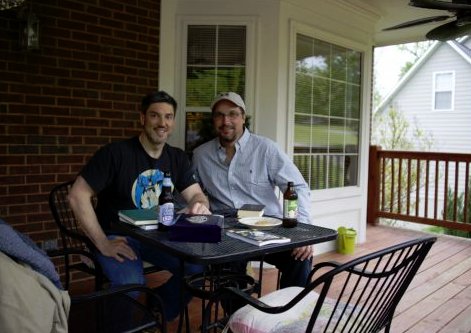
clickedIt clicked when I saw this photo. I realized what’s been bothering me all along. I finally got why I was counting time down. Why I was waiting for it all to end. Why I didn’t believe my life in the community of faith was ever going to last. I realized I didn’t belong. I wasn’t part of the whole. No matter how hard I tried, I’d always be on the outside looking in.

Let me explain.

In reading the Rudolph and Willitts book Introduction to Messianic Judaism: Its Ecclesial Context and Biblical Foundations, I found a confirmation of what I believed about Jewish/Christian relations on so many levels. It all made so much sense. Chapters 17, 18, and 19, written by Craig Keener, William Campbell, and Scott Hafemann respectively, all spoke of Jewish and Gentile interdependence within the body of Messiah, specifically accessing Paul’s letter to the Romans. I’ll write about those chapters in more detail some other time, and I believe that there is an interdependence between believing Jews and Gentiles, but there’s a puzzle to solve, at least for me. The contributors to the Rudolph/Willitts book universally present the Messianic Jewish movement as one that is a home to believing Jews who are ethnically, culturally, religiously, and experientially Jewish. You cannot separate the lifestyle of being Jewish from the person who is Jewish, regardless if they have come to faith in Jesus as Messiah or not.

However, for the vast amount of Gentiles who are believers, their culture is the church. I know there are multiple expressions of the Christian church in our world, but they all have one thing in common. Their culture isn’t even remotely Jewish. Jewish religious and lived culture isn’t even remotely Christian. It’s like two different worlds that are trying to intersect and as interrelated as they are in Messiah, I’m not sure how they’re ever going to fit together.

And then there’s me.

No matter who you are as a believer, you “fit” somewhere. There are Gentiles, just tons and tons of them, who fit extremely well in the church. I’m anticipating seeing a lot of them tomorrow morning, Sunday morning at the church I attend. They are all very comfortable where they are. I’m the only one who sticks out like a sore thumb.

No, don’t tell me to go to a Jewish religious venue. None are accessible to me and even if they were, I don’t fit in there, either. Even if I fit in, that wouldn’t “fit in” with my wife. She’d feel extremely uncomfortable with my being a square peg trying to fit into a round hole. And that’s what I’d be. My past participation in pseudo-Jewish Hebrew Roots wouldn’t even come close to preparing me for an actual Jewish cultural encounter.

I like to think of myself as a person with a foot in each of two worlds but the fact is, I am only standing in between them. I’m not in contact with either one. I don’t belong in either one. That isn’t to say I don’t believe, but faith and religion and worship don’t exist in a vacuum, they exist in community, and I don’t belong in any of them.

It’s like someone tried to transplant a heart into my chest, but my body is rejecting it. It doesn’t belong. It’s alien. Without it, I’ll die (metaphorically speaking, of course), but I’m not being nourished by it, either.

A friend of mine once said, don’t seek Christianity and don’t seek Judaism, but rather, seek an encounter with God. But how do I meet God without a context and a culture? People can’t experience God in raw, unshielded contact. We need an interface, layers of abstraction so we can make sense of what’s happening to us, so we won’t be obliterated by connecting to God. For Jews, that interface is Judaism, cultural, Talmudic, tradition-based Judaism. For Christians, that’s the church and all the culture and traditions that are attached to the various “Christianities” in our world.

But I don’t connect to either one. I don’t belong. That’s the problem. I can read the Bible, but if I read it in a Jewish or Christian framework, it seems alien. Only just plain reading it makes any sort of sense to me, but then I’m limited to my own experience. To access the sages and the experts, I have to apply a context, which puts me in contact with denomination, with doctrine, with theology, with culture, and while that seems to work for everyone else, it doesn’t work for me because their doctrine, theology, culture, and context doesn’t belong to me and I don’t belong to them.

Classic approach-avoidance syndrome or as put more plainly, can’t live with it and can’t live without it.

That’s why doing my homework for Sunday school seems like an exercise in emptiness. It’s a culture that I don’t relate to, a perspective that seems hollow. If I’m ever going to experience God, it will be somewhere outside religion and culture, but that’s impossible for a human being. So where does that leave a “hollow man?”

157 days.

The Unsimple Truth

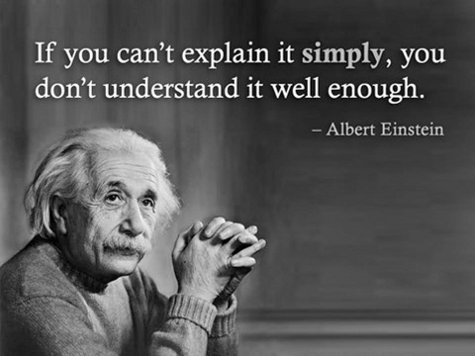
einstein_simplyIf you can’t explain it simply, you don’t understand it well enough.

-attributed to Albert Einstein

According to Rashi, the question is directed against Rav Yirmiyah who had said that the basket in the tree does not actually have to be within ten tefachim of the ground to be valid. We are dealing with a long basket where it could be tilted and emptied even without being brought below into the reshus harabim. In contrast to this, Rav bar Sh’va brings a Baraisa where an eiruv is not valid unless it is actually brought to where it must be situated. Here, we do not take into consideration the fact that the eiruv should be valid due to the potential that it could
theoretically be brought during bein hashemashos to its destination.

Daf Yomi Digest
Distinctive Insight
from “Rabbinic injunctions and Bein HaShemashos
Eruvin 33

I’m a failure. More to the point, I don’t understand God, Jesus, faith, and spirituality well enough. I can’t explain it simply. I’m not sure I can explain it at all. Certainly the fact that I have posted nearly eight-hundred articles in this “morning meditations” blog (not to mention other blogs) about these subjects and have hardly scratched the surface must mean I don’t understand all this well enough. I can’t explain what I believe simply. I certainly can’t explain it briefly.

I quoted from a commentary on an excerpt from Talmud above to illustrate the level of complexity of the halachot related to Orthodox Judaism. Although I read from the Daf Yomi Digest daily, I scarcely comprehend what I’m reading and what I understand most clearly is that the Talmud is an enormously complex set of works. I don’t know how observant Orthodox Jews manage to obey all of the minute details involved in daily living. I can only imagine that Einstein would have contended with the sages based on his above-quoted statement (though it is unsure if Einstein or Richard Feynman actually said those words).

I can hardly be said to live anything close to an Orthodox Jewish lifestyle in my “observance” as a Christian, but as I write and write and write, and then read back what I’ve written, I realize that I am no closer to truly comprehending God and faith than I was when I first accepted Jesus Christ as Lord. Sometimes I wonder if I’ve even gone that far.

For I do not understand my own actions. For I do not do what I want, but I do the very thing I hate. Now if I do what I do not want, I agree with the law, that it is good. So now it is no longer I who do it, but sin that dwells within me. For I know that nothing good dwells in me, that is, in my flesh. For I have the desire to do what is right, but not the ability to carry it out. For I do not do the good I want, but the evil I do not want is what I keep on doing.

Romans 7:15-19

If we’re honest with ourselves as Christians, then I suppose we all have to admit that this statement of Paul’s is also true of us. How can we live a life we call “holy” and yet still struggle with the mundane, the common, and even the evil within us? If God’s Word is written on our hearts, how can we defy that word and pursue what we know isn’t right? I can only imagine that atheists have moral struggles as well, though as I recall myself from before I came to faith, they didn’t seem as dire.

Is a life of faith really that hard or that hard to explain? It certainly seems that hard to live. But then again, is Einstein’s quote the litmus test we should be using against ourselves? After all, he also said this:

If I could explain it to the average person, I wouldn’t have been worth the Nobel Prize.

Einstein made that statement in response to being asked to give a brief quote on why he won the Nobel Prize. That’s the problem with taking quotes out of context. It’s easy to make a person seem completely inconsistent. How much more difficult it is to analyze “chunks” of the Bible and find consistency and comprehension?

My conversations with Pastor Randy (which are on hiatus for the month of April and for several weeks in May) about D.T. Lancaster’s book The Holy Epistle to the Galatians aren’t hugely complex, but they do get detailed…and we’ve barely covered one chapter in Galatians! How about the book of Romans?

mystery-in-midtownI know that Mark Nanos is popular in Messianic circles, but some years ago, when I tried to read his book The Mystery of Romans, I gave up, not getting very far in his book. Maybe I’d be better able to comprehend his writing now, but Paul’s letter to the Roman church is extremely dense with meaning that I wonder if I’ll ever truly understand either Paul or Nanos. I know the Nanos books on Romans and Galatians should be on my “required reading” list, but who knows if they’ll do me any good? I’m tasked to understand a scholar and author in order to understand the mystery of “letter writer.” Are these reasonable goals?

In some ways, trying to comprehend a life of faith is a fool’s errand. While the concept of Christian salvation is supposed to be simple enough for a small child to understand, the fact remains that the Bible contains depths that if plumbed, would make even explorers such as Jacques Cousteau bolt for the surface as if hotly pursued by Leviathan.

Maybe it’s not quite that bad, but I feel that way sometimes.

Of course there’s a difference between understanding a life of faith and living it. Well, maybe not for the Orthodox Jews since behavior and conceptualization are largely interwoven, but certainly for Christianity, where one can live a basic Christian life without having to know much of the Bible at all. You can feed the hungry, visit the sick, remain faithful to your spouse, give to charity, pray to God, and fellowship with other believers without having to spend even a single day in seminary. Of course studying the Bible gives such a life context and meaning, but you don’t really have to know all of the arcane debates about the doctrine of Divine Election, for example.

Don’t get me wrong. I enjoy reading. I enjoy studying. I enjoy discussing all of these little details. But at what point do you turn it all off and just spend time with God? What’s the point of all of our debates on the web? Why do you try to convince me you’re right about something and why do I try to convince you that I’m right about something? What difference does it make? OK, probably a pretty big one, depending on what we’re talking about, but we can’t all be right? Can we all be wrong? That seems far more likely.

If we believe God exists, then He must exist separately from what we believe and from the web of theology and doctrine we’ve spun for ourselves. God must be an “objective” God. If the world’s population stopped believing in God totally and completely, God would continue to exist and His plan for the universe would continue to move forward toward its ultimate conclusion. We spend all our lives examining the Bible trying to uncover the clues to that plan and what it means in our lives, but we only get bits and pieces, and much of the time, we can’t really be sure we understand what we think we’ve got in our hands.

This theologian espouses one particular theory and another theologian opposes him or her. More theories spring up, more debates occur. But God is God. Our theories and debates don’t affect him in the slightest. He exists as He exists regardless of our “religious orientation.”

We’re all seeking truth but even with the help of the Holy Spirit, who is supposed to guide us in all truth (John 16:13), we all come up with different conclusions. You’d think if there were one Spirit and He was guiding us to One truth, we’d all arrive at the same conclusion.

But we don’t.

I’m most of the way through Carlos Castaneda’s book The Teachings of Don Juan: A Yaqui Way of Knowledge. It’s not really what I expected, but I appreciate Castaneda’s honesty in saying that he didn’t quite succeed either in his field study or as a disciple of don Juan. I decided to read this book because I hadn’t read any Castaneda before and felt I owed it to myself to have the experience.

letting-goMaybe I should just let go and move away from religious and spiritual reading altogether and just read for pleasure (not that reading books on religion and spirituality aren’t pleasurable). I used to read a lot of science fiction and mystery back in the day, with a few of the classics thrown in just for giggles. Maybe that would be more satisfying. Nothing I know or don’t know affects God. I’m not sure it even affects me. I can probably explain simply Castaneda’s book, but how could I possibly explain even one letter of Paul’s? Many have tried, including Nanos and Lancaster, but what does it matter if you end up with a body of work about the Bible that is fraught with disagreement?

I guess there’s a reason people pursue truth all their lives but either never find it or find only what some people (but not all) call “truth.” Maybe we never find it at all. Maybe we just delude ourselves and say what we have is “truth” because living a life of existential uncertainty is too difficult to bear.

Maybe that’s why there are so many atheists. There are no mysteries to the universe beyond what they can see. It’s all nuts and bolts with no colors, textures, or moods. There’s only light and darkness. More’s the pity.

One who returns from the darkness must bring of it with him and convert it to light. He must exploit his experience to surge higher and higher with greater strength.

Therefore, the one who returns from a distance is greater than the one who was always close. What matters is not so much where you stand, but with what force you are moving in which direction.

-Rabbi Tzvi Freeman
“Exploiting the Darkness”
Based on letters and talks of the Rebbe
Rabbi M. M. Schneerson
Chabad.org

So which direction should I move in next in pursuing truth or God or whatever?

The Transcendent Path

Tree of LifeIf you find yourself affixed to a single path to truth—the path of prayer and praise, or the path of kindness and love,or the path of wisdom and meditation,or any other path of a singular mode—you are on the wrong path. Truth is not at the end of a path. Truth transcends all paths. Choose a path. But when you must, take the opposite path as well.

-Rabbi Tzvi Freeman
“Two at Once”
Based on letters and talks of the Rebbe, Rabbi M. M. Schneerson
Chabad.org

As human beings, we have a tendency to compartmentalize and specialize our lives. This comes as no surprise to me, since organization of the different elements of life into “categories” is how we understand ourselves. We have an order and a set of habits to what we do. We also have an awareness of what we’re good at and what we aren’t; a set of “gifts” to which we lean upon and if we are kind, offer to others. Organizing our lives by categorization is necessary so we can conceptualize events, circumstances, and objects and make sense of the world around us.

But it can also be a limitation if we believe we are only defined be these categories. Saying, “I’m only good at this, so I won’t try that,” may rob someone who needs you to do “that” for them rather than “this.”

I’m as guilty of this sort of thinking and behaving as anyone. I’m a writer, both professionally and “for fun.” I find that I can clarify my own thinking and understand better what some people are saying to me if I write about those experiences. My Wednesday night meetings with Pastor Randy are a perfect example. He might say a few sentences to me on Wednesday that will fuel my blog posts for an entire week, because I use writing to continually process what he has been teaching.

But I cannot allow writing to be the totality of my identity and my activity. Someone who needs me to give them a lift to a doctor’s appointment because their car broke down won’t be helped if I only write about their need. I should offer them a ride to and from the appointment in my car. I should do something that I’m not accustomed to considering as an “expertise” of mine in order to meet another human being’s need.

Earlier today, I was writing about giving chesed to the stranger, showing someone who needs you a kindness, not because they are your friend or neighbor, but just because they need you.

In the world of “religious blogging,” most of us have a tendency to write about what we’re interested in, and again, I’m no exception. We often write about the theological or doctrinal specifics with which we identify. Jews write about Judaism and Christians write about Christianity. Nothing strange about that. Even within a particular religious structure, we tend to write about those areas of which we are particularly fond or in which we are interested.

I’ve written lately on Divine Election because I was processing that information. For another person, that might be a rather meaningless topic. I’ve read blogs recently about the Leviticus 11 kosher laws, Bibles limited to the New Testament and the Psalms, Shomer Negiah, Good Friday, and other religious subjects. Nothing wrong with writing about any of those religious topics…

…unless they limit what else we should be doing.

We tend to choose a path and then walk it, but then we only walk that path and no other. According to what Rabbi Freeman said above, that’s not the right path. If we are on the path of prayer and praising God but a homeless person on the street needs us to give them something to eat, then we are on the wrong path, at least for that moment. If we are busy donating our time at a shelter or food kitchen, but God needs us to read and meditate upon His Word, then we are on the wrong path, at least for that moment.

The individual’s avoda must be commensurate with his character and innate qualities. There may be one who can drill pearls or polish gems but works at baking bread (the analogy in the realm of avoda may be easily understood). Though baking bread is a most necessary craft and occupation, this person is considered to have committed a “sin.”

“Today’s Day”
Friday, Nissan 25, 10t day of the omer, 5703
Compiled by the Lubavitcher Rebbe
Translated by Yitschak Meir Kagan
Chabad.org

white-pigeon-kotelAvoda is a Hebrew word that is commonly translated as “work,” but among the Chassidim, it “generally refers to Divine service (or worship). For example, it’s part of the Divine service to serve God with joy.” Is who we are as servants of God limited to our theology or our religious identity, or is there something that transcends all that information, and unites us as living, human creations of the Most High God?

We often drone on and on and on about our insights into the Bible, our own theological pet peeves, or about how people with different theological pet peeves annoy us and are guilty of “false teaching,” but do we take the time to transcend our categories, our pigeon-holed lives, and realize that truth is much, much larger than the box we’ve put ourselves in?

And if your brother is not close to you and you do not know him.

Deuteronomy 22:2

Perhaps the reason that other people are not close to you is because you do not know them.

The Chassidic master of Apt said: “As a young man, I was determined to change the world. As I matured, I narrowed my goals to changing my community. Still later, I decided to change only my family. Now I realize that it is all I can do to change myself.”

Some things in the world are givens, and others are modifiable. The only thing we can really modify is ourselves. All other people are givens. Unfortunately, many people assume the reverse to be true. They accept themselves as givens and expect everyone else to change to accommodate them.

(There is one limited exception. When our children are small, we can teach and guide them. When they mature, however, we can no longer mold them.)

Trying to change others is both futile and frustrating. Furthermore, we cannot see other people the way they truly are, as long as we are preoccupied with trying to change them to the way we would like them to be.

The people we should know the most intimately are those who are closest to us. Yet it is precisely these people whom we wish to mold into the image we have developed for them. As long as this attitude prevails, we cannot see them for what they are. How ironic and tragic that those we care for the most may be those we know the least!

Today I shall…

…try to focus any desires to change on myself and let other people determine for themselves who and what they wish to be.

-Rabbi Abraham J. Twerski
“Growing Each Day, Nissan 20”
Aish.com

light-of-the-worldTo extend Rabbi Twerski’s metaphor, we can only change the world by changing ourselves. We can only serve God and change the world, by accepting that others will always be different from us and then realize that’s not always a bad thing. We, in the end, are only responsible for who we are. God will not judge us on what other people have done but only on what we have done with our lives. If we have treated others kindly, our theology, doctrine, dogma, or any of the other boxes and pigeon holes we’ve used to categorize and identify ourselves in this world will be worth less than who we are in Christ.

If anyone else thinks he has reason for confidence in the flesh, I have more: circumcised on the eighth day, of the people of Israel, of the tribe of Benjamin, a Hebrew of Hebrews; as to the law, a Pharisee; as to zeal, a persecutor of the church; as to righteousness under the law, blameless. But whatever gain I had, I counted as loss for the sake of Christ. Indeed, I count everything as loss because of the surpassing worth of knowing Christ Jesus my Lord. For his sake I have suffered the loss of all things and count them as rubbish, in order that I may gain Christ.

Philippians 3:4-8

Paul isn’t saying that his being Jewish is literally worthless, and I’m not suggesting that how we study and understand the Word of God is meaningless, either. What I am saying is that, like Paul, there is something much, much greater. The Master taught us that loving God to our fullest extent and loving other human beings as ourselves are the essence of everything in the Bible. He also taught that we would be known as his disciples specifically by our love of one another, a love that goes so far that we would be willing to give up our lives for another if required.

If anything can be said to transcend all of our paths, our categories, our religious posturing, it is love…even love for the unlovable and the unlikable ..especially love for those who otherwise make us feel hurt and angry and aggravated. If we can authentically show them love, then we are better than all of the sermons and blog posts about theology that we could ever produce. Then, we are written in His Book of Life because we have loved.

“When I was young, I admired clever people. Now that I am old, I admire kind people.”

-Abraham Joshua Heschel

We must be more.

Lancaster’s Galatians: Sermon Four, Wind and Sail

wind-sky-spirit-ruachAll Scripture is breathed out by God and profitable for teaching, for reproof, for correction, and for training in righteousness…

2 Timothy 3:16 (ESV)

Is given by inspiration of God – All this is expressed in the original by one word – Θεόπνευστος Theopneustos. This word occurs nowhere else in the New Testament. It properly means, God-inspired – from Θεός Theos, “God,” and πνέω pneō, “to breathe, to breathe out.” The idea of “breathing upon, or breathing into the soul,” is that which the word naturally conveys. Thus, God breathed into the nostrils of Adam the breath of life Genesis 2:7, and thus the Saviour breathed on his disciples, and said, “receive ye the Holy Ghost;” John 20:22. The idea seems to have been, that the life was in the breath, and that an intelligent spirit was communicated with the breath. The expression was used among the Greeks, and a similar one was employed by the Romans. Plutarch ed. R. 9:p. 583. 9. τοὺς ὀνείρους τοὺς θεοπνεύστους tous oneirous tous theopneustous. Phocylid. 121. τῆς δὲ θεοπνεύστου σοφίης λόγος ἐστὶν ἄριστος tēs de theopnoustou sophiēs logos estin aristos.

Barnes’ Notes on the Bible for
2 Timothy 3:16

You may be wondering how this connects to my ongoing discussion with Pastor Randy about D. Thomas Lancaster’s book The Holy Epistle to the Galatians. The answer is, “not much.” Frankly, we started our discussion last night with trying to clarify his thoughts on Divine Election (Pastor has a paper he wants to loan me that describes all of the various positions), but then moved to how we can understand the Bible (Pastor has some reservations relative to how Lancaster derives certain conclusions in his book from the Galatians text). We addressed Sermon Four of the book eventually, but it didn’t occupy the significant portion of our time together, nor was it the most compelling topic upon which we touched.

Going back to “God-breathed,” Pastor said that the Greek word used has the implication of wind filling a sail and pushing the boat along (Correction, according to Pastor Randy’s comment below, “the phrase about ‘the wind filling a sail’ has to do with the II Peter 1:21 passage and the meaning of men being ‘carried along by the Holy Spirit’.” See the following quote). He told me he believes that as God gave His inspiration to the human writers of the Bible, the authors did not say anything, at least as originally given in their manuscripts, that contradicted what God intended.

And we have the prophetic word more fully confirmed, to which you will do well to pay attention as to a lamp shining in a dark place, until the day dawns and the morning star rises in your hearts, knowing this first of all, that no prophecy of Scripture comes from someone’s own interpretation. For no prophecy was ever produced by the will of man, but men spoke from God as they were carried along by the Holy Spirit.

2 Peter 1:19-21 (ESV)

People, that is, prophets and those people who have written the Word of God we have in our Bible, did not hear something from God and then interpret what it meant through their own intellect and emotions. God used their personalities, their vocabulary, their style of writing, their perceptions to craft His message, but the message was and is His message, not the prophets’, and the message “carried them along” as it was first given and recorded in the original documents, and the message was and is exactly what God meant to say and meant to carry us along as well.

But then we have a problem.

We don’t have the original documents…any of them.

Also, Bible reading and translation is an enormously complex task.

According to Pastor Randy, and I agree with him, we have to start with what the text literally says. We also have to apply the immediate context of the scripture, not taking it out and making it stand on its own. Beyond that, we have to consider the history, the culture, and the circumstances in which the scripture was written. On top of that, we have to connect the scripture to the larger context of the entire Bible, including other times when similar circumstances were mentioned and similar or identical wording was used. If, for instance, in describing the two greatest commandments (see Matthew 22:37-40), Jesus references Deuteronomy 6:5 and Leviticus 19:18, in understanding the Matthew 22 passage, we must also take into consideration the context, history, culture, and circumstances in which Deuteronomy 6 and Leviticus 19 take place, including the author and his personality, vocabulary, style of writing, and personal experiences. We cannot separate what Jesus was trying to say from what Moses was trying to say, however Jesus and all that was in play when he was talking may modify the original meaning, giving it a somewhat different shape, color, and texture.

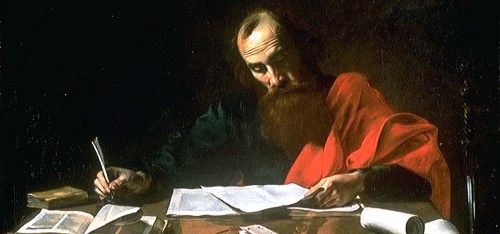
paul-editedOh, and let’s not forget the intended audience. Moses may not have been aware that what he was writing was ultimately intended for the entire world, but we realize that God has a greater scope. Jesus may well have understood that his words would eventually be consumed by all of humanity across time, but his immediate audience, like Moses’ was the Jewish people or more specifically in Jesus’ case, the Pharisee he was addressing at that particular moment.

We must take all that into consideration when reading the Bible and seriously attempting to understand its message.

And we must constantly remind ourselves that it is all God-breathed.

Pastor Randy and I spent most of our time together exploring how to understand the Bible, with the promises and pitfalls built into such an effort. We discussed how we don’t necessarily have to “reinvent the wheel,” since many people have read and observed the literal meaning of the text from a variety of perspectives, and it would be irresponsible of us to disregard their work and rely only on our own. Pastor described how he approaches understanding texts looking at those who came before him. He reads a variety of expert analyses and takes into consideration what the scholars they did and didn’t take into consideration.

For instance, a particular writer may have a good grasp of the original language but not sufficiently address the history involved, or another writer may have a good handle on the historical context, but not the cultural context. Pastor said he looks at the various scholarly opinions in that manner and ultimately settles on which one he…wait for it…

…which one he likes best.

What?

Pastor Randy is a literalist, an educator, a scholar, a linguist, and is very serious about pursuing as accurate an understanding of the Bible as he can achieve, but after much discussion we agreed that even under the best of circumstances and intentions, there will always be this little, fuzzy, grey, area in the middle of our understanding where we fill in the blanks with our own personalities.

Geordi La Forge (played by Levar Burton): I don’t know, Data, my gut tells me we ought to be listening to what this guy’s trying to tell us.
Data (played by Brent Spiner): Your gut?
Geordi: It’s just a… a feeling, you know, an instinct. Intuition.
Data: But those qualities would interfere with rational judgment, would they not?
Geordi: You’re right, sometimes they do.
Data: Then… why not rely strictly on the facts?
Geordi: Because you just can’t rely on the plain and simple facts. Sometimes they lie.

-from the Star Trek: the Next Generation Episode
The Defector (original air date 30 Dec. 1989)

In the scene from which I just quoted, Data concludes that in any meaningful analysis, the observer must fill in whatever blanks there are in the facts and other available information with their personality. In Data’s case, he was in a bind because effectively, he had no personality. All he had were the facts. By the way, it turns out Geordi’s “gut” was wrong. The defector in question had been fed disinformation by his superiors to mislead the Enterprise and ultimately to provoke a war. Fortunately, Picard’s “gut” proved to be more accurate and the ruse was exposed.

All this doesn’t mean that we can never understand the Bible or that we should always equivocate on its meaning, but we should be a little less than one-hundred percent certain that we always know what everything in the Bible means all of the time.

It also means that when we realize we’ve made a mistake based on subsequent study and analysis, we should admit it.

Pastor Randy says that’s one thing he admires about Boaz Michael, President and Founder of First Fruits of Zion (FFOZ). When Boaz and the organization came to the conclusion, several years ago, that they had made a significant error in understanding what the Bible said in relation to Jewish and Gentile covenant responsibilities to God, after much prayer and soul-searching, he announced that FFOZ was making a major shift in its theological and doctrinal position. Boaz knew it would cost FFOZ much of its income and might even result in the organization collapsing completely. Thank Hashem that the latter did not occur, but many sacrifices had to be made. Sadly, to this day, Boaz and his group continue to be severely criticized and harangued by their detractors as a consequence.

That’s the price of integrity and following God where He calls you to go. That’s also part of the ongoing struggle of understanding God through His Word and maturing as people of Spirit and of faith.

ancient-sail-boatI tried to get Pastor Randy to say that you can have a room full of people with equal intelligence, equal qualifications, all people of good character, and they could still disagree with each other on what parts of the Bible mean, but he wouldn’t go for it. He said that we’re all human and we’re all capable, not just of making mistakes, but of following our own human desires. We all can and do sin.

Does that mean there is only one right person (or close-knit group of people) who understands the Bible correctly and it is because he or she is the best person morally and ethically that their understanding is right? Does that mean all of this person’s critics are liars and haters who purposely want to bring the “right” person down in order to elevate their own agendas?

I don’t think it’s that simple. I think that you can gather a group of people together who are of good will and intent who will disagree. Sure, some of the people in that room will be liars and haters, but they should be easily spotted by their lack of integrity and good character (their fruits) in how they treat others and how they walk with God. Even the best of us can allow our personal, pet theories and biases affect our judgment. We all want to be right and to be admired and respected.

But at the end of the day, the best of us (and I’m hardly saying I’m among the best) will put all that aside, suck it up, and make the hard call, even if it costs them, because that’s just what God’s true servants do. Once we realize that the evidence is solid about some piece of scripture, even if it’s not what we want it to mean, we’ll go forward and accept it and embrace it, because that’s part of who we are if we are disciples of our Master. We’ll also continue to study, to learn, and to mature, because God continually breathes in us.

For a ninety minute conversation, last night’s talk with Pastor Randy inspired a lot in me that I could write about…and maybe I will, but I won’t try to cram it all into a single “meditation” today.

But I do want to be a sail. And I do want to be available to the wind. And I do want to let my sail conform to the wind, to the shape it causes me to manifest, to the direction it drives me, toward the destination to which it guides me.

I don’t know yet what distant and alien shore God has planned for my future, but I can feel His hand on me. Do I have the integrity and courage to let Him take me where He wants me to go? I hope so. I pray to possess those qualities that I may serve Him…even in something as “simple” as reading the Bible.

Pastor will be out of the country for the rest of April so naturally, we won’t be meeting each Wednesday evening for the next several weeks. We’ll revisit Lancaster’s Galatians next month and reformulate our study plan for the book…I promise.

In the meantime, I’ll try to continue writing in the spirit of what my Pastor, and ultimately God, provokes in my mind and heart, and move forward with integrity and purpose. Unfurling my sail and setting my course for uncharted seas as the wind sends me forth.

On Choosing God

TrustNegate your own will in favor of God’s will.

-Ethics of the Fathers 2:4

If I surrender my will and turn my life over completely to the will of God, do I not thereby abrogate my power of free choice?

Certainly not. Take the example of a child who receives money for his birthday. An immature child may run off to the toy store or candy store and spend the money on everything his heart desires. He may indeed have several moments of merriment (although a stomach ache from indulging too heavily in confections is a possibility). Without doubt, however, after a short period of time those moments of enjoyment will be nothing but a memory, with the candy long since consumed and the broken toys lying on the junk heap.

A wiser child would give the money to a parent and ask that it be put into some type of savings account where it can increase in value and be available in the future for things of real importance.

Did the second child abrogate his prerogative of free choice by allowing the parent to decide how to invest the money? Of course not. In fact, this was a choice, and a wise choice as well as a free choice.

We can choose to follow our own whims or we can choose to adopt the will of an omniscient Father. We are wise when we make the second choice.

Today I shall…

…turn my will over to God, and seek to do only that which is His will for me.

-Rabbi Abraham J. Twerski
“Growing Each Day, Nisan 23”
Aish.com

How much is this like the choice Jesus made on that last night?

saying, “Father, if you are willing, remove this cup from me. Nevertheless, not my will, but yours, be done.”

Luke 22:42

Last week, I started talking about free will and Divine Election and how that describes the nature of man and our relationship with God. I still don’t think that we are wind up toy soldiers, pre-programmed by God in all our responses, including the most important response, accepting or rejecting the Almighty.

I don’t think this issue comes up for Jewish people, but then, all Jews are born into a covenant relationship with God just by virtue of being Jewish. Still, the recognition and acceptance of Messiah is a vital task that remains hidden from most Jews, largely due to how Gentile Christianity has “morphed” the Jewish Messiah into a Goyishe King. Still, many Jews see God, not as a harsh overseer with a whip controlling the gates of life and death, but as a teacher, gently but firmly guiding us in the lessons of life as we walk the path with our companion.

That very day two of them were going to a village named Emmaus, about seven miles from Jerusalem, and they were talking with each other about all these things that had happened. While they were talking and discussing together, Jesus himself drew near and went with them. But their eyes were kept from recognizing him. And he said to them, “What is this conversation that you are holding with each other as you walk?” And they stood still, looking sad. Then one of them, named Cleopas, answered him, “Are you the only visitor to Jerusalem who does not know the things that have happened there in these days?” And he said to them, “What things?” And they said to him, “Concerning Jesus of Nazareth, a man who was a prophet mighty in deed and word before God and all the people, and how our chief priests and rulers delivered him up to be condemned to death, and crucified him. But we had hoped that he was the one to redeem Israel. Yes, and besides all this, it is now the third day since these things happened. Moreover, some women of our company amazed us. They were at the tomb early in the morning, and when they did not find his body, they came back saying that they had even seen a vision of angels, who said that he was alive. Some of those who were with us went to the tomb and found it just as the women had said, but him they did not see.” And he said to them, “O foolish ones, and slow of heart to believe all that the prophets have spoken! Was it not necessary that the Christ should suffer these things and enter into his glory?” And beginning with Moses and all the Prophets, he interpreted to them in all the Scriptures the things concerning himself.

Luke 23:13-27

Imagine having this conversation with the Master along the road, but imagine it being a picture of your entire life.

Jewish in JerusalemRabbi Twerski paints for us an image of giving our lives over to God by conscious choice. Even if a Jew is born into covenant, he or she can still completely reject God, and many Jews have done so. The majority of the Jewish population of Israel is secular, so even in the Holy Land, which contains Jerusalem and the Holy Temple Mount, most of the Jewish inhabitants choose not to connect to God.

Both Easter and the Week of Unleavened Bread are now done. Religious Jews continue to Count the Omer, but Christians just “coast” into April and for most of the church, Pentecost (Shavuot) is hardly a little blip on our radar. This is why it is so important for those few of us who are conscious of the season to remind everyone else.

The presence of Mashiach is revealed on Acharon Shel Pesach, and this revelation has relevance to all Israel: Pesach is medaleg, “skipping over” (rather than orderly progress), and leil shimurim, the “protected night.” In general the mood of Pesach is one of liberty. Then Pesach ends, and we find ourselves tumbling headlong into the outside world. This is where Mashiach’s revealed presence comes into play – imbuing us with a powerful resoluteness that enables us to maintain ourselves in the world.

“Today’s Day”
Wednesday, Nissan 23, Issru chag, 8th day of the omer, 5703
Compiled by the Lubavitcher Rebbe
Translated by Yitschak Meir Kagan
Chabad.org

After the week of Matzot, we see that beyond the Omer count, some Chassidic Jews carry forward the revealed presence of the Mashiach into the outside world with them. How much more should we, who know for certain that Messiah is revealed in Jesus Christ, should carry him forward into the world with us?

Any Jew alive on the face of this planet today is a walking miracle. Our mere existence today is wondrous, plucked from the fire at the last moment again and again, with no natural explanation that will suffice.

Each of us alive today is a child of martyrs and miracles.

-Rabbi Tzvi Freeman
“Walking Miracle”
Based on letters and talks of the Rebbe
Rabbi M. M. Schneerson
Chabad.org

I can only imagine that just seeing a Jew walking the streets of the old city in Jerusalem, buying falafel for lunch, davening at the Kotel, must all be miraculous. Who would have thought such a thing possible a scant six decades before? Yes, of course it is a miracle of God that there are any Jewish people left alive today in our world and that they live in a Jewish nation.

But it is also a miracle that there are any Christians, for who of his own free will and in his nature of sin, would choose the Almighty, to come to Him through His Son, unless the Spirit of God were not whispering in our ear, urging us, pleading with us, exploring our heart?

And once Moshiach Rabbeinu has opened our eyes to God, and our minds and hearts to the scriptures, and we choose Him, and we learn of Him and who we are as His sons and servants, what would we not do, from the wisest among us to the most simple, to serve Him who is the author of our story and the lover of our soul?

Choose Love. Choose God. Choose Life.

Dogma on a Leash

dogma-on-a-leashChristian theology is the enterprise which seeks to construct a coherent system of Christian belief and practice. This is based primarily upon the texts of the Old Testament and the New Testament as well as the historic traditions of Christians. Christian theologians use biblical exegesis, rational analysis, and argument to clarify, examine, understand, explicate, critique, defend or promote Christianity. Theology might be undertaken to help the theologian better understand Christian tenets, make comparisons between Christianity and other traditions, defend Christianity against objections and criticism, facilitate reforms in the Christian church, assist in the propagation of Christianity, draw on the resources of the Christian tradition to address some present situation or need, or for a variety of other reasons.

“Christian theology”
Wikipedia

Your pastor Randy seems to be a Calvinist. Calvinism is one of the most disturbing (and erroneous) christian theologies that I’ve come across.

I extensively addressed the issue of Calvinism on my old blog site and I found that no other topic inspired so many hostile comments:

In your article you write:

“Think about it. It’s all Adam’s and Eve’s fault. They are the only ones who ever had a choice. According to ‘Divine Election,’ “

However the Calvinist view isn’t even as “fair” as that. According to Calvin:

“God not only foresaw that Adam would fall, but also ordained that he should….I confess it is a horrible decree; yet no one can deny but God foreknew Adam’s fall, and therefore foreknew it, because he had ordained it so by his own decree” (Cal. Inst., b. 3, c. 23, sec. 7).

-Onesimus, from comments he made on the blog post
Lancaster’s Galatians: Sermon Three, Paul’s Gospel, and the Unfair Election

I had a kind of revelation this morning (as I write this) while driving to work. Christians have a strong tendency to be critical of the “man-made rulings” of the Jewish sages and rabbis that are binding to various branches of Judaism. Particularly in Orthodox Judaism, Christians see the rabbinic rulings overriding the word of God and elevating the sages to a higher standing than God’s written word.

But I think Christians do exactly the same thing. Consider the words of Onesimus I quoted above. There are all manner of Christian “sages,” such as John Calvin, who issue proclamations that are considered binding by their followers.

I’m really ignorant of all the different doctrines, creeds, and dogmas running around out there, so it’s difficult for me to compare them, let alone claim a specific path for my very own. Trying to look up a comparative list of Christian doctrines is difficult, and the best I could do was About.com. In comparing, for example, Calvinism and Arminianism relative to Divine Election, I found this:

  • Calvinism – Before the foundation of the world, God unconditionally chose some to be saved. Election has nothing to do with man’s future response.
  • Arminianism – Election is based on God’s foreknowledge of those who would believe in him through faith. In other words, God elected those who would choose him of their own free will. Conditional election is based on man’s response.

These are both perfectly acceptable Christian doctrines, but they contradict each other. They are also binding doctrines in terms of the individuals and churches who follow them. How is that different from Jews who choose to follow the dictates of Reform Judaism, vs. those who adhere to Orthodox Judaism or even the Chabad?

The first Big Issue is this: If I’m going to switch my focus to the New Testament, should I continue following all the rules of the Hebrew Bible? In other words, should I keep my beard and fringes? Or should I break out the Gillette Mach3 and order shrimp fajitas?

After asking this question to pretty much every Christian expert I meet, I’ve come to this definitive conclusion: I don’t know.

You can find a small group – a very small group – of Christians who say that every single Old Testament rule should still be followed by everyone. The ultralegalist camp.

On the other end of the spectrum are those Christians who say that Jesus overrode all rules in the Old Testament. He created a new covenant. His death was the ultimate sacrifice, so there’s no need for animal sacrifice – or, for that matter, any other Old Testament laws. Even the famous Ten Commandments are rendered unnecessary by Jesus.

-A.J. Jacobs
“Month Nine: May”, pp 254-5
The Year of Living Biblically: One Man’s Humble Quest to Follow the Bible as Literally as Possible

AJ-Jacobs-bibleI just finished this book, which Pastor Randy lent me, and Jacobs illustrates quite graphically how the Bible, and particularly Christianity, seems so strange when looked at from a complete outsider’s point of view. He had some familiarity with religious Judaism since he’s a secular liberal Jewish person and has religious relatives.

However, in his inventory of the different “Christianities” he was able to contact, he showed his readers quite dramatically how hard it would be to choose one particular path and call it the “right” one. He contacted a number of Christian scholars and pastors to act as advisors, and visited such diverse groups as Answers in Genesis, Jerry Falwell’s MegaChurch, a Gay men’s Christian Bible Study in New York, and a group of “snake handlers” in Tennessee. It doesn’t get more “mixed bag” than this.

Day 292. I’ve got a decent biblical library going now. Perhaps a hundred books or so. And I’ve divided them into sections: Moderate Jewish. Fundamentalist Jewish. Moderate Christian. Fundamentalist Christian. Atheist. Agnostic. Religious Cookbooks.

I’ve tried to keep the conservative books on the right side and the liberal ones on the left. When I started my year, I thought that nothing would go to the right of my Falwell collection. But of course, I was wrong…

-Jacobs, pg 292

Of course, Jacobs was trying to live the Bible as literally as possible, so he skewed his sampling of Judaism and Christianity to those branches that express themselves in a more literal and often, fundamentalist manner. But even restricting himself to those particular “Christianities,” it was still confusing.

There’s a phrase called “Cafeteria Christianity.” It’s a derisive term used by fundamentalist Christians to describe moderate Christians. The idea is that the moderates pick and choose the parts of the Bible they want to follow. They take a nice helping of mercy and compassion. But the ban on homosexuality? They leave that on the countertop.

Fundamentalist Jews don’t use the phrase “Cafeteria Judaism,” but they have the same critique. You must follow all of the Torah, not just the parts that are palatable.

The point is, the religious moderates are inconsistent. They’re just making the Bible conform to their own values.

The year showed me beyond a doubt that everyone practices cafeteria religion. It’s not just the moderates. Fundamentalists do it too. They can’t heap everything on their plate. Otherwise, they’d kick women out of church for saying hello (“the women should keep silence in the churches. For they are not permitted to speak…” -1 Corinthians 14:34) and boot out men for talking about the “Tennessee Titans” (“make no mention of the names of other gods…” -Exodus 23:13).

-Jacobs, pp 327-8

There’s nothing like having an outsider sincerely look at your faith to give you (or me, in this case) fresh perspective.

In reading Jacobs’ book or reviewing the websites I’ve mentioned so far, I wasn’t really satisfied that I got a good look at the different “Christianities” so I kept searching and found a chart of the differences between denominations at religionfacts.com.

It’s too long to quote from in any meaningful fashion, but if you take a look that page, you’ll see how many different ways there are to apply the different Christianities to different doctrines and topics (Trinity, Nature of Christ, Holy Spirit, Original Sin, Free Will, and on and on and on).

So when Pastor presents his point of view and backs it up with scripture, it’s not the only valid Christian point of view. If I disagree with him or even if I am aghast at something he says, it doesn’t automatically mean I have to agree with him, even if I can’t immediately come up with Bible verses that state another perspective.

I remember being told (in a seminary class) that we must choose between Armenian or Calvinist theology. I found it strange to be forced into an either/or position like that.

-Ruth on Facebook

If I were to run all this past the Apostle Paul, what would he say? Would any of this even make sense to him? Would he advise me to take a Calvinist or Armenian approach, or would he think both were equally dodgy? I don’t know. I have said that I think religion evolves over time to meet the needs of each generation, but there’s a difference between adaptation to adjust to new technologies or social situations, and totally new ways of understanding the basic nature a completely unchanging God.

rabbinThe following story is said of Moses (see Menachot 29b.) that when he was about to receive the Torah from God, he saw God attaching crowns to the letters. Moses asked why God was doing this and God answered, “There is a man who will live many generations after you and his name is Akiva, son of Yosef. He will examine every single spike of every letter and draw from them piles upon piles of halachot.”

To help Moses understand, God allowed Moses to visit a class of Rabbi Akiva. As Moses listened to the esteemed Rabbi’s teaching, he couldn’t follow any of it and “became weak with despair.” At the end of the Rabbi’s explanation, a student asked him, “Where do you learn this from,” and the Rabbi replied, “This is an oral tradition passed down from Moses.”

“By those words, Moses was set at ease.”

(see Is It Really the Torah, Or Is It Just the Rabbis for more)

This is midrash and I don’t believe God literally sent Moses forward in time to visit Rabbi Akiva in the early First Century of the common era (but what do I know?), but this tale is meant to illustrate how there can be new interpretations of our original Biblical data designed to illuminate subsequent generations. There are no doubt many matters in Judaism that Moses could not anticipate, so he wouldn’t have looked at the Torah in those ways.

No doubt, there are many issues in modern Christianity that would have escaped Paul, so he wouldn’t have written any of his letters addressing them.

Still, how far afield can Christian doctrine go before it completely escapes the bounds of the intent of the writers of the Bible and more than that, the intent of God? Does God require that we choose between Armenian or Calvinist theology or can we be servants of the Most High and disciples of our Master without doing so?

Is that like asking if a religious Jew can be a good Jew and not choose between the halachot specific to a particular branch of Judaism? If it is, then Christianity is doing almost exactly what Judaism is doing. The only substantial difference, is for Christianity the required responses are largely conceptual (what you believe), and for Judaism the required responses are largely behavioral (what you do).

Maybe we Christians should cut religious Jews some slack or stop being so dogmatic with our doctines…or both.