Tag Archives: God

The Rabbi and The Taxi Driver

HumbleThe position which baalei teshuvah [penitents] occupy cannot be occupied even by tzaddikim [completely righteous].

-Berachos 34b

A surgeon once encountered difficult complications during an operation and asked his assistant to see if there was anyone in the surgical suite who could help. The assistant replied that the only one who was there was the chief of the surgical staff. “There is no point in calling him,” the operating surgeon said. “He would not know what to do. He never got himself into a predicament like this.”

As far as people’s own functioning is concerned, it might be better not to have made mistakes. Still, such perfection makes them relatively useless as sources of help to others who have made mistakes, because they have no experience on which to draw to know how to best help them correct their mistakes.

A perfect tzaddik may indeed be most virtuous, but may not be able to identify and empathize with average people who need help in correcting their errors. The “position” to which the Talmud is referring may be the position of a helper, and in this respect the baal teshuvah may indeed be superior to a tzaddik.

Today I shall…

…reflect on how I dealt with the mistakes I have made, and share my experience with others who may benefit from them.

-Rabbi Abraham J. Twerski
“Growing Each Day, Shevat 8”
Aish.com

I love stories. I suppose you know that if you’ve been following these “meditations” for very long. I like the stories the Rabbis tell. Many of them are very inspiring without being particularly schmaltzy.

I like stories that tell a lesson or impart a moral, and one of my favorite movie lines about this comes from an unlikely source:

But there’s a bright side to this, and a moral. I think morals are good for you, I love morals, and the moral of this story is: If you’re walkin’ on eggs, don’t hop.

-Jack Braddock (played by Warren Oates)

I didn’t include that quote randomly. Mr Oates, who sadly passed away in 1982 at the age of 53, often played tough guys and other character roles rather than the “leading man.” In that way, he could be much more relatable to the audience than the handsome and always capable hero-type. The above-quoted line was delivered with his usual Kentucky drawl that, in spite of him playing a rather intimidating character, was like the advice you might get from your father or favorite uncle.

I think that’s what a life of holiness is supposed to be like.

Now I suppose that last statement requires an explanation. After all, how can a tough guy character actor delivering a line in a 1983 action film remind me of a life of holiness?

Time for another story.

I once had this exact conversation with a taxi driver. He was Catholic, and asked me if rabbis marry. I told him that not only are rabbis allowed to marry, they are obligated to marry. “Be fruitful and multiply” is a command to all, regardless of career or position in the community.

The taxi driver shook his head and said, “You Jews have got it good. In my community, when someone is dating and confused, or is going through a rough patch in his marriage, or needs guidance on how to discipline their kids, who should we turn to? Our celibate priest? He wouldn’t have a clue what it means to argue with your wife, he’s never been dumped, and certainly doesn’t have a kid that pokes other kids’ eyes out. If I have a question in theology, or need to know which prayers to say, then sure, I’ll go to him. But real-life issues—he can’t help me!”

This taxi driver’s comments brought home for me an important truth. Judaism does not differentiate between “clergy” and “laymen.” Whether you are a rabbi or a taxi driver, you are expected to live a “normal” life, to be involved with the struggles and pleasures of the mundane world.

But it works the other way as well. Whether you are a taxi driver or a rabbi, you are expected to make your everyday mundane world a home for G‑d. The Torah’s ideal is to create a society of holy people. Sanctity and morality are not the domain of rabbis alone: every individual must live to the same standard, and each one of us can engage in direct dialogue with G‑d and Torah.

The rabbi is there just to help others bridge the needs of the spirit with the realities of life. But he has to do the same in his own life.

Perhaps that cab was a microcosm of an ideal world. What could be more beautiful than a society in which taxi drivers share spiritual wisdom, and rabbis change diapers?

-Rabbi Aron Moss
“Can a Rabbi Get Married?”
Chabad.org

taxiRabbi Twerski and Rabbi Moss are almost telling the same tale. In the first story, we have a picture of two “experts,” two surgeons, one who is “ordinary,” and one who is “chief of the surgical staff.” In this instance, although the first surgeon has encountered a problem and needs help, no one believes the “chief,” or in the case of a moral dilemma, the “perfect tzaddik,” will be much help, because they’ve never encountered the problems of an ordinary person.

Rabbi Moss adapts that to the relationship between a married Catholic who has children and a Priest. How could the celibate Priest possibly understand the problems of a husband and a father, at least by direct experience?

But the Rabbi can. Further, not only can the Rabbi relate because he is not only allowed but commanded to marry and have children, but he is, in many ways, no greater keeper of holiness or wisdom than the taxi driver.

What could be more beautiful than a society in which taxi drivers share spiritual wisdom, and rabbis change diapers?

That’s a life of holiness we can all live and pursue. In some ways, maybe that’s the only way we can understand God and other human beings, by being immersed both in a world of spirituality, and in a world of going to work every day, taking out the garbage, and changing diapers. Life has many troubles, but a journey of faith does not serve God if it is undertaken in some ivory tower or study hall where you never encounter pain, frustration, or tears.

In these days especially, when by G-d’s kindness we stand at the threshold of redemption, we must make every conceivable effort to strengthen every facet of our religion. Mitzvot must be observed b’hidur, with “beauty,” beyond minimal requirements. Customs must be kept scrupulously, nothing compromised. It is a Mitzva and duty of every Rabbi in Israel to inform his congregation that the current tribulations and agonies are the “birth-pangs of Mashiach.” G-d is demanding that we return to Torah and mitzvot, that we not hinder the imminent coming of our righteous Mashiach.

“Today’s Day”
Thursday, Sh’vat 8, 5703
Compiled by the Lubavitcher Rebbe
Translated by Yitschak Meir Kagan
Chabad.org

The baal teshuvah and the tzaddik both live inside of you, and you will see the return of Mashiach, may he come soon and in our day.

Bo: I Will Betroth You to Me Forever

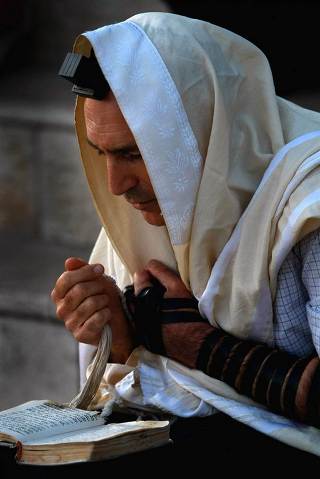
Laying Tefillin “And so it shall be as a sign upon your hand and as a symbol on your forehead that with a mighty hand the Lord freed us from Egypt.”

Exodus 13:16 (JPS Tanakh)

The Children of Israel are commanded to consecrate all firstborn, and to observe the anniversary of the Exodus each year by removing all leaven from their possession for seven days, eating matzah, and telling the story of their redemption to their children. They are also commanded to wear tefillin on the arm and head as a reminder of the Exodus and their resultant commitment to G‑d.

“Bo in a Nutshell”
Summary of Torah Portion Bo
Chabad.org

It isn’t easy for most Christians to understand many aspects of Jewish religious and ritual life. We can comprehend the need to pray, to gather together in worship, and to acknowledge God as King over all, but the way that Jews express their faith is often alien to Christians, especially Protestants, since we don’t have a strong ritual component (relative to Judaism) in our private and corporate worship lives.

Take Tefillin (phylacteries) for example. Why should a man have to wrap straps around one arm and the forehead with little boxes attached in order to pray to God? In this case, modern Jews are obeying a very ancient commandment from God as quoted above.

Here’s the commandment again as expressed in scripture that is also a part of the Shema:

“Hear, O Israel: The Lord our God, the Lord is one. You shall love the Lord your God with all your heart and with all your soul and with all your might. And these words that I command you today shall be on your heart. You shall teach them diligently to your children, and shall talk of them when you sit in your house, and when you walk by the way, and when you lie down, and when you rise. You shall bind them as a sign on your hand, and they shall be as frontlets between your eyes. You shall write them on the doorposts of your house and on your gates.

Deuteronomy 6:4-9 (ESV)

I don’t believe it’s a coincidence that this is also part of what Jesus referenced when asked about the two greatest commandments.

And one of the scribes came up and heard them disputing with one another, and seeing that he answered them well, asked him, “Which commandment is the most important of all?” Jesus answered, “The most important is, ‘Hear, O Israel: The Lord our God, the Lord is one. And you shall love the Lord your God with all your heart and with all your soul and with all your mind and with all your strength.’ The second is this: ‘You shall love your neighbor as yourself.’ There is no other commandment greater than these.”

Mark 12:28-31 (ESV)

If you put the commandment of tefillin within the context of loving God and loving your neighbor, then obeying this mitzvot is a sign of that love and adoration, not only of the Creator above, but of your fellow human being, because you cannot say you are performing the former if you do not perform the latter.

daven-tefillin-siddurOne of the First Fruits of Zion (FFOZ) commentaries for Torah Portion Vaetchanan (Deuteronomy 3:23-7:11) specifically addresses the commandment of tefillin.

There is some argument over whether the commandment of tefillin was meant to be taken literally, or if it is just a figurative language. In the Near East, it was once common for blood covenant partners to exchange amulet-like pouches which contained tokens, or even full copies, of their covenant obligations to one another. These were worn as bracelets or necklaces. The commandment of tefillin is consistent with that ancient ritual, especially when one considers the rabbinic tradition that God Himself wears tefillin with Israel’s name on them. In that sense, the tefillin are similar to wedding rings. In fact, while a Jew winds the black leather straps for tefillin of the hand about his middle finger like a ring, he recites the betrothal passage from the book of Hosea:

“I will betroth you to Me forever; Yes, I will betroth you to Me in righteousness and in justice, in lovingkindness and in compassion, I will betroth you to Me in faithfulness. Then you will know the LORD.” (Hosea 2:19–20)

The binding on of tefillin is a tangible, ritual reminder of our obligation to bind God’s commandments on our very lives. God’s Word is to be between our eyes, filtering all that we see and think. It is to be bound on our hands, weighing all that we set our hands to do.

As you can see, the love and marital symbolism is unmistakable and in reciting the blessings for donning tefillin, the Jewish heart is drawn in affection and adoration toward God…

…and toward each other.

As we were saying goodbye, I said to the man who had been asking the questions: “I suppose that you have a special interest in tefillin; is that was why you were asking those questions about them?”

“I haven’t put on tefillin for over 20 years!” was his reply.

“But you should!” I responded.

He then said: “Everyone here is now going home to sleep, but I am going to work. I own a bakery, and we work all through the night. If you want me to put on tefillin, you can come to my bakery at about 6:30 AM. At that time we are between bakes, and I’ll put on tefillin.”

I must admit that this was not my style, but I could not refuse, so at 6:30 Wednesday morning I arrived at his bakery with tefillin, prayerbook and skullcap, and amongst the sacks of flour he put on tefillin. What surprised me was that he needed no help—he knew exactly what to do and what to say.

After he finished, I said to him: “You obviously know how to put on tefillin, and you know the blessings and the prayers. Why don’t you do it regularly?” He told me that he didn’t own a pair of tefillin, and it was not one of his priorities to buy a pair—but if someone gave him a pair of tefillin, he would put them on regularly. I answered that I was returning to England via New York, but I expected to be back in Detroit in about six weeks, and that I would bring him a pair of tefillin.

-Benzion Rader
“Another Day Without Tefillin?”
Chabad.org

This is part of a rather lengthy story about one Jew going well out of his way (much more than the segment above indicates) to make sure another Jew could fulfill the commandment of tefillin. You might ask yourself if it was so important to the baker to daven with tefillin, why didn’t he just purchase some for himself?

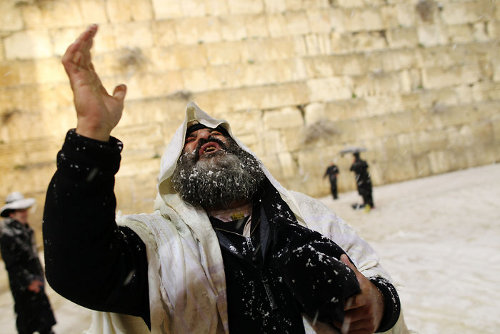
jews-praying-in-the-snowI don’t know. Regardless of his reasons or circumstances, once the other man became aware of the situation, he became obligated to help his fellow Jew. You can click the link I provided to read the entire article, but in short, here’s the rest of the story. The transaction between the businessman and the baker happened in Detroit. The businessman stopped in New York on his way back home to London to consult with the Rebbe in Crown Heights (Brooklyn), and the Rebbe convinced the businessman to make sure the baker had acquired tefillin immediately, before going back home rather than waiting six weeks. With great difficulty due to limited time and finances, the businessman was finally able to purchase tefillin and had them shipped to Detroit so that the baker would not go one more day without being able to pray with tefillin.

I left for London only after advising the Rebbe what had been arranged, and after waiting to hear that they had been collected and delivered in Detroit.

A few months later, I met this person again in Detroit, and asked him how he was doing with the tefillin. He told me that he had not missed a day—even walking home in the snow one day when his car broke down so that he put on the tefillin before sundown. He said: “Because of the trouble you went to in order that I should receive the tefillin the very next day, they are especially important to me.”

Again, this might seem rather a strange thing to a Christian since we do not experience any circumstance or situation that would inhibit or diminish our prayers, and certainly nothing like a physical object or device used in prayer.

Nevertheless, from a Jewish point of view, everything that happened was the performance of a single act of love in order to help one Jewish man perform another act of love…by davening with tefillin.

The results are obvious.

Good Shabbos.

Silent Faith at the Sea

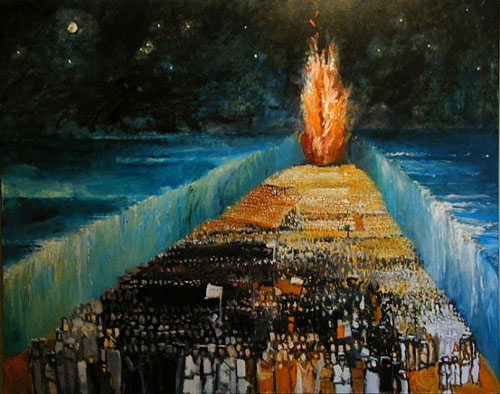
exodus-reed-seaWhen the king of Egypt was told that the people had fled, Pharaoh and his courtiers had a change of heart about the people and said, “What is this we have done, releasing Israel from our service?” He ordered his chariot and took his men with him; he took six hundred of his picked chariots, and the rest of the chariots of Egypt, with officers in all of them. The Lord stiffened the heart of Pharaoh king of Egypt, and he gave chase to the Israelites. As the Israelites were departing defiantly, boldly, the Egyptians gave chase to them, and all the chariot horses of Pharaoh, his horsemen, and his warriors overtook them encamped by the sea, near Pi-hahiroth, before Baal-zephon.

As Pharaoh drew near, the Israelites caught sight of the Egyptians advancing upon them. Greatly frightened, the Israelites cried out to the Lord. And they said to Moses, “Was it for want of graves in Egypt that you brought us to die in the wilderness? What have you done to us, taking us out of Egypt? Is this not the very thing we told you in Egypt, saying, ‘Let us be, and we will serve the Egyptians, for it is better for us to serve the Egyptians than to die in the wilderness’?” But Moses said to the people, “Have no fear! Stand by, and witness the deliverance which the Lord will work for you today; for the Egyptians whom you see today you will never see again. The Lord will battle for you; you hold your peace!”

Then the Lord said to Moses, “Why do you cry out to Me? Tell the Israelites to go forward.

Then Moses caused Israel to set out from the Sea of Reeds. They went on into the wilderness of Shur; they traveled three days in the wilderness and found no water. They came to Marah, but they could not drink the water of Marah because it was bitter; that is why it was named Marah. And the people grumbled against Moses…

Exodus 14:5-15; 15:22-24 (JPS Tanakh)

The miracle of the splitting of the Red Sea is the culmination of the Exodus. One week after the calamitous plague of the First Born, once again Pharaoh is chasing after the Jews to enslave them. As he advances, the Jews are trapped between the sea and the advancing Egyptian army.

Groups of Jews suggest a variety of responses to the impending disaster. God tells Moses to cease praying and travel toward the sea. In a heroic act of faith, Nachshon, prince of the tribe of Judah, throws himself into the sea, and it splits. (Talmud – Sotah 37a)

-Rabbi Dave Rudman
“Chumash Themes #11: Splitting of the Sea”
Commentary on Torah Portion Beshalach
Aish.com

One of the arguments I sometimes hear (though fortunately, not lately) about how Christians are ultimately superior to the ancient Israelites, has to do with faith. Basically, I’ve heard that Christians have an abundance of faith in God through Jesus Christ and the Israelites had none. The “proof” of the latter has to do with the continual grumbling of the Israelites (as I’ve tried to illustrate above) and how it seems to be a characteristic of them for the next forty years. That first generation out of Egypt never seems to get it right. It appears amazing after all, since they witnessed miracles of God that would stagger the senses. They saw the plagues against Egypt. They saw the parting of the Reed Sea. The entire population of Israel directly encountered God at Sinai and received the Torah “as one man.”

How could they not know that God is was with them?

The response to that question is much bigger than I’m able to answer, particularly in a blogging format, but through metaphor, midrash, and a little Chasidic mysticism, I want to use a tiny bit of the Exodus narrative to tell a story about us…about you and me…about people of faith.

When the Jewish people left Egypt, they were the spiritual equivalent of children. Their active participation in the Ten Plagues and the Exodus was negligible. The plagues were accomplished in a completely miraculous way through the agency of Moses and Aaron. The Exodus itself was predicated on the covenant that God promised Abraham to redeem his descendants from slavery. (Genesis 15:13-14)

Therefore, the Jewish people needed to mature and interact with God on their own.

-Rabbi Rudman

And he said to them, “Do you not understand this parable? How then will you understand all the parables? The sower sows the word. And these are the ones along the path, where the word is sown: when they hear, Satan immediately comes and takes away the word that is sown in them. And these are the ones sown on rocky ground: the ones who, when they hear the word, immediately receive it with joy. And they have no root in themselves, but endure for a while; then, when tribulation or persecution arises on account of the word, immediately they fall away. And others are the ones sown among thorns. They are those who hear the word, but the cares of the world and the deceitfulness of riches and the desires for other things enter in and choke the word, and it proves unfruitful. But those that were sown on the good soil are the ones who hear the word and accept it and bear fruit, thirtyfold and sixtyfold and a hundredfold.”

Mark 4:13-20 (ESV)

sower-seedThe full “Parable of the Sower” can be found in Mark 4:1-20 and I find it an interesting parallel to what Rabbi Rudman said about the Children of Israel being “spiritual children” at the point when they’re leaving Egypt. They were a people but not yet a nation. Their bodies had been freed from slavery but not their minds and hearts. They moved forward with joy but were terrified at every setback.

Here’s another way of looking at the choices we make as cited in a more “mystic” source:

A king had lost a costly pearl. He sent his three sons to look for it. The first son was of the opinion that his father did not need him anymore, and he did not return to him. The second son did not think about the pearl at all, he only wanted to be back home with his father. The third son understood that he had been sent out for this purpose: to become completely independent. So he searched for the pearl and found it and brought it to his father.

It is very much like that with humanity. One person is deeply involved in this world. For him it would have been better if he had never been born. Another strives his whole life to get back home to his Source, to his Father; but he is thereby thinking only about himself. Still other men seek after and find the precious pearl. They return the holy sparks of God which have been scattered in the world back to their original Source again. Such men are the true redeemers of mankind.

Paul Philip Levertoff
“Repentance and Redemption”
Religious Ideas of the Chasidim
Chapter 1, Sections 12 and 13
as quoted from Messiah Journal, Issue 112 (Fall 2013/5773), pp 79-80

Now how does all that compare to us?

young-levertoffYou may have been a Christian for so long that you’ve forgotten what it was like to be a brand new believer. You may have initially come to faith as a child within the context of a Christian family, so you may never have encountered God without the support of a church and loved ones, just you and Him alone and unfiltered. Taking the Master’s parable as a model, and given all that I’ve just said, you may have never faced nurturing a new and fragile faith that just about anything could blow away if you let it…like when the Adversary comes to take the word back out of your heart, or when you don’t allow the word to take root, or when you let the problems and worries of the world around you distract you and choke your faith to death. The challenge of letting faith and the word grow in good soil is to protect it long enough to become strong.

I suppose that’s one of the advantages I have in coming to faith later in life, although it comes with many disadvantages as well. Faith is something I’ve had to fight for within myself and it remains a struggle, sometimes between me and God.

Therefore, the Jewish people needed to mature and interact with God on their own. This was the purpose of the second phase of the Exodus, the splitting of the sea. In order to bring the Jews to this degree of independence, God directs them on a specific journey…

-Rabbi Rudman

I frequently refer to a life of faith as a journey taken along a path and I think the metaphor serves quite well. I sometimes feel that the first generation out of Egypt were never meant to enter the Holy Land of Israel, and that the trial of slavery in Egypt was just too much for them to overcome on the journey, even though God was with them.

But what was Egypt to them and why would it have left such an indelible brand on its slaves, at least as certain “mystic” viewpoints in Judaism see it today?

Mitzrayim (Egypt) expresses constriction, limitation. The spiritual Egyptian exile is the animal soul’s restricting and concealing the G-dly soul so severely that the G-dly soul is compressed to the degree that it is diminished and obscured. “Exodus from Egypt” is the removal of the constriction and bounds; i.e. the intellect in the brain illuminates the heart, bringing about fine character traits translated into actual practice.

“Today’s Day”
Sunday, Sh’vat 4, 5703
Compiled by the Lubavitcher Rebbe
Translated by Yitschak Meir Kagan
Chabad.org

They had been slaves all their lives, their parents, their grandparents, and all of their people had been slaves in Egypt for almost as long as their collective memory could recall. I sometimes feel as if they existed to prepare their children to inherit the promises God made to Abraham, Isaac, and Jacob.

But I’ll never know, I suppose. That’s just my imagination. I’ll never know if the journey was for the sake of the children who left Egypt and the children who were the first generation of Israelites born in freedom after several hundred years of enthrallment. The journey had a purpose, but it may not have been the one that we think of when we read of the forty years of wandering.

But what about us? It would be an immense tragedy to try to apply the forty years of wandering and the ultimate death of that first generation as a metaphor of us as individual believers. It would mean that the lives of some Christians who don’t quite make it in their faith are only illustrations for the witnesses to their lives. That sounds unfair to them and maybe I’m being unfair to the first generation to leave Israel as well. I don’t know.

But I do know that the journey has a purpose, even when it doesn’t appear that such a purpose exists. Each miracle, each tragedy, each meal of manna, each harsh encounter with Moab or the Amalakites…all of that shaped and molded the journey and shaped and molded the Israelite faith in the presence and purpose of God who was among them.

It is just the same with our journey as well. In reading and re-reading the Torah cycle each year, we are witnesses to the Israelite journey and as witnesses, we can try to learn the lessons their path is teaching us about our own trip through life. As we see their struggle, it is one of human beings contending with God. Can God save them from the latest calamity or must the Israelites take matters into their own hands and return to Egypt? Can Moses and Aaron be trusted to lead the people, or should Korach and his associates take over?

As far as we’re concerned, when difficulties happen to us, who should we trust and what should we do?

Sometimes you see that things have been taken out of your hands and are following a supernatural order. At this point, just do your best at what you have to do—and stay out of G‑d’s way.

-Rabbi Tzvi Freeman
“Getting Out of the Way”
Based on letters and talks of the Rebbe
Rabbi M. M. Schneerson
Chabad.org

WateringThis doesn’t mean we have no responsibility to act on our own behalf or on the behalf of others as circumstances require, but on the other hand, it doesn’t mean we have license to always drive ourselves into each problem as if God doesn’t exist, either. There is a time to act and a time to let God act and have faith that, even though things seem hard or even impossible, He will prevail.

Moses said to the people, “Do not fear. Stand still, and see the salvation of G-d that He will show you today: for the Egyptians whom you have seen today, you shall never see them again. G-d will fight for you, and you shall be silent.”

Exodus 14:13-14

Talmud Yerushalmi – Ta’anit 2:5 explains:

  • One group felt they could not win this battle. So rather than be captured alive, they wanted to commit suicide by casting themselves into the sea. To this, the response was “stand still.”
  • Another group of Jews desired to return to Egypt and surrender. To them, the response was, “the Egyptians whom you have seen today, you shall never see them again.”
  • A third group desired to go to battle. But Moses told them, “God will fight for you.”
  • For those who wanted to pray, Moses said, “Be silent.”

I told you midrash would be involved.

Listen to God and do what you are required, as best as you can comprehend, to address your life as it exists each day because it is faith in God that gives us courage to act. This helps us to mature and interact with God on our own. But remember that it is also faith and courage to “stand still” and to “be silent” and let God take care of you as well.

Articulating an Encounter with God

saul-on-the-roadNow there was a disciple at Damascus named Ananias. The Lord said to him in a vision, “Ananias.” And he said, “Here I am, Lord.” And the Lord said to him, “Rise and go to the street called Straight, and at the house of Judas look for a man of Tarsus named Saul, for behold, he is praying, and he has seen in a vision a man named Ananias come in and lay his hands on him so that he might regain his sight.” But Ananias answered, “Lord, I have heard from many about this man, how much evil he has done to your saints at Jerusalem. And here he has authority from the chief priests to bind all who call on your name.” But the Lord said to him, “Go, for he is a chosen instrument of mine to carry my name before the Gentiles and kings and the children of Israel.

Acts 9:10-15 (ESV)

This is part of the section of Acts 9 Christians typically call “the Conversion of Saul” (Acts 9:1-19). It is what Pastor Randy’s message was about during last Sunday’s sermon, and it is what Charlie taught to the Sunday school class I attended after the worship service.

There’s just tons and tons and tons I could comment on, especially regarding the material and discussion in Charlie’s class, but I’m going to address almost none of it in this week’s “church report.” If I did, I’d probably start more of a messy debate than I really want to deal with. But rather than talk about the things I don’t always agree with the church about, I want to talk about something that actually “clicked” for me.

In fact, when I heard some of the folks in class mention this, I practically wanted to jump for joy. I’d never heard Christians talk like this before. It was as if they were reading my mind.

Let me explain.

Have you ever heard any Christian say something like, “And then the Lord told me to do such-and-thus?” How about this one: “I felt that it was a calling from the Lord for me to do such-and-thus?”

I’ve heard those phrases from time to time and I’ve always wondered about how those Christians could know that what they were experiencing was from God vs. a “message” they were telling themselves based on what they wanted to hear from God. When I’ve made such a statement before, I’ve usually been criticized for not understanding how the Holy Spirit moves in people’s lives. But get this…the members of my class who were vocal about it agreed with my assessment. One gentleman even said it gives him goosebumps in a “creepy” way when people talk like that.

Wow!

I even felt comfortable enough to weigh in with my own opinion.

Now just to be clear, no one was saying that God doesn’t work in our lives, direct us in our actions, and require that we serve Him.

It’s just not based on a “calling” such as we see in Paul’s encounter with Jesus in Acts 9. An interesting opinion that’s been coming out of the church I attend for the past several weeks is that Acts is a “transitional” book and doesn’t describe what we can typically expect in a Christian life. We can’t expect to have a “Paul on the road to Damascus” encounter with Christ. We aren’t going to (probably) see a blinding white light or hear a Bat Kol from Heaven. And we aren’t going to receive an amazingly clear-cut calling to perform a specific set of actions from Jesus the way Paul received it.

Or for that matter, we won’t have an experience like this one, either.

Now there was a disciple at Damascus named Ananias. The Lord said to him in a vision, “Ananias.” And he said, “Here I am, Lord.” And the Lord said to him, “Rise and go to the street called Straight, and at the house of Judas look for a man of Tarsus named Saul, for behold, he is praying, and he has seen in a vision a man named Ananias come in and lay his hands on him so that he might regain his sight.” But Ananias answered, “Lord, I have heard from many about this man, how much evil he has done to your saints at Jerusalem. And here he has authority from the chief priests to bind all who call on your name.” But the Lord said to him, “Go, for he is a chosen instrument of mine to carry my name before the Gentiles and kings and the children of Israel. For I will show him how much he must suffer for the sake of my name.” So Ananias departed and entered the house. And laying his hands on him he said, “Brother Saul, the Lord Jesus who appeared to you on the road by which you came has sent me so that you may regain your sight and be filled with the Holy Spirit.” And immediately something like scales fell from his eyes, and he regained his sight. Then he rose and was baptized; and taking food, he was strengthened.

Acts 9:10-19 (ESV)

covering-eyesDon’t get me wrong. It would be great for Christ to talk to us and we could talk back, just like the conversation Ananias had with the Master, but such is not to be (to the best of my knowledge). It would be great if we could receive such specific information and even better if, like Ananias in verses 13 and 14, we could respond back, even questioning our instructions. Of course, that sort of communication presupposes that, again like Ananias, we would then respond in obedience, even if it was against our better (human) judgment, and do what we were told to do, That sort of communication presupposes that we would even act in obedience to restore the sight of someone who, up until a few days ago, had been a bitter enemy bent on imprisoning us and even killing us. It would mean we would have to obey the Lord and learn to address our enemy sincerely and with compassion as “brother.”

That doesn’t happen too often.

It must have been a difficult thing for Ananias to do, but he did it because he was a Jew and a disciple of the Master who was obedient to God.

But that doesn’t particularly mean what Paul and Ananias experienced transfers in any way to what we experience. Paul heard a voice from Heaven. When a modern-day Christian says, “the Lord spoke to me,” what do they “hear” if anything at all? We are not Paul. We are not Ananias. There’s no real evidence in New Testament scripture of Christians receiving a “calling” as many believers use the expression. I think the best we can hope for is this.

Now there are varieties of gifts, but the same Spirit; and there are varieties of service, but the same Lord; and there are varieties of activities, but it is the same God who empowers them all in everyone. To each is given the manifestation of the Spirit for the common good. For to one is given through the Spirit the utterance of wisdom, and to another the utterance of knowledge according to the same Spirit, to another faith by the same Spirit, to another gifts of healing by the one Spirit, to another the working of miracles, to another prophecy, to another the ability to distinguish between spirits, to another various kinds of tongues, to another the interpretation of tongues. All these are empowered by one and the same Spirit, who apportions to each one individually as he wills.

1 Corinthians 12:1-11 (ESV)

The entire chapter of 1 Corinthians 12 describes how we are all different and all possess varying skill sets within the body of believers, but our gifts originate from a single Spirit and we serve One God.

I’m sure you have noticed what you’re good at and what you’re not so good at. I’m sure you have been in situations where what you’re good at can (and hopefully has) been applied to serving other people and serving God. Beyond specific skills, anyone can donate a can of food to their local foodbank. Anyone can visit a sick friend in the hospital. Anyone can listen to a friend who is going through a tough time tell you their troubles for an hour or so just because you don’t want them to feel alone.

But it doesn’t mean that God has “called” you to do this or that or such or thus.

So the question came up, how do you know you are where you are and doing what God wants you to do?

That’s a tough one. It really is. We tossed that one around in class for a bit. Some folks think that if they’re in a situation and there’s no adversity, then that’s where God wants them to be. Problem is, sometimes God puts you in a spot where you’re going to experience adversity, such as what Christian missionaries face in certain African countries. Just because there are problems doesn’t mean you’re in the wrong place to serve God.

My own litmus test (and this is just me) is that when I find myself doing something I never would have chosen for myself in a million years and it is something that is helping other people and serving God, then that’s where God wants me to be.

walking-side-by-sideNo, it’s not like God always puts me in uncomfortable and even miserable situations. In fact, on Saturday, I had a meeting with Pastor Randy to discuss some work I wanted to do for the congregation (yes, I met with him on Shabbos…if that bothers you, then you’re going to have to get past it). We ended up talking about a great many topics near and dear to my heart. I discovered that we have many attitudes and opinions in common and I even managed to bring up subjects with him that I thought might be premature, given how little time we’ve had to get to know one another.

I’ve had my doubts in the recent past that this church was where God wanted me to be. No, I haven’t heard even a single audible word from God for or against my being at this church, but the way things seem to be presenting themselves, I can see that there’s a fit between this church and me (no one was more surprised than I was).

Am I being “called?” Nah, probably not. But God does work in our lives in ways we can’t always explain or even understand. Beyond what I’m saying in today’s “church report,” I can’t really articulate the experience. I just know that like my bi-monthly coffee companion said not to long ago, I have encountered God in church.

Imagine that.

Searching for the Writer of Life

writer-of-lifeThe Jews recognized that God no longer spoke to them in the same way as in the past. The prophets who persisted in seeing heavenly visions and hearing heavenly voices saw and heard in a manner very different from those of earlier times. As a consequence (cause?) of the cessation or permutation of prophecy, the Jews began to seek the word of the Lord not from people but from texts. The sacred traditions of the past were compiled and redacted, and the Torah was created. The words of the great prophets of the past were similarly compiled and redacted. This process, whose ultimate result was the formation of the Bible, raised two important questions. First, which books were to be considered canonical? Second, how were the canonical books to be interpreted, and who was authorized to interpret them?

-Shaye J.D. Cohen
Chapter 5: Sectarian and Normative, pg 126
From the Maccabees to the Mishnah, 2nd Ed

It is one of the oldest puzzles in the world. Investigators have been wrestling with it practically since the Bible was completed. As it happens, it did not start as an investigation into the authorship of the Bible. It simply began with individuals raising questions about problems that they observed in the biblical text itself. It proceeded like a detective story spread across centuries, with investigators uncovering clues to the Bible’s origin one by one.

It began with questions about the first five books of the Bible: Genesis, Exodus, Leviticus, Numbers, and Deuteronomy. These books are known as the Pentateuch (from Greek, meaning “five scrolls”) or the Torah (from Hebrew, meaning “instruction”). They are also known as the Five Books of Moses. Moses is the major figure through most of these books, and early Jewish and Christian tradition held that Moses himself wrote them, though nowhere in the Five Books of Moses themselves does the text say that he was the author. But the tradition that one person, Moses, alone, wrote these books presented problems.

-Richard Elliott Friedman
Introduction: Who Wrote the Bible? pp 15, 16-17
Who Wrote the Bible?

Yes, this is a continuation of yesterday’s morning meditation. I was prompted by the mention of Friedman’s book on Derek Leman’s blog post to check and see if my local public library had a copy available. It did and so I checked it out over my lunch hour (I work about a ten minute walk from the Boise Public Library’s main branch).

Depending on your thoughts and feelings about the origins of the Bible we have today, this could be dangerous stuff. In fact, questioning the traditions we have about the Bible has historically been very dangerous stuff.

At the first stage, investigators still accepted the tradition that Moses wrote the Five Books, but they suggested that a few lines were added here or there. In the eleventh century, Isaac ibn Yashush, a Jewish court physician of a ruler in Muslim Spain, pointed out that a list of Edomite kings that appears in Genesis 36 named kings who lived long after Moses was dead. Ibn Yashush suggested that the list was written by someone who lived after Moses. The response to his conclusion was that he was called “Isaac the blunderer.”

-Friedman, pp 18-19

But that’s not the half of it.

He (Bonfils) still thought that the passages in question were written by “one of the later prophets.” He was only concluding that they were not written by Moses. Still, three and a half centuries later, his work was reprinted with the references to this subject deleted.

Van Maes suggested that a later editor inserted phrases or changed the name of a place to its more current name so that readers would understand it better. Van Maes’ book was placed on the Catholic Index of Prohibited Books.

De la Peyrere’s book was banned and burned. He was arrested and informed that in order to be released he would have to become Catholic and recant his views to the Pope. He did.

Spinoza had been excommunicated from Judaism. Now his work was condemned by Catholics and Protestants as well. His book was placed on the Catholic Index, within six years thirty-seven edits were issued against it, and an attempt was made on his life.

Simon was attacked by other Catholic clergy and expelled from his order. His books were placed on the Index. Forty refutations of his work were written by Protestants. Of the thirteen hundred copies printed of his book, all but six were burned.

-Friedman, pp 18-21

jewish-traditionAt least up to the 17th century, it was worth your life to suggest that Moses didn’t literally write every single word that appears in the first five books of the Bible. Jewish, Catholic, and Protestant tradition vehemently defended this viewpoint and if you were a scholar who studied such matters, it was better to keep any opinions that deviated from tradition strictly to yourself.

But what about now? Are we as a body of believers more tolerant of serious, scholarly study of the Bible?

The answer is probably yes and no. I don’t believe that anyone in the modern era has ever been put in prison or (gulp) executed for having non-traditional beliefs about the Bible, but you rarely hear controvertial views on scripture spoken of in a Sunday morning sermon. For that matter, how much controversy about the Bible makes its way into the Rabbi’s discussion of the Torah portion on Shabbat?

In addition to the written scriptures we have an “Oral Torah,” a tradition explaining what the above scriptures mean and how to interpret them and apply the Laws. Orthodox Jews believe G-d taught the Oral Torah to Moses, and he taught it to others, down to the present day. This tradition was maintained only in oral form until about the 2nd century C.E., when the oral law was compiled and written down in a document called the Mishnah.

-from “Torah: Oral Torah, the Talmud”
Judaism 101

Within these four methods of understanding Torah, there exist countless possible avenues of understanding. For example: There are many different ways to understand the Torah according to Peshat. That’s why there are many Torah commentators who concentrate on Peshat — Rashi, Ibn Ezra, Rashbam and many more – and they will very often (it seems, more often than not…) disagree on the literal meaning of a verse. In fact, according to Kabbalastic teachings there are 600,000 ways to understand Peshat, 600,000 ways to understand Remez, 600,000 ways to understand Drush, and 600,000 ways to understand Sod!

Any insight in Torah is acceptable as long as it (makes sense and) does not contradict any of our fundamental beliefs.

-Rabbi Naftali Silberberg
“How is the Torah Interpreted?”
Chabad.org

My wife tells me that in Judaism, one does not interpret Torah outside of tradition, so at least from an Orthodox point of view (her perspective was likely learned from the local Chabad Rabbi), it would be unacceptable practice to consider interpreting Torah from any viewpoint other than established Jewish halachah.

But what about Christianity?

The Bible is God’s Word. But some of the interpretations derived from it are not. There are many cults and Christian groups that use the Bible, claiming their interpretations are correct. Too often, however, the interpretations not only differ dramatically but are clearly contradictory. This does not mean that the Bible is a confusing document. Rather, the problem lies in those who interpret and the methods they use.

We need, as best as can be had, the guidance of the Holy Spirit in interpreting God’s Word.

Because we are sinners, we are incapable of interpreting God’s word perfectly all of the time. The body, mind, will, and emotions are affected by sin and make 100% interpretive accuracy impossible. This does not mean that accurate understanding of God’s Word is impossible. But it does mean that we need to approach His word with care, humility, and reason. Additionally, we need, as best as can be had, the guidance of the Holy Spirit in interpreting God’s Word. After all, the Bible is inspired by God and is addressed to His people. The Holy Spirit helps us to understand what God’s word means and how to apply it.

On the human level, to lessen the errors that come in our interpretations, we need to look at some basic biblical interpretive methods. I’ll list some of the principles in the form of questions and then apply them one at a time to a passage of Scripture.

-Matt Slick
“How to Interpret the Bible”
Christian Apologetics and Research Ministry

You can click on the link I provided to read Mr. Slick’s ten principles for interpreting the Bible and everything else he has to say. I selected this resource basically because it was at the top of the Google search results for the “how do christians interpret the bible” search string. However, Mr. Slick and the carm.org web site don’t address the role of tradition in interpreting the Bible (except unintentionally by mentioning more than once that in Christian tradition, the Holy Spirit is required and considered always available to interpret the Bible).

How the Bible is translated from its ancient languages to English, for example, is driven by theology and tradition. Consider how Christian and Jewish translators address the text of the “Old Testament” let alone how they interpret its meaning. Sure, for the most part, reading a Christian Old Testament and a Jewish Tanakh will produce a similar experience, but it won’t be identical. Also consider, for example, how the text of Isaiah 56 is interpreted between Christians and Jews. Christianity largely believes that the Messiah, that is, the Christ, is being described, while its traditional in Judaism to say that Israel itself is the “suffering servant.”

Sofer-Sefer-TorahNot only is the origin of the Bible understood by various traditions, but what the text is supposed to mean is also interpreted in that manner, at least for the most part. I don’t doubt that there are certain individuals who are willing to take a wider look and a less dogmatic approach to the Bible, and certainly there are numerous scholars who will broach the subject of the authorship of the Bible, but how many of us, the “rank and file” of the church (or synagogue) are willing to take such a risk?

I say “risk” because if we aren’t able to detach our traditions from our faith, at least temporarily, in the study of the Bible, then we are likely to find ourselves approaching the edge of a very steep precipice and risk falling into the abyss of crisis. For some people, faith hangs in the balance.

But so does enlightenment. Frankly, if your faith can’t stand being shaken up a time or two, it probably isn’t very strong. Also, no one grows spiritually by playing it safe. Sure, it’s comfortable, and nice, and warm, and cozy inside the cocoon of tradition and pre-programmed belief systems, but who we are as disciples of the Master requires a modicum of courage at a minimum. Paul commended the Bereans (Acts 17:11) for examining the scriptures daily in order to verify what Paul was teaching. Can we do any less when addressing the scriptures themselves, including their sometimes mysterious authors?

Some people who do this, exit faith completely, unable to reconcile their relationship with God with the dissonance about the Bible. Some people abandon critical examination of the Bible and retreat into their former comfort zone, manufacturing some explanation about why such an examination is in error if not heretical. But some people actually grow.

I’m finding that Cohen’s and Friedman’s books seem to work well when read in parallel. However, it is important (to me, anyway) to stay grounded in the world of faith and not to stray too far into the area of objectification of the Bible. I still “just plain read” the Bible every day and more recently, I go to church every week. Every other week, I meet with a friend who has been a Christian for forty years. All this acts as an anchor on the shore as I also choose to explore deep (well, deep for me) waters.

In his book (Chapter 5), Cohen writes:

Judaism is a relativistic construct of human beings, and no variety of Judaism is any more correct or authentic than any other. This is the perspective of the historian.

Judaism is a body of absolute truths revealed by God and/or sanctioned by tradition, and those interpretations of Judaism that are more nearly approximate these absolute truths are truer and more authentic than those that do not. This is the perspective of the believer.

Following those definitions, of himself, Cohen writes:

In this book, I write as a historian.

I can see how the above definitions can be applied to how we view Christianity as well as Judaism, so it is possible to look at the Bible and its origins from either the historian’s or the believer’s point of view. I’m a believer but it is my opinion that my life as a believer can be enhanced by also looking at the Bible as a historian (with the aid or real historians and scholars such as Cohen and Friedman). It’s an adventure and as such, it presents a set of challenges and dangers.

If that doesn’t scare you off, I invite you to participate in the adventure along with me as I continue to read and comment upon Cohen and Friedman and their revelations about the Bible, tradition, history, and faith. May we all learn together and may we all draw closer to the One who is the Author of our lives and the Lover of our souls.

Missing Author

empty-bibleWho wrote the Torah? Most people you ask — depending on your circle of friends — will answer, “A group of very wise men got together and wrote it.” For the past 3,300 years the Jewish people have lived with the consciousness that the Almighty dictated the Torah to Moses who wrote it down word for word, letter by letter. Every Torah-educated Orthodox Jew believes that. Are they fools, fantasizers, misguided religious fanatics?

It will surprise some people to know that for the past 3,300 the Jewish people have taught their children the evidence for the belief that there is a God and that He dictated the Torah to Moses. Actually, I am sure that for the first hundred or two hundred years after the giving of the Torah at Mt. Sinai the authorship of the Torah was not even a question. For generations all a Jewish child had to do was to ask his father if he was at Mt. Sinai or if his father or grandfather was there. Even Moses himself tells all generations to “Go and ask … has a people ever heard the voice of God speaking … as you have heard and survived?” (Deuteronomy 4:32-35).

-Rabbi Kalman Packouz
“Shabbat Shalom Weekly”
Commentary on Torah Portion Vaeira
Aish.com

This post may trouble some readers. It really shouldn’t. Religious leaders in some circles have sought to suppress the overwhelming evidence that something like the Documentary Hypothesis is true. Attacks against this idea usually claim that those who believe this theory simply disbelieve God. Such attacks also tend to refer to Julius Wellhausen and his views, which actually do not represent what is essential about the Documentary Hypothesis. The Documentary Hypothesis (DH) has many forms and is better known as JEDP. In my opinion, the best developed understanding of the DH is found in Richard Friedman’s work, including the very readable Who Wrote the Bible? (which was a bestseller).

-Derek Leman
“Exodus 6:2-3 and the Documentary Hypothesis”
Messianic Jewish Musings

I haven’t revisited this topic in a long time and even after I read Derek’s blog post, I was determined not to regurgitate it again from the murky depths so that it could come back up into the cold light of day. Then I read Rabbi Packouz and I was reminded that there is a fair distance between the stories we tell ourselves about the Bible and the story that the Bible tells us about itself (I know these gentlemen are specifically discussing the Torah, the Five Books of Moses, but I’m choosing to expand the discussion to the Bible as a whole).

I don’t mean the story the Bible tells in the actual text, but the history and evolution of the creation of the Bible as we have it today. I’m no scholar, but even I’ve read enough to realize that the Bible has lots and lots of warts, bruises, wrinkles, and other imperfections. No reliable and trustworthy Bible scholar would suggest that God literally dictated the Bible word-for-word to its various human authors.

So where is God in the Bible? No I don’t mean where is God mentioned, but is there anything of God in the actual composition of the Bible? Or is the Bible just the stories we tell ourselves about it? Frankly, we have told ourselves some pretty interesting stories about the Bible.

One way to establish and support an acceptance of Talmudic interpretation and judgment relative to Torah for post-Second Temple Judaism is to project the values and even the “reality” of Talmud (and later, Kabbalah) not only forward in time but backward. Peering at the Patriarchs through this lens, we can indeed “see” Abraham, Isaac, and Jacob studying Torah and Talmud in the study house of Shem when by historical knowledge and a plain reading of the Torah, such events seem very unlikely to have actually taken place.

-from my blog post:
The Rabbinization of Abraham

study-in-the-darkI periodically wrestle with this issue. Back on my previous blog, I wrote such articles as Reading the Bible in the Dark, The Bible is a Mystery Novel, and Who to Believe. I manage to “tame” the questions and conundrums by reading the Bible as if it were a series of Chassidic, or in my case, Messianic Tales. Maybe that’s the only way to make sense of the Bible, and especially the Gospels.

He read the Gospels in German. Then he obtained a Hebrew version and reread them. Though he was in the midst of a Gentile, Christian city where Jesus was worshiped in churches and honored in every home, Feivel felt the Gospels belonged more to him and the Chasidic world than they did to the Gentiles who revered them. He found the Gospels to be thoroughly Jewish and conceptually similar to Chasidic Judaism. He wondered how Gentile Christians could hope to comprehend Yeshua (Jesus) and His words without the benefit of a classical Jewish education or experience with the esoteric works of the Chasidim.

Taken from Jorge Quinonez:
“Paul Philip Levertoff: Pioneering Hebrew-Christian Scholar and Leader”
Mishkan 37 (2002): 21-34
as quoted from Love and the Messianic Age

But this presents a problem. During last Sunday’s sermon, Pastor said (I don’t have my notes with me, so what I’m about to write isn’t an entirely accurate quote) that the only way to show an unbeliever how to encounter God and come to faith in the Father through Jesus Christ is by reading and using scripture.

Um…whoa. Waitaminute.

Given everything I’ve said above, plus Derek’s commentary, plus just a boatload of Biblical scholars , scripture is not and cannot be the literally dictated words of the God of Heaven as whispered into the little, shell-like ears of the prophets and other writers of the books of the Bible.

In fact, I’m hard-pressed to tell you what the Bible is and who actually wrote it. Even portions of the New Testament weren’t in all likelihood, written by the people whose names are attached to them. Not all of the epistles written by Paul? Probably not. Did the Apostle John who (supposedly) wrote the Gospel of John also write Revelation?

Once you stop taking the Bible for granted, a lot of new territory opens up in front of you…in front of me.

In defense of the Bible (the Torah actually), Rabbi Packouz has this to say:

Perhaps the most powerful example is Shmitah (the Sabbatical year for the land). Modern agriculture science has taught us the value of letting the land rest and replenish itself. A sensible law would be to divide the Land of Israel into 7 regions and each year let one region lie fallow while people eat from the crops of the other 6 regions. However, that’s not the law of the Torah! The Torah writes, “For six years you may plant your fields … but the seventh year is the Sabbath of the land in which you may not plant your fields nor prune your vineyards (Leviticus 25:36).

The WHOLE land is to rest all at the same time! What happens to an agrarian society that stops farming for one year? Starvation! And how long does a religion last that advocates letting the whole land rest in the 7th year? My guess … about 6 years!

Perhaps they could avoid starvation by buying food from surrounding countries? A good idea and a reasonable idea … but the Torah has other plans. The Almighty says, “I have commanded My blessing to you in the sixth year and you will have produce for three years” (Leviticus 25:20-22).

Either one has to be God to have the “audacity” to make a law for the whole land to rest and then to promise a bounty crop 3 times as large as usual in the sixth year — or a stark raving mad lunatic!

Yet, the Jewish people neither starved nor abandoned the Torah! 3,300 years later a sizable portion of our people still adhere to the laws of Torah and still trust in the promises of the Almighty!

How could any human being promise in writing something that requires powers totally beyond his control?

And furthermore, why would anyone be willing to risk his own credibility and the legitimacy of his religion, when it would be easier to present a more rational solution and avoid the credibility issues.

Going to GodCan we accept that somewhere in the pages of the Bible we might actually be able to encounter the Divine? If so, where and how (apart from Shmitah)? If we can’t take the Bible as literally, page-by-page, the Word of God, then what do we consider it? If God is in there somewhere, then is it an intellectual and scholarly race to discover the secret location of the well of God’s Spirit?

Derek Leman seems to think that it’s possible to have a very questioning view of the Bible and yet still have faith:

People get from their religious background the idea that “Moses wrote all” or “Moses wrote almost all” of the Torah. For example, people will say “Moses wrote Genesis.”

This is complicated by things like Yeshua referring to “Moses and the prophets.” People take this to mean that Yeshua, who they suppose was omniscient during his earthly sojourn (but he was not) affirmed that Moses wrote all of Gen-Deut. He did not. His references to Moses actually writing all concern commandments, not narratives. With Moses as the originator of the commandments (or original vessel through whom they were revealed), all the five books are called “of Moses” but this need not mean authorship.

Anyway, because some of the earliest people to doubt Moses as the final author of Torah were skeptics, it is common for people to think anyone with a more complicated view than “Moses wrote it” are doing so because of a small faith or a lack of faith or a dislike of faith.

But I’ve never heard a satisfactory explanation of how other people do it. I only have how I do it and my “method” requires usually suspending disbelief for the sake of faith. I have encountered God before, so in an extraordinarily subjective way, I know He is real, He is alive, and He is God. I’m not going through the crisis of faith I had when I first faced this particular realization, but I do allow myself to periodically become aware of just how fragile a knowledge of God is if based solely on the Bible. On the other hand (and I’ve alluded to this already), basing knowledge of God solely on our experiences with the Holy Spirit can be just as hazardous, because most human beings have very little ability to tell the difference between an emotional experience and a spiritual one (barring the occasional saint or tzaddik).

I may not be able to take everything I read in the Bible and everything that Christianity and Judaism says about those events as actual, factual events (though some of them probably are), but I can still take what I read and what I study and try to apply them so that I can learn to live a better life.

The Patriarch Abraham was tested (by God) ten times and withstood them all. This proves Abraham’s great love for God.

-Ethics of the Fathers 5:3

Abraham was tested with ten trials of progressively increasing severity, ultimately culminating in the test of sacrificing his beloved son Isaac if God so willed.

Abraham successfully passed all the tests. Still, while he did demonstrate his intense loyalty and devotion to God, how did it prove his love for God?

In yesterday’s message we learned that God does not challenge people beyond their capacities. It follows, then, that as they advance in spiritual growth and strength, they actually render themselves vulnerable to trials of greater intensity. In the course of his many trials, Abraham detected this pattern. He could have logically decided to avoid any further spiritual progression, because it might subject him to even greater ordeals than those he had already sustained.

Abraham decided otherwise. He desired so much to come closer to God that he was willing to pay any price. Thus, when he was put to the ultimate task – to sacrifice Isaac – Abraham was not taken aback. He had fully anticipated such an eventuality.

We are not of the mettle of Abraham, and we pray every day, “Do not put us to test.” While we indeed wish to advance spiritually, we ask to be spared the distress of trial. Yet, should we experience adversity in life, we would do well to realize that this may be a testimony to our spiritual strength.

looking-upToday I shall…

try to advance myself spiritually. Although I pray to be spared from distress, I will try not to recoil if adversity does occur.

-Rabbi Abraham J. Twerski
“Growing Each Day, Tevet 26”
Aish.com

Thomas Gray once penned the famous words, “Where ignorance is bliss, ’tis folly to be wise” (in the poem “Ode on a Distant Prospect of Eton College,” 1742). I suppose many “Bible-believing Christians” feel very blissful as long as they don’t consider the rather troubling questions I’m bringing up this morning. On the other hand, once the “bliss bubble” is popped, then we can only face the painful trial of reality, if not the wisdom, of whatever we have left.

Chances are, Abraham never faced the ten challenges, at least as we see chronicled in Pirkei Avot (but not the Bible). Chances are Abraham, Isaac, and Jacob never studied Torah in the academies of Shem and Eber as we learn from the Talmud. Maybe the only place we really encounter God is in our prayers. Or maybe we encounter God everyday, as long as we continue to seek Him.

According to Gedaliah Nigal’s book The Hasidic Tale, some of the goals of the hasidic story are to “rouse its hearers into action for the service of God” and to win “adherents, among them some outstanding individuals, to hasidim.” In relation to this, I’ve said:

The “Chasidim” of Jesus also made sure the stories of their Master were passed on from generation to generation, eventually being recorded and passed on to the future…to us.

Paul Philip Levertoff thought that the teachings of Jesus read like a collection of Chasdic tales. Perhaps as Gentile Christians reading tales of the Chasidim, we can also find a connection to the Messiah, the Prophet, and the greatest Tzadik, whose own death atoned for not just a few, but for all.

Having gone through all this again, I feel reassured.