Tag Archives: God

Opting Out of Yiddishkeit?

On today’s daf we find halachos that apply to converts.

Converting is a huge sacrifice, which God values greatly—and so should we. But as is well known there is a halachah that a non-Jew who converted as a minor can recant his decision upon reaching majority. In that case, he reverts to being a non-Jew. How sad that he lost out on such a special distinction due to some passing whim!

There was a case where a family converted together; mother, father and children. When one son heard that he was allowed to opt out of Yiddishkeit, he honestly said that he wanted to let go of his conversion. “If I am obligated to be a Jew that is one thing, since God wants me to fulfill the mitzvos. But if I am able to be a non-Jew, why should I take on the obligation to do all the mitzvos? How can I know that I will fulfill them as I should? Isn’t it better for me to go the easier but more sure way?”

But when he expressed this wish, the dayan he spoke to wasn’t sure what to do. “I am not sure whether when an entire family converts one who was a minor at the time can opt out. This is a machlokes Rishonim and I am not certain how we rule.”

When this question reached the Chasam Sofer, zt”l, he ruled decisively. “We hold like the Rishonim who rule that a convert whose entire family converted with him cannot opt out of his Jewishness.”

Daf Yomi Digest
Stories Off the Daf
“The Convert’s Choice”
Niddah 49

I’ve been thinking a lot about religious observance recently. Actually, I’ve been thinking about it for a long time and wondering if I’d ever get up the nerve to actually blog about it.

So here goes.

It’s fairly common knowledge within the Messianic Jewish and Hebrew Roots communities that the status of non-Jews and their possible obligation to Jewish religious observance is a matter of some concern. Mark Kinzer’s book Postmissionary Messianic Judaism: Redefining Christian Engagement with the Jewish People is something of a blueprint of one end of the spectrum of Messianic Judaism that advocates for parallel but wholly separate conduits of Jews occupying Messianic Judaism and Gentiles occupying traditional Christianity. In theory, both groups relate to One God and to Jesus (Yeshua) as the Jewish Messiah, but their recommended approaches to religious practice are totally different, and the two groups rarely if ever, interact.

On the other side of the spectrum is the One Law group which states that there are no distinctions or differences between Jews and non-Jews in the Messianic movement. Except for a matter of DNA, Jews are no different from Gentiles in their obligation to the 613 commandments that define the modern understanding of the Torah. This brings up the uncomfortable reality that all Christians everywhere have the same obligation to the Torah, whether they realize it or not. The One Law position must come to the conclusion (though I’ve never heard them state it as such) that the vast majority of the Christian church is continually in sin because they don’t refrain from eating trief and work and play on Saturday.

The educational ministry First Fruits of Zion (FFOZ) has proposed a sort of “middle ground” in this arena with the idea of something called “divine invitation.” FFOZ has produced a number of books and other, similar materials presenting information from Jewish literary sources suggesting that historically, Gentiles were not always completely forbidden from certain Jewish observances. I won’t attempt to list the details here since they are too numerous, but the basic idea is that, while non-Jews are not obligated to fulfill the Torah mitzvot in the manner of Jews, they are, in many cases, permitted to do so.

This would no doubt fly in the face of more traditional Jewish viewpoints and certainly Orthodox Judaism would be in almost complete disagreement. Nevertheless, within the Messianic context, you will find many non-Jewish people voluntarily taking on board some of the Torah mitzvot as they feel led to do so, but with the understanding that refraining from any of the mitzvot does not constitute a sin on the part of a non-Jewish Christian.

Divine invitation is an opportunity for non-Jews in the movement who have become accustomed to keeping certain of the mitzvot to continue to do so without necessarily crossing the distinction barrier between Gentile and Jew and thus preserving Jewish distinction in Messianic Judaism.

But there’s a flip side to the coin. Divine invitation allows non-Jews in the movement or at least associated with the movement to not observe the mitzvot…at all…ever.
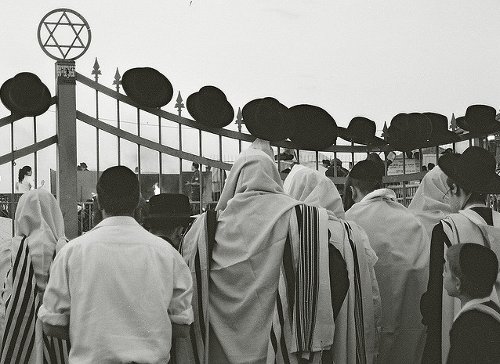
It’s been well over a month since I attended FFOZ’s Shavuot conference at Beth Immanuel Sabbath Fellowship in Hudson, Wisconsin. For several days, I was allowed to worship in what seemed to be the ideal Messianic Jewish religious environment. The Gentiles still outnumbered the Jews by quite a bit, but the model for worship was definitely that of the synagogue, though great accommodations were made for non-Hebrew speakers and readers.

There were a lot of non-Jews worshiping in the Jewish manner, though in that environment, they were not obligated to do so. We non-Jews were not obligated to eat the fine kosher food that was provided. We were not obligated to daven shacharit. We were not obligated to don tzitzit. And yet most of the non-Jewish worshipers did so and no one seemed to mind.

But what if we didn’t? I mean, if we’re not obligated and let’s say, we don’t feel led, so what if we didn’t worship in even a remotely Jewish manner? I suppose nothing bad would happen. But is there an expectation that even if we don’t have to keep the mitzvot, that we should, particularly if we are choosing to worship with Jews who are worshiping God as Jews in a (Messianic) Jewish synagogue?

It would be an interesting experiment in that environment to have a non-Jew observe absolutely none of the mitzvot, just to see what it would be like to decline a “divine invitation.” I suppose it would be like going to your high school senior prom and then continually refusing invitations to dance. What would be the point?

The point I suppose, is that the “prom” is where you feel you belong, where your friends and maybe your family are, and yet you feel you aren’t called to dance their dance because you believe you don’t really belong to that group of dancers.

OK, it’s a crummy metaphor, but you get the idea.

Of course, most of the time, I don’t worship with anybody. In fact, I don’t worship in a community at all. This avoids the whole problem of how I should worship, identity confusion, and the whole shooting match, but there’s a problem. I live with Jewish people. Do I do what they do?

Well, sort of.

Here’s the scary part.

The Jewish people I live with aren’t particularly observant.

There, I said it.

It’s true. At this point, my wife and daughter don’t even light the candles on Erev Shabbat. For a long time, I was the only one doing it, but it seemed absurd that I continue since I’m the only non-Jew in the house and a male and I’m the one lighting the candles. I kept asking my wife on Friday as sundown approached, “Do you want to light the Shabbos candles?” Her response was always something like, “You can if you want to.”

Like I said, it got kind of absurd. No one seemed to care if I lit the candles or not. So I stopped.

My wife hasn’t gone so far as to serve up pork chops for dinner and in fact, she’s rather studious about making sure we all continue to eat “kosher style” (see Leviticus 11), but our kitchen isn’t kosher and, strictly speaking, my wife doesn’t understand why I don’t choose to eat trief, since the kosher obligation doesn’t apply to me.

We also (gasp) work on the Shabbat. This part really bothers me, but there’s not a lot I can do about it. My daughter’s and my wife’s employers require that they work highly variable hours including the weekends, and they often work late Friday nights and on Saturday. The missus has made no bones about saying she would like me to keep my writing and editing schedules up on the weekends, though I’m able to refrain from household chores on Shabbos for the most part, deferring them to Sunday. I can’t remember the last time she went to shul, except perhaps to cook for some special occasions.

Yes, I do know that my Jewish family members are obligated to the Torah, though none of them are observant at the moment.

I suppose that makes me a bad husband and father for not compelling them to do so.

But I can’t really compel them to do anything. I have tried being supportive, but my children are all of adult age and my wife is of course, my wife, so she takes responsibility for her Jewishness and again, it seems rather absurd for a non-Jew and particularly a Christian to be telling her the business of being Jewish.

So having tried that and seeing that it didn’t work out so well, I stopped.

(I suppose at this point I should add that my wife subscribes to and reads the same (more or less) Chabad.org newsletters and tutorials that I do, which means her “morning meditations” are substantially similar to my own. I should also say that she anticipates leaving her current “slave job” at some point in the reasonably near but not clearly defined future, so what she does with her “free” Sabbaths after that is up in the air…but I can hope.)

The whole “divine invitation” and Christian identity thing means that I am not obligated to a Jewish lifestyle. I’m sure most Jews out there are relieved to hear that I’m not living like a Jew. But depending on your view of Jewishness and Jewish obligations to God, some of you may be distressed that my Jewish family members are not observant. Heck, there are members of the local Reform shul who are more observant than my family.

I can imagine that many Jews would blame me for all of this. After all, my wife and I are intermarried. Intermarriage is usually seen as the gateway for a Jew to leave Judaism and assimilate into Gentile secular culture or even into Christianity. While I can assure you that my wife has no attraction to Christianity on any level and I don’t believe she has become secularized, she doesn’t display a strong religious Jewish lifestyle.

More’s the pity.

(I’ll add here that my wife does keep up on events at the local synagogues and does have definite opinions about people at the Reform shul with a “questionable” Jewish background positioning themselves to lead services and teach [and that would never happen at the Chabad]. She’s “OK” with non-Jews and even Christians attending synagogue as long as they don’t talk about their faith, but she draws the line at “Messianics” or those who were formerly associated with the movement assuming any formal synagogue role.)

I have been trying to encourage my son David to return to the synagogue. His wife has recently rekindled her interest in attending church but I don’t think David would go with her on a regular basis. His basic internal template for religion is still Jewish and he remembers fondly some of his “debates” with the local Reform Rabbi. Actually, just last Sunday, my wife said she’d love it is David would visit the Chabad here in town, so she has her hopes as well.

The “religious identity” of my family continues to be in flux. I’m not even sure how much more my wife can tolerate my Christianity, so where I’ll end up in the months and years ahead is uncertain. I’d like my Jewish family to return to Judaism as an observant lifestyle. I hope they don’t see me as a barrier. I’m really anything but. In fact, in a recent conversation about conversion with my wife, (hence the quote at the beginning of this “meditation”) she said it would be ridiculous for a Gentile to try to convert to Judaism in Boise, (although a good friend of hers converted within the past year) since the convert wouldn’t have a strong Jewish community in which to live. So I don’t think my wife wants me to be “Torah observant” in any way, shape, or form. But what about her?

It would seem that for the sake of peace in the home, I must decline my “invitation,” and as a Christian, I would not only make a poor model of Jewish observance for my Jewish family, but I would actually be an annoyance if I tried. Thus, I cannot encourage them by my example since my example would be completely unwelcome.

I suppose if I were a Jewish husband and father, it might be different, but that’s not an option. Maybe the fears of Judaism are authentic fears and intermarriage is the path to slow death for the Jewish people. Even though it is not my intent, I certainly seem to be killing the Judaism in my home.

Across the long span of history, an untold number of Jews have suffered and died to preserve who they are as Jews. Given that realization, I wish I understood what was going on in my own home. But then, in this particular case, I don’t have a say. I only have to wait and pray that God, who has never abandoned His people Israel before, won’t abandon those who live in my household now.

My wife and children are Jewish. I want and even need them to live like Jews. May the God of mercy grant this for them and for the sake of Israel.


And Don’t Forget To Dance

Imagine there’s no heaven
It’s easy if you try
No hell below us
Above us only sky

-John Lennon
Imagine (1971)

And I heard a loud voice from the throne saying, “Behold, the dwelling place of God is with man. He will dwell with them, and they will be his people, and God himself will be with them as their God.”

“He will wipe away every tear from their eyes, and death shall be no more, neither shall there be mourning, nor crying, nor pain anymore, for the former things have passed away.”

Revelation 21:3-4 (ESV)

I hate to keep picking on Joe and Heidi, but their continual battle with cancer is a continual inspiration to me. More than that, it’s their courage, faith, and humor in the face of living a nearly impossible life that is the real inspiration. It puts to shame most of us who complain about our rather modest discomforts.

The first thing I thought of when I saw the photo of Joe and Heidi dancing, and knowing something about the hardships they face was, “this is what it must be like to watch people dancing in Heaven.” Then I thought about the “no more tears” portion from John’s Revelation. Then I thought about writing.

And here I am.

But what if, as John Lennon suggested, that there is no Heaven. What if we face insurmountable hardships, heartbreak, tragedy, and sorrow with no hope and no end except a black and empty death? How would that change us? What would it make human behavior like?

Or is this why the world is in the shape it’s in today? Because the majority of the world, as Lennon suggested, believes there is no Heaven…no accountability…no God?

I know I’m going to experience some serious “blowback” about that comment from secular humanists and atheists who see themselves as the greater moral force in the world and I can’t say they’re not. It doesn’t take a belief in God in order to do good. However, I think it takes such a belief to give it all a greater meaning beyond our temporal context. But some atheists cast themselves in the superior role because they don’t do good just to satisfy some abstract and alien being sitting in judgment on a throne. They do so because…um, why? Because it’s the right thing to do? But how do they know? How does anyone know?

Where do we get the idea that something is good and some other thing isn’t? What is “good” and what is “evil?” How do you know? If you’re an atheist, there is no moral structure attached to your belief since not believing in God isn’t value laden. It simply means you don’t believe a supernatural being created the universe and is involved in our lives.

What if there is no Heaven for Joe and Heidi? What would it mean in terms of the overwhelming fight they’ve been waging against cancer? Have they been praying to empty air? Has the courage they’ve gotten from faith been in vain?

Based on Lennon’s lyrics, he seemed to believe that if we deconstructed all human (and supernatural) infrastructures, organizations, groupings, and distinctions, the world of human beings would be a better place. Maybe it would be, I don’t know. It won’t happen because human beings absolutely need to identify, label, and organize their environment in order to make any sort of sense of it. All people groups use two basic names. One for themselves and the other for everyone else. Those names mean something to them and to us. Of course, they might not mean the same things.

When I say I’m a Christian, I mean a particular thing. Other people hear that label and perhaps comprehend it in a different way than I do. Some people hear that label and comprehend it in the most negative possible light. In their world, they have one name for themselves, which means they’re “good”, but the name “Christian” or “Jew” means something that bad, wrong, immoral, or evil (and where did the concepts of good and evil come from, anyway?)

But from inside my point of view and from inside my faith, I don’t perceive my faith to be evil. I know I am not a perfect person and I have made mistakes. I’ll make mistakes again. I don’t brag about it or enjoy it, but that’s part of what it is to be a flawed human being living in an broken world. And after all, human beings broke it.

I’m accountable not just to other human beings (my wife, my family, my employer, the government), but I’m accountable to a force that is larger than human institutions and an intelligence that comprehends the infinite mysteries of the universe. For me, there is a greater sense of morality and ethics that exists and One who is the origin of what it is to be good or to be evil.

What shall we say, then? Is the law sinful? Certainly not! Nevertheless, I would not have known what sin was had it not been for the law. For I would not have known what coveting really was if the law had not said, “You shall not covet.” –Romans 7:7 (ESV)

Sometimes it helps to have an external standard to help us define our role in life. For those of us who have faith, God is that standard. For those without faith, I suppose our government, or the news media, or a social organization will have to do. I can’t tell anyone else how to live their lives, but it would be wonderful if others would stop insisting they have the right to tell me to abandon my faith. But that’s the way of the world. If faith isn’t strong enough to withstand the winds of criticism from society, it will never stand up against the brutal storms of some disaster like cancer.

So Joe and Heidi showed me what it’s like to dance in Heaven this morning. As I looked at their photo, all of the sorrow and grief and hostility of the world surrounding me momentarily faded away. Imagine there is no Heaven if you want. But grasping hold of my faith not only gives me peace about the future, but the strength to carry on in the harsh and uncertain present and to try to do a little good in the world I live in every day. I pray, whoever you are reading this, that you can find the same.

In your worldly business, just do what needs to be done and trust in G-d to fill in the rest.

In your spiritual business, however, you’ll have to take the whole thing on your own shoulders. Don’t rely on G-d to heal the sick, help the poor, educate the ignorant and teach you Torah.

He’s relying on you.

-Rabbi Tzvi Freeman
“Make it Your Business”
Based on letters and talks of the Rebbe
Rabbi M. M. Schneerson
Chabad.org

And don’t forget to dance.

Where Is Your Heart?

A guest who had traveled from afar once visited the saintly Chofetz Chaim, Rabbi Yisrael Meir Kagan zt”l, and was taken aback by the Rabbi’s simple living conditions. The home was lacking the most basic furnishings! When he relayed his surprise, the Chofetz Chaim asked him, “And where is your furniture? Why didn’t you bring it?” The guest replied with the obvious, “I’m just passing through here. I live quite a distance from here, and there I have many furnishings to decorate my home.” “I’m following the same practice,” responded the Chofetz Chaim. “In this world I’m just passing through. My real home is in the next world, and with the eternal treasures produced from my service of the Al-mighty I am furnishing that future home.”

-Rabbi Mordechai Dixler
“Those People Are In Tents!”
Commentary on Torah Portion Balak
ProjectGenesis.org

“Do not lay up for yourselves treasures on earth, where moth and rust destroy and where thieves break in and steal, but lay up for yourselves treasures in heaven, where neither moth nor rust destroys and where thieves do not break in and steal. For where your treasure is, there your heart will be also.

Matthew 6:19-21 (ESV)

I know. This is pretty elementary. Most relatively new Christians are taught that what we have in the here and now is transitory while our true home and treasure lies with God.

Rabbi Dixler uses this principle in his commentary on last week’s Torah Portion, but adds that it’s not just living here temporarily that’s important, but our attitude about it.

Bilaam was hired to curse the Jewish nation, but was denied the ability to do so. In fact, he eventually formulated a number of blessings and praises, including “How goodly are your tents, Jacob, your dwelling places, Israel!” (Numbers 24:5) The Jews were indeed dwelling in tents at the time, but the message was that they not only dwelt in tents, but their attitude was in tents. All the wealth and possessions they had, whatever “stuff” they collected, was understood for what it was — temporary, like a tent. What they really valued and focused on was their everlasting spiritual acquisitions in their service of the Al-mighty. (Sefer Taam V’Daas)

Of course, this is midrash and not necessarily absolute fact as far as the Children of Israel are concerned, but it is also long-established Jewish tradition and this tradition teaches a lesson.

But maybe not the lesson you are thinking about.

Let the faith of God be in you. For amen, I say to you, anyone who says to this mountain, “Be lifted up and moved into the middle of the sea,” and does not doubt in his heart, but rather believes that what he says will be done, so it will be for him as he has said. Therefore I say to you, all that you ask in your prayer, believe that you have received it, and it will be so for you. And when you stand to pray, pardon everyone for what is in your heart against them, so that your Father who is in heaven will also forgive your transgressions. But as for you, if you do not pardon, neither will your Father who is in heaven forgive your transgressions.

Mark 11:22-26 (DHE Gospels)

This verse is used to fuel the “name it and claim it” theology, which seems to be a subset of the prosperity theology; a gross distortion of the intent of Jesus when he’s describing faith. Faith isn’t about greed and it isn’t about “magic tricks.” We see by the words of the Master in the latter portion of the quote, it’s about mercy, grace, and compassion.

It’s also about conditional forgiveness.

Huh?

I thought God’s forgiveness through the sacrifice of Jesus and the grace of Christ our Lord was unconditional. I thought we couldn’t merit salvation or buy our way into Heaven. I thought it was a free gift. All I have to do is believe.

Sure. Except that’s not exactly what Jesus said, is it?

There seems to be a bit of craziness involved in some of the beliefs of the church (or at least some churches). If our treasures are stored in Heaven rather than on earth, and we are told everything here is temporary, then why are we so concerned with praying for “stuff” so we can get “stuff?” I don’t get it.

What’s more, we seem to see that while material “stuff” isn’t supposed to be such a big deal, people are. In fact, people are such a big deal to God that Jesus tells us we are only forgiven to the degree that we forgive others.

I’m sure I’ve written about this before, but it needs to be repeated from time to time.

According to midrash, the Israelites lived in tents realizing that their true hope was with God and not their physical possessions. When Jesus tells us to “love your neighbor as yourself” in Matthew 5:43 and Mark 12:31, he’s quoting what God said to the Israelites in Leviticus 19:18, so the lessons of Jesus are not disconnected from the understanding and faith of the ancient Israelites.

If you claim to have faith, what is your faith in? How far does that faith go? Is it dependent on what God gives you, or could your faith endure living in a tent as a homeless person or a homeless family? Does your love of other people only extend to how much stuff God gives you (so you have tangible proof of God’s love) or could you love your neighbor, even if you were destitute?

We tend to feel more forgiving when we believe God has forgiven us, but turn the equation completely around. Forgive others first. Grant people mercy, compassion, grace, and hope. Value human beings more than the crap you collect in your living room and your garage.

Then turn to God and ask Him to forgive you.

God so loved the world that He gave His only Son. How does God show love today? By giving us stuff? No. By how much you give your love to others because you love Him.

If you want to receive love and forgiveness, give them away first.

If That’s Not Love

An elderly woman and her little grandson, whose face was sprinkled with bright freckles, spent the day at the zoo. Lots of children were waiting in line to get their cheeks painted by a resident artist who was decorating them with tiger paws..

“You’ve got so many freckles, there’s no place to paint!” a girl in the line said to the little boy. Embarrassed, the little guy dropped his head. His grandmother knelt down next to him. “I love your freckles. When I was a little girl I always wanted freckles,” she said, while tracing her finger across the child’s cheek. “Freckles are beautiful!” The boy looked up, “Really?” “Of course,” said the grandmother. “Why just name me one thing that’s more beautiful than freckles.” The little boy thought for a moment, peered intensely into his grandmother’s face, and softly whispered…

“Wrinkles!”

-Rabbi Label Lam
“Wrinkles!”
Commentary on Torah Portion Balak
Torah.org

Elsewhere in Rabbi Lam’s commentary, he discusses the power of words. When we speak we have the power to heal or to harm, to educate or mislead, to raise one person to the highest achievements possible in his nation, and reduce another to abject defeat and despair. Even as I write this, two men are using the power of words to try to convince our nation which one of them should be our President and the leader of the free world for the next four years. Words have great power.

The writings of James, the brother of the Master, also tell us just how powerful words can be.

So also the tongue is a small member, yet it boasts of great things. How great a forest is set ablaze by such a small fire! And the tongue is a fire, a world of unrighteousness. The tongue is set among our members, staining the whole body, setting on fire the entire course of life, and set on fire by hell. For every kind of beast and bird, of reptile and sea creature, can be tamed and has been tamed by mankind, but no human being can tame the tongue. It is a restless evil, full of deadly poison. With it we bless our Lord and Father, and with it we curse people who are made in the likeness of God. From the same mouth come blessing and cursing. –James 3:5-10 (ESV)

Rabbi Lam tells us that the “entire world was created by G-d with words! We say every day in our liturgy, “Blessed is He Who spoke and the world came to be!” So it is said elsewhere:

In the beginning was the Word, and the Word was with God, and the Word was God. He was in the beginning with God. All things were made through him, and without him was not any thing made that was made. In him was life, and the life was the light of men. The light shines in the darkness, and the darkness has not overcome it.

And the Word became flesh and dwelt among us, and we have seen his glory, glory as of the only Son from the Father, full of grace and truth. –John 1:1-5, 14 (ESV)

We human beings wield a terrible power; we have the ability to speak. With that ability, we can create or destroy, much in the same manner that God creates or destroys with words. One misspoken word and we can destroy a child’s dreams or break a lover’s heart. We can crush a grandmother’s love or reduce a young girl’s spirit to ashes.

Not that we’d mean to, but mistakes happen. One slip of the tongue is all it takes. This is how we are not like God. We can make mistakes and He can’t…

…or can He?

We know that G‑d is the most perfect Being, and that everything exists solely because of Him. Furthermore, He knows everything through His knowledge of Himself, so of course He does not make mistakes.

At the same time, our rabbis shake it up and tell us that there are things which G‑d “regrets” having created, such as the evil inclination.

One way to reconcile these viewpoints is to understand that of course G‑d knew what He was doing when He created these negative things, but He knew that they were necessary in order for humanity to attain the greater good He had in mind. So, while He created these things, He does not “like” them, and we are supposed to view them as temporary.

-Rabbi Shmary Brownstein
“Does G-d Ever Make Mistakes?”
Chabad.org

We have a tendency to anthropomorphize God, to make Him seem human. We do this in order to relate to Him better because how can you imagine an infinite, unimaginable being?

You can’t.

So you make Him seem a little more like you in order to talk to Him. I think that’s why some Christians pray directly to Jesus instead of God the Father (even though Jesus said to direct prayers only to God). Because Jesus lived as a human being and walked among his people. He’s easier to relate to, to talk to, to express ourselves in words to.

And he’s supposed to understand mistakes.

For we do not have a high priest who is unable to sympathize with our weaknesses, but one who in every respect has been tempted as we are, yet without sin. –Hebrews 4:15 (ESV)

Well, yes he was tempted, but no he didn’t sin. So he never made a mistake. And God never makes a mistakes, though He has His “regrets.”

We have our regrets, too. We make mistakes. Lots of them. We hurt people. We use words carelessly. Then we don’t like to admit mistakes because we’re embarrassed. And we hurt people again. We’re irresponsible. We don’t say we’re sorry. We don’t apologize. We don’t ask for forgiveness. We don’t say, “I forgive you.”

God doesn’t make mistakes but we do. Jesus didn’t make mistakes but we do, all of the time.

So why are we here? It’s not like we’re going to get any better. Well, maybe we’ll get somewhat better, but perfection is beyond our capacity. The church tells us that if we just confess our sins to Jesus and ask for forgiveness, we are covered in Christ’s blood, so we appear as pure as the driven snow to God.

But that does nothing to get rid of remorse.

The progressive humanist society around us says that if we become atheists and surrender our archaic belief in God, then we’ll have nothing to feel guilty about. But does that mean surrendering accountability and a conscience? Isn’t that just replacing one system of laws and judgments for another, but with human fallibility being the final arbiter of right and wrong?

I suppose one of the reasons my faith is sustainable is that my pursuit of a Holy God gives me an ideal to shoot for that isn’t based on humanity’s foibles, errors, and selfishness. All men fail. All men make mistakes. There is no “Messiah” apart from God.

God gave us the ability to use words and shows us how to be perfectly creative with them, whereas mankind mixes up creativity and destruction. It’s the destruction where I find despair. But even in our imperfection, God finds hope.

We are the finishing tools for His handiwork.

He applies His breath, our souls, to the harsh earth , softening it to absorb the rains of blessing from heaven; to the coarse surfaces of human life to polish them, so they can receive light from above and shine.

That friction that wears us down, those sparks that fly—it is all a byproduct of His handiwork.

And if you should ask, how could it be that a mundane world presents resistance to the infinitely powerful breath of G‑d?

In truth, it cannot. But He condenses that breath into a soul, He tightly focuses her power, until the harshness of this world can seem real to her, and then she will struggle, and in that struggle she will make the world shine.

-Rabbi Tzvi Freeman
“Friction”
Based on letters and talks of the Rebbe
Rabbi M. M. Schneerson
Chabad.org

And struggle we do. An imperfect vessel vainly attempting to contain and utilize the power of a perfect soul. And yet we fail to use even a simple set of words such as “I love you” correctly.

King Solomon had acknowledged that “Life and death are in the hands of the tongue!” The famous British poet Rudyard Kipling expressed it this way, “Words are the most intoxicating drug known to man!” Isn’t it so!? Lives rise and fall on a single word! People get courage to carry on or so discouraged to end it all, based on the slight turn of a phrase. It makes a world of difference if the message says, “I love you!” or “I hate you!”

-Rabbi Lam

Even when you know inside that someone loves you, a single word spoken in anger or disdain can be ultimately annihilating. The apology comes too late. The memory of a thousand, thousand prior failures springs unbidden from the abyss. A lifetime of verbal slaps is re-experienced in a moment.

If we are to make mistakes, then we need to make a lot fewer of them. For every word of anger, we need to speak ten of love and compassion. It’s not as hard as we imagine. All we have to do is this.

His grandmother knelt down next to him. “I love your freckles. When I was a little girl I always wanted freckles,” she said, while tracing her finger across the child’s cheek. “Freckles are beautiful!” The boy looked up, “Really?” “Of course,” said the grandmother. “Why just name me one thing that’s more beautiful than freckles.” The little boy thought for a moment, peered intensely into his grandmother’s face, and softly whispered…

“Wrinkles!”

If that’s not love…

Try to speak words of love before it’s too late.

They Are All Our Children

In 1972 I was part of a group of young internationals who travelled to Israel to help defend our land and our people. Communication was rough; we were from South Africa, Britain, Australia, Poland, Argentina, America, France and Russia, and most of us could hardly speak or read Hebrew.

The IDF (Israeli Defense Force) designated me a Nahal soldier – a sort of part pioneer and part fighter farmer. Our base was located halfway between the yellow-bricked, fly-infested Egyptian town of El-Arish and the Suez Canal.

We tramped through sand and desert scrub, looking for any signs of landmines or intruders. I liked to be assigned to the watchtower. No one would bother me up there and I loved to look at the mountains and wonder which one was Mt. Sinai.

For the most part it was blessedly quiet. Our biggest excitement involved a Phantom jet roaring 100 feet above us heading to the Canal.

During basic training I obtained a small prayer shawl, tallit, and a prayer book in Hebrew and English. On Shabbat I would go off on my own to pray.

I wanted a set of tefillin, the black ritual boxes (containing the holy shema prayer) donned on weekdays…I wanted to feel the binding on my arm and the weight of the tefillin on my head. I wanted to be reminded that G‑d is above me. But at Nahal Yam there were no tefillin.

-Jerry Klinger
“Tefillin in the Sinai Desert?”
from the “First Person” series
Chabad.org

I suppose this could be just me quoting a random article because of my support of Israel and my attraction to Jewish religious and faith practices.

But it isn’t.

I recently read another story about the American Girl in the Bunker, a young Jewish woman from New York City to has volunteered to serve with the IDF among 85 combat soldiers on the border of Gaza and Sinai. She’s seen a little more “excitement” than Jerry Klinger did back in 1972:

Three days ago we were just minding our business when we heard a huge explosion that literally shook the ground. I know the floor moved because our coffee spilled.

I didn’t think it could be a rocket or bomb because the warning siren, the tzeva adom, had not sounded. We all ran out to see what the noise was all about, and in the distance, maybe 2 kilometers away, we could see the telltale plume of smoke.

Seconds later, the siren rang and we all ran to the nearest shelter. The shelter is windowless. The room is built to hold 30 people, but somehow we managed to squeeze 70 inside. Luckily there was air conditioning, but it leaked everywhere and no matter where we sat, our bodies were splattered. People were pushing themselves up against the bunker walls to make room for the latecomers. In this chaos, it was my job to get a head count of my whole unit and make sure everyone had made it.

After three hours, we were told by the head of the base’s intelligence that it was safe to leave. It wasn’t for long, though. BOOM! BOOM! BOOM! Three more rockets fell minutes later, this time even closer to us. The tzeva adom rang, but there was no time to find safety. Two seconds after the siren’s scream we felt the earth shake beneath our feet. We were totally vulnerable.

The nights are hell. I cannot sleep. I lie in bed, fully clothed, boots and helmet on, waiting to hear the alarm, waiting to dash out of the room to safety.

-Talia Lefkowitz, volunteer soldier with the Israeli Defense Force Paratroopers Brigade

My son David served in the Marine Corps for four years. On his deployment to Iraq, he was fired on by mortars on numerous occasions but wasn’t in a position to be able to fire back. I can’t imagine what the experience was like, but I can imagine what it’s like to have one of your children in that position, in harm’s way, in combat, at risk, where he could die.

And there was nothing I could do about it.

There was nothing I could do about it the day David told my wife and me that he was joining the Marines (though we tried very hard to talk him out of it). There was nothing we could do the day he left for boot camp. There was nothing we could do the day he graduated from boot camp, except be very proud of him. There was nothing we could do the day he left for Iraq, the day he left to go to war, the day I knew that I might never see him again.

Except pray that God would watch over him and bring our son safely home.

And He did.

Mostly.

Like a lot of veterans, David suffers from various injuries, not as a direct result of combat, but of the conditions he had to serve under. He has a body that seems much older than his almost 26 years (his birthday is just two days away as I write this). We work out together five days a week. I watch him as he tries to repair a damaged ankle, a damaged knee, a damaged back, the pain he can never escape.

He also struggles with numerous emotional issues as a result of what he’s seen and what he’s experienced. It’s not like his personality is different, but his personality is being forced to filter and manage what it was like when people were trying to kill him with mortars, when people trying were trying to kill him by hiding explosives under pieces of trash so he’d drive over it, making it (and him) blow up, when he had to watch people all the time to make sure they weren’t going to shoot him.

This isn’t movie combat like you see in films such as Saving Private Ryan or gaming combat like when you play Call of Duty. This is real life where real people are holding real guns, getting ready to shoot other real people, listening to explosions, feeling the real fear of what could happen to them, and waiting for the next “boom” and wondering if they will be hurt or killed.

But David came home. He came home more or less intact. He’s married to a loving, compassionate wife and has a wonderful, three-year old son. And he struggles everyday with the consequences of having served in combat zone as a United States Marine.

I talked to him recently about Israel and the IDF. He has a great admiration for the IDF and, as a Jew, he supports the nation of Israel. If things had been different, if he had been a little more mature in years gone by, a little more in tune with a plan, he probably would have done what Jerry Klinger did or what Talia Lefkowitz is doing.

Or what Shayna Detwiler is about to do.

I met Shayna at a conference I attended last May. In fact, she was the co-ordinator for the conference and the person who made sure that I had a room, transportation, and everything else I needed to make it possible for me to attend the conference.

And she’s only twenty years old.

I don’t know what to feel. I don’t really know her, but she seems like a nice person. She young, energetic, friendly, outgoing.

Did I mention that she’s young?

I’m not really old. Not like my father, who just turned 80 is old. But I’m older. I see younger people through the eyes of a father and grandfather. I sometimes look at younger people and try to remember what I was doing when I was their age.

But mostly, I look at people like Shayna and remember the day when David went off to war. I hoped for the best and planned for the worst. Thank God the worst never came, but war is war. You never walk away from it exactly the same person you were when you walked into it.

Jerry Klinger told us what he remembers about his experience with war and in many ways it is very uplifting (read the whole article to find out why). Talia Lefkowitz is the girl sandwiched into a bunker with 85 combat soldiers, listening to the explosions and wondering if the next one is for her. David Pyles is still telling me his stories, even though he’s been honorably discharged from the Marines for a few years now.

David is my son and I listen and I become retroactively scared when he tells me something I didn’t know before about what happened to him. I sometimes get scared when he tells me something that’s happening to him now, which might be a flashback to something that happened years ago, and yet it is also happening to him now.

Shayna has parents and grandparents who love her and are probably worrying about her right now. I can’t help them. I’d be worried, too. In fact, I am worried too, even though I barely know her.

But I don’t have to know her. I have a son who served in war but in the end, they are all our sons and daughters…our brothers, our sisters, our fathers, our mothers. When someone goes off to war, they are all our family, and they all belong to us.

And may God go with Shayna and with all of our young men and women. And may God bring them all home again so that we can continue loving them.

I am a New York City girl who came to Israel to defend the Jewish state. I am proud of my service and of all the remarkable young men I have met who risk their lives every day to keep this country safe. I am the girl in the bunker, and I can tell you that these rocket attacks are a big deal.

-Talia

They are all our children.

Randomly Covering Territory

Do you only believe when you can see with your eyes? When your prayers are answered and miracles carry you on their wings? Or do you also believe when circumstances fly in your face?

If it touches you to the core, if it is a belief you truly own, if it is as real to you as life itself, then it does not change.

And if it does not change, then you are bound up with the true essence of the One who does not change.

-Rabbi Tzvi Freeman
“Faith in the Dark”
Based on letters and talks of the Rebbe
Rabbi M. M. Schneerson
Chabad.org

I’ve said before that I don’t consider myself the “sharpest knife in the drawer.” In the world of faith, I think I have plenty of company, though. For instance, I don’t think most Christians consider the idea that there are two basic levels of knowledge in our religion (or probably most religions): the common worshiper’s view and the scholar’s view. For instance, New Testament scholar Larry Hurtado recently posted on his blog an article called An “Early High Christology”. I mean really. What in the world is high Christology and what’s the difference between high vs. low Christology?

I’ll let you click the links I provided since my discussion today isn’t focused on those topics. I’m just including them to illustrate that most people in the church don’t have the same view of God, Jesus, and the Bible as do theologians and Bible scholars. These people talk a different language than we do and conceptualize the Word of God in ways most of us can’t even imagine. I’m not even sure most of them could communicate their ideas and perspectives to a crowd of “regular Christians” at their local neighborhood church in any successful way.

Which is kind of a shame, because the information these people work with would almost assuredly challenge and perhaps even change the viewpoint and direction of most believers in most churches if we had access to it in a comprehensible way.

Well, they do publish popular books, some of them anyway, but most Christians don’t take advantage of that material (let alone anything more scholarly, such as a Ph.D Thesis). Most people who sit in the pew on Sunday are content to believe that they are being adequately “fed” by their local Pastor, who no doubt is doing a good job, but may feel constrained to offer only the “food” he or she believes the audience will comfortably tolerate.

I occasionally get “dinged” for including non-Biblical sources in my writings since they are, after all, non-Biblical and thus cannot carry the same weight of authority as the scriptures in the Bible. But I’m no Bible scholar and I do love a good metaphor, so I include things like Rabbinic midrash, Chassidic tales, and commentary about Kabbalah, largely for their cultural, metaphorical and symbolic meaning. I certainly can’t discuss them from the perspective of a Pastor, Rabbi, or someone else with an advanced education in Theology or Divinity.

That doesn’t keep me from being curious though, and curiosity often leads me down interesting if troublesome paths.

Here’s one such path:

Numbers 22-24: While the Numbers text itself is inconclusive, both rabbinic legend and the Apostolic Scriptures clearly paint Balaam as wicked through and through.

“The Error of Balaam”
Commentary on Torah Portion Balak
First Fruits of Zion

Um, what was that? The Torah was inconclusive about the nature and character of the “wizard” Balaam, but both the New Testament and midrashim agreed that he was evil? That seems like an odd combination. Of course, it’s not that the New Testament writers and the authors of midrash expected to agree with each other, but in this case, strangely enough, they did. Here’s the New Testament commentary on Balaam.

Forsaking the right way, they have gone astray. They have followed the way of Balaam, the son of Beor, who loved gain from wrongdoing, but was rebuked for his own transgression; a speechless donkey spoke with human voice and restrained the prophet’s madness. –2 Peter 2:15-16 (ESV)

But these people blaspheme all that they do not understand, and they are destroyed by all that they, like unreasoning animals, understand instinctively. Woe to them! For they walked in the way of Cain and abandoned themselves for the sake of gain to Balaam’s error and perished in Korah’s rebellion. –Jude 1:10-11 (ESV)

Admittedly, the opinions being rendered about Balaam in the New Testament text are rather brief. But what about the midrash?

Some say Balaam of Pethor (פתור) was called a money-changer (petor, פתור) because the kings of the nations rushed to him for counsel in the same way that people rush to a money-changer to change their currency. –Numbers Rabbah 20:7

This may not be the only Rabbinic commentary on Balaam, but it’s the only one I have access to due to my limited knowledge in this area.

Am I saying that we can compare the New Testament and Talmud, for example? Probably not, or at least, only very, very carefully, with lots of caveats attached (as a side note, can the New Testament and the later Rabbinic commentaries both be considered midrash?). On the other hand, there is just so much we don’t truly understand about the Bible, and there are so many other sources of information that we have access to that may provide additional perspective. We just need to be able to clearly delineate between the Bible and other information sources. We also need to remember that we don’t have to be so binary in our thinking that we always have to say, “Bible good! Everything else, bad!”

After pursuing my personal faith issues for the past few years, I’m slowly coming to the conclusion that the Bible doesn’t always tell us the “whole story.” Both Christian and Jewish scholars and sages have spent the past several thousand years trying to understand the mind of God by delving into the Word of God. They’ve produced an untold amount of commentary that their audiences judge to be of greater or lesser value in defining the faith. The fact that gentlemen like Larry Hurtado even exist as New Testament scholars tells us there is more to be learned about the New Testament than we already know or think we know. I’m sure the same is true for the rest of the Bible.

I’ve previously mentioned last Thursday’s conversation between me, my son, and two other believers that lead to quite an interesting theological discussion. One of the things I didn’t mention was that David asked me what the minimum amount of knowledge was that would still qualify a person as a believer in God and a disciple of the Master. I don’t recall the details of my answer, but I don’t doubt it’s a good deal less than what the scholars, sages, and experts possess.

I suppose we could limit ourselves to knowing just the basics.

And one of the scribes came up and heard them disputing with one another, and seeing that he answered them well, asked him, “Which commandment is the most important of all?” Jesus answered, “The most important is, ‘Hear, O Israel: The Lord our God, the Lord is one. And you shall love the Lord your God with all your heart and with all your soul and with all your mind and with all your strength.’ The second is this: ‘You shall love your neighbor as yourself.’ There is no other commandment greater than these.” –Mark 12:28-31 (ESV)

But people are curious creatures. We very rarely hold ourselves back to the basics, well, some of us, anyway. We want to know more and we push our limits. We push the limits of religious propriety, asking questions the church doesn’t want to answer. We push our intellectual limits, asking questions that have answers we may not have the ability to understand. We push the limits of what are considered viable information sources and methods of study and what are not, at least by those folks who are “in the know,” such as Hurtado or Timothy George.

But the alternative is to shut up, don’t ask questions, and do as we’re told. For some people, that’s the entire scope of their faith. For others, for people like me, that would be the end of my faith. It would die for lack of nourishment.

So I’ll probably keep asking questions, being rebuffed, offending people, entering areas that are “off limits” to mere mortals and those of us with a limited religious education (and IQ), and generally stubbing my toe every other step.

I feel like a person who is trapped in an endless, man-sized maze looking for the cheese. Problem is, the maze is completely blacked out. I can’t see a thing. So the only way to discover my path is to bump into a lot of walls as if I were a human Roomba. My path seems completely random. Hopefully, I’ll cover the necessary territory.

What else can I do?

You don’t need to move mountains.
You just need to know where to aim.
You can transform an entire family forever with one flickering Shabbat candle of one little girl.

-Rabbi Tzvi Freeman
“A Small Candle”
Based on letters and talks of the Rebbe
Rabbi M. M. Schneerson
Chabad.org

I recently read a very interesting blog post written by Jacob Fronczak called Every man is not a theologian which seems to give me a sort of “permission” not to pretend I know what a theologian knows. You might want to have a look and see what you think.