Tag Archives: God

Encountering Differences

differencesThe Talmud says, “Precious is the human being who was created in the image of G-d. And an even greater sign of this preciousness is that man was informed that he was created in G-d’s image.”

-Rabbi Shimon Apisdorf
“Freedom and Self Awareness”
Torah.org.

Don’t be afraid of the other person because he is different from you. There is far more in common between any two human beings than there are differences.

As for the differences, think of them as the hooks that hold us together.
Differences are that which we have most in common.

(The Rebbe was talking to children and discussing relationships between Jews and non-Jews).

-Rabbi Tzvi Freeman
“Differences”
Based on letters and talks of the Rebbe
Rabbi M. M. Schneerson
Chabad.org

I was wondering how I’d start off writing about what was on my mind today and Rabbi Freeman handed me the answer in my email inbox. This theme of “differences” has been coming up a lot lately. As most of you who read my blog regularly know, my post on an openly gay Orthodox Rabbi performing a same-sex wedding ceremony has attracted a lot of attention and many comments. What’s really interesting is that the conversation shifted from the primary topic to Orthodox Judaism in general. Add to the mix Derek Leman’s Torah Fundamentals blog series which compares Christian (or Gentile Messianic depending on your perspective) and Jewish differences in how the Torah is read and understood, and a whole “can of worms” is opened up and spewed all over the place. The “Messianic” movement is the intersection where Christianity and Judaism tries to meet and integrate, which is sort of like taking the contents of the can and packaging it together again in a new way. However,  like intermarriage (something I’m familiar with), differences don’t always enter the mixing bowl very smoothly and sometimes there are significant bumps, lumps, and bruises involved in the process (and I apologize for mixing my metaphors along with Christians and Jews).

When Rabbi Freeman quoted the Rebbe in his conversation to children about relationships with non-Jews, he offered some hope that there can be a conduit of communication between Judaism and Christianity. I wish I could have heard the entire conversation. I’m sure it would have been inspiring.

I think the Messianic movement, at least for the Gentiles in it and perhaps for some of the Jewish members, believes the “keys” to the “Judaism” in “Messianic Judaism” are held, in part, by the Orthodox. This may or may not be true in any sense, but because the Orthodox live in a manner so distinctive in its Judaism and tradition, many Gentiles see them as “the real Jews” (some Jewish people think that Christians = Catholics and believe that all Christians follow the Pope and consider the Vatican as our “holy city”). In following the comments on last week’s blog post, it became apparent that what most Christians don’t know about Judaism in general and the Orthodox in particular, would fill volumes. That includes those non-Jews in the Messianic community, but Messianic non-Jews can make their lack of knowledge exceedingly apparent because many are trying to live a “Jewish” lifestyle without knowing that much about Jewish lifestyles.

I suppose it’s one of the reasons I don’t currently worship with Messianics on a regular basis and prefer to self-identify as a Christian. I can probably “do” Christianity a little better than I can “Judaism” at this point (though I’m sure I’d stick out like a sore thumb in any church once I started opening my mouth) and as far as me being a Goy is concerned, it’s a little more honest, too.

While Rabbi Freeman’s previous message is very encouraging, he also wrote a message about guiding each person to their own path:

Just as it is a mitzvah to direct someone onto the path where he belongs, so too it is a crime to direct someone onto a path that does not belong to him.

Each person is born with a path particular to his or her soul, generally according to the culture into which he or she was born.

There are universal truths, the inheritance of all of us since Adam and Noah. In them we are all united. But we are not meant to all be the same.

Our differences are as valuable to our Creator as our similarities.

interfaithFor people who are traditionally Christian or people who are traditionally Jewish in their religious and cultural expression, the path that belongs to them may be quite apparent, but for those of us who straddle the line between two worlds (since I’m intermarried) the path where we belong isn’t always very clear. I know in this, Rabbi Freeman would be the first to say that my path should lead me to a church or perhaps back to Noah, but if combined with the idea of making differences live together, and believing that Jesus was and is a Jew, I can’t allow my focus to become that narrow.

I mentioned yesterday that sometimes I have to take time out from this mess, close the books, get away from the computer, and pray. At the point of prayer (and forgive me for saying this), it doesn’t matter if you’re Jewish or Christian or anything else. The moment you move the rest of the world to one side and you authentically engage with God in prayer, it is just you and God. It can be like Jacob wrestling with the angel in that we struggle with God to understand who we are, who God is (we may even ask His Name), and what we are supposed to be doing. We cling to God and in that embrace demand, “I will not let you go, unless you bless me.” (Genesis 32:27). The mechanics of how we pray and the manner in which we conceptualize God may differ depending on whether we are Christian or Jewish, but the need to connect with God and even to contend with Him is universal.

I have been questioning lately where to find wisdom and insight into God in relation to the traditional Jewish texts but here too, there is an answer and a truth, as expressed by Rabbi Freeman, that we can all consume.

Truth can come from anywhere—there is nothing that does not have its truth. Because, without a spark of truth, nothing can exist. Not even falseness.

Therefore, the wise man is he who knows how to learn truth from every person and discover the truth of each thing.

Different religious traditions and different people groups understand themselves and God in varied ways. Sometimes one group will watch the ways of another and respond by being puzzled, confused, or even appalled. Each group thinks they have the corner market on the best way to pray, do good deeds, worship, and even eat and dress. Yet we were all created in the image of God and despite our obvious differences, that image is the universal link between man and man and between man and God.


The Insurmountable Wall

freestyle1All the elaborate proofs, all the philosophical machinations, none of that will never stand you firmly on your feet. There’s only one thing that can give you that, and that’s your own inherent conviction.

For even as your own mind flounders, you yourself know that this is so, and know that you believe it to be so. It is a conviction all the winds of the earth cannot uproot, that has carried us to this point in time, that has rendered us indestructible and timeless.

For it comes from within and from the heritage of your ancestors who believed as well, back to the invincible conviction of our father, Abraham, a man who took on the entire world.

The doubts, the hesitations, the vacillations, all these come to you from the outside. Your challenge is but to allow your inner knowledge to shine through and be your guide.

Inside is boundless power.

-Rabbi Tzvi Freeman
“Conviction”
Based on letters and talks of the Rebbe
Rabbi M. M. Schneerson
Chabad.org

“Any intelligent fool can make things bigger, more complex, and more violent. It takes a touch of genius — and a lot of courage — to move in the opposite direction.”

Albert Einstein

It’s no small feat to try to understand God. In truth, we never will. Religion and theology is the interface by which we try to make some sense out of a God that exists in the realm beyond reason and comprehension. Even the systems we develop that allow us to build a religious interface can be exceedingly complex and practically impossible to navigate. For instance, take my situation. I’m trying to shift my focus from a traditional Gentile Christian perspective to one that includes at least some elements from Jewish wisdom and learning.

It’s not easy. Here’s what I mean.

As we will see shortly, not all rabbinic sources share the view that the Oral Torah was received as a discrete and finite set of traditions. Later controversies between the Rabbanites (early medieval inheritors of rabbinic tradition) and the Karaites (those who rejected the authority of the rabbinic tradition) made this view of Oral Torah particularly appealing to those who accepted the authority of rabbinic tradition.

-Elizabeth Shanks Alexander
“The Orality of Rabbinic Writing” (p. 42)
As published in The Cambridge Companion to the Talmud and Rabbinic Literature
Edited by Charlotte E. Fonrobert and Martin S. Jaffee

Here’s another example from the same source.

In contrast with the Talmud, the Mishnah itself nowhere advances the theory of the Oral Torah and, aside from the opening paragraphs of Avot, seldom calls itself “Torah” or associates itself with either Moses or Mount Sinai.

-Shane J.D. Cohen
“Judaean Legal Tradition and Halakhah of the Mishnah” (p. 122)

Not easy material for the non-Jew to wrap his brain around. Catherine Hezser, in her article for the same publication “Roman Law and Rabbinic Legal Composition” (pp 144-5) agrees.

Rabbinic texts are not easily accessible to modern readers with little exposure to classical rabbinic educations. Even a cursory glance will reveal the imposing compositional nature of these texts.

alone-desert
After three days, I had hoped to leave this topic and move on, but the concept of being an “intelligent fool” is something that I continue to dwell upon. And yet (if I dare to contradict Einstein), I don’t see how to make the vast body of Jewish religious and intellectual law, interpretation, and commentary into anything less than a dizzying conundrum. However, I take some comfort in Rabbi Freeman’s words since he not only describes the “doubts, the hesitations, the vacillations” of my mind in trying to grasp what is beyond me, but says that it’s conviction, not comprehension, that allows “inner knowledge to shine through and be your guide.”

Periodically in my journey of faith, I become lost in the maze of information and details, not just because of its vastness but because of its alien nature. God is alien to humanity and Jewish wisdom is alien to the Gentile (and yet tantalizingly familiar, somehow). I know somewhere there is a bit of cheese waiting for me at the end of the maze if I’m able to correctly trace my route, but I can’t quite figure out which turn to make next.

Yesterday, I quoted from the lyrics of the Jackson Browne song, “Looking into You” (1972) which include:

The great song traveler passed through here
And he opened my eyes to the view
And I was among those who called him a prophet
And I asked him what was true
Until the distance had shown how the road remains alone
Now I’m looking in my life for a truth that is my own

Compare what Browne is saying to Rabbi Freeman:

The doubts, the hesitations, the vacillations, all these come to you from the outside. Your challenge is but to allow your inner knowledge to shine through and be your guide.

I know. I tend to get in trouble when I compare information from vastly different sources, but both men seem to be saying that depending solely on outside information to define reality and meaning isn’t going to work. Yes, study is important, knowledgeable and insightful teachers are important, but while God does speak to us from those sources, He also speaks to us.

I said earlier that religion and theology is the interface by which we interact with God. That’s true. Without them, we could never be able to operationalize a life of faith. We wouldn’t have a starting point or any idea of what actions we should take to enact holiness. But we also need to own our end of the relationship. It has to be part of us and probably it has to be the core of us. Not understanding the complexities of Mishnah, Talmud, and Gemara isn’t a death sentence and particularly for the Gentile, there is nothing specific that commands us to adopt such comprehension and to define our relationship with God by its tenets. I pursue that path of learning because I feel driven to do so, but I also must stop and realize that, with or without that learning, God is here.

There is something of God in each of us, with or without the Bible, with or without the church and synagogue, with or without the wisdom of the sages and the writings of the church fathers. They provide vital context, but they are not God, nor are they the actual relationship, the conduit between man and Divine. It’s that relationship and what we can take from man-on-a-mazeit that is “the truth that is our own” and the “inner knowledge that shines and guides” us to God.

It’s at times like these, when I open my eyes and really see the immense vastness of what I am trying to understand, encounter it with awe, feel overwhelmed, and realize that I have no idea what I’m doing, that I have to close the books for a few minutes, find some quiet place where I won’t be interrupted, and begin, “Our Father who is in heaven.”

Uncertain Traveler

walkingThe Torah is a code which assumes a community tradition to fill in its gaps. That is, the Torah does not spell out how to carry out many of its commands. The details of procedure are often left to the people. And the intention of Torah is clearly not to arrive at a situation like that in the book of Judges, where “every man did what was right in his own eyes.”

In matters of legal judgment, the Torah’s gaps were to be filled in by judges and by a sort of high court (Deut 17:8-13) and the people are not to turn to the right or to the left from the rulings of Israel’s judges. In matters of worship procedure and liturgy, the Levitical priests are the ones who determine the practice of the community.

-Derek Leman
“Torah Fundamental #2”
Messianic Jewish Musings

The Toras HaNefesh learns an important message about when to temper one’s avodah from a statement on today’s daf. “When a person ascends in understanding, he should also develop greater empathy for the pain of others. This is even true regarding fulfilling a mitzvah. If one is overzealous in fulfilling mitzvos, he can sometimes insult another Jew undeservedly. Usually this kind of person has forgotten his friend’s feelings and doesn’t even realize that he has sinned. He might have insulted another Jew, or he might have treated his fellow with less than the honor that he deserves, or he might have forgotten to consider the ramifications of his actions on his friend’s livelihood.

Daf Yomi Digest
Stories Off the Daf
“Send Her Away – No Matter What”
Chullin 141

For yesterday’s morning meditation, I wrote something that is a reversal from my usual theme and asked if a Christian should limit his or her Jewish learning. I know I typically advocate for Christians pursuing the traditional Jewish texts in order to discover the “Jewishness of Jesus”, but obviously this has pitfalls. For one thing, it may not be easy or even possible to really deconstruct Mishnah, Talmud, and Gemara back to that very special first century Rabbi in order to learn what he was teaching within its intended context. I must admit that much of the material I study seems to resemble what Jesus has taught to his disciples, but I know I have probably been deceiving myself. I hope I wasn’t deceiving you.

Wait. Let me explain.

I’m not “throwing the baby out with the bathwater” and I still think there is value in a Christian studying Judaism. I’m still here and I’m still studying, so it’s still important to me. But maybe I’ve been generalizing information beyond reasonable bounds. I quoted that small piece from from the “story off the daf” to illustrate that this information was written by and for Jews. Sure, some of what is presented in Jewish literature can be applied to a larger, non-Jewish audience but a lot of it can’t. Here’s another example:

In any case, since virtually all Jews with an interest in proper practice – lay preachers, priests, pietists, scribes – will have appealed to the Torah for support, the scriptural origins of mishnaic law will tell us nothing about the social group or groups from which the Mishnah derives. Nor can such derivation tell us whether a given law is a pre-mishnaic tradition or a mishnaic creation, since Jews read Scripture both before and after 70 C.E. If a mishnaic law can be shown to derive from a specific mode of reading Scripture, and if that mode of reading can be shown to derive from a specific group or a specific period, then of course the origins of that law would be established. But, as far as I know, convincing examples of this have yet to be adduced.

-Shaye J.D. Cohen
“The Judaean Legal Tradition and the Halakhah of the Mishnah”
Published in The Cambridge Companion to the Talmud and Rabbinic Literature
Edited by Charlotte E. Fonrobert and Martin S. Jaffee

Also, as Derek Leman says on the blog post I previously quoted:

The problem with Torah Fundamental #2 is that modern readers of the Bible tend to prefer the “every man does what is right in his own mind” ethic of our time. Tradition is a bad word. Authority in the hands of a group of people, such as the rabbis, is deemed oppressive and false. The Bible means what it means to me and no one should dictate procedure or tradition. How does Israel’s tradition work and how can those who want to know Torah respect the tradition?

Here is a problem that occurs often in our time: a person discovers Torah coming from a free church tradition and becomes “Hebraic” or “Messianic” and they read Torah as a free thinker descended from the Enlightenment. The people who fall into this trap generally don’t realize that they are reading Torah in a modernist mode. They think they are being true to the Bible.

Even if we look at the same texts as Jewish people, we don’t always see the same things. In fact, to the degree that Gentile Christians lack a Jewish conceptual framework, we are guaranteed not to see the same things. When a Jewish teacher tries to explain this to us, we are likely to reject his comments out of hand, because they go against how our Gentile perceptions construct God, Jesus, and the Bible. I try very hard to avoid falling into this trap and in my own limited way, I think I am successful. But not entirely.

at-the-edgeI struggle with how far I can take my present course and whether or not I’ll go sailing off the edge of the world and into the infinite abyss (I’m being overly dramatic) in my zeal, but the other option is to censor myself and limit what I read and study. I don’t like that idea, either. What I require ideally is the context I lack because I was not born Jewish, not raised in a Jewish home, and not educated as a Jew. No, I don’t regret who I am, how I was raised, and what I have learned in my life as it has been, but my “identity” automatically restricts my abilities and perceptions in terms of studying Judaism.

Some Christians have overcome this barrier, but only after many years of study, usually in a Jewish context such as classes offered at a synagogue, Jewish Community Center, or similar environment. For reasons too lengthy to explain, those options are not currently available to me. Still, I cannot simply let this go. I just have to try to be more careful.

Of course, I’m still going to make mistakes, I just hate making them.

I found something interesting at Chabad.org yesterday.

Wisdom lives in the future, and from there it speaks to us. There is no such thing as wisdom of the past.

Wisdom preceded the world and wisdom is its destiny. With each passing moment, wisdom becomes younger, as we come closer to the time when it is born and breathes the air of day.

Our ancient mothers and fathers, the sages, all those from whom we learn wisdom—they are not guardians of the past. They are messengers of the future.

The truth can never be old-fashioned. It was never in fashion to begin with.

-Rabbi Tzvi Freeman
“Youthful Wisdom”
Based on letters and talks of the Rebbe
Rabbi M. M. Schneerson

I’m used to thinking of wisdom as being locked up in the works of the past and the minds and hearts of people long gone from this world. When I think of “wisdom” as a goal, it never occurred to me to consider wisdom as something we are longing for in the same way we are longing for the Messiah. I know that the path toward wisdom, like living a life, cannot be experienced without making mistakes. Making a mistake is sometimes more helpful in learning something revolutionary than making 1,000 correct decisions. It’s also more painful.

no-danger-of-fallingThe conclusion I’m approaching is that limiting my access to Jewish educational materials isn’t going to help me, but attempting not to stretch them too far outside of their original form and substance might. That still goes against my nature, because stretching or bending information and concepts more often leads to revolutionary or evolutionary learning than playing it safe.

As you can see, I’m still arguing with myself about what I should do and where I should go from here. I just gave a piece of advice to another Christian blogger not to make a change just to reduce anxiety or just for the sake of changing something. In that same vein, I don’t think I’ll change to much around here in the near future. I’ll try to be more careful in how I apply what I’m learning, but to tell you the truth, I learn more when someone comes in here and explains what I said wrong and why it was wrong, than when people come around and say that I got it right (not that I mind complements).

I don’t think I’m really in danger of falling off the edge of the world (and based on the lack of comments in that blog post to date, other people don’t think so, either). However, I do need to verify that my footing is a little more sure sometimes. Perhaps someday, wisdom will lend me her wings so I can fly across the edge and discover the other side.

Why do I do this? Why am I on this rather problematic path? I feel driven by something I can’t explain and I feel that it’s important to try to understand certain things. I believe this trail, for me, is the right one, even though I walk it very imperfectly. I stumble, stagger, and fall like a drunken student on the floor of my school house that keeps tilting and twisting under me. But I’m waiting for something. I’m waiting for someone. Is wisdom coming from the future, tracing a backward path toward humanity like the coming of Messiah?

The great song traveler passed through here
And he opened my eyes to the view
And I was among those who called him a prophet
And I asked him what was true
Until the distance had shown how the road remains alone
Now I’m looking in my life for a truth that is my own

Well I looked into the sky for my anthem
And the words and the music came through
But words and music will never touch the beauty that I’ve seen
Looking into you

And that’s true

-Jackson Browne
“Looking Into You” (1972)

Sailing Toward the World’s Edge

worlds-edgeSometimes the sages tell us, “This wisdom is out of bounds. This contains truth for which you are not yet ready.”

If the soul is intact, it will thirst all the more to attain that wisdom. In truth, that is the inner reason we are told such things.

-Rabbi Tzvi Freeman
“Forbidden Water”
Based on letters and talks of the Rebbe
Rabbi M. M. Schneerson
Chabad.org

When someone asked the Korban Nesanel, zt”l, whether he should make a brochah when doing shiluach hakein, he replied that he should not. “The reason why is obvious: maybe the egg or eggs are inedible. As we find in Chullin 140 there is no mitzvah to do shiluach hakein on such an egg. It follows that we cannot make a brochah on this mitzvah.”

Daf Yomi Digest
Stories off the Daf
“Blessing the Mitzvah”
Chullin 140

Generally in this blog, but especially in the last two blog posts, I’ve been trying to filter Jewish Rabbinic learning through a Gentile Christian understanding. Most of the time, I believe that Christians must struggle with Judaism in some manner or fashion in order to gain a better insight into our faith and our Savior. I believe there is a dimension to be explored that, if we dare enter, will provide a form of illumination into who we are as disciples of the Master that otherwise would completely escape us.

Of course there is the other side of the coin. As Rabbi Freeman suggests, perhaps there is a “wisdom…out of bounds” for us, a boundary that we should not cross, a road that we should not travel, even though it cruelly beckons us.

I don’t know.

Part of my frustration is that I lack the essential educational and cultural foundation to truly do justice to the path I’ve selected. As has become abundantly clear, there is so much I do not know, not only at the level of education, but of experience and identity. Although I seriously doubt I see the world the way most other Christians see it, I also am incapable of seeing the world the way most Jews see it. I deliberately inserted a small paragraph from the Daf on Chullin 140 to illustrate this point.

But if the story of religious Judaism as transmitted in the Bible cannot be comprehended by Gentile Christians, then what the heck are we doing here and why are we reading it? Most churches and Christianity as a whole have refactored the Bible to make it transmit a wholly non-Jewish message and that message, for the most part, is extremely comfortable to most Gentile believers. It speaks our language which is certainly not Hebrew or Aramaic and it offers us a picture we can conveniently wrap our brains and feelings around with little or no effort.

Once you start deconstructing the story of the Bible back to its original language, context, and people, that message becomes increasingly alien to us. We blink our eyes a few times and discover once familiar terrain has become unrecognizable, incomprehensible, and even frightening. A 21st century Gentile Christian suddenly caught on the other side of the Bible, hundreds or thousands of years in the past, among a foreign people, trying to cope with strange customs, and a virtually encrypted language is totally removed from understanding the people of the Bible and hasn’t the vaguest idea how to approach God. Even the safe and loving Jesus Christ becomes Yeshua ben Yosef, whose face, voice, and demeanor are completely at odds with our “meek and mild” Savior. Just how strange would he appear to us and, to the degree that he rarely spoke with non-Jews, if we could understand him, what would he say to us, if anything at all?

So what are we doing here, why do we read the Bible, and especially, why do we attempt to understand where it came from and who the people inhabiting its pages really were as flesh and blood human beings? Should we attempt to know them? Can we really know them?

Isaac then brought her into the tent of his mother Sarah, and he took Rebekah as his wife. Isaac loved her, and thus found comfort after his mother’s death. –Genesis 24:67 (JPS Tanakh)

Isaac took his bride into his mother’s tent. All this time Sarah’s tent had been empty and forlorn, symbolizing the absence of the eishet chayil (virtuous wife). The Torah portion began the story of Rebekah by telling us of the death of Sarah. Since his mother’s death, Isaac had been in mourning. He keenly felt her absence. Isaac taking his bride into Sarah’s tent symbolizes Rebekah stepping into Sarah’s role as matriarch over the house of Abraham. In the language of the rabbis, Rebekah became the house of Isaac.

“Love and Marriage”
Commentary on Parasha Chayei Sarah
FFOZ.org

here-there-be-dragonsThis is where a Christian can intersect with the ancient Jewish universe, understand what is going on, and learn what it is for a person to interact with God. Who couldn’t understand grief at the loss of a mother, loneliness, and the need to be comforted? How many of us who depend on God have come to realize that we also need to hold onto a living, breathing human being when we are troubled or in distress? In this, is it so hard to understand Isaac and what he was going through at that moment?

But there is that rather mysterious and puzzling question about “whether a person should make a brochah when doing shiluach hakein.” Attempting to force some of the very human lessons of the Bible into a framework made up of Mishnah, Talmud, and Gemara may be a case, at least for me, of my reach exceeding my grasp. I may long to understand the “Jewish condition” and believe that it can be applied to the much larger context of human beings and our desire to encounter God, but longing for a thing does not make it occur nor does that longing even make it possible.

I’ve mentioned this before, but my wife has told me on several occasions that there is a perspective and thought process shared by people who were born and raised in a Jewish cultural, religious, and ethnic context that is fundamentally different from how people operate who come from other contexts. In that sense, it’s amazing any Jew and Christian can talk to each other at all, even though we may have the English language in common. I suppose I’m overstating my point, but with good reason. While I still think that shared knowledge is good and that there is a wisdom Christians can glean from Jewish education on some level, I’m starting to wonder where the limit of that journey lies. In ancient times, people believed that there was an edge to the world and mariners who sailed too far away from safe and familiar shores risked being lost forever as they fell endlessly down into the mists of the unknown. While we now know this “danger” is completely untrue, in a past centuries gone, those otherwise brave and daring men would experience fear and horror while contemplating that part of the map that declared, “Here there be dragons!”

I’m sure there are Jewish people in the world who, from their perspective, rightfully desire to limit Gentile access to Jewish learning. Should a Ger Toshav study the laws pertaining to the Kohen Gadol? Is it proper for a Christian who worships oto ha’ish as God and man to sit in at a “Talmud 101” class taught by a Rabbi at the local Chabad? From my point of view, if there is a line I should not cross or a barrier I should respect and not transverse, I don’t know where it is. In the violent mists and roar of the waters pouring over the vastness of the world’s edge, I cannot see it or hear it. One can only find “world’s end” by sailing across it and then, when it’s finally too late, declaring, “I’ve gone too far.”

Or we can simply turn our tiny wooden vessel around and head for safe harbor.

I’m not inclined to do that right now, but the day may come when I will have to revisit that option. Until then, I’m letting the wind take me to places not on my map and trying to draw a chart of currents, islands, and shoals I don’t always recognize. Even imagining they seem familiar, I am sometimes told by those who live there that I have my map upside down and my picture is askew.

Each pull at the oars takes me someplace I’ve never been before and each gust of wind pushes me into mysterious territory. What will I find and will I even understand what I’m looking at when I arrive? I don’t know, yet I’m driven to continue the journey, dangerous though it may be, until I either finally understand this strange book I hold in my hands or admit that it was written by and for men who are from a different world and always will be. Then I’ll either return to more familiar environs, where ever they may be found, or let myself sail over the edge of the world and discover if I will fly or drown.

On Considering Christian Halachah

birds“If, along the road, you chance upon a bird’s nest, in any tree or on the ground, with fledglings or eggs and the mother sitting over the fledglings or on the eggs, do not take the mother together with her young.”Deuteronomy 22:6 (JPS Tanakh)

Rural areas have both advantages and disadvantages, even in terms of observing mitzvos. One of the advantages is bonafide opportunities to fulfill the mitzvah of shiluach hakein, sending away the mother bird to take the eggs or chicks discussed in the last chapter of Chullin, which begins with today’s daf. One of the strange things about fulfilling rare mitzvos is that that one has no experience of exactly how to fulfill the mitzvah or various details relevant to it.

Daf Yomi Digest
Stories off the Daf
“A New Mitzvah Opportunity”
Chullin 138

The Beraisa teaches that there is no requirement to search for
a nest in order to fulfill the mitzvah of sending away the mother
bird from its nest. This mitzvah is only incumbent upon a person
if he happens to come across a nest.

Is there an obligation to pursue other mitzvos, or are we expected
to fulfill mitzvos only when they come our way?

Daf Yomi Digest
Distinctive Insight
“Is one required to pursue finding a nest, or does it apply only when one comes across a nest?”
Chillun 139

I often include quotes in my blog posts that no doubt seem strange, mysterious, or perhaps even ridiculous to a Christian. Comprehending Jewish Rabbinic teachings, opinions, and rulings is something that is generally disregarded in the church and considered the “wisdom of men” working in opposition to the Word of God. While I don’t want to debate such a broad topic in today’s “morning meditation”, I do want to see if we Christians can take away anything from some of these teachings (and I wouldn’t be writing about this unless I thought it was possible).

Christians believe that we should do good, as we were taught by Jesus. That we should give people who are hungry and thirsty food and drink, visit the sick and the prisoner, and clothe those without adequate clothing is clearly illustrated in teachings such as the one we find in Matthew 25:31-46. In fact, Jesus states that seeing a person in need and failing to help them will result in our being sent to “eternal punishment”, so just “believing in Jesus” in our minds and hearts is hardly enough to “save” us.

However, are we only to perform such acts of kindness if the opportunity comes our way, or are we, as Christians, to actively seek out situations where we can do what we have been commanded to do? Let me give you another example.

Therefore go and make disciples of all nations, baptizing them in the name of the Father and of the Son and of the Holy Spirit, and teaching them to obey everything I have commanded you. –Matthew 28:19-20

This directive of Jesus to his Jewish disciples is commonly referred to as “the Great Commission”. Entire churches and religious organizations are dedicated to fulfilling this commandment by evangelizing to not only people in our lives, but entire nations and people groups. There are specific missions devoted to evangelizing the Jewish people (much to the consternation of many Jews). Churches regularly send representatives to third-world countries to teach the Gospel of love and salvation to the people living there.

In other words, as far as “the Great Commission” is concerned, a significant percentage of the body of Christ deliberately and actively seeks to fulfill the commandment, rather than waiting for some opportunity to arise where we can perform evangelism.

While Christianity doesn’t provide an organized list of our duties, Judaism very specifically codifies the responsibilities of each Jewish person as 613 commandments. A few days ago, I quoted Rabbi Shmuley Boteach as saying:

There are 613 commandments in the Torah. One is to refrain from gay sex. Another is for men and women to marry and have children. So when Jewish gay couples tell me they have never been attracted to members of the opposite sex and are desperately alone, I tell them, “You have 611 commandments left. That should keep you busy.”

He seemed to be saying that, even if you cannot obey all of the commandments, there is much merit in obeying some or even most of them. This defies the common Christian criticism of “the Law” in that Torah obedience is supposed to be an all or nothing affair. Christians believe that no human being can always keep the Law and that no one, except Jesus, ever perfectly obeyed the mitzvot. It also appears to indicate that the various commandments stand alone or are contained in distinct “silos” of activity so that a Jew can be doing good by obeying some of the mitzvot while not obeying others. Additionally, there’s the idea that each mitzvah is unique and has some sort of individual value not carried by the others. Sort of like obeying the mitzvah of visiting the sick carrying a wholly different merit than the mitzvah of (for a Jew) praying with tefillin.

There is an excellent example of this in the Preface to The Concise Book of Mitzvoth: The Commnandments Which Can Be Observed Today as authored by Israel Meir Kagan and translated Charles Wengrov. Preface writer Ben Zion Sobel discusses the commandment to compensate a hired worker within a specific time frame:

Now, one who is not an employer might think that he has no opportunity to fulfill this commandment and be rewarded for it. But if he were to examine his everyday activities, he would realize that in fact, this mitzvah comes his way more often than he imagined.

For example, whenever one hires a painter to paint his house, or a handyman to build or repair something, or a plumber to fix a leak, he is required to pay the hired worker on time. Moreover, whenever one rides in a coach (or in our times, in a taxi), he has actually “hired” the driver to transport him to his destination, and he is thus responsible for seeing to it that the driver’s wages are paid promptly. Before paying, he is to take a momemt to say to himself, “I am about to perform the commandment of my Creator, Who instructed us to pay a worker on time.” Then he would deserve the full reward for having fulfilled a mitzvah of the Torah.

Pouring waterAs I mentioned before, this is a very different way for a Christian to think about performing acts of charity and righteousness, especially the “reward” part. And yet being rewarded for obeying God and doing good deeds is not alien to Christianity.

For I am already being poured out like a drink offering, and the time for my departure is near. I have fought the good fight, I have finished the race, I have kept the faith. Now there is in store for me the crown of righteousness, which the Lord, the righteous Judge, will award to me on that day—and not only to me, but also to all who have longed for his appearing. –2 Timothy 4:6-8

Paul was a Jew and he conceptualized the world around him, including God, the Messiah, and the mitzvot, as a first century Jew. It’s no mystery that what he wrote actually fits into how later, Talmudic period Jews conceptualized their role in relation to the Torah. As 21st century Gentile Christians, do we allow this “intersection” of the New Testament, the Torah, and The Concise Book of Mitzvoth to get in our way or to provide a lens of clarity? Was Paul’s statement in 2 Timothy 4 “too Jewish” for us to understand and thus do we ignore it, deferring only to NT writings that are more palitable to the non-Jew, or do we start to realize that there is something in Judaism that provides context, understanding, and focus to our lives as disciples of the Master?

Returning to the mitzvah of shiluach hakein, there are apparent contradictions in the interpretations regarding this particular commandment and on the whole, Christians would rather not be bothered with having to puzzle through our responsibilities to God and our duties to Jesus. When we think of ourselves as “free from the Law”, we imagine we are free from having to put much time and effort into understanding who we are and what our God desires from us.

However, maybe God has, in some way, built complexity into His desires for us on purpose. Maybe we are supposed to actually think and not just feel about a life of faith, compassion, and holiness. If we engage more of who we are and more of our internal and external resources into living a life conforming to God’s will, more of who we are is involved in that holiness. We are forced to consider even the most trivial of actions in relation to what God wants us to do and how He wants us to do them.

I’m not saying that Christians should emulate Jews in every small detail. Far from it. But I am saying that we can take the “light” that Judaism shines on God and His Word and use that light to see how we can be better disciples and servants of both our Creator and his beloved creations.

At the Intersection of Intolerance and Humanity

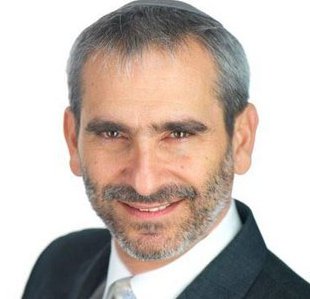
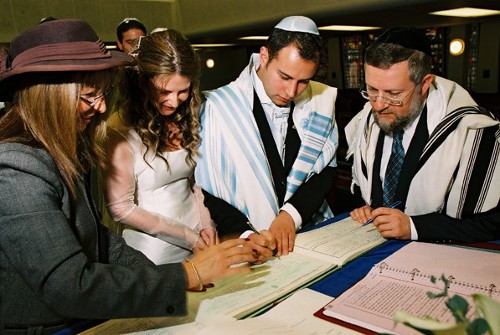
Greenberg-weddingFor the first time in history, Steve Greenberg, an openly-gay American rabbi ordained by the Orthodox movement, has officiated at a same-sex wedding ceremony.

On Thursday night at Washington DC’s “Historic 6th and I Synagogue,” Greenberg stood under the chupah, a traditional Jewish wedding canopy, as newlyweds Yoni Bock and Ron Kaplan tied the knot before some two-hundred guests. Recognizing the unique – and controversial – moment, Greenberg’s voice notably cracked when near the end he stated, “By the power invested in me by the District of Columbia, I now pronounce you married.”

-by Roee Ruttenberg
“Orthodox rabbi marries gay couple in historic wedding in Washington, DC”
+972.com

You shall not lie with a male as one lies with a female; it is an abomination.Leviticus 18:22

Warning. If this is a topic that pushes all your buttons, makes you see red, or otherwise causes you to lose all control of your emotions because you think homosexuality is a worse sin than murder, rape, bank robbery, embezzlement, and stealing from a five-year old’s piggy bank all rolled into one, then you should stop reading right now and either close your web browser or just move on to a different, more politically correct (religiously correct?) blog. End of disclaimer.

I probably shouldn’t do this. I probably shouldn’t write a blog on this topic. People tend to become horribly polarized about this sort of thing and it will most likely end up in a verbal bloodbath. On the other hand, I’m still trying to figure out how an Orthodox Rabbi could marry a same-sex couple. No, that’s not right. I know why, or at least part of “why”. The news story says so.

Greenberg is no stranger to controversy. He publicly admitted his sexuality following his ordination from an Orthodox rabbinical school, making him the first openly gay practicing Orthodox rabbi.

Greenberg gained notoriety following his role in the 2001 documentary by an American filmmaker, “Trembling Before G-d,” which portrayed the conflicts of gay and lesbian Orthodox Jews trying to reconcile their religious convictions and sexual orientations. After the films successful release, Greenberg traveled with director Sandi Simcha Dubowski, screening the film globally.

What I’m wondering is how Orthodox Judaism even remotely “fits” with homosexuality and same-sex marriage. If a Christian man had been ordained as a Fundamentalist Pastor and then announced that he was gay, I can only imagine his ordination would be yanked out from under him faster than he could blink. More than that, if he continued in his role of Pastor in a fundamentalist Christian church, I can’t possibly imagine he’d have much of a following, at least much of a traditionally conservative fundamentalist Christian following.

Shifting the context back to Orthodox Judaism, Rabbi Greenberg doesn’t seem to be having any of these problems. Well, not exactly.

While he (Greenberg) was warmly received by many (after publicly announcing that he was gay), his book, “Wrestling with God and Men: Homosexuality in the Jewish Tradition,” led him to be shunned by some in the Orthodox community and even by some gay and lesbian Orthodox Jews who felt his views did not align with Orthodox readings of Jewish law. His participation in Thursday’s ceremony will be viewed by some as a step that crosses a line of no return.

While a number of same-sex couples – many of them Jewish – have now married in US areas that recently legalized gay and lesbian unions, none were officiated by a rabbi who holds Orthodox ordination. The movement maintains a strict interpretation of Jewish law, including the biblical verse found in Leviticus 18 which refers to a man lying with another man as an abomination.

To be fair, this isn’t the first time Orthodox Judaism and same-sex marriage issues have appeared in the news. In a news item published at advocate.com, the Orthodox community pushed back against support of two men getting married, which is kind of what I’d expect to happen. Why didn’t it happen this time when Rabbi Greenberg married a same-sex couple in D.C.?

Greenberg_steve_rabbiPerhaps there is some fallout yet to come from Rabbi Greenberg’s role in marrying Yoni Bock and Ron Kaplan. After all, this just happened last Thursday. But Greenberg has apparently been an Orthodox Rabbi and openly gay for years and as far as the source article goes, there doesn’t seem to be much of a problem.

I didn’t write this blog to bash gays or to bash the Orthodox or to bash anyone. I wrote it to try and understand how this apparent dissonance can not only occur but subsist over time. I know that Rabbinic interpretation of Torah can reveal details that are not readily apparent on the surface, but how do you, especially in an Orthodox context, reconcile Leviticus 18:22 with performing a ceremony joining two men in a Jewish marriage?

OK, this would not be such as head-scratcher if the wedding ceremony were officiated by a Reform, Reconstructionist, and even (lately) Conservative Rabbi, but an Orthodox Rabbi and one who is openly gay?

I don’t get it.

I’m tempted to think it’s an application of the following, but somehow, I don’t think it’s true.

Intolerance lies at the core of evil. Not the intolerance that results from any threat or danger. Not the intolerance that arises from negative experience. Just intolerance of another being who dares to exist, who dares to diminish the space in the universe left for you. Intolerance without cause.

It is so deep within us, because every human being secretly desires the entire universe to himself. Our only way out is to learn compassion without cause. To care for each other simply because that ’other’ exists.

-Rabbi Tzvi Freeman
“Intolerance”
Based on letters and talks of the Rebbe
Rabbi M. M. Schneerson
Chabad.org

I don’t think that gay marriage or intolerance of homosexuality in the Orthodox community is what Rabbi Freeman was writing about. I don’t think (but who am I to know) that the Rebbe would have supported an Orthodox Rabbi being openly gay and performing a same-sex wedding ceremony. The mixing of Orthodox Judaism and free acceptance of gay marriage just does not compute.

On the other hand, I’ve spent a lot of blogging time trying to figure out how or if the very significant differences between Christianity and Judaism can be reconciled and made to live peacefully and even productively with each other. Can these two situations somehow be compared? If the relationship between Christianity and Judaism can flex over time, is it possible that Orthodox Judaism’s viewpoint of Leviticus 18:22 can flex, too?

jewish-wedding-customsBefore someone says it in a comment, I know the classic response to these questions is to say that there is no question. Sin is sin and Rabbi Greenberg is sinning, both by being gay and by using the authority of his Rabbinic standing to marry two men. I also know someone is (probably) going to say that they “hate the sin but love the sinner.” I realize these are the answers we’ve been taught to produce, but it doesn’t actually address what you do with human beings. When you meet a gay person, do you automatically start shaking your finger at him or her and cry “Sinner, repent” in their face? If your brother or nephew, or daughter has a friend and you all go out to dinner together, when it pops out that the friend is gay (you can have a friend who is gay and just be friends), how do you respond?

I’m know I’m asking a lot questions. Stereotypes and gut reactions aside, when you are face to face with a gay person, as a person of faith, how do you deal with that? When you hear about or meet someone who apparently is deeply religious and loves God but lives a lifestyle that, in one single dimension, goes against everything you’ve been taught is right, true, and holy, what do you do with it? Whoever administers the ordination for Rabbi Greenberg hasn’t stopped him from practicing as an Orthodox Rabbi. There are gay people who, even knowing exactly how Orthodox Judaism thinks and feels about homosexuality, nevertheless, choose to practice and adhere to (except for that one dimension) Orthodox halacha rather than shifting to a more liberal form of religious Judaism.

This isn’t a matter of gays in a liberal synagogue or a liberal church. This is, or perhaps just seems to be, the start of acceptance of human beings into Orthodox Judaism who previously would have been shunned. Is the world just disintegrating morally or are we at the intersection of our faith and the realization that gay people are also people?

I don’t know what to do with this. The comments section is now open. Please be polite or at least civil, but what do you think?