Tag Archives: God

Leaving the House of God

broken-crossSo what is it like to leave? Some quietly slip out of their religious beliefs without much fuss. There are many though, who were previously strongly convinced that their religion is utter reality. It is highly revealing to listen to those who have had experience into and out of Christianity and are in a position to know and authoritatively evaluate and relate their actual experiences. Deconversion for such people, although sometimes initially very emotional or traumatic, comes as a revelation far more spiritually enriching than conversions into religion. In the stories scattered over the Internet and in books ex-Christians have repeatedly said this enrichment of life is the case.

Leaving Christianity

One of Israel’s most celebrated writers, Yoram Kaniuk, has resigned from the Jewish religion. He won his case in court to have the word “Jewish” removed from his identity at the Population Registry, and from now on he will be listed as “without religion”.

He is not alone. Apparently, hundreds of Israelis are lining up to follow his example.

-Rabbi Gideon Sylvester
“Resigning from Judaism”
Haaretz.com

I’ve said before that one of the fundamental differences between Judaism and Christianity is that although you can stop being Christian, you can never stop being a Jew. I guess I was wrong. Israeli Yoram Kaniuk has legally stopped being a Jew and apparently, he has good reasons for doing so.

As an Orthodox Rabbi, I am troubled by their actions, however, I understand the frustration that drives them.

Many Jewish traditions such as the Passover seder, the lighting of Chanukah candles and our lifecycle events are popular, beautiful, and inspiring to religious and secular Jews alike.

Unfortunately, this beauty has been overshadowed by the religious leadership’s coercive tactics. Our religion demands precision, but when the legalistic minutiae of ritual become the raison d’etre of Judaism drowning out the beautiful ethical messages of our tradition, people feel cheated out of the outstanding beauty of their heritage.

Of course, everything Rabbi Sylvester says to describe why Kaniuk and many others have decided to abandon their peoplehood and their faith can be distilled down to a single sentence:

Religious coercion is the enemy of true religion.

What does this bode for Christianity? No one is born a Christian. Even if you are born to Christian parents and are raised in the church, you still must make an independent decision to the cause of Christ and accept Jesus as Lord and Savior over your life and over the world. Plenty of kids have been raised in warm, loving, Christian homes only to leave the church when they were old enough to make their decision stick (i.e. refuse to go to church with the family and/or leave home).

A new survey by LifeWay Christian Resources indicates that most Millenials are not religious and are leaving churches, although many consider themselves to be spiritual.

Youth are walking away from Christianity and the Christian church, opting instead for spirituality.

Millenials are defined as those born from 1980 to 1991. They are aged between 18-29 years old.

Of the total surveyed, 65 percent said they are Christian; 14 percent atheist or agnostic; 14 percent do not favor any religion; and 8 percent mentioned affiliations with other religions. Seventy-two percent said they are more spiritual than religious, the Christian Post reported.

“Survey shows trend of young people leaving Christianity, church”
Posted 30 April 2010
The Underground

Why do Christians leave the church? One answer is that they were never really “Christians” to begin with, that is, they never fully gave their hearts and lives to Jesus and were never completely dedicated to the faith. On the other hand, perhaps many have left for the same reason that Yoram Kaniuk left Judaism.

Unfortunately, if ones closest friends and relatives are very religious then not being a Christian can cause problems in the family and amongst peers. We often hear how Christians claim high standards for “family values” and yet, especially amongst more fundamentalist Christians, ex-Christian family members who “come out” are not only shunned but are even told that they will go to hell. Belief in the justice of unrelenting torture for your family is not a way to bring family unity. Also Christians seldom do justice to the possibility of what we have read, thought and discovered, merely claiming we can’t have been “true Christians” or asking “where did you go wrong?”

It is a common misapprehension to claim that those who leave Christianity never understood what Christianity was “really about.” The full range of Christian types leave Christianity, from all denominations, doctrines, and persuasions. From the most liberal to the most fundamentalist. The philosophical liberal, the conservative orthodox, the born-again and the hyper-charismatic fundie.

Despite the fact that there are plenty of “liberal” churches to go around, Christianity can seem very heavy-handed, judgmental, and cruel at times. I know the church doesn’t see itself that way, but the worst examples seem not to try to reach out and help Jesus save the world, but to condemn it and want to watch everyone, including every single Jew on the planet, burn. This seems “OK” to the church as long as the “true believers” are “raptured” safely to Heaven and the elect get to sit at the right hand of God. Judah Gabriel Himango has recently posted yet another example of how Christianity seems to want to delete Judaism from the face of the earth by letting Jesus replace Israel. There’s a spirited debate going on in the comments section of the blog over the intent of Pastors John Piper and Jonathan Parnell, and wondering if perhaps their recent messages were not ones of supersessionism. However, replacement theology, as I commented on Judah’s blog, is a:

…deeply woven thread in the tapestry of the church. Most Christians don’t consider themselves doing wrong by adopting a supersessionist viewpoint, they just think that’s what the Bible says. Unfortunately a subtle kind of arrogance has crept into the church.

Many years ago, admittedly after only a few years as a Christian, I left the traditional church (in my case, a large Nazerine church in Southwest Idaho) to join what I thought of as the “Messianic movement”, a religious tradition that attempts to preserve the Jewish foundation of the Christian faith (the actual definition of “Messianic” is much more involved than I’m stating here). While I have met and maintain friendships with many Messianics, I realize that a “grafted in” non-Jew is not meant to imitate Judaism for the sake of the Jewish Jesus and that Jews have always been and remain God’s chosen “treasured splendorous people”. We, who have been granted a covenant closeness with God by Jesus cling to the robes of the Master and worship alongside the Jew…but we don’t become Jewish nor do we replace them.

magen-davidIt’s the “religious coercion” of Christianity, the “arrogance” of believing that only the Gentile church has a direct pipeline to God and the undercurrent of disdain for Jews, and even antisemitism that keeps me from entering the sanctuary on any Sunday. If Yoram Kaniuk can remove himself from the Jewish life stream because of rigidly frozen Rabbinic religious dictates, then by comparison, leaving the church should be a walk in the park.

Of course, by choice, I still self-identify as Christian and I do not abandon my faith. I simply await what I pray will be God’s instructions for how best to express my worship while remaining unified with my Jewish wife. For Kaniuk’s part, though he voluntarily walks away from Judaism, it is still impossible for Judaism to walk away from him.

Rabbis have not taken him seriously either, because Jewish law makes it clear that however much a Jew tries to escape their origins, they remain Jewish (Sanhedrin 44a).

But even if the act has no halachic significance, it should still concern all who care about Judaism in Israel.

If the Nazis were to return tomorrow, they would still come for Kaniuk and herd him with the rest of the Jews into cattle cars across the long, slow miles to the camps and the march of death into the ovens. Still, the fact that he can take such a bold step is a little terrifying. It takes another Jew out of the world, though Kaniuk still lives. It is also a Jew’s personal indictment of the present state of religious Judaism in the land of Israel. Have the extremely Orthodox elements of the Israeli Rabbinic system, the stated guardians of all that it means to be a Jew, committed a “Chillul Hashem” – a desecration of God’s name?

The villains represent only a tiny minority of observant Jews, most of whom are good, law abiding citizens, but their actions tarnish all of us. Seeing their behavior, we can understand why many of the most idealistic people feel alienated from their religion.

Even a minority, whether they be ultra-orthodox Jews in Israel or extreme fundamentalist churches in the United States, can take a tremendous toll on the larger people of faith, by driving them completely out of that faith.

If any Rabbis and Pastors are reading this (probably not, but I can never tell), please consider the following story Rabbi Sylvester relates.

Many years ago, when zealots in Petah Tikva tried to prevent Sabbath desecration by calling for the closure of cinemas on Shabbat, my teacher Rabbi Riskin rejected their coercive techniques. “Let every cinema remain open”, he told us, “but let them be empty, because every Jew has been invited to a traditional Shabbat meal with their friends, neighbors and family”.

When I challenged him on the need to protest religious transgression, his answer was straightforward and wise; “No one appointed you God’s policeman!” he said.

Even when we commit heinous acts “for the sake of Heaven”, they are still heinous acts. I’m sure, at this point, some critic of religion could chime in and say the Bible is full of heinous acts of genocide that were commanded by God, but I’m speaking of those commanded by well-meaning but misguided men. There will be another time to discuss and debate those acts of God with which we struggle with as Jacob wrestled the angel. The blog Failed Messiah reports that:

Nehorai is Mea Shearim’s mob lawyer, defending haredi gangsters and thugs. His favorite tactic is to claim that his clients should get preferential treatment from the court because his clients’ intent in beating, attacking, robbing, destroying and vandalizing the bodies and property of other Jews, often haredim, is for the sake of heaven.

While this blog consistently presents a critical picture of Haredi Jews (as you can tell by the language used), it also paints a portrait of how religion can go out of control and any act can be justified if it is committed in God’s name; “for the sake of heaven”. Christianity has its extremes as well, the most blatant and outrageous being the Westboro Baptist Church, a group made up mostly of the members of a single family, who are devoted to performing any act that will fail to promote the love of Christ and who tout their hateful self-righteous causes above all others.

The extremists are easy to see and dodge and we do not have to let them drive us out of our churches and out of our synagogues simply because they’ve got a loose wire burning in their brain pans. However, it’s the subtle acts of arrogance and self-servitude that are much harder to avoid. Those are the congregations and the people that compel men like Yoram Kaniuk to have their Jewish identity legally erased and who are emptying the church of almost anyone under the age of 30.

god-will-lift-you-upIt doesn’t have to be this way. This isn’t faith. This isn’t service to God. That we believe only a remnant will remain in the end doesn’t mean we must ensure this by deliberately chasing away the majority from the houses of worship. Small wonder the Master lamented, “However, when the Son of Man comes, will He find faith on the earth?” (Luke 18:8). Our faith is not based on how others define it. The “ark” that lifts us above the waters was not made by men. Our words and prayers come not from hate, but from the heart and God in His Heavens.

There is a raging storm at sea. There are hellish waves that crash and pound at the shore, carrying all away, leaving desolation behind.

The sea is the world of making a living. The waves are the stress and anxiety of indecision, not knowing which way to turn, on what to rely. Up and down, hot and cold—constantly churning back and forth.

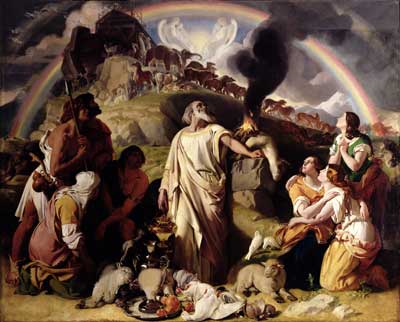
Do as Noah did, and build an ark. “An ark” in Hebrew is teivah—which means also “a word.” Your ark shall be the words of meditation and of prayer. Enter into your ark, and let the waters lift you up, rather than drown you with everything else.

-Rabbi Tzvi Freeman
“The Ark”
Based on letters and talks of the Rebbe
Rabbi M. M. Schneerson
Chabad.org

Noach: What We Allow in Heaven

Noah's ArkThe Maggid of Mezritch interpreted our Sages’ statement: “Know what is above you,” as: “Know that everything ‘above’ all that transpires in the spiritual realms is ‘from you,’ dependent on your conduct. Each of us has the potential to influence even the most elevated spiritual realms.”

The Torah alludes to this potential in the opening verse of our reading: “These are the chronicles of Noach. Noach was a righteous man.” The word noach refers to satisfaction and repose. By repeating the word, the Torah implies that Noach and by extension, every one of his descendants can sow these qualities in two different fields, both among his fellow men, and in the spiritual worlds above.

Every person affects his environment. Our thoughts, words and deeds can inspire peace and tranquility in our fellow men, helping create meaningful pleasure. And by establishing such conditions in our world, we accentuate similar qualities in the worlds above. To highlight our obligation to spread these virtues, this week’s Torah portion is called Noach.

-Rabbi Yanki Tauber
“Genuine Satisfaction: Noach’s Legacy”
Adapted from
Likkutei Sichos, Vol. XX, p. 285ff;
Vol. XXV, p. 23ff
Chabad.org

This is the line of Noah. — Noah was a righteous man; he was blameless in his age; Noah walked with God.Genesis 6:9 (JPS Tanakh)

It’s difficult and sometimes even a little dangerous to go beyond the plain meaning of what we read in the Bible and enter hidden or even mystic interpretations. First off, even though Christianity also has its mystic tradition, looking at the Bible through a Chassidic lens can tend to be disorienting, and most people will immediately reject the view rather than attempt to explore the value that might be gained from a radical change in perspective. And yet, this is what “jumped out at me” when studying the Torah Portion Noah (some Jewish sources spell the name “Noach”) this week.

Yesterday, I posted two “meditations” on this blog about how we can have an influence on others. Both messages were, for the most part, grounded in traditional methods of doing good and improving the world, but a Chasid believes that anything that is done on earth is reflected in Heaven. To punctuate this, I previously quoted Rabbi Tzvi Freeman as saying:

For all that is, physical or spiritual or Divine, was only created to be part of the repair of this world of action. And once that repair is done, all that will be true are those things that made it happen.

Even the Master said:

“I tell you the truth, whatever you bind on earth will be bound in heaven, and whatever you loose on earth will be loosed in heaven. –Matthew 18:18

But what does this mean and what does it have to do, not only with Noah, but with us?

One rather awesome conclusion, as stated above, is that what we do here doesn’t just matter here or to the people around us, but it actually has effects beyond the physical realm.

It has been noted by our Sages that “Torah preceded the world,” i.e., although Torah as studied in this physical world is to be understood in its plain context, it preceded the world. For every letter of Torah also possesses inner and esoteric meaning. Such meaning emanates from the study of Torah in the higher spiritual realms – worlds that transcend physicality.

Understandably, this applies not only to the Torah’s commandments, but to its stories; although all the stories recounted actually transpired in all their detail, still, since Torah preceded the world, we must perforce say that these tales also contain meanings found in the higher, spiritual worlds.

This gives rise to the following inescapable conclusion: Since “No evil sojourns with You,” we must say that even though the Torah contains things that in their simple context seem undesirable – such as misdeeds, punishments, and the like – in the world above, where it is impossible for evil to reside, these selfsame events are understood as being entirely desirable, holy and good.

The Chassidic Dimension: Noach
Based on the teachings of the Lubavitcher Rebbe
Rabbi Menachem M. Schneerson and
Likkutei Sichos , Noach 5747
Chabad.org

noah-rainbowThat probably doesn’t clear things up much, but consider this. For any event that you read about in the Torah, there is a corresponding event or meaning that has occurred in Heaven. There’s a mysterious, mystic, connection between the ordinary document that we study and what God used to create the universe. Extending the metaphor, we might be able to say that whenever we obey one of the Torah mitzvah, there is an impact, not only on earth, but in Heaven. Jesus said as much in Matthew 18.

Going back to this week’s Torah portion, we can apply this metaphor to say that the names, words, and events depicted in this reading is not just a report of what happened to Noah and his family and to the earth during and after the flood, but that there are much larger ramifications. Those ramifications are particularly meaningful to those people who aren’t Jewish. Remember, Rabbi Tauber said that all of Noah’s descendents can affect both the world of men and the spiritual realms. We are all Noah’s descendents.

God blessed Noah and his sons, and said to them, “Be fertile and increase, and fill the earth. The fear and the dread of you shall be upon all the beasts of the earth and upon all the birds of the sky — everything with which the earth is astir — and upon all the fish of the sea; they are given into your hand. Every creature that lives shall be yours to eat; as with the green grasses, I give you all these. You must not, however, eat flesh with its life-blood in it. But for your own life-blood I will require a reckoning: I will require it of every beast; of man, too, will I require a reckoning for human life, of every man for that of his fellow man!

Whoever sheds the blood of man,
By man shall his blood be shed;
For in His image
Did God make man.

Be fertile, then, and increase; abound on the earth and increase on it.”

And God said to Noah and to his sons with him, “I now establish My covenant with you and your offspring to come, and with every living thing that is with you — birds, cattle, and every wild beast as well — all that have come out of the ark, every living thing on earth. I will maintain My covenant with you: never again shall all flesh be cut off by the waters of a flood, and never again shall there be a flood to destroy the earth.” –Genesis 9:1-11

The covenant God made with Noah and his sons is the basis for what Judaism calls The Seven Noahide Laws. While Judaism doesn’t consider the full 613 Commandments of the Torah to be binding on a non-Jew, the Noahide Laws are applicable to everyone. In Judaism, any non-Jew who lives a life as a Noahide merits a place in the world to come (in “Christianese” that would mean he’s “saved”).

This doesn’t make much sense to a Christian because we believe that there is only one way to the Father and that’s through the Son (John 14:6). In traditional Christianity, it doesn’t matter if you’re Jewish or not Jewish, you must come to faith in the Messiah to be fully reconciled with God. How the Messianic covenant addresses the Mosaic I’ll address another time, but did the Messianic covenant wipe out the Noahide covenant completely?

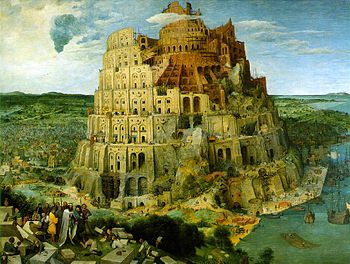
In the days of Noah and for ten generations afterward, there was only one people, one language, and one standard by which a man could have a covenant with God. It was the standard God gave to Noah. At the tenth generation, this people united to build an affront to God at Babel and we are told that God “confused their languages” and made the seventy nations (Genesis 11:1-9). At the end of this reading, we see Abram enter the narrative for the first time, but even after Abraham, Isaac, and Jacob, what was the standard of righteous living for all of mankind until the coming of Jesus?

We can look at the story of Noah and see the story of mankind’s influence, not only upon the world around us but, according to mystic interpretation, the world above. When man defied God and built a tower, God could have ignored them. After all, it wasn’t as if building a structure, no matter how high, really could have reached Heaven, could it? But if not, then why did God react and do what He did?

the-towerNo, I don’t believe you can make a tower to reach up to Heaven, but I do believe that somehow, what we do on earth, for good or for bad, does affect Heaven and it does affect God. Certainly we can’t do anything to adversely affect God but we also have a unique relationship with our Creator that no other creature has, not even the angelic beings. We are special. We matter personally to God. Our actions are not our own and they are not limited to the “nuts and bolts” of life in our own little world.

If even the name “Noach” has meaning, if the stories in the Torah somehow reach beyond the words on a page and resonate in Heaven itself, if what we loose on earth is loosed in God’s realm, then the story of Noah teaches us that we dare not be careless with what we say and do. Noah’s planting a vineyard, making wine, and becoming intoxicated resulted in a permanent curse on Ham, but we don’t know why. The descendents of Noah built a great tower to symbolize their invincibility over God, defying God as man did in Eden, and defying God as the generation before the flood, and God reacted by confusing their language and splitting the one people into the seventy nations of the earth, and we don’t really know why. We say and do things in our lives, sometimes in the service of God and sometimes in the service of ourselves, and yet they have an impact in the Heavenly courts, and we don’t know how or why.

But if what we do matters that much, or even if it just might be possible that it matters that much, do we dare say a careless word or perform a careless act? Are not only our lives, but each thing we say or do that important to God? What are we loosing on earth…and in heaven?

Good Shabbos.

Being Heaven on Earth

feeding“Then the King will say to those on his right, ‘Come, you who are blessed by my Father; take your inheritance, the kingdom prepared for you since the creation of the world.

For I was hungry and you gave me something to eat, I was thirsty and you gave me something to drink, I was a stranger and you invited me in, I needed clothes and you clothed me, I was sick and you looked after me, I was in prison and you came to visit me.’

“Then the righteous will answer him, ‘Lord, when did we see you hungry and feed you, or thirsty and give you something to drink? When did we see you a stranger and invite you in, or needing clothes and clothe you? When did we see you sick or in prison and go to visit you?’

“The King will reply, ‘Truly I tell you, whatever you did for one of the least of these brothers and sisters of mine, you did for me.’Matthew 25:34-40

Question:

Each year, we Jews spend so many millions of dollars, and devote so much time and energy, to building synagogues, Jewish schools, and a slew of other religious and academic institutions. Wouldn’t it be better if we applied all those resources to feeding the hungry, housing the homeless, and working to alleviate all the horrendous suffering that goes on in so many places in the world?

Answer:

Jewish education is the impetus for charity. Any charity. People with a proper Jewish education are most likely to give more charity to the hungry, to the sick, and to the helpless. And to future Jewish education.

Because when you invest in Jewish education and Jewish institutions you are investing in every form of charity.

-Rabbi Tzvi Shapiro
AskMoses.com

What separates Jews and Christians? It shouldn’t be the desire, the will, and the action of helping others, such as feeding the hungry, clothing the unclothed, and visiting the sick. This is a value that is inexorably woven into the fabric of both faiths and has been since the beginning. Tzedakah or “charity” is at the very heart of the Jewish service to God. It is considered more than just a good thing to do and is an actual obligation to Heaven, as described at the Judaism 101 website.

Giving to the poor is an obligation in Judaism, a duty that cannot be forsaken even by those who are themselves in need. Some sages have said that tzedakah is the highest of all commandments, equal to all of them combined, and that a person who does not perform tzedakah is equivalent to an idol worshipper. This is probably hyperbole, but it illustrates the importance of tzedakah in Jewish thought. Tzedakah is one of the three acts that gain us forgiveness from our sins. The High Holiday liturgy repeatedly states that G-d has inscribed a judgment against all who have sinned, but teshuvah (repentance), tefilah (prayer) and tzedakah can alleviate the decree.

Numerous positive and negative commandments are devoted to the needs of the poor and unfortunate based on verses from Exodus, Leviticus, and Deuteronomy. When Jesus commands his disciples to “Love your neighbor as yourself”, he is quoting Leviticus 19:18, so the core of both Judaism and Christianity is charity and love. Nevertheless, as I pointed out in yesterday’s morning meditation, there is a startling degree of separation between Judaism and Christianity. Although much in our culture, worship, and identity keeps us apart, we also find there should be much that makes us alike.

A few events inspired me to write today’s “extra meditation”. The first was a story I read yesterday at jweekly.com about a woman named Linda Cohen.

When Linda Cohen’s father died in 2007, the mother of two was reeling. Grief-stricken, she decided to take time off from her active life and health consulting job in Oregon for a “spiritual sabbatical.”

“I just wanted to be quiet. I wanted the time to be with that loss,” recalls Cohen, a Boston native.

But within a month, she had a new sense of direction. Inspired by her father’s wishes to have friends and relatives make donations to charities in lieu of sending flowers after his death, she decided to honor his memory by performing 1,000 mitzvahs.

LindaCohenThe story goes on to say that Linda’s husband encouraged her to chronicle her progress on a blog which became 1000mitzvahs.org. Four years later, Linda’s compassion and her story has become a book: 1,000 Mitzvahs: How Small Acts of Kindness Can Heal, Inspire and Change Your Life.

Linda Cohen is just one person who lost her father. A lot of people have lost a loved one and we all know that sooner or later, our parents are going to die. We all go through that grief at some point in our lives, but most of us don’t recognize it as anything except another stage in our existence. Linda turned her grief into not only a way to honor her father, but a way to help many others and to inspire the rest of us.

The second inspiration came in the form of a video I watched on Facebook earlier this morning about a fellow in India who was so moved by compassion for the people starving in his own village, that he quit his job just to feed them, to clothe them, to bathe them, and to remind them that we are all human beings.

The original story is from CNN. Here’s the link to the Facebook page for Achyut Sharma’s Video on this story. It’s less than three minutes long. Please watch it before continuing to read here.

It’s not like any of this is revolutionary news, or at least it shouldn’t be. I’ve talked about being the answer to someone’s prayer before. You don’t have to quit your job and make it your full time mission to help the starving in your community. You don’t have to abandon you life, goals, and dreams, but you can make doing even one small mitzvah a day part of those goals and dreams.

Debate about what counted as a mitzvah – Replacing a roll of toilet paper? Smiling at a stranger? – became the stuff of Cohen family’s dinner-table discussion. (Cohen’s children were 6 and 9 when the project started, and grew to see the recurring topic as perfectly normal, she says.) These questions also served as conversation-starters on Cohen’s blog, which steadily gained followers over the course of the 2 1/2-year mission.

“There’s nothing really too small,” she says. “The idea is that bringing even a bit of kindness into the world is a holy connection.”

Just imagine if you did one thing today as a good deed that you didn’t have to do. It doesn’t have to be a big thing. Maybe it’s just picking up one piece of trash off the ground and putting it in a garbage can. Maybe it’s smiling at someone you pass on the street. Maybe it’s buying one extra can of food at the store and then stopping by the local food bank and donating it. Nothing big.

Now imagine doing that one thing every day. That’s 365 mitzvot in a year. Now imagine inspiring one other person to do the same thing. Imagine that other person inspires one other person, and so on, and so on, and so on, and…

Tikkun Olam doesn’t begin with huge, heroic, “Superman-like” acts of courage and strength. It begins with one person who cares enough to pass along some small blessing to the next person. It can be one person feeding the poor, the starving, the old, and the mentally ill in his village, or it can be a person taking five minutes out of their day to help their next door neighbor move a sofa. It can be anything, but it must be something.

You don’t have to be religious to do something like this and, to the shame of people who profess faith and yet do nothing for others, many secular people perform frequent acts of kindness for the sake of doing good. If you are a person of faith, it is a duty to God to serve other human beings, not as a burden and a chore, but because it is passing along the grace we received from God to the next person, regardless of who they are, or regardless if your acts ever become known to others.

You may never put your deeds on a blog, write a book, or be filmed by CNN, but as the Master taught, “whatever you did for one of the least of these brothers and sisters of mine, you did for me.”

You can change the world. You can inspire others to change the world. You don’t need to make some herculean effort to accomplish this. You only have to do one extra deed a day and then do it every day. Anyone can complain about the terrible condition of our world. Anyone can carry signs, protest, and cry out for justice. But very few actually do something about it, even though anyone can. If you seek justice, act justly toward others. If you seek mercy, then be merciful. If you want to be forgiven, then forgive. If you value kindness, then be kind.

I learned so much throughout this process,” she says. “I moved out of a place of grief, into a place of feeling very inspired. If there’s something negative that happens, I feel like there’s a lesson I can glean from that. I really learned how to see the good in the world.” –Linda Cohen

your kingdom come,
your will be done,
on earth as it is in heaven.
Give us today our daily bread.
And forgive us our debts,
as we also have forgiven our debtors. –Matthew 6:10-12

Don’t wait for goodness to come into the world. It’s here now because you’re here now. All you have to do is perform it. Your faith means nothing until you do. Then your faith means everything.

A Small Light Against the Darkness

candleSome think life is all about doing good and keeping away from evil. To them, struggle has no purpose of its own — to have struggled is to have failed. Success, they imagine, is a sweet candy with no trace of bitterness.

They are wrong, very wrong. Struggle is an opportunity to reach the ultimate, when darkness itself becomes light. In the midst of struggle, an inner light is awakened. Light profound enough to overwhelm the darkness, encasing it and winning it over. But if darkness never fights back, how will it ever be conquered?

-Rabbi Tzvi Freeman
“Perpetual Struggle”
Based on letters and talks of the Rebbe
Rabbi M. M. Schneerson
Chabad.org
I watched an interview quite sometime ago with Oprah and actor Will Smith. He shared his insight about dealing with negative people. He asks this profoundly important question to himself on a frequent basis: “Is there someone in your life who is not contributing to your life and not helping you move forward?” If your answer to this question is a resounding: Yes! Then: “Why do you insist on allowing them to remain in your life?” A big A-ha moment for me! There must be some payoff for you if you continue allowing these negative influences in your life. When you know better you do better. If you want to change your life you have to also change the folks you chose to surround yourself with.

-Debra Moser
“What Are Your Personal Boundaries?”
MorningCoach.com

Oddly enough, I do read the occasional “inspirational” blog, though I don’t put a lot of stock in them. I find the advice they offer is often superficial and overly optimistic. Of course, the writers of such blogs have to keep the content short in order to hold the attention of their readers. Most people won’t read web content beyond a certain length, so if you want to get your point across, you have to make it short and sweet.

I can live with the short part, though it comes with liabilities, but sometimes such blogs are just a little too “sweet” for a middle-age “curmudgeon” like me.

I suppose that’s one of the reasons why I like reading the Bible (I know this will probably sound irreverent). It doesn’t soften the blow and it doesn’t pull any punches. In fact, I’ve heard some people say they aren’t religious just because some of the “advice” offered in the Bible is too harsh (see 2 Thessalonians 3:10 for example). On the other hand, there are times when the ancient sages and today’s “life-coaches” seem to be saying the same thing.

Nitai the Arbelite would say: Distance yourself from a bad neighbor, and do not cleave to a wicked person. -Ethics of our Fathers, 1:7

Debra Moser said something quite similar and, unlike Nitai the Arbelite, provides methods for “weeding out the negative nellies in her life”. Actually, that’s not fair. The commentary for Pirkei Avot 1:7 is just as illuminating as Moser and probably more so.

On the surface, Nitai the Arbelite appears to be conveying a simple, if redundant, message: Stay away from bad people. In truth, however, a much deeper lesson is implicit in his words. In fact, a close examination of his phraseology yields an altogether different sentiment.

What is the difference between a “bad neighbor” and a “wicked person”? And why must one go so far as to “distance oneself” from the former, while, concerning the latter it is enough to avoid “cleaving” to him?

A “bad neighbor” means just that: not a bad person, but one whose proximity to yourself is detrimental to you. It may be that he is a righteous person, and that his path in life is, for him, most suitable and desirable; but if for you it is wrong and destructive, keep your distance.

On the other hand, a “wicked person” is not necessarily a bad neighbor if he is not in the position to influence you. From him you need not, and must not, distance yourself: on the contrary, befriend him, draw him close and help him improve himself, all the while taking care not to cleave to him and emulate his ways.

In other words: The evil in another is never cause for your rejection of him—only your susceptibility to what is evil for you. On the contrary, the “wickedness” of your fellow it is all the more a reason to become involved with him, and prevail upon him to cleave to the positive in yourself.

I am always amazed at how the sages provide teachings so like the Master.

While Jesus was having dinner at Levi’s house, many tax collectors and sinners were eating with him and his disciples, for there were many who followed him. When the teachers of the law who were Pharisees saw him eating with the sinners and tax collectors, they asked his disciples: “Why does he eat with tax collectors and sinners?”

On hearing this, Jesus said to them, “It is not the healthy who need a doctor, but the sick. I have not come to call the righteous, but sinners.” –Mark 2:15-17

By comparison, Moser’s advice is something of a mixed bag. Of course, her goal isn’t to help her audience help others, it’s to help her audience enhance their own lives.

When you value and love yourself those loving and thoughtful people will come into your life. They are a direct reflection of how you see yourself. Be your own person and don’t allow others to define you. These positive people have your interests at heart and celebrate you with the world. There is no animosity and jealousy; just love and acceptance for the unique person you are. The people in my personal and professional life add to my life and that is a wonderful feeling.

against the darkThat’s a little too “warm and fuzzy” for me. But while there’s nothing wrong with that advice as far as it goes, the goal starts and stops with the individual: you. It has little to do with anyone else unless those other people in your world are only there to support and augment your “personal and professional life”. This is Madison Avenue marketing meets personal life development meets New Age “all-about-me-ism”. It’s certainly not the message the Master or Nitai the Arbelite are sending. Pirkei Avot advices that we distance ourselves from a bad neighbor, not because they’re a bad person, but because they can be a bad influence on us (and Debra Moser would agree with this part). However, we are not to avoid a “wicked person” because, as long as we don’t cleave to them and adopt their ways, we may become a positive influence on them, turning them away from sin.

As the Master taught, it “is not the healthy who need a doctor, but the sick.” Part of tikkun olam, repairing the world, isn’t keeping all of the “health” to yourself like some self-esteem King Midas, but giving it back to others and to “love your neighbor as yourself” (Lev. 19:18; Mark 12:31).

To be fair, Moser did very briefly touch upon the matter of influencing others, but immediately returned to her primary subject.

You do make a positive difference in someone’s life. Believe in yourself. When you’re not in a good mood STOP and get back to your positive mindset and look with gratitude around you and see what an incredible life you have. Living with gratitude and coming from a loving heart space attracts loving positive people into your life.

Again, to be fair, I expect that if I could give Debra Moser an opportunity for rebuttal, she could expand upon her viewpoint and I suspect provide added dimension to what she writes, including how to be a better support and influence on others who need the help.

One of the 613 commandments in Judaism is to “rebuke the sinner”, based on Leviticus 19:17. The deeper meaning of the commandment has little to do with chiding someone for their faults but instead, it’s more like saving someone’s life. If you see someone in moral and spiritual trouble, and if you have the opportunity and ability to help, you are obligated to help. A Jew must become involved rather than let a fellow Jew fall into or remain within their sins. If they fail to do so, the penalty their fellow will suffer for his sins will also fall upon the person who didn’t help.

Jesus seems to be communicating the same thing to his audience in both Mark 2 and Mark 12 (as well as in other scriptures). Of course there is always a danger involved. Like a lifeguard swimming against hazardous ocean currents to save a drowning person, there’s always the risk that you’ll be pulled under yourself, but its a risk you’ve accepted. A lifeguard accepts the risk by virtue of accepting the position of being a lifeguard. As disciples of Christ, we accept the risk by virtue of virtue; by the fact that we accepted the man with the cross and the God of Heaven.

It’s not easy. That’s what most advice blogs leave out of their content. It’s not a walk in the park. Like any discipline, it takes time and practice. You’ll make mistakes. Sometimes you’ll get hurt. With perseverance, you’ll get better at it. You’ll probably never be perfect. There will be days when you are magnificent and other days when you’ll want to stay in bed and hide. There are even days when you will feel like it’s not worth it and want to give up. But even when we don’t like hearing it, we were created for a very simple reason, to help God help the world. Rabbi Freeman interprets the Rebbe’s teaching on this topic thus:

For all that is, physical or spiritual or Divine, was only created to be part of the repair of this world of action. And once that repair is done, all that will be true are those things that made it happen.

In every thought, look for the power to change the world.

It’s the struggle that creates the light that holds back the dark abyss. Without our struggle, we are only silhouettes fading into the night.

We were so close there was no room
We bled inside each others wounds
We all had caught the same disease
and we all sang the songs of peace
Some came to sing, some came to pray
Some came to keep the dark away
So raise the candles high
’cause if you don’t we could stay
black against the sky
Oh oh raise them higher again
and if you do we could stay dry against the rain

-Melanie Safka
Candles in the Rain (1970)

The road

If life is a strugle, it doesn’t mean that you’ve failed. You only drown when you stop struggling against the waves.

The Long Dark Road

intermarriage“Marrying gentiles is like playing into the hands of the Nazis,” Yad Vashem Council Chairman and former Chief Rabbi Yisrael Meir Lau has been quoted as saying to students from Ramat Gan’s Ohel Shem High School.

According to the students, the rabbi made the remark during a lecture on the Holocaust and on his personal memories as a survivor of the Buchenwald concentration camp which he delivered to teenagers who had returned from a trip to Poland.

-Udi Avni
“Intermarriage plays into Nazis’ hands”
YNETNews.com

Now, on my suggestion, Benjamin is trying some churches (and looking to get re-involved in a mainstream synagogue, perhaps, since he can’t get Jewish prayer in a Messianic congregation there). His experience in Church-Land so far has been dreadful. I didn’t think it could be worse than in the so-called Messianic congregations, but at least in a bad Messianic group people are usually sympathetic to Jewish concerns on some level. Yes, you guessed it: Benjamin has already been told that it is wrong to be Jewish!

-Derek Leman
“Jewish Adventures in Church-Land”
Messianic Jewish Musings

I have to admire some of the high school students listening to Rabbi Lau since, according to the news article, “Lau’s remark and the nature of his lecture caused several 12th graders to walk out of the auditorium.” The person leading a small group study at the church Benjamin attended wasn’t quite so principled:

The person leading this week’s small group time was “uncomfortable with my keeping the law,” says Benjamin. He “asked me to go home, pray for the Holy Spirit to give me discernment as to what Scripture says, and read Romans and Hebrews.”

Part of the “mission” of my blog is to explore the issues and ramifications of being intermarried and how sometimes Christianity and Judaism can have “uncomfortable encounters”. I don’t experience these sorts of issues in my home life, but I have no doubt I would elicit such responses from at least a few folks in both the church and the synagogue. It’s not that either venue is populated by bad people, but we all have biases and opinions based on our experiences, and we can all act out those experiences on people around us.

I don’t really blame Rabbi Lau for making statements against intermarriage and assimilation. As a Holocaust survivor, he has experienced the extraordinary pain and suffering of the Jewish people and is responding in a way that he believes will repair the damage. He sees intermarriage as just another form of Holocaust (and he’s not alone in this) and is reacting to assimilation of Jews as the same sort of danger (and he’s probably not entirely wrong). Still, according to one 12th grader:

“He said the Jewish people must not assimilate and that we must maintain the Jewish identity. In addition, he presented delusional statistics, claiming that had there been no assimilation the United States would now have 30 million Jews, and showing contempt for those who assimilated – as if they are inferior to others.”

My wife has neither assimilated nor is she inferior. With respect to Rabbi Lau, I will not accept his judgment on intermarried Jews and particularly not on my wife.

On the other hand, I can’t exactly give “props” to the church for making a Jew feel inferior because he has faith in Jesus and also continues to live as a Jew. This shows a complete lack of understanding of who Jesus is, what he taught, and everything he brought into the world in order to allow the nations to have a covenant relationship with God. If the church would try to understand Jesus in his actual context (and I tried to explain this yesterday), perhaps the small group leader at Benjamin’s church wouldn’t have (metaphorically) kicked him in the teeth for being Jewish.

The introduction to The Cambridge Companion to the Talmud and Rabbinic Literature adds dimension to the historical roots of this dynamic, which has targeted what is often seen as the essence of what it is to be Jewish.

Christian theologians and historians have on occasion viewed the Talmud, much more than the Hebrew Bible itself, as encapsulating the spiritual and intellectual core of Judaism. This interest has not always had benign results; it has, at times turned the Talmud into a target of polemics and even violence. Repeated burnings of the Talmud and its associated writings by Christian authorities in medieval Europe were meant to destroy the intellectual sustenance of Judaism.

We don’t seem to have advanced very far from those times, at least in some churches, have we?

More than once recently, I have despaired God’s creating the universe. More than once I wondered why He did it and, if He could do it all over again, would He? Of course, in a sense, He creates the universe anew every year. He reaffirms His faith in humanity annually by punching the cosmic reset button and recreating the world and our souls as brand new, bright and shining.

And then, I start reading Genesis and the daily news and look at what happens. The place is a mess again. Life is a mess again. Sometimes, I get pretty angry at the injustice and the suffering. Then I realize that I’m also angry at my own imperfection and my own impatience with God.

Anger at your faults is arrogance, and of a very self-destructive form. Every failure becomes pain, every pain becomes a gruesome punishment.

An objective person is able to look at his faults and what needs to change and say, “This is what G-d gave me to work with.” He accepts stormy weather as part of the course and slowly and patiently steers his ship to port.

-Rabbi Tzvi Freeman
“Arrogance”
Based on letters and talks of the Rebbe
Rabbi M. M. Schneerson
Chabad.org

What man does with his religions isn’t always what God intended. Probably what man does with his religions isn’t what God intended the vast majority of the time. I think we’ll all be very surprised when the Messiah finally comes and he straightens out all of our messed up thinking and crazy ideas about what God wants, how we are supposed to worship Him, and how we are supposed to treat each other.

The faults that God gave me, and gave all of us to work with reminds me of what God said to Paul once.

Three times I pleaded with the Lord to take it away from me. But he said to me, “My grace is sufficient for you, for my power is made perfect in weakness.” –2 Corinthians 12:8-9

This is the world God gave us to work with. It’s a broken world populated by broken people. Even the best of us is a mess compared to God’s expectations. We focus our attention on the wrong things a lot of the time (and I’m probably a very good example of this). For instance, in Benjamin’s experience in the small group study:

This week, Benjamin spoke during small group, since the small group leader asked for people to share stories of things that had “brought them closer to Jesus this week.”

That seems an innocent enough question, but statements like this always make me wonder where Christians think God took off to. I don’t think of the things that bring me closer to Jesus when I pray but rather, I think and ponder upon the way Jesus brings me closer to God. If man has one, pure, transparent interface between himself and God, it is the Messiah. It’s the reason He came. It’s the reason He died and was raised. So that the rest of us could enter into covenant and be reconciled to the God of Israel. Nevertheless, Israel and the Gentile disciples continue to collide with each other, perpetuating a conflict that has lasted for millennia.

This isn’t the world God originally created but it’s the world we have to work with. Only faith can convince us that it can be repaired. Only faith can inspire us into action and allow us to work with God in tikkun olam. Only God can show us that we will succeed, with His help and grace.

I see we have a long way to go.

Addendum: I just finished reading a couple of blog posts written by Julie Wiener for the JewishWeek.com series “In the Mix”, a blog series about Jewish/Gentile intermarriage. Today’s entry, Intermarriage And The Holocaust: Part II mentions Rabbi Lau comparing intermarriage to the Holocaust, but you’ll also want to read Part I to get the whole picture.

The road

Where to Find Jesus

Hasid AlleywayIt is important that before we dig into the Gospel texts themselves we understand some of the cultural background regarding ritual purity in the late Second Temple period. The Tosefta tells us that during this time “purity broke out among Israel.” Archeological evidence verifies that in the decades preceding the fall of the Temple in 70 CE ritual purity had become a major concern even among the common people throughout the land of Israel.

-Toby Janicki
“The Master and Netilat Yadayim”
Messiah Journal
Issue 108 – Fall – 2011/5772 p. 27

This isn’t the first time I’ve discussed netilat yadayim or the ritual handwashing, but I’m not making it my main focus this time. Rather, I want to address how Janicki supports his argument for Jesus advocating, or at least not dismissing this portion of First Century Jewish halacha. The clue is right in the quote that is just above. Not relying on the Bible alone to interpret the Bible.

That’s probably going to raise a few eyebrows among some people reading this. I’ve heard it said often enough that we should “let scripture interpret scripture”, which I take to mean using one part of the Bible to interpret another part. I wonder if that’s always possible or if we shouldn’t also take into consideration other information, such as the “archeological evidence” Janicki mentions. Of course, that’s not the only supporting data he cites.

While the washing of hands before eating bread is not specifically commanded in the Torah, the sages of the Talmud attempted to find a scriptural basis for it in various biblical passages. For example in Leviticus 15:11 there is the injunction, “Anyone whom the one with the discharge touches without having raised his hands in water.” They felt that the Torah made allusions to the entire scope of this practice in a roundabout way (citing Chullin 106a). -Janicki p. 27

I know that Mark 7 seems to be very clear that Christ disapproved of the hand washing ritual, but can we rely just on the text as translated into English without any contextual frame of reference to tell us the entire story? I know that Christians (and many “Messianics”) are rather squeamish when it comes to the Talmudic wisdom, especially since it was documented decades to centuries later than the events in Mark 7, but halachah did exist in Christ’s day, he was (and is) a Jew, and despite what supersessionist church teachings may say to the contrary, Jesus did not play fast and loose with his being a Jew.

I’m saying all this (and it’s not the first time) to illustrate that we cannot simply pick up a Bible, read a passage, and immediately know all of the details and subtle nuances that are being communicated. In fact, we don’t know what is being said and often, we don’t bother to try and find out. We, meaning Christians, tend to rely on the traditional church interpretation of the passage and believe that Jesus was talking about how all meats were clean and ham sandwiches were forevermore a really cool snack. However, a close reading of even the English text (minus Christian perspective) will reveal that he wasn’t talking about food at all.

Interestingly enough, from the Jewish point of view, scripture is interpreted by tradition as well, although the tradition points to the sages and the Mishnah. This is something completely foreign to Christians and many “Messianics” who say they embrace the “Jewish Jesus.” But from our early 21st century perspective, do we really know just how foreign Jesus would be to us if we could go back and meet him on the streets of his home village or in the courts of the holy Temple in First Century Jerusalem?

Connecting to the Master and thus to the God of our faith means entering worlds where we are considered strangers. We have to cross the barriers of time, culture, and education. We have to set aside our western preconceptions and look at the person Jesus as an ancient near-eastern man living in an occupied nation; a former carpenter turned itinerant Rabbi. This isn’t the Jesus you learned about in Sunday school or the European-looking actor you’ve seen portray him in half a dozen films.

To learn about the true “Maggid of Nazaret”, you’ll need to do what Toby Janicki did in researching the Master and the Netilat Yadayim. You’ll need to look for him in all of the ancient Jewish places, in all the traditional Hebrew texts. You won’t find him any place else.