Tag Archives: God

Jesus, the Oral Law, and the Talmud

Moses at SinaiIf a man will have a wayward son, who does not hearken to the voice of his father and the voice of his mother, and they discipline him, but he does not hearken to them; then his father and mother shall grasp him and take him out to the elders of his city and the gates of his place. They shall say to the elders of his city, “This son of ours is wayward and rebellious; he does not hearken to our voice; he is a glutton and a drunkard.” All the men of his city shall pelt him with stones and he shall die; and you shall remove the evil from your midst; and all Israel shall hear and they shall fear.Deuteronomy 21:18-21 (The Stone Edition Chumash)

This commandment, from yesterday’s Torah Reading Ki Tetzei, is very difficult for us to understand. It’s one of the examples that Christians traditionally point to in explaining why God has removed the law and replaced it with grace. It’s one of the commandments the secular world uses to illustrate the “evil” religion represents and how much better humanistic and “progressive” atheism is in terms of compassion for others, including children and “wayward teens”.

This is also an example of how you can’t just read the Bible, any part of it, without employing some modifying information to help understand what is being taught. After all, even if your son is a total rebel, drunken, disobedient, even a criminal, what mother and father could simply hand him over to the court and, without a trial or any due process, watch him be stoned to death at the gates of their city?

But then, if the Torah as we have the document in our hands today doesn’t present the whole story, and if it didn’t fully explain commandments like this one when they were given in the day of Moses, how can we possibly understand the Bible? Let’s take another example.

He returned and began to teach by the seashore, and a great crowd of people was assembled to him. He went down and sat in a boat in the sea, and all the people stood on the seaside on dry land. He taught them many things with parables, and he said to them as he taught them:

Listen closely: The sower went out to sow seed. As he sowed, some of the seed fell by the road, and the birds of heaven came and ate it. There was some that fell on a rocky place where there was not much soil, and it sprouted quickly because it did not have deep soil. When the sun shone, it was scorched and dried up because it had no root. There was some that fell among thorns, and the thorns came up and crowded it out, and it did not bear fruit. There was some that fell on the good soil, and it bore fruit, coming up and growing. One made thirty times, another sixty, and another a hundred. –Mark 4:1-8 (DHE Gospels)

This is the entire text of the parable that Jesus taught to those listening to him at the lake. In verse 9, we read Jesus saying, “Whoever has ears to hear, let him hear.” If Mark had ended his narrative there and we had no other way to interpret the words of the Master, we might be just as puzzled as Christ’s audience. Even the Master’s closest inner circle of disciples had no idea what he was saying. Sure, you know what Jesus meant when he told the parable, but only because you’ve read his explanation as he related it to his most intimate of disciples:

When he was alone, the men that were with him approached with the twelve and they asked him about the parable. And he said to them:

To you it is given to know the secret of the kingdom of God, but to those outside, everything is in parables, so that they may look closely, but they will not know. They will listen well, but they will not understand, or else they may repent and be forgiven for their sins.

And he said to them:

Do you not know this parable? How will you understand any of the parables? The sower sows the word. Beside the road, these are those in whom the word is sown, but when they hear it, the satan immediately comes and picks up the word that is planted in their heart. Likewise, the ones sown on the rocky places are those who hear the word and they quickly receive it joyfully. But they have no root in them, and they only stand for an hour. After that, when trouble and persecution come on account of the word, they quickly stumble. And these are those sown among the thorns: They are those who hear the word, but the worries of this age and the guile of wealth and other cravings come and crowd out the word, and it does not have fruit. But these are those sown on the good soil: They are those who hear the word and receive it, and they produce fruit. One produced thirty times, another sixty, and another a hundred. –Mark 4:10-20 (DHE Gospels)

I want to emphasize my point here so I’ll quote verse 10 again: “the Twelve and the others around him asked him about the parables.” Even those who walked and talked with Jesus daily had no idea what he meant when he taught in parables. Only those closest to him were able to ask what he meant and hear his more straightforward explanation. We have the parable and the explanation together only because Mark and the other Gospel writers documented them together decades after these lessons were originally spoken. It would be many centuries before everything was put together as one “New Testament” and centuries more before the Bible was mass-produced and accessible to anyone who wanted to read it (Gutenberg didn’t invent the printing press until around 1440). We take reading the Bible as a unified document for granted today, but in times past, information like parables and their explanations weren’t always available in one book or scroll.

Now let’s get back to the example of the wayward son and his rather ghastly death sentence. If we, like the audience of Jesus, can’t get the full explanation from one place, where else can we go?

The Torah tells us that the Ben Sorer U’Moreh [Wayward and Rebellious Son] is brought to Beis Din [Jewish Court]. If the evidence is upheld, he is put to death, based on the principle “better he should die innocent now, than have to be executed as a guilty party somewhere down the road.”

The rules and circumstances for a Ben Sorer U’Moreh are so complex, specific and narrow that the Talmud in the eighth chapter of Sanhedrin says that there has never been and will never be a Ben Sorer U’Moreh. So then why, in fact, was the entire section written? The Talmud answers that the section was written in order that we might “expound it and receive reward”. In other words, this section was written for the sake of the lessons inherent in it.

The lessons that the Torah wants us to derive from this section are lessons about raising children. The Torah wants to teach us how we should and should not raise a child. It is likely that some grievous mistakes were made in the raising of the Wayward and Rebellious son. The Torah is providing us with clues of what to do and what not to do when raising our sons and daughters.

-Rabbi Yissocher Frand
“Rabbi Frand on Parshas Ki Seitzei”
Torah.org

This may make the Torah seem even more difficult to comprehend. Why would there be a commandment documented by the hand of Moses for the Children of Israel that they were never expected to obey?” Rabbi Frand tells us the commandment had a much deeper intent regarding parenting but where was this intent to be discovered?

He references the Talmud and particularly tractate Sanhedrin 8, but the Talmud didn’t exist in the time of Moses and wouldn’t be recorded in any written form until after the time of Jesus.

But is that exactly true?
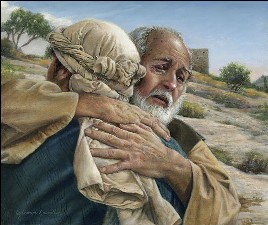
Wayward SonAccording to classic Jewish thought, when Moses was on Sinai with God for forty days and forty nights (Exodus 24:18), in addition to imparting the instructions for building the Mishkan (Tabernacle) and its various elements, God also gave Moses the Oral Law or the means by which to interpret the directives listed in the written document, such as the aforementioned commandment regarding wayward sons. However, no list of commandments, written or oral, could possibly cover all contingencies and circumstances as they would arise in the following years and centuries, so God also commanded that a group of Judges be assembled to hear the various cases and complaints as they arose (Numbers 11:24-30). Authority was given to this system of Judges, originally the Sanhedrin but in modern times, the rabbinic Beit Din, to make rulings and judgments regarding the practical application of the written and oral Torah we have with us today.

So in the case of the wayward son, for an ancient Israelite, it wasn’t enough to know the written Torah on how best to deal with the situation. You had to learn and understand its intent via the Oral Law given to Moses at Sinai and interpreted by the ancient Israeli judicial system which also was established by God. Add to this that, as you grew up and were taught the elements of Torah by your parents, teachers, and priests, you would learn that the commandment of wayward children was meant not as a harsh punishment to use against your son should he become a drunken thug, but a lesson in how to parent your children so that they would “hearken” to your voice.

All that is fine and well for the Israelites, but you’re probably asking yourself what all this has to do with Jesus and his parables. What if I were to tell you that Jesus did the same thing: took the Torah and interpreted it? Christians believe he did so, but only in the very limited scope of doing away with the Torah, but I believe that, like Moses, like the Sanhedrin, like the lesser courts there were appointed in the various towns in Israel, and like the individual judges, Jesus also gave oral rulings, laws, and interpretations by the authority given to him by God the Father, the great Ayn Sof, the infinite, unknowable, ultimate, and unique One God.

Now look at this. We have a written Bible, for Jews, the Tanakh, what Christians call the Old Testament. It isn’t sufficient as a guide to provide a means by which Jews can apply the will of God in every possible situation they may encounter in their lives (and by inference, it means Christians may not have all the information we need just by reading the Bible). There are many questions Jews encounter as to how a commandment may or may not fit something that happens to them, such as a son coming home late and drunk. In fact, since situations and interpretations change across the scope of time, the Torah couldn’t possibly tell a 21st century Jewish parent how to deal with this situation in a way that would also meet the needs of a 12th century Jewish parent under similar circumstances. Both the Talmudic rulings and probably the advice of a Rabbi or a Beit Din might be needed.

Jesus did the same thing in the New Testament. The most famous example of him doing so is in the “Sermon on the Mount” (see Matthew 5) but keep in mind, Jesus wasn’t undoing the Torah commandments or giving a radical and “unJewish” meaning to them. If he had done that, he would have completely lost his Jewish audience including all of his closest disciples. The reason anyone in ancient Roman Judea listened to Jesus and followed him; the reason even the Pharisees could not discredit anything he taught, was because everything he taught and interpreted was completely consistent with the Torah of Moses and the intent of God at Sinai.

There’s no way that we can simply toss the Oral tradition, the Talmud, and the rabbinic rulings out the window and proceed as if the Bible were a completely self-sufficient document. The Bible is the firm foundation of the Word of God and the Rock on which we all stand. But it is not like a latest best-selling novel that we can read and digest all by itself without studying and relying on authoritative interpretations. Jesus is the living expression of that Rock (“the Word became flesh”John 1:14). However, Jesus himself must have followed the halakhah or the traditional rulings of Torah observance as understood during the Second Temple period (if he didn’t, all of his followers, including Peter, would have walked away from him, branding him a heretic). Those places where we see him apparently disregarding halakhah, are those points where his authority is giving a better ruling; one more consistent with the original intent of God at Sinai.

Just as Moses, the Sanhedrin, the lesser courts, and the judges and priests of Israel were given authority on earth to interpret Torah and to make rulings and judgments for the people, Jesus was given that authority and more as the Son of God. If we understand Mark 12:28-44 correctly, none of his rulings, judgments, and interpretations contradicted the Torah in any way, although as I mentioned, some of his rulings weren’t entirely consistent with the understanding of the Pharisees and Sadducees. In Jesus, we have a living example of how there can be a written Torah and a set of oral interpretations. This supports the ancient and modern Jewish tradition of having a written Torah, an oral interpretation, as well as later rabbinic rulings which were recorded in the Talmud, and a rabbinic court to interpret Torah and Talmud in individual cases.

Given everything I’ve just said, I’m not supporting that Christians suddenly start trying to live their lives by Jewish standards. Most of what is written in the Torah and Talmud applies only to Jews, but if you’ve been reading this blog for any length of time, you know that I believe Christians can learn much about God, the teachings of Jesus, and the meaning of our lives as disciples of the Master by studying the Jewish texts. If Jesus, in a sense, taught like Moses, like a Judge, like a Priest, and like a Rabbi, then only by learning about and trying to understand the complete system of Jewish teachings and judgments can we even begin to understand the Savior and Messiah we follow and adore.

Talmud StudyLike the ancient Israelite and the commandment of the wayward son, we don’t have all the information we need just by reading a few paragraphs in the Bible. Like the inner disciples of Jesus, we don’t understand the parables of the Master given to the masses without his interpretation of them. As modern Christians, we can’t always know the underlying meaning of the teachings of Christ (even though we currently have a record of his parables and their explanations) without digging a little deeper into how Jesus taught like a Maggid.

Christian, I’m not saying that we must take on board the full yoke of Torah including Talmud and halakhah. Far from it. However, I am saying that while it is not required of us, we can still learn a great deal about Jesus by the study of Judaism, for it is from Judaism that our faith has emerged and it is within Judaism that the heart of the Messiah beats for his people, both those who are the natural branches and those of us who have been grafted in (Romans 11).

As believers, we have no right to judge the Jewish people for following the halakhah, from studying Talmud, from living by the rulings of the sages, and from obedience to the Torah of Moses as understood and interpreted by oral tradition and rabbinic judgments. These rules are not binding on us, but the Jewish people were given a more comprehensive yoke than what has been asked of the Gentile disciples (Acts 15). Yet, as implied by James and the Jerusalem Council, there is still value in learning the Torah among the Gentile disciples because it is that Torah, those Judges, those Prophets, those Disciples of the God of Israel that are the core of Christ’s message and the foundation of who we are as believers in Jesus.

You have heard it said, but there is more than that. A great deal more. Let’s continue to study together and to allow both Christian and Jew to take their specific paths to the gates of God’s Temple.

Note: Quotes from the Gospel of Mark were taken from the Delitzsch Hebrew Gospels, Hebrew/English translation adapted and published by Vine of David from the original 1890 text that was produced by Franz Delitzch and supervised of Gustav Dalman.

Ki Teitzei: The Bridegroom is Approaching

Ki TeitzeiThe vast majority of laws relating to Jewish marriage and divorce are derived from verses in the Torah portion Seitzei.

The relationship between husbands and wives is similar to the relationship between G-d and the Jewish people. It thus follows that marriage and divorce as experienced between mortal spouses derives from the “marriage” and the so-called “divorce” between G-d and the Jewish people.

The marriage of G-d and the Jewish people took place when He gave them the Torah, as the Mishnah states: ” ‘The day of His marriage’ — this refers to Mattan Torah. “

The Chassidic Dimension: Ki Seitzei
Based on the teachings of the Lubavitcher Rebbe
Rabbi Menachem M. Schneerson
from Likkutei Sichos Vol. IX, pp. 143-150.
Chabad.org

“At that time the kingdom of heaven will be like ten virgins who took their lamps and went out to meet the bridegroom. Five of them were foolish and five were wise. The foolish ones took their lamps but did not take any oil with them. The wise ones, however, took oil in jars along with their lamps. The bridegroom was a long time in coming, and they all became drowsy and fell asleep.

“At midnight the cry rang out: ‘Here’s the bridegroom! Come out to meet him!’

“Then all the virgins woke up and trimmed their lamps. The foolish ones said to the wise, ‘Give us some of your oil; our lamps are going out.’

“‘No,’ they replied, ‘there may not be enough for both us and you. Instead, go to those who sell oil and buy some for yourselves.’

“But while they were on their way to buy the oil, the bridegroom arrived. The virgins who were ready went in with him to the wedding banquet. And the door was shut.

“Later the others also came. ‘Lord, Lord,’ they said, ‘open the door for us!’

“But he replied, ‘Truly I tell you, I don’t know you.’

“Therefore keep watch, because you do not know the day or the hour.Matthew 25:1-13

I’m still trying to figure out how God can be married to the Jewish people as a whole while Christ is married to the church. The former is easier for me to comprehend since Judaism as a whole has a relationship with God more so than any individual Jew, based on the Sinai event. Even through there are religious Jews and secular Jews, because each are part of the Jewish whole, regardless of their personal beliefs, God must consider them His “bride”.

Jews are an ethnicity and a community, not just a religion. To be sure, that’s true of other religions, to some extent. Part of what it means to be an Italian, Polish or Irish American is being Catholic, and the Black church is at the core of the African-American community. So Jews are not alone in being partly an ethnic grouping, but community bonds play an unusually prominent role in our religion. I’m a Jew by choice—I converted 50 years ago, and I’m even more satisfied with that choice now than I was a half-century ago. That’s partly because being Jewish is mostly not about beliefs, but about connections with other people, sharing values and a collective destiny. Even for non-observant Jews, Jewish values are embodied in the Torah. Most Jews, unlike most Christians, don’t take the Torah literally, but it’s an exceptional account of the shared history and values of our people. Those values include respect for learning—we’re the “People of the Book”—respect for the individual, and pervasive concern about the fate of the community. It’s not an accident that Jews are among the most generous people in America philanthropically, and not just for Jewish causes; this trait embodies tikkun olam. Sociologically, Jews behave in a way that’s consistent with putting a high value on caring for other people, as well as on respect for learning. Even the atheists among us share those values.

Robert Putnam is the author of Bowling Alone: The Collapse and Revival of American Community and the Malkin Professor of Public Policy at Harvard University.
Quoted from Moment Magazine

Compared to Judaism, there really isn’t a “Christian people”. We refer to Christians collectively as “the church” but Christians don’t comprise a people group in the way that Jews do since Judaism transcends the definition of a “religion” and extends to a community, a people, an ethnicity (depending on how you look at it) and a culture. You can be a devoutly religious Jew or your can be a Jew who is an atheist, but you are always a Jew.

By contrast, a Christian is only a Christian because he or she has made a conscious faith decision. A person can decide to become a Christian and they can decide to surrender their faith and become an atheist. There’s no such thing as a secular Christian and once you leave the church, you have given up that identity.

When people describe themselves as Christian, they imply some element of belief. The beliefs may vary, but it would be hard for them to say, “I am a Christian,” if they don’t believe in God. In Judaism, there is a vibrant Jewish community separate from the theological underpinnings of the Torah. You don’t have to believe God made a covenant with our ancestors—where He gave us the land of Israel and commanded us to live by His teachings—to be Jewish.

Jason Rosenhouse is an associate professor of mathematics at James Madison University, writes EvolutionBlog for the Science Blogs network, and is the author of Among the Creationists: Dispatches from the Anti-Evolution Frontline, forthcoming from Oxford University Press.
Quoted from Moment Magazine

Christians are called “believers” because the essential element for being a Christian is belief; the acceptance of a certain set of propositions with an unerring certainty. It has nothing really to do with who you are, where you were born, who your parents are, or even anything that you do in life. You are a Christian because you believe in Christ. A Jew isn’t a Jew because of what he or she believes, a Jew is a Jew because of who they are. Even a religious Jew isn’t really religious because of a set of beliefs but instead is considered “yare Hashem”:

According to Heschel, “Awe rather than faith is the cardinal attitude of the religious Jew. In Biblical language, the religious man is not called ‘believer,’ as he is for example in Islam (mu’min) but yare hashem (one who stands in awe of God).”

Quoted from MyJewishLearning.com

RainbowI think we can argue that God is still “married” to any individual Jew because that Jew is always part of the Jewish whole. Not so a Christian since a Christian can accept or reject their faith at will and it is faith and belief, and nothing else, that defines the Christian. So it seems that a Jew remains part of the tribe regardless and thus is “married” in a way that they cannot be divorced, but not so the Christian.

I know what you’re thinking. God did “divorce” the Jewish people and we have scripture to prove it. We also have this:

“For a brief moment I abandoned you,
but with deep compassion I will bring you back.
In a surge of anger
I hid my face from you for a moment,
but with everlasting kindness
I will have compassion on you,”
says the LORD your Redeemer. –Isaiah 54:7-8

God continues to address Israel as a corporate entity rather than commenting on the behavior of any individual Jew. God briefly and temporarily divorced all of Israel and He has promised to gather all of Israel to Himself again.

Paul re-enforces this commitment here:

I do not want you to be ignorant of this mystery, brothers and sisters, so that you may not be conceited: Israel has experienced a hardening in part until the full number of the Gentiles has come in, and in this way all Israel will be saved. As it is written: “The deliverer will come from Zion; he will turn godlessness away from Jacob. –Romans 11:25-26

As much as I try to find one, I can’t discover the solution or reconciliation between the two marriage metaphors: the one involving God and Israel and the one depicting Christ and the church. As I read over what I’ve written, it’s almost as if I’m saying that all Jews merit a place in the world to come no matter what they’ve done by virtue of being Jews. However, there are conflicting points of view involved:

And do not think you can say to yourselves, ‘We have Abraham as our father.’ I tell you that out of these stones God can raise up children for Abraham. –Matthew 3:9

All Israel has a share in the World to Come, as is stated: “And your people are all righteous; they shall inherit the land forever. They are the shoot of My planting, the work of My hands, in which I take pride.” –Sanhedrin, 11:1

How can I put all of this together in a way that makes sense? How to I reconcile God’s relationship with the Jewish people vs. His relationship with Christianity? I know that what we do, Jew and Christian alike, matters to God and that there are consequences, both in the present and in the world to come, for our behavior, but how can that be applied to the identity of Jew vs. Christian in terms of being a “bride”?

(Yes, I know I could take the Christian “hard line” and say that God replaced Israel with the church, but if I ever believed in such supersessionist nonsense, I’ve long since given it up. There has to be another answer)

I don’t know the answer. I’m inviting comments from anyone who has an opinion to share. I do want to leave you with one more quote for this last morning mediation of the week.

Fire can be dangerous – but nothing is as dangerous as ice.

If a fire burns inside you, keep going, just turn the fire towards G-d.
But if your path is of cold, lifeless intellect, you must stop, turn around, and warm yourself with the fiery coals of the sages.

-Rabbi Tzvi Freeman
“Hot and Cold”
Based on the teachings of the Lubavitcher Rebbe
Rabbi Menachem M. Schneerson
Chabad.org

Being cold to our bridegroom is a dangerous thing for anyone as we learn here. But how is it different for a Jew than a Christian against the vista of eternity?

Good Shabbos.

Mystery Story

MysteryCan you fathom the mysteries of God?
Can you probe the limits of the Almighty?
They are higher than the heavens above—what can you do?
They are deeper than the depths below—what can you know?
Their measure is longer than the earth
and wider than the sea.
Job 11:7-9

Whosoever gives his mind to four things, it were better for him if he had not come into the world: what is above? what is beneath? what was beforetime? and what will be hereafter?Mishnah Hagigah 2:2

There are two kinds of ignorance. The one is “dull, unfeeling, barren,” the result of indolence; the other is keen, penetrating, resplendent; the one leads to conceit and complacency, the other humility. From the one we seek escape, in the other the mind finds repose.

-Abraham Joshua Heschel
God in Search of Man: A Philosophy of Judaism
pp 56-7

Can we know God? I know that I’ve spent a lot of time writing blog posts about whether or not God wants to know us. My general conclusion was an incredible “yes” but then in any relationship, the current is supposed to flow both ways. Knowing God is sort of like going on a blind date with someone who has talked to our best friend and who knows all about us but we don’t know anything about her (“him” if you’re reading this and you’re female). The date can feel really one-sided and uncomfortable.

God knows all about us and we don’t really know a thing about Him…no, not really.

Sure, we have the Bible. We can read about God’s involvement with people. We can contemplate the mighty works of the Creator and marvel at His power and greatness, but the human mind cannot imagine the unimaginable. God is far beyond our ability to comprehend.

And what if we’re not even supposed to try to know His mysteries? More from Rabbi Heschel:

To the Jewish mind the ultimate enigmas remain inscrutable. “It is the glory of God to conceal things” (Proverbs 25:2). Man’s royal privilege is to explore the world of time and space; but it is futile for him to try to explore what is beyond the world of time and space…We have said..that the root of worship lies in the sense of the “miracles that are daily with us.” There is neither worship nor ritual without a sense of mystery (Heschel pg 62).

That sounds a little like a religious setup. It sounds like the line given by some crafty “holy man” to his new converts telling them that they don’t need to know anything about God. Just let the priests interpret it all for you.

I don’t think that’s what Heschel is saying, though. He isn’t really saying “don’t look under the hood”, he’s saying that it will do us no good to try because we wouldn’t understand what we were looking at. It would be like a physicist trying to explain the inner workings of the CERN Large Hadron Collider to a three year old child. Even if he or she were the top genius of all three year old kids, the child still wouldn’t “get it”. How much less can any one of us “get” the inner workings of God?

Beyond that, the mystery of God is sort of the point. The gods of myth we studied in school were all rather “knowable” because they were pretty much like human beings are. For God to really be God, the God who created the Universe and everything in it, from the largest galaxy to the smallest sub-atomic particle (and whatever else is “out there” that we don’t even know about), then He absolutely has to be beyond our comprehension. That’s the paradox of our relationship with Him. Getting to know and unknowable God.

The awareness of mystery, not often expressed, is always implied. A classical example of that awareness is the attitude toward the Ineffable Name. The true name of God is a mystery. It is stated in the Talmud, “And God said unto Moses…This is My name for ever (Exodus 3:15). The Hebrew word ‘for ever’ (leolam) is written here in a way that it may be read ‘lealem’ which means ‘to conceal’. The name of God is to be concealed.” (Heschel, pp 63-4)

There are some religious circles that won’t want to accept this conclusion, since they put a great deal of value in “knowing” and using the Ineffable Name (which they usually pronounce as “Yahweh” or something similar). Having “secret knowledge” may give some people or groups a certain thrill, but it becomes arrogant presumption to use that which you do not know, and to attempt to possess that which you are not allowed to appropriate.

You shall not misuse the name of the LORD your God, for the LORD will not hold anyone guiltless who misuses his name. –Exodus 20:7

The LORD reigns, let the earth rejoice;
Let the many islands be glad.
Clouds and thick darkness surround Him;
Righteousness and justice are the foundation of His throne. –Psalm 97:1-2

AweThis isn’t to say that people have not tried to pierce the veil between man and God. Both Christianity and Judaism enjoy a rich mystic tradition and in both the Tanakh and the Apostolic scriptures, we have examples of men going beyond the normal perceptions of the Creator and seeing much more than most of us were meant to experience. Consider the visions of the Prophets such as Isaiah, Ezekiel, and Daniel. What of John’s revelation. Then there are these witnesses:

Then Moses said, “Now show me your glory.”

And the LORD said, “I will cause all my goodness to pass in front of you, and I will proclaim my name, the LORD, in your presence. I will have mercy on whom I will have mercy, and I will have compassion on whom I will have compassion. But,” he said, “you cannot see my face, for no one may see me and live.”

Then the LORD said, “There is a place near me where you may stand on a rock. When my glory passes by, I will put you in a cleft in the rock and cover you with my hand until I have passed by. Then I will remove my hand and you will see my back; but my face must not be seen.” –Exodus 33:18-23

I must go on boasting. Although there is nothing to be gained, I will go on to visions and revelations from the Lord. I know a man in Christ who fourteen years ago was caught up to the third heaven. Whether it was in the body or out of the body I do not know—God knows. And I know that this man—whether in the body or apart from the body I do not know, but God knows— was caught up to paradise and heard inexpressible things, things that no one is permitted to tell. –2 Corinthians 12:1-4

But where does that leave us?

What would be so bad about letting the mystery be the mystery? This isn’t to say we should avoid drawing closer to God and that study is futile, but the Psalmist said, “The awe (Yirah) of the LORD is the beginning of wisdom.” (Psalm 111:10). The word “Yirah” in Hebrew can mean either “fear” or “awe”. Fear usually implies a reaction to potential punishment, either in this life or in the life beyond, while awe is our reaction to God in His infinite glory, and not based on whatever consequences we might end up facing:

Though He may slay me, yet I will trust Him. –Job 13:15

Jesus admonished his disciples (including us) not to worry because we have no control over the things God provides (Matthew 6:25-34). Expand his “sage advice” to include not worrying about God, who He is, what He does, how He works. If we trust Him then we do know Him, or at least we know as much as we need to know. It is said that awe (or fear) of the Lord is “the beginning of wisdom: and the knowledge of the holy is understanding” (Proverbs 9:10), but that doesn’t have to include infinite knowledge or understanding beyond where God has placed His boundary markers. What we need to know, He’s already told us. The rest can remain a mystery, and we can be in awe.

The King is in the Field

The fieldsAs the month of “Divine Mercy and Forgiveness,” Elul is a most opportune time for teshuvah (“return” to G-d), prayer, charity, and increased Ahavat Yisrael (love for a fellow Jew) in the quest for self-improvement and coming closer to G-d. Chassidic master Rabbi Schneur Zalman of Liadi likens the month of Elul to a time when “the king is in the field” and, in contrast to when he is in the royal palace, “everyone who so desires is permitted to meet him, and he receives them all with a cheerful countenance and shows a smiling face to them all.”

Elul Observances in a Nutshell
Chabad.org

Antignos of Socho received the tradition from Shimon the Righteous. He would say: Do not be as slaves, who serve their master for the sake of reward. Rather, be as slaves who serve their master not for the sake of reward. And the fear of Heaven should be upon you. Pirkei Avot 1:3

My wife refers to the month of Elul and the High Holidays as an opportunity to “hit the reset button”. So many undesirable things seem to pile up in our lives over a twelve month period that Elul is a good opportunity to make a serious evaluation of who we are, what we’ve been doing, and if we have been behaving as the sort of person we are, or want to be.

I find it interesting that during Elul, Rabbi Schneur Zalman of Liadi considers the King to be walking among His subjects. It reminds me of another King under somewhat similar circumstances:

“I dare say you love him not so ill, to wish him here
alone, howsoever you speak this to feel other men’s
minds: methinks I could not die any where so
contented as in the king’s company; his cause being
just and his quarrel honourable.”

-Henry V – Act 4, Scene 1
by William Shakespeare

While our King is readily apparent to us, like the case of King Henry, this was not always so. Shakespeare’s Henry disguised himself as a commoner and walked among this troops on the eve of battle, encouraging them. For many people today, our own King is among us but walks “anonymously”. He is not recognized in his “disguise” and he is seen instead to be a false Messiah, a false Prophet, and even a fictional character in a book of myths. Among the Jews, even today, we can think of him like Joseph, who in the guise of the Egyptian viceroy Zaphenath-Paneah was not recognized by his own brothers until such a time as when Joseph chose to reveal himself:

Then Joseph could no longer control himself before all his attendants, and he cried out, “Have everyone leave my presence!” So there was no one with Joseph when he made himself known to his brothers. And he wept so loudly that the Egyptians heard him, and Pharaoh’s household heard about it. Joseph said to his brothers, “I am Joseph! Is my father still living?” But his brothers were not able to answer him, because they were terrified at his presence. –Genesis 45:1-3

Yet there will be a time when the King will return in power and all will know his name:

I saw heaven standing open and there before me was a white horse, whose rider is called Faithful and True. With justice he judges and wages war. His eyes are like blazing fire, and on his head are many crowns. He has a name written on him that no one knows but he himself. He is dressed in a robe dipped in blood, and his name is the Word of God. The armies of heaven were following him, riding on white horses and dressed in fine linen, white and clean. Coming out of his mouth is a sharp sword with which to strike down the nations. “He will rule them with an iron scepter.” He treads the winepress of the fury of the wrath of God Almighty. On his robe and on his thigh he has this name written: King of King and Lord of Lords. –Revelation 19:11-16

I said previously that the vast majority of Christians see no particular significance in Elul or the approach of Rosh Hashannah and Yom Kippur, since as we are taught, Christ paid the price for our sins once and for all. Still, if you’re human, you know there’s a difference between the price being paid and our living perfectly sinless lives in the wake of being “saved”. There is no one who is above bowing to the King and begging His forgiveness for the wrongs we have done and continue to do.

Elul and ShofarIt is true that our King is “closer than a brother” (Proverbs 18:24) and He is always accessible through prayer, but there will be a time when we are judged for what we have done and what we have failed to do in His Name. Elul is an annual opportunity to review who we are and what we need to do to be better servants of our Master and better sons and daughters of our Father. “Rabban Gamliel would say: Assume for yourself a master” (Pirkei Avot 1:16) and we have done so. Now it is time to heed our Master’s wishes.

Although it would be easy to misunderstand the events commemorated in Elul and the High Holidays themselves as terribly grim and fearful, it is actually a time of great joy and wonder. The King is among us. He desires that we draw near to Him. He wants none to perish (2 Peter 3:9) and to that end, he calls to each of us, especially now. Though, as Peter says, the Lord is not slow “but is patient toward you”, he is also merciful enough to build “reminders” into his calendar for us. Elul is one of the markers along the road cautioning us and encouraging us.

During Elul, observant Jews add Psalm 27 to their daily prayers and the first verse should tell us why:

The LORD is my light and my salvation—
whom shall I fear?
The LORD is the stronghold of my life—
of whom shall I be afraid? –Psalm 27:1

Indeed, with the King walking among us, who should make us afraid?

During Elul, Jews often greet each other and bless each other by saying “Ketivah vachatimah tovah” which basically means “May you be inscribed and sealed for a good year.”

May it ever be so for this year and always.

Love and Be Perfect

ForgivenessThe Baal Shem Tov taught that a sin in itself is only the bite of the snake. The real damage comes from the poison that spreads afterwards, saying, “What a worthless thing you are. Look what you’ve done! Now you’re really lost.”

With those few words, all the gates of hell are opened.

-Rabbi Tzvi Freeman
“Aftermath”
Based on the letters and talks of the Rebbe
Rabbi M.M. Schneerson
Chabad.org

I spend a fair amount of time on this blog talking about tikkun olam, repairing the world. That’s probably because the world seems so “broken” and in need of repair. In fact, the world seems to be getting more broken all the time.

Yesterday, I discussed how Christianity could be breaking the world in how we treat the Jewish people. Even if we take no overt actions against Jews, what we harbor in our minds and hearts about them is just as much of a sin (see Genesis 12:3, Matthew 5:21-22, Romans 11:17-21, and 2 Corinthians 10:5).

But a broken world sometimes starts with a broken self.

In quoting Rabbi Freeman, I’m illustrating the sort of person who knows that they’re broken and who is caught in a loop of sin, discouragement, hopelessness, and sin some more. Disobedience to God is only the first step and in most cases, it’s a recoverable state. However, once you’ve convinced yourself that your sin makes you truly irredeemable, then why do you have to care whether you sin again or not? You already believe it’s too late for you so you’ve given up.

But what about the person who sins and justifies their behavior? Some people simply lie and say they didn’t sin when they know they did, but others really don’t believe that their sin is a sin or their mistake is a mistake. They have created a set of explanations for themselves, usually based on scripture, that either excuses their poor behavior or completely redefines it as good behavior.

But mark this: There will be terrible times in the last days. People will be lovers of themselves, lovers of money, boastful, proud, abusive, disobedient to their parents, ungrateful, unholy, without love, unforgiving, slanderous, without self-control, brutal, not lovers of the good, treacherous, rash, conceited, lovers of pleasure rather than lovers of God — having a form of godliness but denying its power. Have nothing to do with such people.

They are the kind who worm their way into homes and gain control over gullible women, who are loaded down with sins and are swayed by all kinds of evil desires, always learning but never able to come to a knowledge of the truth. Just as Jannes and Jambres opposed Moses, so also these teachers oppose the truth. They are men of depraved minds, who, as far as the faith is concerned, are rejected. But they will not get very far because, as in the case of those men, their folly will be clear to everyone. –2 Timothy 3:1-9

This is terrifying because Paul isn’t describing the dangers of the secular world. He’s describing the church. Welcome to “terrible times”. It’s become all too easy to teach poor doctrine and be wholly convinced that you are completely correct and in line with the Bible, yet be supporting the most vile of positions and even opposing God.

In the case of a person who knows they have sinned and who seeks forgiveness, once they have been forgiven by God, they must learn to forgive themselves:

“But the tax collector stood at a distance. He would not even look up to heaven, but beat his breast and said, ‘God, have mercy on me, a sinner.’ “I tell you that this man, rather than the other, went home justified before God. For all those who exalt themselves will be humbled, and those who humble themselves will be exalted.” –Luke 18:13-14

But what do you do about a person, a group of people, or an entire church who sins and yet refuses to admit it, even to themselves?

“If your brother or sister sins, go and point out their fault, just between the two of you. If they listen to you, you have won them over. But if they will not listen, take one or two others along, so that ‘every matter may be established by the testimony of two or three witnesses.’ If they still refuse to listen, tell it to the church; and if they refuse to listen even to the church, treat them as you would a pagan or a tax collector. –Matthew 18:15-17

Tikkum OlamWhen Jesus taught that, he may not have had the Internet in mind. It seems that so much of the bad teachings of Christianity happen online these days. If you attend a church with a Pastor or a Bible teacher who seems to have gone off the tracks, so to speak, you have the difficult choice of either confronting the problem or finding another church. That said, people usually select and attend a church based on agreeing with their doctrinal position in the first place.

On the Internet, opinions fly fast and furious and just about any viewpoint you could imagine, no matter how outrageous, is represented on someone’s blog somewhere. It’s easy to drop reading a blog or at least to not comment on it (depending on how much you need to fix it when someone’s wrong on the Internet) but what do you do about the people?

It would be easy just to give them up too, but do we have a responsibility to help a person to make amends with others and with God?

Do not hate a fellow Israelite in your heart. Rebuke your neighbor frankly so you will not share in their guilt. –Leviticus 19:17

This verse is the basis in Judaism for the commandment that one Jew should attempt to correct another Jew when the second Jew sins or is about to sin. Admittedly, we can’t say this necessarily applies to Christians as well, but can we say categorically that it doesn’t? Look at the example from Matthew 18:15-17 again. There is a certain amount of effort that goes into approaching someone who has sinned against you. You don’t get to brush them off at the initial affront. You are obligated to first approach them privately and, if they don’t listen, to take a couple of witnesses with you and try again. If the person still doesn’t respond, then you bring the matter to the entire congregation.

How do you do that on the Internet…or do you?

The Internet is a funny place. It fosters a false sense of intimacy based on our perceived anonymity. Because we think people don’t know who we are and can’t find out, we believe we can be more free with disclosing information about ourselves, including our opinions, than we would in a face-to-face encounter. On the other hand, because Internet relationships don’t have the “anchor” of a “real” relationship (the aforementioned “face-to-face”), we can feel very comfortable about cutting people off without even a glance backward to say “good-bye”.

There have been some folks on the web I’ve said good-bye to in one way or another and some I’ve been tempted to drop like an angry rattlesnake. But is that the right thing to do?

Very rarely is the person you disagree with “evil” or “irredeemable”. Most of the time, they’re probably not that much different from you. They are certainly just as loved by God as you are. They are often your brother and sister in Christ and even if they’re not, they have been created in the image of God, just as you have been. How can we walk away from people so casually, abandoning them to what is a problematic but correctable situation?

The oft-quoted “am I my brother’s keeper” (Genesis 4:9) comes to mind.

I don’t want to take endless amounts of abuse or rebuff in a hopeless attempt to get someone to change their minds on a matter of which they are fully convinced, but on the other hand, there’s this:

Then Peter came to Jesus and asked, “Lord, how many times shall I forgive my brother or sister who sins against me? Up to seven times?” Jesus answered, “I tell you, not seven times, but seventy-seven times. –Matthew 18:21-22

Forgiveness is one thing, reconciliation is something else. The web is full of concrete people with concrete opinions, based on what they think is a rock-solid interpretation of the Bible but interpretations can be and often are built on sand. A person may say that they are willing to listen to your side so you can “prove them wrong”, but how often do you really encounter someone who is willing to surrender their viewpoint because you devastated them with your overpowering logic?

People can be very afraid of even questioning their assumptions let alone giving them up. We pin a lot of our security on believing that, once we’ve made our mind up about something, the “something” will not change from being right to being wrong. We can justify hurting anyone in any way as long as we believe what we’re doing puts us on the side of right, virtue, and God. That’s how the various inquisitions and pogroms operated. That’s how the Nazis operated when they murdered six-million Jews. That’s how a lot of people operate, including a lot of religious people.

Loving OthersI can try to convince others that they are opposing God (and that is not their intent) but in the end, most will not be convinced. I can walk away from them, but it feels like abandoning a severely injured person trapped in a mass of twisted steel in the aftermath of a twelve-car pile up. In the end, it all belongs to God and not to me, but then what sin do I become guilty of by leaving them?

If we are our brother’s (or sister’s) keeper, then how heavy is the burden supposed to be and how long must we carry it? Seven times seventy? Seventy-seven times? What does that mean? What did the Rebbe say?

Anxieties, worries, feelings of inadequacy and failure — all these smother and cripple the soul from doing its job. You need to find the appropriate time to deal with them. But don’t carry them around the whole day.

During the day, you are Adam or Eve before they tasted the fruit of good and evil.

I had meant to write about learning to forgive yourself after sin, but a great deal of the time, these blogs end up having a will of their own and I’m only the fingers on the keyboard recording them. I don’t know what to do about repairing the world or even “repairing” other people. It seems like I spend a lot of time learning how to repair myself. Yet I know that my responsibilities to God extend outside of myself and into the world around me.

But then, there’s always this teaching from the Master:

“You have heard that it was said, ‘Love your neighbor and hate your enemy.’ But I tell you, love your enemies and pray for those who persecute you, that you may be children of your Father in heaven. He causes his sun to rise on the evil and the good, and sends rain on the righteous and the unrighteous. If you love those who love you, what reward will you get? Are not even the tax collectors doing that? And if you greet only your own people, what are you doing more than others? Do not even pagans do that? Be perfect, therefore, as your heavenly Father is perfect. –Matthew 5:43-48

Even on the Internet, I am required to love and to be perfect. Is this where I get to ask God for help in doing that?

Breaking the World

GlobeThis above all: to thine own self be true,
And it must follow, as the night the day,
Thou canst not then be false to any man.
Farewell, my blessing season this in thee!

-William Shakespeare
Hamlet Act 1, scene 3, 78–82

Just as it is a mitzvah to direct someone onto the path where he belongs, so too it is a crime to direct someone onto a path that does not belong to him.

Each person is born with a path particular to his or her soul, generally according to the culture into which he or she was born.

There are universal truths, the inheritance of all of us since Adam and Noah. In them we are all united. But we are not meant to all be the same.

Our differences are as valuable to our Creator as our similarities.

-Rabbi Tzvi Freeman
“To Each His Path”
Based on the letters and talks of the Rebbe,
Rabbi M.M. Schneerson
Chabad.org

Both the Bard and the Rebbe, as interpreted by Rabbi Freeman, say something very similar. Not only are we not all the same but we must all “be true” to who we are, differences and all. It’s not a crime to be different from others, even in the worship of God, but there are plenty in the church that would have you believe otherwise. If you don’t go along with “the herd”, if you don’t fit in with “the group”, if you see life, scripture, and God from a different angle based on who God created you to be, not only are you likely not to be understood, but it is very possible you will be actively criticized. In the world of believers, you are even likely to be considered un-Christian, heretical, or apostate.

I’m not saying that there are people who aren’t apostate or heretical, but we must be careful how we toss about our accusations. Are we reacting honestly to the statements and practices of those who profess Christ but who practice a lifestyle opposed to his, or are we allowing our visceral responses to lifestyles consistent with Christ’s but inconsistent with the lifestyle we choose for ourselves to affect us and mistakenly labeling another’s lifestyle apostasy?

I used to consider myself a “Messianic”, that is, a person (in my case, a Gentile) who attached himself to the God of Abraham, Isaac, and Jacob and who believed that I was required to conform to a completely Jewish religious practice because I was “grafted in”. This actually describes only one subset of the Messianic movement, called “One Law”, which believes that Jewish and non-Jewish believers in Jesus (Yeshua) are all the same in terms of covenant obligation to God. It’s as if becoming “one new man” (Ephesians 2:15) for One Law (OL) means that Christians turn into Jews without having to undergo circumcision. There are tons and tons of problems with this interpretation but one of my problems with OL is that it tends to actually discourage believing people who were born and raised in ethnic, cultural, and religious Jewish families from acting like ethnic, cultural, and religious Jews.

I mentioned in a previous “meditation” that I’ve been following a couple of blog conversations lately. One is A Response to Rabbi Dauermann’s Messianic Substitution and the other is Karaite leader Nehemiah Gordon responds to anti-missionary charges. Not leaving well enough alone, not only did I read these posts at Judah Gabriel Himango’s blog Kineti L’Tziyon, but I replyed. I should have known better. These conversations almost never end well.

If you visit the two blog posts and review the comments, you’ll see various snide remarks and unkind words (I’m not criticizing Judah’s blog, but some of the people who comment occasionally express “interesting” opinions). Granted, there is room for “spirited debate” on the religious blogosphere, but often, the religious blogs follow the same standard as the secular ones, especially in responding to the cry, “someone is wrong on the Internet.” We can’t seem to get it through our thick skulls that sometimes, someone isn’t “wrong”, they are just following a different path to the same destination.

I’m not going to balance the relative differences between Christianity (including the OL/MJ world which views religion from a largely Christian viewpoint) and Judaism, but I do want to caution folks not to point to Jews, including those who believe that the Jewish Messiah is realized in the person of Jesus Christ, and say that they’re “wrong” for wanting to live a Jewish lifestyle, worship in a traditionally Jewish manner, pray from a Jewish siddur, and to actually continue to be Jewish.

WrongOne of my favorite Jewish (not Messianic) blogs is Lev Echad. Blogger Asher is focused on the different “threads” of Judaism that tend to get uncomfortably tied up with each other, and his desire is to support Jewish unity among dissimilar perspectives and practices, forming “one heart” (hence, “lev echad”) among Jews. Much of what he says can be adapted and applied to Christianity and indeed, to humanity. Relative to those in Messianism/Christianity who criticize and virtually “demonize” those Jews who have faith in Jesus and who also live and worship like Jews, there is something that Asher wrote in one of his blog posts, although not intended to be applied to my context, that I believe should be read by Christians:

Similarly, there are some Orthodox Jews who too easily brand their less observant coreligionists as “heretics” or “non-believers.” Yet, prominent sages such as Rabbi Abraham Isaac Kook and the Chazon Ish have ruled that we live in a time of God’s concealment and therefore cannot apply the religious laws concerning heresy to modern-day Jews who question their faith. Furthermore, it is wrong to harm those who deny even Judaism’s most basic beliefs. Not only should we not hurt such people, we should help them if the situation ever presents itself.

Now marry Asher’s words with Paul’s:

And so all Israel will be saved, as it is written: “The deliverer will come from Zion; he will turn godlessness away from Jacob. –Romans 11:26

This isn’t the first time I’ve addressed anti-semitism among Christians. About six weeks ago, I wrote The Irrelevant Drunkard, which I wish all Christians/Messianics would read and try to comprehend. I realize the tone of that blog post (and this one) could put off a Christian/Messianic from reading beyond the first few paragraphs. It’s tough to take a good, hard look at what you’re saying and doing, especially basing it on scripture (and just because scripture can be bent and twisted to say many different things doesn’t mean all those different things are actually correct), and then to humble yourself before God and realize that you’re using the Bible to trash God’s Chosen People (see Genesis 12:3).

Going back to Asher’s blog, why can’t we do this instead?

One of the unique aspects of Judaism is learning about all the different roads people take that lead them to God and a life of goodness. While this is certainly a fascinating phenomenon, it can also be a great impediment to how we treat one another. Therefore, our goal in life should not be to turn all our fellow Jews into ideological and/or religious replicas of ourselves. Rather, it should be to guide – not force – others into a life of serving God and His children in a way that best matches their individual personality.

While the above-quote is addressed to Jews about Jews, certainly Christians can extend the sentiment to other Christians and to Jews who have accepted the Jewish Jesus as the Jewish Messiah.

Or, we can lock ourselves in a tiny, unidimensional box with God and the Bible, telling ourselves that we’re right and all other churches, synagogues, and everybody else are wrong. We get to be a big deal and everybody else…not so much.

I mentioned before that one of the reasons I do not consider myself a “Messianic” any longer is that I do not believe the Bible supports a Gentile living an ersatz-Jewish lifestyle. Another reason is that calling myself “Messianic” limits what I can say and who I can say it to. As a “Messianic”, even one who supports the message that Jews and Gentiles have overlapping but distinct covenant relationships with God which do not involve identical obligations, if I say I’m “Messianic”, then only “Messianics” will want to hear what I have to say. Christians won’t listen because they consider Messianics to be Judaizers who want to bring believers “under the law”. Jews won’t want to hear what I have to say because many of them consider Messianics as a combination of “Christians in kippot” and “wolves in tallitot”, particularly the Gentiles who dress and behave as if they’re Jews but who don’t do “Jewish” very well. The value of the message becomes diluted or even discounted because of the label associated with the message and because of the audience it is presumed to be attached.

(I should say at this point that there are many people in Messianic Judaism who I consider friends and who do have a very powerful and meaningful message. It is a message that I pray daily will be heard by all Christians and Jews, not because of its “label” but because of the truth it communicates. I try to communicate a similar meaningful message but I do so from my own perspective and personal identity).

For me, it’s much more straightforward to say that I am a Christian, a Gentile who is a disciple of Jesus Christ, and someone who sees a great deal of added dimension to the teachings and life of the Master through the lens of ancient and modern Judaism. I’m not claiming there are one-to-one parallels between the Gospels and the Talmud, Chassidism, and Jewish mysticism, but there are certainly thematic similarities that can be considered. If I proceed from the basic platform that Jesus was a Jewish man, living in the Second Temple period in what was then Roman Judea, who lived as a Jewish man, taught as a Jewish Rabbi, and who did not abandon what it was and is to be a Jew, then the only logical place for me to go in understanding Jesus is to try (in my admittedly limited fashion) to comprehend Jesus as a Jew.

This doesn’t require that I become Jewish or to pretend to behave as if I were a “pseudo-Jew”. It does require that I make a paradigm shift and to study materials, concepts, and ideas that aren’t considered particularly “Christian” (and in fact, there are Messianic Jews who read many more Christian historic and modern texts than I do).

UnderstandingAs a Christian married to a Jewish wife, I can’t simply take the Christian “party line” and judge my wife as condemned because she doesn’t throw her Judaism into the trash heap and turn into a “good Christian woman”. While there’s nothing wrong with being a “good Christian woman”, that’s not who she is or who God made her to be.

God didn’t create Jews and preserve them against all kinds of hideous persecution including the Holocaust, just to have them finally deleted from existence by converting them into Christians. Those Christians who suggest that Jews stop being Jews are considered to be finishing the job that Hitler started (and while that may sound very harsh, I can see why Jews view conversion to traditional, Jewish-rejecting Christianity that way). Those Christians who want to erase Jews from existence by turning them into clones of themselves are saying they want to destroy my Jewish wife (and as you can imagine, that’s not something I’m going to accept with any amount of graciousness or patience).

Like it or not, it takes more than evangelical Christianity or charismatic Christianity or “Messianic Christianity” (OL) to repair the world and make it whole, as Rabbi Freeman suggests:

To create is to reveal the parts from the whole.

To repair takes a greater wisdom. It is to discover the whole from the shattered parts.

He creates a world, knowing it will be broken, so He may empower us with the wisdom to repair it.

While Rabbi Freeman’s intent wasn’t to address the topic of today’s “morning meditation”, I believe his words can be re-shaped to do so. Repairing the world requires that we have all the pieces. If we throw out some of the pieces as irrelevant, apostate, evil, or just “too Jewish”, we are dooming the world to never becoming whole again. It would be as if God tried to make a person but tossed out the heart as unnecessary or the liver as “too different”. By Christianity condemning the Jews as a whole and particularly those Jews who have come to faith in Jesus as the Messiah, we are literally frustrating the work of Jesus and what he will complete on his return; the final restoration of everything that was lost because of the fall of man at Eden.

It would be ironic and indeed tragic, if Christianity in dismissing Judaism, desiring the eradication of all Jews everywhere through conversion, and in failing to embrace the picture of Jesus as a Jew, were putting the entire Christian church in opposition to everything that Jesus did and does stand for, both as a man on earth and as our high priest in the Court of Heaven. The church then would be opposed to the will of God. Like I said, “ironic”.

Are some Christians helping to repair the world or to break it?