Tag Archives: God

Re’eh: When Did We Feed You?

Feeding Hungry Children“Then the righteous will answer him, ‘Lord, when did we see you hungry and feed you, or thirsty and give you something to drink? When did we see you a stranger and invite you in, or needing clothes and clothe you? When did we see you sick or in prison and go to visit you?’

“The King will reply, ‘Truly I tell you, whatever you did for one of the least of these brothers and sisters of mine, you did for me.’”Matthew 25:37-40

We are told in the Torah Portion Re’eh , “Follow G-d your L-rd, fear Him, observe His commandments, hearken to His voice, serve Him and cleave to Him.” On the words “cleave to Him,” Rashi explains: “Cleave to His ways, perform acts of loving kindness, bury the dead, visit the sick, just as G-d has done.”

The Chassidic Dimension: Re’eh
From the teachings of the Lubavitcher Rebbe
Rabbi Menachem M. Schneerson
Based on Likkutei Sichos Vol. XIV, pp. 53-63.

For last week’s Torah Portion Eikev, I wrote that cleaving to God is actually an effort to bring the Messiah:

Cleaving to a Rebbe, honoring him, and learning from him, and then passing what you’ve learned to others and particularly down to the next generation in response to the desire to cling to God. When we cling to our “Rebbe”, to Jesus, we are fulfilling God’s desire.

In quoting the Master’s words above, as recorded in Matthew, I mirrored the interpretation of the Torah portion as rendered by Rashi:

Rashi’s comment must be understood: Since, according to Rashi , the verse means to tell us that we should cleave to G-d’s ways and act as He does, why doesn’t the verse explicitly state “cleave to His ways” rather than “cleave to Him?”

Moreover, since the command to cleave to G-d’s ways is stated as “cleave to Him ,” it is understandable that the ultimate unity with G-d is accomplished specifically through following G-d’s example and performing acts of loving kindness.
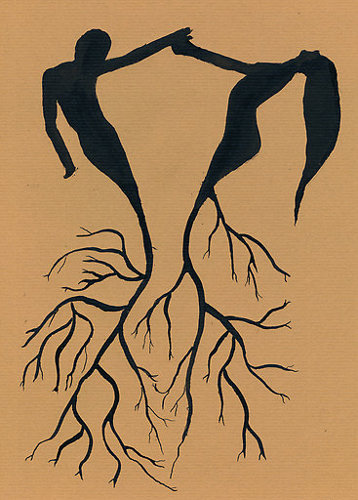
One SoulThe word “to cleave” in Hebrew, gives the sense of adhering or “gluing” yourself to the object of adherence. It is the same word used in Genesis 2:24 when the Torah states, “a man leave his father and his mother, and shall cleave unto his wife”. It would be impossible for a human being to literally “cleave” to God as a man cleaves to his wife, and we see that to obey the will of God in this matter, we must attach ourselves to someone to typifies the characteristics of God (performing acts of loving kindness, burying the dead, visiting the sick, and so on), ultimately performing the behaviors we learn from them.

Jesus described his disciples, that is “us”, cleaving to God, as it were, by obeying the will of our Master and doing the same things he does; inviting the stranger into our home, clothing the unclothed, and visiting the sick and the prisoner. Sounds somewhat like knowing a tree by the fruit it bears (Matthew 7:20).

We might be tempted to force ourselves to do good deeds in order to “earn” favor in Heaven, but there’s something else to consider from this week’s Torah portion:

These concepts are relevant with regard to this week’s Torah reading, Parshas Re’eh, which begins: “See that I am placing before you today a blessing and a curse.” The portion continues to allude to free choice, reward and punishment: “The blessing [will come] if you obey the commandments. and the curse [will come] if you do not heed. and go astray from the path which I have commanded.”

Moshe is telling the people that their observance of G-d’s commandments will not be a spontaneous response. Instead, they will constantly be required to make conscious choices.

Why does G-d grant man choice?

-Rabbi Eli Touger
Commentary on Torah Portion Re’eh
“The Power of Sight”
Adapted from Likkutei Sichos, Vol. IV, p. 1339ff; Vol. XV, p. 44

Good question, and one that’s been asked many times throughout the sometimes turbulent relationship between man and God.

Rabbi Touger continues:

Were man’s choice between good and evil to come naturally, he would not have any sense of accomplishment. What would he have earned?

For this reason, man is confronted at every stage of his spiritual progress with challenges which he must overcome on his own. By nature, evil has no substance, and as darkness is repelled by light, evil would be instantly subdued by the power of holiness.

The themes of loving God, obeying Him, having a greater purpose in life, finding our mission, have been part of a series of blogs I wrote recently, based on the Rohr Jewish Learning Institute course Toward a Meaningful Life. We see in the commentaries for Torah Portion Re’eh, that we not only bring something of the Messiah into the world now by behaving as he does, loving God and loving other people, but that our actions today ripple into a time when God’s manifestation on Earth will be absolute:

The ultimate expression of the potential of sight will be in the Era of the Redemption, with the fulfillment of the prophecy: “The glory of G-d will be revealed and all flesh will see.” In contrast to the present era, when we can see only material entities and G-dliness is perceived as an external force, in that future time, we will see directly how G-dliness is the truth of all existence.

Nor is this merely a promise for the distant future. The Redemption is an imminent reality, so close that a foretaste of its revelations is possible today.

Feed My Starving Children logoWhat we do matters right now. What we do also matters in the Messianic age. It is inescapable. We have free will to act or to refrain from acting, to choose to cling to God or to withdraw from Him. Either way, there are tremendous consequences, not only for ourselves, but for people and events we effect, whether we realize it or not.

Lord, when did we see you hungry and feed you?

Who will your next act of kindness or indifference serve or fail to serve?

Good Shabbos.

Loving God

Burning BushWhen God appeared to our Teacher Moses, and commanded him to address the people and to bring them the message, Moses replied that he might first be asked to prove the existence of God in the Universe, and that only after doing so he would be able to announce to them that God had sent him. For all men, with few exceptions, were ignorant of the existence of God; their highest thoughts did not extend beyond the heavenly sphere, its forms or its influences. They could not yet emancipate themselves from sensation, and had not yet attained to any intellectual perfection. Then God taught Moses how to teach them, and how to establish amongst them the belief in the existence of Himself…

Ehyeh asher Ehyeh, a name derived from the verb hayah in the sense of “existing,” for the verb hayah denotes “to be,” and in Hebrew no difference is made between the verbs “to be” and “to exist.” …This is, therefore, the expression of the idea that God exists, but not in the ordinary sense of the term; or, in other words, He is “the existing Being which is the existing Being,” that is to say, the Being whose existence is absolute.

from The Guide for the Perplexed
by Moses Maimonides
translated by M. Friedlander (1903)

This blog continues my series based on the JLI course book for Toward a Meaningful Life. If you haven’t done so yet, please review the previous blog, A Knock on the Door, and then return here and keep reading.

I don’t doubt the actual existence of God and haven’t for quite some time. Too much has happened to me that can’t be explained any other way but that God, the God of the Bible, must exist and be active in the world. It’s comprehending God and particularly, what He wants from a relationship with me that has me “perplexed”. Understanding God is no small matter and I don’t believe it’s possible for any human being to comprehend God, though that hasn’t stopped me from trying to grasp Him on some miniscule scale.

A few days ago, I wrote a blog saying, in part, that God is the only being who truly stands alone and without peer. God is a unique and radical One and there is no other like Him.

G-d replied that His name is “Ehyeh Asher Ehyeh.” That is to say: the Being Whose existence depends on nothing but Himself…. “I exist because I exist, not because of another existence. Unlike other beings, My existence and power is not dependent on anything.”

This name does not apply to any other being. They cannot say, “I exist because I exist.” They are only able to say…”I exist because another being exists,” that is, the First Cause upon which all beings depend.

But G-d depends on Himself, not on any other cause….Therefore, His existence is a true existence because He does not need any other being.

Rabbi Yosef Albo
Sefer Ha’ikarim 2:27

This, as much as anything, is what makes God so incomprehensible. As people, we like to think we’re self-sufficient and independent, but even on a human scale, we must admit that our existence is dependent on our parents. On a cosmic scale, all that lives and all that exists depends on God for our very being and purpose. That is a daunting and humbling thought, and if you are a secular humanist, you will reject the concept out of hand. People don’t like to think that we aren’t in control our lives. In fact, we do control what we do with our lives, we just don’t determine why we were created in the first place, and we often don’t have a clue as to which “destiny” or purpose we are best suited. That is up to God, not a blind and random meeting between your father’s and mother’s genetic material, and not by any other set of arbitrary probabilities.

We are dependent on so much. Only God is alone.

Rabbi Albo also wrote, in Sefer Ha’ikarim 2:30:

It is impossible for anyone outside of G-d to grasp His essence. Like the answer given by the wise man upon being asked if he knows the essence of G-d – “If I knew Him I would be Him.” In other words, there is no one who can grasp G-d’s essence except God….The ultimate we can grasp about G-d is that we cannot grasp Him. As the wise man said, “The ultimate knowing of You is knowing that I cannot know You.”

Woman prayingAdmitting all of that, where does that leave humans in relation to God? We can’t know Him, at least not in the sense of His most complete essence. And yet, we are commanded to “love the Lord, your G-d, with all your heart and with all your soul, and with all your means.” (Deuteronomy 6:5). Jesus taught these very words (Matthew 22:37) so I feel confident that they apply to Jews and to everyone else. We are also taught to fear God (Deuteronomy 6:13) with (my interpretation) a fearful awesomeness. But how do we connect to God when He is so infinite and we are so…not?

An article written by Rabbi Aaron Moss is included in the JLI course material for Toward a Meaningful Life and is crafted in the form of an “Ask the Rabbi” column:

Question: Rabbi, I am uninspired, I used to pray to G-d and study Torah, but I’ve lost the spark. I feel flat and empty and I haven’t done anything spiritual in ages. What should I do to find my soul again?

I won’t attempt to replicate the Rabbi’s rather lengthy answer, but at the core, he says that if you wait for a feeling to inspire you to start praying, studying and rekindling your relationship with God, you’ll wait forever. It’s like an out-of-shape person saying that they can’t go to the gym to get back in shape until they start getting more strength and stamina. They are too out-of-shape to be able to work out in order to get back into shape. I’m sure you can see the “Catch-22” involved here.

Stephen Covey, in his bestselling book 7 Habits of Highly Effective People, relates an encounter he had with a fellow after a speaking engagement. The man told Covey that he hadn’t loved his wife for many years and no matter what he tried, he couldn’t resurrect his emotional connection with her. He pleaded with Covey to give him some advice or insight as to how he could start loving his wife again.

Covey’s only answer was, “Just love her”.

If you wait for a feeling before you start treating someone as if you love them, you’ll be waiting forever. This is as true of a relationship with God as with a spouse. To love God, don’t wait for a feeling. Start praying. Start reading the Bible. Start allowing God to just be with you. By the by, you will start “feeling” the love returning.

Rabbi Adin Steinsaltz in his article Each of Us Has a Personal Relationship with God says in part:

I also believe that God supervises the smallest details and every single individual….Thus, God has a plan for each and every human being and every single creature. But I cannot know what His plan is for me. Every now and then I ask Him (and sometimes receive an answer…). What am I supposed to do now according to the plan? Have I done what You wanted me to do, or have I erred and misunderstood you?

SproutI’m sure I’ve asked those questions of God before. Rabbi Steinsaltz goes on:

That is why prayer, no matter the form, is so important. Prayer is always a conversation with God. It is the way we relate feelings, fears or aspirations, or make requests…Human beings have the right (perhaps also the duty) to converse with God, to ask things from Him and also to complain to Him…

Probably the capstone of today’s missive was written by Rabbi Jonathan Sacks in his article When People Lose Faith in God, They Lose Faith in Humanity Also:

We are small but capable of greatness, selfish but often selfless, dust of the earth but also the image of god. When I have faith in God I find that I recover my faith in humanity as well.

Expressing faith through prayer and study, even when the heart seems empty is like coaxing a small, tender shoot to begin to bud in the desert. With persistence, care, and patience, it can grow into a forest.

“But words and music can never
touch the beauty that I’ve seen
looking into you
and that’s true”

-Jackson Browne
from his song “Looking Into You”

This series of blogs based on the JLI course Toward a Meaningful Life will conclude on Sunday’s “morning meditation” when I look at whether or not its reasonable or fair to apply a series of lessons written specifically for a Jewish audience to Christians and the world at large.

Later today, I’ll post my commentary for this week’s Torah Portion, Re’eh: When Did We Feed You?

A Knock on the Door

Open doorIt should have said “And I will dwell in its midst”; instead it says, “And I will dwell in their midst.” This is because every person is obligated to make a sanctuary [for G-d]. And this [element of the mitzvah] can always be fulfilled, [even during the era when there is no temple].

Rabbi Yeshayah HaLevi Horowitz
Shenei Luchot Haberit
Masechat Ta’anit 28

When a person reflects on this, his soul will burn with love. He will say to himself, “Am I worthy that G-d Who cannot be contained by the upper heavens shall yet desire to dwell with me – a mere mortal being, but dust and ashes, carved from clay? Who am I that the King should come dwell in my home? It is therefore fitting that I make a beautiful dwelling place for Him to dwell with me.”

Rabbi Eliyahu ben Moshe Vidas
Reishit Chochmah
Sha’ar Ha’ahavah 6:19

This blog continues my series based on the JLI course book for Toward a Meaningful Life. If you haven’t done so yet, please review the previous blog, Time is the Fire, and then return here and keep reading.

How amazing that God would want to dwell among mortal humanity, not only as a collection of beings but as individuals, which is what both of these esteemed Rabbis is suggesting. This is a direct extension of my previous blog post Who Are We to God where I explored why God would want to “marry” the nation of Israel or why Christ would want “the church” as his “bride”. I still find it a stunning image and rather mind-boggling to entertain the thought, but I can’t deny that God does desire this.

God wants to dwell among His creation, among human beings. We see this in Eden when God walks in the Garden and speaks to Adam (Genesis 3:8-9). We see this at the end of all the things (Revelation 21:22-27) when people from every nation and tongue will enter into the Holy City of God and of the Lamb. We also see some sense of it here:

The Word became flesh and made his dwelling among us. We have seen his glory, the glory of the one and only Son, who came from the Father, full of grace and truth. –John 1:14

We see that God, His glory, His Divine Presence, did dwell among His people Israel in ancient times:

And they shall make Me a sanctuary and I will dwell in their midst. –Exodus 25:8

Then the cloud covered the tent of meeting, and the glory of the LORD filled the tabernacle. Moses could not enter the tent of meeting because the cloud had settled on it, and the glory of the LORD filled the tabernacle. –Exodus 40:34-35

I surely have built You a house to dwell in; a settled place for You to dwell in forever….But will G-d indeed dwell on the earth? Behold the heaven and the highest heaven cannot contain You; much less this temple that I have erected. –I Kings 8:13-27

Though it seems more than a little crazy and even impossible from a totally human perspective, God not only wants to enter into a close, intimate relationship with corporate and individual humanity, but He wants to live with us, both as a group (looking at the examples of the Tabernacle and the Temple when He dwelt among Israel) and within our individual homes and lives.

The church readily accepts the concept of God; the Holy Spirit actually, dwelling in our hearts and that people, individual Christians, are “spiritual Temples”, effectively replacing the Holy Temple in Jerusalem (and sadly from a supersessionist point of view, permanently replacing the Temple), so the idea of God living with us as individuals doesn’t come as too big a shock. However, if Christianity took this imagery more seriously and literally, would individual believers try to amend their behavior (since God is with you, right next to you and dwelling inside of you, even when you think you’re alone)?

But is the heart of man God’s “home” so to speak, or are there times when He is more “with” us than others? For that matter, what is a home (as opposed to a house)?

Shabbat candlesThe JLI course material for Toward a Meaningful Life has an extensive set of definitions comparing a home and a house. A home is a “shelter” for who we are spiritually and emotionally. A place where it is safe to nurture our families with the values we have received from God. It is a place where we can fully welcome God into our lives without the distractions of the outside world, where we can embrace Him completely and open ourselves to Him. A house is just wood and plaster, a roof and walls, but we transform it into a home, as the Tabernacle in the desert was transformed, from its raw materials into a structure, and into a place that incredibly could contain the Presence of the living God, even though the Universe itself cannot encompass Him.

But how do we welcome God into our home? Is He just “there”? Do we take him (God forbid) for granted, like the kitchen table or our old, worn out sofa?

If a person does not have enough money to purchase both Shabbat candles and Chanukah candles, or if a person doesn’t have enough money to purchase both Shabbat candles and wine for Shabbat kidush, the Shabbat candles take precedence because [they bring] peace to his home…Peace is so great that the entire Torah was given to bring peace to the world, as it says (Proverbs 3:17), “Its ways are ways of pleasantness, and all its paths are peace.”

-Maimonides, Mishnah Torah
Laws of the Megilah and Chanukah 4:14

Relative to how a Jew makes a house a home, this is especially important. Christianity doesn’t have an analogous process for welcoming God’s peace into the home and I believe that’s our loss. The “feeling” that God is with us is one thing, but people so often ignore what they “feel” and pay attention to the concrete. I think that’s why God mandated so many visual and physical “reminders” for the Jewish people. Part of the JLI lesson book contains a list of what a Jew can do to help welcome God into the home:

  • Place mezuzot on the doors to remind all that this is a G-dly home.
  • Fill your home with Torah books to inspire and set the tone of the home.
  • Place a charity box in each room of the house to create an atmosphere of giving.
  • Light Shabbat candles to create an environment permeated with peace and love.
  • Invite guests into your home to share the warmth with others.
  • Use your home to host meaningful classes and charitable functions.

The list goes on, but this gives you a general idea that a home with God in-dwelling is one that is actively used for His purposes and one in which everyone feels His Presence.

One of the commandments observed by religious Jews is to cling to God. In order to fulfill the commandment, a Jew must attach himself or herself to a tzadik or Torah scholar, since they are considered closer to God due to their studies and status. Often, this means inviting such groups of scholars and teachers into your home, creating a welcoming atmosphere for them and in doing this, God is also present.

For where two or three come together in my name, there am I with them.” –Matthew 18:20

Small plantI’m nurturing a little bud of hope taking root within me. Maybe God isn’t so impossibly distant after all. Perhaps He really does want to be close to people and has taken incredible steps to make Himself available to us, ashes and dust though we are. This is why I love to watch my wife lighting the Shabbat candles and anticipate God dwelling among us in a particularly close and special way as the first two or three stars appear in the Friday night sky.

Here I am! I stand at the door and knock. If anyone hears my voice and opens the door, I will come in and eat with that person, and they with me. –Revelation 3:20

Is it really as simple as answering a knock at the door? So it would seem.

Time is the Fire

Woman in fireRav Yaakov Meir wrote, “In Chullin 58 we find a fascinating story. The Gemara records that people tell of a gnat who rebelled against her husband for seven years since he once enjoyed sucking a man’s blood without telling her. The Gemara explains that although gnats don’t live that long this number of years is meant to be relative to its brief lifespan. Its short life is divided into seventy segments. For seven of those segments this insect abandoned her mate in anger. Although gnats live a very short lifespan, these creatures still squandered their days on folly, fighting and taking vengeance. This story begs for an explanation.”

Daf Yomi Digest
Stories Off the Daf
“Life’s Too Short”
Chullin 58

This is part of a series of blogs I’m writing based, though not always directly, on the JLI course Toward a Meaningful Life. If you haven’t done so yet, please review yesterday’s installment, Why Are We Who We Are?, then return here and continue reading.

Yes, it certainly does beg for an explanation. Fortunately, the explanation is obvious.

The life of mortals is like grass,
they flourish like a flower of the field;
the wind blows over it and it is gone,
and its place remembers it no more. –Psalm 103:15-16

LORD, what are human beings that you care for them,
mere mortals that you think of them?
They are like a breath;
their days are like a fleeting shadow. –Psalm 144:3-4

The aforementioned “Story off the Daf” includes the following:

A certain person had a hard time capitalizing on his time. He learned but also wasted lots of time on what he knew was nonsense. Although he wished to stop, he didn’t feel like he could do so himself, so he sought some inspiration to wake him up.

It’s not like we don’t know that life is short. It’s not like we don’t know that we are wasting time in frivolous pursuits. Social networking is just the latest method we have of pouring our hours down the drain, but we also have many other activities that don’t contribute to those things we know are most important:

Jesus replied: “‘Love the Lord your God with all your heart and with all your soul and with all your mind.’ This is the first and greatest commandment. And the second is like it: ‘Love your neighbor as yourself.’ All the Law and the Prophets hang on these two commandments.” –Matthew 22:37-40

So what are we doing? Is even blogging on topics such as this one a waste of time? What should I be doing instead?

When I realize all that there is to learn, all that there is to accomplish in even attempting to understand one more thing about God, about humanity, about how to live a better, more meaningful life, I feel time gaining on me. I am aware that in my life, there are more days behind me than there are ahead. When you’re young, you think that time is an infinite resource, like the ocean or the sky, but as you get older, you realize that even the water and the air can become used up. So it is with life.

Is there an optimal amount of learning that, when accomplished, can be said to be “enough”? I can’t imagine that there is, and yet so many Christians, Jews, and other people of faith seem to behave as if that were true. I guess that’s how we justify sitting in front of the TV, or going to a baseball game, or even taking an afternoon nap.

But on the other side of the coin, is life just for toil, even in the service of God? That’s hard to say. We don’t see the Apostle Paul ever taking a vacation. Moses didn’t ask God for time off when leading the Children of Israel in the desert so he could relax in Cabo or Aruba. Did Isaiah or Jeremiah or Ezekiel ever take a break to go and “smell the roses”?

Running out of timeOn the one hand, there’s a tremendous urgency about life, living, learning, and serving God. On the other hand, we have this:

“Meaningless! Meaningless!”
says the Teacher.
“Utterly meaningless!
Everything is meaningless.”

What do people gain from all their labors
at which they toil under the sun?
Generations come and generations go,
but the earth remains forever. –Ecclesiasties 1:2-4

We’re here today and gone tomorrow. Does what we do really matter? In seventy or eighty years in life, what sort of real impact do we make? Sure, there are very famous people whose lives do make a tremendous difference on the national or global landscape. I’m sure most people know of the accomplishments of people like Dr. Martin Luther King or Mother Theresa, and many people will continue to learn about them for years to come. But most of us aren’t like them. Most of us…the vast, vast majority of us, don’t really make that much of a difference.

Maybe it just comes down to making a decision about what to pay attention to. If we focus on the futility of life and realize that not much we do really affects more than a tiny handful of people in the world, we can then just sit down and stop moving, because it doesn’t really matter. Or we can focus on that tiny handful of people who do think what we do matters…our spouse, our children, our parents, our friends…if we stopped doing and being, what would happen to them?

I know we can’t learn everything and we can’t do everything. When I’m gone, nothing I’ve ever done will really be remembered. Eventually, it will be as if I never existed. On the other hand, maybe it’s enough to matter, even a little, to just a few people. If one person’s life matters to just five or ten other people. and everything those five or ten people do matters to another five or ten each, if we multiple all of that out, eventually reaching all the people there are, then we do matter. Futile or not, each individual is a small part of a larger system. From the point of view of a molecule, it’s hard to see that it makes up the structure of something vital like a human heart.

Also, from our temporal point of view, it’s sometimes hard to see the wider scope that we are a part of, simply because God cares for us and we are His children:

Now that you have purified yourselves by obeying the truth so that you have sincere love for each other, love one another deeply, from the heart. For you have been born again, not of perishable seed, but of imperishable, through the living and enduring word of God. For,

“All people are like grass,
and all their glory is like the flowers of the field;
the grass withers and the flowers fall,
but the word of the Lord endures forever.”

And this is the word that was preached to you. –1 Peter 1:22-25

As people, we know that regardless of what we accomplish in any endeavor, it will never be enough. But we have to let whatever we can do be enough against the larger background of eternity. Even, if like the gnat, we waste some portion of our precious lifespan, we are still a part of something that is much, much larger than we could possibly imagine…and that our days, even when exhausted, spent, and depleted, will continue to extend to that place that has no time, when our tiny feeble sparks once again fly free and reunite with the fire that is the source of all things…God.

Why Are We Who We Are?

Who am IA certain man wondered why the mussar works make such a big deal about rectifying one’s character traits. “After all, the Torah hardly deals with this area. Doesn’t that mean that middos are less important than mitzvos?” he posed.

Rav Chaim Vital, zt”l, rejected such reasoning out of hand, however. “Middos are the most important aspect of a person since without good middos it is impossible to observe the Torah properly. Conversely, if one has good middos he will have an easy time fulfilling the mitzvos, as is fitting.”

Daf Yomi Digest
Stories off the Daf
“Limbs of the Spirit”
Chullin 56

I wake up in the morning with the knowledge that my unique opportunities will be used to convey my individual personality in the places I find myself, thus inspiring the people around me.

-from the Jewish Learning Institute course
“Toward a Meaningful Life”

This is a continuation of the series of blogs I’ve been writing based on the JLI course Toward a Meaningful Life. If you haven’t done so yet, please review yesterday’s installment, Who Are We to God, then return here and continue reading.

Mitzvos vs. Middos. Mitzvos can be thought of as obedience to God’s commandments or performing acts of charity and righteousness. Middos are basically personality traits. Let’s take a look at the statement I quote from the JLI course “Toward a Meaningful Life”, focusing on just a few words:

I wake up in the morning with the knowledge that my unique opportunities will be used to convey my individual personality in the places I find myself…

According to Rav Chaim Vital, my personality traits (your personality traits, anyone’s personality traits) are more important than the acts we perform. Here’s why:

The Alter of Kelm, zt”l, expands on this point. “Just as a person was created with physical abilities that are manifest through the activity of his physical organs, so too does he possess spiritual abilities that are articulated through the middos. His spiritual strengths include the desire for truth and to hate lies; feeling disgusted with injustice; love and humility; a good eye; a modest spirit; love and fear of God and many others. Since we see that people have these middos we understand that these are spiritual attributes that we were created with, just like we were endowed with physical ones. And just like the lack of an essential physical organ renders an animal a treifah, the same is true regarding these character traits. One who lacks one is like a person who has no lungs or kidneys.”

He goes on to say that, “How great is a person who uses his middos single-mindedly to serve God! How much more can he accomplish! And how great is a household that focuses on serving God. The more people who bind together to serve God, focusing on the same goals, the more they can accomplish.”

There’s a certain assumption being made here. The assumption is that all people have the same basic raw materials or personality traits that enable them to serve God in the same way (at least that’s how I’m reading it). Look at the Alter of Kelm’s list:

  • The desire for truth and to hate lies
  • Feeling disgusted with injustice
  • Love and humility
  • A good eye (generosity)
  • A modest spirit
  • Love and fear of God

The question is, does everyone come equipped with these personality traits; these built-in characteristics that are available for use in the service of God?

I don’t think so.

DirectionsI don’t think everyone just naturally has a modest spirit. I don’t think all human beings everywhere spontaneously experience love and humility. Certainly we see evidence in both current events and human history of an abundant lack of love and fear of God in many people.

So does that mean only people who have these natural personality traits (provided by God) can love and serve God? If that were true, it would mean that God has pre-selected His people, those who will be “saved”, using the Christian term, just by creating those people and “wiring” and “programming” them to naturally possess the qualities in the aforementioned bullet list. Everyone else is doomed to failure, right out of the starting gate.

OK, lets assume that’s not true. Let’s assume that it’s possible for people who aren’t naturally inclined to love God, be modest and humble, and who don’t innately desire truth to still turn to God, to learn to love Him, and then learn to serve Him. How is this done?

As it turns out, there’s no end to ways to improve your middos. A quick Internet search yielded quite a few. Examples include Tefillah – When Your Situation Doesn’t Change, Rabbi Forsythe on Perfecting Your Relationships and Self, and The Yeshiva World News discussion topic how do you improve your middos?. In fact, the Mussar movement has existed in Judaism since the 19th century and is “devoted to character and behavioral improvement”, according to Rabbi Ephraim Becker. Probably one of the best known modern texts on Mussar is Alan Morinis’s book Everyday Holiness: The Jewish Spiritual Path of Mussar. Face it. The Jewish “self-improvement” business is booming.

It seems, despite how the matter of middos was presented in the “Story off the Daf”, there is a significant acknowledgement in Judaism that not all people are “created equal” in terms of “positive” personality traits. Some of us have to face the challenge of overcoming our natural tendencies that lead us away from God, in order to turn to Him and to serve Him and the people around us.

While writing this blog, the thought of being made a certain way and having that be immutable stirred up some rather compelling and disturbing thoughts. If, as was suggested in the Daf, people are all created with the same set of positive qualities and the only difference between people is how we use them, then it would mean people are making very radical decisions. If everyone, literally everyone, is born with an innate love for God, where do atheists come from? If we are all born to be naturally generous, why does personal and corporate greed run rampant in the world? If we all burn with a desire for truth and we hate lies, why are so many people liars?

When the Alter of Kelm says that our personality traits stem from our spiritual gifts, and compares them to our physical attributes, I can’t help but think that physically, we aren’t all the same. Some people are gifted athletes while other people are terribly disabled. If lacking some of these essential spiritual traits is like being born with a severe physical handicap, and we know that some people are born this way, then are some human beings by their very nature, spiritually crippled? Is that how we answer the questions I asked in the previous paragraph? Does this explain how people who are gay or transgender, for example, can truthfully say they were “born this way”?

Those questions and the potential answers suggest startling issues about the nature of God, man, and reality.

We have to be more or at least different than the sum of our parts, or there is no hope for repentance. It would mean that God is setting significant portions of humanity up for failure by creating standards and goals they (we) couldn’t possibly meet.

From time to time, I do encounter someone who really does seem naturally cheerful and giving. A person who just “innately” loves God and other people. Someone who seems to be just “made” to serve God. I don’t meet many people like that, even in the community of faith. Why does doing good to others and loving God seem so hard for so many people, even when they…we desire it with all our hearts?

Who are we really? Are we only the way we were born and can’t become anything more? Why are we who we are?

To keep reading in this series, go to the next “morning meditation” Time is the Fire.

Who Are We to God?

Who are we?Let us rejoice and be glad
and give him glory!
For the wedding of the Lamb has come,
and his bride has made herself ready.
Fine linen, bright and clean,
was given her to wear.”

(Fine linen stands for the righteous acts of God’s holy people.)

Then the angel said to me, “Write this: Blessed are those who are invited to the wedding supper of the Lamb!” And he added, “These are the true words of God.”Revelation 19:7-9

“Do not be afraid; you will not be put to shame.
Do not fear disgrace; you will not be humiliated.
You will forget the shame of your youth
and remember no more the reproach of your widowhood.
For your Maker is your husband—
the LORD Almighty is his name—
the Holy One of Israel is your Redeemer;
he is called the God of all the earth.
The LORD will call you back
as if you were a wife deserted and distressed in spirit—
a wife who married young,
only to be rejected,” says your God.
“For a brief moment I abandoned you,
but with deep compassion I will bring you back.
In a surge of anger
I hid my face from you for a moment,
but with everlasting kindness
I will have compassion on you,”
says the LORD your Redeemer.Isaiah 54:4-8

This is a continuation of my series based on the JLI course Toward a Meaningful Life. If you haven’t done so already, before going on, review yesterday’s “morning meditation” Shattered Fragments. Then come back and continue reading here.

There are “marriage metaphors” recorded many places in the Bible. We see an example here of Israel being God’s “wife” but also in Revelation we have a picture of “the church” as “the bride of Christ”. Given the traditional Christian viewpoint that Jesus is part of the Trinity and thus is God as much as God the Father is God, how do we reconcile this? Does God have two brides? Is God the bridegroom of Israel and Jesus the husband of the church? Or do we have to entertain the idea that as “co-heirs”, both Jews and Christians become “one new man” and the difference between Jews and non-Jews becomes obliterated under the Kingship and glory of Jesus Christ?

I reject that last option out of hand because I see too much evidence in the Bible for the Jewish people; the nation of Israel being the beneficiaries of an eternal covenant relationship with God, while the other people of the earth can “approach the Throne” through the covenant made available through Christ.

But where does that leave us in terms of these seemingly contradictory “wedding images”?

I’ll tell you right now, that I don’t have an answer. I don’t believe that God has two brides but I don’t know how to make these different parts of the Bible fit together, either.

What I do know is that God is saying something important when he describes His relationship with people as a marital relationship.

Consider yesterday’s morning meditation. We saw a very compelling (though probably flawed) picture of a man and a woman who were “joined” since the beginning. We have an archetype of humanity, created as a single being at the dawn of Creation, and then literally split in half to become man and woman. How could any two people ever get any closer than the two who had been one?

What is God trying to tell us here? Does He really want to be that close to any of us?

The “marriage metaphor” breaks down pretty quickly when we consider that a married couple are supposed to be two equal halves of the same whole. After all, how can we even remotely consider ourselves equal to God? And since we’re not, what sort of “marriage” do we have to a groom who is infinite, all-powerful, and needs nothing from His “bride”? What can we contribute when God does the vast, vast majority of the “heavy lifting” and, by comparison, our efforts amount to a symbolic token, like allowing a four-year old to “help” set the table for dinner?

Am I being cynical?

Experiencing GodThat brings us right back to the question, why did God create us in the first place? Why does He love us? What can we contribute to God and the Universe that He can’t do for Himself?

I mentioned yesterday that only God is a unique One. Only God stands alone with no equal or peer (speaking of why marriage metaphors break down). Ideally, people are created to bond with another in marriage, and to live out the model God designed for living creatures in general and for human beings specifically.

When I started this series, it was with the intent to illustrate, if possible, that the life of each individual has a special meaning and purpose in the world and that we; each and every one of us, is loved by God for who we are and who He created us to be. Part of what I’ve written seems to show that every one of us has something unique to contribute to the world, to each other, and to God, that no one else can provide. The only real mystery involved is discovering what that purpose happens to be and then figuring out how we can possibly live up to our purpose day by day for the rest of our lives.

Put that way, just being here is kind of intimidating. After all, who wants to fail “Life 101”, right?

People’s lives are supposed to have meaning. If meaning doesn’t exist, then God just created a large cosmic maze, made a bunch of white lab rats (humanity), dumped us into the maze, and now He’s sitting back, collecting data, and seeing what we’ll come up with next.

So we decide God created us with a purpose because the alternative is to say nothing matters, life is meaningless, and we might as well devour each other alive because it’s a “dog-eat-dog” world.

Yet, as we saw in the comments section of yesterday’s “morning mediation”, if we aren’t created for one special person, if we could potentially successfully mate with any number of people; having thousands or even tens of thousands (or more) possible selections, then how “special” are our marital relationships? Extending the metaphor back to being God’s “bride”, what does this perspective do to the “specialness” of our relationship with Him? Even if there is a “bride of Christ” or of God, we always see it expressed in the Bible in terms of groups and not individuals. God chooses Israel as a wife, all of Israel, not the individual Jew. And it’s “the church” who is the bride of Christ, not individual Christians.

I can’t see this vast landscape from God’s point of view, so I have no idea how He really perceives all this and all of us. Frankly, even if I could see God’s perspective, I doubt I could comprehend it for even a second. All I can see of Creation is through the other end of the telescope and the image is small and indistinct. I don’t know why the Bible has marriage metaphors unless God, in some manner or fashion, is trying to communicate that He does want to be close to us. He wants some form of intimacy with people, either with the mass of human kind or with each of us as specific individuals (or both), but He desires something and we don’t understand what it is.

We know what we want, or we think we do. We want shelter in an uncertain world. We want to be taken care of and protected in a dangerous and violent universe. We want someone or something more powerful than us to care whether we live or die, and to care about what happens to us in-between birth and death (and beyond). It’s easy to see why people would try to imagine our relationship with God as Him being a loving and protective bridegroom. But it’s hard to see the motivation from God’s point of view.

I gratefully thank You, living and existing King
for returning my soul to me with compassion.
Abundant is your faithfulness. –Modeh Ani

Thank you that I woke up alive this morning, God. Now please tell me what I’m supposed to do.