

What is the differences between the letter of the Law and the Spirit of the Law in Pauline terminology?
A discussion on the promise in Jeremiah 31 regarding the Torah written on our hearts in the New Covenant, with reference to Paul’s discourse in Romans 7-8 regarding the Spirit and the Law.
-D. Thomas Lancaster
Sermon Thirty-One: The Inner Torah
Originally presented on November 16, 2013
from the Holy Epistle to the Hebrews sermon series
As I was listening to this recording, I paid close attention to see if I could hear the sounds of an audience in the background, indicating that Lancaster was actually speaking to his congregation at Beth Immanuel Sabbath Fellowship rather than this being a direct repurposing of the third lecture on his What About the New Covenant CD series.
Yes, I could hear people in the background, but the material was virtually identical, right down to the jokes he told. I don’t feel like writing the same review over again, so you can get the details about what Lancaster said concerning “the Inner Torah” at Review of “What About the New Covenant” Part 3.
However, my reviews are always influenced by whatever else I’m reading or listening to at the time, so my head is in a different place now than it was last April when I wrote that review. And given my recent reviews of J.K. McKee’s book One Law for All: From the Mosaic Texts to the Work of the Holy Spirit (see Part 1 and Part 2 as well as my follow-up in If You Love Something), I heard different details than I did before, or at least they seemed more pronounced this time around.
Lancaster was talking about how some Christians, including some Messianics, understand the Holy Spirit. The Holy Spirit could be thought of by these folks as “obedience light”. The covenant conditions God wants Christians to fulfill have not only changed, they are very few and fairly easy to manage. You often can tell what God wants just by how you feel.
I’ve heard a lot of Christians say they’ve felt led by the Spirit to do this and not led to do that. One of the examples Lancaster used was how (amazingly) a Messianic Gentile could actually say they aren’t led by the Spirit to observe Shabbat. Lancaster seemed to be making a point that Christians really should feel led by the Spirit to observe Shabbos.
But later on in his sermon, Lancaster went through a list of the signs of the different covenants and the Sabbath is the sign of the Sinai Covenant God made with Israel.
“But as for you, speak to the sons of Israel, saying, ‘You shall surely observe My sabbaths; for this is a sign between Me and you throughout your generations, that you may know that I am the LORD who sanctifies you.
–Exodus 31:13 (NASB)
I’ve just spent several blog posts and frankly, a lot of years believing and writing that the Sinai covenant conditions, that is, the Torah mitzvot, don’t apply to Gentiles as they do to Jewish Israel, so what do we do with Lancaster’s statement here?
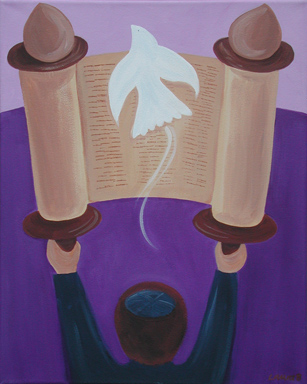 He also said that the sign of the New Covenant (also see my review of last week’s sermon) is the outpouring of the Holy Spirit, which we see famously in Acts 2 with the Jewish Apostles and Acts 10 with the Gentile Cornelius and his entire household. We also know from 2 Corinthians 3:3, 2 Corinthians 5:5, and Ephesians 1:13-14 that the Holy Spirit given to believers is but a down-payment, a token, a small deposit on the whole sum that will not be delivered in full until the resurrection.
So, as Lancaster said before, we’re not living in New Covenant times yet because if we were, then we wouldn’t sin but instead, have the conditions of the covenant written on our hearts as opposed to on paper or animal skins, and we would have an apprehension of God equal to or greater than the greatest of all the prophets.
But if the conditions of the covenant don’t change from the Sinai Covenant to the New Covenant, and if the Sabbath is a sign of the Sinai (Old) Covenant God made exclusively with Israel, and if Lancaster believes that Gentiles today should be led by the Holy Spirit, our down-payment on the deliverables to come in the New Covenant times, to observe the Sabbath, what does that say about Messianic Gentiles and our observance relative to Messianic (or any other kind of) Jews?
So then, brethren, we are under obligation, not to the flesh, to live according to the flesh—for if you are living according to the flesh, you must die; but if by the Spirit you are putting to death the deeds of the body, you will live. For all who are being led by the Spirit of God, these are sons of God. For you have not received a spirit of slavery leading to fear again, but you have received a spirit of adoption as sons by which we cry out, “Abba! Father!”
–Romans 8:12-15 (NASB)
We are not under obligation or “debtors” to the flesh, that is our human inclinations, but to the Spirit, which leads us to obey God as if His statues were already written on our hearts, even though they aren’t yet. What makes Romans 6, 7, and 8 so confusing is when Paul refers to “law”, he’s not always talking about the Torah. He’s comparing and contrasting the Law of Torah with the Law of Sin. What’s the Law of Sin?
For the wages of sin is death, but the free gift of God is eternal life in Christ Jesus our Lord.
–Romans 6:23 (NASB)
Lancaster didn’t go into a detailed analysis of these passages in Romans so neither will I, but know that it’s quite possible to see the Torah as always good in Paul’s words, and when the law is supposedly denigrated by Paul, this law is the law of sin and death.
But if we are obligated to at least try to the best of our abilities to live life as if it were already the Messianic Era, already the resurrection, when the Torah is written on all hearts and the Spirit is fully poured out on all flesh (Joel 2:28), and that Torah is identical to the conditions of the Sinai Covenant given to Israel in the days of Moses, then where does that leave all Christians right now?
It’s puzzling.
Lancaster, citing Jewish mysticism, leads us to the idea that there is a heavenly Torah, a supernal Torah in Heaven, and that this Torah is the perfect expression of God’s will and wisdom. Lancaster says it is this Torah that will be written on our hearts.
He also says that there is no difference between the supernal Torah and the earthly Torah, but it gets confusing. Over a year ago I wrote a review of Michael Fishbane’s book The Garments of Torah: Essays in Biblical Hermeneutics. While the book was not mystical as such, it certainly illustrated the difficulty in translating God’s perfect will and wisdom into methods, principles, and terms human beings can understand let alone perform. When God “clothed” the Torah so that it could be delivered to our world, the material world, it took on the nature and characteristics of our world so it could be an adequate interface for people.
If it is this “unclothed” Torah that will be written on our hearts, what will that be like? Will the actual mitzvot (Shabbat, Kosher, tzitzit, visiting the sick, charity to the poor) remain exactly the same and our human abilities to perfectly carry them out will be enhanced, or will the nature and character of the commandments themselves be subtly changed because they are internal drives and not external lists?
I don’t know. It gets pretty metaphysical from here.
I did recall a quote from mechon-mamre.org about the days of Mashiach:
In the messianic age, the whole world will recognize YHWH, the LORD God of Israel, as the only true God, and the Torah will be seen as the only true religion (Isaiah 2,3; 11,10; Micah 4,2-3; Zechariah 14,9).
The only true religion for the whole world will be the Torah.
 Is this saying that there’s a principle in Judaism that the Torah will be applied to the Gentiles as well as the Jews in Messianic Days including what are called “sign commandments?”
If I didn’t know what First Fruits of Zion (FFOZ) taught (Lancaster is a primary author of FFOZ’s educational material), I could be convinced Lancaster was preaching some form of “One Law.”
And yet I know that they do describe two sometimes overlapping paths for Jews and Gentiles in Messiah. Their long-awaited Sabbath Table materials have content that is tailored differently, at certain junctions in the reading, to be recited either by a Jew or a Gentile.
And yet, when Lancaster said that the Shema is recited at Beth Immanuel every week, and I know the majority of people who attend that congregation are not Jewish, I found myself wondering if a Gentile disciple of Messiah could or should recite the Shema. I sometimes miss the “old days” when I did recite the Shema on Shabbat, but in deference to the requirements of Messianic Jews (not to mention my wife who is not Messianic but is a Jew), I surrendered that practice along with most other behaviors one could think of as “jewish”.
The very first words you utter when you recite the Shema are:
Hear, O Israel, the L-rd is our G-d, the L-rd is One.
But if everything I’ve been taught and believe is correct, we Gentiles are not Israel, nor will we ever be Israel. Such a thing is a direct violation of the promises God made to Abraham, Isaac, and Jacob about the Land and their inheritance.
Lancaster quoted from Isaiah something I must have read many times before but never picked up on:
O people in Zion, inhabitant in Jerusalem, you will weep no longer. He will surely be gracious to you at the sound of your cry; when He hears it, He will answer you. Although the Lord has given you bread of privation and water of oppression, He, your Teacher will no longer hide Himself, but your eyes will behold your Teacher.
–Isaiah 30:19-20 (NASB)
Of course, the prophet is talking to Israel and not the rest of the world, but given that he is referencing a teacher, according to certain circles of Judaism, one of the things the Messiah is supposed to do is teach Torah correctly. Except that once the Holy Spirit is fully poured out on all flesh, that won’t really be necessary since it will all be inscribed on our hearts, the full wisdom and will of God. Our “teacher” then, will no longer hide Himself and we will see Him.
I normally put a section toward the end of these reviews called What Did I Learn but my entire “review” of this sermon today is about interpreting and learning (or at least struggling to learn) rather than an analysis of Lancaster’s lecture and what was new to me in it.
One thing is certain. In the New Covenant age there will be no questions, only answers. Our teacher will be in our hearts. We only currently possess a small down-payment against the full amount to be paid in the resurrection, but Lancaster says that’s no excuse to slack off and blame God for not giving us everything we need up front. The answers are coming but we are supposed to behave as if they’re already here. I feel like I’ve been blindfolded with my hands tied behind my back, and then sent into a maze with the instructions to make it to the other end without falling victim to any of the many, sometimes lethal traps that infest the maze at every turn.
No wonder a life of faith feels so dangerous and frustrating. No wonder it’s so hard to understand the difficult teachings of the Bible. No wonder the temptation is almost overwhelming to turn off my brain and to cleave to the teacher with the easiest story to follow.
But that would drive me crazy. My “inner teacher” won’t allow it.
Lancaster likens faith to a battle between our flesh and spirit natures, a lifetime struggle between two elemental forces locked in conflict until trumpets sound and graves open depositing the dead into life again. The battle is hard but that’s no excuse. We don’t have the option of giving up because if we do, sin and flesh wins and there’s no resurrection among the righteous for us…only among the damned.
 I’m tired of the war, God. I’m tired of fighting with myself every waking minute of every day. And yet people of faith, both Gentile Christians and religious Jews have been fighting this battle for thousands of years. None of them were perfect at it and none of them found its even remotely easy.
I’m no tzaddik. I’m no saint. I’m only a guy trying to figure it all out and then live it all out. It would be nice to have the rules of life all spelled out for us, but as I’ve been trying to say, they’re not, at least not very clearly. Our teacher is still hiding.
Yes, I’ve heard Christians say that “Bible” stands for “Basic Instructions Before Leaving Earth.” A little too cute for me and it trivializes the enormous struggle each one of us faces every day. What do we learn from the sermon of the Inner Torah? Only that we must pray for endurance and perseverance that we last in faith until it arrives, until the King returns, and may God have mercy on those of us whose strength should fail.
Addendum: I wrote this about a week ago and obviously I’ve been doing a lot of reading, pondering, and writing since then. On the FFOZ eDrash for Torah Portion Re’eh, referencing Deut. 12:7, 12, it says in part:
Messiah offers us a similar invitation. He invites us into the Father’s house eternally. He tells His disciples, “In My Father’s house are many dwelling places; if it were not so, I would have told you; for I go to prepare a place for you.” (John 14:2) He invites us into the LORD’s house, not just as invited guests, but as family members. Thanks to Yeshua, we will rejoice before the Father in His holy house for all eternity. We will sit at the table in the kingdom with Abraham, Isaac and Jacob and all Israel. How could we ever refuse such a fabulous invitation?
When I read “not just as invited guests, but as family members,” I saw the relationship between the redeemed nations and Israel again knocked somewhat into a cocked hat. If we believing Gentile disciples of the Master are considered “family members,” that implies a level of access and intimacy very close to the born-sons (if Gentiles are considered adopted). The only way I can resolve this within my current conceptual framework is that in the Messianic Kingdom, the ekklesia of Jews and Gentiles do share a “oneness” of access and knowledge of God. But what does that make Gentiles and Jews together in Messiah?












 Morning Meditations