
Tag Archives: intermarriage

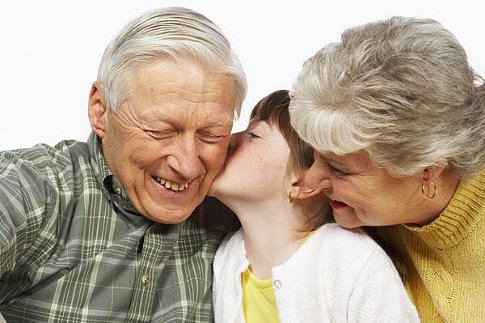
Will My Grandchildren Be Jewish?

Jewish GrandchildrenYou could call this “extra” meditation a “Part 2” of my earlier blog post What God Has Joined Together. Part of the “mission” of my blog is to document the life of an intermarried couple and what that means. Here we go.

Based on current intermarriage rates and the average number of children per family, the chances of young, contemporary Jews having Jewish grandchildren and great-grandchildren, with the exception of the Orthodox, are increasingly remote.

From “Will Your Grandchildren be Jewish”
Aish.com (PDF/graphic)

Based upon the data and the various population studies that are now available, it appears that an extraordinary disintegration of the American Jewish community is in process. There was a time when every Jew could take it for granted that he or she would have Jewish grandchildren with whom to share Seders, Sabbath and other Jewish moments. However, the clear data indicates that this expectation is no longer well founded. Indeed, our studies show that within a short period of time the entire complexion of the American Jewish community will be altered inexorably.

From “Will Your Grandchildren be Jewish?”
VirtualJerusalem.com

Will my grandchildren be Jewish? Probably not. Let me explain, but I have to go back a little bit.

My wife is Jewish and I’m not. She’s Jewish because her mother was Jewish (both of my wife’s parents passed away many years ago). My wife’s father wasn’t Jewish and my wife wasn’t raised in a religiously or culturally Jewish home. She only realized that she was Jewish by halachah (because her Mom is Jewish) when she was a young adult. Even then, she waited decades until she fought to enter into a culturally and religiously Jewish world, and that’s where she is today.

My wife has two brothers and two sisters. None of them acknowledge being Jewish. One brother and one sister are actively Christian and her Christian brother even denies the possibility that his mother was Jewish, saying there’s no proof (we have tons of proof, including the documentation of many maternal relatives buried in Jewish cemeteries). Out of five children of a Jewish woman, my wife is the only one living a Jewish life today. Sad but typical. My wife beat the odds but she had to work really hard to do it.

We have three children. All self-identify as Jews, at least marginally. I say “marginally” because they don’t really involve themselves in Judaism on a cultural or religious level. My daughter is the one who has come closest to embracing her Judaism. She sometimes goes to Chabad functions with my wife. When she was an exchange student in Japan for a year during high school, my daughter made the effort (and it was significant) to attend the synagogue in Tokyo on a few occasions (my daughter lived about 50 miles away). My daughter has tutored Hebrew to some of the kids at our local Reform shul.

My sons acknowledge that they’re Jewish but that’s about it. I think David has a basic faith in Jesus but he doesn’t lead any sort of religious lifestyle. Michael doesn’t have a Jewish lifestyle as far as I can tell.

Only David is married and he’s married to a (wonderful) non-Jewish girl. They have one son, my grandson, the apple of my eye. And my grandson is not Jewish.

Michael will probably marry someday, but he’s not currently dating and the chances of him marrying a Jewish woman isn’t very good. My daughter Jamie says she wants to marry someday, but doesn’t want to have any children (even through adoption).

No, my grandchildren will not be Jewish.

Things seem grim for the Jews in America but I’m going to try to inject something upbeat.

Julie Wiener writes a series of articles for The Jewish Week magazine called In the Mix. Julie is intermarried to a “Righteous Gentile husband” and they have two daughters (and because Julie is Jewish, so are her kids…I don’t know if Julie’s parents are intermarried). According to an article she wrote last June, intermarried Jews are breeding like crazy.

Depending on your point of view, that’s either good or bad. Depending on who you are, intermarried couples (like Natalie Portman and her partner Benjamin Millepied) can raise their children Jewish or (like Anthony Weiner and his Muslim wife, Huma Abedin) not. Not that it’s up to the Mom exclusively what cultural and religious identity the children will have. Julie published a more recent article called Battle Hymn of the Gentile Mom describing how the non-Jewish wives of Jewish husbands commit to raising their children Jewish. There’s even this quote:

Also of interest in JTA is an article about a recent study of Chicago’s Jewish population, which finds that while intermarriage (and the Jewish population) has increased, the percentage of intermarried families raising Jewish children has also increased…

I can read all the articles and research studies I want, but all I really have to do to see where the children and grandchildren of intermarried couples end up is to look at my own family. We never chose to embrace Judaism in the home until fairly late in life when the kids were almost grown. I often wonder what would have happened if we could have made the decision earlier. A futile waste of time, I know.

God has never permitted the Jewish people to vanish from the face of the Earth and I don’t believe He ever will. When the Messiah comes, there will be Jews here. But it will be a miracle from God. It seems like people aren’t helping with the process all that much.


What God Has Joined Together

MarryToday’s “extra” meditation.

Tens of thousands of Jews have married non-Jews with similar worthy intentions, only to realize when it is already too late that raising a Jewish family with a non-Jewish partner is a near impossibility.

You are my sister. I want to dance at your wedding. I want my daughters to be your flower girls. I want to cry tears of happiness at your chuppah.

I love you. I admire and am very fond of Mike. But if you marry Mike, as difficult as it will be for me as well as for you, I will not be able to attend your wedding. I could not attend your wedding because, as Jews, what would happen on your wedding day would not be a happy event. It would be a tragedy of historic proportions.

I wish that this was not a letter that I had to write. I wish that I could just keep on smiling and acting as though everything is all right, like everybody else in our family. But I feel that, as painful as this is, because I care about you as much as I do, I must tell you the truth.

from “Dear Rebecca: A Letter on Intermarriage”
found at Chabad of Mineola

This is part of a very poignant letter from one Jewish sister to another on the announcement that the other sister “Rebecca” is marrying a non-Jew. As you can see, this is no small thing for many Jews and, in this circumstance, the sister writing the letter feels so strongly that, if her sister “Rebecca” insists on marrying “Mike”, the letter-writer won’t be attending the ceremony.

I know this sounds cruel and heartless. After all, if this woman has found her “soulmate” and that man happens not to be Jewish, is it really so bad?

Let’s go back a step.

The 52nd prohibition is that we are forbidden from marrying heretics.

The source of this commandment is G-d’s statement, “do not intermarry with them,” which then explains what kind of intermarriage is referred to – “do not give your daughters to their sons, and do not take their daughters for your sons.”

Tractate Avodah Zarah states clearly, “the Torah prohibition applies where there is marriage.”

-from Chabad.org

Do not intermarry with them. Do not give your daughters to their sons or take their daughters for your sons, for they will turn your children away from following me to serve other gods, and the LORD’s anger will burn against you and will quickly destroy you. –Deuteronomy 7:3-4

This is the Biblical and Talmudic basis for prohibiting intermarriage between a Jew and a non-Jew. We also see a dramatic example of what happens when Jews are tempted to intermarry in Genesis 34. However, you might say that Christianity also has a similar “commandment”:

Do not be yoked together with unbelievers. For what do righteousness and wickedness have in common? Or what fellowship can light have with darkness? What harmony is there between Christ and Belial? Or what does a believer have in common with an unbeliever? What agreement is there between the temple of God and idols? For we are the temple of the living God… –2 Corinthians 6:14-16

However, for a Christian, Paul provided a “loophole”:

To the rest I say this (I, not the Lord): If any brother has a wife who is not a believer and she is willing to live with him, he must not divorce her. And if a woman has a husband who is not a believer and he is willing to live with her, she must not divorce him. For the unbelieving husband has been sanctified through his wife, and the unbelieving wife has been sanctified through her believing husband. Otherwise your children would be unclean, but as it is, they are holy. –1 Corinthians 7:12-14

Traffic ConesI have a personal stake in this matter because I’m intermarried to a Jewish woman but with a twist; neither of us was religious when we first married. My wife wasn’t raised in a religious home and her own parents were also intermarried (her mother was Jewish). Only one of my wife’s Jewish relatives (a cousin) was at our wedding, but the matter of intermarriage never came up.

Since then, my wife and I have both come to faith, albeit different faiths, and I’ve been actively exploring what all this is supposed to mean. I’ve read a lot of books, including Rabbi Kerry Olitzky’s Making a Successful Jewish Interfaith Marriage, but the materials available on the market always address people who are already religious or observant and who are about to be married. I’m not 25 anymore and just starting out, and in fact, my wife and I have been married for almost 30 years. It’s only in the past five years or so that “intermarriage” has become a factor in our relationship. As our paths continue to diverge in our individual journeys with God, what will that mean?

Dr. David Rudolph published a paper on intermarriage statistics which states that Jewish-non-Jewish intermarriages are pretty much going through the roof. It’s considered an “epidemic” by more conservative sects of Judaism and a threat to Jewish survival. Not only is there a tangible fear that if a Jew marries a non-Jew, that the Jew will be drawn away from their faith, but that the children will have no definitive Jewish identity, thus effectively eliminating a large population of Jews from the next generation.

There’s also the threat of divorce to contend with:

In a paper published in 1993, Evelyn Lehrer, a professor of economics at the University of Illinois at Chicago, found that if members of two mainline Christian denominations marry, they have a one in five chance of being divorced in five years. A Catholic and a member of an evangelical denomination have a one in three chance. And a Jew and a Christian who marry have a greater than 40 percent chance of being divorced in five years.

-Naomi Schaefer Riley, Interfaith Marriages Are Rising Fast, But They’re Failing Fast Too, Washington Post, 6 June 2010

The Chabad of Mineola website also published a response by Rabbi Tzvi Freeman to a Jewish woman asking if she should marry her Muslim boyfriend. Here is part of Rabbi Freeman’s response:

I don’t know where this man stands, whether he is a secular Muslim, a literalist or a mystic, or has beaten his own path. But it is not possible that there will not be conflict over these issues. On the one hand, as his wife, you will need to defend him before family members and other Jews. Yet it’s not possible that in all issues you will agree. After all, if you did, where would the “other” be? The conflict could be deeply painful, destructive of family ties and friendships for both of you. Rather than leading to self-discovery, it may lead instead to a sacrifice of your own identity to save the marriage.

In the end, if you truly love this man, direct him on the right path. Let him realize that for him, a happy marriage will be union with a mate to his own soul, and raising children within his own community, without confusion, with a clear message, “This is who we are and this is what is expected of you.” There he can find happiness, and so too the family he will raise.

May you too find a soulmate of your people and build a family within your people. That is the Jewish concept of the messianic world: not a mush of blended egos, but a magnificent panorama of colors and textures, each individual, family and people playing its part, each contributing its own part in the symphony that is humankind.

Rabbi Freeman gives a measured, compassionate, and kind reply to this woman but it is also a firm reply. A Jewish soul should marry another Jewish soul.

That however, doesn’t address the vast army of married couples who are “unequally yoked”, who have been married for years or decades, and who are well into raising children or have even raised children into adulthood. What of them? What of us?

Since part of this blog has to do with exploring the world of Jewish-Christian intermarriage, I thought it was high time I blogged about it. While there isn’t significant friction between my wife and I on our different religious viewpoints, there isn’t a great deal of agreement either. I suppose it isn’t an issue most of the time because we don’t discuss it most of the time. I let pass the occasional disparaging remarks about “what Christians believe” that come from my wife or daughter, but it’s at those moments when I am acutely aware of the barrier that exists between me and them. I choose to remain silent about it for the sake of peace in the home. I’m not here to “convert” them, nor would I ever try, and the Christians reading my words are free to criticize me for this.

Yet, God made us “one flesh” (Genesis 2:24; Mark 10:8) and one flesh we remain. We have “forsaken all others” and are united as man and woman before God.

In spite my previous quotes from Rabbi Freeman, he also published a different kind of commentary on love and marriage:

Even if all your complaints about your spouse are well-founded and valid – show her your love, nevertheless. Show her unconditional love.

It is said that all our exile is due to the sin of unmitigated hatred.
When each one of us will start with unmitigated love in our own domain, from there it will spread to all else that we do, and from there to the entire world, speedily in our days, Amen.

Yes, he’s probably addressing Jewish married couples or married couples who are both alike in faith, but is an interfaith marriage an exception to “unconditional love”? If, as the Rabbi says, we start with “unmitigated love in our own domain”, and it spreads out from there, can’t that love expand between a spouse of one faith to the spouse of another?

What now, God?