Tag Archives: Jesus

Eikev: Blessing God

EikevIn this week’s reading (Eikev), the Torah warns us that after the people enter Israel, they may be prone to think only about their own accomplishments, and forget the source of all blessings: “and you become haughty, and forget HaShem your G-d who brought you out from Egypt, from the house of slavery… and you say in your heart, my own might and the strength of my hand have made me all of this wealth.” [Dev. 8:14, 17]

This is something that can affect all of us. Maimonides says that we should look for the middle ground, that even bad traits have their place (meaning, sometimes it is right to appear angry, for example), but that haughtiness is the exception. There is never a time to be “full of ourselves.”

This does not mean we should fail to appreciate our gifts. Moshe was the leader and teacher of the Jewish people, he spoke directly with G-d, and received the Torah and taught it to us. But the Torah also testifies that he was more humble than anyone — and the Torah doesn’t exaggerate!

Rabbi Yaakov Menken
Director, Project Genesis / Torah.org
Note from the Director
“Talent on Loan from G-d”
Project Genesis

It seems almost an impossibility to be able to lead millions of people on a journey across great distances for forty years and even be able to talk to God “face-to-face” and yet be considered “more humble than anyone else on the face of the earth” (Numbers 12:3). How is this possible, especially given some of our common dictionary definitions for this word?

  1. not proud or arrogant; modest: “to be humble although successful”.
  2. having a feeling of insignificance, inferiority, subservience, etc.: “In the presence of so many world-famous writers I felt very humble”.
  3. low in rank, importance, status, quality, etc.; “lowly: of humble origin; a humble home”.
  4. courteously respectful: “In my humble opinion you are wrong”.
  5. low in height, level, etc.; small in size: “a humble member of the galaxy”.

Yet, we don’t really think of Moses as arrogant, either. According to Rabbi Menken, he couldn’t have been:

Rav Shamshon Rephael Hirsch writes that arrogance is the first step towards forgetting G-d. Moshe never ignored his gifts, but he also recognized where they came from. What prevents us from becoming arrogant or haughty is the appreciation that everything we have is a gift.

How does that work for the rest of us, particularly when we’re not the leader of millions (most of us) and don’t talk to God the way Moses talked to God (I don’t know anyone who does that, although a few people claim to have this ability)? It seems like a lot of people either take no credit at all for what they do well or they take all the credit for everything that happens good in their lives and in the lives of others. Should we give total credit to God for everything at our expense or take credit for everything, leaving no room for God? Where is the balance? How does this “partnership” between people and God work?

We were all created in the image of God (Genesis 1:27). Think of this as meaning that God created us with a certain configuration of wiring and programming. We “naturally” have certain personality traits, talents, and characteristics that are unique to us. Some give us the ability to easily accomplish particular tasks, like a person who just “naturally” draws well, sings well, or is a gifted carpenter. Other characteristics we find we must master and bring under our control, such as a quick temper or a tendency to like alcohol too much.
HamazonWhen things go well, sometimes because of our talents, we tend to credit ourselves and feel that we’re really great. When things go badly, sometimes because of our “evil inclination” or the character traits that we need to control, we tend to either blame God for how He made us, or to suddenly remember God and beg for His forgiveness and help. We see this in Rabbi Menken’s commentary about how Moses warned the Children of Israel against haughtiness. Ironically, the answer is in a very simple but unusual (from a Christian point of view) commandment:

And you shall eat and be satisfied, and you shall thank the Lord your God for the good land which he has given you. –Deuteronomy 8:10

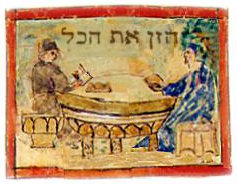
In Judaism, this is one of the 613 commandments that define a Jew’s obligations to God and to other people. This has resulted in the blessing of Birkat Hamazon or “Grace After Meals” being said after eating, as opposed to the Christian tradition of blessing God (sometimes at length) before a meal.

There’s a reason for this as stated by Rabbi Menken:

The Ohr Gedalyahu, Rabbi Gedalyah Schorr zt”l, tells us that the holy Kabbalistic work, the Zohar, says that the Torah frequently relates the positive and the negative. Our reading, he says, is one example of this concept. The Torah goes on to warn us that after we are sated, we can make a tragic mistake.

“Guard yourselves lest you forget HaShem your G-d… lest you eat and be satisfied, and build good houses and dwell therein… and you instill pride in your hearts and forget HaShem your G-d who took you out from Egypt, from the house of slavery… and you say in your hearts, ‘my strength and the might of my hand made me all of this great wealth!'” [8:11-17] Say a blessing recognizing that it all comes from G-d, to avoid the false claim that your own abilities brought you wealth.

It’s when we are successful and satisfied that we most need to connect to God. It’s not a sin to ask for His help when we are hurt or scared or desperate, but He must be a part of everything in our lives, to good and the bad alike, or we will forget Him. We might also forget ourselves and who He made us to be.

There is a portion of the morning prayers called Birkat HaShachar that observant Jews say every day where the person thanks God for various attributes and circumstances (the full text in English and Hebrew is found on this site as a PDF). This includes thanking God for giving us (in this context, “us” are the Jews reciting these blessings) discernment, for making us free, for making us in His Image, and so on. This, like the Birkat Hamazon, is also a good model for Christians to consider because it illustrates the partnership between people and God.

Yes, God made us and all things come from God, but He made us to possess certain “innate” talents and abilities. How we choose to use those abilities is up to us, but that they are there is both a testament to God’s mastery over Creation and the fact that we have control of what we possess as human attributes. We are not puppets on God’s string. We can take pride in our achievements and thank God for having made us the way He did at the same time.

I think that’s how Moses approached his own life and in whatever circumstances we may find ourselves, I think that’s how we can approach life, too. We can do what Moses did, by never forgetting the God who created us.

Whoever possesses the following three traits is of the disciples of our father Abraham; the disciples of our father Abraham have a good eye, a meek spirit and a humble soul. The disciples of our father Abraham benefit in this world and inherit the World To Come, and is stated, “To bequeath to those who love Me there is, and their treasures I shall fill.” –Pirkei Avot 5:19

Good Shabbos.

Eikev: Bringing the Moshiach

And I will put enmity between you and the woman, and between your offspring and hers; he will crush your head, and you will strike his heel.Genesis 3:15

Because (eikev) you listen to these laws and safeguard and keep them, G-d your L-rd will keep His covenant and kindness that He swore to your fathers.Deuteronomy 7:12

The Hebrew word eikev not only means “because,” but also “heel.” Thus Midrash Tanchuma explains that “these laws” refers to mitzvos that seemingly lack significance, so that people tend to “ignore them and cast them under their heels.”

-from “The Chassidic Dimension” series
Commentary on Torah Portion Eikev
“The Healing Effect of Heeling”
Based on the teachings of the Lubavitcher Rebbe
Rabbi Menachem M. Schneerson
Chabad.org

This play on words would completely bypass anyone who doesn’t understand Biblical Hebrew or anyone who doesn’t read traditional or Chassidic Torah commentaries. But now that you know about it, what does it matter?

As it turns out, it matters a lot. Here’s more from the “Chassidic Dimension”:

Eikev alludes to the time just before the coming of Moshiach — “On the heels of Moshiach.” The verse is thus telling us that close to Mashiach’s coming Jews will surely obey G-d’s commands. This is in keeping with the Torah’s assurance that prior to Mashiach’s coming the Jews will return to G-d. (Or HaTorah beginning of Eikev ; ibid. p. 491; ibid. p. 504.)

Recall the quote from Genesis that starts this blog post. This is the first Messianic prophesy in the Bible, and here we see a clear association with the enmity between man and God that only the Messiah can heal, and the words of Moses as he is about to send the Children of Israel on their ordained mission to fulfill God’s promises to Abraham, Isaac, and Jacob, and take possession of the Land.

Somehow, Christianity imagines that Jesus will return and then everyone will repent and turn their hearts, minds, and hands back to God, but this is exactly the opposite of what Judaism expects. In the last days, we will all turn to God and obey His commands and His desires and only then the Messiah will come.

This rather flies in the face of traditional Christian doctrine that says we are saved by grace and not by works, as if God’s grace and our behavior were mutually exclusive concepts. While it is true that we can’t work or buy our way into heaven, it is also true that once saved, we aren’t to sit idly by, read a magazine and wait for the bus to the clouds of glory.

We were given life for a reason. We’re supposed to be doing something with it and what we do or fail to do, will make a difference in the eyes of God.

I know I’ve talked about all this before, but since Moses brought it up, I felt I should go follow his lead, so to speak.

In Deuteronomy 10:20, Moses says, “You shall fear the Lord your God; you shall serve Him and cling to Him…” Here, according to the First Fruits of Zion (FFOZ) commentary for this Torah Portion. “to cling to”:

is actually the same Hebrew word which is used of Adam in the garden when it says, “a man shall leave his father and his mother, and shall cleave to his wife, and they shall become one flesh.” (Genesis 2:24)

But how can we cling to God in the sense that one person can cling to another person with whom they have an intimate bond? In Judaism, the traditional way of interpreting the fulfillment of this command is for a person to cling to a tzadik (Holy person) or Torah teacher. It’s the act of a disciple learning from and following in the footsteps of their Master or Rebbe. The FFOZ commentary continues:

Chasidic Judaism believes that through clinging to one’s rebbe (spiritual leader), one is brought into union with his rebbe. Because the rebbe is in union with God, the disciple is also elevated into union with God by virtue of that connection. In the same way, our Rebbe, Yeshua, taught us that in order to cling to God we must cling to him (John 15:1-7) and by clinging to him, we cling to God. “In that day you will know that I am in my Father, and you in me, and I in you.” (John 14:20)

Cleaving to a Rebbe, honoring him, and learning from him, and then passing what you’ve learned to others and particularly down to the next generation in response to the desire to cling to God. When we cling to our “Rebbe”, to Jesus, we are fulfilling God’s desire.

One of the most important parts of the Shema appears in this Torah Portion (Deut. 11:1): “Love, therefore, the Lord your God, and always keep His charge, His laws, His rules, and His commandments. Moses continues to comment on this theme thus:

Therefore impress these My words upon your very heart: bind them as a sign on your hand and let them serve as a symbol on your forehead, and teach them to your children — reciting them when you stay at home and when you are away, when you lie down and when you get up; and inscribe them on the doorposts of your house and on your gates — to the end that you and your children may endure, in the land that the Lord swore to your fathers to assign to them, as long as there is a heaven over the earth. –Deuteronomy 11:18-21

For the Children of Israel, the concepts of God’s favor and the obedience of the nation are inexorably intertwined along with clinging to God and the promise of the Messiah’s coming. The fulfilling of the promise to give the Holy Land to the Children of Israel and the promise of the coming of the Messiah to bring universal peace to the world go hand-in-hand for the Jewish people, and obedience and living in Israel is a form of joining with the Creator for the Jewish people.

ShemaWhy don’t we have such a clear picture in Christianity?

It’s as if we’ve been told that it doesn’t matter what we do. We’re covered by the grace of Jesus Christ. We’re already saved; we’re already “clinging” to Jesus, so now all we have to do is sit on our thumbs and wait for him to come back and everything will be hunky dory.

Where did we get such a disconnect between the Torah and the Gospels? Who says we just get to sit around? Who says that the minute we were saved that our obligations to God were completed? Certainly not James, the brother of the Master:

What good is it, my brothers and sisters, if someone claims to have faith but has no deeds? Can such faith save them? Suppose a brother or a sister is without clothes and daily food. If one of you says to them, “Go in peace; keep warm and well fed,” but does nothing about their physical needs, what good is it? In the same way, faith by itself, if it is not accompanied by action, is dead.

But someone will say, “You have faith; I have deeds.”

Show me your faith without deeds, and I will show you my faith by my deeds. You believe that there is one God. Good! Even the demons believe that—and shudder.

You foolish person, do you want evidence that faith without deeds is useless? Was not our father Abraham considered righteous for what he did when he offered his son Isaac on the altar? You see that his faith and his actions were working together, and his faith was made complete by what he did. And the scripture was fulfilled that says, “Abraham believed God, and it was credited to him as righteousness,” and he was called God’s friend. You see that a person is considered righteous by what they do and not by faith alone. –James 2:14-24

I know I quote a lot from this passage too, but it says something that we aren’t told very often. It says that Jesus agreed with Moses (and you don’t hear that said in church very much) that a passive faith means nothing. The Children of Israel would draw closer to God and cling to God and they would succeed on their mission to take the Holy Land as long as they obeyed God and taught their children to do the same. We Christians, you and I, have a mission, too. Not just to spread the good news of Jesus and to live lives conformed to our Master, but we have individual missions based on who we are, where we live, and the opportunities God provides for us.

We have a road to walk. God set us upon a path. He has provided us with a light (Psalm 119:105) so we can see the path. Many times He has admonished us to turn neither left nor right, but to keep our eyes on the goal, not only the ultimate goal of existence as believers, but the immediate goals of helping others, feeding the hungry, visiting the sick, and performing whatever special mission and purpose God assigned to us from before the Creation of the world.

We can choose to stand still. We can choose to take God’s words and His purpose for us, throw them under our heels and walk all over them. Or we can choose to start walking and then see where the path leads. Along the way, we’ll meet people and encounter circumstances. How we manage them matters to God and to the people we interact with.

In this week’s Torah portion, Moses is trying to prepare the Israelites for a journey of fresh challenges full of promise and perils. God is doing that with us every day starting when we wake up each morning. Because somewhere out there in what we do today, tomorrow, next week, and into the future, not only affects our lives and the lives of who knows how many others, but each step we take along the path brings the footsteps of the Messiah one step closer to us. To bring the Moshiach, we must cling to our Rebbe who is close to God.

“If you love me, you will keep my commandments. –John 14:15

“A Jew never gives up. We’re here to bring Mashiach, we will settle for nothing less.” -Harav Yitzchak Ginsburgh

Later this afternoon, I’ll be posting another commentary on this week’s Torah Portion called “Eikev: Blessing God”, probably a few hours before Shabbat begins.

The Prophet and the Shade Plant

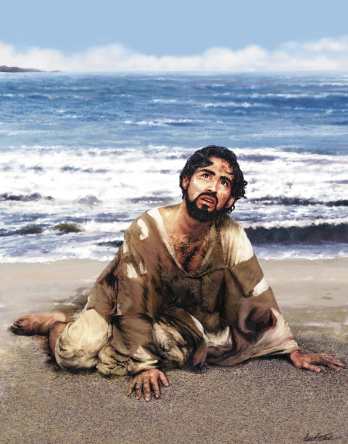
JonahJonah had gone out and sat down at a place east of the city. There he made himself a shelter, sat in its shade and waited to see what would happen to the city. Now the Lord G-d appointed a kikayon, and it grew up over Jonah to be shade over his head, to save him from his discomfort. Jonah was overjoyed with the kikayon.

But G-d designated a worm when the morning rose the next day, and the worm attacked the kikayon, and it withered.

Now it came to pass when the sun shone, that G-d appointed a stifling east wind; the sun beat on Jonah’s head, and he felt faint. He begged to die, and he said, “It would be better for me to die than to live.”

And G-d said to Jonah: “Are you very grieved about the kikayon?” And he said, “I am very grieved even to the point of death.”

And the Lord said: “You took pity on the kikayon, for which you did not toil nor did you make it grow; it lived one night and the next night perished. Now should I not take pity on Nineveh, the great city, in which there are many more than one hundred twenty thousand people that cannot discern between their right hand and their left, and many animals as well?”Jonah 4:5-11

Before continuing to read, if you haven’t done so already, go to yesterday’s meditation and review part 2 in this series: Mission Drift, then come back here.

The Rohr Jewish Learning Institute’s Rabbi Mordechai Dinerman wrote a commentary called “Jonah and the Big Shade” on which today’s morning meditation is based. You all probably know the basic story of Jonah. My inserting Jonah’s story here may seem a little mysterious in light of what I’m trying to study in this series of blog posts. Most people walk around the earth searching for purpose and meaning, but for Jonah, those things were abundantly clear. Right from the beginning, Jonah was a Prophet of God and his path was set before him:

The word of the LORD came to Jonah son of Amittai: “Go to the great city of Nineveh and preach against it, because its wickedness has come up before me.” –Jonah 1:1-2

I would imagine that if God came out point blank and told me the specifics of my purpose in life, where I was to go to find it, and what I was to do to fulfill it, I’d be thrilled beyond comprehension. But then again, maybe not. Jonah wasn’t thrilled. In fact, he tried to run away from his purpose and from God. He didn’t get very far. He was meant to go to Ninevah one way or the other. Like the old joke says, “we can do this the easy way or the hard way.” Jonah didn’t choose the easy way.

A few weeks ago, I wrote a blog post as a commentary for Torah Portion Masei. One of the key features of this Torah Portion is Moses reciting all of the places the Children of Israel camped during the 40 years of wandering. Why do that? Wasn’t the journey more important than the rest stops?

Perhaps not.

Recall the quote from yesterday’s morning meditation that was taken from the course book for the “Toward a Meaningful Life” lesson:

I wake up in the morning with the knowledge that my unique opportunities will be used to convey my individual personality in the places I find myself, thus inspiring the people around me.

Pay attention to the phrases, “my unique opportunities” and “in the places I find myself”. For Jonah, he could go no place on earth besides Nineveh in order to fulfill his purpose. He tried to go just about anyplace else, but that didn’t work out. Once the Children of Israel were consigned to wander the Sinai for 40 years, were they just wandering, or was there a purpose to where they went and what they did while they were there? What would have happened if they hadn’t encountered the descendents of Lot or Esau? Was it important that Aaron die specifically on Mount Hor? What about the battles and victories over Og, King of the Bashan and Sihon, King of the Amorites?

If the wanderings were truly aimless and the people and events they encountered really just random, why did Moses recount them to all of Israel on the threshold of entering Canaan? Why did Moses even bother to remember? Why were his words recorded in the Torah for all time to come, and why do we have them today?

Jonah's KikayonJonah had a reason to be at Ninevah and there was even a special purpose in his encounter with the kikayon plant (no one know exactly what this plant was supposed to be…it’s just a plant, but it had a purpose, too). Now think about where you go every day. Think about all of the places you’ve lived. Where have you gone on vacation? Where have you been “randomly” sidetracked? What did you do there and did any of it matter?

If your life isn’t random and arbitrary but rather, has a purpose and meaning assigned by God, then so does where your feet have taken you, or your car, or a train, or a plane, or whatever transportation you have used.

But what about the kikayon? Why did Jonah care more about that plant than he did for over 120,000 people in one of the largest cities in the world (at that point in history)? For that matter, why did God care about Ninevah when they had sinned greatly, including against the Israelites? God has exterminated whole people groups for their sin. Why did he care enough to spare Ninevah?

The most common explanation is that He felt compassion for their lives. They didn’t know their left hand from their right. They were helpless and blind, as far as God was concerned. Did Jonah care about the kikayon in the same way that God cared for Ninevah?

Yes and no.

Rabbi Dinerman explains:

In fact, the final message of the Book of Jonah is much more than a message about compassion. It is a message about the utter indispensability of every creature. G-d allows Jonah to enjoy the shade of a simple plant that protects him from the blazing sun. And the relief that Jonah feels as a result is so great that he cannot imagine being deprived of it, and when it is taken away, he is so upset that he cannot imagine living without it.

Jonah wasn’t upset about the kikayon’s death because he had compassion for it. He was upset because the kikayon served the purpose of shading him from the elements, and its death ended that purpose in Jonah’s life. How does this apply to the people and animals of Ninevah? Did God spare them because they repented and He had pity on them, or did He spare them because they repented and they were ready to fulfill their purpose in life?

Wow!

Yesterday, I quoted Rabbi Simon Jacobson’s famous definition of purpose:

Birth is G-d’s way of saying “you matter.”

Perhaps life is G-d’s way of saying “you still matter.” As long as it lived, the kikayon had a purpose and when its purpose ended, God appointed the means of its death. Though Jonah fully expected to die when he was thrown into the sea, God appointed a sea creature to preserve his life and to deliver him to his destination. Although the Book of Jonah ends abruptly, as if stopping in the middle of the story, we know that God spared Ninevah for a reason, we just don’t know what happens next.

You and I are still alive today, but the rest of our story hasn’t been written yet. There are still places to go, people to meet, things to do, and somehow, that’s all part of the reason we are here, even if we don’t always understand it.

“And why do you worry about clothes? See how the flowers of the field grow. They do not labor or spin. Yet I tell you that not even Solomon in all his splendor was dressed like one of these. If that is how God clothes the grass of the field, which is here today and tomorrow is thrown into the fire, will he not much more clothe you – you of little faith? –Matthew 6:28-30

The kikayon was only a plant, and yet it had a purpose assigned by the Creator of the Universe. Even the cattle in Ninevah each had a purpose. Jesus talks about grass growing one day and being thrown into the fire the next, and yet it is clothed in more splendor than King Solomon in all his royal glory.

Are not two sparrows sold for a penny? Yet not one of them will fall to the ground outside your Father’s care. And even the very hairs of your head are all numbered. So don’t be afraid; you are worth more than many sparrows. –Matthew 10:29-31

Grass, kikayons, sparrows, and cattle. Are you not worth more than all of these? If these common things all have a purpose and significance in the eyes of the Creator, how much greater is your purpose and significance to God?

Don’t go away. I’ll publish my commentary for Torah Portion Eikev in a few hours.

This series will continue on Sunday’s “morning meditation” Shattered Fragments. How does man and woman becoming “one flesh” affect the reason God made us?

Struggling in the Dark

Woman in the darkDepression is not a sin, but it can take you to places lower than any sin.
-Chassidic saying

That is why, every mitzvah must be done with joy, every prayer with song and every word of Torah studied with enthusiasm – not just because without that joyful enthusiasm, you are simply not there within that mitzvah, but because without joy, the Jew lives in a precarious state. “Because you didn’t serve G-d your G-d with joy and a good heart…and so you will serve your enemies.” Meaning: When a Jew acts as a Jew but with a heavy heart, he is fair game for the enemy within – the urges and passions of his animal soul.

-Rabbi Tzvi Freeman
“Why Did G-d Give Me Depression?”
Chabad.org

And the Lord said to Cain, “Why are you distressed, And why is your face fallen? Surely, if you do right, there is uplift. But if you do not do right Sin couches at the door; Its urge is toward you, Yet you can be its master.”Genesis 4:6-7

Cain and Abel, the sons of Adam and Eve, each brought offerings to God. God “paid heed” to Abel’s offering but not to Cain’s. Cain’s “face fell” (he became discouraged or depressed) and subsequent to God’s “pep talk”, in a fit of rage and jealousy, Cain murdered his brother. Yet had Cain already “killed” Abel while God was still talking to him?

“You have heard that it was said to the people long ago, ‘You shall not murder, and anyone who murders will be subject to judgment.’ But I tell you that anyone who is angry with a brother or sister will be subject to judgment. Again, anyone who says to a brother or sister, ‘Raca,’ is answerable to the court. And anyone who says, ‘You fool!’ will be in danger of the fire of hell. –Matthew 5:21-22

Ironically, Jesus says something immediately after these verses that directly applies to Cain and Abel, and perhaps to us as well.

“Therefore, if you are offering your gift at the altar and there remember that your brother or sister has something against you, leave your gift there in front of the altar. First go and be reconciled to them; then come and offer your gift. –Matthew 5:23-24

Depression, discouragement, and anger get in the way of drawing close to God. Certainly Cain’s feelings for Abel and his disappointment at Abel’s gift being accepted while Cain’s was not, inhibited Cain’s relationship with God, yet God cared enough about Cain, not to chastise him for his feelings, but to try and encourage him. God didn’t berate Cain for bringing an inferior gift but supported his efforts to do better in the future.

But was Cain’s gift inferior? All we know is “Cain brought an offering to the Lord from the fruit of the soil; and Abel, for his part, brought the choicest of the firstlings of his flock” (Genesis 4:3-4). We assume that Cain’s offering was not the “choicest” of his “fruit of the soil” but what if it was? What if Cain had problems before even bringing his offering? After all, it’s hard to believe that a single incident was enough to drive Cain to murder, something that had never happened before in the history of humanity. Maybe Cain already had “something against” his brother, whatever that might have been. Maybe Cain believed that Abel was generally better or was seemingly more accepted as a son by their parents and as a person by God.

If Cain had been nursing a grudge for sometime against Abel and was nurturing a slow-burning depression and resentment, his “rejected” offering may have simply been the final catalyst that fanned these smoldering embers into a blazing conflagration resulting in a passionate, violent murder.

In Rabbi Freeman’s commentary, he says:

When a person is happy, he’s healthy. True happiness is when every faculty, every sense, every neuron and every muscle is in tune and functioning harmoniously. When happy, a person can fulfill his purpose in life, all of him, all of his purpose. Which is why depression is so despicable. Because depression is a surrender of purpose, of meaning.

Walking in darknessThus being depressed draws us away from the very reason God created us in the first place. A depressed person cannot fulfill the purpose for which God created him or her. The person becomes like Rabbi Yehuda Loewe’s Golum, “an unfinished person – one with all the right aptitudes not yet in the right places…a hunk of clay or otherwise shapeless substance”. We’ve already learned that “every mitzvah must be done with joy, every prayer with song and every word of Torah studied with enthusiasm” and maybe that was Cain’s big mistake. Maybe his offering was indeed the very best his garden had to offer, but he didn’t bring it with the boundless joy that Abel brought his offering.

Maybe that’s the mistake you make sometimes. Maybe that’s the mistake I make sometimes…trying to serve God without joy, song, and enthusiasm. Without joy, even the holiest of actions is performed by an empty heart.

But what is there to do? Rabbi Freeman responds:

Depression argues that you’re a worthless, hopeless scum in whom nobody would ever take interest. So agree with it. Tell it back, “You’re absolutely right. I’m even less than that. I was created with a purpose that I have not lived up to. I’ve messed up again and again. And yet, nevertheless, I have a G-d who has put up with me despite all my failures, who continues to ask me to be His agent in His world, eagerly awaiting my mitzvahs, looking forward to me sharing my concerns with Him three times a day. My purpose still lies before me, and whatever of it I can fulfill, even for a moment, is worth more than all the pleasures of the Garden of Eden.”

The Rabbi admits that he “ripped off” his answer from Chapter 31 of The Tanya (an early work of Chasidic philosophy), but is that really sound advice? The Tanya (and Rabbi Freeman) suggests “reasoning” with depression, but depression is hardly a rational state of mind. It’s a heaviness of spirit that seems to weigh down every human thought and action that tries to oppose it. Is the secret to overcoming depression just admitting that God still waits for you, even when you feel like doing nothing?

There must be something to it. Before psychiatrists and anti-depressant medications, some of the greatest men known to us and to God suffered similar feelings, as Rabbi Freeman recounts:

Looking at it that way, it makes sense that the greatest men and women of history, including our own giants, were people who suffered dark moods to the extreme. Moses cries out to G-d, “I can’t deal with these people any longer! If this is the way You treat me, if I have found favor in Your eyes, please kill me so that I don’t have to see my own tragedy.” King David cries, “I am a worm and not a man; a reproach of man, despised by peoples. All who see me will mock me; they will open their lips, they will shake their head.” The question arises: Without that capacity for inner suffering, would these men have been as great as they were?

And yet it was not their suffering that made them great, but the vital energy that burst out of that darkness.

Miriam, the sister of Moses and Aaron, has a name based on the Hebrew root word “merirut” meaning “bitterness”. “She was bitter about exile, slavery, oppression and she refused to surrender to it. She fought it, defying Pharaohs decrees and encouraging others to do the same.” Midrash considers Miriam’s Song to be one of the “ten preeminent songs in the history of Israel — ten occasions on which our experience of redemption found expression in melody and verse” (Exodus 15:1-21).

Is there a beautiful song in this world with not a tinge of bitterness? Is there a story that uplifts the soul without first striking its darker chords? Is there an act of love that does not contain sorrow, a magnificent scene that does not harbor strokes of blackness?

The Tanya, that classic work of Chassidic thought that I’m always encouraging people to study, describes the joy of breaking out of that tunnel as the joy of returning home. You were lost, forsaken, alienated from your true self, and now rediscover that place where you belong. The child who never leaves home can hardly celebrate being where you’ve always been. You, who have tasted the other side of life, you now know the true meaning of the word “home.”

My brilliant light of selfCain had a choice. If Cain had listened to God and relied upon God to lift up his downcast spirit, he could have risen above his depression and experienced the joy of conquering what separated him from his brother and from God. Jesus tells a parable about two brothers who also chose different paths, but this tale has a different outcome.

“Not long after that, the younger son got together all he had, set off for a distant country and there squandered his wealth in wild living. After he had spent everything, there was a severe famine in that whole country, and he began to be in need. So he went and hired himself out to a citizen of that country, who sent him to his fields to feed pigs. He longed to fill his stomach with the pods that the pigs were eating, but no one gave him anything.

“When he came to his senses, he said, ‘How many of my father’s hired servants have food to spare, and here I am starving to death! I will set out and go back to my father and say to him: Father, I have sinned against heaven and against you. I am no longer worthy to be called your son; make me like one of your hired servants.’ So he got up and went to his father. –Luke 15:13-20

The full narrative is found in Luke 15:11-32, but you’re probably already aware how the story turns out. Instead of completely surrendering to his depression, the son who had fallen away, humbles himself, for after all, he has nothing left to lose, and returns to his father and his brother. While his brother ironically objects, the son’s father rejoices that his son, once dead, is now alive again, and celebrates with great feasting and merriment.

Sometimes, the greatest height of joy cannot be reached without descending onto an equal depth of sorrow and darkness. Every descent is for the sake of an ascent and the purpose of every darkness is so we can fill it with light. While we might not be able to reason our way out of depression in the short run, God, like the prodigal son’s father, is always waiting for us. Even in our depths He is encouraging us, even as he encouraged Cain. Like Cain and like Miriam, we have a choice to either surrender completely to our darkness, or to rise above it in joyous song. In following Miriam’s path “one day you will turn to look back, and discover depression itself has been transformed and all you are left with is a celebration of life.”

The road

The road is long and often, we travel in the dark.

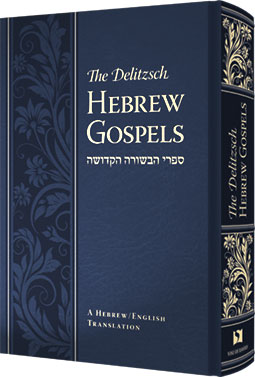
The Delitzsch Hebrew Gospels: A Review

DHEIn 1873 the British and Foreign Bible Society commissioned Franz Delitzsch to prepare a translation of the New Testament into Hebrew. Delitzsch agreed and set to work utilizing his extensive knowledge of mishnaic Hebrew and first century Judaism to create a translation and reconstruction of the Greek text back into an original Hebrew voice. His reconstructing translation was completed in 1877. After the first edition, it went through extensive review and revision for the next 13 years. The final edition was published in 1890 under the care and supervision of Gustav Dalman. Sixty thousand copies were distributed for free throughout Europe resulting in tens of thousands of Jewish people coming to know Yeshua as the Messiah of Israel.

Those Jewish believers and their influences are the very embers that have ignited this modern-day hope and revival.

This is the introduction on the Vine of David website to the Levy Hirsch Memorial Edition of the Delitzsch Hebrew Gospels. Over a century has passed since the last edition of this critical and faithful publication has been produced and Vine of David, the ministry arm of First Fruits of Zion (FFOZ) that specializes in early Messianic Judaism and the development of Messianic liturgical resources, has taken up the mission of publishing this Gospel and distributing it for free to any Jewish person, allowing Jews to explore the teachings of the Master, both in Hebrew and in English.

The Delitzsch Gospels is an elegant Bible and holding it, is like holding a bridge between Jewish believers in Yeshua (Jesus) from the 19th century to those carrying the Messianic banner today. While there are other New Testaments written in Hebrew and other Semitic languages, Delitzsch’s translation uses sources and interpretations that are the most well-known.

Although the Delitzsch Hebrew Gospels are specifically reaching out to the Jewish people, as a non-Jewish Christian, I find the resources this publication offers to be compelling. From the Translator’s Preface and Introduction to the abundance of reference materials, including maps and charts, this version of the Gospels provides history and context, not only of the Franz Delitzsch and the 19th century believing Jews, but a hint of the true Jewish origins of the Gospels and of the 1st century Gospel writers.

The heart of the Delitzsch Gospels are the Gospels themselves. Reading them reminds me  of the experience of reading the Chumash or the Tanach. Opening the Gospel to Mattei (Matthew) 1:1, the genealogy of Jesus is presented in English on the left page and in Hebrew on the right. Even with Hebrew skills far less than fluent, I can still imagine going through the opening words of the first Gospel alongside both Christian and Jewish believers, and perhaps get a small sense of what the author was thinking in his own language as he began recording his understanding of the life of the Master.

Beyond the value the Delitzsch Gospels present to Jewish believers, this modern edition also offers a unique gift to Gentile Christians who have little or no understanding of the “Jewish Jesus”. It presents those in the church with a taste of “original” Jesus, the Jewish Rabbi who walked the streets of 1st century Jerusalem and who taught his disciples in the hills of Galilee. In reading and studying from the Delitzsch Hebrew Gospels, we all can attain a clearer vision of who Jesus was and is among his people, the Jews, and his mission to save the lost sheep of Israel.

Who is Jesus of Nazareth, Son of the living God, called the Christ and the Moshiach? You may think you know. But the images invoked by reading his words and his life from the pages of Vine of David’s Delitzsch Hebrew Gospels may well introduce you to the Jewish Messiah and the Israelite Carpenter, Teacher, and King of Kings for the very first time.

To learn more, please visit the Vine of David. The blessings will be yours.

When We Were Five

The Rebbe and the ChildIf you want to see the face of the Moshiach, just look at the children!

At Sinai, all men, women and children had to be present. All received the same truth, all at once.

In a simple commentary written for a five year old, great secrets of the Torah can be found. But only once you understand the simple commentary as a five year old does.

From the wisdom of the Rebbe
Menachem M. Schneerson
as compiled by Rabbi Tzvi Freeman in his book
Bringing Heaven Down to Earth

Perhaps in the Rebbe’s words, we find the keys to unlock this 2,000 year old mystery:

At that time the disciples came to Jesus and asked, “Who, then, is the greatest in the kingdom of heaven?” He called a little child to him, and placed the child among them. And he said: “Truly I tell you, unless you change and become like little children, you will never enter the kingdom of heaven. Therefore, whoever takes the lowly position of this child is the greatest in the kingdom of heaven. And whoever welcomes one such child in my name welcomes me. –Matthew 18:1-5

We sometimes make the mistake of imposing our assumptions when we read this teaching from Jesus. The first thing we imagine when we think of a small child is that, compared to an adult, he or she doesn’t know very much about the world. Children have an extremely simple understanding of how things work. They can see the moon in the sky, but not know what it is. They can play with their favorite stuffed toy and believe it is as alive as they are. They are easily convinced of the most outrageous suggestions and accept them as utter truth. How else could we get a child to believe that there is a fat guy who rides in a sled pulled by flying reindeer, and who delivers presents to every child on Earth in a single night?

Translating all of that back into the words of Christ, we imagine he means that we don’t need to know very much about the Bible, the history of the church, the wisdom of the great Sages, or most anything else in order to be saved and have a right relationship with God. It means that studying the Bible is a waste of time, because it doesn’t change the status of being saved. It means that Bible commentaries, the Talmud, and everyone who reads and tries to comprehend them, are just making your relationship with God too complicated. After all, once you are saved in Christ, the deal is sealed and nothing else matters at all. If you’re a Christian it’s only about you and Jesus.

Right?

That tends to illustrate one of the qualities of small children; the tendency toward being self-absorbed and the difficulty in seeing a world outside of our own small sphere. Being saved and becoming a disciple of the Master is the first step in our journey, not the last.

So what does Jesus mean? What does the Rebbe mean? How are great secrets possessed by little, uncomprehending children that elude perhaps some of the greatest scholars who have ever lived? Is Bible study; Torah study a waste of time? Here’s Rabbi Freeman’s response:

The Rebbe often repeated that through the study of Torah you could conquer the world. And from the way the Rebbe discussed Torah you could see he was doing just that: Every thought, every teaching was a new understanding of the entire universe. A simple story..became in his hands an insight to the workings of time and space.

Rabbi Freeman, who describes the Rebbe as one of the foremost Torah scholars of his age, also tells this story about him:

The child he (the Rebbe) saw as a lucid, glistening crystal vessel in which to find G-d. More than once the Rebbe pointed out how his own thoughts strove to attain the simplicity of those of a child. In that simplicity, he taught, can be found the simplicity of the Infinite.

The Rebbe formed a club for Jewish children called “Tzivos Hashem”. He told the children that with verses of Torah and good deeds they would fight the forces of darkness in the world and bring Moshiach.

The Children began to stand close to the Rebbe at public gatherings. Some went under the table near his feet. Legend has it that occasionally a small band would rise up from under the table to snatch a piece of the Rebbe’s cake.

For me, this really clarifies why Bible study and immersion in the Torah are vital to achieving and retaining the perspective of a small child who is contemplating God.

Remember what I said about how adults can cause a child to have an unswerving belief in the existence of Santa Claus? It’s not the child’s fault that he or she believes in a fantasy, it’s the adults who taught them. Children are open to those they trust and they believe their parents (in most cases) mean them nothing but good. Sure, they get mad at us temporarily when we discipline them for some misdeed, but they know with complete trust that we are the source of all good in their lives. This is how we saw the world when we were five.

We fail them when we don’t tell them the truth and prove unworthy of their trust.

TrustBut now let’s bump that concept up the ladder a bit. We, as adults, can question whether or not something is the truth. We no longer believe in Santa Claus and we can (most of the time) recognize the difference between fantasy and reality. We have a Father in Heaven who is the source of all good in our lives. He wants nothing but the best for us and He does not tell us tales of Santa Claus or the Easter Bunny, which we later find out are quaint lies. God tells us the truth. In essence, we are like children standing close to the Rebbe and sitting at his feet under the table. Now here’s where the “child” part comes in.

If we choose to believe and to trust God as completely as small children trust their parents, whatever God tells us, we will believe. Whatever He wants us to do, we will do, without questioning why. When we “snatch a piece of cake” (so to speak) from His table, He won’t mind, because He knows we’re going to do it and He put the cake there to share with us. If we want to know how to accept God in the manner He desires to be accepted, trusted, and loved, all we have to do is to look at the relationship between little children and their parents.

For me, one of the lessons I must learn about the little children is what the Rebbe says here:

With Torah, you don’t get all the answers all at once.

Why does the moon only come out at night? Why is the sky blue? How can a fish breathe underwater? How old is God? Have you ever tried to answer these questions? It’s hard to do. Even if you know why the sky is blue or how fish breathe underwater, you can’t always communicate the answer in a way a child will understand. It’s that way for me. I want to know so much. It seems as if there’s so little time. And yet I wait. You don’t get all the answers all at once. Sometimes you have to get older first before you can understand.

In the meantime, you trust and believe, because that’s what small children do best.

Now to finish the story about the children snatching the Rebbe’s cake:

Finally, one of the adults became fed up with this lack of decorum and attempted to escort some children away. The Rebbe turned to him and exclaimed, “You are only a civilian and they are soldiers – and you want to remove them?

As the Rebbe also said, “Wealth is not a mansion filled with silver and gold. Wealth is children and grandchildren growing up on the right path.”

May we all “grow up” on the right path, too.